

Navigating the Path to CyberPeace: Insights and Strategies
Featured #factCheck Blogs

Executive Summary
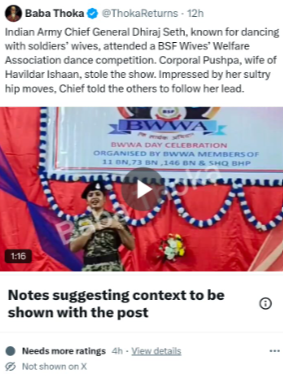
Social media users are claiming that Indian Army Chief General Dhiraj Seth dances with soldiers’ wives and attended a dance competition organised by the Border Security Force Wives Welfare Association (BWWA). CyberPeace Research found no credible sources to substantiate the viral claim. Our research revealed that the viral image is related to his visit to Nepal. According to reports, he travelled to Nepal on his first foreign visit after taking charge of the Indian Army, where he was welcomed by senior Nepal Army officials. During the visit, he was also scheduled to receive the honorary rank of General of the Nepal Army. However, his photograph is being linked to a dance video from an event organised by the Central Armed Police Forces (CAPF), accompanied by objectionable claims about him. Our research found no credible evidence confirming that General Dhiraj Seth attended the event or was associated with the activities shown in the video. Therefore, linking his photograph from the Nepal visit to the dance video is misleading.
Claim:
It is being claimed on social media that Indian Army Chief General Dhiraj Seth attended a dance competition organised by the BSF Wives Welfare Association (BWWA), where he was impressed by a woman’s dance performance and asked other participants to follow her lead.
https://x.com/ThokaReturns/status/2110854323760693485
Fact Check
To verify the viral claim, we conducted a reverse image search using keyframes from the video. During this process, we found the video on Instagram. The text “BSF Wives Welfare Association” was visible on the backdrop behind the stage. However, there was no mention of Army Chief General Dhiraj Seth anywhere in the video.
https://www.instagram.com/reels/Ddl7oTEgnf7/
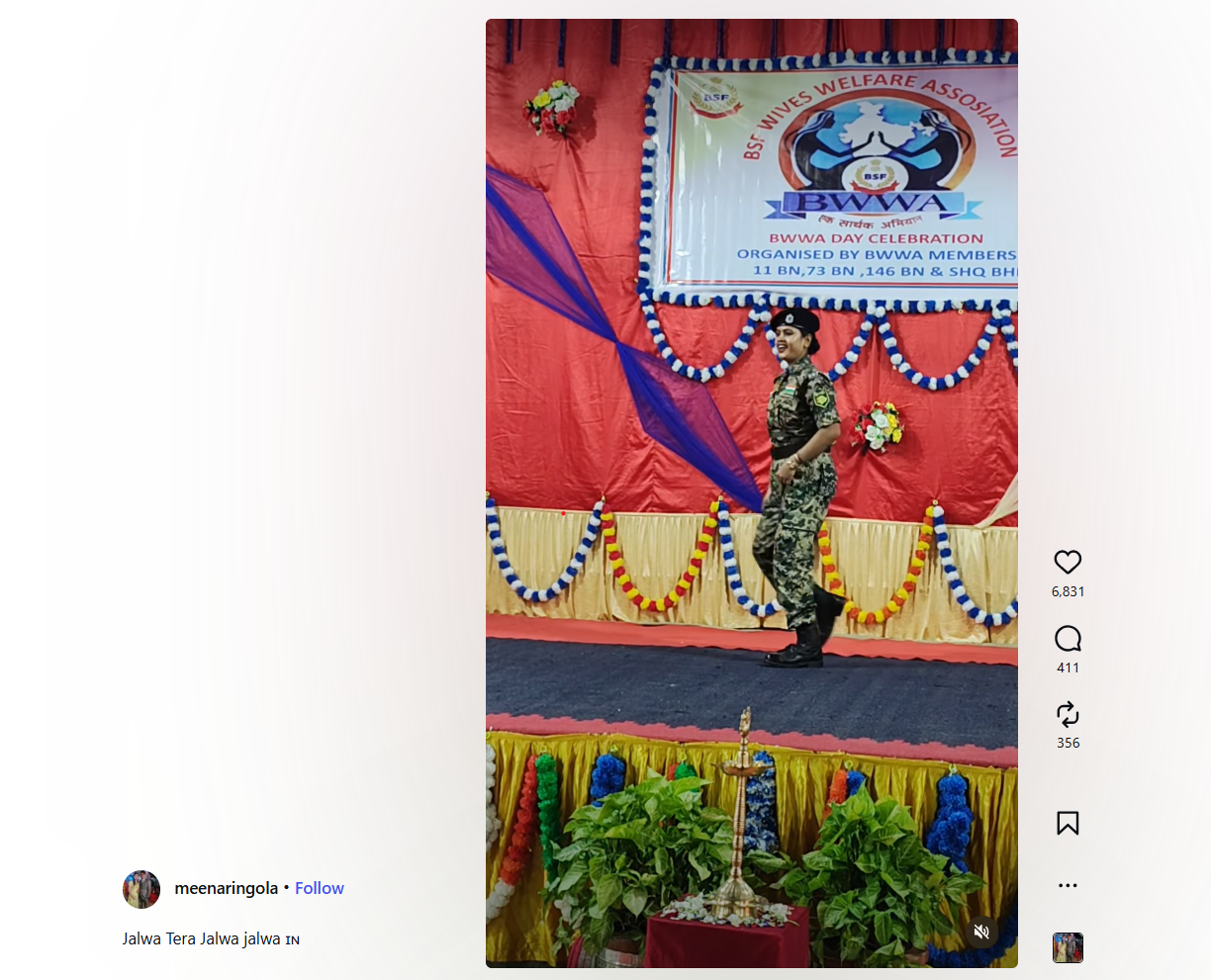
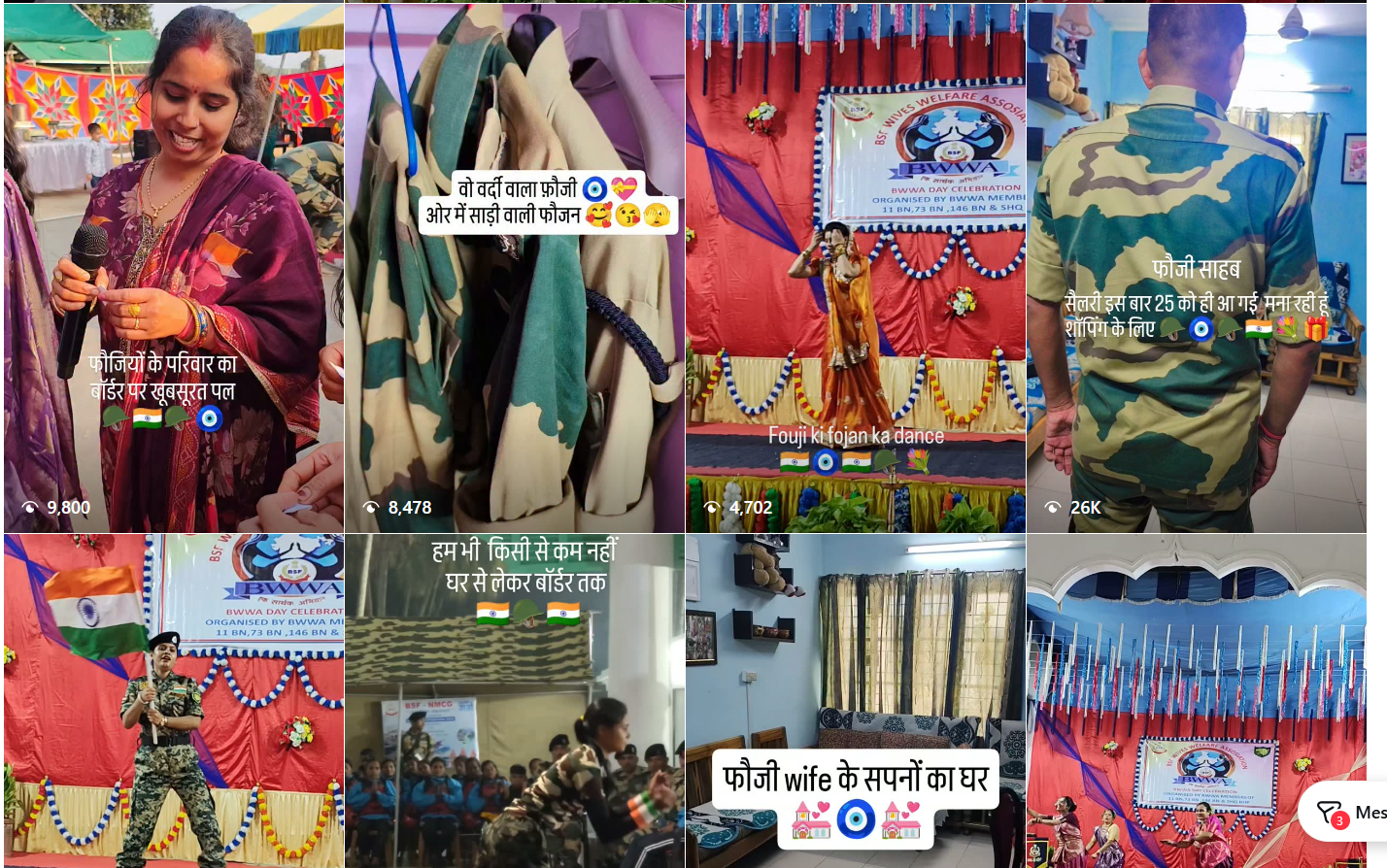
After reviewing these videos, our research found no evidence to substantiate the claim that General Dhiraj Seth attended an event organised by the BSF Wives Welfare Association or danced at the event. His photograph is being linked to the dance video, but no credible evidence supporting this claim was found.
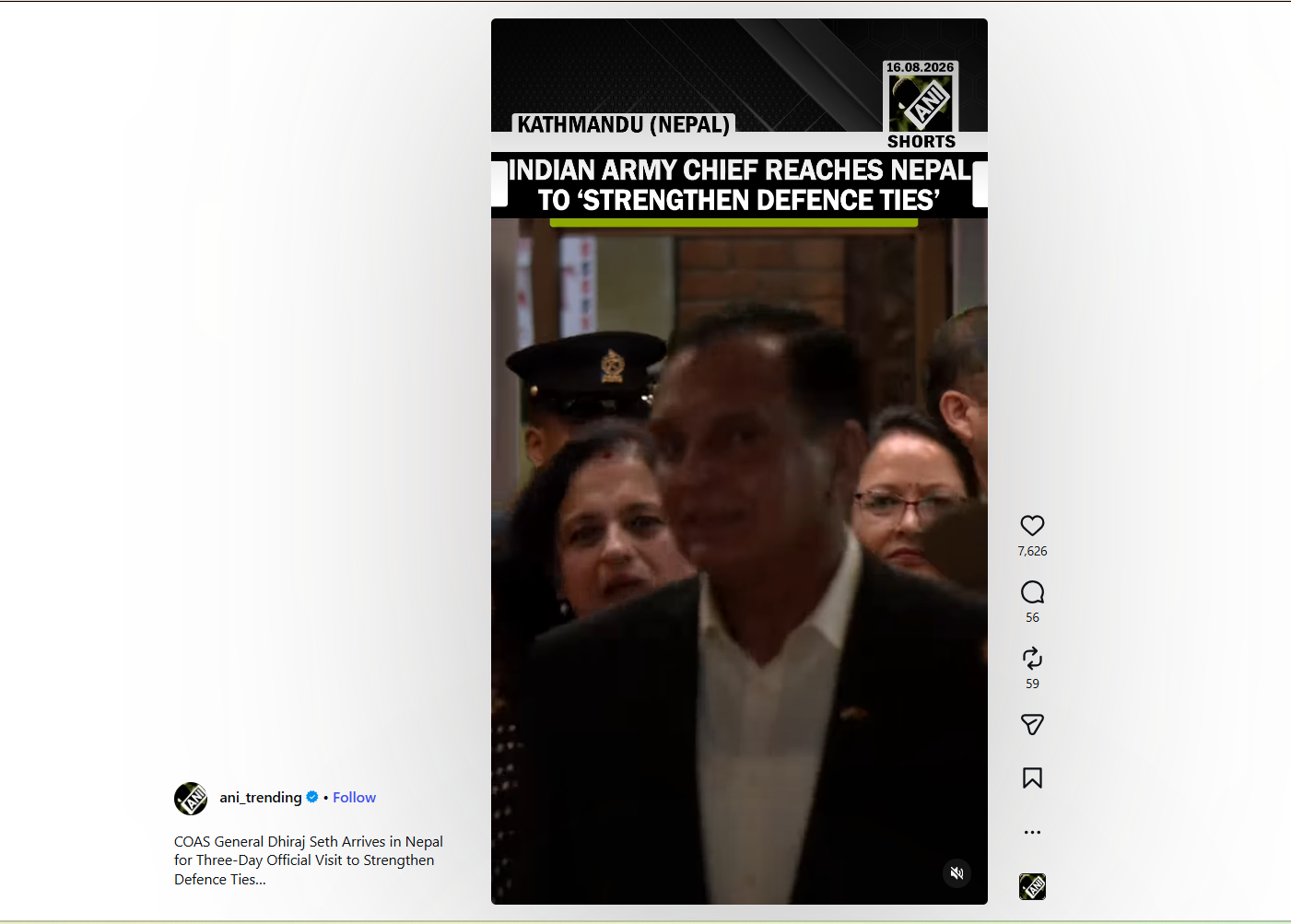
During our research, we found the original video of Army Chief General Dhiraj Seth shared by ANI. According to the report, General Dhiraj Seth arrived in Nepal on a three-day official visit aimed at strengthening defence ties between the two countries.
https://www.instagram.com/reels/DcGxzLPExR5/
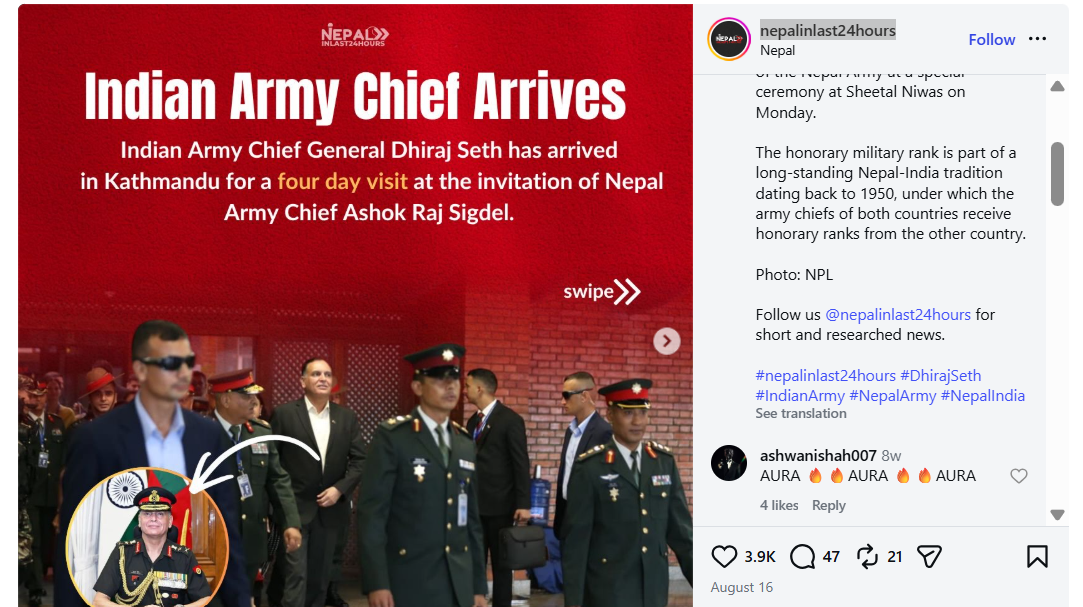
In the final stage of our research, we found a report on an Instagram account named ‘nepalinlast24hours’. According to the report, Indian Army Chief General Dhiraj Seth arrived in Kathmandu on his first foreign visit after taking command of the Indian Army on June 30, 2026. He was welcomed by senior Nepal Army officials at Tribhuvan International Airport.
The report stated that during his four-day visit, General Seth was scheduled to meet Nepal’s Prime Minister Balendra Shah and Nepal Army Chief Ashok Raj Sigdel. Additionally, he was scheduled to be conferred with the honorary rank of General of the Nepal Army at a special ceremony at Sheetal Niwas on Monday.This tradition between India and Nepal dates back to 1950. Under the arrangement, the army chiefs of both countries are conferred with honorary military ranks in each other’s armies.
https://www.instagram.com/p/DcGbgm0jUBH/?dlrf=MXFndzM5dGp4ZTh5OA%3D%3D
Conclusion
Our research found that the viral photograph of Indian Army Chief General Dhiraj Seth is related to his visit to Nepal. According to reports, he travelled to Nepal on his first foreign visit after taking command of the Indian Army, where he was welcomed by senior Nepal Army officials. During the visit, he was also scheduled to be conferred with the honorary rank of General of the Nepal Army.However, his photograph is being linked on social media to a dance video from an event organised by the Central Armed Police Forces (CAPF), accompanied by objectionable claims about him. Our research found no credible evidence confirming General Dhiraj Seth’s presence at the event or his association with the activities shown in the video. Therefore, linking his photograph from his Nepal visit to the dance video is misleading.

Executive Summary
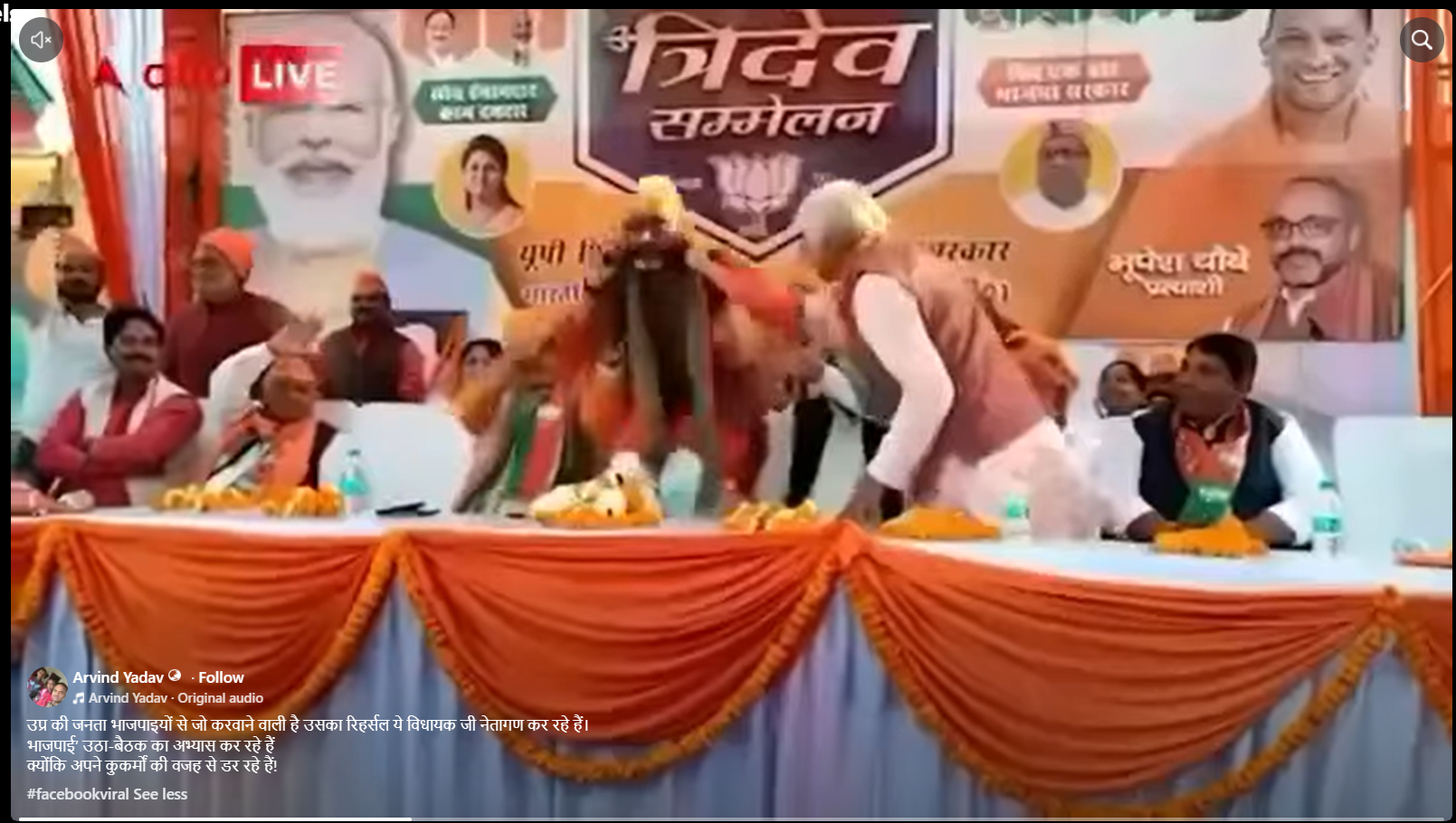
A video is being shared on social media with the claim that a Bharatiya Janata Party (BJP) leader is doing sit-ups in front of the public. Some users are sharing the video as a recent incident, claiming that a BJP MLA performed sit-ups in front of the public. CyberPeace Research found the claim to be misleading. Our research revealed that the viral video is not recent but dates back to February 2022, when Bhupesh Chaubey, the BJP MLA from the Robertsganj Assembly constituency in Sonbhadra, apologised to disgruntled party workers during a party workers' convention.
Claim:
A user on Facebook shared the viral image on October 11, 2026, with the caption: “This is the bond submitted by coward Abhijeet Dipke in court for his release, and he says he will take to the streets again.” The link to the post, its archive link, and a screenshot are provided below.
https://www.facebook.com/reel/1806020163922780
Fact Check
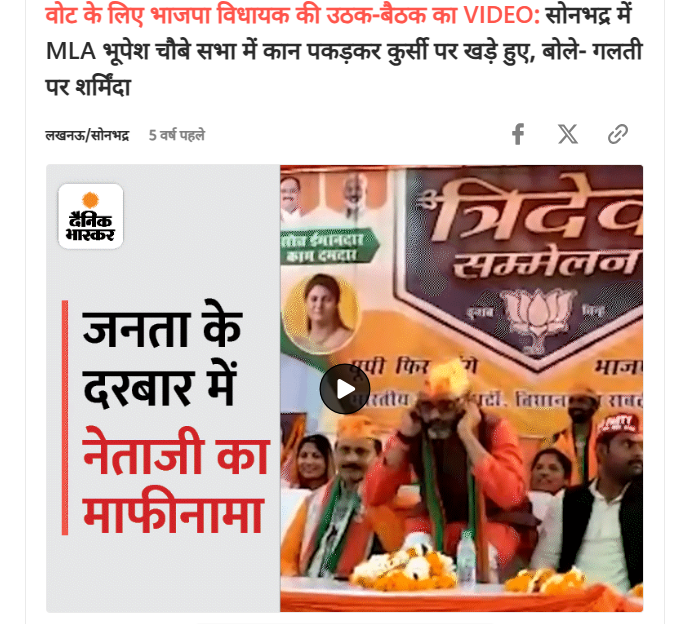
We conducted a reverse image search using keyframes from the viral video. During the search, we found a report published on the Dainik Bhaskar website on February 23, 2022, which featured the same video. According to the report, polling in Sonbhadra was scheduled for March 7 as part of the seventh phase of the Assembly elections. During the election campaign, Bhupesh Chaubey, the BJP MLA and candidate from the Robertsganj Assembly constituency, was seen adopting an unusual approach. He stood on a chair, held his ears and performed sit-ups on the chair, apologising to the public for the mistakes he had made over the previous five years.The link to the report and a screenshot are provided below.
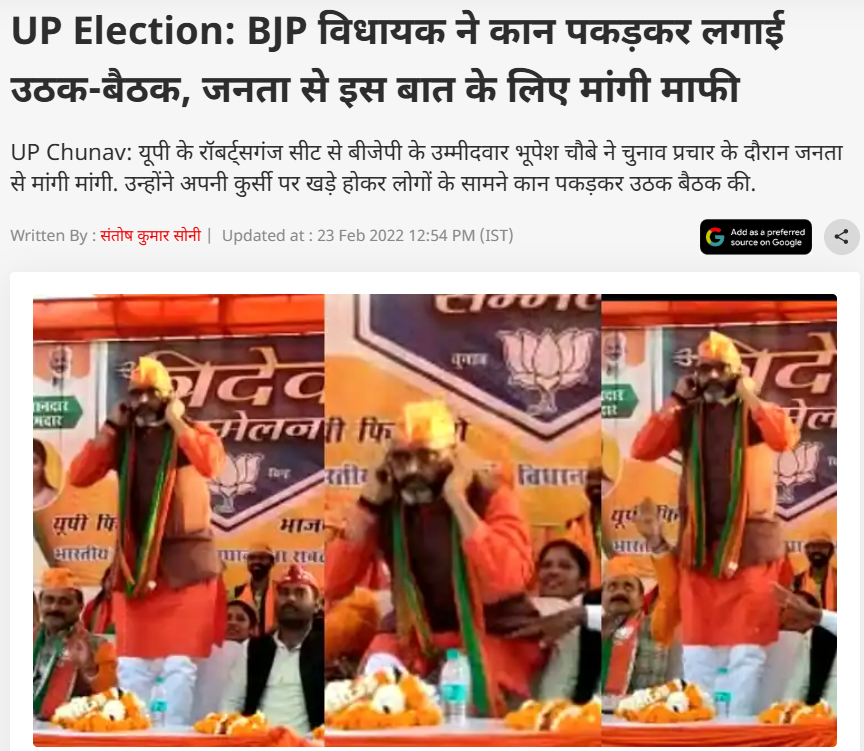
In the next stage of our research, we found a report published on ABP News’ Hindi website on February 25, 2022, which featured the viral video in a general context. We found the same video in this report as well. The link to the report and a screenshot are provided below.
Conclusion
Our research found that the viral video is not recent but dates back to February 2022, when Bhupesh Chaubey, the BJP MLA from the Robertsganj Assembly constituency in Sonbhadra, apologised to disgruntled party workers during a party workers' convention.

Executive Summary
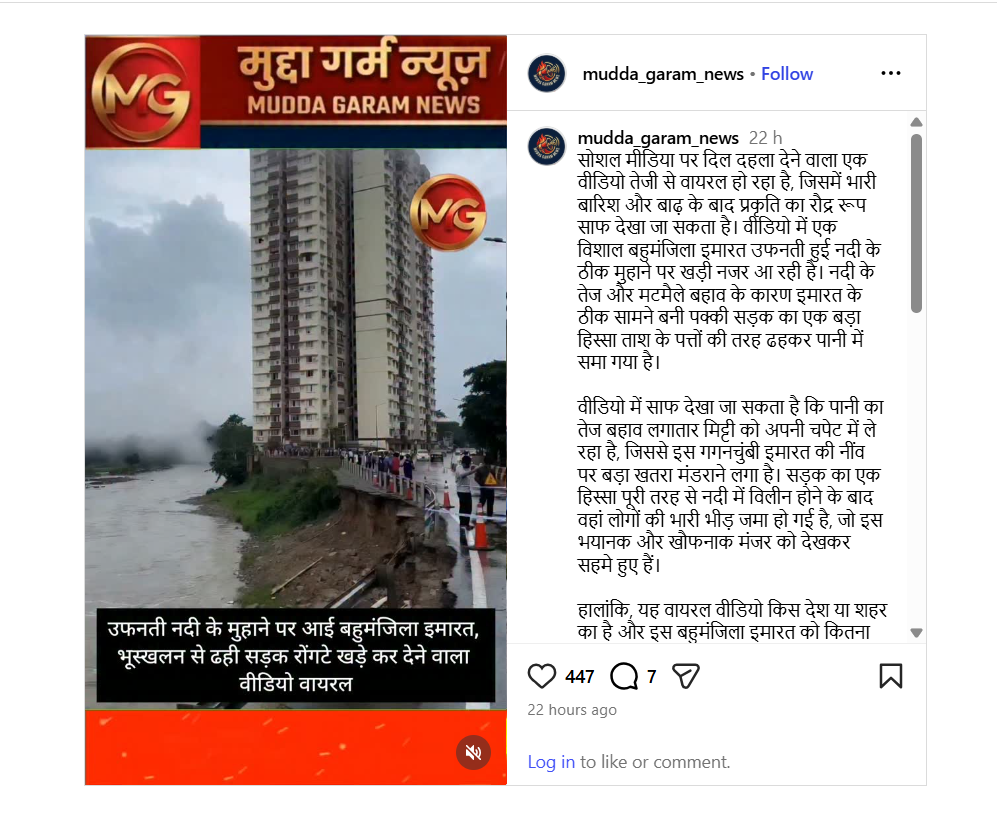
A video is being shared on social media showing a multi-storey building located beside what appears to be a river. A road runs alongside the building, with visible erosion and large cracks. A crowd of people can be seen standing near the edge of the road close to the building. Suddenly, the front portion of the building collapses into the water, followed moments later by the rear section tilting and falling into the river. As the building collapses, people are seen running in panic. The video is being shared with the claim that it shows a real incident in which a multi-storey building collapsed like a house of cards due to heavy rainfall, a swollen river, and severe erosion that also caused part of the road to cave in. CyberPeace Research Wing’s research found the viral claim to be false. Our research revealed that the video is not real. It was generated using Artificial Intelligence (AI) and is being circulated with a false claim.
Claim
An Instagram user shared the viral video on July 15, 2026, claiming that it shows a multi-storey building collapsing into a swollen river due to heavy rainfall and strong water currents, while part of the adjacent road also collapsed because of a landslide.
https://www.instagram.com/reel/DazTcrBCBrI/?utm_source=ig_web_button_share_sheet
Fact Check
To verify the claim, we extracted several keyframes from the viral video and conducted a reverse image search using Google Lens. During the research, we found no credible news reports, authentic videos, or reliable sources related to the incident. However, we found the same video uploaded on a YouTube Shorts channel named @mohammedalmekhlafiht1555. The channel's cover image describes the creator as an "AI & Automation Engineer." In addition, the descriptions of videos uploaded on the channel explicitly mention "Made With AI."
https://youtube.com/shorts/zFotETyAz8E?si=b6wj_eAG-nj7U1HE


We also carried out a detailed visual analysis of the footage. During the collapse, the front portion of the building falls into the water almost as a single block without breaking apart, which is highly unrealistic. After a brief pause, the rear section tilts and also falls almost intact onto the first section, without disintegrating despite the massive impact. The behaviour of people in the video also appears unnatural. Some individuals are seen running with their hands raised, while others inexplicably move toward the collapsing building and even jump into the water. Workers repairing the damaged road appear completely unaffected by the nearby collapse. In a real structural failure of this magnitude, buildings typically break apart into multiple sections, generating debris, dust, and strong shockwaves that would significantly affect nearby people.

In the next stage of our research, we analysed the video using the AI detection tool Hive Moderation, which indicated a 78.1% probability that the video was AI-generated.
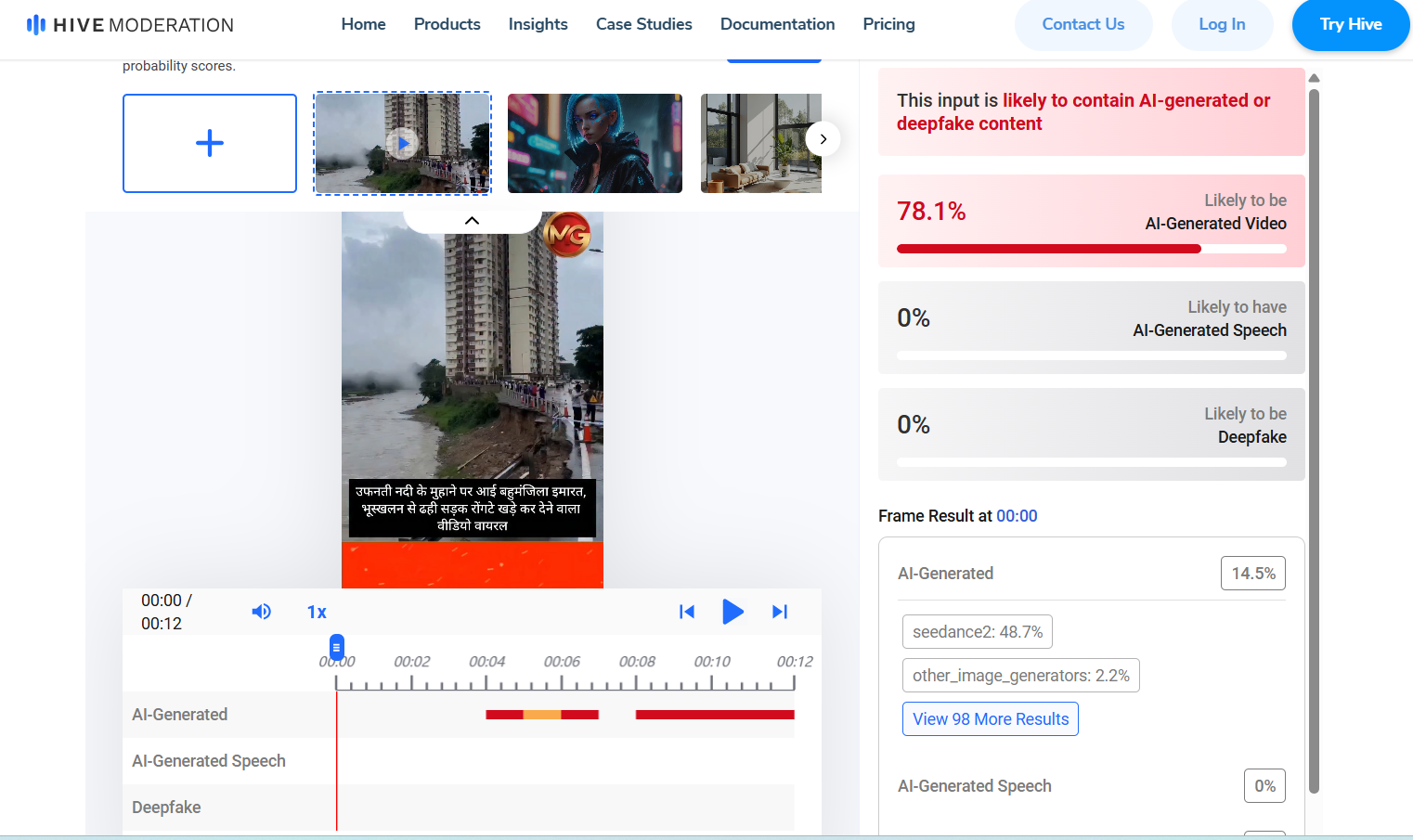
For additional verification, we also examined the video using AI or Not, which concluded that the footage has a 96% probability of being AI-generated.

Finally, we analysed the video using Wasit.AI, which also indicated a 75% probability that the video had been created using Artificial Intelligence.

Conclusion
Our research found that the viral video does not depict a real incident. It was generated using Artificial Intelligence and is being shared on social media with a false and misleading claim that it shows a multi-storey building collapsing into a river due to heavy rainfall and erosion.

Executive Summary
A photograph is being widely circulated on social media with the claim that it shows Chinese soldiers blindfolding and escorting three Indian soldiers after entering 60 kilometres inside Arunachal Pradesh. The image is being shared as evidence of an alleged Chinese military intrusion into Indian territory.
CyberPeace Research Wing’s research found the claim to be false. Our research revealed that the viral image is AI-generated and has no connection to any real incident in Arunachal Pradesh. The Government of India and the Indian Army have also rejected claims of Chinese forces entering Indian territory.
Claim
An Instagram user, 'star8atik', shared the viral image on July 6, 2026, with the caption:"China has occupied 60 km of land in Arunachal Pradesh."
https://www.instagram.com/reel/Dac60uVtH4j

Fact Check
To verify the claim, we first performed a reverse image search using Google Lens. However, we did not find any authentic source or credible report linking the viral image to an actual incident involving Chinese troops in Arunachal Pradesh. We also conducted keyword-based searches on Google using terms related to the alleged Chinese incursion. The search yielded no credible news reports confirming that Chinese soldiers had captured Indian troops or entered 60 kilometres inside Arunachal Pradesh. We then closely examined the image and noticed several visual inconsistencies commonly associated with AI-generated content. The facial features and body proportions of the soldiers in the background appeared distorted and unnatural. Additionally, one of the Indian soldiers was shown with what appeared to be a Chinese flag patch on his arm, but its design and placement were inconsistent and visually flawed. These anomalies raised strong suspicions that the image had been generated using artificial intelligence. To verify this, we analysed the image using the AI detection tool Hive Moderation, which indicated a 98% probability that the image was AI-generated.
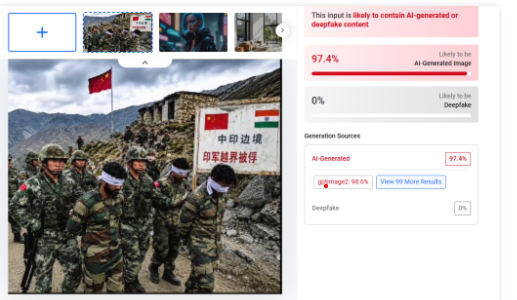
For additional verification, we also scanned the image using Undetectable AI, which found a 97% probability that the image had been digitally generated or manipulated using AI.

Conclusion
Our research found that the viral image claiming to show Chinese soldiers capturing Indian troops after entering Arunachal Pradesh is fake. The image is AI-generated and is being falsely circulated to support misleading claims of a Chinese military incursion. Furthermore, Union Minister Kiren Rijiju and the Indian Army have publicly rejected claims that Chinese forces entered Indian territory, making the viral claim baseless.

Executive Summary
A purported clipping from an Australian newspaper is being circulated on social media with the claim that it published a report stating that people attended Prime Minister Narendra Modi’s public event in Melbourne only because free roti and curry were being served. CyberPeace Research Wing’s research found the viral newspaper clipping to be fake and digitally edited. Our research revealed that The Age, the newspaper featured in the viral image, did not publish any such report in its July 10 edition. Prime Minister Narendra Modi arrived in Melbourne, Australia, on July 8, after concluding his visit to Indonesia. On July 9, he addressed the Indian diaspora at Melbourne's stadium alongside Australian Prime Minister Anthony Albanese, with more than 30,000 people attending the event. The viral newspaper clipping falsely links this event to a fabricated headline claiming that “the crowd gathered because free roti and curry were being served.”
Claim
Sharing the purported newspaper clipping, an X user wrote:“Modi supporters go anywhere for free food! If there is anything left to disgrace the country, let us know. Free curry and roti were served using taxpayers’ money to gather a crowd at PM Modi’s event in Australia. Australian newspaper report.”
https://x.com/ssrajputINC/status/2075806767129235668
https://archive.ph/https://x.com/ssrajputINC/status/2075806767129235668

Fact Check
To verify the authenticity of the purported Australian newspaper clipping, we first extracted keyframes and performed a reverse image search. During the research, we found that the original newspaper clipping had been posted on X by journalist Aman Sharma on July 10, 2026. The original clipping contained no such report as the one seen in the viral image. According to the caption of the post, the newspaper coverage was published by Australian newspapers during Prime Minister Narendra Modi’s visit to Australia.
https://x.com/AmanKayamHai_/status/2075362478364787165/photo/3

Since Prime Minister Modi's Melbourne event took place on July 9, we examined the July 10 digital edition of The Age. We found the same coverage on Pages 4 and 5 of the newspaper. However, there was no report mentioning that people attended the event because free food was being distributed. Instead, the space shown in the viral clipping actually carried a report about Australian Opposition Leader Angus Taylor's criticism of far-right Senator Pauline Hanson's One Nation party. https://edition.theage.com.au/shortcode/THE965/archive

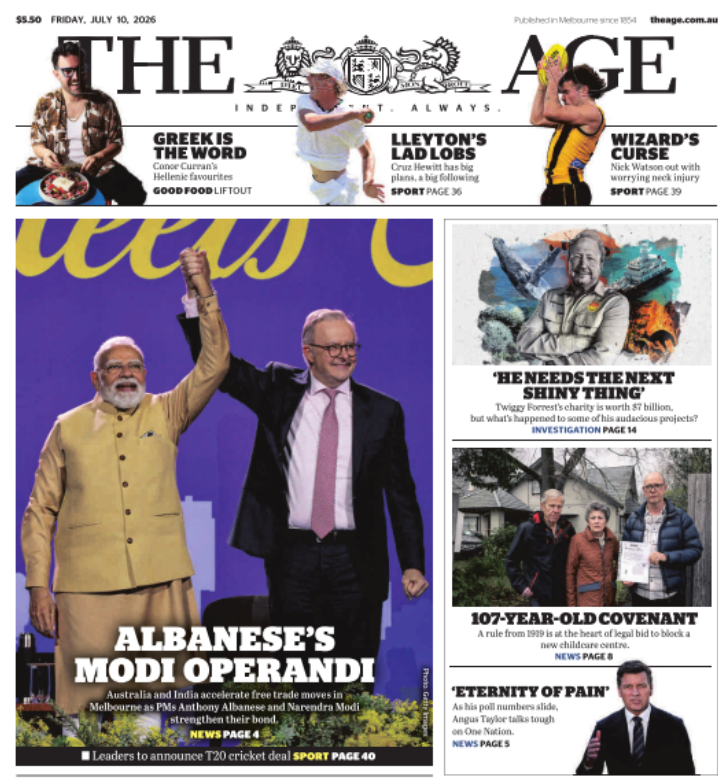
Our comparison confirmed that the viral image had been digitally altered, with the original news story replaced by fabricated text to falsely suggest that The Age had published such a report.
Conclusion
Our research found that the purported Australian newspaper clipping is fake and digitally edited. The Age did not publish any report claiming that people attended Prime Minister Narendra Modi's Melbourne event because free roti and curry were being served. The viral image has been manipulated to spread a false narrative and is being shared with a misleading claim.

Executive Summary
A graphic featuring a photograph of Mojtaba Khamenei, the son of Iran’s Supreme Leader Ayatollah Ali Khamenei, is being widely circulated on social media. The graphic carries a statement attributed to him: “It is not appropriate for the Prime Minister of India to bow before Trump, and India was a matter of pride under Indira Gandhi.” The graphic claims that Mojtaba Khamenei made this statement. CyberPeace Research Wing’s research found that Mojtaba Khamenei did not make any such statement. The research revealed that there is no credible evidence, official statement, interview, or verified social media post supporting the claim. Had such a statement been made by him, it would have been reported by credible media outlets.
Claim
Sharing the graphic, an X user named Thakur Kuldeep Singh wrote:“Narendra Modi has tarnished India’s name across the entire world. Do we now have to hear all this from Iran too?”
https://x.com/Ramesh18498367/status/2066095602954649607?s=20
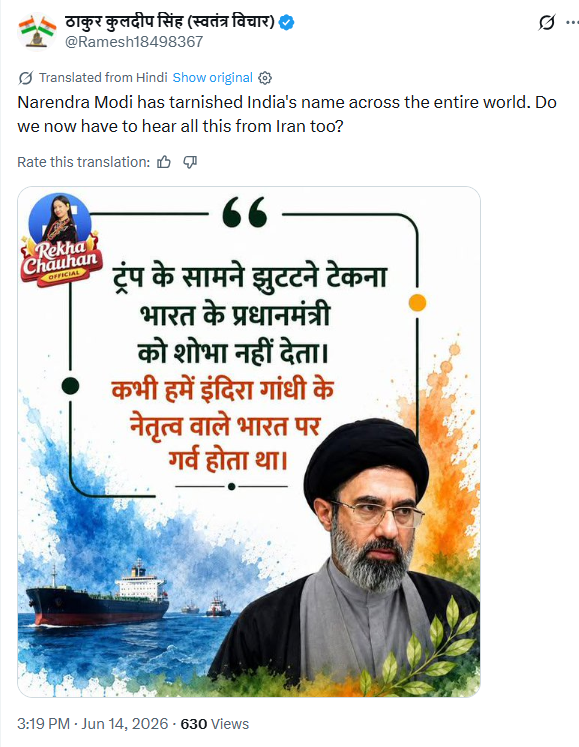
Fact Check
As part of our fact-checking process, we conducted a keyword search on Google using terms such as “Mojtaba Khamenei criticized India’s Prime Minister for bowing before Trump” and “Mojtaba Khamenei praised India under Indira Gandhi.” However, we found no credible news reports, official statements, interviews, or verified social media posts supporting the claim that Mojtaba Khamenei made such remarks. During our research, we also found a report published by NDTV on March 12, 2026, which mentioned remarks made by a representative of Iran’s Supreme Leader regarding Iran-India relations.

According to the report, the representative stated that Mojtaba Khamenei “loves India” and values the long-standing civilizational ties between the two countries. He further said that Iran’s leadership has historically admired India’s culture, philosophy, and history and has consistently supported stronger relations between the two nations.
Conclusion
Our research found that the claim attributing a statement to Mojtaba Khamenei criticizing India’s Prime Minister for bowing before Trump and praising India during Indira Gandhi’s tenure is false. There is no credible news report, official statement, interview, or verified social media post confirming that Mojtaba Khamenei made such a statement. The viral graphic is being circulated with a false attribution.

Executive Summary
A social media account on X (formerly Twitter) named @MEABharat is being circulated as the official account of India's Ministry of External Affairs (MEA). Many users are sharing posts from the account, believing it to be an authentic government handle and treating the information published there as official communication. CyberPeace Research Wing’s research found the viral claim to be misleading. Our research revealed that @MEABharat is not an official X account of the Ministry of External Affairs. The Ministry has publicly clarified that it has no association with the account and stated that it is impersonating the Ministry, misleading the public, and undermining public interest.
Claim
Social media users are claiming that @MEABharat is the official X account of India's Ministry of External Affairs and that the information posted on the account is officially issued by the Ministry.
https://x.com/MEAFactCheck/status/2076650791453270332

Fact Check
To verify the claim, we conducted a keyword-based search on Google. During the research, we found an official clarification posted by the Ministry of External Affairs' fact-check handle, @MEAFactCheck. In its post, the Ministry clearly stated that the @MEABharat account has no connection whatsoever with the Ministry of External Affairs. It further clarified that the account is impersonating the Ministry, misleading the public, and undermining public interest. The Ministry also advised users to exercise caution and rely only on its verified official social media accounts and website for authentic information.
https://x.com/MEAFactCheck/status/2076650791453270332
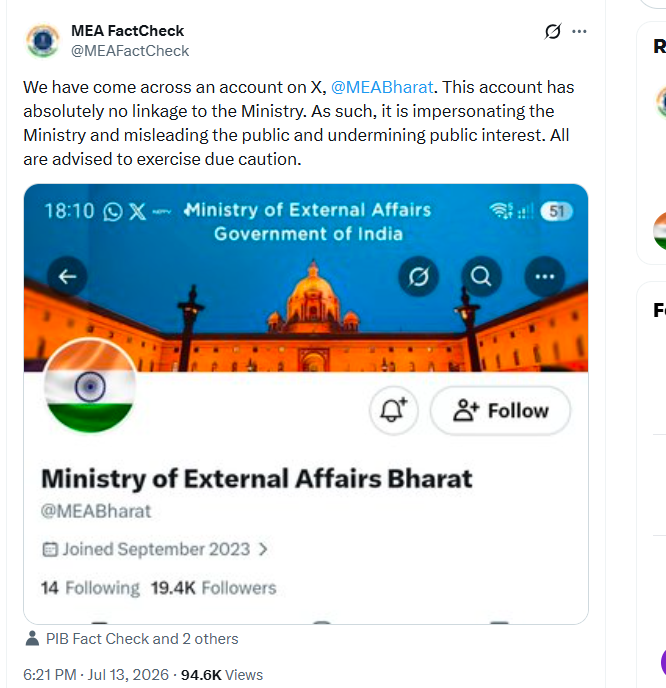
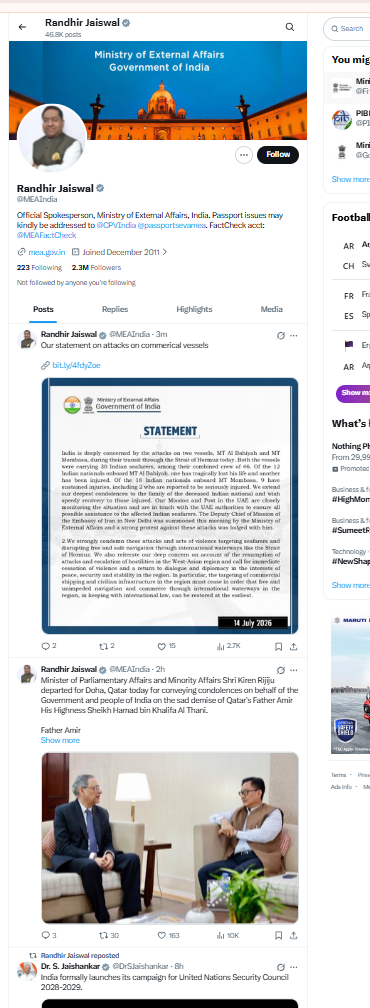
As part of our research, we also examined the Ministry's official X account, @MEAIndia, which carries the verified blue badge. The account regularly publishes official statements, diplomatic updates, press briefings, and other communications related to India's foreign policy. It also serves as the official spokesperson's handle for the Ministry of External Affairs.
https://x.com/MEAIndia
Conclusion
Our research found that @MEABharat is not the official X account of India's Ministry of External Affairs. The Ministry itself has publicly clarified that the account is fake, has no affiliation with the government, and is impersonating the Ministry to mislead the public. Therefore, the claim that @MEABharat is the official MEA handle is misleading. Users should rely only on the Ministry's verified accounts, including @MEAIndia and @MEAFactCheck, for authentic government information.

Executive Summary
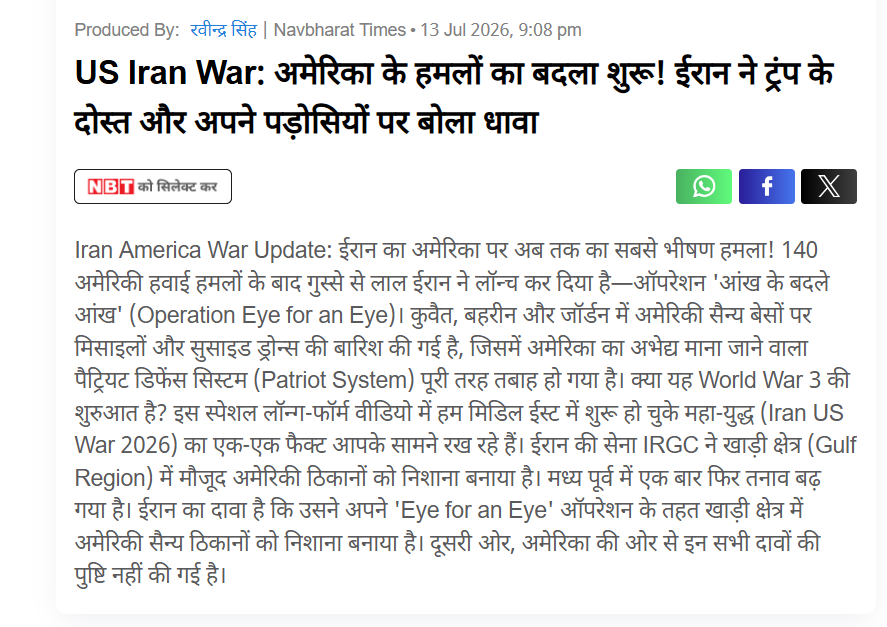
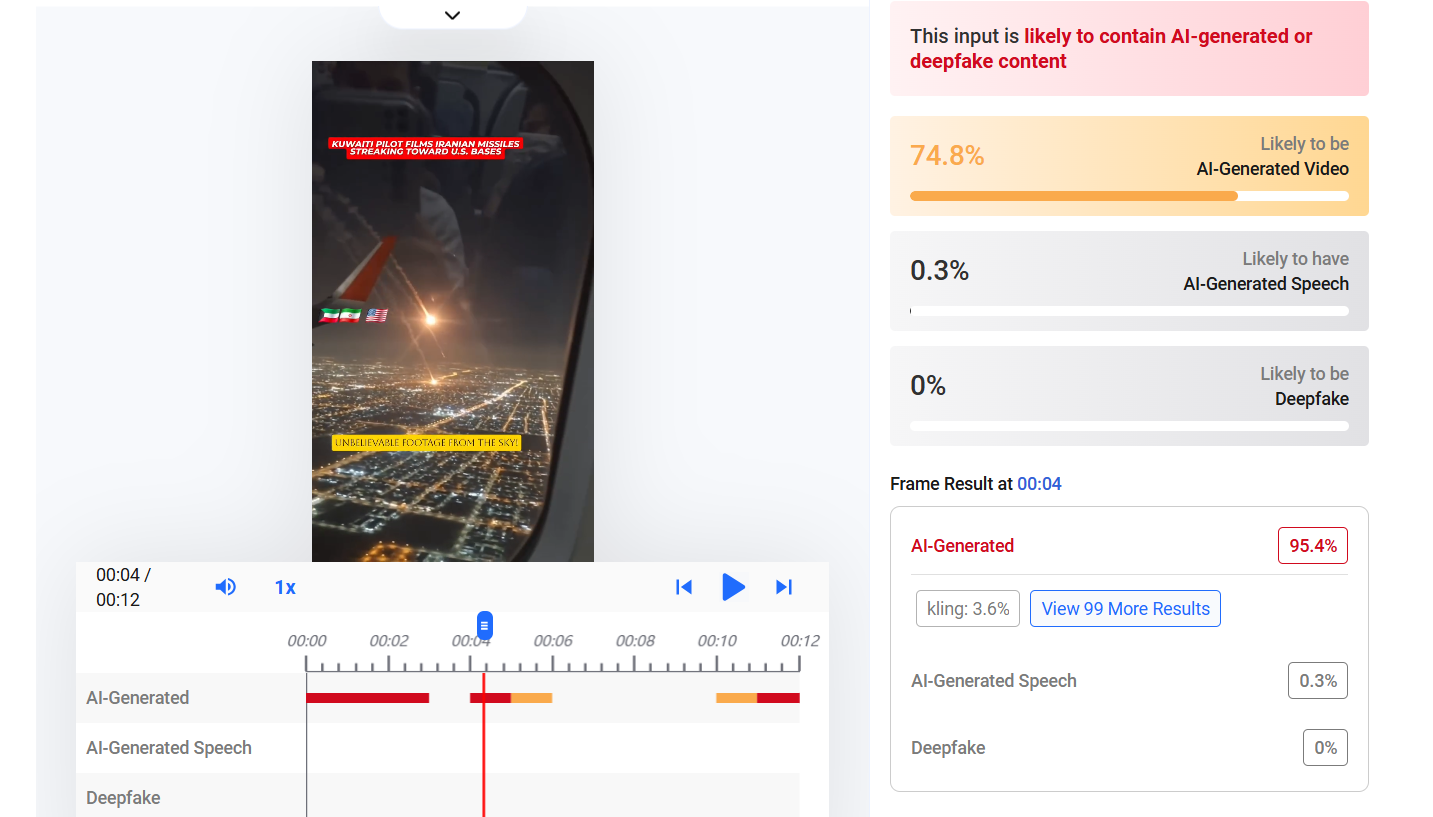
A video is being widely shared on social media showing what appears to be a missile attack over a densely populated city at night. The footage, seemingly recorded from inside a passenger aircraft, shows multiple explosions and missiles lighting up the sky.The video is being circulated with the claim that a Kuwaiti pilot filmed Iranian missiles being launched towards a US military base in the Middle East from the cockpit of an aircraft.
CyberPeace Research Wing’s research found the viral claim to be false. Our research confirmed that while Iran has launched attacks on US military installations in the Middle East, the viral footage is not related to those incidents. The video was found to be AI-generated and is being shared with a false and misleading narrative.
Claim
An Instagram user shared the viral video on July 11, 2026, claiming that it was recorded by a Kuwaiti pilot from an aircraft and shows Iranian missiles targeting a US military base in the Middle East.
Post Link: https://www.instagram.com/reel/DanymEDIdp2/?utm_source=ig_web_button_share_sheet
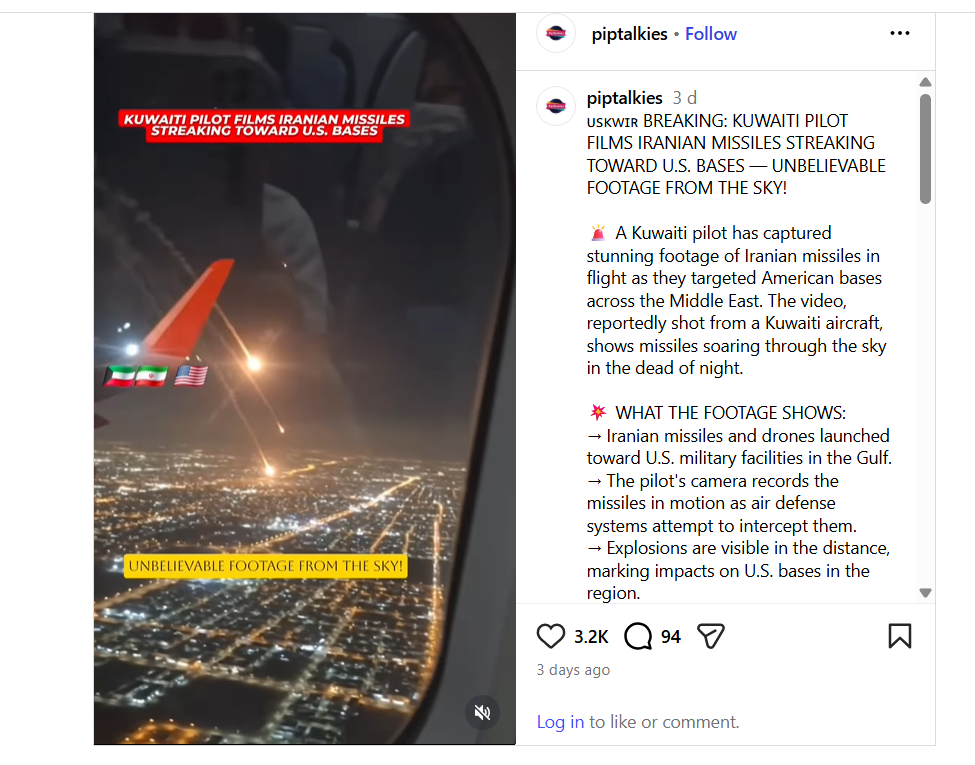
Fact Check
To verify the claim, we conducted a keyword-based search on Google. During the research, we did not find any credible news report or authentic source linking the viral video to the alleged Iranian missile attack. We did find a Navbharat Times report covering Iran's strikes on US military bases in the Middle East. However, the report did not contain the viral footage or any reference suggesting that such a video had been recorded by a Kuwaiti pilot. https://navbharattimes.indiatimes.com/video/news/america-iran-war-retaliation-for-us-attacks-begins-iran-strikes-at-trumps-allies-and-its-neighbour/videoshow/132370583.cms
In the next stage of the research, we analysed the viral video using the AI detection tool Hive Moderation. The tool indicated that the video had a 74.8% probability of being AI-generated.
For additional verification, we also analysed the footage using another AI detection tool, DetectVideo AI. Its analysis showed a 61% probability that the video was AI-generated.

Conclusion
Our research found that the viral claim is false. Although Iran has carried out missile strikes on US military facilities in the Middle East, the viral video is not authentic and has no connection to those attacks. The footage was found to be AI-generated and is being circulated on social media with a misleading claim that it was recorded by a Kuwaiti pilot from an aircraft.

Executive Summary
A video is being widely circulated on social media showing thousands of drones forming an image of Cristiano Ronaldo wearing his iconic Portugal jersey over what appears to be a water body. Moments later, the drones are seen creating his famous “SIUUU” celebration pose. The video is being shared with the claim that this spectacular aerial drone show was organised as a tribute to Ronaldo.
CyberPeace Research Wing’s research found the viral claim to be false. The research revealed that the video is not a real drone display but was created using Artificial Intelligence (AI) and is being circulated with a misleading claim.
Claim
The viral video is being shared on social media with the claim that the drone show was organised in honour of Cristiano Ronaldo.
https://www.instagram.com/reel/DamaeegILpU/?igsh=NmtjOTN4cWJzenJ1

Fact Check
To verify the claim, we extracted multiple keyframes from the viral video and conducted a reverse image search using Google Lens. During the research, we did not find any credible video, news report, or reliable source confirming that such a drone show was organised for Cristiano Ronaldo.
In the next stage of the research, we analysed the video using the AI detection tool Hive Moderation. The tool’s results indicated that the viral video had a 71% probability of being AI-generated.
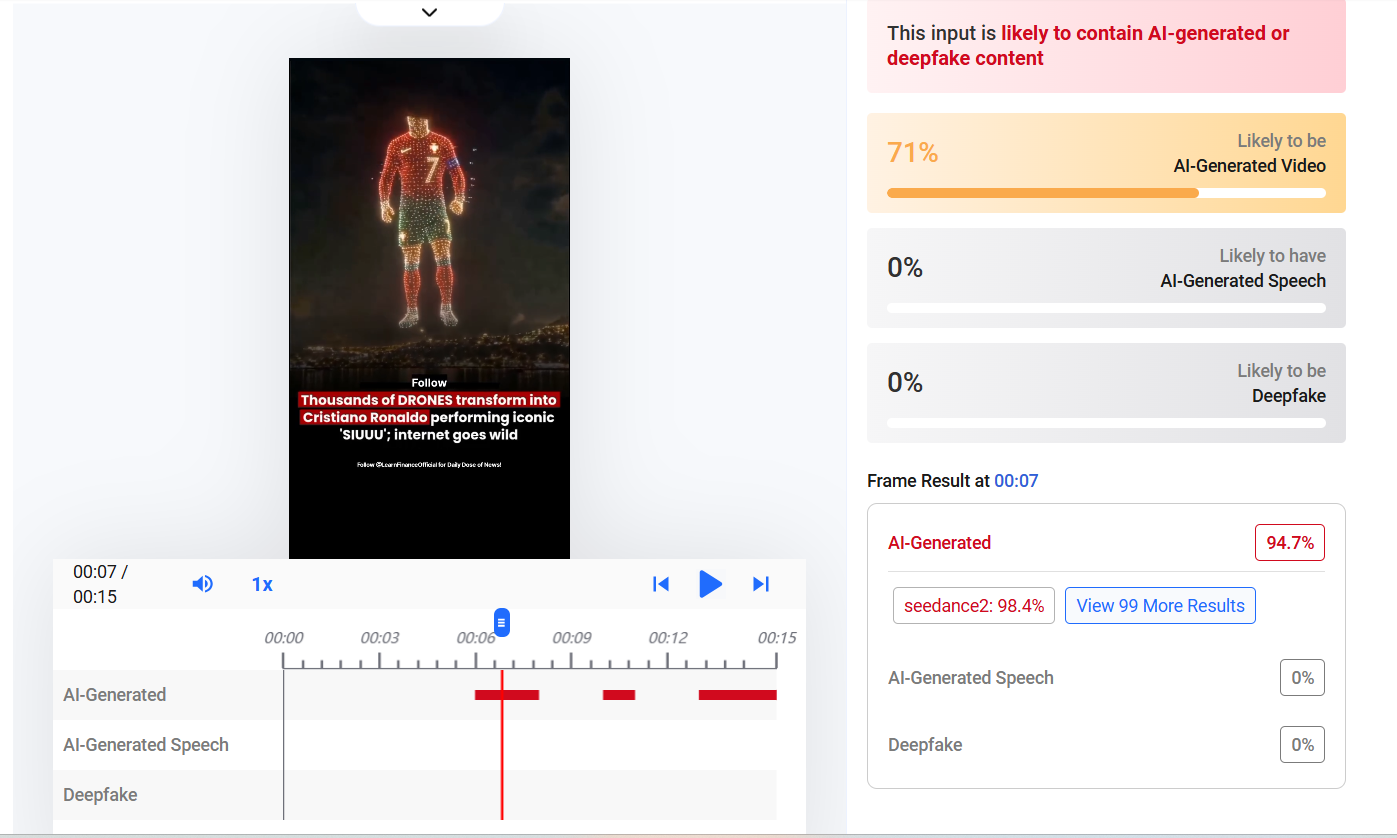
For further verification, we checked the video using another AI detection tool, DetectVideo AI. The analysis showed that the video had an 80% probability of being AI-generated.

At the final stage of the research, the video was also analysed using Deepfake-O-Meter. The tool indicated an almost 100% probability that the video was AI-generated.

Conclusion
Our research found that the viral claim is false. The video does not show a real drone show organised in honour of Cristiano Ronaldo. The footage was found to be AI-generated and is being circulated on social media with a false narrative.

Executive Summary
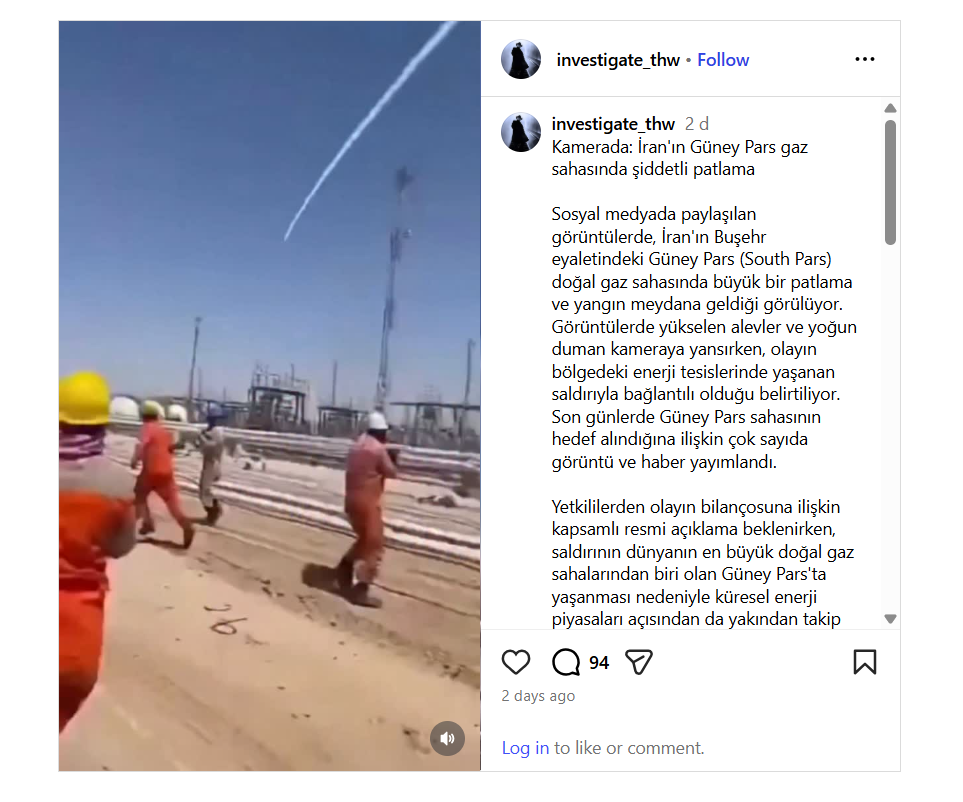
A video showing a massive explosion and fire at what appears to be a gas facility is being widely circulated on social media. In the footage, huge flames and thick smoke can be seen rising from the site, while workers and security personnel are seen running around in panic.
The video is being shared with the claim that it shows an attack on the South Pars natural gas field in Iran’s Bushehr province.
CyberPeace Research Wing’s research found the viral claim to be false. The research revealed that the video is not from a real incident but was created using Artificial Intelligence (AI) and is being circulated with a false narrative.
Claim
The viral video is being shared on social media with the claim that it shows an attack on energy facilities at the South Pars natural gas field in Iran’s Bushehr province.
Post Link:
https://www.instagram.com/reel/DanX_iJIfTu/?utm_source=ig_web_button_share_sheet
Fact Check
To verify the claim, we extracted multiple keyframes from the viral video and conducted a reverse image search using Google Lens. During the search, we did not find any credible news report or reliable source confirming that the video was related to any attack on Iran’s South Pars gas field.
In the next step of the research, we analysed the video using the AI detection tool Deepfake-O-Meter. The tool’s results indicated that the viral video was approximately 100% likely to be AI-generated.


For further verification, we also checked the video using another AI detection tool, DetectVideo AI. The analysis showed that the video had a 64% probability of being AI-generated.

Conclusion
Our research found that the viral claim is false. The video does not show any real attack on Iran’s South Pars natural gas field. The footage was found to be AI-generated and is being shared on social media with a misleading claim.

Executive Summary
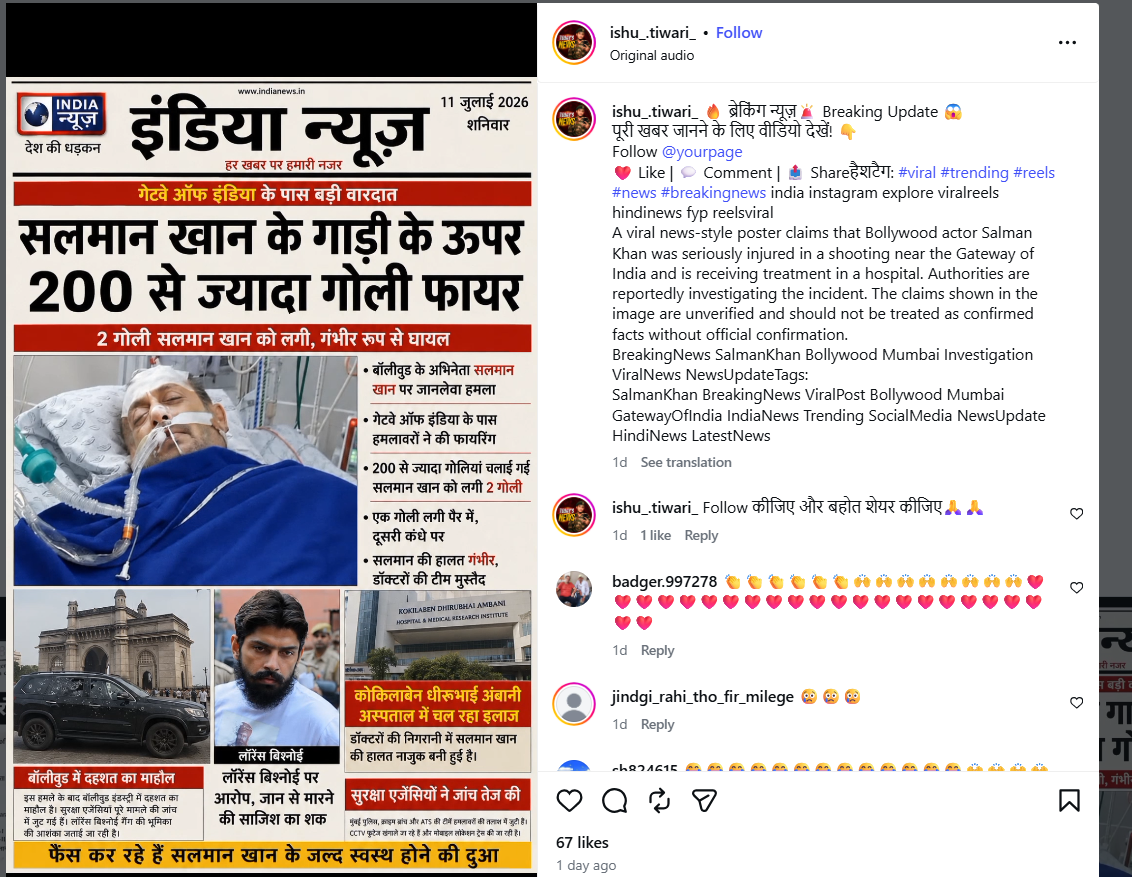
A newspaper clipping is being widely shared on social media with the claim that more than 200 bullets were fired at actor Salman Khan’s vehicle, two of which allegedly hit him and left him seriously injured. CyberPeace Research Wing’s research found the viral claim to be false. The research revealed that Salman Khan is safe and healthy, and there is no credible information confirming any such firing incident. The probe further found that the alleged newspaper clipping circulating on social media was created using Artificial Intelligence (AI).
Claim
An Instagram user shared the viral newspaper clipping on July 11, 2026, claiming that more than 200 bullets were fired at Salman Khan’s vehicle, two bullets hit him, and he was seriously injured.
https://www.instagram.com/reel/DaqNtAfSGyI/
https://ghostarchive.org/archive/81qpF
Fact Check
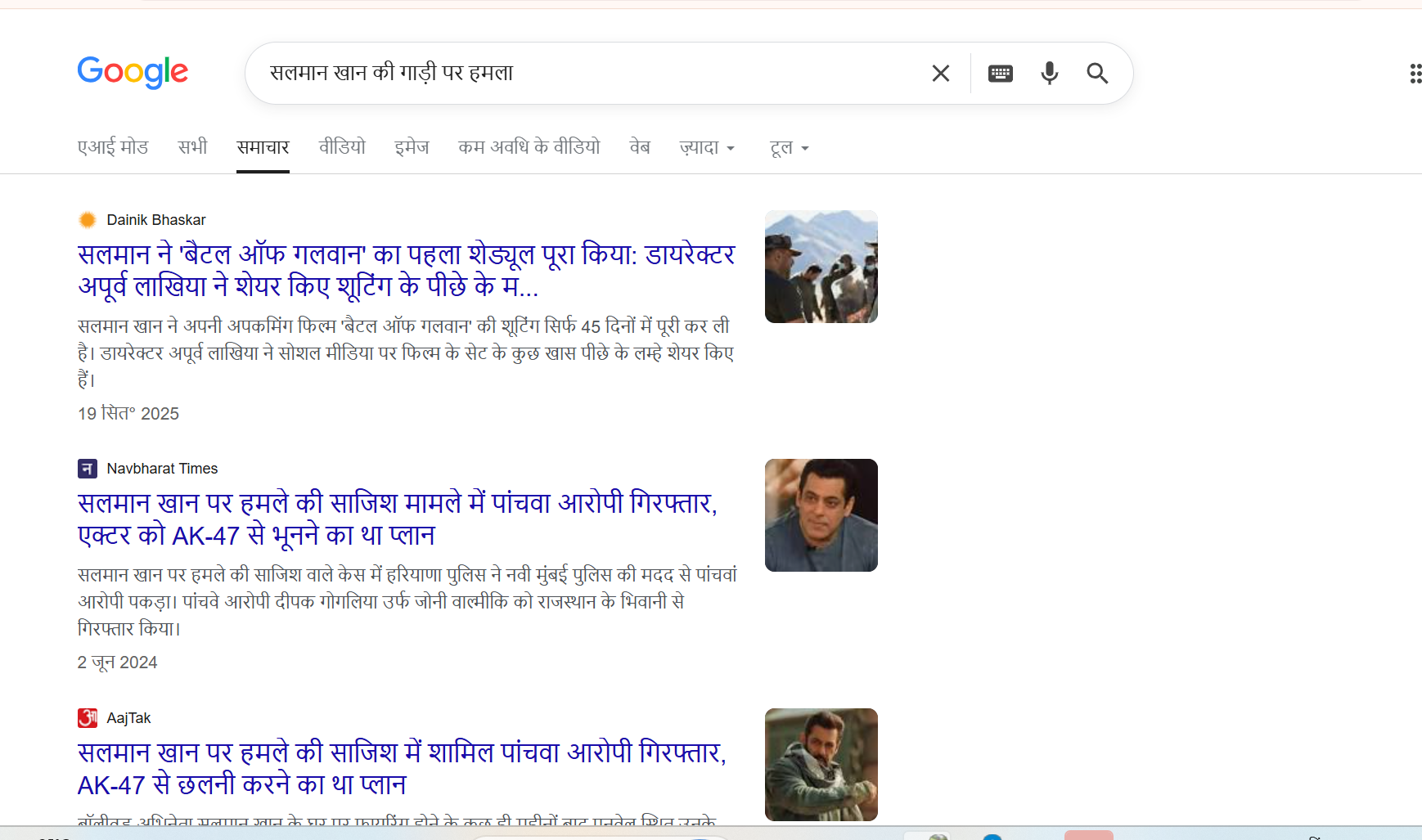
To verify the viral claim, we conducted a keyword-based search on Google. However, we did not find any credible media report confirming that Salman Khan was injured in any such firing incident.
During further research, we found a report published by Dainik Bhaskar on July 11, 2026. According to the report, actor Salman Khan sold another apartment located in Bandra, Mumbai. The report did not mention any incident involving an attack or injury.
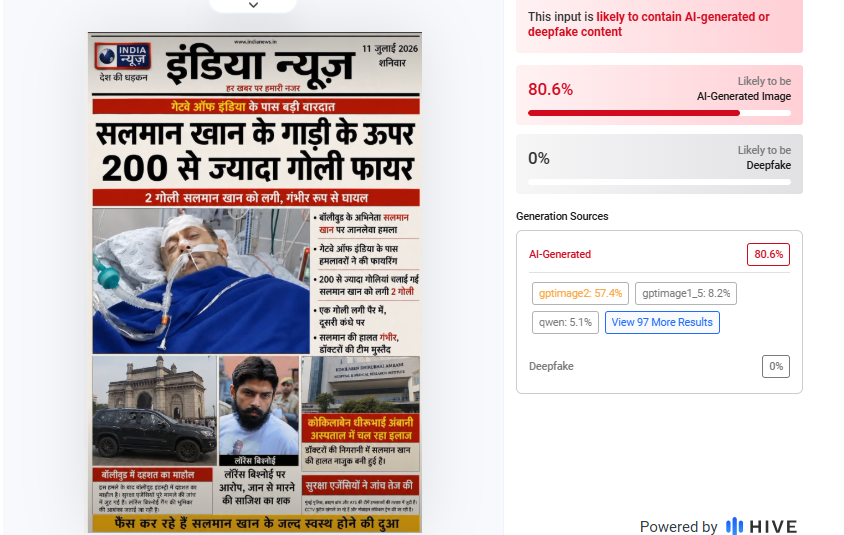
In the next step of the research, we analysed the viral newspaper clipping using the AI detection tool Hive Moderation. The tool’s analysis indicated an 80% probability that the newspaper clipping was AI-generated.
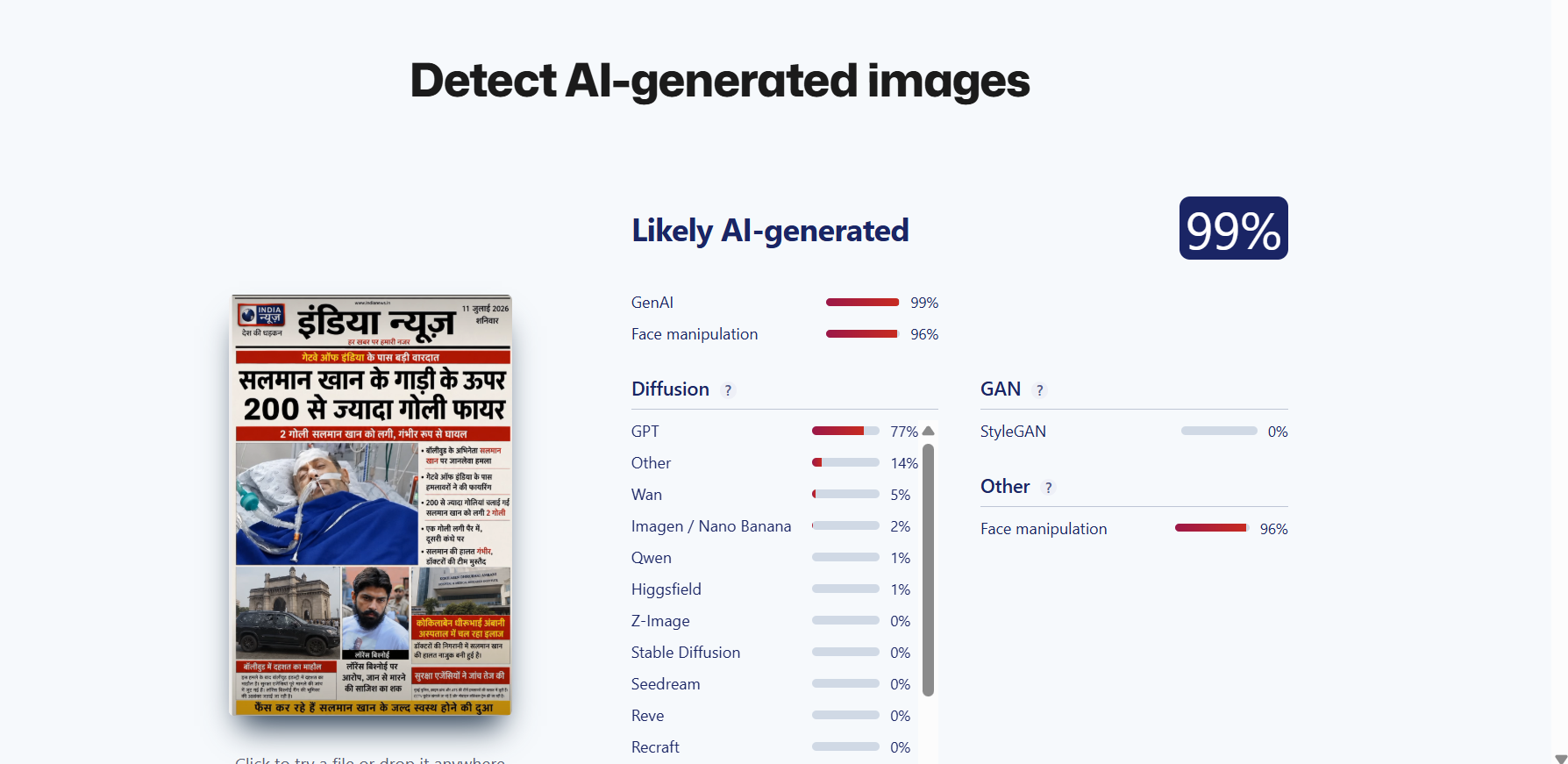
For further verification, the viral image was also checked using another AI detection tool, Sightengine. The tool’s result showed a 99% probability that the image was AI-generated.
Conclusion
Our research found that the viral claim is false. There is no evidence that actor Salman Khan was injured in a firing incident or that more than 200 bullets were fired at his vehicle. The alleged newspaper clipping being circulated on social media was found to be AI-generated and is being shared with a false narrative

Executive Summary
A video showing a massive human pyramid has gone viral on social media. In the clip, dozens of people are seen forming a towering human pyramid that begins to sway violently as if struck by strong winds. Surprisingly, the structure regains balance within seconds and no one falls. Many users are sharing the video as footage of a real-life incident. CyberPeace Research Wing 's research found that the viral video is fake. It does not depict a real incident; rather, it has been created using Artificial Intelligence (AI).
Claim
An X user, "Cockroach Janta Party," shared the viral video on July 10, 2026, with the caption: "The human pyramid started swaying due to strong winds... but surprisingly, no one fell. Would you dare stand at the very top of this human pyramid?"
https://x.com/CJP_for_India/status/2075405269899866415?s=20
https://perma.cc/T993-99RZ
Fact Check
We first carefully examined the viral video. During our visual analysis, we observed several irregularities. The people forming the pyramid appeared to be standing in unnatural positions, and when the structure began to sway, the movements of the individuals looked highly unnatural and robotic. These visual anomalies raised suspicion that the video had been generated using AI. To verify this, we analysed the video using multiple AI detection tools.
The video was first scanned using Hive Moderation, which detected an almost 100% probability that the content was AI-generated. According to Hive's analysis, the video was most likely created using the Seedance2 model, an AI-powered video generation system.

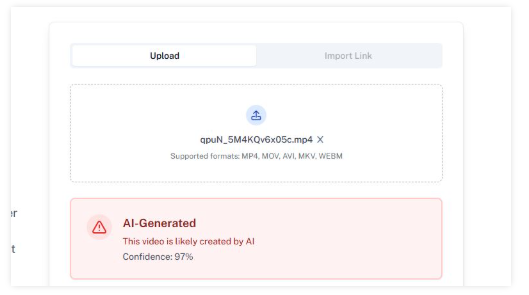
For additional verification, we analysed the video using Undetectable.ai. The tool also concluded that there was a 97% probability that the video had been generated using Artificial Intelligence.
Conclusion
Our research found that the viral human pyramid video is AI-generated. It does not depict a real incident and has been created using artificial intelligence. The video is being circulated on social media without disclosing its AI-generated nature, misleading users into believing it shows an actual event.
Executive Summary
Several social media posts are claiming that Chinese troops have entered nearly 60 kilometres inside Arunachal Pradesh. Amid these claims, a video showing security personnel managing a large crowd is being widely circulated as footage from Arunachal Pradesh. Users are sharing the clip claiming it captures the situation following the alleged Chinese intrusion. CyberPeace Research Wing found the claim to be false. The viral video is not from Arunachal Pradesh. It actually shows Baltal Base Camp during the Amarnath Yatra in Jammu and Kashmir. The Government of India has also categorically denied reports of any recent Chinese intrusion into Indian territory.
Claim
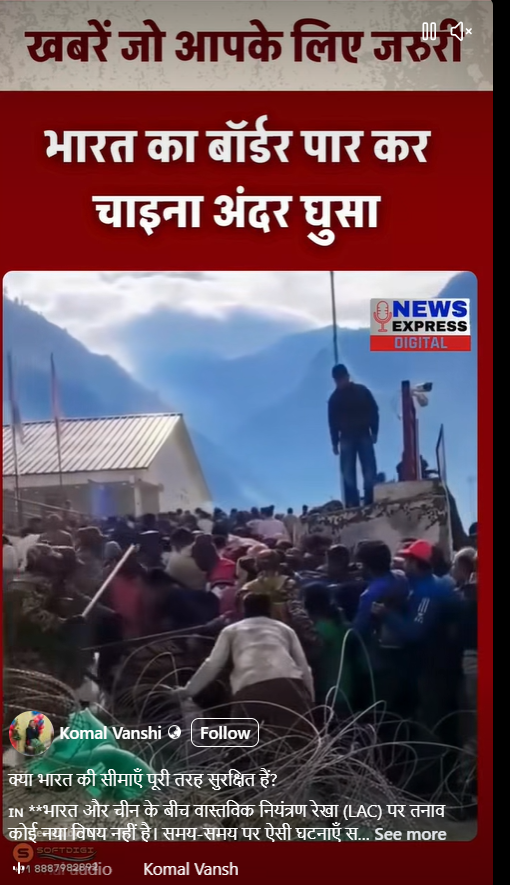
A Facebook user, "Komal Vanshi," shared the video on July 8, 2026, claiming that Chinese People's Liberation Army (PLA) soldiers had entered deep inside Arunachal Pradesh and referring to alleged incidents along the Line of Actual Control (LAC). The post was accompanied by the viral video, suggesting it was related to the alleged intrusion.
https://www.facebook.com/reel/1585091393251089
Fact Check
We first carefully examined the viral video. During the analysis, we noticed barricades bearing the words "Jammu & Kashmir Police." This clearly indicated that the footage could not have been recorded in Arunachal Pradesh.
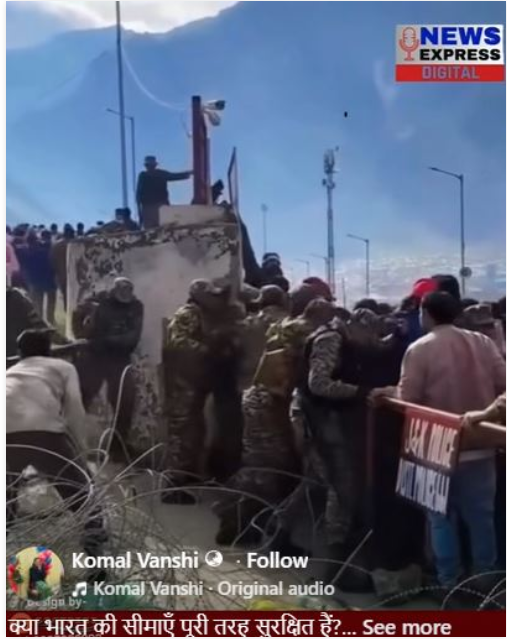
In the next step, we extracted multiple keyframes from the video and conducted a reverse image search using Google Lens. Although the video was widely shared with the Arunachal Pradesh claim, our search led us to a YouTube Shorts video uploaded on July 7, 2026, identifying the location as Baltal, one of the main base camps for the annual Amarnath Yatra in Jammu and Kashmir.
https://www.youtube.com/watch?v=EEfP2RckyJM
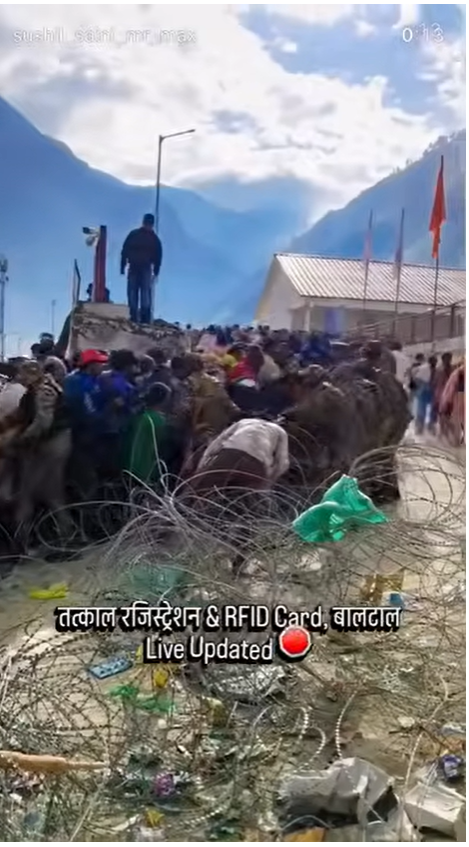
The visual details in the YouTube video matched the viral footage, confirming that it was filmed at Baltal Base Camp and had no connection with Arunachal Pradesh or any alleged Chinese military movement
Conclusion
CyberPeace Research Wing found that the viral claim is false. The video being circulated as evidence of a Chinese military incursion into Arunachal Pradesh actually shows crowd management arrangements at Baltal Base Camp during the Amarnath Yatra in Jammu and Kashmir. The footage has been falsely linked to an unrelated claim about Chinese troops entering Indian territory. There is no evidence that the video depicts any incident related to the India-China border.

Introduction
Two videos are being widely circulated on social media with the claim that Chinese troops have entered Arunachal Pradesh, India. The first video shows a large group of soldiers marching in formation, while the second shows armed personnel disembarking from military trucks. Social media users claim that the footage shows Chinese soldiers advancing into Indian territory. CyberPeace Research Wing’s research found the claim to be false. The two viral videos are unrelated to India and actually show Thai Army personnel during military training exercises. Both the Government of India and the Indian Army have also dismissed the claim of any recent Chinese intrusion into Indian territory.
Claim
An Instagram user, "mtkv.ideo," shared the viral videos on July 7, 2026, with the caption,"Chinese army has entered 60 km inside India."
https://www.instagram.com/reels/DaehrgExzUl/

Fact Check
To verify the claim, we extracted several keyframes from the viral videos and conducted a reverse image search using Google Lens.
During the research, we found one of the videos posted on June 16, 2026, on the Facebook page "Liangpha Kha Khaeng."
https://www.facebook.com/reel/992963226961409
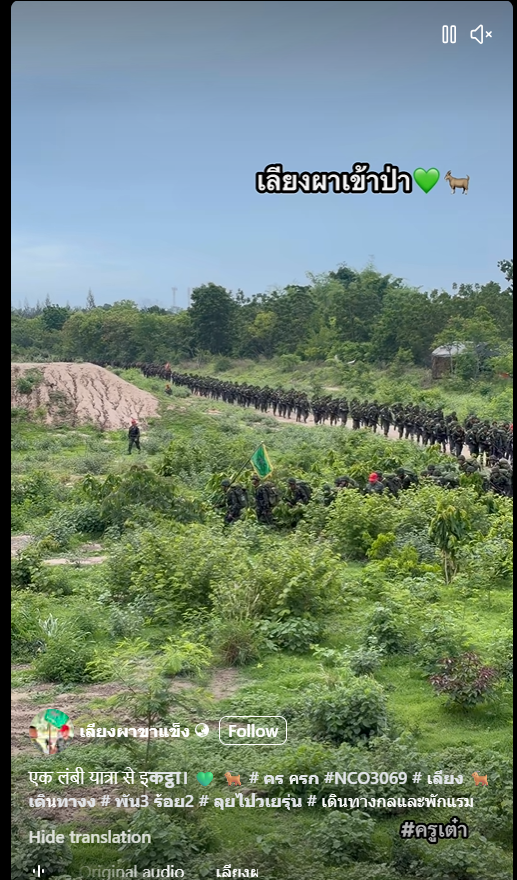
According to the information provided with the post, the video shows a training exercise of Non-Commissioned Officers (NCOs) from the 3rd Battalion, 2nd Regiment of the Royal Thai Army. The page also contains several other posts featuring Thai military drills and training activities. We further reviewed the Facebook page and found multiple training videos featuring the same flag carried by soldiers in the viral footage, confirming that the personnel shown belong to the Thai Army, not the Chinese military.
https://www.facebook.com/profile.php?id=61588894033585&locale=hi_IN

We also found a report published by The Times of India, quoting Union Minister Kiren Rijiju, who dismissed claims of any Chinese intrusion into Arunachal Pradesh. Rijiju clarified that no intrusion had taken place, adding that occasional movement across undemarcated areas occurs because the boundary has not been fully delineated. https://timesofindia.indiatimes.com/india/no-intrusion-transgression-in-absence-of-demarcation-kiran-rijiju/articleshow/132101410.cms

Conclusion
Our research found that the viral claim is false. The videos being shared as evidence of Chinese troops entering Arunachal Pradesh actually show Royal Thai Army personnel participating in military training exercises in Thailand. There is no evidence that the footage is related to India or that it depicts any recent Chinese military intrusion into Indian territory. Government officials have also rejected the viral claim.
