
#FactCheck - Viral Video of Man ‘Running on Water’ Found to Be AI-Generated
Executive Summary:
A video is being shared on social media showing a man running rapidly in a river with water bottles tied to both his feet. Users are circulating the video claiming that the man is attempting to run on water using the support of the bottles. CyberPeace’s research found the viral claim to be false. Our research revealed that the video being shared on social media is not real but has been generated using artificial intelligence (AI).
Claim :
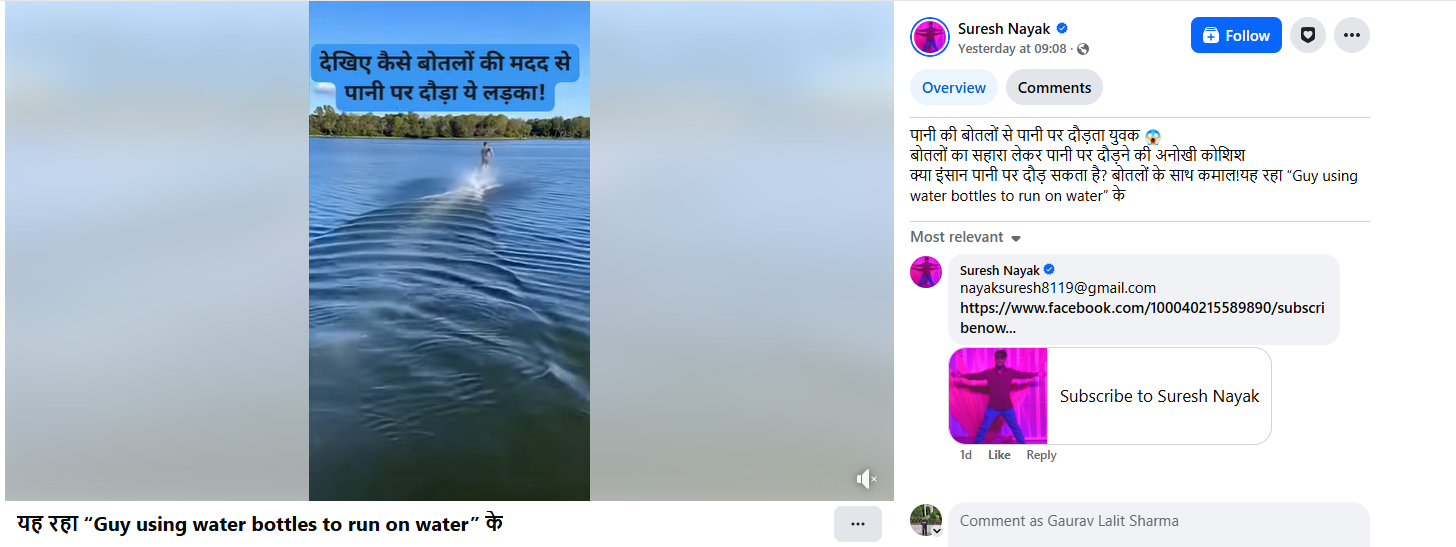
The claim was shared by a Facebook user on February 5, 2026, who wrote that a man was running on water using water bottles tied to his feet, calling it a unique attempt and questioning whether humans can run on water. Links to the post, its archived version, and screenshots are provided below.
Fact Check:
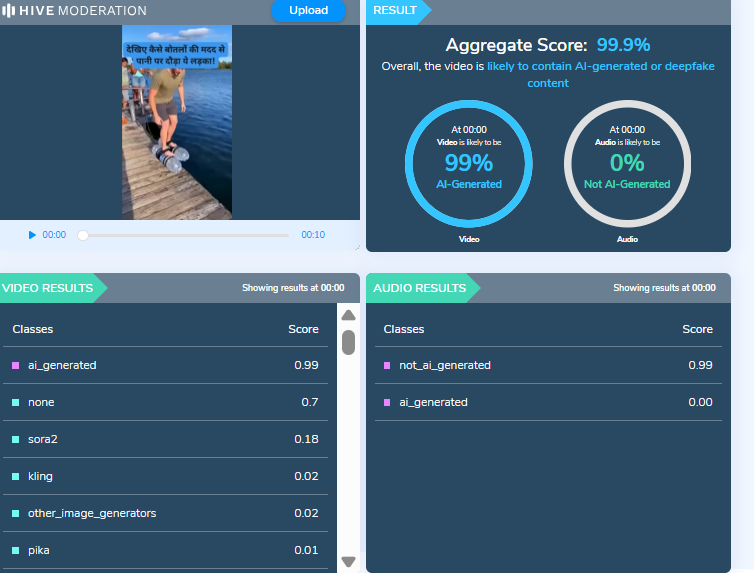
To verify the claim, we searched relevant keywords on Google but did not find any credible media reports supporting the incident. A closer examination of the viral video revealed several visual irregularities, raising suspicion that it may have been AI-generated. The video was then scanned using the AI detection tool Hive Moderation. According to the tool’s results, the video is 99 percent likely to be AI-generated.
Conclusion:
Our research confirms that the viral video does not depict a real incident and has been falsely shared as a genuine attempt to run on water.

Related Blogs
Introduction
The rapid rise of AI tools has reshaped how health content spreads on platforms like Instagram Reels and YouTube Shorts. These sub-minute videos promise quick fixes for weight loss, glowing skin, or reduced anxiety, often delivered through polished visuals and confident AI-generated voiceovers. The result feels highly personalised, as if the advice is tailored to each viewer, even though it is usually generic and widely recycled.
Short-form videos tend to compress complex health topics into “one tip” solutions, such as drinking a specific detox drink daily or following a single workout for rapid fat loss. While appealing, this oversimplification removes essential context, including individual health conditions, long-term risks, and scientific nuance. For example, viral diet trends or fitness hacks may work for some but can be ineffective or even harmful for others.
Algorithms play a major role in amplifying such content. Videos that promise dramatic transformations or instant results are more likely to gain engagement, which pushes them to wider audiences. Repeated exposure then builds familiarity, making the advice seem more credible over time. Audiences often trust this content due to its clean presentation, authoritative tone, and frequent repetition. However, the risks include misinformation, unrealistic expectations, and potential harm from unverified practices. To approach such content critically, viewers should cross-check claims with credible medical sources, avoid relying on single tip solutions, and remember that real health advice is rarely one size fits all.
The Illusion of Personalisation
AI-generated health content often mimics personalisation through:
- Synthetic voiceovers that designers created to match different age groups through their voice output, which speak specifically to people who are 20 years old and younger.
- The script development process uses data that tracks currently popular search terms.
- Viewers can interpret information through visual elements, which show changes between two different states.
The process of "personalisation" uses generalised data that does not match individual health profiles to create targeted results. The videos fail to provide a medical assessment because they do not consider:
- Existing medical conditions
- Hereditary differences
- Personal habits and the impact of surrounding conditions
The users will think that general medical advice applies to their personal health needs, which will lead them to use this advice inappropriately.
Short-Form Content and Oversimplification
Short-form videos have time limitations, which result in reduced complex medical information development into basic medical stories. The typical patterns of evaluation include these two patterns of evaluation include:
- “One-tip solutions” (e.g., “Drink this before bed to burn fat”)
- Binary framing (“good vs bad foods”)
- The process of eliminating all disclaimers and side effects information
For example, the three diet methods here the three diet methods here
- Viral detox drinks that make the claim to "flush toxins" from the body
- Extreme calorie-cutting diet hacks
- Fitness shortcuts that guarantee users will see results within days
The content demonstrates a pattern of disregarding essential human body operation rules that include both metabolic patterns and human body operation over extended periods of time.
Algorithmic Amplification and Virality
The recommendation algorithms used by Instagram and YouTube deliver their most important results through three main factors, which include:
- Engagement (likes, shares, watch time)
- Retention rates
- Emotional or aspirational triggers
Health-related content that claims to deliver:
- Immediate body changes
- Needs minimal work from viewers
- Results in extreme physical changes
Attractive health-related content that displays extreme physical changes through quick transformations. The system produces a continuous cycle during which:
- Misleading content gains traction
- Algorithms amplify it further
- More creators replicate similar formats using AI tools
The system produces a secondary result that favours content that people share instead of content that has authentic credibility.
Why Do Users Trust AI-Generated Health Content?
Several psychological and technological factors contribute to trust:
- Professional Aesthetics - AI tools generate high-quality visual content together with authentic voiceover performance and expert-level script documentation, which replicates professional communication methods.
- Repetition and Familiarity - When people encounter identical recommendations multiple times, their belief in those recommendations increases through the illusory truth effect.
- Authority Signals
- Medical terminology serves as a standard term
- Medical professionals appear in stock footage through lab coat visuals
- The narrator delivers information through an assertive speaking style
- Perceived Personal Relevance - Algorithmic targeting makes users feel the content is "meant for them.
Real-World Examples of Viral Trends
The typical types of health misinformation that artificial intelligence systems spread through their enhanced capabilities include:
- Diet Trends: Keto shortcuts, extreme intermittent fasting variants
- Fitness Hacks: Spot reduction exercises (scientifically unsupported)
- Supplement Advice: Unverified claims about vitamins or herbal products
- Mental Health Tips: Oversimplified coping strategies that lack clinical evidence
The statement that drinking warm lemon water will detox your liver continues to be popular despite the fact that the liver has natural self-detoxification abilities.
Risks and Public Health Implications
The widespread consumption of such content creates multiple dangers, which include:
1. Physical Health Risks
- Nutritional deficiencies from extreme diets
- Injury from improper exercise techniques
- Delayed medical consultation
2. Psychological Impact
- Unrealistic body image expectations
- Anxiety due to conflicting advice
3. Misinformation Ecosystem
- The public loses confidence in evidence-based medicine
- Unverified or pseudoscientific practices spread throughout society
Regulatory and Ethical Concerns
The increase of AI-generated health materials connects to more extensive problems, which include:
- Who is responsible for the content
- Who is responsible for the platform
- How AI systems show their inner workings to users
Most platforms today do not have strict systems that can:
- Verify medical claims
- Display which health advice comes from artificial intelligence
- Punish users who spread false information multiple times
The absence of regulations allows misleading information to spread without consequences.
A CyberPeace Perspective: Building Digital Health Resilience
The problem needs complete involvement from several parties to create effective solutions that protect both online security and data integrity.
For Users
- Users should confirm claims by using trustworthy medical resources, which include the WHO and peer-reviewed studies.
- People should avoid using "quick solutions" until they receive guidance from certified experts.
- Users should exercise caution when they encounter content that does not include necessary warning signs.
For Platforms
- Platforms should implement systems that enable users to identify AI-generated content.
- Platforms should decrease the visibility of health information that contains false statements.
- Platforms should support authentic health content producers who have been validated.
For Policymakers
- Policymakers should create standards that govern AI-produced medical content.
- Policymakers need to enhance initiatives that teach people about the health information available online.
For Content Creators
- Content creators must show how they implement AI technologies.
- They should stay away from making claims that either go beyond what is needed or state things as absolute truth.
Conclusion
AI-generated health tips on short-form video platforms create complex research conditions that involve three scientific fields: technology, psychology and public health. The tools provide equal access to information, yet create higher risks for people to believe false information when they use the tools without responsible usage.
The challenge requires organisations to maintain user safety through accurate information management while providing users with transparent digital health services. The growing dependence of users on algorithm-based content requires educational institutions to develop students' critical thinking abilities and digital skills to minimise negative effects from AI-driven communication methods.
References
- https://pmc.ncbi.nlm.nih.gov/articles/PMC12924558/
- https://academic.oup.com/heapro/article/40/2/daaf023/8100645
- https://pmc.ncbi.nlm.nih.gov/articles/PMC12673052/
- https://www.frontiersin.org/journals/public-health/articles/10.3389/fpubh.2025.1713794/full
- https://www.who.int/teams/digital-health-and-innovation/digital-channels/combatting-misinformation-online
- https://link.springer.com/article/10.1186/s12982-025-00777-2
- https://www.washingtonpost.com/health/2026/04/21/chatbot-medical-advice-accurate/

Introduction
Whatsapp is one of the leading OTT messaging platforms, which has been owned by the tech giant Meta since 2013. WhatsApp enjoys a user base of nearly 2.24 billion people globally, with almost 487 million users in India. Since the advent of Whatsapp, it has been the most commonly used messaging app, and it has made an impact to such an extent that it is used for professional as well as personal purposes. Meta powers the platform and follows similar guidelines and policies as its parent company.
The New Feature
Users of WhatsApp on the web and desktop can now access one account from various devices. One WhatsApp account may now be used on up to four handsets thanks to a new update from Meta. Be aware that the multi-device capability has been planned for some time and is finally being made available to stable WhatsApp users. Each linked device (up to four devices can be linked) will function independently, and the independent devices will continue to receive messages even if the central device’s network connection is lost. Remember that WhatsApp will automatically log out of all the companion devices if the primary smartphone is dormant for an extended period. Four more gadgets may be a mix of four PCs and smartphones or four smartphones. This feature is now available for updates and downloads on Android as well as iOS platforms.
Potential issues
As we go deeper into the digital age, it is the responsibility of the tech giants to pilot innovation with features of security by design. Thus such new features should be accompanied by coherent safety and security policies or advisories to ensure the users understand the implications of the new features. Convenience over conditions is an essential part of cyberspace. It points to the civic duty of netizens to go through the conditions of any app rather than only focus on the convenience it creates. The following potential issues may arise from the new features on Whatsapp –
- Increased cybercrime- The bad actors now do not need to access SIM cards to commit frauds over the platforms as now on a single number 4 devices can be used hence the cybercriminal activity can increase over the platform. It is also pertinent for the platform to create SoPs for fake accounts which use multiple devices, as they pose a direct threat to the users and their interests.
- Difficulty in identifying and tracing- The LEAs will face a significant issue in identifying the bad actors and tracing them as the individual’s involvement through a linked device needs to be given legal validity and scope for investigation. This may also cause issues in evidence handling and analysis.
- Surge in Misinformation and Disinformation- With access to multiple devices, the screen time of an individual is also bound to increase. This leads to more time spent online, thus causing a rise in instances of misinformation and disinformation by bad actors. Thus the aspect of fack checking is of prime importance.
- Potential Oversharing of Personal Data- With the increased accessibility on different devices, it is very easy for the app to seek data from all devices on which the app is running, thus leading to a bigger reservoir of personal data for the platforms and data fiduciaries.
- Higher risk of Phishing, Ransomware and Malware Attacks- As the devices under the same login credentials and mobile number will increase, the message can be viewed on all the devices, thus increasing the risk of widespread embedded ransomware and malware in multiple devices is and ever-present threat.
- One number, more criminals- This feature will allow cybercriminals to operate using one device only, earlier they used to forge Adhaar cards to get new sims, but this feature will enable the bad actors to commit crimes and attacks from one single SIM using 4 different devices.
- Rise in Digital Footprint- As the number of devices increases, the users will generate more digital footprints. As a tech giant, Meta will have access to a bigger database, which increases the risk of data breaches by third-party actors.
Conclusion
In the fast-paced digital world, it is important to remain updated about new software, technologies and policies for our applications or forms of tech. This was a long-awaited feature from WhatsApp, and its value of it doesn’t lie in technological advancement only but also in the formulation of policies to govern this technology towards the trust and safety aspect of users. The platforms, in synergy with the policy makers, need to create a robust framework to accommodate the new features and add-ons on apps vehicle, staying in compliance with the laws of the land. Awareness about new features and vulnerabilities is a must for all netizens, and it is a shared responsibility for all netizens to spread the word about safety and security mechanisms.

The race for global leadership in AI is in full force. As China and the US emerge as the ‘AI Superpowers’ in the world, the world grapples with the questions around AI governance, ethics, regulation, and safety. Some are calling this an ‘AI Arms Race.’ Most of the applications of these AI systems are in large language models for commercial use or military applications. Countries like Germany, Japan, France, Singapore, and India are now participating in this race and are not mere spectators.
The Government of India’s Ministry of Electronics and Information Technology (MeitY) has launched the IndiaAI Mission, an umbrella program for the use and development of AI technology. This MeitY initiative lays the groundwork for supporting an array of AI goals for the country. The government has allocated INR 10,300 crore for this endeavour. This mission includes pivotal initiatives like the IndiaAI Compute Capacity, IndiaAI Innovation Centre (IAIC), IndiaAI Datasets Platform, IndiaAI Application Development Initiative, IndiaAI FutureSkills, IndiaAI Startup Financing, and Safe & Trusted AI.
There are several challenges and opportunities that India will have to navigate and capitalize on to become a significant player in the global AI race. The various components of India’s ‘AI Stack’ will have to work well in tandem to create a robust ecosystem that yields globally competitive results. The IndiaAI mission focuses on building large language models in vernacular languages and developing compute infrastructure. There must be more focus on developing good datasets and research as well.
Resource Allocation and Infrastructure Development
The government is focusing on building the elementary foundation for AI competitiveness. This includes the procurement of AI chips and compute capacity, about 10,000 graphics processing units (GPUs), to support India’s start-ups, researchers, and academics. These GPUs have been strategically distributed, with 70% being high-end newer models and the remaining 30% comprising lower-end older-generation models. This approach ensures that a robust ecosystem is built, which includes everything from cutting-edge research to more routine applications. A major player in this initiative is Yotta Data Services, which holds the largest share of 9,216 GPUs, including 8,192 Nvidia H100s. Other significant contributors include Amazon AWS's managed service providers, Jio Platforms, and CtrlS Datacenters.
Policy Implications: Charting a Course for Tech Sovereignty and Self-reliance
With this government initiative, there is a concerted effort to develop indigenous AI models and reduce tech dependence on foreign players. There is a push to develop local Large Language Models and domain-specific foundational models, creating AI solutions that are truly Indian in nature and application. Many advanced chip manufacturing takes place in Taiwan, which has a looming China threat. India’s focus on chip procurement and GPUs speaks to a larger agenda of self-reliance and sovereignty, keeping in mind the geopolitical calculus. This is an important thing to focus on, however, it must not come at the cost of developing the technological ‘know-how’ and research.
Developing AI capabilities at home also has national security implications. When it comes to defence systems, control over AI infrastructure and data becomes extremely important. The IndiaAI Mission will focus on safe and trusted AI, including developing frameworks that fit the Indian context. It has to be ensured that AI applications align with India's security interests and can be confidently deployed in sensitive defence applications.
The big problem here to solve here is the ‘data problem.’ There must be a focus on developing strategies to mitigate the data problem that disadvantages the Indian AI ecosystem. Some data problems are unique to India, such as generating data in local languages. While other problems are the ones that appear in every AI ecosystem development lifecycle namely generating publicly available data and licensed data. India must strengthen its ‘Digital Public Infrastructure’ and data commons across sectors and domains.
India has proposed setting up the India Data Management Office to serve as India’s data regulator as part of its draft National Data Governance Framework Policy. The MeitY IndiaAI expert working group report also talked about operationalizing the India Datasets Platform and suggested the establishment of data management units within each ministry.
Economic Impact: Growth and Innovation
The government’s focus on technology and industry has far-reaching economic implications. There is a push to develop the AI startup ecosystem in the country. The IndiaAI mission heavily focuses on inviting ideas and projects under its ambit. The investments will strengthen the IndiaAI startup financing system, making it easier for nascent AI businesses to obtain capital and accelerate their development from product to market. Funding provisions for industry-led AI initiatives that promote social impact and stimulate innovation and entrepreneurship are also included in the plan. The government press release states, "The overarching aim of this financial outlay is to ensure a structured implementation of the IndiaAI Mission through a public-private partnership model aimed at nurturing India’s AI innovation ecosystem.”
The government also wants to establish India as a hub for sustainable AI innovation and attract top AI talent from across the globe. One crucial aspect that needs to be worked on here is fostering talent and skill development. India has a unique advantage, that is, top-tier talent in STEM fields. Yet we suffer from a severe talent gap that needs to be addressed on a priority basis. Even though India is making strides in nurturing AI talents, out-migration of tech talent is still a reality. Once the hardware manufacturing “goods-side” of economics transitions to service delivery in the field of AI globally, India will need to be ready to deploy its talent. Several structural and policy interfaces, like the New Education Policy and industry-academic partnership frameworks, allow India to capitalize on this opportunity.
India’s talent strategy must be robust and long-term, focusing heavily on multi-stakeholder engagement. The government has a pivotal role here by creating industry-academia interfaces and enabling tech hubs and innovation parks.
India's Position in the Global AI Race
India’s foreign policy and geopolitical standpoint have been one of global cooperation. This must not change when it comes to AI. Even though this has been dubbed as the “AI Arms Race,” India should encourage worldwide collaboration on AI R&D through collaboration with other countries in order to strengthen its own capabilities. India must prioritise more significant open-source AI development, work with the US, Europe, Australia, Japan, and other friendly countries to prevent the unethical use of AI and contribute to the formation of a global consensus on the boundaries for AI development.
The IndiaAI Mission will have far-reaching implications for India’s diplomatic and economic relations. The unique proposition that India comes with is its ethos of inclusivity, ethics, regulation, and safety from the get-go. We should keep up the efforts to create a powerful voice for the Global South in AI. The IndiaAI Mission marks a pivotal moment in India's technological journey. Its success could not only elevate India's status as a tech leader but also serve as a model for other nations looking to harness the power of AI for national development and global competitiveness. In conclusion, the IndiaAI Mission seeks to strengthen India's position as a global leader in AI, promote technological independence, guarantee the ethical and responsible application of AI, and democratise the advantages of AI at all societal levels.
References
- Ashwini Vaishnaw to launch IndiaAI portal, 10 firms to provide 14,000 GPUs. (2025, February 17). https://www.business-standard.com/. Retrieved February 25, 2025, from https://www.business-standard.com/industry/news/indiaai-compute-portal-ashwini-vaishnaw-gpu-artificial-intelligence-jio-125021700245_1.html
- Global IndiaAI Summit 2024 being organized with a commitment to advance responsible development, deployment and adoption of AI in the country. (n.d.). https://pib.gov.in/PressReleaseIframePage.aspx?PRID=2029841
- India to Launch AI Compute Portal, 10 Firms to Supply 14,000 GPUs. (2025, February 17). apacnewsnetwork.com. https://apacnewsnetwork.com/2025/02/india-to-launch-ai-compute-portal-10-firms-to-supply-14000-gpus/
- INDIAai | Pillars. (n.d.). IndiaAI. https://indiaai.gov.in/
- IndiaAI Innovation Challenge 2024 | Software Technology Park of India | Ministry of Electronics & Information Technology Government of India. (n.d.). http://stpi.in/en/events/indiaai-innovation-challenge-2024
- IndiaAI Mission To Deploy 14,000 GPUs For Compute Capacity, Starts Subsidy Plan. (2025, February 17). www.businessworld.in. Retrieved February 25, 2025, from https://www.businessworld.in/article/indiaai-mission-to-deploy-14000-gpus-for-compute-capacity-starts-subsidy-plan-548253
- India’s interesting AI initiatives in 2024: AI landscape in India. (n.d.). IndiaAI. https://indiaai.gov.in/article/india-s-interesting-ai-initiatives-in-2024-ai-landscape-in-india
- Mehra, P. (2025, February 17). Yotta joins India AI Mission to provide advanced GPU, AI cloud services. Techcircle. https://www.techcircle.in/2025/02/17/yotta-joins-india-ai-mission-to-provide-advanced-gpu-ai-cloud-services/
- IndiaAI 2023: Expert Group Report – First Edition. (n.d.). IndiaAI. https://indiaai.gov.in/news/indiaai-2023-expert-group-report-first-edition
- Satish, R., Mahindru, T., World Economic Forum, Microsoft, Butterfield, K. F., Sarkar, A., Roy, A., Kumar, R., Sethi, A., Ravindran, B., Marchant, G., Google, Havens, J., Srichandra (IEEE), Vatsa, M., Goenka, S., Anandan, P., Panicker, R., Srivatsa, R., . . . Kumar, R. (2021). Approach Document for India. In World Economic Forum Centre for the Fourth Industrial Revolution, Approach Document for India [Report]. https://www.niti.gov.in/sites/default/files/2021-02/Responsible-AI-22022021.pdf
- Stratton, J. (2023, August 10). Those who solve the data dilemma will win the A.I. revolution. Fortune. https://fortune.com/2023/08/10/workday-data-ai-revolution/
- Suri, A. (n.d.). The missing pieces in India’s AI puzzle: talent, data, and R&D. Carnegie Endowment for International Peace. https://carnegieendowment.org/research/2025/02/the-missing-pieces-in-indias-ai-puzzle-talent-data-and-randd?lang=en
- The AI arms race. (2024, February 13). Financial Times. https://www.ft.com/content/21eb5996-89a3-11e8-bf9e-8771d5404543
