
#FactCheck - AI-Generated Image Falsely Linked to Mira–Bhayandar Bridge
Executive Summary
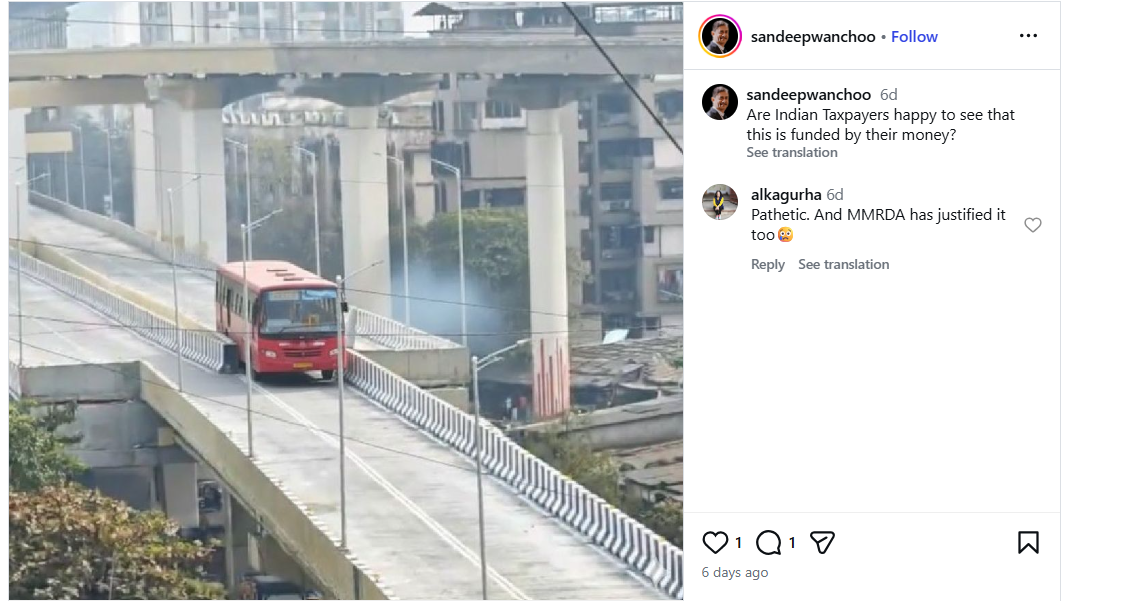
Mumbai’s Mira–Bhayandar bridge has recently been in the news due to its unusual design. In this context, a photograph is going viral on social media showing a bus seemingly stuck on the bridge. Some users are also sharing the image while claiming that it is from Sonpur subdivision in Bihar. However, an research by the CyberPeace has found that the viral image is not real. The bridge shown in the image is indeed the Mira–Bhayandar bridge, which is under discussion because its design causes it to suddenly narrow from four lanes to two lanes. That said, the bridge is not yet operational, and the viral image showing a bus stuck on it has been created using Artificial Intelligence (AI).
Claim
An Instagram user shared the viral image on January 29, 2026, with the caption:“Are Indian taxpayers happy to see that this is funded by their money?” The link, archive link, and screenshot of the post can be seen below.
Fact Check:
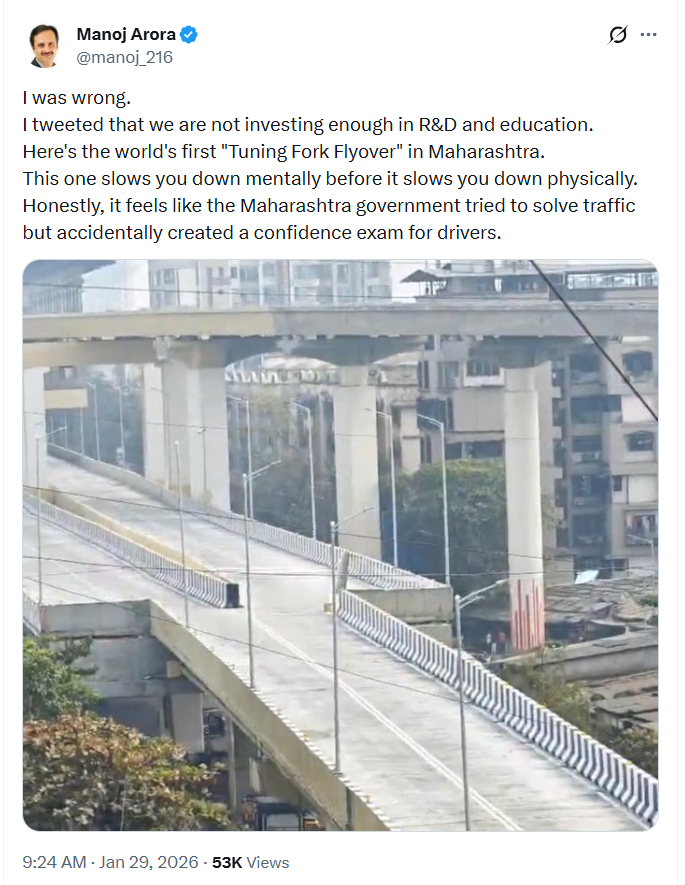
To verify the claim, we first conducted a Google Lens reverse image search. This led us to a post shared by X (formerly Twitter) user Manoj Arora on January 29. While the bridge structure in that image matches the viral photo, no bus is visible in the original post.This raised suspicion that the viral image had been digitally manipulated.
We then ran the viral image through the AI detection tool Hive Moderation, which flagged it as over 99% likely to be AI-generated

Conclusion
The CyberPeace research confirms that while the Mira–Bhayandar bridge is real and has been in the news due to its design, the viral image showing a bus stuck on the bridge has been created using AI tools. Therefore, the image circulating on social media is misleading.

Related Blogs

Executive Summary:
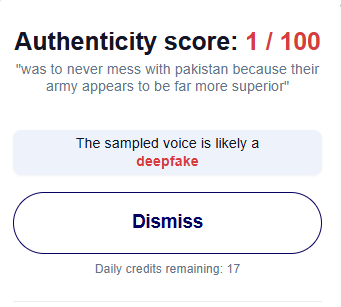
A viral social media claim alleges that India’s Chief of Defence Staff (CDS), General Anil Chauhan, praised Pakistan’s Army as superior during “Operation Sindoor.” Fact-checking confirms the claim is false. The original video, available on The Hindu’s official channel, shows General Chauhan inaugurating Ran-Samwad 2025 in Mhow, Madhya Pradesh. At the 1:22:12 mark, the genuine segment appears, proving the viral clip was altered. Additionally, analysis using Hiya AI Audio identified voice manipulation, flagging the segment as a deepfake with an authenticity score of 1/100. The fabricated statement was: “never mess with Pakistan because their army appears to be far more superior.” Thus, the viral video is doctored and misleading.
Claim:
A viral claim is being shared on social media (archived link) falsely claiming that India’s Chief of Defence Staff (CDS), General Anil Chauhan described Pakistan’s Army as superior and more advanced during Operation Sindoor.

Fact Check:
After performing a reverse image search we found a full clip on the official channel of The Hindu in which Chief of Defence Staff Anil Chauhan inaugurated ‘Ran-Samwad’ 2025 in Mhow, Madhya Pradesh.

In the clip on the time stamp of 1:22:12 we can see the actual part of the video segment which was manipulated in the viral video.
Also, by using Hiya AI Audio tool we got to know that the voice was manipulated in the specific segment of the video. The result shows Deepfake with an authenticity score 1/100, the result also shows the statement which is deepfake which was “ was to never mess with Pakistan because their army appears to be far more superior”.
Conclusion:
The viral video attributing remarks to CDS General Anil Chauhan about Pakistan’s Army being “superior” is fabricated. The original footage from The Hindu confirms no such statement was made, while forensic analysis using Hiya AI Audio detected clear voice manipulation, identifying the clip as a deepfake with minimal authenticity. Hence, the claim is baseless, misleading, and an attempt to spread disinformation.
- Claim: AI Generated audio of CDS admitting that the Pakistan Army is superior to the Indian Army.
- Claimed On: Social Media
- Fact Check: False and Misleading

Executive Summary
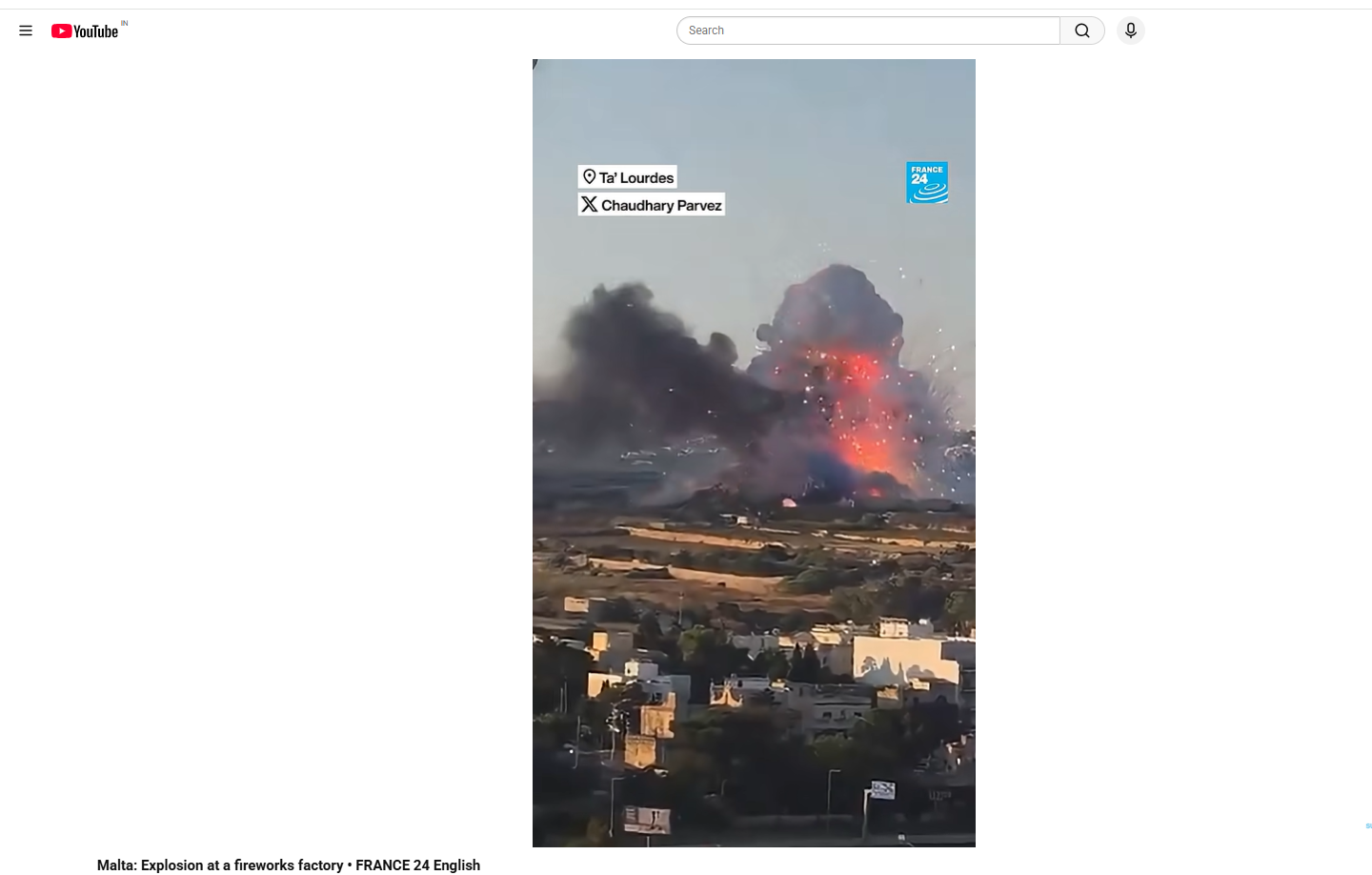
Amid heightened tensions in West Asia, claims are circulating on social media alleging that Iran carried out missile and drone strikes on US military bases in Kuwait, particularly the Ali Al-Salem Air Base. The claim is being accompanied by a viral video showing massive explosions, fire, and thick plumes of smoke, which users say depicts the alleged Iranian attack. CyberPeace Research Wing research found that the viral video is from an explosion at a fireworks factory in Malta, a European country. It has no connection to the ongoing tensions in West Asia. However, Iran has claimed that it targeted US military bases in response to American strikes. Meanwhile, the United States has stated that it successfully intercepted and neutralized several Iranian missile and drone attacks.
Claim:
Instagram user ‘nitesh_nova’ posted a video on June 2, 2026 (archive link), stating: “Iran has carried out ballistic missile and drone attacks on US military bases in Kuwait, particularly the Ali Al-Salem Air Base. This action was taken in response to US airstrikes on Iranian positions, following which tensions in the Gulf region have significantly escalated.”
https://perma.cc/PQ7N-JYQS?type=standard
https://www.instagram.com/nitesh_nova/

Fact Check
A review of keyframes from the video using reverse image search tools led to reports identifying the footage as an industrial accident. The same visuals were found in news coverage published by France 24, which confirmed that the explosion occurred at a fireworks factory in Malta on June 1, 2026. The incident resulted in injuries to two individuals, although no workers were present inside the facility at the time of the blast.
https://www.youtube.com/watch?v=LTLGO-fu_QA
Further verification from 10 News Australia also supports the same context, showing the identical footage and reporting it as a fireworks factory explosion in Malta, posted on June 2, 2026.10 News Australia report
https://www.youtube.com/watch?v=8Lppvtdr50k

Conclusion:
The viral video being shared with claims of an Iranian missile strike on a US military base in Kuwait is misleading. The footage actually shows a fireworks factory explosion in Malta and has no connection to the ongoing geopolitical tensions in West Asia. Social media users are advised to verify such sensitive content before sharing, as misattributed visuals can significantly distort the understanding of real-world conflicts.

Introduction
The appeal is to be heard by the TDSAT (telecommunication dispute settlement & appellate tribunal) regarding several changes under Digital personal data protection. The Changes should be a removal of the deemed consent, a change in appellate mechanism, No change in delegation legislation, and under data breach. And there are some following other changes in the bill, and the digital personal data protection bill 2023 will now provide a negative list of countries that cannot transfer the data.
New Version of the DPDP Bill
The Digital Personal Data Protection Bill has a new version. There are three major changes in the 2022 draft of the digital personal data protection bill. The changes are as follows: The new version proposes changes that there shall be no deemed consent under the bill and that the personal data processing should be for limited uses only. By giving the deemed consent, there shall be consent for the processing of data for any purposes. That is why there shall be no deemed consent.
- In the interest of the sovereignty
- The integrity of India and the National Security
- For the issue of subsidies, benefits, services, certificates, licenses, permits, etc
- To comply with any judgment or order under the law
- To protect, assist, or provide service in a medical or health emergency, a disaster situation, or to maintain public order
- In relation to an employee and his/her rights
The 2023 version now includes an appeals mechanism
It states that the Board will have the authority to issue directives for data breach remediation or mitigation, investigate data breaches and complaints, and levy financial penalties. It would be authorised to submit complaints to alternative dispute resolution, accept voluntary undertakings from data fiduciaries, and advise the government to prohibit a data fiduciary’s website, app, or other online presence if the terms of the law were regularly violated. The Telecom Disputes Settlement and Appellate Tribunal will hear any appeals.
The other change is in delegated legislation, as one of the criticisms of the 2022 version bill was that it gave the government extensive rule-making powers. The committee also raised the same concern with the ministry. The committed wants that the provisions that cannot be fully defined within the scope of the bill can be addressed.
The other major change raised in the new version bill is regarding the data breach; there will be no compensation for the data breach. This raises a significant concern for the victims, If the victims suffer a data breach and he approaches the relevant court or authority, he will not be awarded compensation for the loss he has suffered due to the data breach.
Need of changes under DPDP
There is a need for changes in digital personal data protection as we talk about the deemed consent so simply speaking, by ‘deeming’ consent for subsequent uses, your data may be used for purposes other than what it has been provided for and, as there is no provision for to be informed of this through mandatory notice, there may never even come to know about it.
Conclusion
The bill requires changes to meet the need of evolving digital landscape in the digital personal data protection 2022 draft. The removal of deemed consent will ultimately protect the data of the data principal. And the data of the data principal will be used or processed only for the purpose for which the consent is given. The change in the appellate mechanism is also crucial as it meets the requirements of addressing appeals. However, the no compensation for a data breach is derogatory to the interest of the victim who has suffered a data breach.
