
#FactCheck - Video Showing Sadhus in Ice Is Artificially Generated
Executive Summary
A video showing a group of Hindu ascetics (sadhus) allegedly performing intense penance while their bodies appear to be covered in ice is being widely shared on social media. Users are circulating the video as real and claiming that it represents an ancient tradition of Sanatan Dharma. CyberPeace research found the viral claim to be false.The research revealed that the video circulating on social media is not real but has been generated using artificial intelligence (AI).
Claim
On social media platform Facebook, a user shared the viral video on January 16, 2026. The video shows several ascetics engaged in penance, with their bodies seemingly covered in ice. Users shared the video while claiming that it depicts an authentic spiritual practice rooted in Sanatan Dharma.
Links to the post, archive link, and screenshots can be seen below.

Fact Check:
To verify the authenticity of the viral claim, CyberPeace searched relevant keywords on Google. However, no credible or reliable media reports supporting the claim were found. A close examination of the viral video raised suspicion that it may have been AI-generated. To verify this, the video was analysed using the AI detection tool Hive Moderation. According to the results, the video was found to be 99 percent AI-generated.

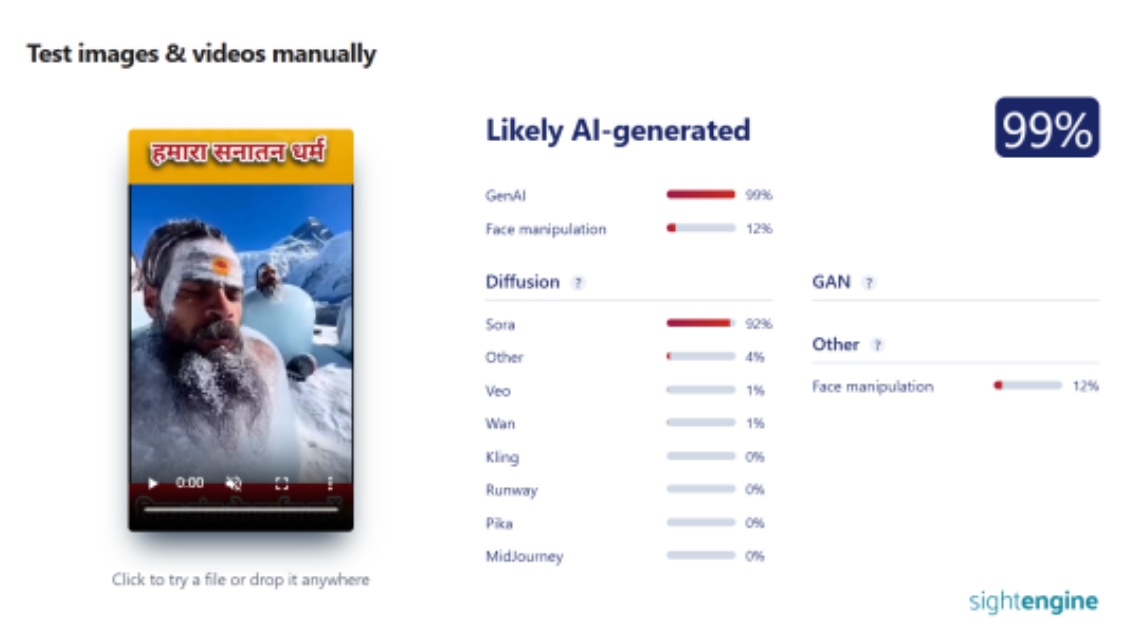
In the next step of the research, the same video was analysed using another AI detection tool, Sightengine. The results again indicated that the video was 99 percent AI-generated.
Conclusion
CyberPeace concludes that the video circulating on social media is not real. The viral video showing ascetics covered in ice was generated using artificial intelligence and does not depict an actual religious or spiritual practice.

Related Blogs
Introduction
A policy, no matter how artfully conceived, is like a timeless idiom, its truth self-evident, its purpose undeniable, standing in silent witness before those it vows to protect, yet trapped in the stillness of inaction, where every moment of delay erodes the very justice it was meant to serve. This is the case of the Digital Personal Data Protection Act, 2023, which holds in its promise a resolution to all the issues related to data protection and a protection framework at par with GDPR and Global Best Practices. While debates on its substantive efficacy are inevitable, its execution has emerged as a site of acute contention. The roll-out and the decision-making have been making headlines since late July on various fronts. The government is being questioned by industry stakeholders, media and independent analysts on certain grounds, be it “slow policy execution”, “centralisation of power” or “arbitrary amendments”. The act is now entrenched in a never-ending dilemma of competing interests under the DPDP Act.
The change to the Right to Information Act (RTI), 2005, made possible by Section 44(3) of the DPDP Act, has become a focal point of debate. This amendment is viewed by some as an attack on weakening the hard-won transparency architecture of Indian democracy by substituting an absolute exemption for personal information for the “public interest override” in Section 8(1)(j) of the RTI Act.
The Lag Ledger: Tracking the Delays in DPDP Enforcement
As per a news report of July 28, 2025, the Parliamentary Standing Committee on Information and Communications Technology has expressed its concern over the delayed implementation and has urged the Ministry of Electronics and Information Technology (MeitY) to ensure that data privacy is adequately ensured in the nation. In the report submitted to the Lok Sabha on July 24, the committee reviewed the government’s reaction to the previous recommendations and concluded that MeitY had only been able to hold nine consultations and twenty awareness workshops about the Draft DPDP Rules, 2025. In addition, four brainstorming sessions with academic specialists were conducted to examine the needs for research and development. The ministry acknowledges that this is a specialised field that urgently needs industrial involvement. Another news report dated 30th July, 2025, of a day-long consultation held where representatives from civil society groups, campaigns, social movements, senior lawyers, retired judges, journalists, and lawmakers participated on the contentious and chilling effects of the Draft Rules that were notified in January this year. The organisers said in a press statement the DPDP Act may have a negative impact on the freedom of the press and people’s right to information and the activists, journalists, attorneys, political parties, groups and organisations “who collect, analyse, and disseminate critical information as they become ‘data fiduciaries’ under the law.”
The DPDP Act has thus been caught up in an uncomfortable paradox: praised as a significant legislative achievement for India’s digital future, but caught in a transitional phase between enactment and enforcement, where every day not only postpones protection but also feeds worries about the dwindling amount of room for accountability and transparency.
The Muzzling Effect: Diluting Whistleblower Protections
The DPDP framework raises a number of subtle but significant issues, one of which is the possibility that it would weaken safeguards for whistleblowers. Critics argue that the Act runs the risk of trapping journalists, activists, and public interest actors who handle sensitive material while exposing wrongdoing because it expands the definition of “personal data” and places strict compliance requirements on “data fiduciaries.”One of the most important checks on state overreach may be silenced if those who speak truth to power are subject to legal retaliation in the absence of clear exclusions of robust public-interest protections.
Noted lawyer Prashant Bhushan has criticised the law for failing to protect whistleblowers, warning that “If someone exposes corruption and names officials, they could now be prosecuted for violating the DPDP Act.”
Consent Management under the DPDP Act
In June 2025, the National e-Governance Division (NeGD) under MeitY released a Business Requirement Document (BRD) for developing consent management systems under the DPDP Act, 2023. The document supports the idea of “Consent Manager”, which acts as a single point of contact between Data Principals and Data Fiduciaries. This idea is fundamental to the Act, which is now being operationalised with the help of MeitY’s “Code for Consent: The DPDP Innovation Challenge.” The government has established a collaborative ecosystem to construct consent management systems (CMS) that can serve as a single, standardised interface between Data Principals and Data Fiduciaries by choosing six distinct entities, such as Jio Platforms, IDfy, and Zoop. Such a framework could enable people to have meaningful control over their personal data, lessen consent fatigue, and move India’s consent architecture closer to international standards if it is implemented precisely and transparently.
There is no debate to the importance of this development however, there are various concerns associated with this advancement that must be considered. Although effective, a centralised consent management system may end up being a single point of failure in terms of political overreach and technical cybersecurity flaws. Concerns are raised over the concentration of power over the framing, seeking, and recording of consent when big corporate entities like Jio are chosen as key innovators. Critics contend that the organisations responsible for generating revenue from user data should not be given the responsibility for designing the gatekeeping systems. Furthermore, the CMS can create opaque channels for data access, compromising user autonomy and whistleblower protections, in the absence of strong safeguards, transparency mechanisms and independent oversight.
Conclusion
Despite being hailed as a turning point in India’s digital governance, the DPDP Act is still stuck in a delayed and unequal transition from promise to reality. Its goals are indisputable, but so are the conundrum it poses to accountability, openness, and civil liberties. Every delay increases public mistrust, and every safeguard that remains unsolved. The true test of a policy intended to safeguard the digital rights of millions lies not in how it was drafted, but in the integrity, pace, and transparency with which it is to be implemented. In the digital age, the true cost of delay is measured not in time, but in trust. CyberPeace calls for transparent, inclusive, and timely execution that balances innovation with the protection of digital rights.
References
- https://www.storyboard18.com/how-it-works/parliamentary-committee-raises-concern-with-meity-over-dpdp-act-implementation-lag-77105.htm
- https://thewire.in/law/excessive-centralisation-of-power-lawyers-activists-journalists-mps-express-fear-on-dpdp-act
- https://www.medianama.com/2025/08/223-jio-idfy-meity-consent-management-systems-dpdpa/
- https://www.downtoearth.org.in/governance/centre-refuses-to-amend-dpdp-act-to-protect-journalists-whistleblowers-and-rti-activists

In the digital era of the present day, a nation’s strength no longer gets measured only by the number of missiles or aircraft it has in its inventory. Rather, it also calls for defending the digital borders. Major infrastructures like power grids and dams are increasingly being targeted by cyberattacks in the global security environment that modern militaries operate in. When communication channels are vulnerable to an information breach, cybersecurity becomes a crucial component of national defence.
Why is cybersecurity a crucial national security concern in the modern era?
The technologies and procedures that shield digital devices, networks, and systems from unwanted access or attacks are referred to as cybersecurity. Cyberattacks are silent in the context of national security, in contrast to conventional warfare. They are swift and are also capable of causing a massive disruption without even a single case of physical infiltration. However, hostile states, terrorist organisations, or criminal networks may be able to steal any classified information or disrupt military infrastructure due to a cybersecurity breach in a military network.
To fully comprehend the significance of cybersecurity, let's examine the various approaches, such as:
- Protecting critical infrastructures- Today's nations rely heavily on digital networks to run vital services like banking, transportation, electricity, water supply, and healthcare. Therefore, a cyberattack on these systems could cause problems across the country and interfere with our daily activities. Therefore, it is also seen that the military forces of a nation closely work in synergy with other government agencies and private organizations to create a strong ecosystem of security in this sector.
- Safeguarding military operations in the present age- The armed forces heavily rely on digital tools for communication, mission planning, surveillance, and coordination. In case the cyber intruders get access to those systems, then a lot of major operational hurdles can come up in the form of breach of mission details, disruption of channels, and compromise of the confidentiality of military operations. These are certain conditions that make cybersecurity an important aspect for protecting the physical bases and the security architectures.
- Preventing cyber warfare- With the evolution of the geopolitical landscape, state and non-state actors are now resorting to cyberattacks to gather intelligence, disrupt security networks, and influence political outcomes. Still, strong cybersecurity can help nations to ensure, detect, defend, and respond to threats in an effective manner.
- Securing government databases- The government databases are known for storing sensitive information about the citizens, military assets, diplomatic data, and vital information related to major national infrastructures. If these get compromised, then it can weaken the strategic position of the nation and put the national security of the nation at a grave risk. Therefore, it becomes necessary to protect government data as a priority.
How can countries improve their cybersecurity defences?
Countries all over the world are developing their cyber capabilities using a variety of tactics to protect against the increasing number of cyber threats. A few of these can be interpreted as;
- Creating cyber defence units- The majority of contemporary armed forces have created specialised cyber domains devoted to threat identification. Their responsibilities have been centred on keeping an eye on those dangers, stopping intrusions, and reacting quickly to cyberattacks.
- Public-Private Partnerships- To safeguard vital industries like energy grids, financial networks, and communication systems, the government collaborates with private businesses and technology suppliers. Additionally, these collaborations foster innovation to improve the overall defence against cyberattacks.
- Establishing international collaborations- Cyber threats do not respect our borders. As a result, which countries are increasing their share of intelligence, best practices, and defensive strategies with their allies? Groups like NATO have conducted a joint cyber defence exercise to prepare for dealing with a digital future.
However, these collaborations can help to develop a united front against cybercrime.
Core Pillars of the modern military cyber defence
The modern defence strategies have been built upon several key designated pillars that are designed to prevent, detect, and respond to cyber threats, which can be mentioned as;
- Cyberspace as an operational domain- Militaries have now begun to treat cyberspace like the land, air, sea, and space as domains where wars can both begin and also end. Developing some dedicated cyber units to conduct digital operations to defend networks and engage in a range of counter-cyber activities when required.
- Active and proactive defence- Instead of passively waiting for the attacks to happen, real-time monitoring tools are used for blocking the threats that arise. Proactive defence goes a step further by hunting for potential threats before they can reach the networks.
- • Protection of vital infrastructures- The armed forces collaborate closely with civilian organisations and agencies to secure vital infrastructures that are important to the country. Critical infrastructure is protected from cyberattacks by layered defence, which includes encryption, stringent access control, and ongoing monitoring.
- • Strengthening alliances- Countries can develop a strong and well-coordinated defence system by exchanging intelligence to carry out cooperative cyber operations.
- Fostering innovation for the development of a workforce- Cyber threats evolve at a rapid pace, which calls for the military to invest in advanced technologies like AI-driven systems, secure cloud technologies, besides ensure continuous training related to cybersecurity.
Conclusion
The modern militaries have adopted the method of protecting digital networks to defend their land and seas. Cybersecurity has become the new line of defence to protect government data and vital defence infrastructure from serious and unseen threats. The countries are building a secure, robust, and resilient digital future with the aid of solid alliances, cutting-edge technologies, knowledgeable workers, and a proactive defence strategy.
References
- https://www.ssh.com/academy/cyber-defense-strategy-dod-perspective#:~:text=Defence%20organizations%20are%20prime%20targets,SSH%20Key%20Management%20and%20Compliance
- https://www.fortinet.com/resources/cyberglossary/cyber-warfare#:~:text=Advanced%20endpoint%20security%20adds%20proactive,information%20by%20halting%20unauthorized%20transfers
- https://medium.com/@lynnfdsouza/the-impact-of-cyber-warfare-on-modern-military-strategies-c77cf6d1a788
- https://ccoe.dsci.in/blog/why-cybersecurity-is-critical-for-national-defense-protecting-countries-in-the-digital-age

Introduction
In the past few decades, technology has rapidly advanced, significantly impacting various aspects of life. Today, we live in a world shaped by technology, which continues to influence human progress and culture. While technology offers many benefits, it also presents certain challenges. It has increased dependence on machines, reduced physical activity, and encouraged more sedentary lifestyles. The excessive use of gadgets has contributed to social isolation. Different age groups experience the negative aspects of the digital world in distinct ways. For example, older adults often face difficulties with digital literacy and accessing information. This makes them more vulnerable to cyber fraud. A major concern is that many older individuals may not be familiar with identifying authentic versus fraudulent online transactions. The consequences of such cybercrimes go beyond financial loss. Victims may also experience emotional distress, reputational harm, and a loss of trust in digital platforms.
Why Senior Citizens Are A Vulnerable Target
Digital exploitation involves a variety of influencing tactics, such as coercion, undue influence, manipulation, and frequently some sort of deception, which makes senior citizens easy targets for scammers. Senior citizens have been largely neglected in research on this burgeoning type of digital crime. Many of our parents and grandparents grew up in an era when politeness and trust were very common, making it difficult for them to say “no” or recognise when someone was attempting to scam them. Seniors who struggle with financial stability may be more likely to fall for scams promising financial relief or security. They might encounter obstacles in learning to use new technologies, mainly due to unfamiliarity. It is important to note that these factors do not make seniors weak or incapable. Rather, it is the responsibility of the community to recognise and address the unique vulnerabilities of our senior population and work to prevent them from falling victim to scams.
Senior citizens are the most susceptible to social engineering attacks. Scammers may impersonate people, such as family members in distress, government officials, and deceive seniors into sending money or sharing personal information. Some of them are:
- The grandparent scam
- Tech support scam
- Government impersonation scams
- Romance scams
- Digital arrest
Protecting Senior Citizens from Digital Scams
As a society, we must focus on educating seniors about common cyber fraud techniques such as impersonation of family members or government officials, the use of fake emergencies, or offers that seem too good to be true. It is important to guide them on how to verify suspicious calls and emails, caution them against sharing personal information online, and use real-life examples to enhance their understanding.
Larger organisations and NGOs can play a key role in protecting senior citizens from digital scams by conducting fraud awareness training, engaging in one-on-one conversations, inviting seniors to share their experiences through podcasts, and organising seminars and workshops specifically for individuals aged 60 and above.
Safety Tips
In today's digital age, safeguarding oneself from cyber threats is crucial for people of all ages. Here are some essential steps everyone should take at a personal level to remain cyber secure:
- Ensuring that software and operating systems are regularly updated allows users to benefit from the latest security fixes, reducing their vulnerability to cyber threats.
- Avoiding the sharing of personal information online is also essential. Monitoring bank statements is equally important, as it helps in quickly identifying signs of potential cybercrime. Reviewing financial transactions and reporting any unusual activity to the bank can assist in detecting and preventing fraud.
- If suspicious activity is suspected, it is advisable to contact the company directly using a different phone line. This is because cybercriminals can sometimes keep the original line open, leading individuals to believe they are speaking with a legitimate representative. In such cases, attackers may impersonate trusted organisations to deceive users and gain sensitive information.
- If an individual becomes a victim of cybercrime, they should take immediate action to protect their personal information and seek professional guidance.
- Stay calm and respond swiftly and wisely. Begin by collecting and preserving all evidence—this includes screenshots, suspicious messages, emails, or any unusual activity. Report the incident immediately to the police or through an official platform like www.cybercrime.gov.in and the helpline number 1930.
- If financial information is compromised, the affected individual must alert their bank or financial institution without delay to secure their accounts. They should also update passwords and implement two-factor authentication as additional safeguards.
Conclusion: Collective Action for Cyber Dignity and Inclusion
Elder abuse in the digital age is an invisible crisis. It’s time we bring it into the spotlight and confront it with education, empathy, and collective action. Safeguarding senior citizens from cybercrime necessitates a comprehensive approach that combines education, vigilance, and technological safeguards. By fostering awareness and providing the necessary tools and support, we can empower senior citizens to navigate the digital world safely and confidently. Let us stand together to support these initiatives, to be the guardians our elders deserve, and to ensure that the digital world remains a place of opportunity, not exploitation.
REFERENCES -
- https://portal.ct.gov/ag/consumer-issues/hot-scams/the-grandparents-scam
- https://www.fbi.gov/how-we-can-help-you/scams-and-safety/common-frauds-and-scams/tech-support-scams
- https://consumer.ftc.gov/articles/how-avoid-government-impersonation-scam
- https://www.jpmorgan.com/insights/fraud/fraud-mitigation/helping-your-elderly-and-vulnerable-loved-ones-avoid-the-scammers
- https://www.fbi.gov/how-we-can-help-you/scams-and-safety/common-frauds-and-scams/romance-scams
- https://www.jpmorgan.com/insights/fraud/fraud-mitigation/helping-your-elderly-and-vulnerable-loved-ones-avoid-the-scammers
