
#FactCheck - AI-Generated Image Falsely Linked to Doda Army Vehicle Accident
Executive Summary
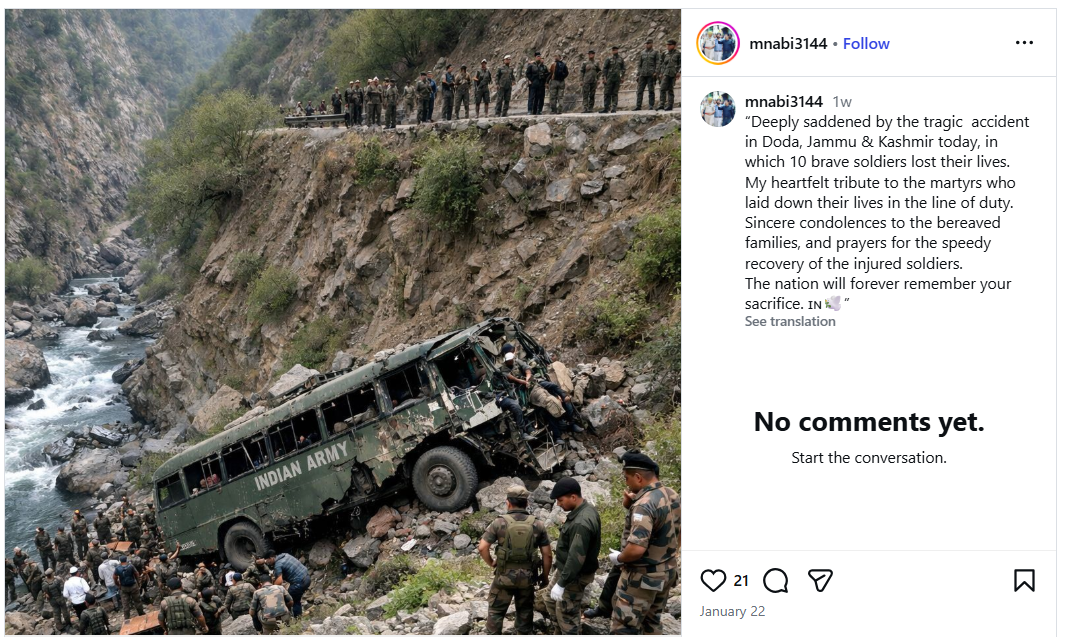
On January 22, an Indian Army vehicle met with an accident in Jammu and Kashmir’s Doda district, resulting in the death of 10 soldiers, while several others were injured. In connection with this tragic incident, a photograph is now going viral on social media. The viral image shows an Army vehicle that appears to have fallen into a deep gorge, with several soldiers visible around the site. Users sharing the image are claiming that it depicts the actual scene of the Doda accident.
However, an research by the CyberPeacehas found that the viral image is not genuine. The photograph has been generated using Artificial Intelligence (AI) and does not represent the real accident. Hence, the viral post is misleading.
Claim
An Instagram user shared the viral image on January 22, 2026, writing:“Deeply saddened by the tragic accident in Doda, Jammu & Kashmir today, in which 10 brave soldiers lost their lives. My heartfelt tribute to the martyrs who laid down their lives in the line of duty.Sincere condolences to the bereaved families, and prayers for the speedy recovery of the injured soldiers.The nation will forever remember your sacrifice.”
The link and screenshot of the post can be seen below.
- https://www.instagram.com/p/DT0UBIRk_3k/
- https://archive.ph/submit/?url=https%3A%2F%2Fwww.instagram.com%2Fp%2FDT0UBIRk_3k%2F+
Fact Check:
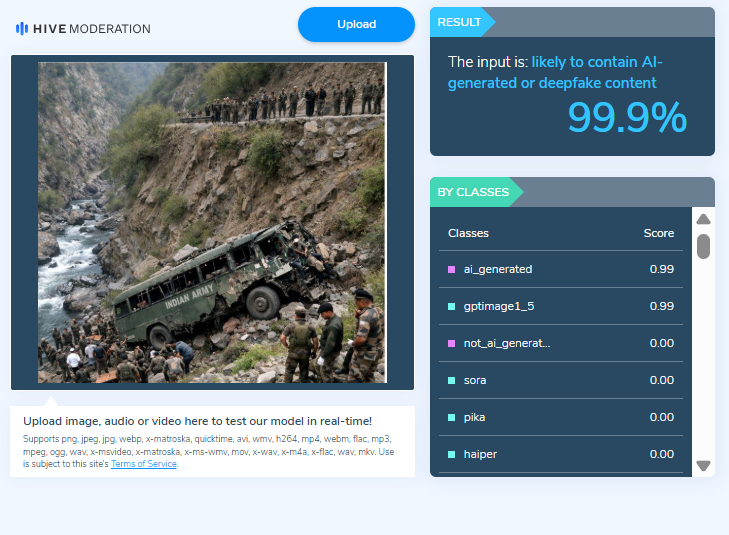
To verify the claim, we first closely examined the viral image. Several visual inconsistencies were observed. The structure of the soldier visible inside the damaged vehicle appears distorted, and the hands and limbs of people involved in the rescue operation look unnatural. These anomalies raised suspicion that the image might be AI-generated. Based on this, we ran the image through the AI detection tool Hive Moderation, which indicated that the image is over 99.9% likely to be AI-generated.
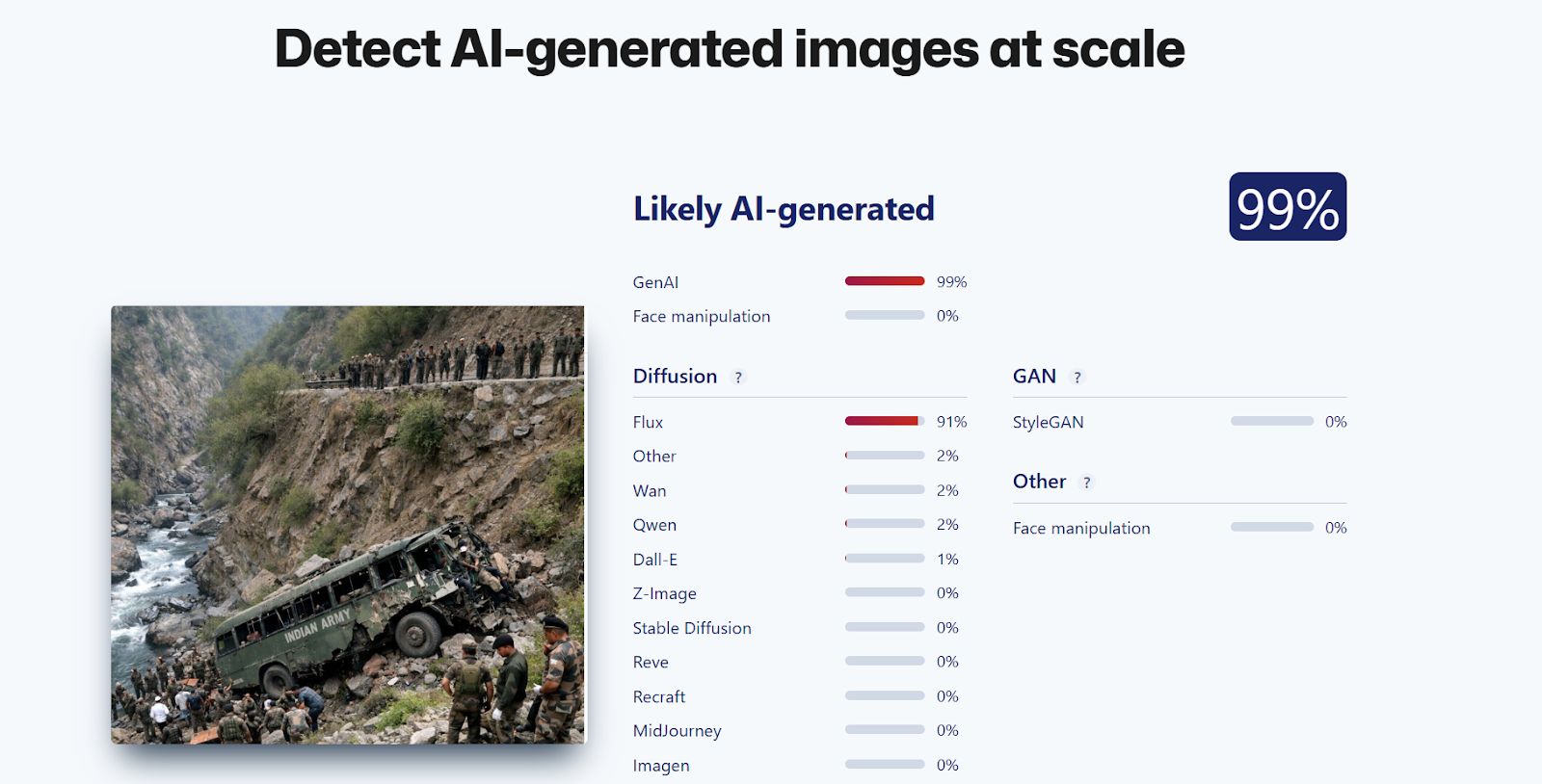
Another AI image detection tool, Sightengine, also flagged the image as 99% AI-generated.
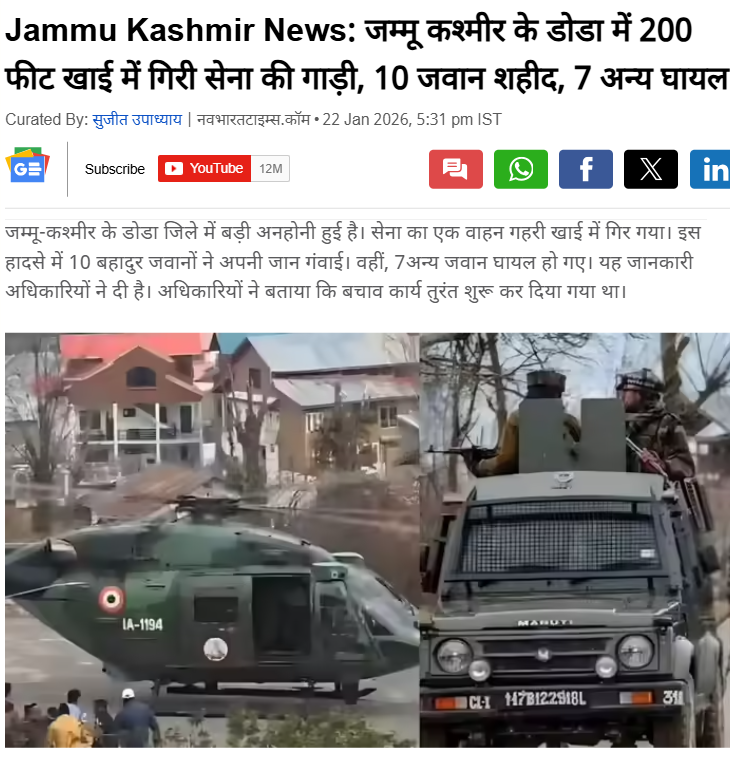
During further research , we found a report published by Navbharat Times on January 22, 2026, which confirmed that an Indian Army vehicle had indeed fallen into a deep gorge in Doda district. According to officials, 10 soldiers were killed and 7 others were injured, and rescue operations were immediately launched.
However, it is important to note that the image circulating on social media is not an actual photograph from the incident.
Conclusion
CyberPeace research confirms that the viral image linked to the Doda Army vehicle accident has been created using Artificial Intelligence. It is not a real photograph from the incident, and therefore, the viral post is misleading.

Related Blogs

Executive Summary:
A video has gone viral that claims to show Hon'ble Minister of Home Affairs, Shri Amit Shah stating that the BJP-Led Central Government intends to end quotas for scheduled castes (SCs), scheduled tribes (STs), and other backward classes (OBCs). On further investigation, it turns out this claim is false as we found the original clip from an official source, while he delivered the speech at Telangana, Shah talked about falsehoods about religion-based reservations, with specific reference to Muslim reservations. It is a digitally altered video and thus the claim is false.

Claims:
The video which allegedly claims that the Hon'ble Minister of Home Affairs, Shri Amit Shah will be terminating the reservation quota systems of scheduled castes (SCs), scheduled tribes (STs) and other backward classes (OBCs) if BJP government was formed again has been viral on social media platforms.

English Translation: If the BJP government is formed again we will cancel ST, SC reservations: Hon'ble Minister of Home Affairs, Shri Amit Shah


Fact Check:
When the video was received we closely observed the name of the news media channel, and it was V6 News. We divided the video into keyframes and reverse searched the images. For one of the keyframes of the video, we found a similar video with the caption “Union Minister Amit Shah Comments Muslim Reservations | V6 Weekend Teenmaar” uploaded by the V6 News Telugu’s verified Youtube channel on April 23, 2023. Taking a cue from this, we also did some keyword searches to find any relevant sources. In the video at the timestamp of 2:38, Hon'ble Minister of Home Affairs, Shri Amit Shah talks about religion-based reservations calling ‘unconstitutional Muslim Reservation’ and that the Government will remove it.

Further, he talks about the SC, ST, and OBC reservations having full rights for quota but not the Muslim reservation.
While doing the reverse image, we found many other videos uploaded by other media outlets like ANI, Hindustan Times, The Economic Times, etc about ending Muslim reservations from Telangana state, but we found no such evidence that supports the viral claim of removing SC, ST, OBC quota system. After further analysis for any sign of alteration, we found that the viral video was edited while the original information is different. Hence, it’s misleading and false.
Conclusion:
The video featuring the Hon'ble Minister of Home Affairs, Shri Amit Shah announcing that they will remove the reservation quota system of SC, ST and OBC if the new BJP government is formed again in the ongoing Lok sabha election, is debunked. After careful analysis, it was found that the video was fake and was created to misrepresent the actual statement of Hon'ble Minister of Home Affairs, Shri Amit Shah. The original footage surfaced on the V6 News Telugu YouTube channel, in which Hon'ble Minister of Home Affairs, Shri Amit Shah was explaining about religion-based reservations, particularly Muslim reservations in Telangana. Unfortunately, the fake video was false and Hon'ble Minister of Home Affairs, Shri Amit Shah did not mention the end of SC, ST, and OBC reservations.
- Claim: The viral video covers the assertion of Hon'ble Minister of Home Affairs, Shri Amit Shah that the BJP government will soon remove reservation quotas for scheduled castes (SCs), scheduled tribes (STs), and other backward classes (OBCs).
- Claimed on: X (formerly known as Twitter)
- Fact Check: Fake & Misleading

Executive Summary
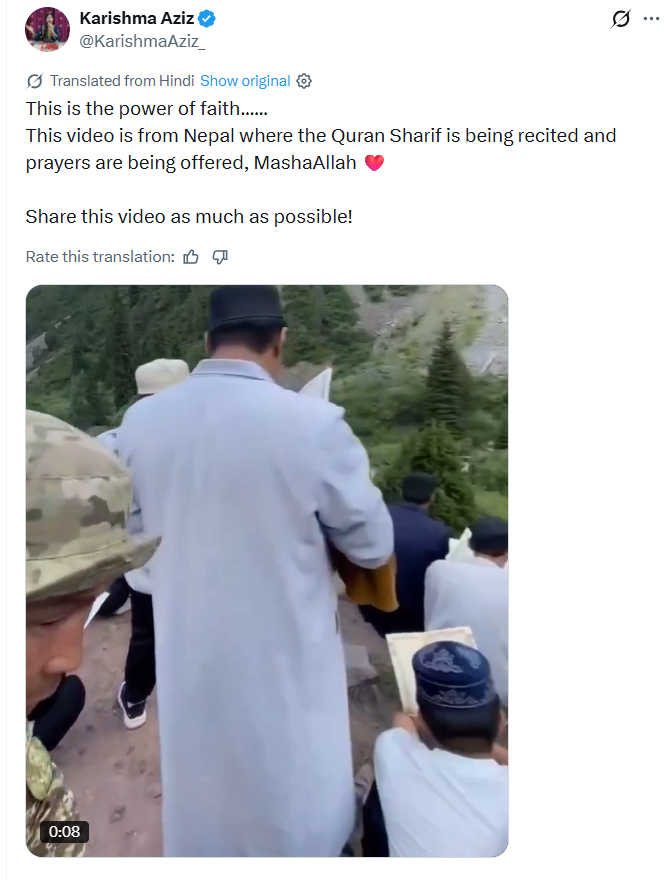
A video is being shared on social media with the claim that the Quran is being recited in Nepal to seek protection from floods. Research by the CyberPeace Research Wing found that the video is actually from Kyrgyzstan, a Central Asian country, and dates back to June. It shows people praying for the safety of a six-year-old boy who had been swept away by floodwaters.
Claim:
The video is being shared on X with a caption making the viral claim. It reads, “This is the power of faith. This video is from Nepal, where the Holy Quran is being recited and prayers are being offered. Mashallah.”
https://x.com/KarishmaAziz_/status/2095053199531286855
Fact Check
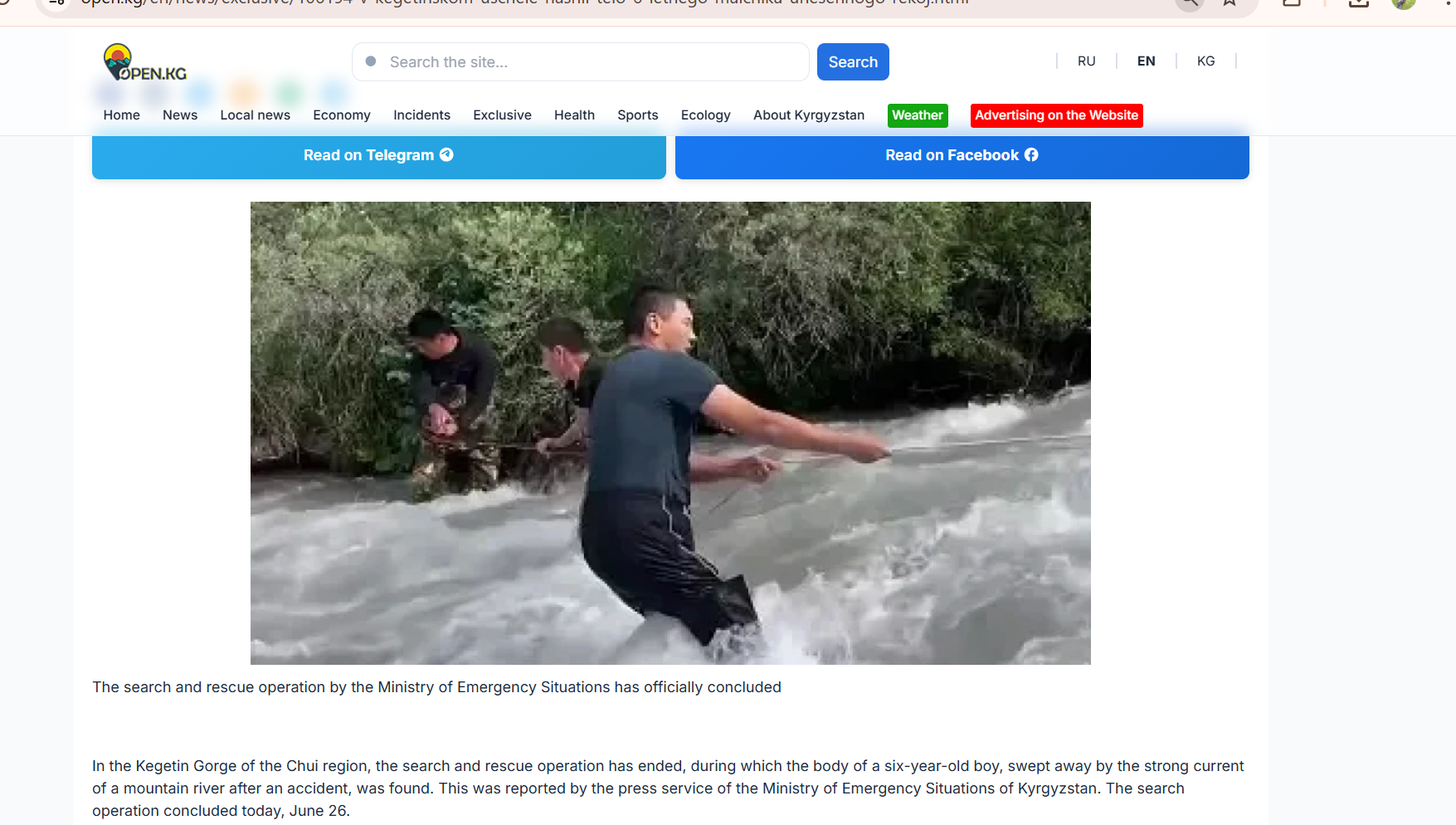
During our research into the viral video claiming that the Quran is being recited in Nepal to seek protection from floods, a reverse image search using keyframes led us to the same video uploaded on an Instagram account on June 25.
https://www.instagram.com/reels/DaAtnyUN4WP/
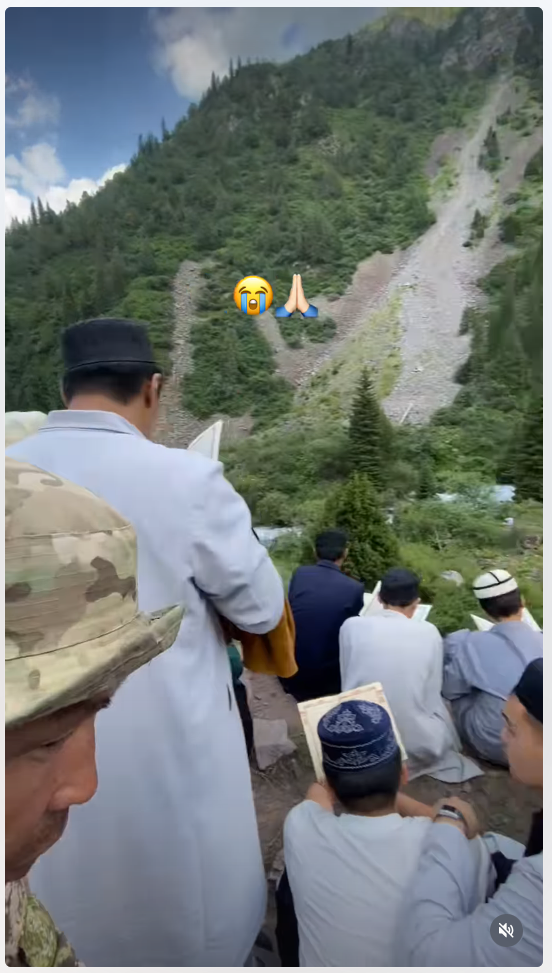
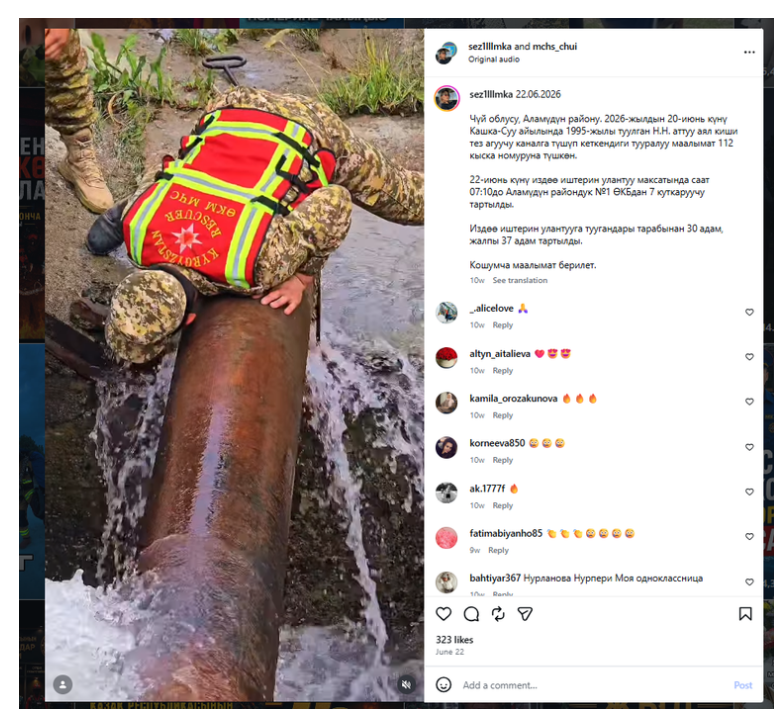
We translated the bio of the said Instagram account and found that it is associated with the Press Department of the Ministry of Emergency Situations in Kyrgyzstan’s Chuy Region. We also found several videos uploaded on the account featuring uniformed personnel wearing the same attire as those seen in the viral video.

The life jackets worn by the uniformed personnel in these videos also clearly bear the words “Kyrgyzstan Rescue.”
During our research, we also found several Instagram posts published on June 25 featuring visuals similar to those in the viral video. The captions stated that Hafizs were reciting the Quran and offering prayers for the safety of a six-year-old boy during his rescue operation.
https://www.instagram.com/reels/DaBK3nYtfDf/https://www.instagram.com/reels/DaBK3nYtfDf/
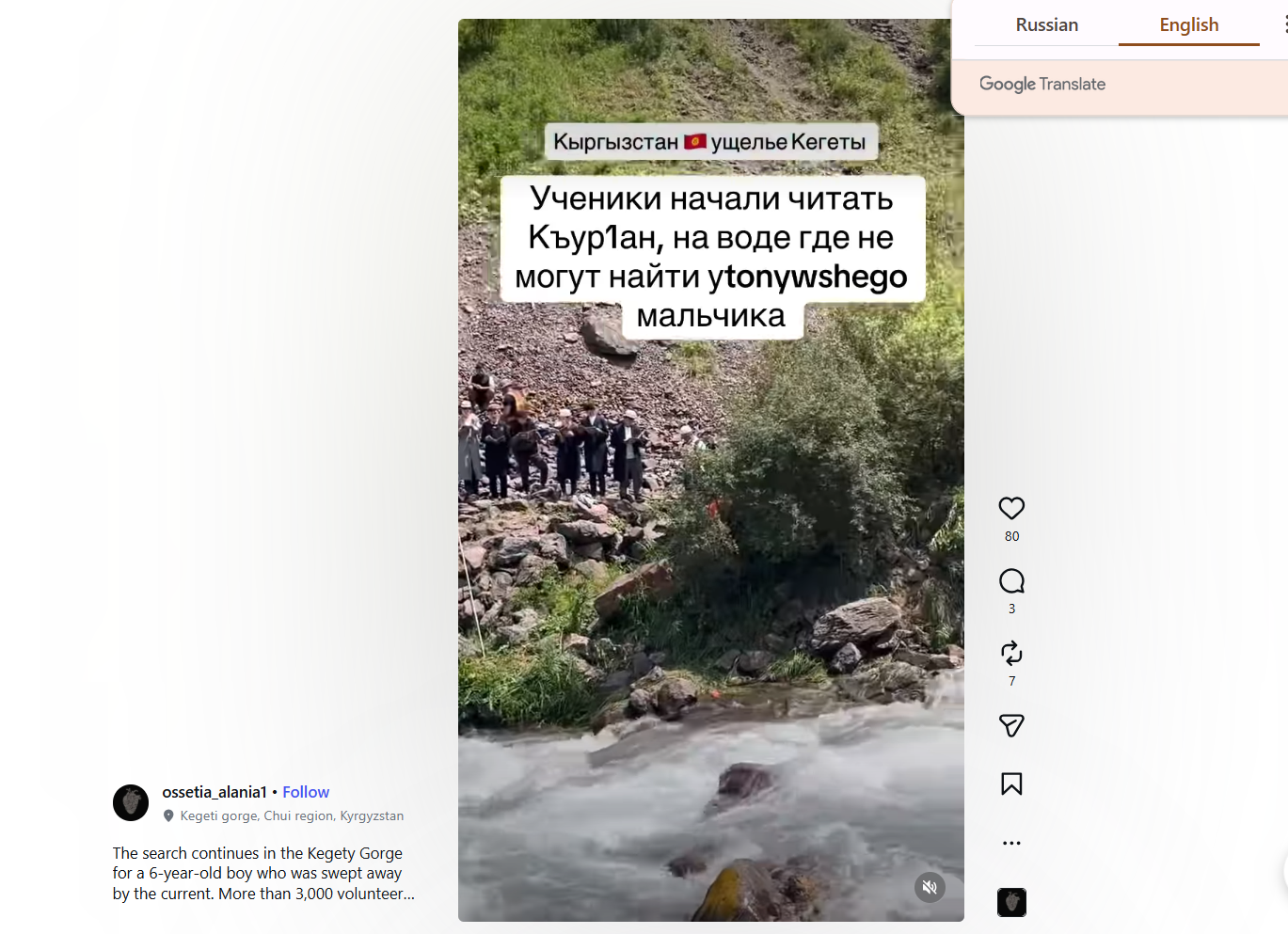
In this regard, we also found a report published on June 26 by a Kyrgyz news website. The report stated that on June 23, a car carrying two women and five children fell into the Kegety River. The two women and three children managed to get out of the vehicle, but two children remained trapped inside. The body of a 12-year-old girl had already been recovered by the rescue team. Later, on June 26, the body of the other child was also recovered.
Conclusion
Our research found that the viral claim is false. The video being shared with the claim that the Quran was being recited in Nepal to seek protection from floods is actually from Kyrgyzstan and dates back to June. The evidence gathered during our research, including the original social media posts and reports from Kyrgyzstan, confirms that the footage is related to a rescue operation involving children after a car fell into the Kegety River. Therefore, the viral video has no connection with the recent floods in Nepal and is being shared with a false claim.
Executive Summary
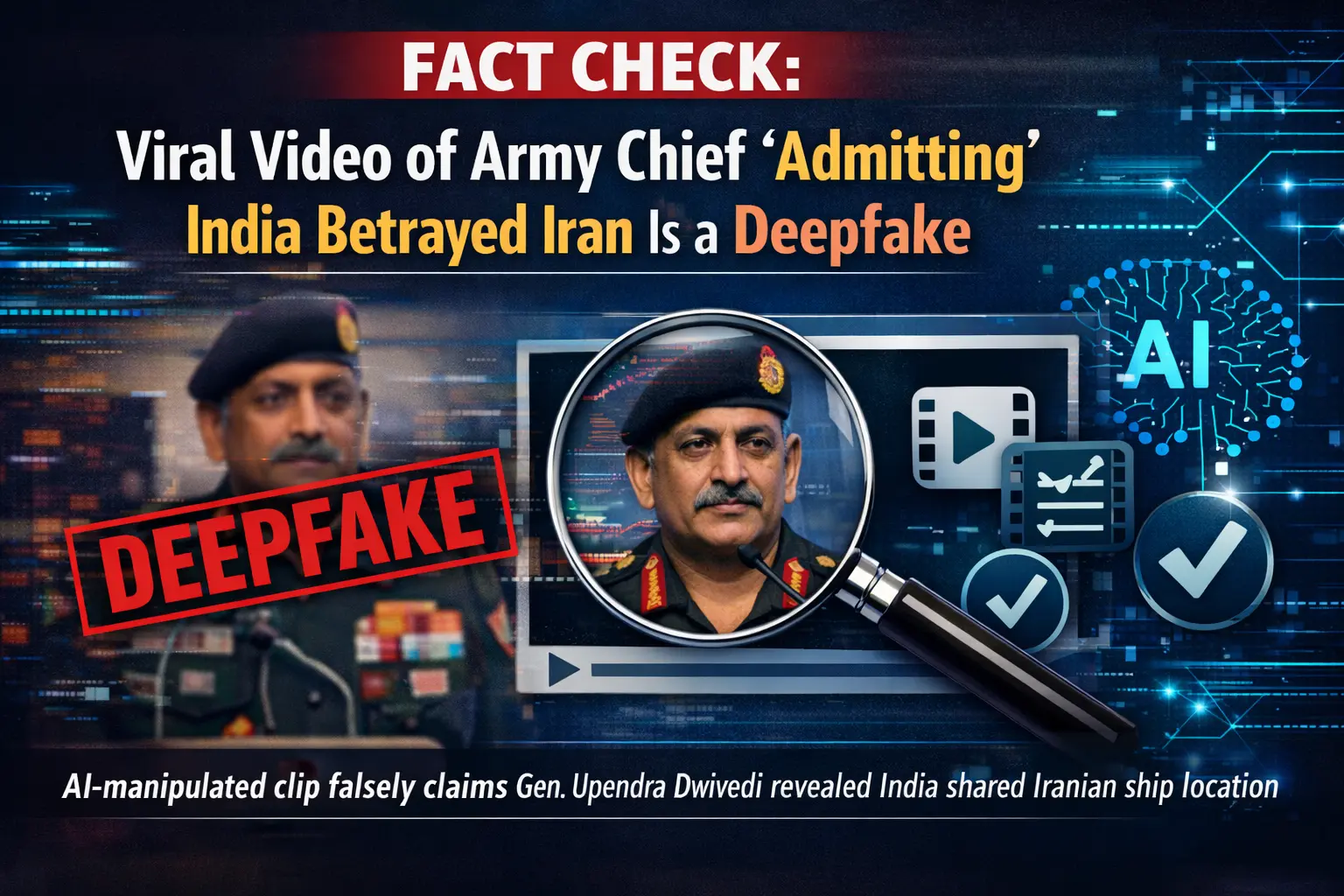
A 57-second video featuring India’s Chief of Army Staff Upendra Dwivedi is widely circulating on social media. The clip is being shared with the claim that the Army chief admitted India had “betrayed” Iran by providing the location of an Iranian naval ship to Israel, allegedly leading to its destruction The video is spreading amid heightened tensions in West Asia involving United States, Israel, and Iran. According to posts sharing the claim, the Iranian naval vessel IRIS Dena, which had participated in a naval event in Visakhapatnam and was returning to Iran with around 130 personnel onboard, was torpedoed by a US submarine near the southern coast of Sri Lanka on March 4 while sailing in the Indian Ocean.
In the viral clip, the speaker—presented as the Indian Army chief—appears to say that India informed Israel about the exact location of the Iranian ship after it left Indian waters, describing Israel as a strategic ally and suggesting that the attack occurred in international waters. The clip also claims that India had no direct involvement in the alleged joint US-Israel torpedo strike.
However, research conducted by the CyberPeace found the claim to be false. Our research shows that the video does not contain a genuine statement from Army Chief Upendra Dwivedi and is in fact a manipulated clip.
Claim
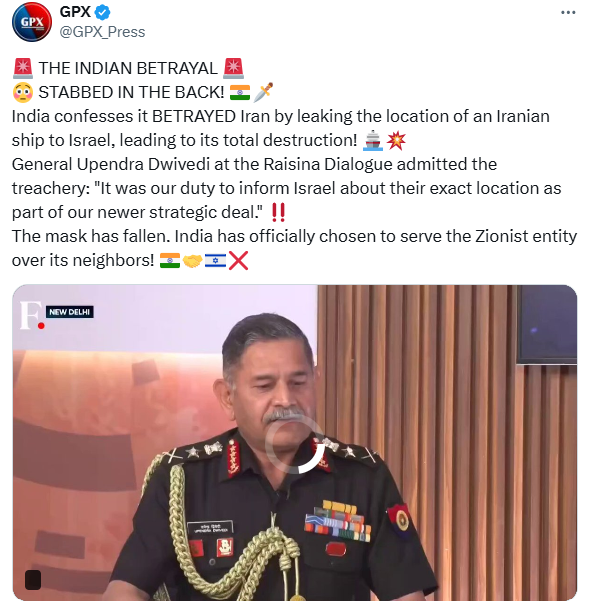
On X (formerly Twitter), a page named GPX (@GPX_Press) shared the video on March 9 with the caption: “India confesses it BETRAYED Iran by leaking the location of an Iranian ship to Israel, leading to its total destruction!”
Fact Check
During the verification process, researchers noticed a ticker in the viral video reading “Raisina Dialogue 2026 × Firstpost.” Using this clue, we conducted a keyword search on YouTube and located a video uploaded by Firstpost on March 7 titled “India’s Army Chief Speaks on Op Sindoor, Pakistan and Future of Warfare | Raisina Dialogue 2026.”
In the 21-minute interview, Army Chief Upendra Dwivedi is seen speaking with strategic affairs expert Harsh V. Pant. According to the video description, the discussion focuses on lessons from Operation Sindoor and the evolving nature of modern warfare.

The viral clip appears to be taken from this interview. However, throughout the conversation, Dwivedi does not mention any conflict involving the United States, Israel, and Iran, nor does he refer to the sinking of an Iranian naval ship in the Indian Ocean. This indicates that the circulating clip has been edited and misrepresented to create a misleading narrative.
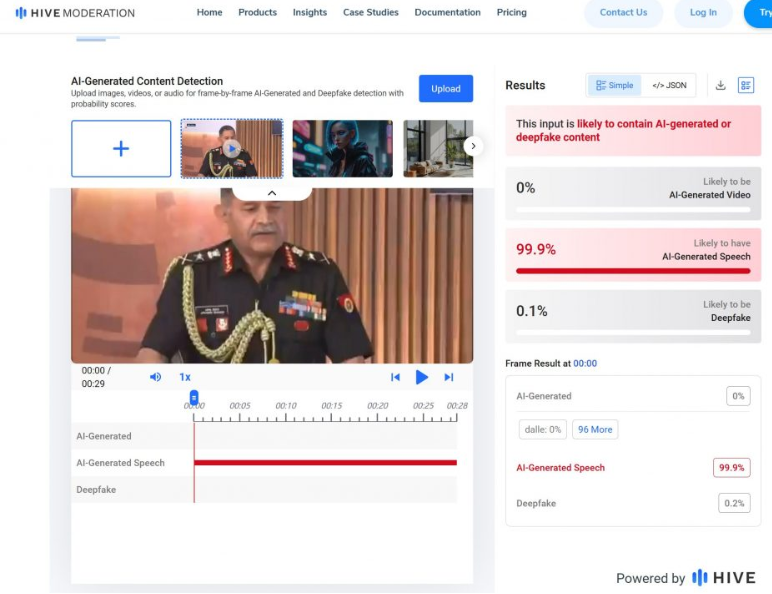
For additional verification, the viral video was analyzed using the AI detection tool Hive Moderation. The results suggested a 99.9% probability that the speech in the clip was generated using AI, indicating manipulation of the original footage.
Conclusion
The research makes it clear that the viral video does not reflect an authentic statement by India’s Army Chief Upendra Dwivedi. The clip has been altered and the audio appears to be AI-generated. In other words, the circulating video is a deepfake being shared with a misleading claim.
