
#FactCheck - 2013 Aircraft Video Misleadingly Shared as Ajit Pawar’s Plane Accident
Executive Summary:
A video showing poor runway visibility from inside an aircraft cockpit is being widely shared on social media, linking it to an alleged aircraft accident involving Maharashtra Deputy Chief Minister Ajit Pawar in Baramati on January 28, 2025. Users claim that the footage captured the final moments before the crash, suggesting that the runway visibility disappeared just seconds before landing. However, research conducted by the CyberPeace found the viral claim to be misleading. The research revealed that the video has no connection to any aircraft accident involving Deputy Chief Minister Ajit Pawar. In reality, the video dates back to 2013 and shows a pilot attempting to land an aircraft amid heavy rain. During the approach, the runway briefly disappears from the pilot’s view, prompting the pilot to abort the landing and execute a go-around. The aircraft later lands safely after weather conditions improve.
Claim
An Instagram user shared the viral video on January 29, 2026, claiming:“Baramati plane crash: video of the aircraft accident surfaces. Runway disappears just three seconds before landing.” (The link to the post, its archived version, and screenshots are provided below.)

Fact Check
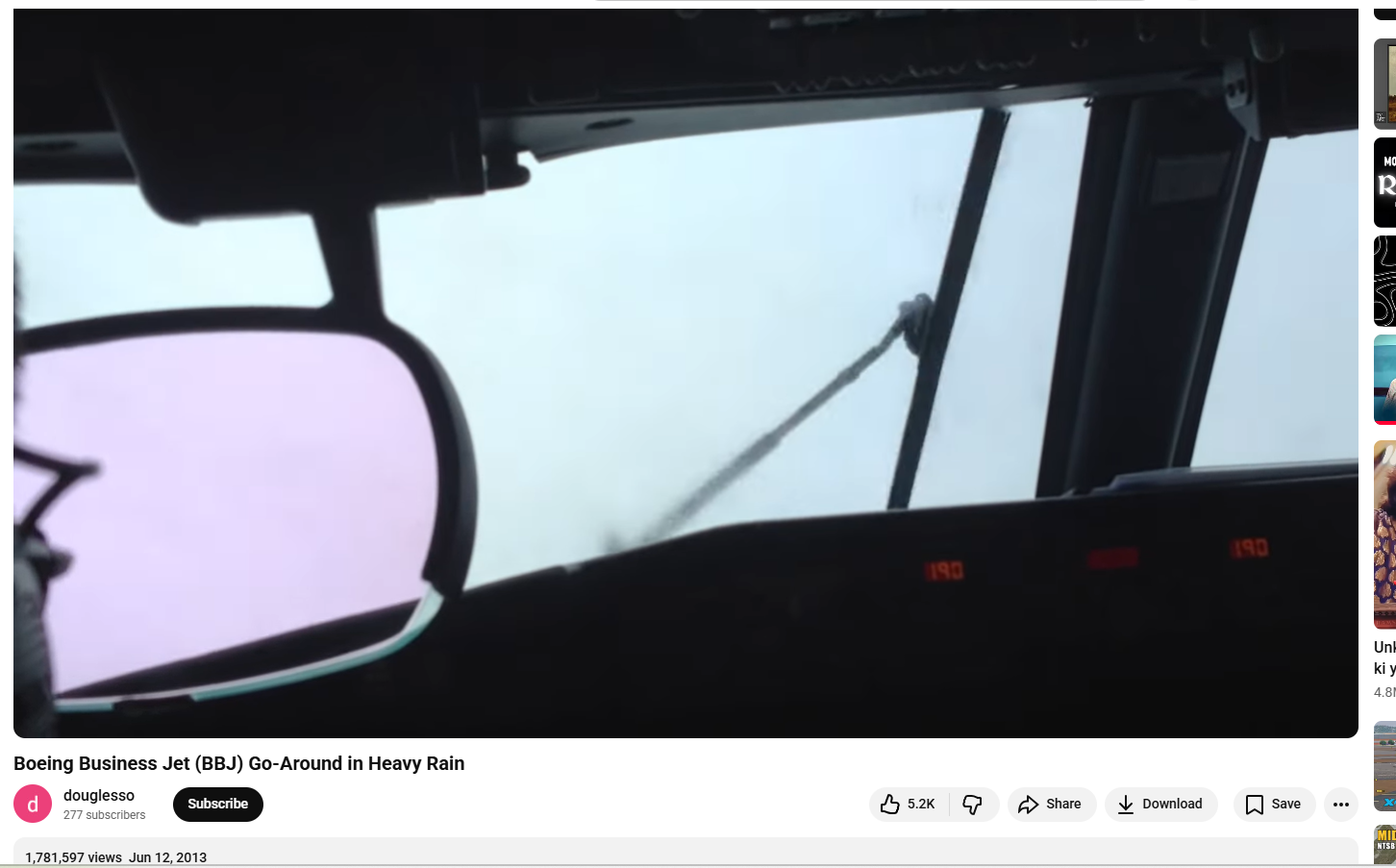
To verify the claim, we extracted keyframes from the viral video and conducted a reverse image search using Google Lens. The search led us to the same video uploaded on a YouTube channel named douglesso, which was published on June 12, 2013. (Footage link and screenshot available below.)
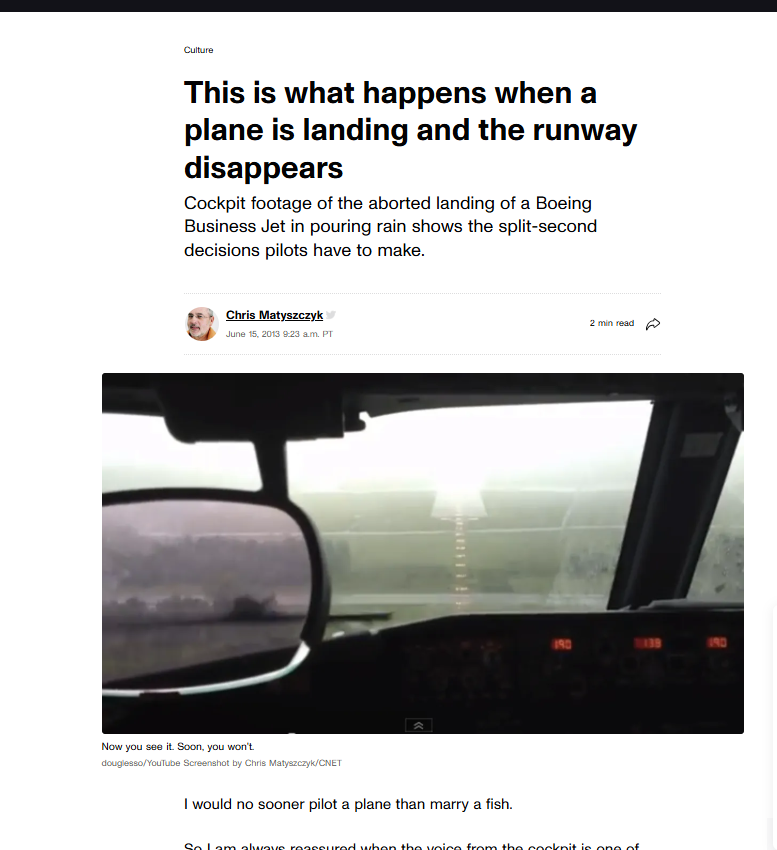
Further research led us to a report published by the American media website CNET, which featured the same visual. According to the report, the video shows a Boeing Business Jet attempting to land during heavy rainfall. The aircraft was conducting a CAT I Instrument Landing System (ILS) approach when a sudden downpour drastically reduced visibility at decision height. As the runway briefly disappeared from view, the pilots aborted the landing and carried out a go-around. The aircraft later landed safely once weather conditions improved. (The link to the CNET report and its screenshot are provided below.)
- https://www.cnet.com/culture/this-is-what-happens-when-a-plane-is-landing-and-the-runway-disappears/
Conclusion
Our research confirms that the video circulating on social media is unrelated to any recent aircraft accident involving Maharashtra Deputy Chief Minister Ajit Pawar. The clip is an old video from 2013, which is now being shared with a false and misleading claim.

Related Blogs

Executive Summary:
Amid the ongoing conflict in West Asia involving the United States, Israel and Iran, a video is being widely circulated on social media with the claim that Iran attacked the headquarters of tech giants Apple and Microsoft in Israel. The clip shows a building engulfed in flames, with firefighters attempting to douse the fire. However, research by the CyberPeace found that the viral video is AI-generated and is being falsely linked to the ongoing conflict to spread misinformation.
Claim:
An Instagram user ‘bharat_updatenews’ shared the video on March 19, 2026, claiming that Iran had launched an attack on major tech company headquarters, including Apple and Microsoft, in Israel. The post suggested that the incident had raised serious security concerns and was being widely reported by international media.
Link: https://www.instagram.com/bharat_updatenews/reel/DWEUhLEAKaw

Fact Check:
To verify the claim, we extracted keyframes from the viral video and conducted a reverse search using Google Lens. During this process, we found the same video on a TikTok account named ‘dailyupdate122’, where it had been uploaded on March 15, 2026.

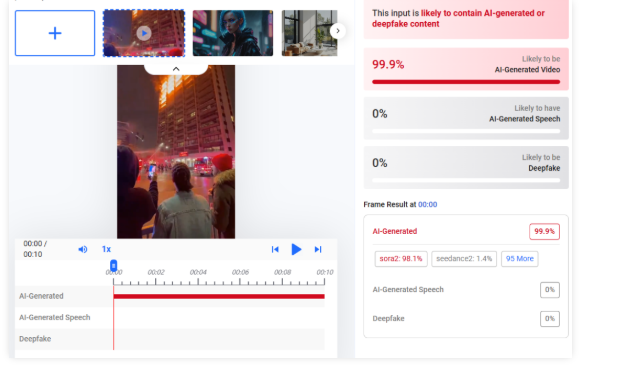
The video on this account was clearly labelled as “AI-generated media.” The account also featured several other AI-generated videos, raising doubts about the authenticity of the viral clip. Following this, we analysed the video using the AI detection tool Hive Moderation. The results indicated that the video is nearly 100 percent AI-generated. The tool further suggested with over 98 percent probability that the clip may have been created using OpenAI’s Sora or a similar AI video generation model.
Conclusion:
The viral claim that Iran attacked Apple and Microsoft headquarters in Israel is false. The video circulating online is AI-generated and has no connection to the ongoing conflict in West Asia.
.webp)
Executive Summary:
A video circulating on social media claims that people in Balochistan, Pakistan, hoisted the Indian national flag and declared independence from Pakistan. The claim has gone viral, sparking strong reactions and spreading misinformation about the geopolitical scenario in South Asia. Our research reveals that the video is misrepresented and actually shows a celebration in Surat, Gujarat, India.

Claim:
A viral video shows people hoisting the Indian flag and allegedly declaring independence from Pakistan in Balochistan. The claim implies that Baloch nationals are revolting against Pakistan and aligning with India.

Fact Check:
After researching the viral video, it became clear that the claim was misleading. We took key screenshots from the video and performed a reverse image search to trace its origin. This search led us to one of the social media posts from the past, which clearly shows the event taking place in Surat, Gujarat, not Balochistan.

In the original clip, a music band is performing in the middle of a crowd, with people holding Indian flags and enjoying the event. The environment, language on signboards, and festive atmosphere all confirm that this is an Indian Independence Day celebration. From a different angle, another photo we found further proves our claim.

However, some individuals with the intention of spreading false information shared this video out of context, claiming it showed people in Balochistan raising the Indian flag and declaring independence from Pakistan. The video was taken out of context and shared with a fake narrative, turning a local celebration into a political stunt. This is a classic example of misinformation designed to mislead and stir public emotions.
To add further clarity, The Indian Express published a report on May 15 titled ‘Slogans hailing Indian Army ring out in Surat as Tiranga Yatra held’. According to the article, “A highlight of the event was music bands of Saifee Scout Surat, which belongs to the Dawoodi Bohra community, seen leading the yatra from Bhagal crossroads.” This confirms that the video was from an event in Surat, completely unrelated to Balochistan, and was falsely portrayed by some to spread misleading claims online.

Conclusion:
The claim that people in Balochistan hoisted the Indian national flag and declared independence from Pakistan is false and misleading. The video used to support this narrative is actually from Surat, Gujarat, India, during “The Tiranga Yatra”. Social media users are urged to verify the authenticity and source of content before sharing, to avoid spreading misinformation that may escalate geopolitical tensions.
- Claim: Mass uprising in Balochistan as citizens reject Pakistan and honor India.
- Claimed On: Social Media
- Fact Check: False and Misleading

Introduction
India is making strides in developing its own quantum communication capabilities, despite being a latecomer compared to nations like China and the US. In the digital age, quantum communication is gradually becoming one of the most important technologies for national security. It promises to transform secure data exchange across government, financial, and military systems by enabling unhackable communication channels through quantum concepts like entanglement and superposition. Scientists from the Defence Research and Development Organisation (DRDO) and IIT Delhi recently demonstrated quantum communication over a distance of over one kilometre in free space. One significant step at a time, India's quantum roadmap is beginning to take shape thanks to strategic partnerships between top research institutes and defence organisations.
Recent Developments
- In February 2022, by DRDO and IIT Delhi, a 100 km Quantum Key Distribution (QKD) link was established between Prayagraj and Vindhyachal using pre-existing commercial-grade optical fibre, with secure key rates of up to 10 kHz. This proved that using India's current telecom infrastructure to implement quantum-secure communication is feasible.
- Scientists at DRDO finished testing a 6-qubit superconducting quantum processor in August 2024, showing complete system integration by submitting quantum circuits through a cloud interface, running them on quantum hardware, and updating the results.
- A free-space QKD demonstration over over 1 km was conducted in June 2025, with a secure key rate of approximately 240 bits/s and a Quantum Bit Error Rate (QBER) of less than 7%. A crucial step towards satellite-based and defence-grade secure networks, this successful outdoor trial demonstrates that quantum-secure communication is now feasible in actual atmospheric conditions.
- India is looking to space as well. Since 2017, the Raman Research Institute (RRI) and ISRO have been collaborating on satellite-based QKD, with funding totalling more than ₹15 crore. In 2025, a specialised QKD-enabled satellite called SAQTI (Secured Applications using Quantum and optical Technologies by ISRO) is anticipated to go into orbit. The initiative's foundation has already been established by ground-based quantum encryption trials up to 300 meters.
- In India, private companies such as QNu Labs are assisting in the commercialisation of quantum communication. QNu, which was founded at IIT Madras, has created the plug-and-play QKD module Armos, the quantum random number generator (QRNG)Tropos, and the integrated platform QShield, which combines QKD, QRNG, and post-quantum cryptography (PQC).
Where India Stands Globally
India is still in its infancy when compared to China's 2,000 km Beijing–Shanghai QKD network and its satellite-based communication accomplishments. Leading nations like the US, UK, and Singapore are also ahead of the curve, concentrating on operationalising QKD trials for government systems and incorporating post-quantum cryptography (PQC) into national infrastructure.
However, considering the nation's limited prior exposure to quantum technologies, India's progress is noteworthy for its rapid pace and indigenous innovation.
Policy Challenges and Priorities
- Strong policy support is required to match India's efforts in quantum communication. The standardisation of PQC algorithms and their incorporation into digital public infrastructure have to be major priorities.
- Scaling innovation from lab to deployment through public-private partnership
- Accelerating satellite QKD to establish a secure communications ecosystem owned by India.
- International standards compliance and worldwide interoperability for secure quantum protocols.
Conclusion
India has made timely strides in quantum communication, spearheaded by DRDO, IITs, and ISRO. Establishing unbreakable communication systems will be essential to national security as digital infrastructure becomes more and more integrated into governance and economic life. India can establish itself as a significant player in the developing quantum-secure world with consistent investment, well-coordinated policy, and international collaboration.
References
- https://www.thehindu.com/sci-tech/science/quantum-communication-iit-delhi-drdo-entanglement-qkd-explained/article69705017.ece
- https://drdo.gov.in/drdo/quantum-technologies
- https://www.indiatoday.in/science/story/the-end-of-hacking-how-isro-and-drdo-are-building-an-unhackable-quantum-future-2743715-2025-06-22
- https://www.pib.gov.in/PressReleasePage.aspx?PRID=2136702
- https://www.pib.gov.in/PressReleasePage.aspx?PRID=1800648
- https://thequantuminsider.com/2024/08/29/indias-drdo-scientists-complete-testing-of-6-qubit-superconducting-quantum-processor/
- https://www.pib.gov.in/PressReleasePage.aspx?PRID=2077600
- https://www.pib.gov.in/PressReleasePage.aspx?PRID=2121617
- https://www.rri.res.in/news/quic-lab-achieves-next-step-towards-realising-secure-satellite-based-quantum-communication#:~:text=QuIC%20lab%20achieves%20the%20next,transactions%2Dsafe%2D2561836.html
- https://www.gsma.com/newsroom/post-quantum-government-initiatives-by-country-and-region/
- https://tech.hindustantimes.com/tech/news/rri-demonstrates-secure-satellite-based-quantum-communication-in-collaboration-with-isro-71680375748247.html
