
#FactCheck - Viral Video Claiming to Show Kashmir Avalanche Is AI-Generated
Executive Summary
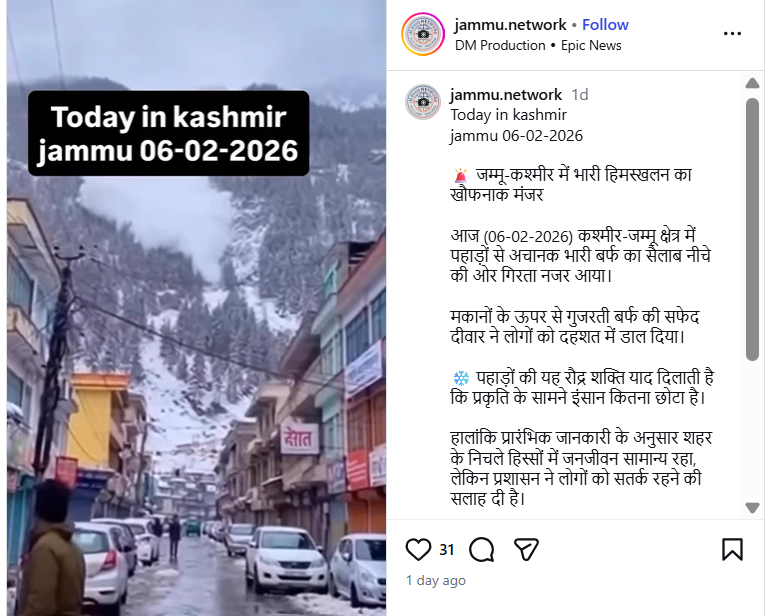
A video is being shared on social media claiming to show an avalanche in Kashmir. The caption of the post alleges that the incident occurred on February 6. Several users sharing the video are also urging people to avoid unnecessary travel to hilly regions. CyberPeace’s research found that the video being shared as footage of a Kashmir avalanche is not real. The research revealed that the viral video is AI-generated.
Claim
The video is circulating widely on social media platforms, particularly Instagram, with users claiming it shows an avalanche in Kashmir on February 6. The archived version of the post can be accessed here. Similar posts were also found online. (Links and archived links provided)
Fact Check:
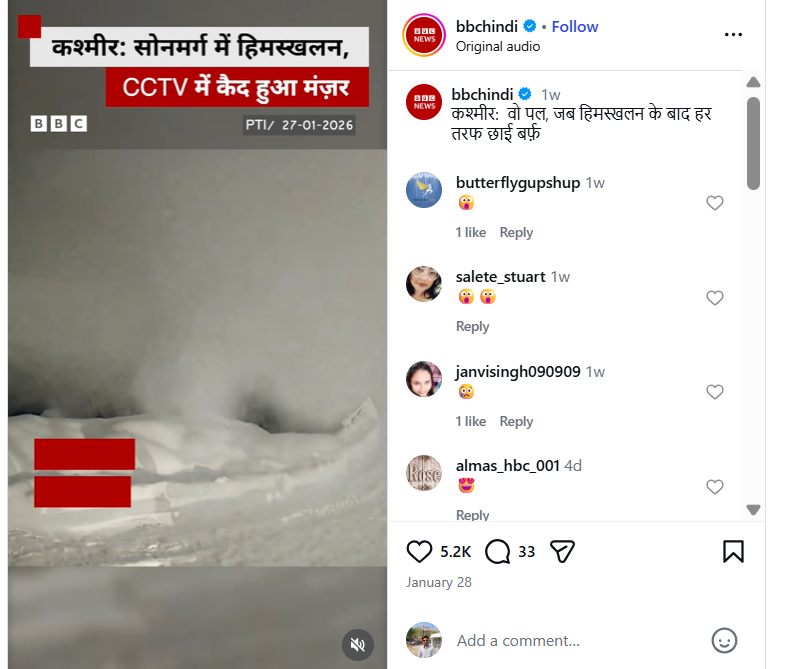
To verify the claim, we searched relevant keywords on Google. During this process, we found a video posted on the official Instagram account of the BBC. The BBC post reported that an avalanche occurred near a resort in Sonamarg, Kashmir, on January 27. However, the BBC post does not contain the viral video that is being shared on social media, indicating that the circulating clip is unrelated to the real incident.
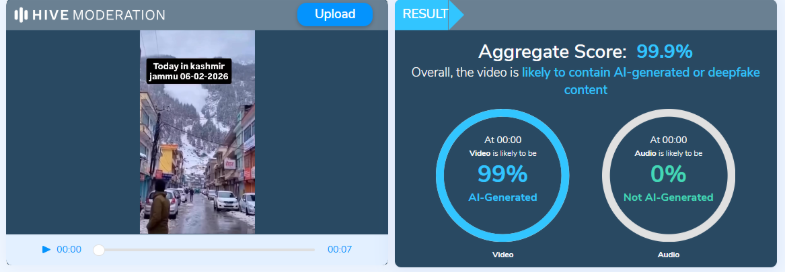
A close examination of the viral video revealed several inconsistencies. For instance, during the alleged avalanche, people present at the site are not seen panicking, running for cover, or moving toward safer locations. Additionally, the movement and flow of the falling snow appear unnatural. Such visual anomalies are commonly observed in videos generated using artificial intelligence. As part of the research , the video was analyzed using the AI detection tool Hive Moderation. The tool indicated a 99.9% probability that the video was AI-generated.
Conclusion
Based on the evidence gathered during our research , it is clear that the video being shared as footage of a Kashmir avalanche is not genuine. The clip is AI-generated and misleading. The viral claim is therefore false.

Related Blogs
Executive Summary
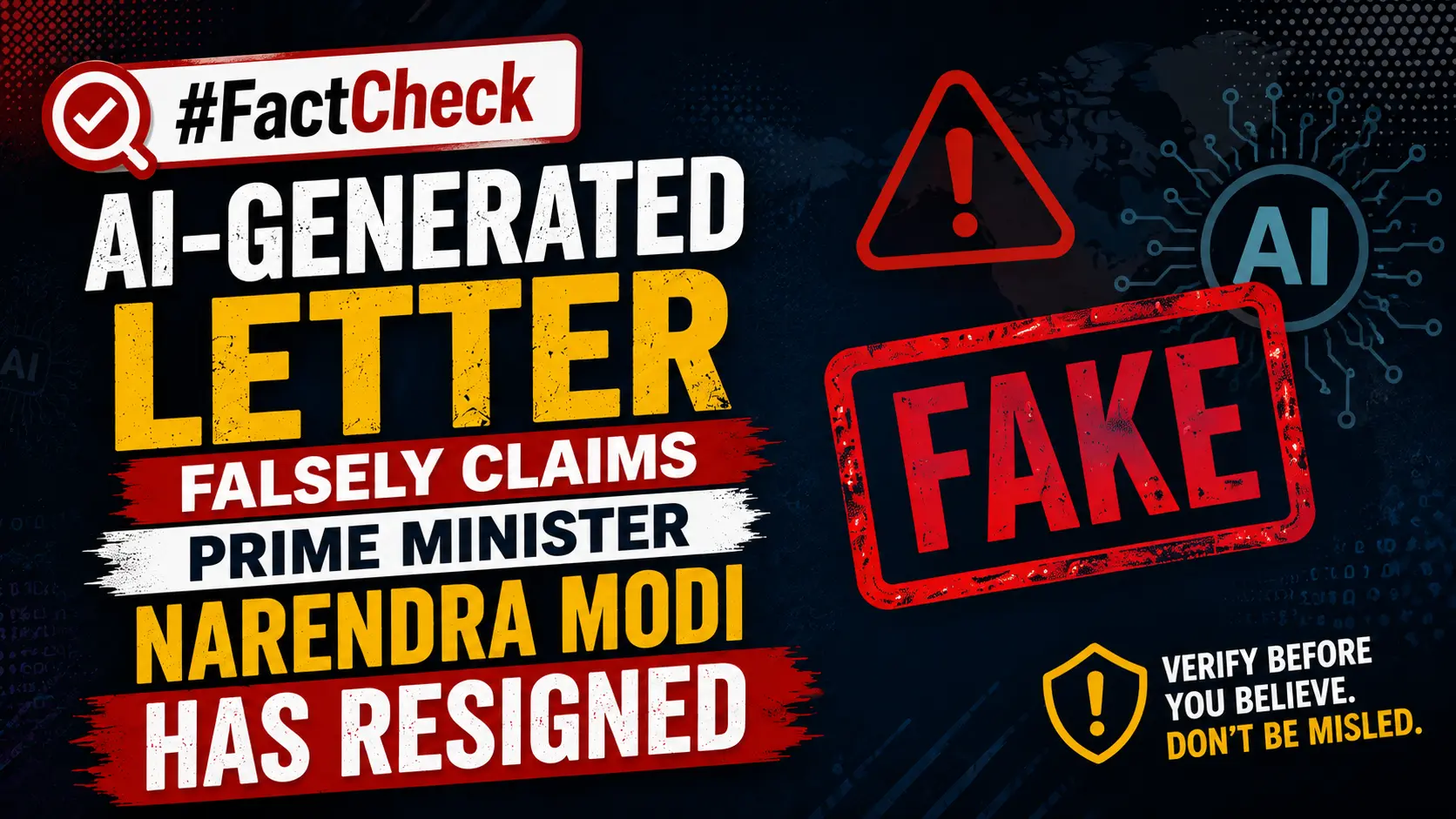
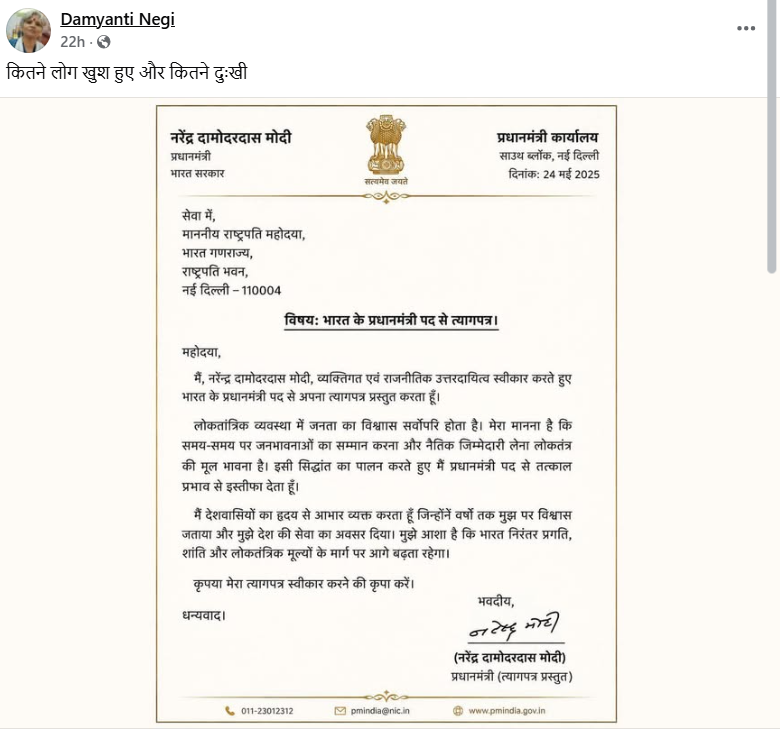
A letter circulating on social media falsely claims that Prime Minister Narendra Modi has resigned from his post. CyberPeace Research Wing's research found the claim to be false. Our research confirmed that the viral letter is fabricated and is being shared with a misleading claim. AI detection tools also indicate that the document is highly likely to have been generated using artificial intelligence.
Claim
An Instagram user shared the viral letter on July 29, 2026, claiming that Prime Minister Narendra Modi had resigned from office.
The post link, archived link, and screenshot are provided below:
https://www.facebook.com/photo/?fbid=2108984893363522&set=a.785246212404070
https://ghostarchive.org/archive/aHXTq
Fact Check
To verify the claim, we conducted a keyword search on Google. However, we found no credible media reports supporting the claim that Prime Minister Modi had resigned.
We then visited the official website of the Prime Minister's Office (PMO India). The website contained no announcement, press release, or official information confirming the purported resignation.
https://www.pmindia.gov.in/en/

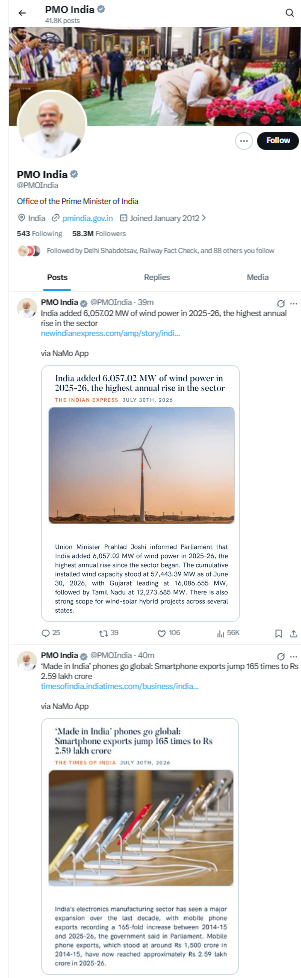
As part of our research , we also reviewed the official X (formerly Twitter) account of PMO India. We found no post or statement related to the viral claim.
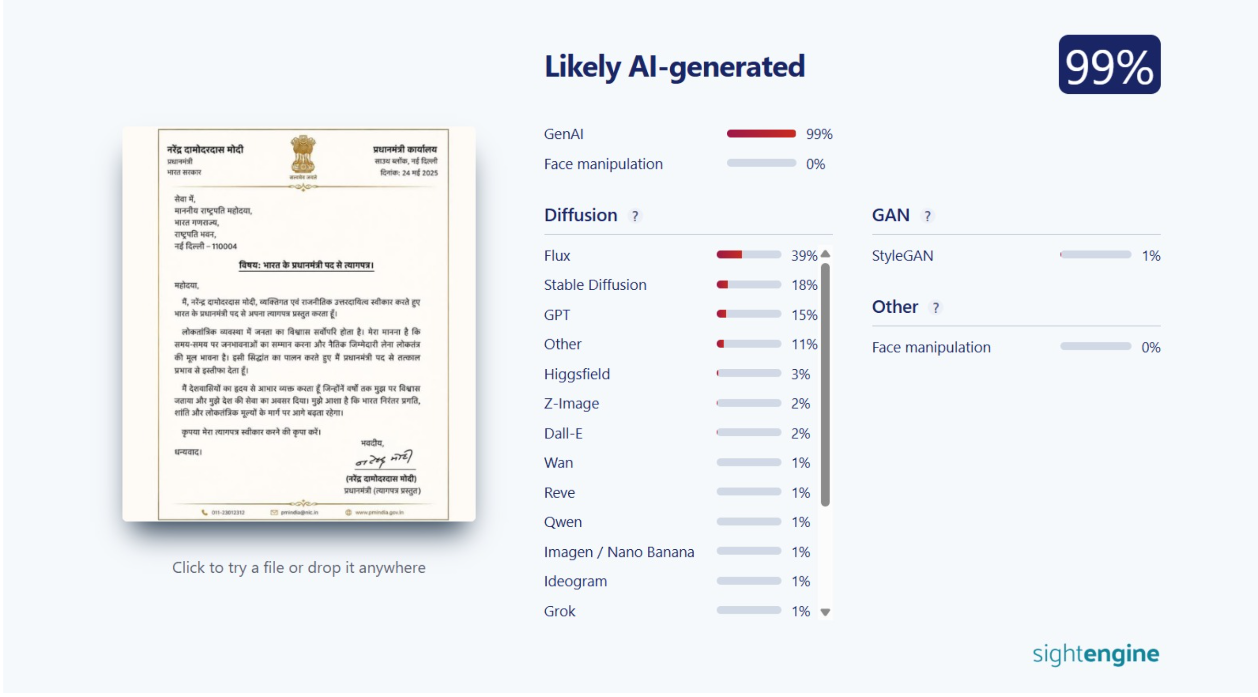
Finally, we analyzed the viral letter using the AI detection tool Sightengine AI. The analysis indicated that the document is 99% likely to be AI-generated.
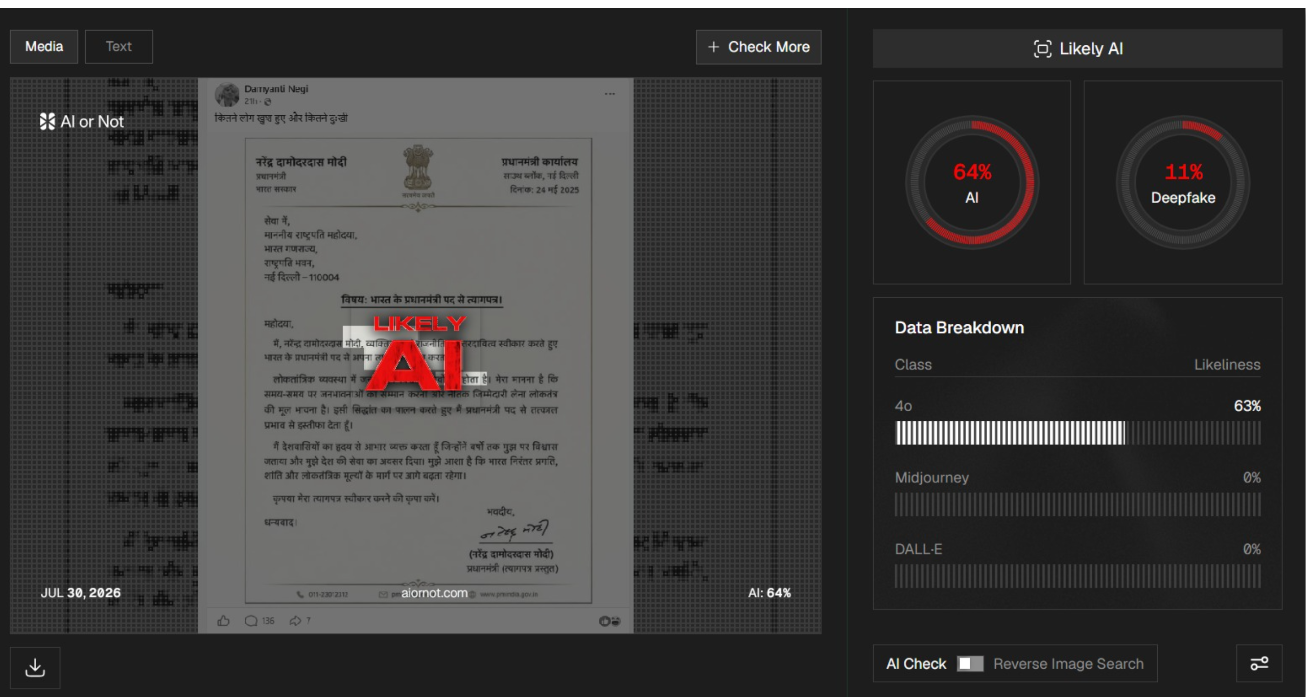
To further verify the findings, we also scanned the letter using AI or Not. According to the tool's analysis, the document is 64% likely to be AI-generated.
Conclusion
The claim that Prime Minister Narendra Modi has resigned is false. No credible media organization or official government source has reported such a development. Furthermore, AI detection tools strongly suggest that the viral resignation letter was generated using artificial intelligence and is being circulated with a false claim.
.webp)
Introduction
In the fast-paced digital age, misinformation spreads faster than actual news. This was seen recently when inaccurate information on social media was spread, stating that the Election Commission of India (ECI) had taken down e-voter rolls for some states from its website overnight. The rumour confused the public and caused political debate in states like Maharashtra, MP, Bihar, UP and Haryana, resulting in public confusion. But the ECI quickly called the viral information "fake news" and made sure that voters could still get access to the electoral rolls of all States and Union Territories, available at voters.eci.gov.in. The incident shows how electoral information could be harmed by the impact of misinformation and how important it is to verify the authenticity.
The Incident and Allegations
On August 7, 2025, social media posts on platforms like X and WhatsApp claimed that the Election Commission of India had removed e-voter lists from its website. The posts appeared after public allegations about irregularities in certain constituencies. However, the claims about the removal of voter lists were unverified.
The Election Commission’s Response
In a formal tweet posted on X, it stated categorically:
“This is a fake news. Anyone can download the Electoral Roll for any of 36 States/UTs through this link: https://voters.eci.gov.in/download-eroll.”
The Commission clarified that no deletion has been done at all and that all the voters' rolls are intact and accessible to the public. Keeping with the spirit of transparency, the ECI reaffirmed its overall practice of public access to electoral information by clarifying that the system is intact and accessible for inspection.
Importance of Timely Clarifications
By countering factually incorrect information the moment it was spread on a large scale, the ECI stopped possible harm to public trust. Election officials rely upon being trusted, and any speculation concerning their honesty can prove harmful to democracy. Such prompt action stops false information from becoming a standard in public discourse.
Misinformation in the Electoral Space
- How False Narratives Gain Traction
Election misinformation increases in significant political environments. Social media, confirmation bias, and increased emotional states during elections enable rumour spread. On this occasion, the unfounded report struck a chord with widespread political distrust, and hence, people easily believed and shared it without checking if it was true or not.
- Risks to Democratic Integrity
When misinformation impacts election procedures, the consequences can be profound:
- Erosion of Trust: People can lose faith in the neutrality of election administrators quite easily.
- Polarization: Untrue assertions tend to reinforce political divides, rendering constructive communication more difficult.
- The Role of Media Literacy
Combating such mis-disinformation requires more than official statements. Media skills training courses can equip individuals with the ability to recognise warning signs in suspect messages. Even basic actions like checking official sources prior to sharing can move far in keeping untruths from being spread.
Strategies to Counter Electoral Misinformation
Multi-Stakeholder Action
Effective counteracting of electoral disinformation requires coordination among election officials, fact-checkers, media, and platforms. Actions that are suggested include:
- Rapid Response Protocols: Institutions should maintain dedicated monitoring teams for quick rebuttals.
- Confirmed Channels of Communication: Providing official sites and pages for actual electoral news.
- Proactive Transparency: Regular publication of electoral process updates can anticipate rumours.
- Platform Accountability: Social media sites must label or limit the visibility of information found to be false by credentialed fact-checkers.
Conclusion
The recent allegations of e-voter rolls deletion underscore the susceptibility of contemporary democracies to mis-disinformation. Even though the circumstances were brought back into order by the ECI's swift and unambiguous denunciation, the incident itself serves to emphasise the necessity of preventive steps to maintain election faith. Even though fact-checking alone might not work in an environment where the information space is growing more polarised and algorithmic, the long-term solution to such complications is to grow an ironclad democratic culture where everyone, every organisation, and platforms value the truth over clickbait. The lesson is clear: in the age of instant news, accurate communication is vital for maintaining democratic integrity, not extravagances.
References
- https://www.newsonair.gov.in/election-commission-dismisses-fake-news-on-removal-of-e-voter-rolls/
- https://economictimes.indiatimes.com/news/india/eci-dismisses-claims-of-removing-e-voter-rolls-from-its-website-calls-it-fake-news/articleshow/123190662.cms
- https://www.thehindu.com/news/national/vote-theft-claim-of-congress-factually-incorrect-election-commission/article69921742.ece
- https://www.thehindu.com/opinion/editorial/a-crisis-of-trust-on-the-election-commission-of-india/article69893682.ece

Executive Summary
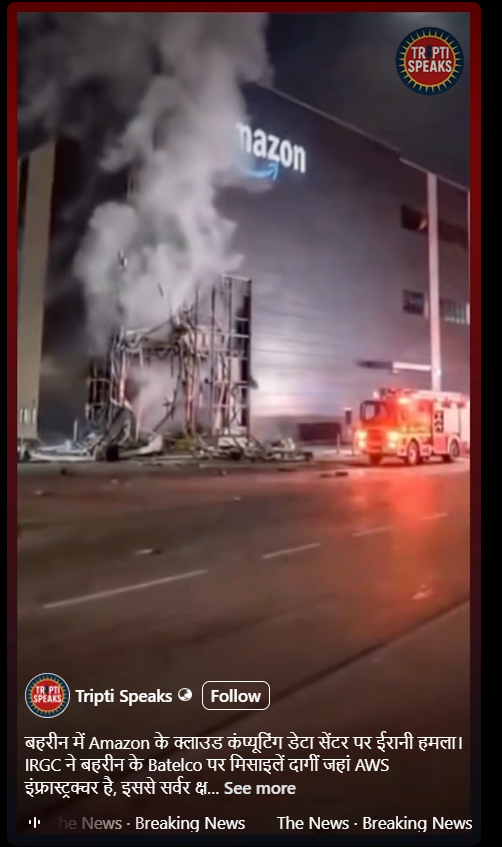
A video showing a damaged building allegedly belonging to Amazon is going viral on social media. The clip is being shared with the claim that it depicts the aftermath of an Iranian missile strike on an Amazon data center in Bahrain on April 1, 2026. However, research by CyberPeace has found the claim to be misleading. While reports confirm that Iran targeted a U.S.-linked cloud infrastructure in Bahrain, the viral video itself is not real footage and has been created using artificial intelligence.
Claim
A Facebook user, “Tripti Speaks,” shared the viral video on April 2, 2026, with the caption:“Iranian attack on Amazon’s cloud computing data center in Bahrain. IRGC fired missiles at Batelco in Bahrain where AWS infrastructure is located, damaging servers and disrupting services.”
- Archived link::https://perma.cc/XH7S-QTX6
Fact Check
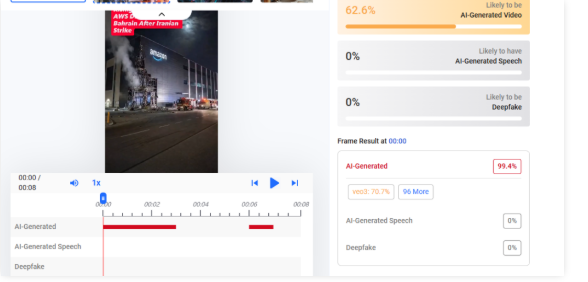
To verify the claim, we extracted multiple keyframes from the viral video and conducted a reverse image search using Google. However, we did not find any credible sources or reports featuring this specific footage. This raised suspicion about the authenticity of the video. We then analyzed it using the AI detection tool Hive Moderation, which indicated a 63% probability that the video is AI-generated.
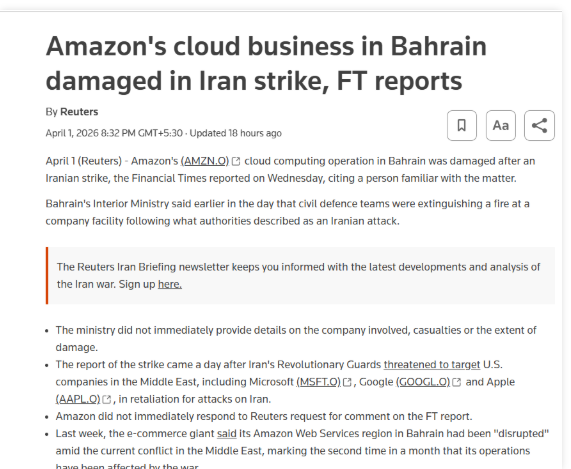
According to a report published by Reuters on April 1, 2026, Iran launched a missile attack targeting Amazon’s cloud computing operations in Bahrain. The Islamic Revolutionary Guard Corps (IRGC) had earlier warned that U.S.-linked companies in the Middle East—including Microsoft, Google, and Apple—could be targeted.
Conclusion
Our research found that while there are credible reports confirming an Iranian attack on cloud infrastructure linked to Amazon in Bahrain, the viral video circulating on social media does not depict the real incident. The footage shows no presence in verified news coverage and has been flagged by AI detection tools as likely artificial. Therefore, the video is AI-generated and misleadingly linked to the incident.
