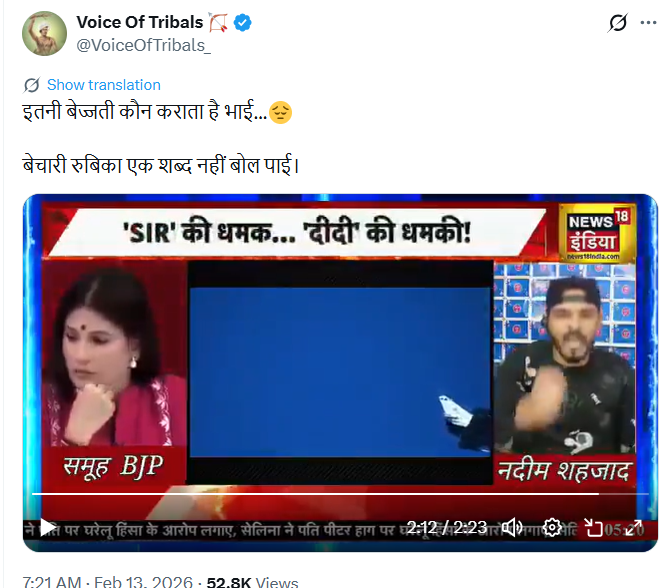
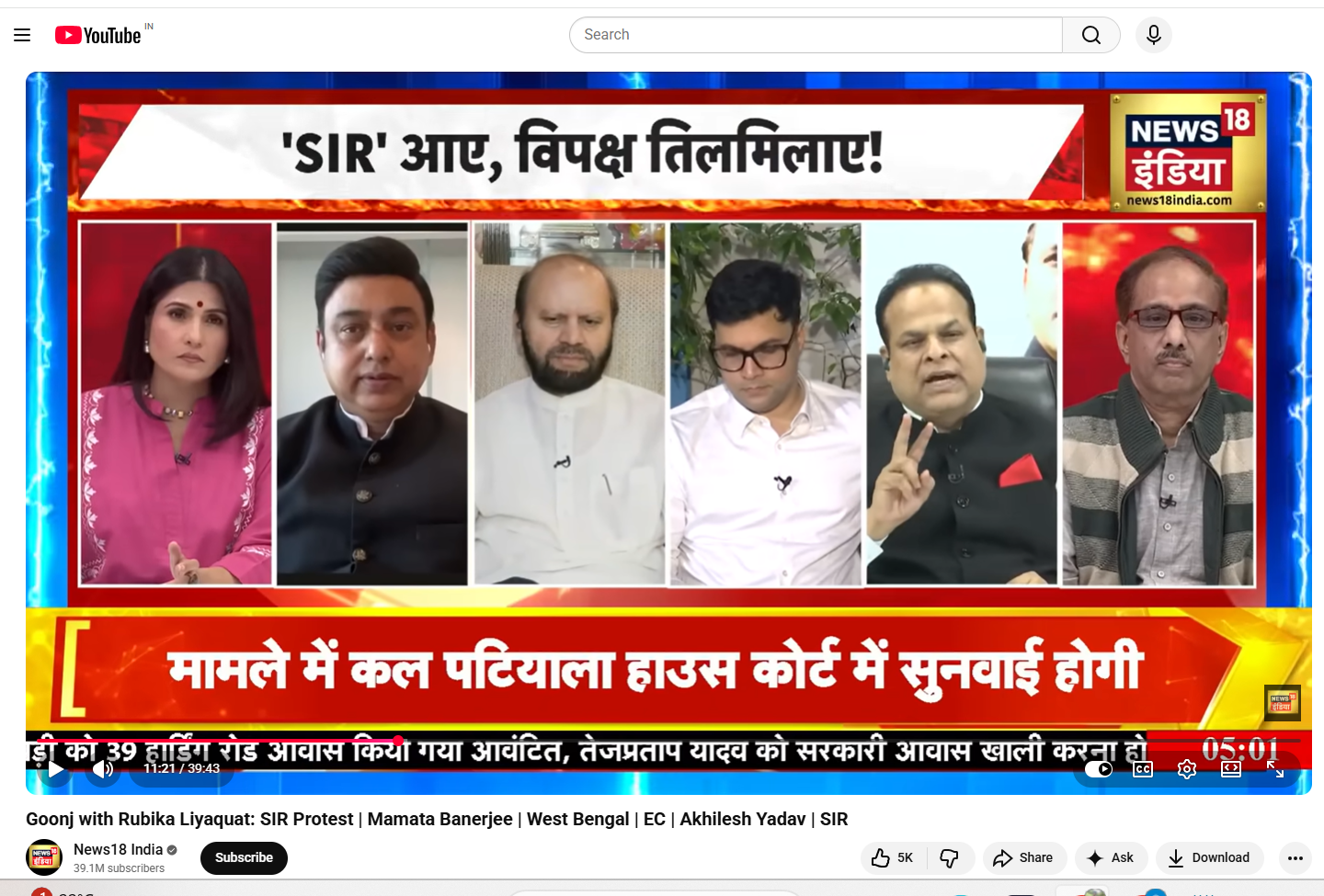
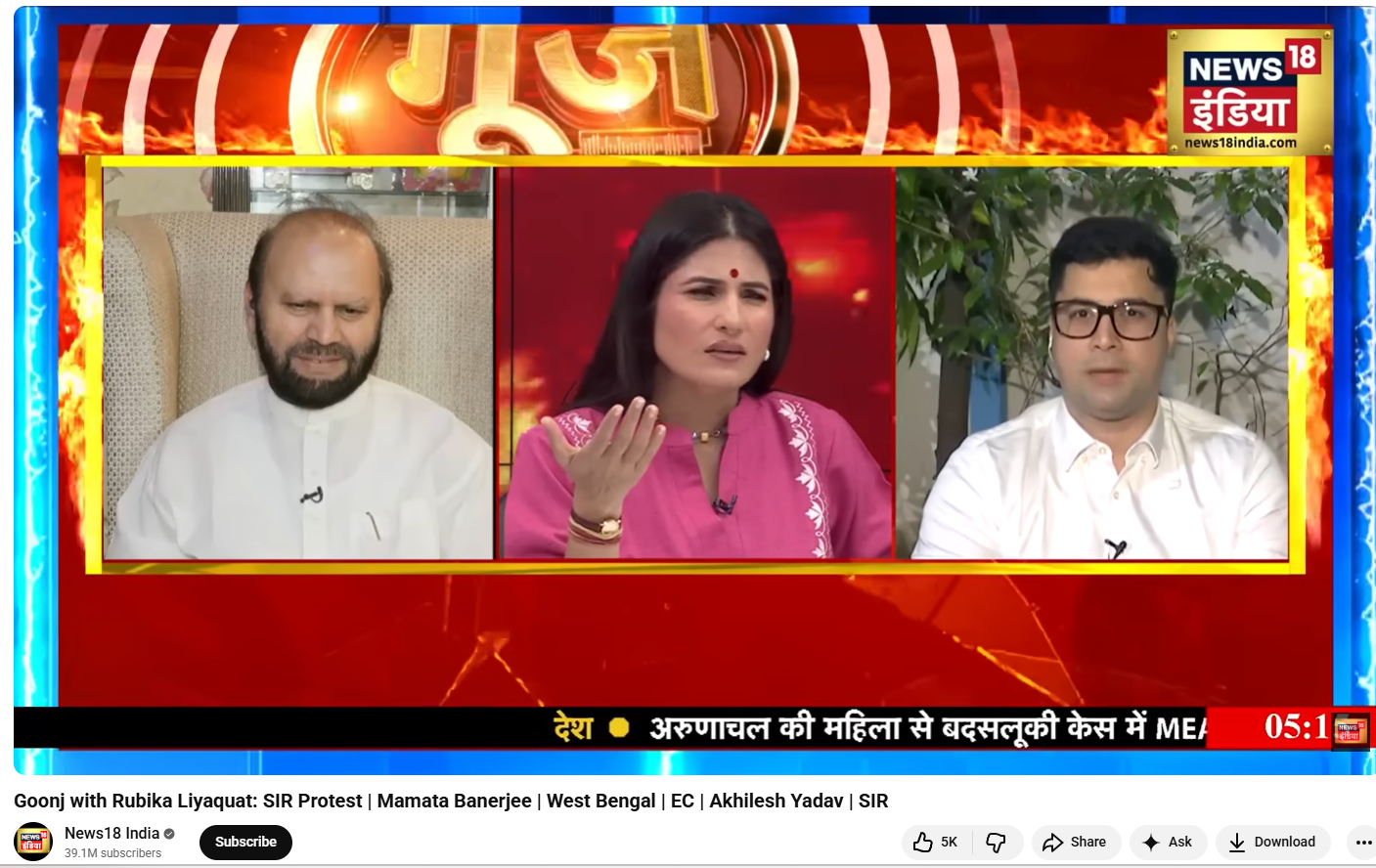
#FactCheck - Viral Postcard Attributing Fake UGC Statement to Keshav Prasad Maurya Is False
Executive Summary
A postcard claiming that Uttar Pradesh Deputy Chief Minister Keshav Prasad Maurya commented on the Supreme Court’s stay on the new UGC regulations is being widely shared on social media. The viral postcard suggests that Maurya stated the Modi government would “fight till its last breath” to implement the UGC law and appealed to Dalit, backward and tribal communities to trust the government as their true well-wisher. However, an research by the CyberPeace has found that the viral postcard is fake. Keshav Prasad Maurya has not made any such statement.
Claim
A Facebook user shared the postcard with the caption:“Now read it yourself. Statement of Deputy CM Keshav Prasad Maurya — the Modi government will fight till its last breath to implement the UGC law. An appeal to Dalit, backward and tribal communities to trust the government, calling it their true well-wisher.”
(Archived version of the post available here.)

Fact Check:
During the research, we did not find any credible news reports mentioning such a statement by Deputy Chief Minister Keshav Prasad Maurya regarding the UGC regulations or the Supreme Court’s order. A closer examination of the viral postcard revealed several inconsistencies. Notably, the text on the postcard lacks proper punctuation, such as commas and full stops, which is unusual for professionally designed news graphics. The postcard carries the logo of Navbharat Times (NBT). However, when compared with genuine NBT postcards, the font style used in the viral image does not match NBT’s official design. We also traced the original NBT postcard that appears to have been edited to create the fake one. In the authentic postcard, shared by NBT on January 20, Keshav Prasad Maurya is quoted as saying: Where the lotus has bloomed, it will continue to bloom, and where it has not, under the guidance of PM Modi and the leadership of Nitin Nabin, the lotus will bloom.”
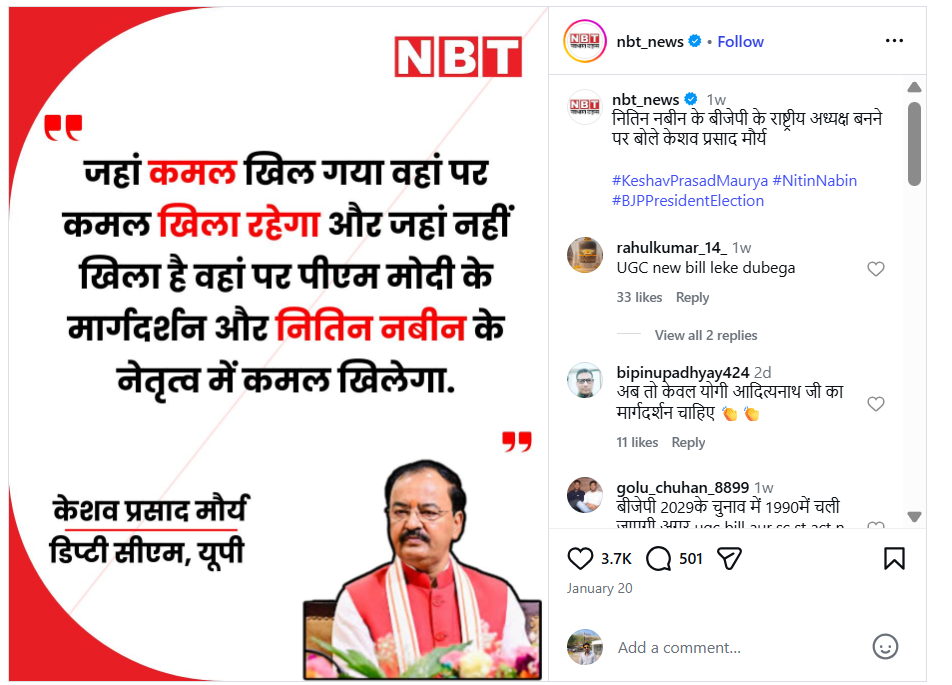
The original statement was digitally altered, and a fabricated quote was inserted to create the viral postcard.
Conclusion
CyberPeace research clearly establishes that the viral postcard is fake. The original Navbharat Times postcard has been tampered with, and Keshav Prasad Maurya’s actual statement has been replaced with a fabricated quote, which is now being circulated with a misleading claim.
Related Blogs
Overview:
The rapid digitization of educational institutions in India has created both opportunities and challenges. While technology has improved access to education and administrative efficiency, it has also exposed institutions to significant cyber threats. This report, published by CyberPeace, examines the types, causes, impacts, and preventive measures related to cyber risks in Indian educational institutions. It highlights global best practices, national strategies, and actionable recommendations to mitigate these threats.

Significance of the Study:
The pandemic-induced shift to online learning, combined with limited cybersecurity budgets, has made educational institutions prime targets for cyberattacks. These threats compromise sensitive student, faculty, and institutional data, leading to operational disruptions, financial losses, and reputational damage. Globally, educational institutions face similar challenges, emphasizing the need for universal and localized responses.
Threat Faced by Education Institutions:
Based on the insights from the CyberPeace’s report titled 'Exploring Cyber Threats and Digital Risks in Indian Educational Institutions', this concise blog provides a comprehensive overview of cybersecurity threats and risks faced by educational institutions, along with essential details to address these challenges.
🎣 Phishing: Phishing is a social engineering tactic where cyber criminals impersonate trusted sources to steal sensitive information, such as login credentials and financial details. It often involves deceptive emails or messages that lead to counterfeit websites, pressuring victims to provide information quickly. Variants include spear phishing, smishing, and vishing.
💰 Ransomware: Ransomware is malware that locks users out of their systems or data until a ransom is paid. It spreads through phishing emails, malvertising, and exploiting vulnerabilities, causing downtime, data leaks, and theft. Ransom demands can range from hundreds to hundreds of thousands of dollars.
🌐 Distributed Denial of Service (DDoS): DDoS attacks overwhelm servers, denying users access to websites and disrupting daily operations, which can hinder students and teachers from accessing learning resources or submitting assignments. These attacks are relatively easy to execute, especially against poorly protected networks, and can be carried out by amateur cybercriminals, including students or staff, seeking to cause disruptions for various reasons
🕵️ Cyber Espionage: Higher education institutions, particularly research-focused universities, are vulnerable to spyware, insider threats, and cyber espionage. Spyware is unauthorized software that collects sensitive information or damages devices. Insider threats arise from negligent or malicious individuals, such as staff or vendors, who misuse their access to steal intellectual property or cause data leaks..
🔒 Data Theft: Data theft is a major threat to educational institutions, which store valuable personal and research information. Cybercriminals may sell this data or use it for extortion, while stealing university research can provide unfair competitive advantages. These attacks can go undetected for long periods, as seen in the University of California, Berkeley breach, where hackers allegedly stole 160,000 medical records over several months.
🛠️ SQL Injection: SQL injection (SQLI) is an attack that uses malicious code to manipulate backend databases, granting unauthorized access to sensitive information like customer details. Successful SQLI attacks can result in data deletion, unauthorized viewing of user lists, or administrative access to the database.
🔍Eavesdropping attack: An eavesdropping breach, or sniffing, is a network attack where cybercriminals steal information from unsecured transmissions between devices. These attacks are hard to detect since they don't cause abnormal data activity. Attackers often use network monitors, like sniffers, to intercept data during transmission.
🤖 AI-Powered Attacks: AI enhances cyber attacks like identity theft, password cracking, and denial-of-service attacks, making them more powerful, efficient, and automated. It can be used to inflict harm, steal information, cause emotional distress, disrupt organizations, and even threaten national security by shutting down services or cutting power to entire regions
Insights from Project eKawach
The CyberPeace Research Wing, in collaboration with SAKEC CyberPeace Center of Excellence (CCoE) and Autobot Infosec Private Limited, conducted a study simulating educational institutions' networks to gather intelligence on cyber threats. As part of the e-Kawach project, a nationwide initiative to strengthen cybersecurity, threat intelligence sensors were deployed to monitor internet traffic and analyze real-time cyber attacks from July 2023 to April 2024, revealing critical insights into the evolving cyber threat landscape.
Cyber Attack Trends
Between July 2023 and April 2024, the e-Kawach network recorded 217,886 cyberattacks from IP addresses worldwide, with a significant portion originating from countries including the United States, China, Germany, South Korea, Brazil, Netherlands, Russia, France, Vietnam, India, Singapore, and Hong Kong. However, attributing these attacks to specific nations or actors is complex, as threat actors often use techniques like exploiting resources from other countries, or employing VPNs and proxies to obscure their true locations, making it difficult to pinpoint the real origin of the attacks.
Brute Force Attack:
The analysis uncovered an extensive use of automated tools in brute force attacks, with 8,337 unique usernames and 54,784 unique passwords identified. Among these, the most frequently targeted username was “root,” which accounted for over 200,000 attempts. Other commonly targeted usernames included: "admin", "test", "user", "oracle", "ubuntu", "guest", "ftpuser", "pi", "support"
Similarly, the study identified several weak passwords commonly targeted by attackers. “123456” was attempted over 3,500 times, followed by “password” with over 2,500 attempts. Other frequently targeted passwords included: "1234", "12345", "12345678", "admin", "123", "root", "test", "raspberry", "admin123", "123456789"

Insights from Threat Landscape Analysis
Research done by the USI - CyberPeace Centre of Excellence (CCoE) and Resecurity has uncovered several breached databases belonging to public, private, and government universities in India, highlighting significant cybersecurity threats in the education sector. The research aims to identify and mitigate cybersecurity risks without harming individuals or assigning blame, based on data available at the time, which may evolve with new information. Institutions were assigned risk ratings that descend from A to F, with most falling under a D rating, indicating numerous security vulnerabilities. Institutions rated D or F are 5.4 times more likely to experience data breaches compared to those rated A or B. Immediate action is recommended to address the identified risks.


Risk Findings :
The risk findings for the institutions are summarized through a pie chart, highlighting factors such as data breaches, dark web activity, botnet activity, and phishing/domain squatting. Data breaches and botnet activity are significantly higher compared to dark web leakages and phishing/domain squatting. The findings show 393,518 instances of data breaches, 339,442 instances of botnet activity, 7,926 instances related to the dark web and phishing & domain activity - 6711.

Key Indicators: Multiple instances of data breaches containing credentials (email/passwords) in plain text.


- Botnet activity indicating network hosts compromised by malware.

- Credentials from third-party government and non-governmental websites linked to official institutional emails

- Details of software applications, drivers installed on compromised hosts.

- Sensitive cookie data exfiltrated from various browsers.


- IP addresses of compromised systems.
- Login credentials for different Android applications.

Below is the sample detail of one of the top educational institutions that provides the insights about the higher rate of data breaches, botnet activity, dark web activities and phishing & domain squatting.
Risk Detection:
It indicates the number of data breaches, network hygiene, dark web activities, botnet activities, cloud security, phishing & domain squatting, media monitoring and miscellaneous risks. In the below example, we are able to see the highest number of data breaches and botnet activities in the sample particular domain.

Risk Changes:

Risk by Categories:

Risk is categorized with factors such as high, medium and low, the risk is at high level for data breaches and botnet activities.

Challenges Faced by Educational Institutions
Educational institutions face cyberattack risks, the challenges leading to cyberattack incidents in educational institutions are as follows:
🔒 Lack of a Security Framework: A key challenge in cybersecurity for educational institutions is the lack of a dedicated framework for higher education. Existing frameworks like ISO 27001, NIST, COBIT, and ITIL are designed for commercial organizations and are often difficult and costly to implement. Consequently, many educational institutions in India do not have a clearly defined cybersecurity framework.
🔑 Diverse User Accounts: Educational institutions manage numerous accounts for staff, students, alumni, and third-party contractors, with high user turnover. The continuous influx of new users makes maintaining account security a challenge, requiring effective systems and comprehensive security training for all users.
📚 Limited Awareness: Cybersecurity awareness among students, parents, teachers, and staff in educational institutions is limited due to the recent and rapid integration of technology. The surge in tech use, accelerated by the pandemic, has outpaced stakeholders' ability to address cybersecurity issues, leaving them unprepared to manage or train others on these challenges.
📱 Increased Use of Personal/Shared Devices: The growing reliance on unvetted personal/Shared devices for academic and administrative activities amplifies security risks.
💬 Lack of Incident Reporting: Educational institutions often neglect reporting cyber incidents, increasing vulnerability to future attacks. It is essential to report all cases, from minor to severe, to strengthen cybersecurity and institutional resilience.
Impact of Cybersecurity Attacks on Educational Institutions
Cybersecurity attacks on educational institutions lead to learning disruptions, financial losses, and data breaches. They also harm the institution's reputation and pose security risks to students. The following are the impacts of cybersecurity attacks on educational institutions:
📚Impact on the Learning Process: A report by the US Government Accountability Office (GAO) found that cyberattacks on school districts resulted in learning losses ranging from three days to three weeks, with recovery times taking between two to nine months.
💸Financial Loss: US schools reported financial losses ranging from $50,000 to $1 million due to expenses like hardware replacement and cybersecurity upgrades, with recovery taking an average of 2 to 9 months.
🔒Data Security Breaches: Cyberattacks exposed sensitive data, including grades, social security numbers, and bullying reports. Accidental breaches were often caused by staff, accounting for 21 out of 25 cases, while intentional breaches by students, comprising 27 out of 52 cases, frequently involved tampering with grades.
⚠️Data Security Breach: Cyberattacks on schools result in breaches of personal information, including grades and social security numbers, causing emotional, physical, and financial harm. These breaches can be intentional or accidental, with a US study showing staff responsible for most accidental breaches (21 out of 25) and students primarily behind intentional breaches (27 out of 52) to change grades.
🏫Impact on Institutional Reputation: Cyberattacks damaged the reputation of educational institutions, eroding trust among students, staff, and families. Negative media coverage and scrutiny impacted staff retention, student admissions, and overall credibility.
🛡️ Impact on Student Safety: Cyberattacks compromised student safety and privacy. For example, breaches like live-streaming school CCTV footage caused severe distress, negatively impacting students' sense of security and mental well-being.
CyberPeace Advisory:
CyberPeace emphasizes the importance of vigilance and proactive measures to address cybersecurity risks:
- Develop effective incident response plans: Establish a clear and structured plan to quickly identify, respond to, and recover from cyber threats. Ensure that staff are well-trained and know their roles during an attack to minimize disruption and prevent further damage.
- Implement access controls with role-based permissions: Restrict access to sensitive information based on individual roles within the institution. This ensures that only authorized personnel can access certain data, reducing the risk of unauthorized access or data breaches.
- Regularly update software and conduct cybersecurity training: Keep all software and systems up-to-date with the latest security patches to close vulnerabilities. Provide ongoing cybersecurity awareness training for students and staff to equip them with the knowledge to prevent attacks, such as phishing.
- Ensure regular and secure backups of critical data: Perform regular backups of essential data and store them securely in case of cyber incidents like ransomware. This ensures that, if data is compromised, it can be restored quickly, minimizing downtime.
- Adopt multi-factor authentication (MFA): Enforce Multi-Factor Authentication(MFA) for accessing sensitive systems or information to strengthen security. MFA adds an extra layer of protection by requiring users to verify their identity through more than one method, such as a password and a one-time code.
- Deploy anti-malware tools: Use advanced anti-malware software to detect, block, and remove malicious programs. This helps protect institutional systems from viruses, ransomware, and other forms of malware that can compromise data security.
- Monitor networks using intrusion detection systems (IDS): Implement IDS to monitor network traffic and detect suspicious activity. By identifying threats in real time, institutions can respond quickly to prevent breaches and minimize potential damage.
- Conduct penetration testing: Regularly conduct penetration testing to simulate cyberattacks and assess the security of institutional networks. This proactive approach helps identify vulnerabilities before they can be exploited by actual attackers.
- Collaborate with cybersecurity firms: Partner with cybersecurity experts to benefit from specialized knowledge and advanced security solutions. Collaboration provides access to the latest technologies, threat intelligence, and best practices to enhance the institution's overall cybersecurity posture.
- Share best practices across institutions: Create forums for collaboration among educational institutions to exchange knowledge and strategies for cybersecurity. Sharing successful practices helps build a collective defense against common threats and improves security across the education sector.
Conclusion:
The increasing cyber threats to Indian educational institutions demand immediate attention and action. With vulnerabilities like data breaches, botnet activities, and outdated infrastructure, institutions must prioritize effective cybersecurity measures. By adopting proactive strategies such as regular software updates, multi-factor authentication, and incident response plans, educational institutions can mitigate risks and safeguard sensitive data. Collaborative efforts, awareness, and investment in cybersecurity will be essential to creating a secure digital environment for academia.

11th November 2022 CyberPeace Foundation in association with Universal Acceptance has successfully conducted the workshop on Universal Acceptance and Multilingual Internet for the students and faculties of BIT University under CyberPeace Center of Excellence (CCoE).
CyberPeace Foundation has always been engaged towards the aim of spreading awareness regarding the various developments, avenues, opportunities and threats regarding cyberspace. The same has been the keen principle of the CyberPeace Centre of Excellence setup in collaboration with various esteemed educational institutes. We at CyberPeace Foundation would like to take the collaborations and our efforts to a new height of knowledge and awareness by proposing a workshop on UNIVERSAL ACCEPTANCE AND MULTILINGUAL INTERNET. This workshop was instrumental in providing the academia and research community a wholesome outlook towards the multilingual spectrum of internet including Internationalized domain names and email address Internationalization.
Date –11th November 2022
Time – 10:00 AM to 12:00 PM
Duration – 2 hours
Mode - Online
Audience – Academia and Research Community
Participants Joined- 15
Crowd Classification - Engineering students (1st and 4th year, all streams) and Faculties members
Organizer : Mr. Harish Chowdhary : UA Ambassador
Moderator: Ms. Pooja Tomar, Project coordinator cum trainer
Speakers - Mr. Abdalmonem Galila, Abdalmonem: Vice Chair , Universal Acceptance Steering Group (UASG)and
Mr. Mahesh D Kulkarni Director, Evaris Systems and Former Senior Director, CDAC, Government of India,First session was delivered by Mr. Abdalmonem Galila, Abdalmonem: Vice Chair , Universal Acceptance Steering Group (UASG) “Universal Acceptance( UA) and why UA matters?”
- What is universal acceptance?
- UA is cornerstone to a digitally inclusive internet by ensuring all domain names and email addresses in all languages, script and character length.
- Achieving UA ensures that every person has the ability to navigate the internet.
- Different UA issues were also discussed and explained.
- Tagated systems by the UA and implication were discussed in detail.
Second session was delivered by Mr. Mahesh D Kulkarni, ES Director Evaris on the topic of “IDNs in Indian languages perspective- challenges and solutions”.
- The multilingual diversity of India was focused on and its impact.
- Most students were not aware of what Unicode, IDNS is and their usage.
- Students were briefed by giving real time examples on IDN, Domain name implementation using local language.
- In depth knowledge of and practical exposure of Universal Acceptance and Multilingual Internet has been served to the students.
- Tools and Resources for Domain Name and Domain Languages were explained.
- Languages nuances of Multilingual diversity of India explained with real time facts and figures.
- Given the idea of IDN Email,Homograph attack,Homographic variant with proper real time examples.
- Explained about the security threats and IDNA protocols.
- Given the explanation on ABNF.
- Explained the stages of Universal Acceptance.

Introduction
The enactment of the Online Gaming (Promotion and Regulation) Act, 2025 has a significant impact, resulting in considerable changes to the structure of the Indian gaming industry. The ban on Real-Money Games (RMG), including fantasy sports, rummy, and poker, aims to curb addiction, illegal betting and most importantly, financial exploitation.
However, this decision sent ripples throughout the industry, resulting in players, companies and their investors re-strategising their plans to move forward. This approach, however, is a sharp contrast to how other nations, including the UK, Singapore and others, regulate online gaming. This, as a result, has also raised doubts about the ban and calls into question whether this is the right move.
Industry in Flux - The resultant Fallout
- MPL’s Layoffs: The Mobile Premiere League has so far laid off nearly 60 per cent of its workforce, with the CEO of the company openly admitting that the company is no longer able to make money in India.
- Dream11’s Lost Revenue: Having seen a position of being a market leader, the company has now witnessed its 95 per cent revenue wiped out, resulting in raised alarms among investors.
- A23’s Legal Move: The company chose to move the Karnataka High Court under the argument that the ban also ends up unfairly criminalising skill-based games that were earlier classified differently from gambling by the courts.
The new face of eSports: With RMGs outlawed, the focus is now on esports, including casual mobile gaming, console/PC gaming, and creating new opportunities and also leaving a void for RMG revenue companies.
Regulations Around the World - & India
India has adopted a prohibition model, whereas many other countries have developed regulatory frameworks that allow sectoral expansion under monitoring.
United Kingdom:
- Online gaming is regulated by the UK Gambling Commission.
- RMGs are legal but subject to strict licensing, age verification and advertising rules.
- Self-exclusion schemes are a must, offered by operators along with tools to prevent gambling addictions.
United States
- State-driven regulations that vary from state to state.
- States including Nevada and New Jersey allow casinos both online and offline, while other states prohibit them completely.
- Regulation for skill-based fantasy games is fragmented but generally legal.
China
- Great focus on controlling and restricting gaming addictions among minors.
- Time limits are enforced for players under 18 (usually as little as 3 hours per week).
- Gambling has been deemed illegal; however, esports and casual gaming operate within China’s regulated gaming ecosystem, subject to certain compliance.
Singapore
- The Remote Gambling Act regulates chance-based games, while other eSports and skill-based games operate out of its jurisdiction and are regulated separately.
- Online gambling isn't completely banned, but is operated under restrictions.
- Only Licensed operators under strict controls are allowed by the government to operate to avoid and prevent black-market alternatives.
Australia
- Regulates under the Interactive Gambling Act.
- Sports betting and certain licensed operators are allowed, while most of the other online gambling services are prohibited.
- Restrictions on advertising and real-time interventions allow emphasis on harm minimisation.
India’s Approach - Comparison
The Online Gaming (Promotion and Regulation) Act, 2025 introduces a prohibition model for real money games. This differs from jurisdictions such as the UK and US, which have implemented regulatory frameworks to oversee the sector. In India, earlier legal interpretations distinguished between games of skill and games of chance. The new legislation provides a single treatment for both categories, which marks a departure from previous judicial pronouncements.
Conclusion
At present, India’s gaming sector is navigating layoffs, court cases, and a pivot towards esports post the RMG ban. Keeping in mind that the intent of said ban is the protection of citizens, the industry also argues that regulation, instead of prohibition, offers a sustainable approach to the issues. On the other hand, on the global scale, most nations prefer controlled and licensed models that ensure consumer safety and work on preserving both jobs and revenues. However, India’s step is diverging from such a model. The lack of safeguards and engagement in the real money gaming industry led to a prohibition model, underscoring that in sensitive digital sectors, early regulatory alignment is essential.
References
- India online gaming ban: Global rules & regulation bill 2025
- Level up or game over? Decoding India’s gaming industry post RMG ban
- MPL lays off 350 employees after GST rules, RMG crackdown
- India’s Dream11 hit by online gaming ban, revenue slumps
- Online gaming ban: A23 moves Karnataka HC against government decision
- UK Gambling Commission – Licensing and Regulations
- Fantasy Sports & Gambling Law – State by State
- China’s gaming restrictions for minors
- Singapore Remote Gambling Act – Ministry of Home Affairs
- Australian Communications and Media Authority – Interactive Gambling Act