
#FactCheck -Social Media Claim of ICC’s One-Year Ban on Pakistan Cricket Is Misleading
Executive Summary:
A purported media release allegedly issued in the name of the International Cricket Council (ICC) is being widely circulated on social media. The release claims that the ICC has decided to impose a one-year ban on Pakistan cricket. CyberPeace’s research found this claim to be false.The research revealed that the media release circulating on social media is fake, and no such letter or official statement has been issued by the ICC.
Claim:
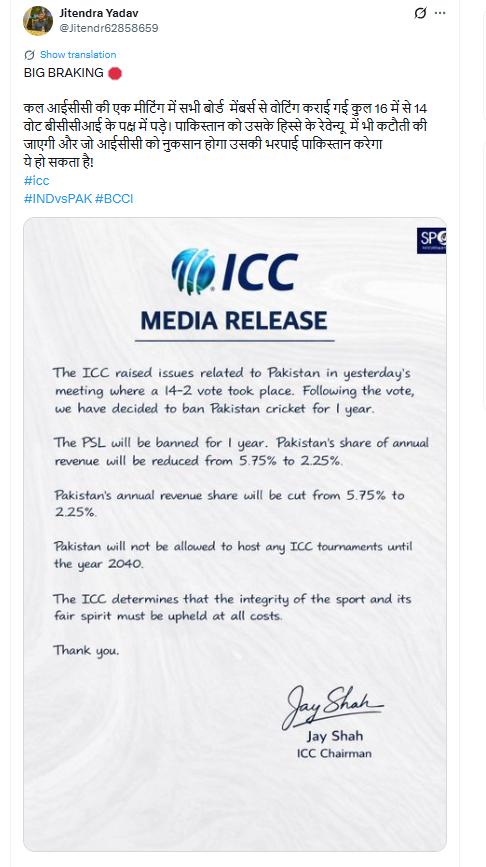
On social media platform X (formerly Twitter), a user shared the viral letter on February 3, 2026, claiming that an ICC meeting was held in which board members voted on issues related to Pakistan. The post alleged that 14 out of 16 votes were cast in favour of the BCCI. The user further claimed that Pakistan’s share of ICC revenue would be reduced and that Pakistan might be asked to compensate for losses incurred by the ICC.
The viral letter, written in English, stated that matters related to Pakistan were discussed in an ICC meeting and that a 14–2 majority vote led to the decision to impose a one-year ban on Pakistan cricket. It further claimed that the Pakistan Super League (PSL) would be suspended for one year, Pakistan’s annual revenue share would be reduced from 5.75 percent to 2.25 percent, and Pakistan would not be allowed to host any ICC tournaments until 2040. The letter also claimed that these decisions were taken to safeguard the integrity and spirit of the game. Links to the viral post, archive link, and screenshots can be seen below.
Fact Check:
To verify the viral claim, CyberPeace conducted a Google search using relevant keywords. However, no credible or reliable media reports supporting the claim were found. In the next step of the research , an official press release uploaded on DD Sports’ Facebook page on February 2, 2026, was found. The press release responded to Pakistan’s decision not to play against India in a Group A match. The DD Sports statement said that the Pakistan Cricket Board should consider the long-term and serious implications of such a decision, as it could impact the global cricket ecosystem—of which Pakistan is itself a member and beneficiary.
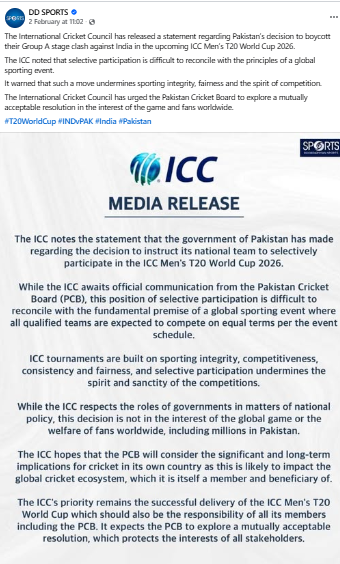
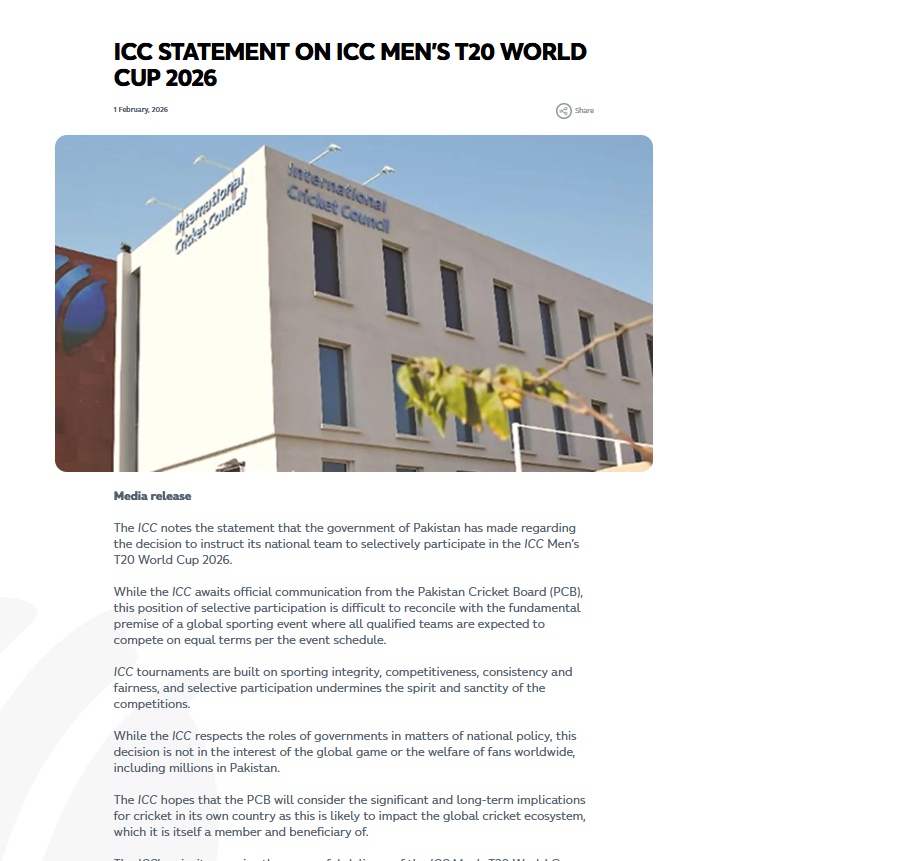
Notably, the official press release made no mention of any ban on Pakistan cricket, reduction in revenue share, suspension of the PSL, or restrictions on hosting ICC tournaments, contrary to the claims made in the viral letter. Further, the same official statement was found published on the ICC’s website on February 1, 2026. This release also did not mention any decision related to banning Pakistan cricket or barring the country from hosting ICC tournaments for the next 40 years.
Conclusion
CyberPeace concludes that the media release circulating on social media is fake. The ICC has not issued any official letter or statement announcing a one-year ban on Pakistan cricket, revenue cuts, or restrictions on hosting ICC tournaments.

Related Blogs

Executive Summary:
A new threat being uncovered in today’s threat landscape is that while threat actors took an average of one hour and seven minutes to leverage Proof-of-Concept(PoC) exploits after they went public, now the time is at a record low of 22 minutes. This incredibly fast exploitation means that there is very limited time for organizations’ IT departments to address these issues and close the leaks before they are exploited. Cloudflare released the Application Security report which shows that the attack percentage is more often higher than the rate at which individuals invent and develop security countermeasures like the WAF rules and software patches. In one case, Cloudflare noted an attacker using a PoC-based attack within a mere 22 minutes from the moment it was released, leaving almost no time for a remediation window.
Despite the constant growth of vulnerabilities in various applications and systems, the share of exploited vulnerabilities, which are accompanied by some level of public exploit or PoC code, has remained relatively stable over the past several years and fluctuates around 50%. These vulnerabilities with publicly known exploit code, 41% was initially attacked in the zero-day mode while of those with no known code, 84% was first attacked in the same mode.
Modus Operandi:
The modus operandi of the attack involving the rapid weaponization of proof-of-concept (PoC) exploits is characterized by the following steps:
- Vulnerability Identification: Threat actors bring together the exploitation of a system vulnerability that may be in the software or hardware of the system; this may be a code error, design failure, or a configuration error. This is normally achieved using vulnerability scanners and test procedures that have to be performed manually.
- Vulnerability Analysis: After the vulnerability is identified, the attackers study how it operates to determine when and how it can be triggered and what consequences that action will have. This means that one needs to analyze the details of the PoC code or system to find out the connection sequence that leads to vulnerability exploitation.
- Exploit Code Development: Being aware of the weakness, the attackers develop a small program or script denoted as the PoC that addresses exclusively the identified vulnerability and manipulates it in a moderated manner. This particular code is meant to be utilized in showing a particular penalty, which could be unauthorized access or alteration of data.
- Public Disclosure and Weaponization: The PoC exploit is released which is frequently done shortly after the vulnerability has been announced to the public. This makes it easier for the attackers to exploit it while waiting for the software developer to release the patch. To illustrate, Cloudflare has spotted an attacker using the PoC-based exploit 22 minutes after the publication only.
- Attack Execution: The attackers then use the weaponized PoC exploit to attack systems which are known to be vulnerable to it. Some of the actions that are tried in this context are attempts at running remote code, unauthorized access and so on. The pace at which it happens is often much faster than the pace at which humans put in place proper security defense mechanisms, such as the WAF rules or software application fixes.
- Targeted Operations: Sometimes, they act as if it’s a planned operation, where the attackers are selective in the system or organization to attack. For example, exploitation of CVE-2022-47966 in ManageEngine software was used during the espionage subprocess, where to perform such activity, the attackers used the mentioned vulnerability to install tools and malware connected with espionage.
Precautions: Mitigation
Following are the mitigating measures against the PoC Exploits:
1. Fast Patching and New Vulnerability Handling
- Introduce proper patching procedures to address quickly the security released updates and disclosed vulnerabilities.
- Focus should be made on the patching of those vulnerabilities that are observed to be having available PoC exploits, which often risks being exploited almost immediately.
- It is necessary to frequently check for the new vulnerability disclosures and PoC releases and have a prepared incident response plan for this purpose.
2. Leverage AI-Powered Security Tools
- Employ intelligent security applications which can easily generate desirable protection rules and signatures as attackers ramp up the weaponization of PoC exploits.
- Step up use of artificial intelligence (AI) - fueled endpoint detection and response (EDR) applications to quickly detect and mitigate the attempts.
- Integrate Artificial Intelligence based SIEM tools to Detect & analyze Indicators of compromise to form faster reaction.
3. Network Segmentation and Hardening
- Use strong networking segregation to prevent the attacker’s movement across the network and also restrict the effects of successful attacks.
- Secure any that are accessible from the internet, and service or protocols such as RDP, CIFS, or Active directory.
- Limit the usage of native scripting applications as much as possible because cyber attackers may exploit them.
4. Vulnerability Disclosure and PoC Management
- Inform the vendors of the bugs and PoC exploits and make sure there is a common understanding of when they are reported, to ensure fast response and mitigation.
- It is suggested to incorporate mechanisms like digital signing and encryption for managing and distributing PoC exploits to prevent them from being accessed by unauthorized persons.
- Exploits used in PoC should be simple and independent with clear and meaningful variable and function names that help reduce time spent on triage and remediation.
5. Risk Assessment and Response to Incidents
- Maintain constant supervision of the environment with an intention of identifying signs of a compromise, as well as, attempts of exploitation.
- Support a frequent detection, analysis and fighting of threats, which use PoC exploits into the system and its components.
- Regularly communicate with security researchers and vendors to understand the existing threats and how to prevent them.
Conclusion:
The rapid process of monetization of Proof of Concept (POC) exploits is one of the most innovative and constantly expanding global threats to cybersecurity at the present moment. Cyber security experts must react quickly while applying a patch, incorporate AI to their security tools, efficiently subdivide their networks and always heed their vulnerability announcements. Stronger incident response plan would aid in handling these kinds of menaces. Hence, applying measures mentioned above, the organizations will be able to prevent the acceleration of turning PoC exploits into weapons and the probability of neutral affecting cyber attacks.
Reference:
https://www.mayrhofer.eu.org/post/vulnerability-disclosure-is-positive/
https://www.uptycs.com/blog/new-poc-exploit-backdoor-malware
https://www.balbix.com/insights/attack-vectors-and-breach-methods/
https://blog.cloudflare.com/application-security-report-2024-update

Executive Summary
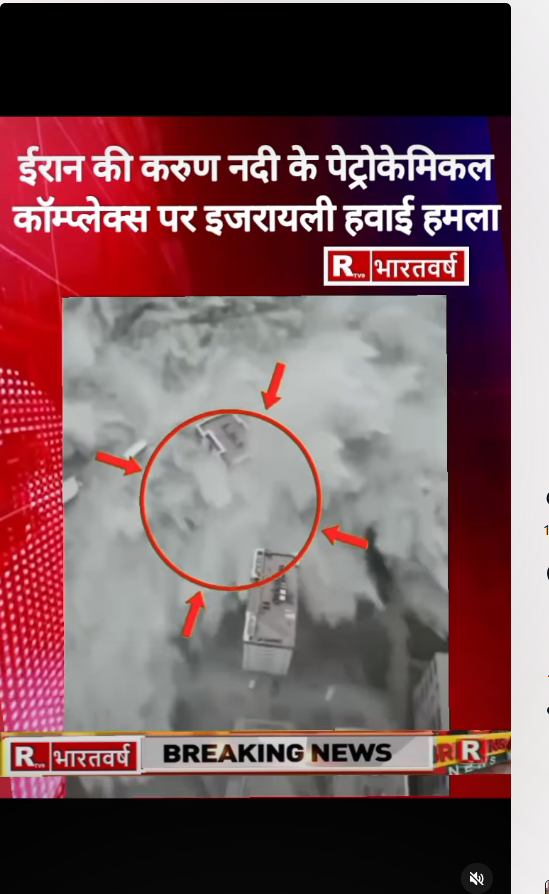
Amid escalating tensions between Iran and Israel, a video showing a fighter jet launching a missile at a massive dam, followed by its collapse and widespread flooding, is being widely shared on social media. Users are claiming that the video depicts a recent Israeli airstrike on a petrochemical plant located along Iran’s Karun River. CyberPeace Research Wing research found that the viral claim is false. The video is not related to any real-world incident and has been generated using artificial intelligence (AI).
Claim:
An Instagram user shared the viral video with a caption claiming that Israel carried out an airstrike on a petrochemical complex along Iran’s Karun River. The post further suggested that the facility is a key industrial site and that the attack caused widespread panic in the region. Post link:
https://www.instagram.com/reels/DZhNuiRx_v1/
https://www.instagram.com/reels/DZhNuiRx_v1/
Fact Check:
A reverse image search of keyframes from the video led to its appearance on a Facebook page named Warfare NextGen. The page clearly described the footage as “dramatic content,” indicating that it is not a real incident.
https://www.facebook.com/reel/1027249019882257

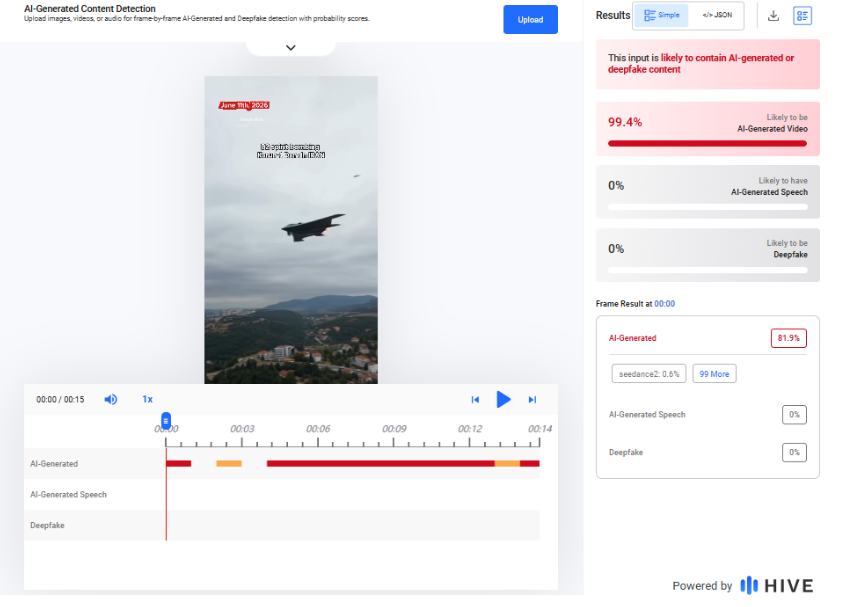
A closer analysis of the visuals also revealed several inconsistencies that raise doubts about its authenticity. To further verify the video, it was analyzed using the AI detection tool Hive Moderation, which indicated a 99.4% probability that the content is AI-generated.
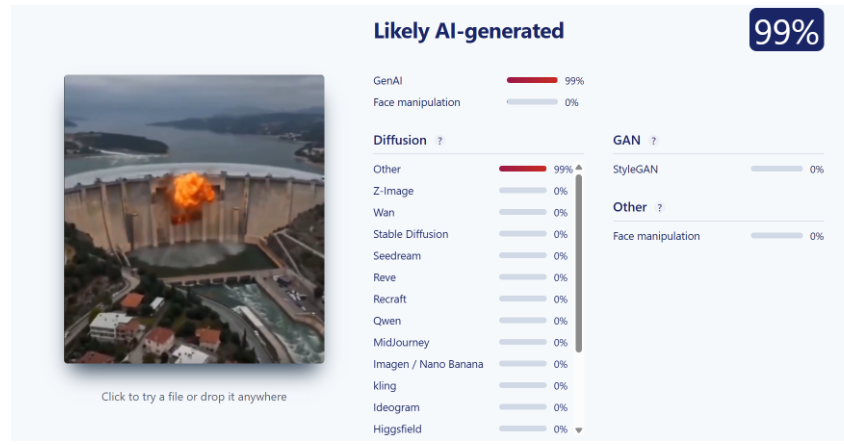
Additionally, a separate analysis using SIGHTENGINE also classified the video as approximately 99% AI-generated.
Conclusion:
The research confirms that the viral video is not a real incident. It has been created using artificial intelligence and is being falsely shared as a depiction of an Israeli strike on a petrochemical plant along Iran’s Karun River.

Introduction
India currently faces a crucial moment because its digital system experiences rapid growth while cyber criminals take advantage of this development to increase their fraudulent activities. The Department of Telecommunications (DoT) has implemented a new regulatory requirement that mandates all messaging and communication platforms to use SIM-binding technology as their primary security measure. The new rule, which starts on 1st March 2026, requires WhatsApp, Telegram, Signal and other similar applications to operate only when users have their registered SIM card present in their device. The telecom identifier restriction aims to prevent unauthorised access, but it creates significant privacy concerns, together with issues of proportionality and platform governance.
Understanding the SIM-Binding Directive
SIM-binding establishes direct links between communication platform accounts and the SIM cards used for registration. The application will stop working when users take out their SIM card, turn it off, or get a new SIM card. Users must re-authenticate their sessions through the main device because web-based sessions, including WhatsApp Web, will automatically log out after six hours of use.
The Telecommunications Act, 2023 and Telecom Cyber Security Rules serve as the base legal authority for this directive. The regulation requires Telecommunication Identity User Entities (TIUEs), which identify users through mobile numbers, to maintain service access based on verified telecommunications credentials.
Rationale: Addressing Cyber Fraud and Misuse
The policy exists because cyber fraud activities have reached a point where they require a more powerful response. Authorities have stated that messaging applications maintain their operational capacity even after users remove their SIM cards, which allows international scammers to use Indian phone numbers for their fraudulent activities. SIM-binding aims to:
- Restore traceability by linking active accounts to verified SIM-based identities.
- Reduce remote access abuse, which includes both account takeovers and impersonation scams.
- Stop fraudulent activities that require physical device access through the creation of permanent sessions.
- Build a system of accountability that extends throughout the telecommunications industry.
The government introduced this measure as an appropriate solution to deal with systemic vulnerabilities because reported cyber fraud losses in 2024 reached more than ₹22,800 crore.
Security with Responsibility
The system requires digital trust to be established through secure identity verification systems, which include official systems for verification and operational systems that enable governmental agencies to work together.
CyberPeace principles require security measures to maintain three essential conditions, which are:
- They must respond to existing dangers
- Their execution process must be open to public observation
- They need to protect user rights, which include their right to privacy and personal independence
- They must provide equal access while safeguarding against negative impacts on at-risk user groups.
Industry Response and Governance Challenges
The directive has received diverse responses from people who work in different fields. Some platforms are testing SIM presence verification features for their upcoming changes, according to reports, while industry groups representing major technology companies have raised legal issues. They argue that the mandate may exceed the regulatory scope of the DoT and potentially conflict with constitutional protections. The existing tension demonstrates how governments face difficulties because they must protect national security while managing international platform operations and legal systems. The situation requires multiple stakeholders to work together because governments, industry, and civil society need to design policies through their collective input.
Policy Insights and Recommendations
The successful balanced execution of this initiative depends on these two essential elements:
- Clear Implementation Guidelines: Organizations need to establish detailed technical standards together with compliance frameworks, which must be followed during their implementation process across various platforms.
- Privacy Safeguards: The telecom service provider must implement strong data protection measures that protect customer data from unauthorised access through SIM-binding technology.
- User Awareness and Transparency: Users should receive information about SIM-binding effects on their access rights, together with security controls, which will help them build trust and provide informed consent.
- Flexibility for Edge Cases: Provisions should exist for legitimate use cases such as device changes, international travel, and accessibility needs.
- Global Interoperability Dialogue: India should engage with global stakeholders to ensure that such measures do not fragment the digital ecosystem.
Conclusion
The SIM-binding directive establishes India’s defence against cyber threats by solving a specific problem that exists in digital identity verification. The system establishes CyberPeace as its fundamental base through its shift from reactive cybersecurity practices toward preventive digital governance methods.
The system will achieve its desired results only if it effectively manages the three elements of security protection, privacy maintenance, and user convenience. SIM-binding and similar policies require ongoing assessment because their implementation affects both national security and the fundamental principles of trustworthiness, inclusiveness, and ethical digital governance.
References
- https://www.opindia.com/2026/02/sim-binding-to-be-implemented-from-1st-march-what-it-means-and-how-it-will-impact-users/
- https://www.ndtv.com/india-news/sim-binding-rule-set-to-change-how-whatsapp-telegram-work-in-india-from-march-1-11148903#:~:text=Under%20the%20new%20framework%2C%20messaging,is%20re%2Dinserted%20and%20authenticated.
- https://timesofindia.indiatimes.com/technology/tech-news/telecom-departments-sim-binding-rule-to-come-into-effect-from-tomorrow-march-1-what-is-sim-binding-how-it-works-and-what-it-means-for-whatsapp-users/articleshow/128879561.cms
- https://www.deccanherald.com/technology/whatsapp-begins-testing-sim-binding-in-india-3913963
