

Navigating the Path to CyberPeace: Insights and Strategies
Featured #factCheck Blogs

Executive Summary
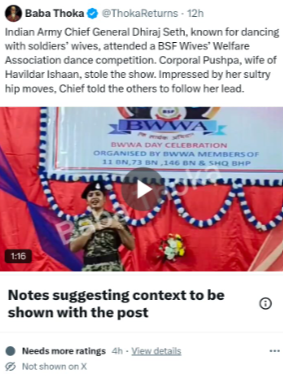
Social media users are claiming that Indian Army Chief General Dhiraj Seth dances with soldiers’ wives and attended a dance competition organised by the Border Security Force Wives Welfare Association (BWWA). CyberPeace Research found no credible sources to substantiate the viral claim. Our research revealed that the viral image is related to his visit to Nepal. According to reports, he travelled to Nepal on his first foreign visit after taking charge of the Indian Army, where he was welcomed by senior Nepal Army officials. During the visit, he was also scheduled to receive the honorary rank of General of the Nepal Army. However, his photograph is being linked to a dance video from an event organised by the Central Armed Police Forces (CAPF), accompanied by objectionable claims about him. Our research found no credible evidence confirming that General Dhiraj Seth attended the event or was associated with the activities shown in the video. Therefore, linking his photograph from the Nepal visit to the dance video is misleading.
Claim:
It is being claimed on social media that Indian Army Chief General Dhiraj Seth attended a dance competition organised by the BSF Wives Welfare Association (BWWA), where he was impressed by a woman’s dance performance and asked other participants to follow her lead.
https://x.com/ThokaReturns/status/2110854323760693485
Fact Check
To verify the viral claim, we conducted a reverse image search using keyframes from the video. During this process, we found the video on Instagram. The text “BSF Wives Welfare Association” was visible on the backdrop behind the stage. However, there was no mention of Army Chief General Dhiraj Seth anywhere in the video.
https://www.instagram.com/reels/Ddl7oTEgnf7/
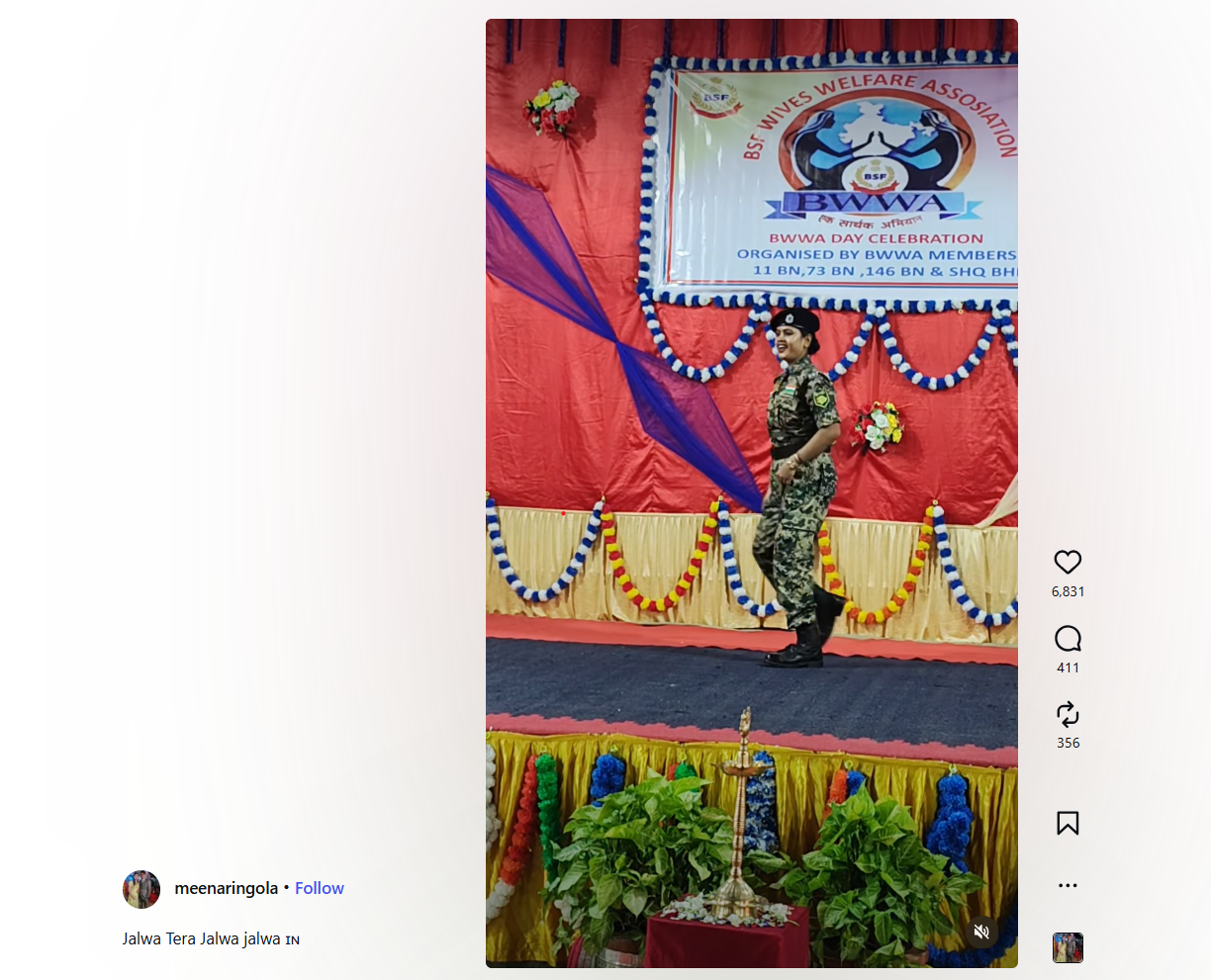
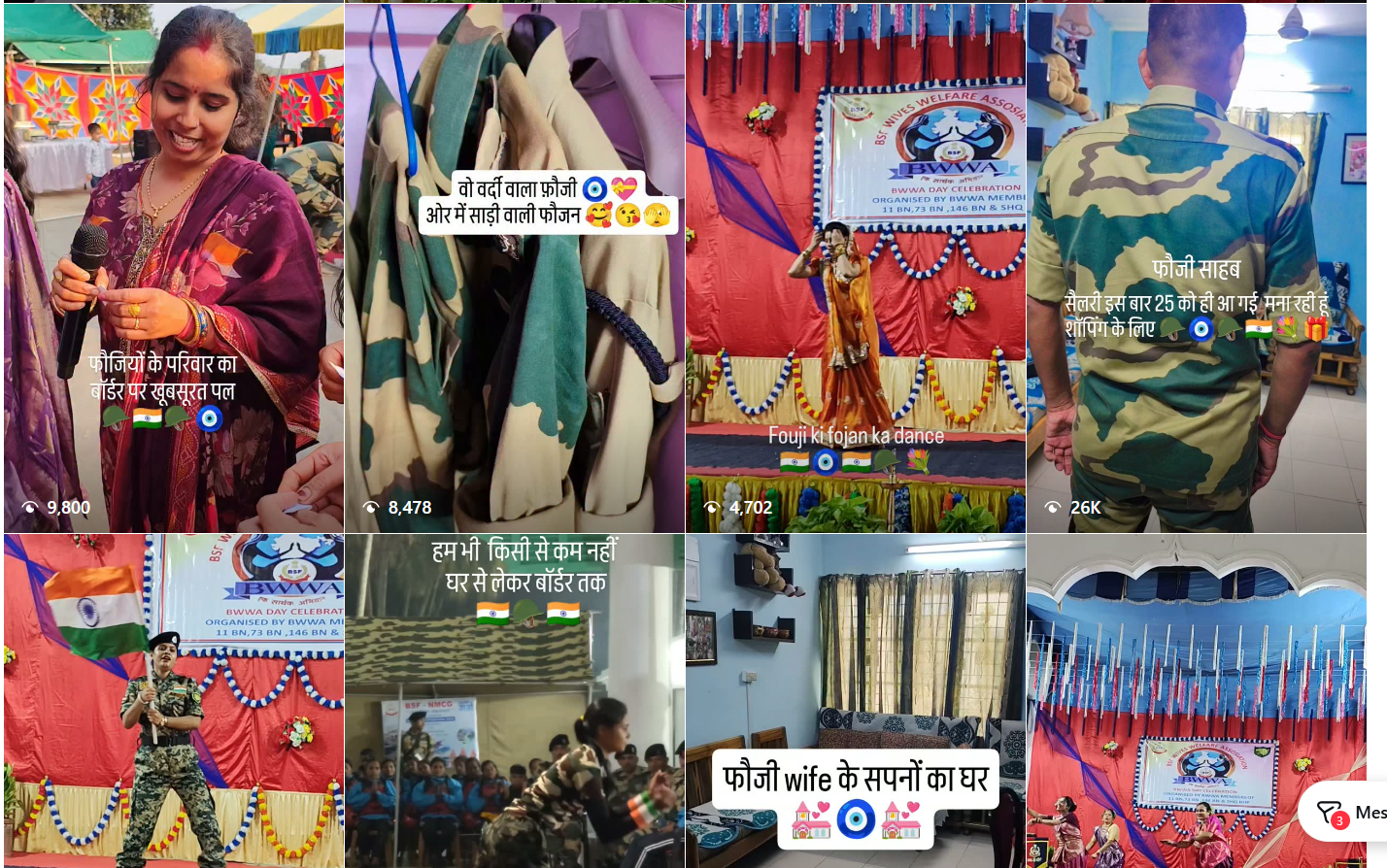
After reviewing these videos, our research found no evidence to substantiate the claim that General Dhiraj Seth attended an event organised by the BSF Wives Welfare Association or danced at the event. His photograph is being linked to the dance video, but no credible evidence supporting this claim was found.
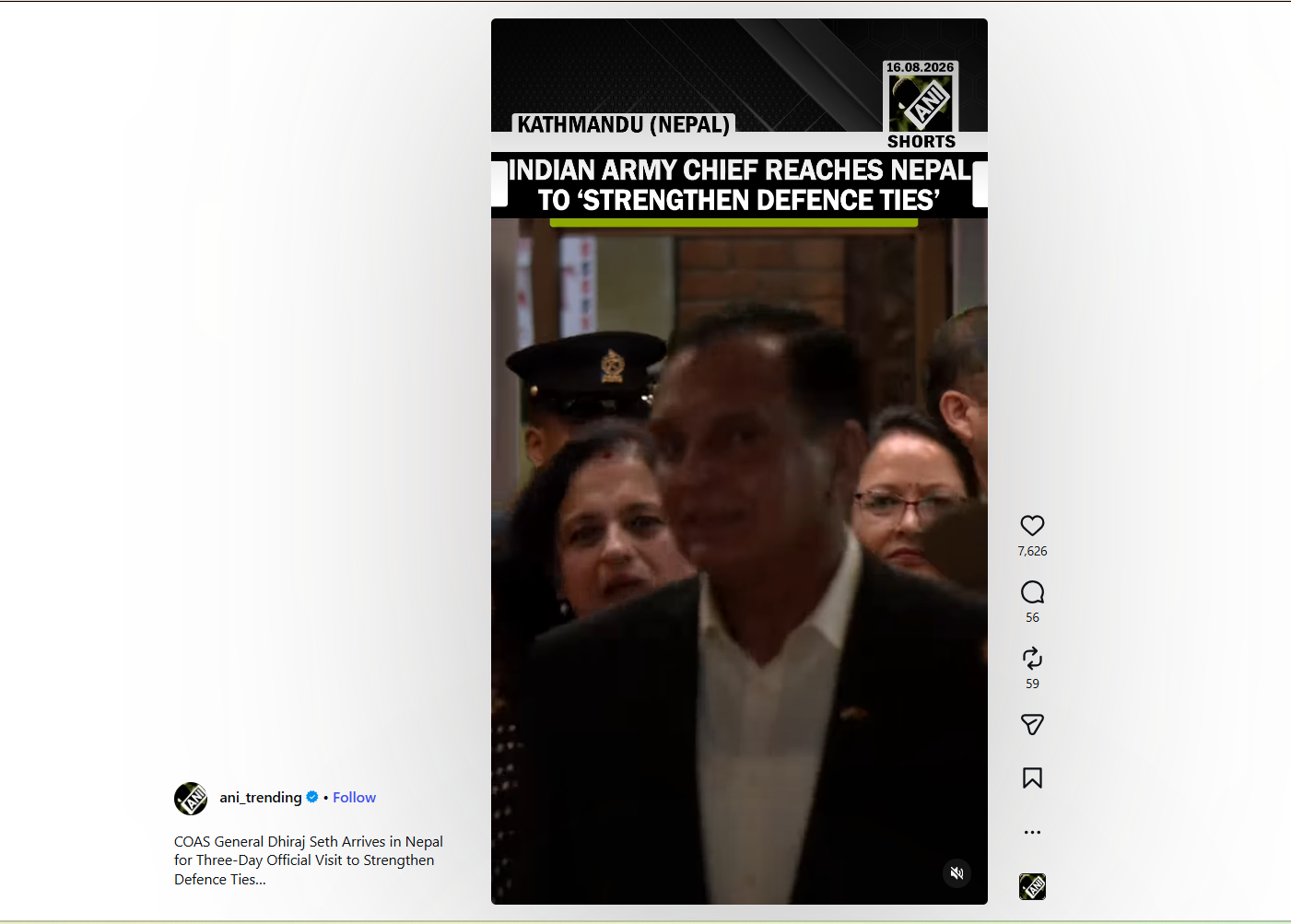
During our research, we found the original video of Army Chief General Dhiraj Seth shared by ANI. According to the report, General Dhiraj Seth arrived in Nepal on a three-day official visit aimed at strengthening defence ties between the two countries.
https://www.instagram.com/reels/DcGxzLPExR5/
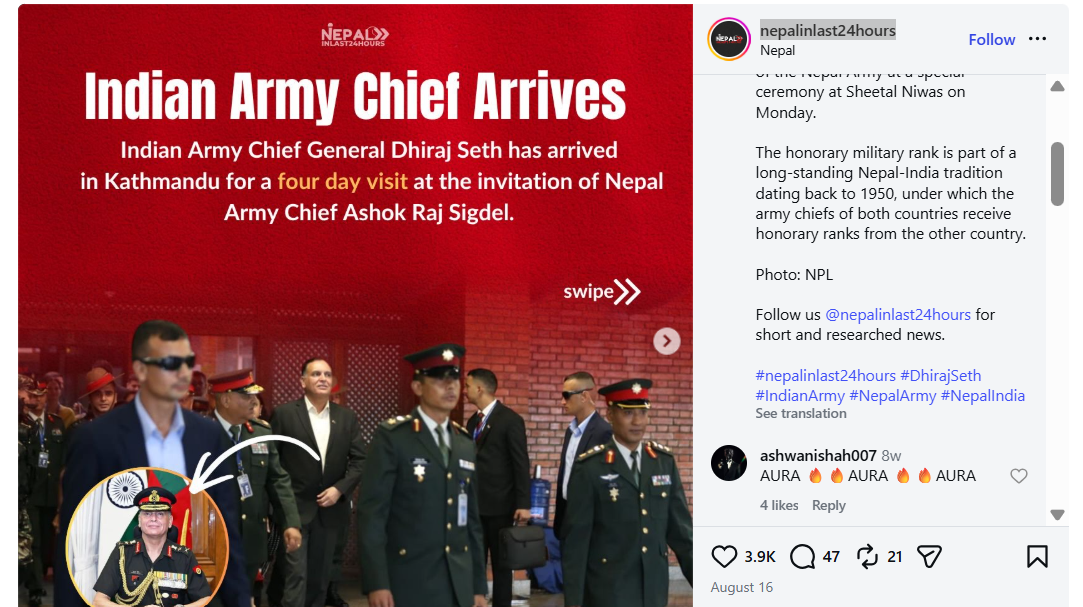
In the final stage of our research, we found a report on an Instagram account named ‘nepalinlast24hours’. According to the report, Indian Army Chief General Dhiraj Seth arrived in Kathmandu on his first foreign visit after taking command of the Indian Army on June 30, 2026. He was welcomed by senior Nepal Army officials at Tribhuvan International Airport.
The report stated that during his four-day visit, General Seth was scheduled to meet Nepal’s Prime Minister Balendra Shah and Nepal Army Chief Ashok Raj Sigdel. Additionally, he was scheduled to be conferred with the honorary rank of General of the Nepal Army at a special ceremony at Sheetal Niwas on Monday.This tradition between India and Nepal dates back to 1950. Under the arrangement, the army chiefs of both countries are conferred with honorary military ranks in each other’s armies.
https://www.instagram.com/p/DcGbgm0jUBH/?dlrf=MXFndzM5dGp4ZTh5OA%3D%3D
Conclusion
Our research found that the viral photograph of Indian Army Chief General Dhiraj Seth is related to his visit to Nepal. According to reports, he travelled to Nepal on his first foreign visit after taking command of the Indian Army, where he was welcomed by senior Nepal Army officials. During the visit, he was also scheduled to be conferred with the honorary rank of General of the Nepal Army.However, his photograph is being linked on social media to a dance video from an event organised by the Central Armed Police Forces (CAPF), accompanied by objectionable claims about him. Our research found no credible evidence confirming General Dhiraj Seth’s presence at the event or his association with the activities shown in the video. Therefore, linking his photograph from his Nepal visit to the dance video is misleading.
Executive Summary
A video is being shared on social media with the claim that a Bharatiya Janata Party (BJP) leader is doing sit-ups in front of the public. Some users are sharing the video as a recent incident, claiming that a BJP MLA performed sit-ups in front of the public. CyberPeace Research found the claim to be misleading. Our research revealed that the viral video is not recent but dates back to February 2022, when Bhupesh Chaubey, the BJP MLA from the Robertsganj Assembly constituency in Sonbhadra, apologised to disgruntled party workers during a party workers' convention.
Claim:
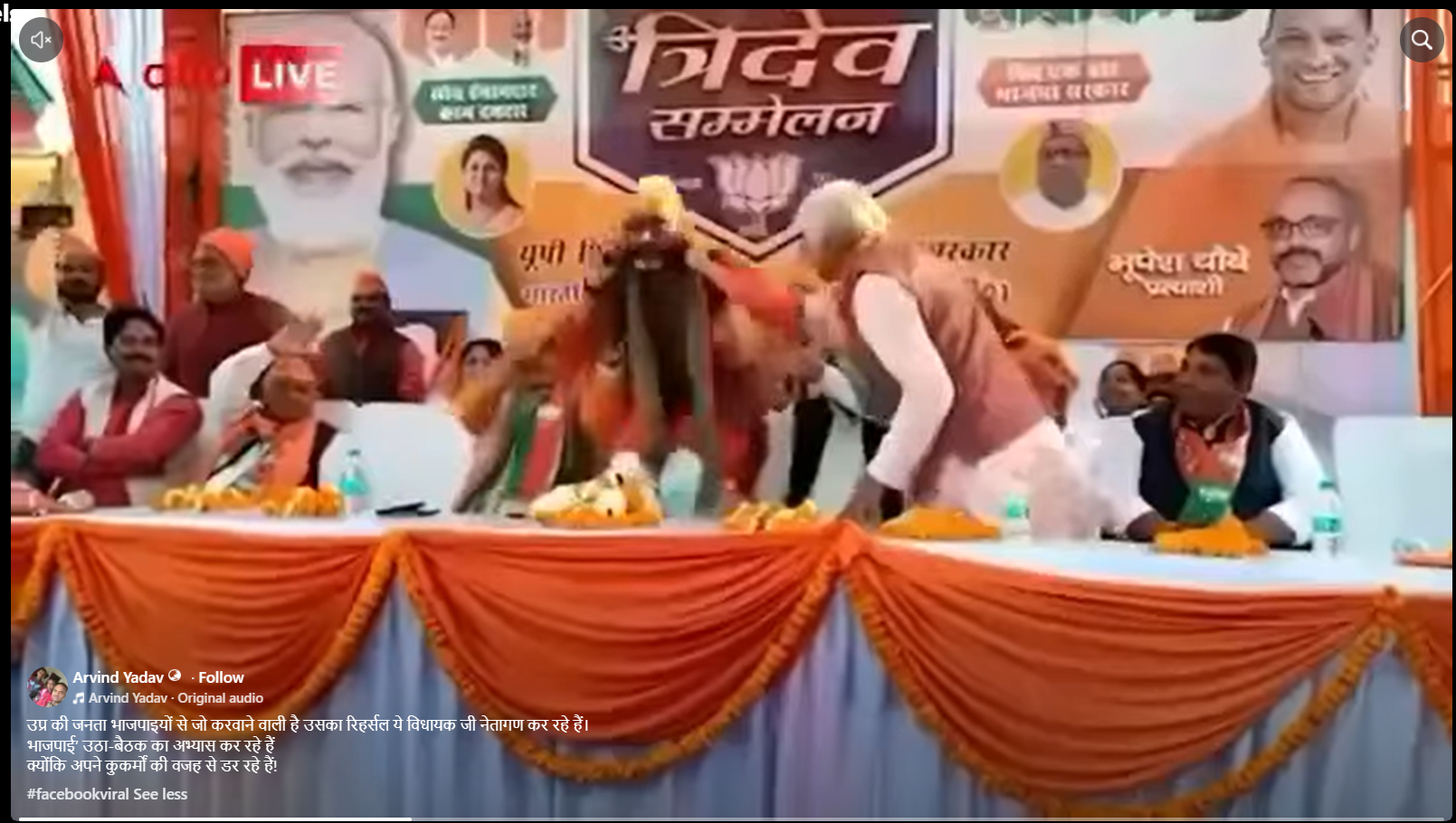
A user on Facebook shared the viral image on October 11, 2026, with the caption: “This is the bond submitted by coward Abhijeet Dipke in court for his release, and he says he will take to the streets again.” The link to the post, its archive link, and a screenshot are provided below.
https://www.facebook.com/reel/1806020163922780
Fact Check
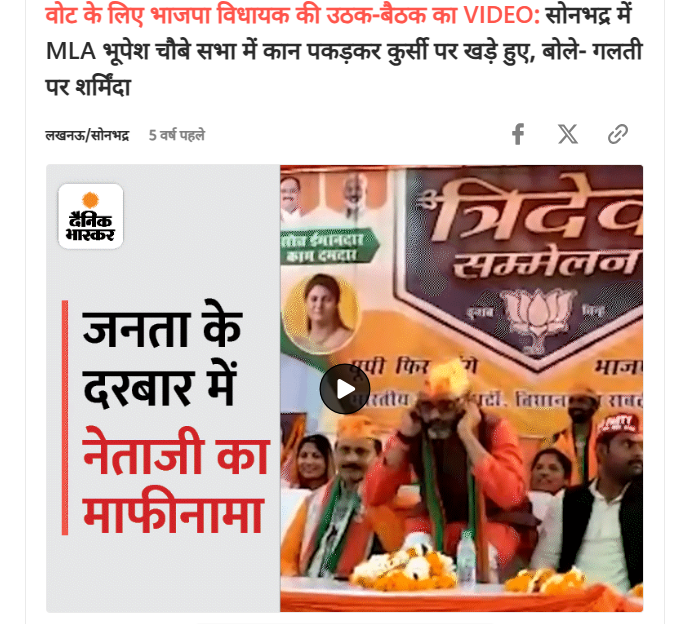
We conducted a reverse image search using keyframes from the viral video. During the search, we found a report published on the Dainik Bhaskar website on February 23, 2022, which featured the same video. According to the report, polling in Sonbhadra was scheduled for March 7 as part of the seventh phase of the Assembly elections. During the election campaign, Bhupesh Chaubey, the BJP MLA and candidate from the Robertsganj Assembly constituency, was seen adopting an unusual approach. He stood on a chair, held his ears and performed sit-ups on the chair, apologising to the public for the mistakes he had made over the previous five years.The link to the report and a screenshot are provided below.
In the next stage of our research, we found a report published on ABP News’ Hindi website on February 25, 2022, which featured the viral video in a general context. We found the same video in this report as well. The link to the report and a screenshot are provided below.
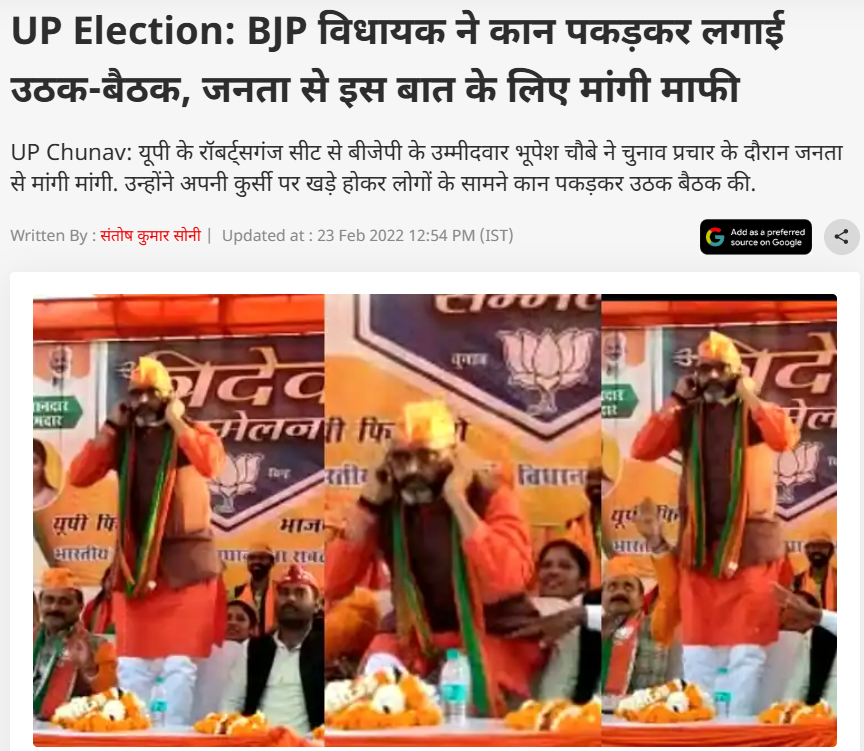
Conclusion
Our research found that the viral video is not recent but dates back to February 2022, when Bhupesh Chaubey, the BJP MLA from the Robertsganj Assembly constituency in Sonbhadra, apologised to disgruntled party workers during a party workers' convention.

Executive Summary
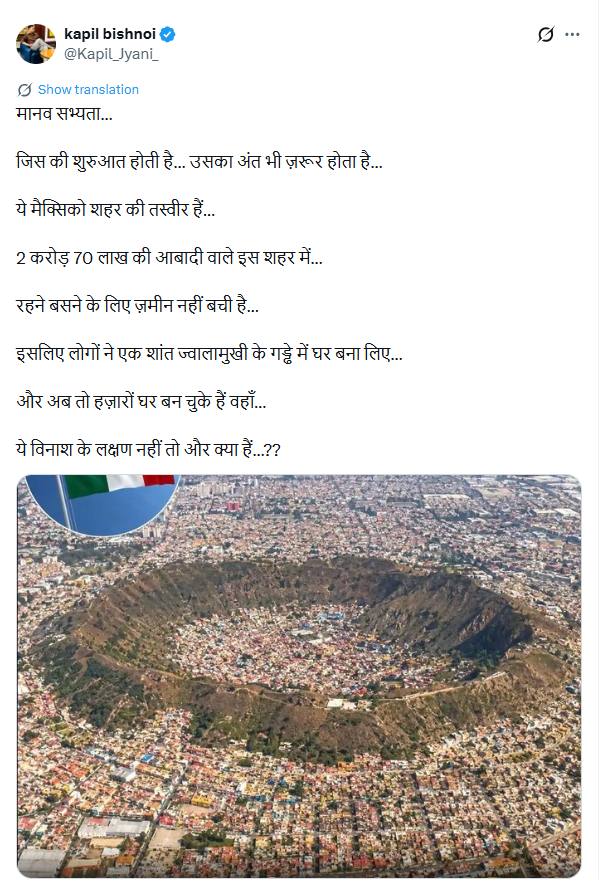
A picture is going viral on social media in the name of Mexico City, with the claim that the city’s population has grown so much that, due to a shortage of space, people have built houses inside the crater of a dormant volcano. The viral picture shows houses and other structures inside the crater, which several users are sharing as a real photograph. The research by the CyberPeace Research Wing found that AI technology was used to create the image. A fact-check by Vishvas News found that there are no houses inside the crater in Mexico, although farming is carried out there and residential areas are located around its outer sections.
Claim:
Facebook page ‘The Great India’ shared a picture on August 12, 2026, claiming, “Mexico City, with a huge population of around 2.5 crore, is facing a severe shortage of land. Due to the city’s unprecedented expansion, people have found an unusual way to create homes — settlements, houses and even playgrounds have reportedly been built inside the crater of a dormant volcano. The city, located in a high plateau surrounded by volcanic hills, has seen people turn volcanic slopes and depressions into habitable areas due to the declining availability of land and rapidly growing population.”
Several users on X also shared the picture believing the claim to be true.
https://x.com/Kapil_Jyani_/status/2087380670909931602?s=20
FactCheck
To verify the viral picture, we first scanned it using Google Lens. We found similar pictures on several websites and social media accounts, where they were identified as the crater of Xico Volcano in Mexico.
During the search, we also found a picture on Shutterstock, which identified the location as the crater of Xico Volcano in Chalco, Mexico.
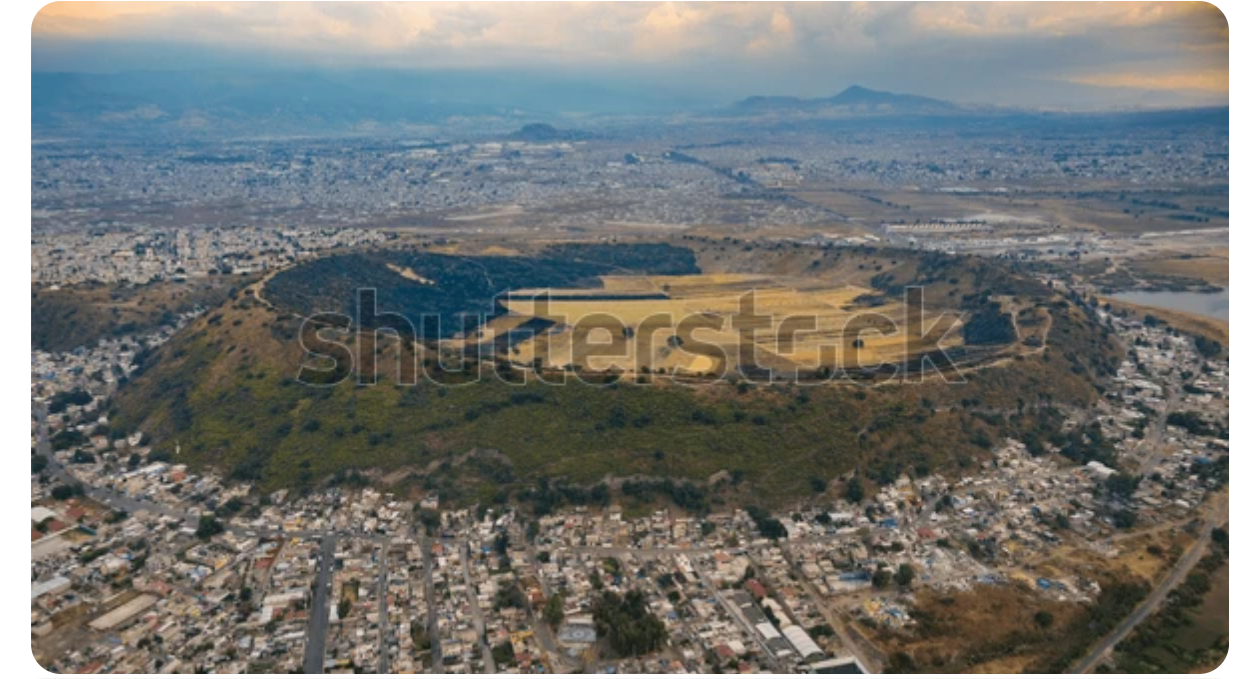
We then used Google Maps to check the location. The search showed that the Xico crater is located on the southern outskirts of Mexico City. Upon checking the area, we found agricultural activity inside the crater, while some houses could be seen in the surrounding areas.
https://maps.app.goo.gl/hszKcR1a8srtYe91A
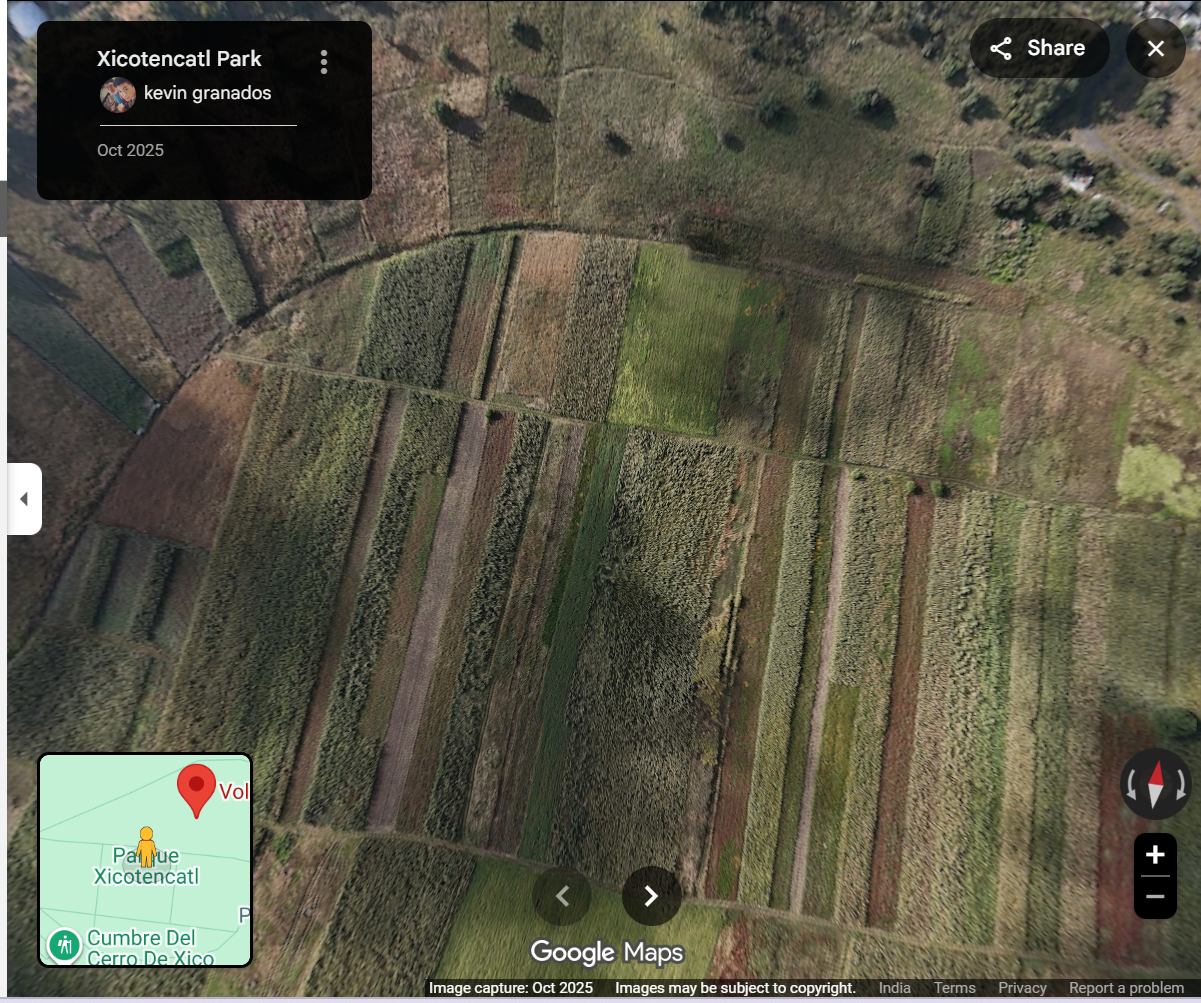
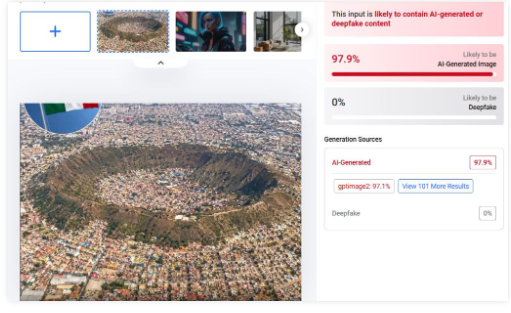
During the next stage of the research, we analysed the viral picture using AI detection tools. We first scanned the image using Hive Moderation. The tool indicated more than a 98 per cent probability that the viral picture was AI-generated.
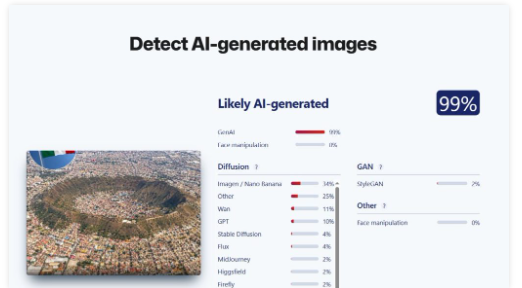
We then checked the picture using another AI detection tool, Sightengine. Its analysis also indicated a 99 per cent probability that the image was AI-generated.
Conclusion
Our research found that the claim that people have built houses inside a volcano crater in Mexico City due to a shortage of land is false. Although farming takes place inside the Xico crater, residential areas are located outside it. The viral picture was created using AI and is being shared with a misleading claim.

Executive Summary
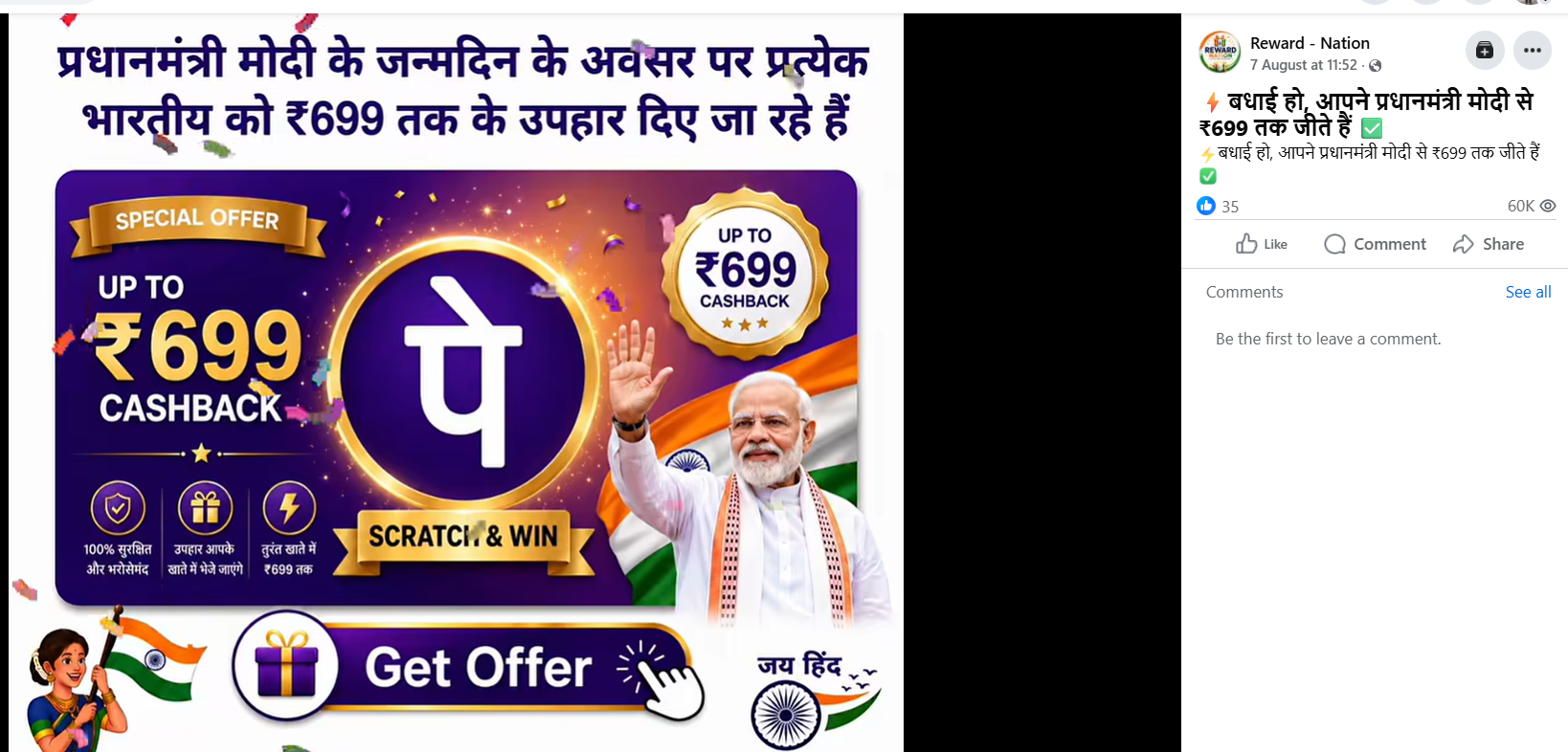
A poster is being shared on social media claiming that people have an opportunity to win up to ₹699 on Prime Minister Narendra Modi’s birthday. The poster carries a “GET OFFER” button and asks users to click on it.
The CyberPeace Research Wing found the claim to be false. The research found that the Government of India has made no such announcement offering ₹699 to people on Prime Minister Narendra Modi’s birthday. The viral post is misleading and fake.
Claim
A Facebook user shared the viral poster with the caption:“Congratulations, you have won up to ₹699 from Prime Minister Modi.”
https://www.facebook.com/100083035017578/videos/1533904658280321/
FactCheck
To verify the claim, we conducted a Google search using relevant keywords. However, we did not find any credible media report confirming that the Government of India had announced such an offer.
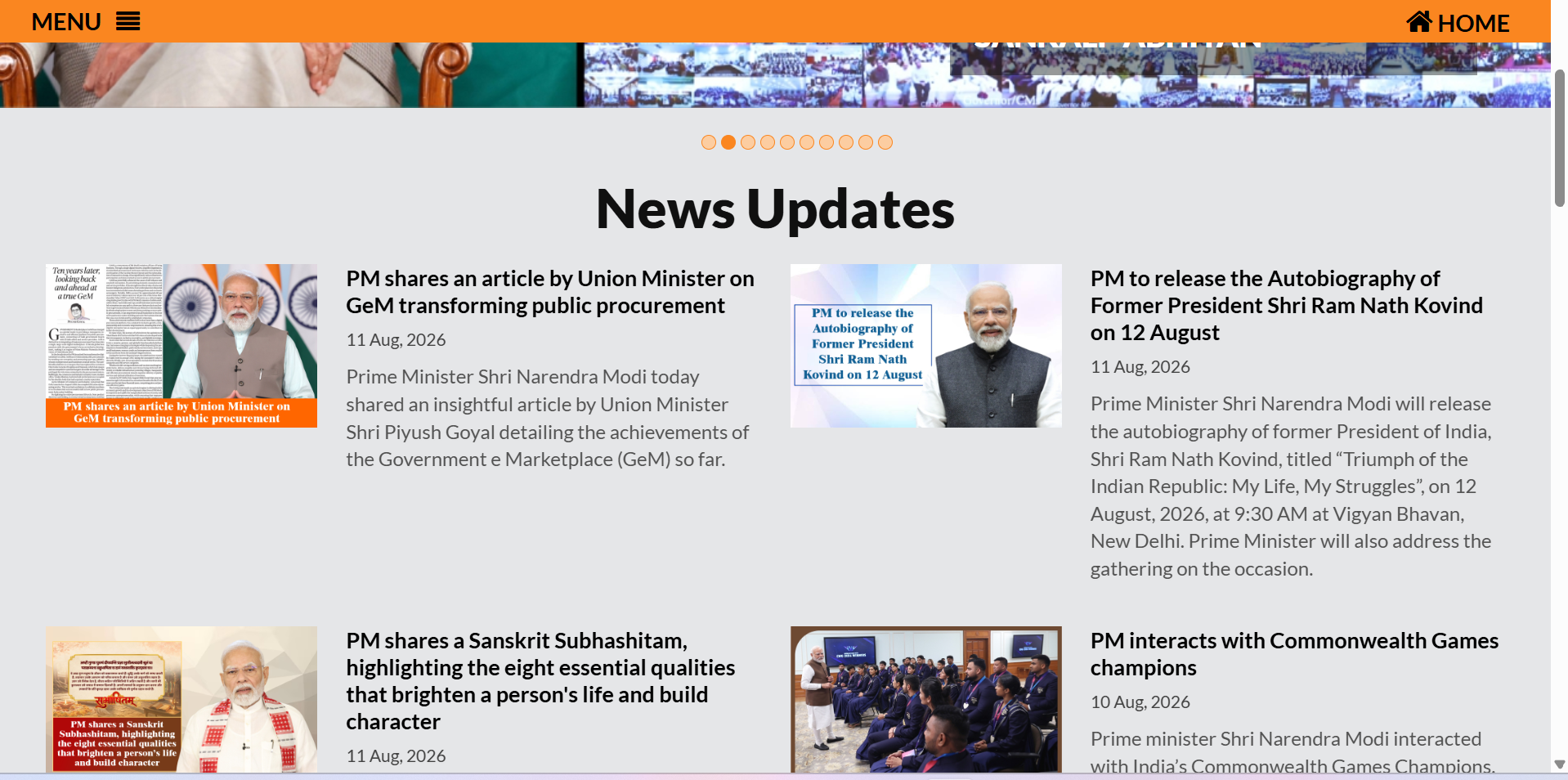
We then checked the official website of the Prime Minister’s Office (PMO) for any announcement related to the alleged ₹699 prize offer. No official notification or report supporting the claim was found.
As part of the next stage of verification, we also checked the official X accounts of the PMO and Prime Minister Narendra Modi. We found no post or official announcement confirming the viral claim.
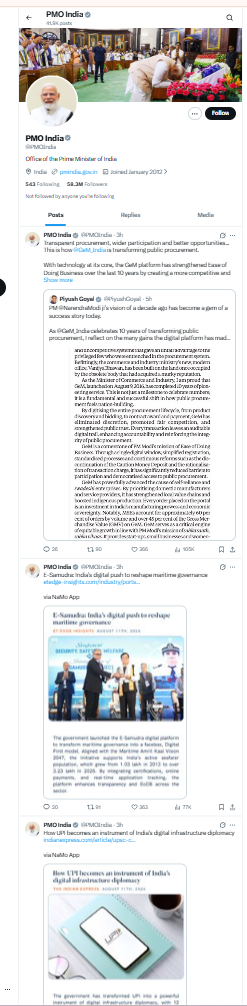
https://x.com/narendramodi
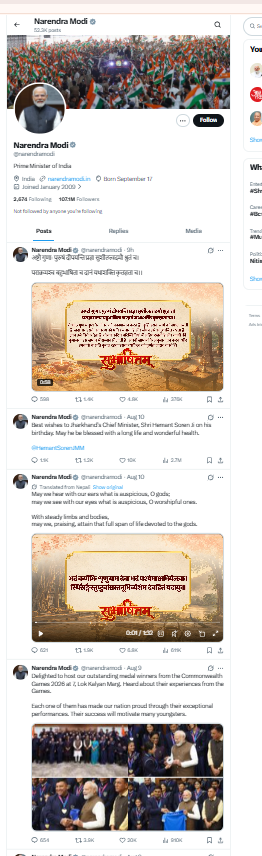
Conclusion
Our research found that the Government of India has not announced any ₹699 prize or offer on the occasion of Prime Minister Narendra Modi’s birthday. The viral poster is therefore fake and misleading. Users should avoid clicking on such suspicious “GET OFFER” links, as they may be designed to redirect users to fraudulent or deceptive websites.

Executive Summary
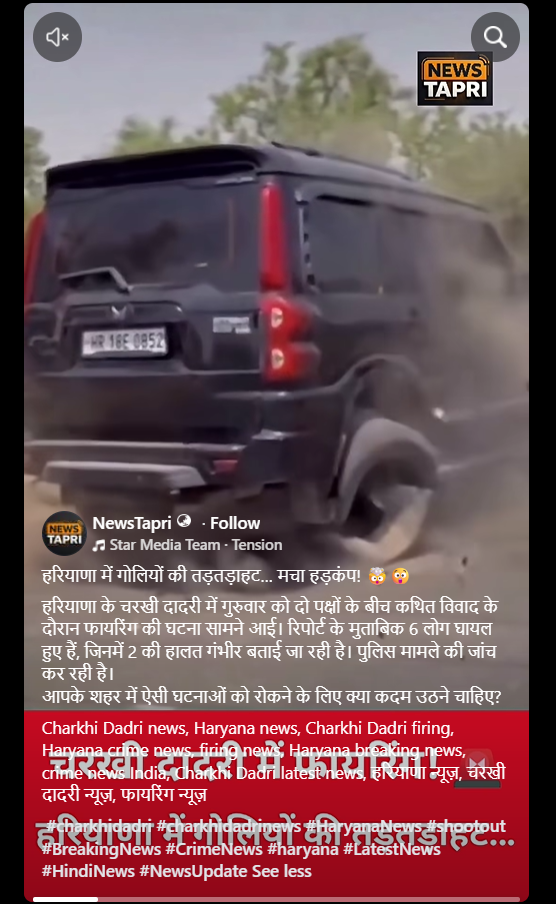
A video showing a black Scorpio being sprayed with bullets is being widely shared on social media.The video is being circulated with the claim that it shows the real footage of the firing incident in Haryana’s Charkhi Dadri on August 6, when around 30 rounds were allegedly fired at a Scorpio outside the City Police Station. The CyberPeace Research Wing found the claim to be false. The research established that the viral video is AI-generated and is being shared with a misleading claim.
Claim
A Facebook user shared the viral video with a caption stating, "Gunshots ring out in Haryana… panic grips the area! A firing incident reportedly took place in Charkhi Dadri, Haryana, during an alleged dispute between two groups on Thursday. According to reports, six people were injured, with two said to be in critical condition. Police are investigating the matter. What steps should be taken to prevent such incidents in your city?"
https://www.facebook.com/reel/991406893937983
FactCheck
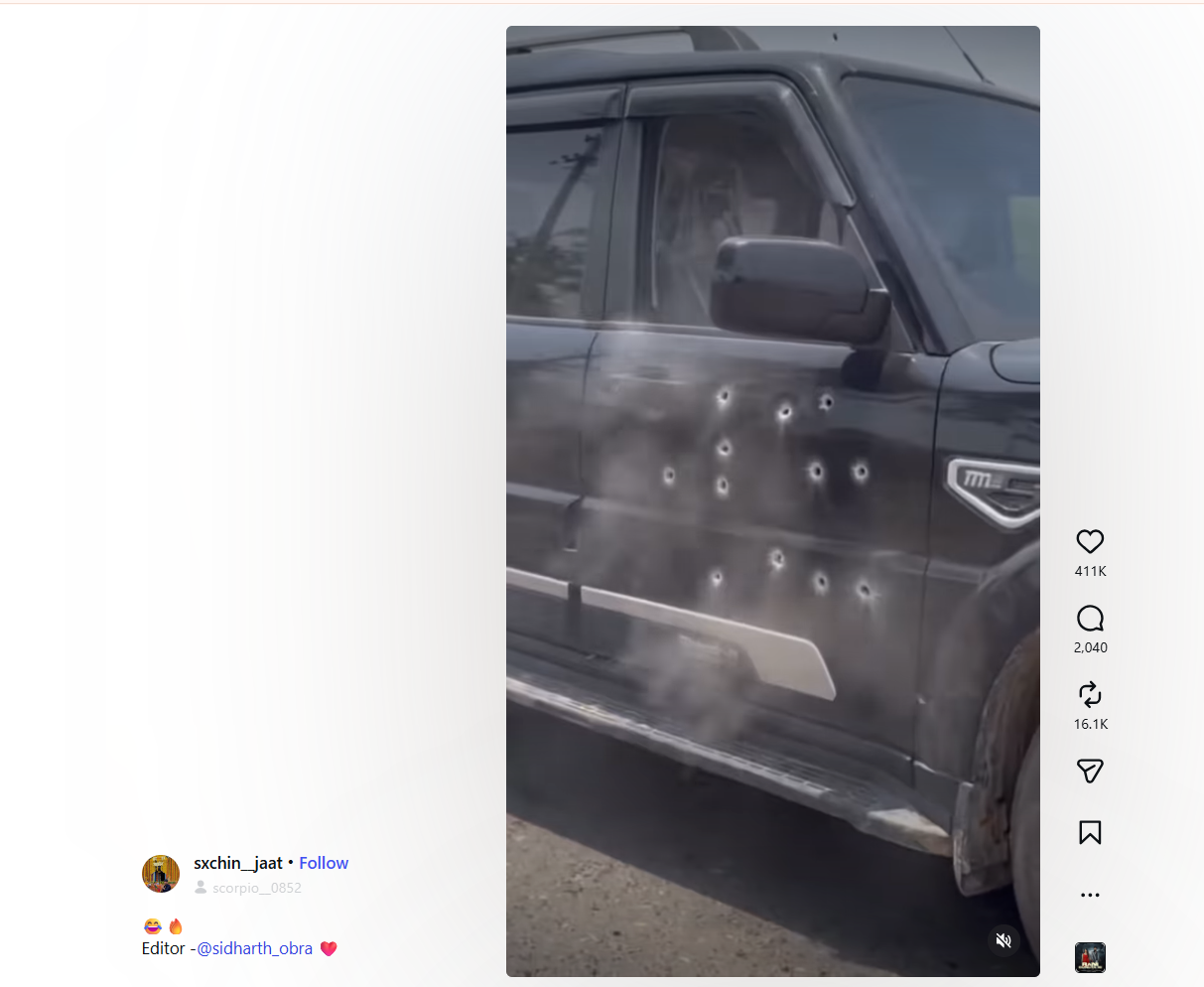
To verify the claim, we extracted keyframes from the viral clip and conducted a reverse image search. During the search, we found an older post containing the same video on an Instagram account named ‘sxchin_jaat’. The video was uploaded on May 12, well before the Charkhi Dadri firing incident of August 6.
The earlier upload establishes that the viral clip is unrelated to the firing incident in Charkhi Dadri.
https://www.instagram.com/reels/DYOOXiASH4h/
We then examined the viral video closely and noticed visual characteristics that raised suspicions that it could be AI-generated. The video was subsequently analysed using Hive Moderation, which indicated a 96 per cent probability of AI-generated content.
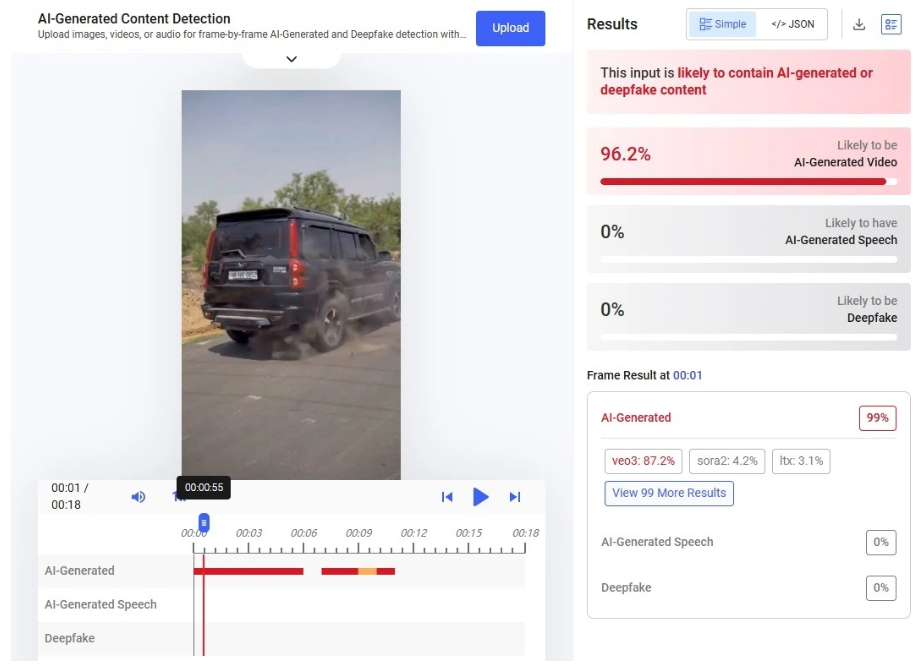
As part of the next stage of verification, we analysed the video using another AI detection tool, Undetectable AI. The tool also identified the viral video as AI-generated.

Conclusion
The viral claim is false. The video being shared as authentic footage of the August 6 firing incident in Charkhi Dadri is not genuine. The clip was posted online as early as May 12 and AI detection tools also identified it as AI-generated. The video is therefore being circulated with a misleading claim linking it to the Charkhi Dadri firing incident.
Executive Summary
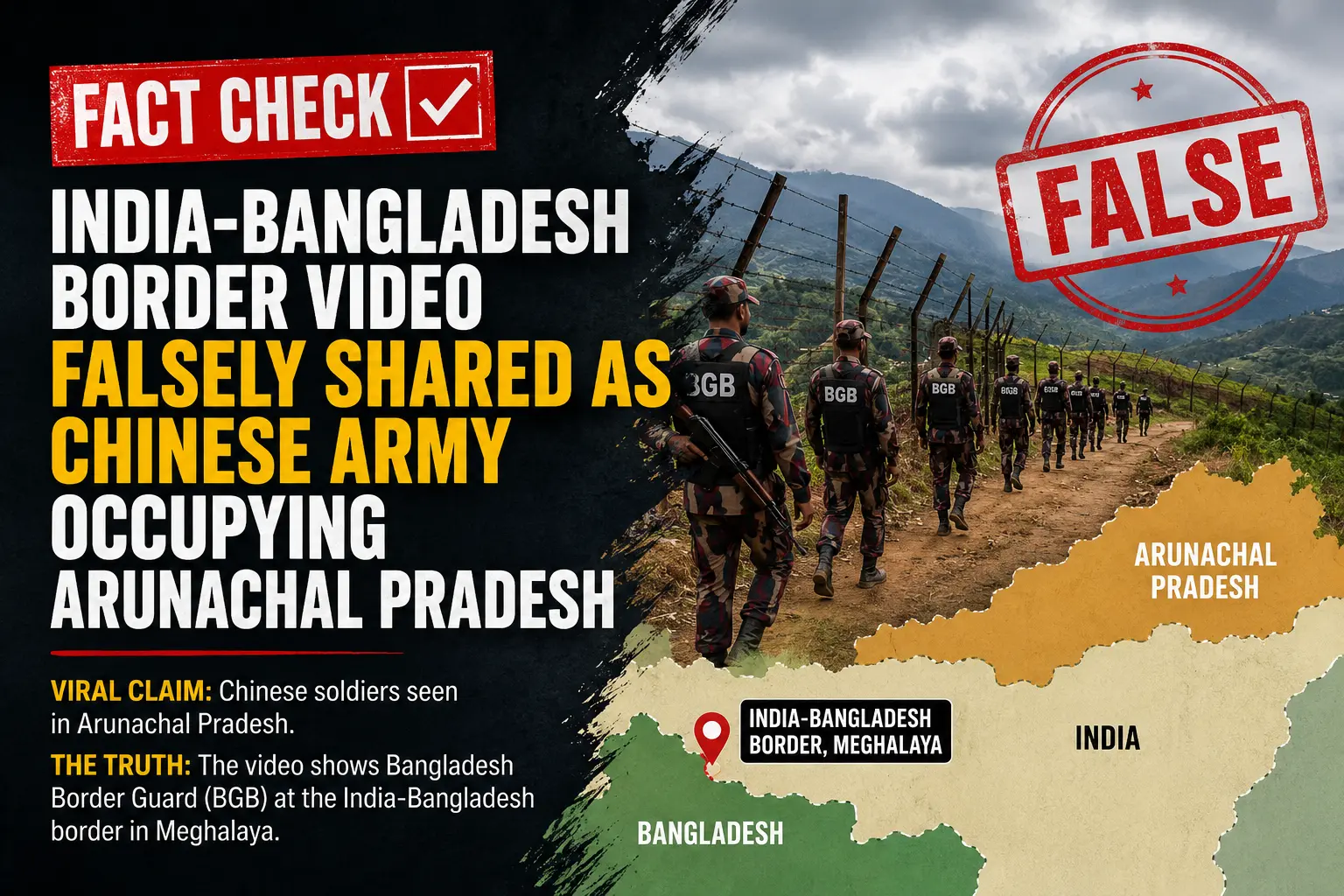
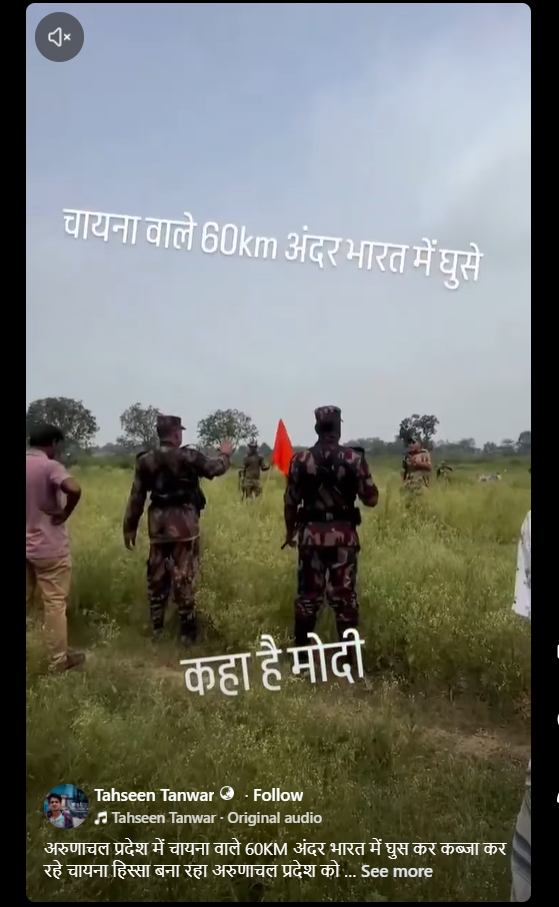
A video is being widely shared on social media with the claim that the Chinese Army has entered 60 kilometres inside Arunachal Pradesh and occupied Indian territory. In the video, a man appears to be recording the situation using his selfie camera, while soldiers can be seen standing face-to-face and arguing with each other in the background. The CyberPeace Research Wing found that the claim is false. The viral video is not from Arunachal Pradesh. It shows a confrontation between India’s Border Security Force (BSF) and Bangladesh’s Border Guard Bangladesh (BGB) along the India-Bangladesh border.
Claim
A Facebook user shared the video with the caption:
"China is entering 60 km inside India and occupying Arunachal Pradesh. China is turning Arunachal Pradesh into its territory. Where are Prime Minister Modi, Defence Minister Rajnath Singh and Home Minister Amit Shah?"
Post link:
https://www.facebook.com/reel/1736825064305394
https://www.facebook.com/reel/1736825064305394
FactCheck
Our research found no credible news report confirming that Chinese troops had entered 60 kilometres inside Arunachal Pradesh or occupied Indian territory.
The people in the viral video can be heard speaking in Bengali, suggesting that the footage could be from the India-Bangladesh border rather than Arunachal Pradesh.
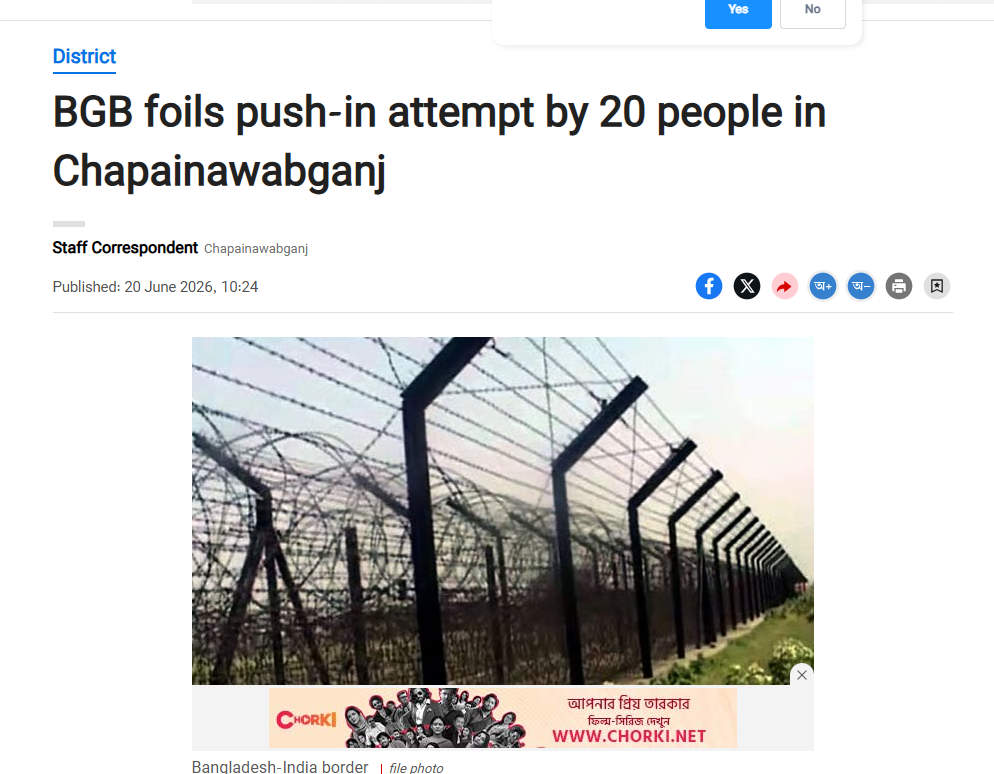
A reverse image search of keyframes from the viral video led us to an identical video posted on the Facebook page of Bangladeshi news channel Jamuna TV on June 20. According to the caption, the incident took place along the Chapainawabganj border in Bangladesh, where personnel of India’s BSF and Bangladesh’s BGB had confronted each other.
https://www.facebook.com/reel/1049262804595610
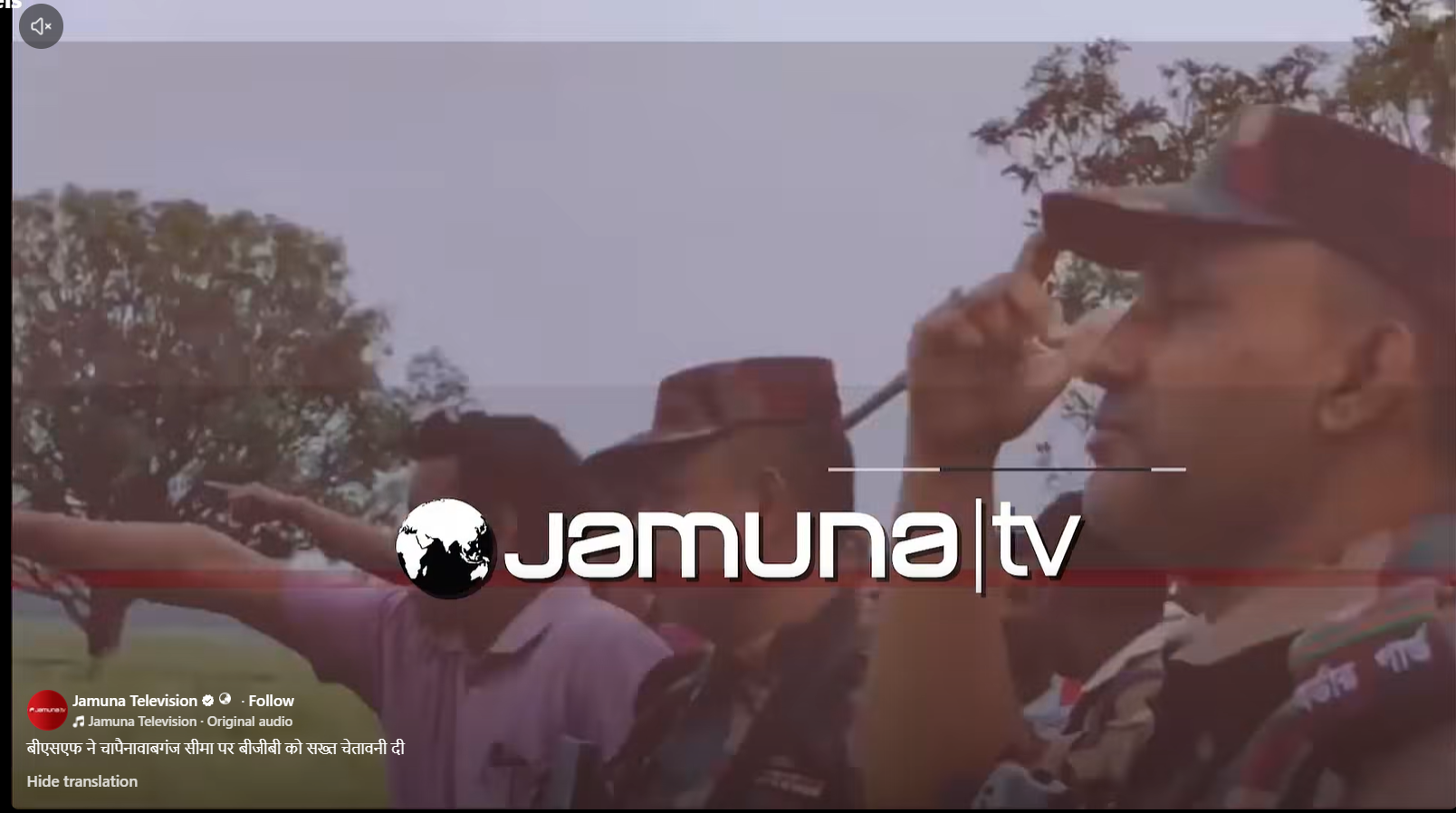
We also found reports from Bangladeshi media outlet Prothom Alo about the incident. According to the reports, Bangladeshi security personnel had stopped around 20 people who were attempting to return to Bangladesh from India, following which a verbal altercation took place between BSF and BGB personnel.
https://www.prothomalo.com/bangladesh/district/syzkfootaq
Conclusion
The viral claim is false. The video does not show Chinese troops entering or occupying 60 kilometres of territory inside Arunachal Pradesh. It actually shows a confrontation between BSF and BGB personnel along the India-Bangladesh border in the Chapainawabganj area of Bangladesh. The footage is being circulated with a false Arunachal Pradesh-related narrative.
Executive Summary
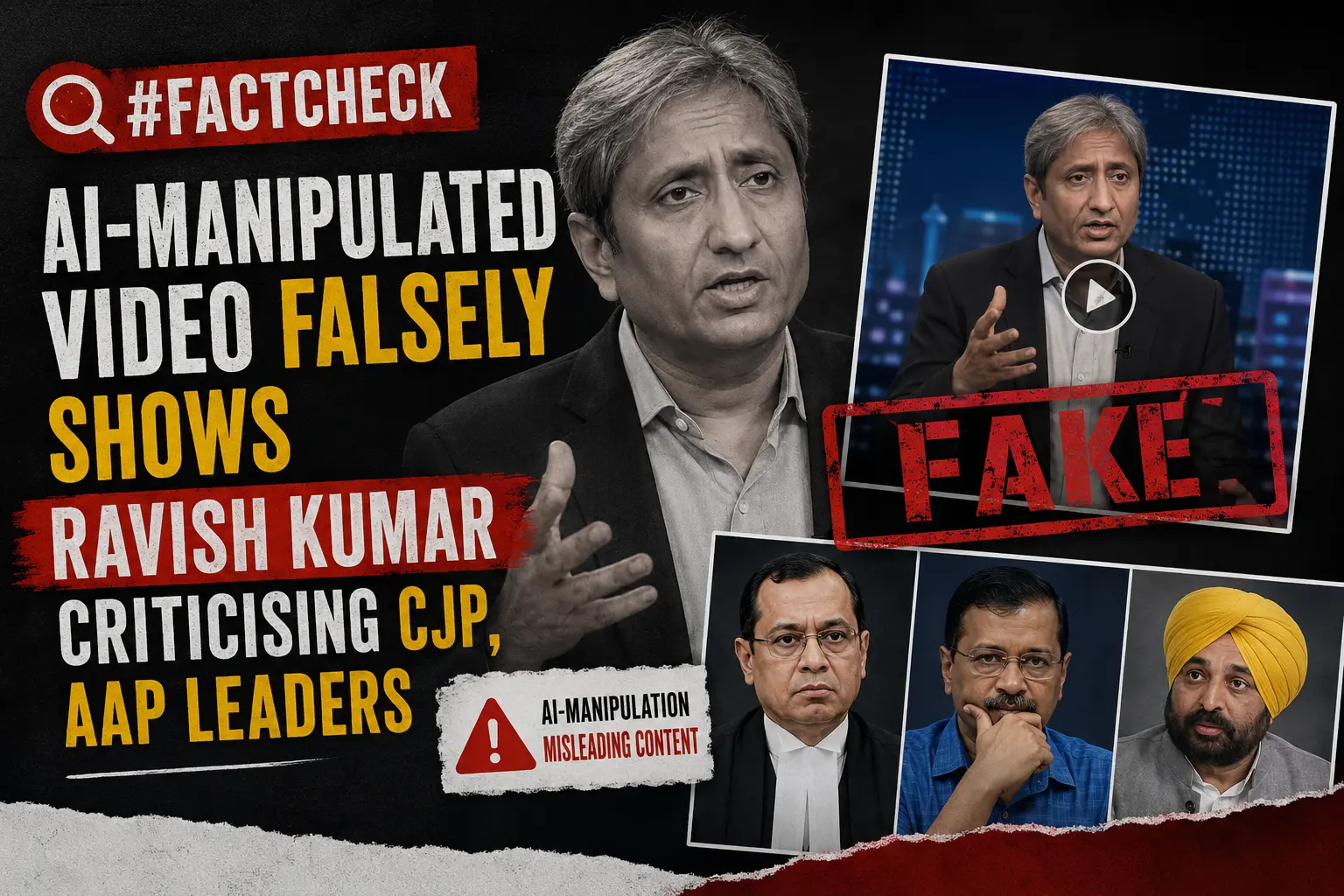
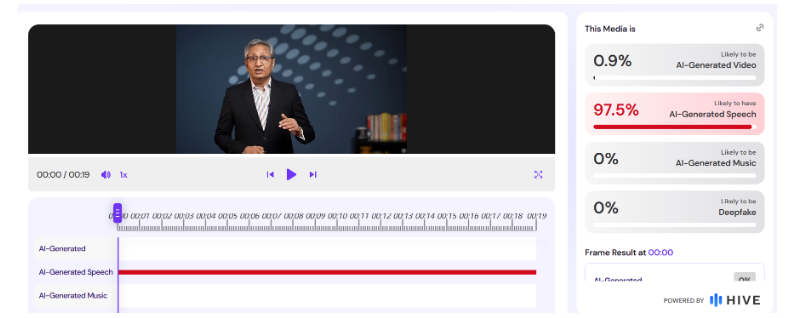
A video of journalist Ravish Kumar is being widely shared on social media. The video is being circulated with the claim that Kumar criticised Abhijeet Deepak, the CJP and Aam Aadmi Party (AAP) leaders over the CJP’s alleged absence from the ongoing student protest in Jharkhand. The CyberPeace Research Wing found the claim to be false. The research established that the original video of Ravish Kumar was digitally manipulated using artificial intelligence (AI), and altered audio was added before it was shared with a misleading claim.
Claim
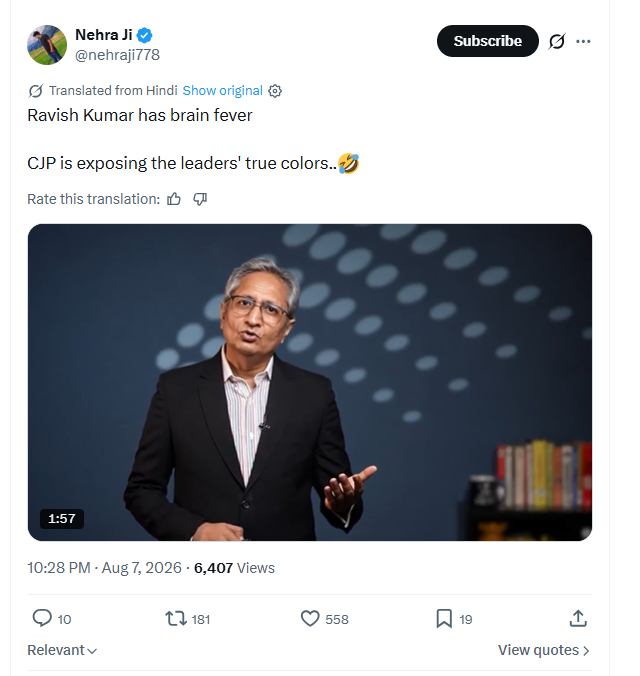
A user on X (formerly Twitter) shared the viral video on August 7, 2026, with the caption: “Ravish Kumar has brain fever. CJP is exposing the leaders’ true colors.”
https://x.com/nehraji778/status/2085772474915164506
Factcheck
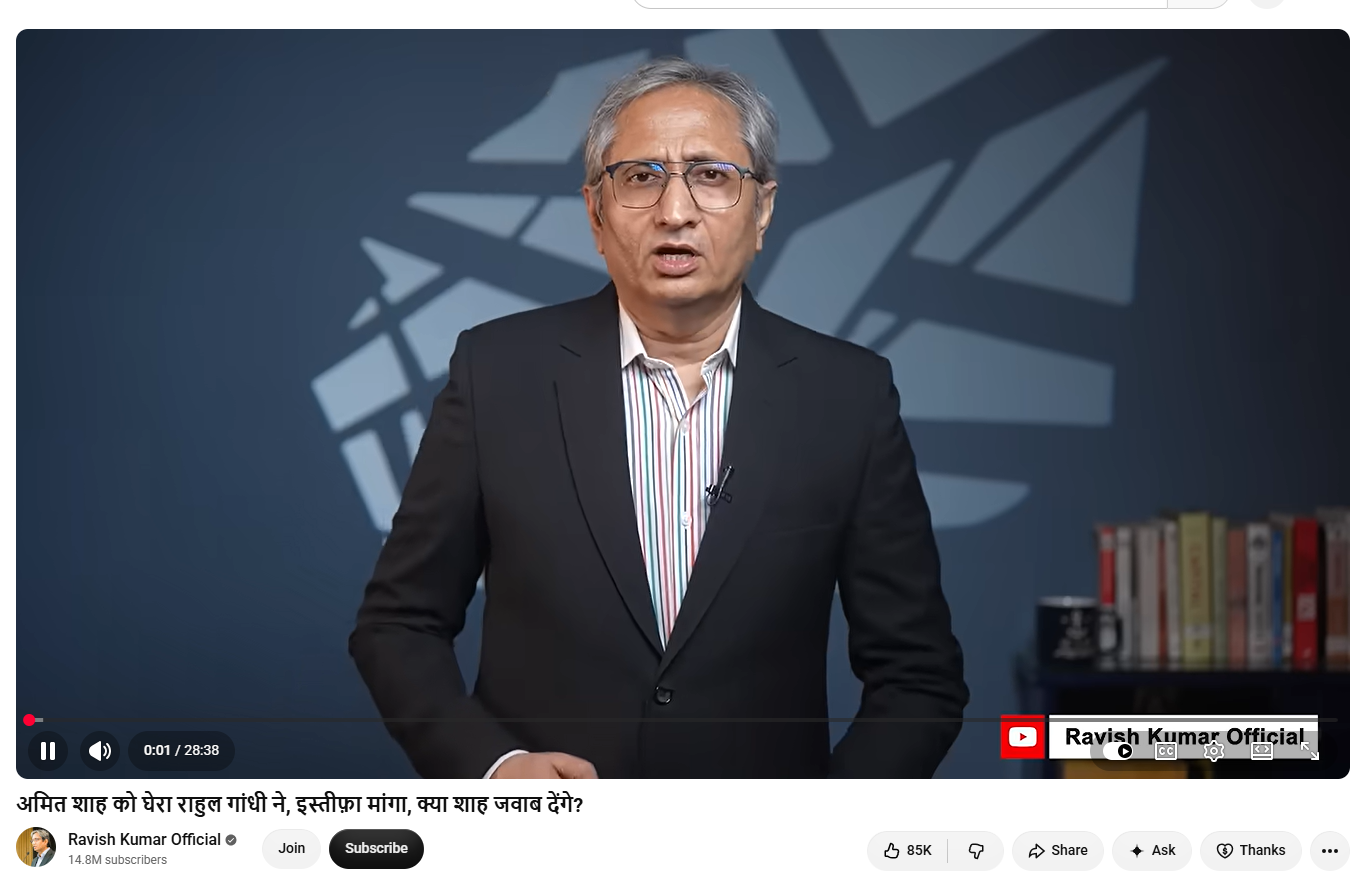
To verify the claim, we extracted several keyframes from the viral video and conducted a reverse image search using Google Lens. During the search, we found a video uploaded on Ravish Kumar’s official YouTube channel on July 29, 2026.
The visuals in the original video match those seen in the viral clip. Ravish Kumar can be seen wearing the same clothes and appearing in almost the same frame as in the viral video.
https://www.youtube.com/watch?v=Rdn_hfyZVRM
In the next step, we analysed the viral video using Hive Moderation. The tool indicated a 97 per cent probability that the video was AI-generated.
Conclusion
The research found that the viral claim is false. The visuals are taken from a genuine video of Ravish Kumar, but the original footage has been digitally manipulated and altered audio has been added using AI. The modified video is being circulated with a misleading claim that Kumar criticised Abhijeet Deepak, CJP and AAP leaders over the Jharkhand student protest.
Executive Summary
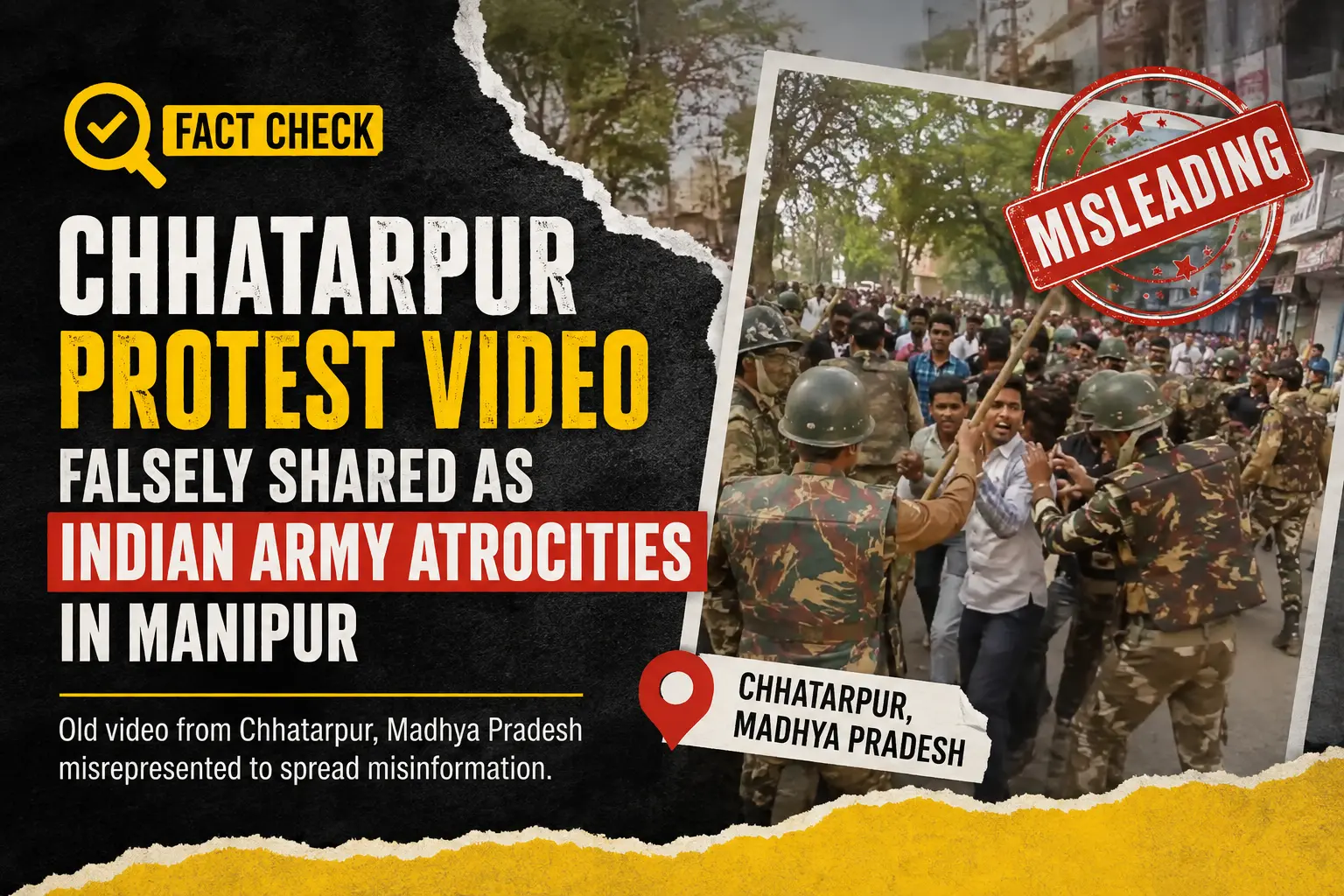
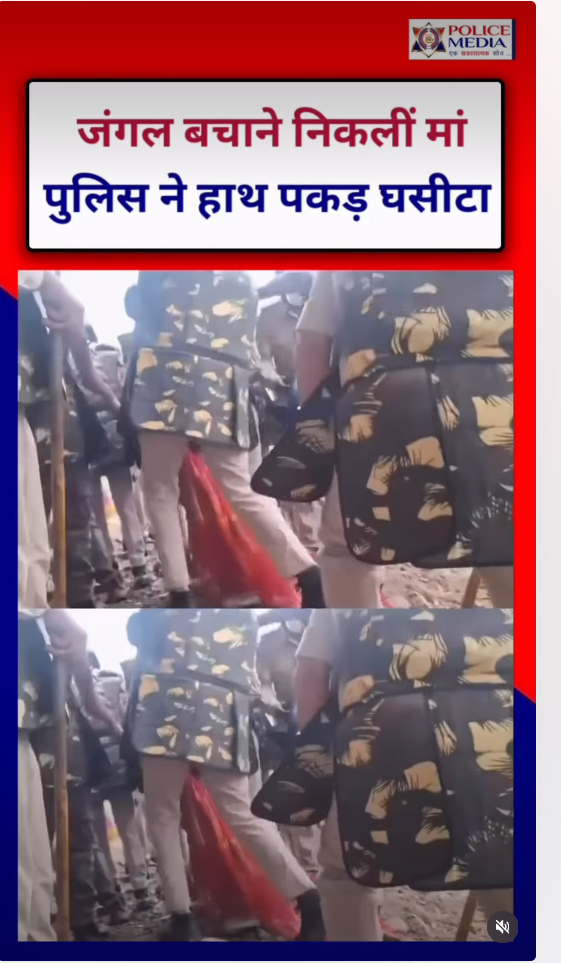
A video is going viral on social media showing police personnel allegedly dragging an elderly woman. The video is being shared with the claim that it was filmed in Manipur and shows the Indian Army committing atrocities against women. The CyberPeace Research Wing found that the viral video is not from Manipur. It was recorded during protests against the Ken-Betwa Link Project in Chhatarpur, Madhya Pradesh, and is being circulated with a misleading claim.
Claim:
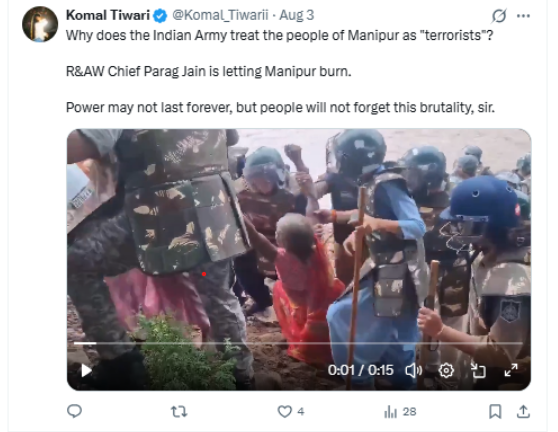
A video shared on social media claims that the Indian Army is committing atrocities against local people, particularly women, in Manipur. The post further alleges that R&AW chief Parag Jain is allowing Manipur to burn and that people will never forget the alleged brutality.
https://x.com/i/status/2084180049285005687
Factcheck
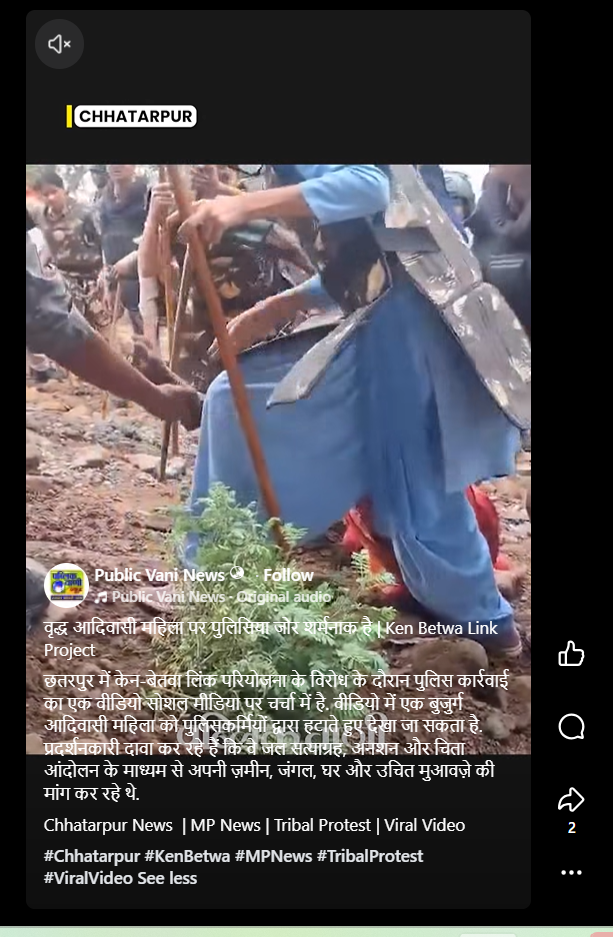
To verify the claim, our team extracted keyframes from the viral video and conducted a reverse image search using Google Lens. During the search, we found the same video uploaded on the Facebook page of Public Vani News on July 31. The accompanying description stated: “Police action against an elderly tribal woman is shameful. During protests against the Ken-Betwa Link Project in Chhatarpur, a video showing police removing an elderly tribal woman has gone viral. Protesters claim they were holding a Jal Satyagraha, hunger strike and Chita Andolan while demanding fair compensation and protection of their land, forests and homes.”
The post and screenshot are provided below:
https://www.facebook.com/reel/1031078973033873
In the next step of the research, we found the same video on an Instagram channel named policemedianews, where it was shared without the misleading Manipur-related claim. The post link and screenshot are provided below
https://www.instagram.com/reels/DbfALvaT4mH/
Conclusion:
The research found that the viral claim is misleading. The video is not from Manipur and does not show Indian Army personnel targeting women there. The footage is from protests against the Ken-Betwa Link Project in Chhatarpur, Madhya Pradesh, where police were seen removing an elderly tribal woman during the demonstration. The video is being shared on social media with a false context.

Executive Summary
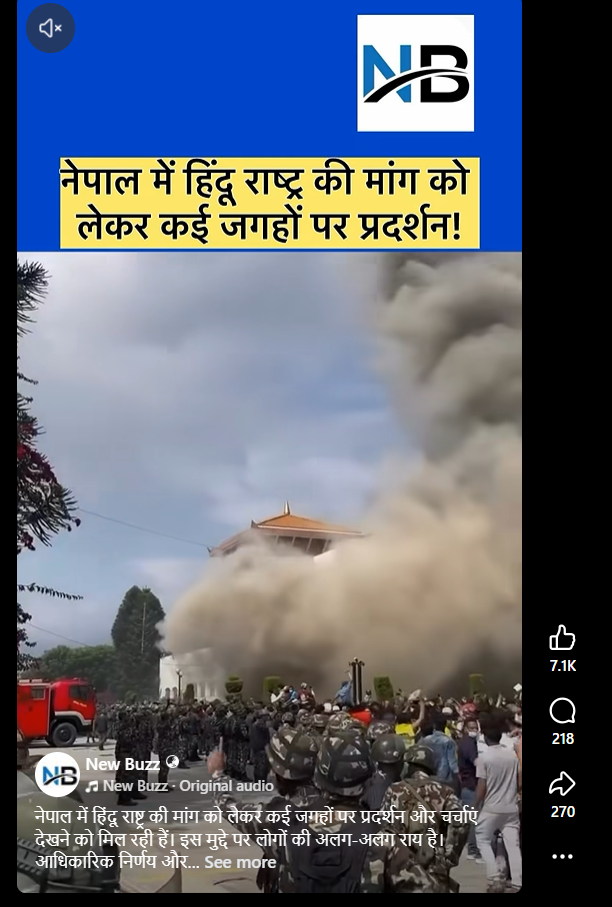
A video showing protesters and smoke rising from an area is being widely shared on social media with the claim that it depicts violent protests in Nepal over demands to declare the country a Hindu nation. The CyberPeace Research Wing found that the claim is false. The viral video is actually from the Gen-Z protests in Nepal in September 2025 and is unrelated to the recent demands for a Hindu state.
Claim
Following reports of communal violence in Nepal in July 2026, an organisation submitted a memorandum to Home Minister Soodan Gurung, calling for discussions on declaring Nepal a Hindu nation. Against this backdrop, a video showing protesters and smoke has gone viral on social media. A Facebook user, ‘New Buzz’, shared the video on August 5, 2026, with the caption:
"Protests and discussions are being seen in several places in Nepal over the demand for a Hindu nation. People have different views on this issue. One should reach a conclusion only on the basis of official decisions and credible information."
https://www.facebook.com/reel/27872198842449234
https://ghostarchive.org/archive/P89Qo
FactCheck:
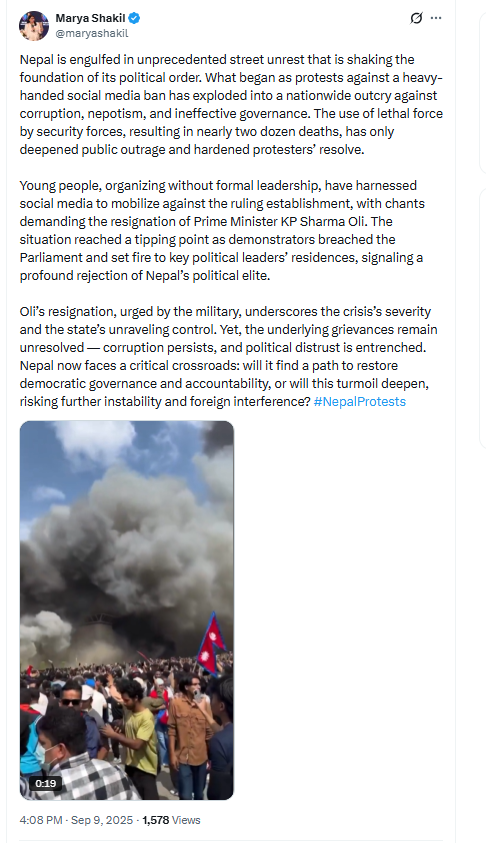
To verify the claim, we extracted keyframes from the viral video and conducted a reverse image search using Google Lens. The search led us to a post by India Today journalist Marya Shakil on X, dated September 9, 2025. She had shared the same video and identified it as footage from the Gen-Z protests in Nepal against corruption
https://x.com/maryashakil/status/1965364156992782723?s=20
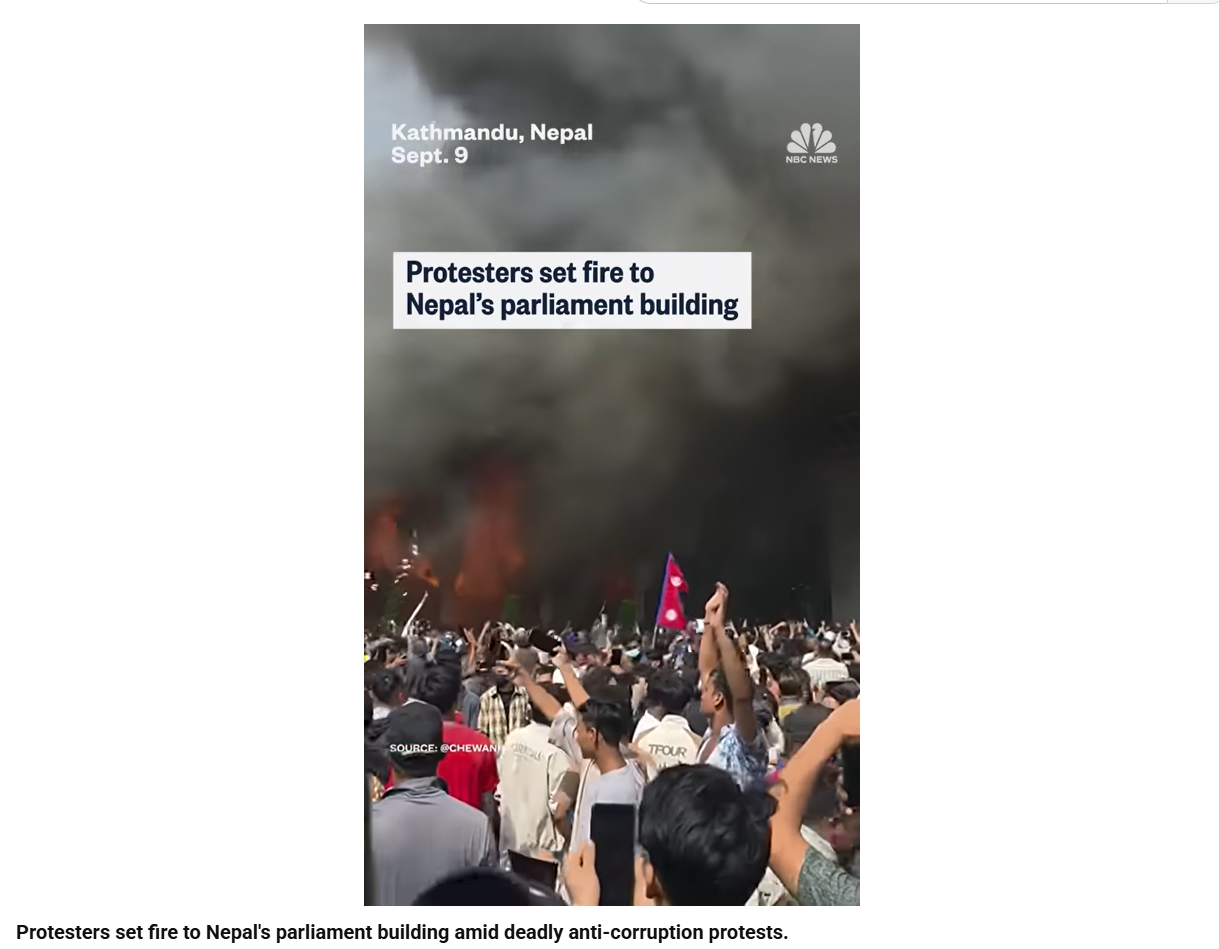
We also found a related news report on the NBC News YouTube channel, published on September 9, 2025. The video report also identified the footage as being from the protests in Nepal..
https://www.youtube.com/watch?v=PXnhHoH0XKE
Conclusion
The viral claim is false. The video being shared as footage of violent protests in Nepal over the demand for a Hindu nation actually dates back to the September 2025 Gen-Z protests against corruption. Although an organisation submitted a 13-point memorandum to Nepal's Home Minister following the July 2026 communal violence, including a demand for discussions on declaring Nepal a Hindu nation, the viral video is unrelated to that development.

Executive Summary
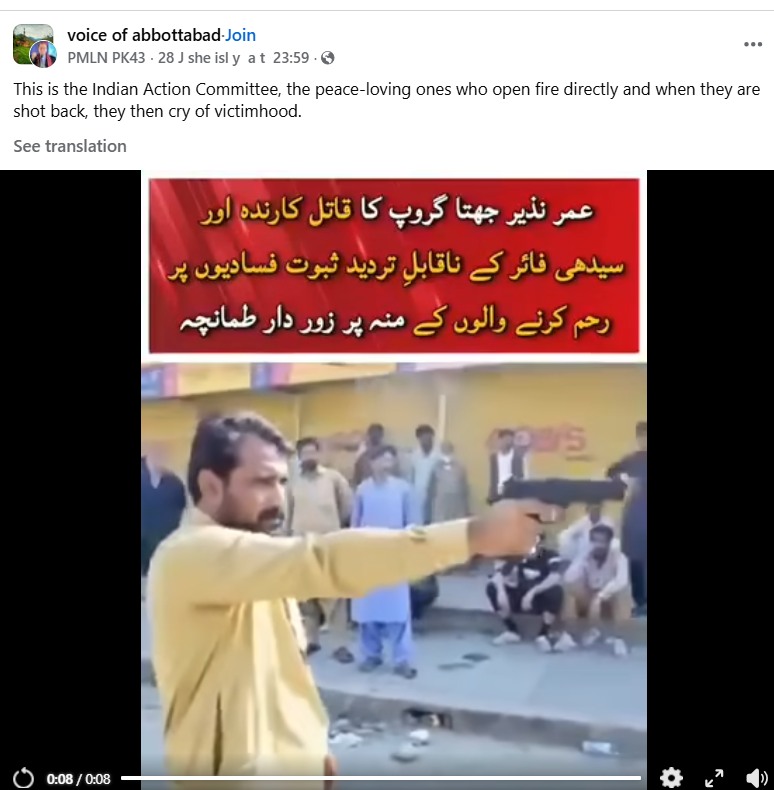
A video is being widely shared on social media, showing a man firing a pistol. The video is being shared with the claim that it is from the recent protests in Rawalakot, Pakistan-administered Kashmir. It is further claimed that the person seen in the video is associated with the Indian Action Committee, who is firing at security forces and later portraying themselves as victims after facing retaliation. The CyberPeace Research Wing analysed the viral video and found several visual inconsistencies. Further analysis using AI detection tools revealed that the viral video was generated using artificial intelligence (AI).
Claim:
A video shared on social media claims to show protesters associated with the Indian Action Committee directly firing at security forces. The post further claims that these individuals later present themselves as victims after facing a response from authorities.
https://www.facebook.com/groups/1052887838090429/permalink/27742200445399139/?rdid=EMCXtwaN9n4OwqFc#
Fact Check:
During the research, the viral video was analysed and multiple visual inconsistencies were observed. At the beginning of the clip, two men riding a motorcycle can be seen behind the person firing the gun. However, instead of moving away from the firing spot, they appear to move towards the direction where the shooting is taking place. Additionally, the hand and head movements of one of the passengers on the motorcycle appear unnatural and distorted, which are common signs of AI-generated content.
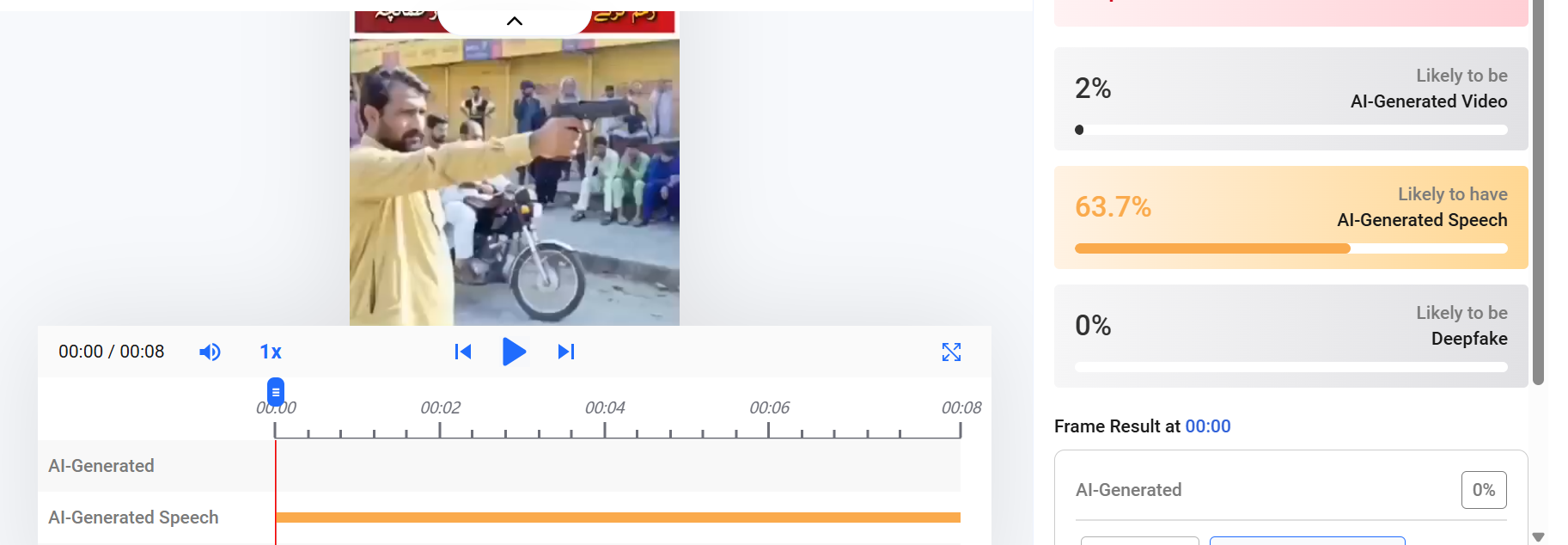
In the next step of the research, the viral video was scanned using Hive Moderation. The results indicated that the video had a 63 per cent probability of being AI-generated.
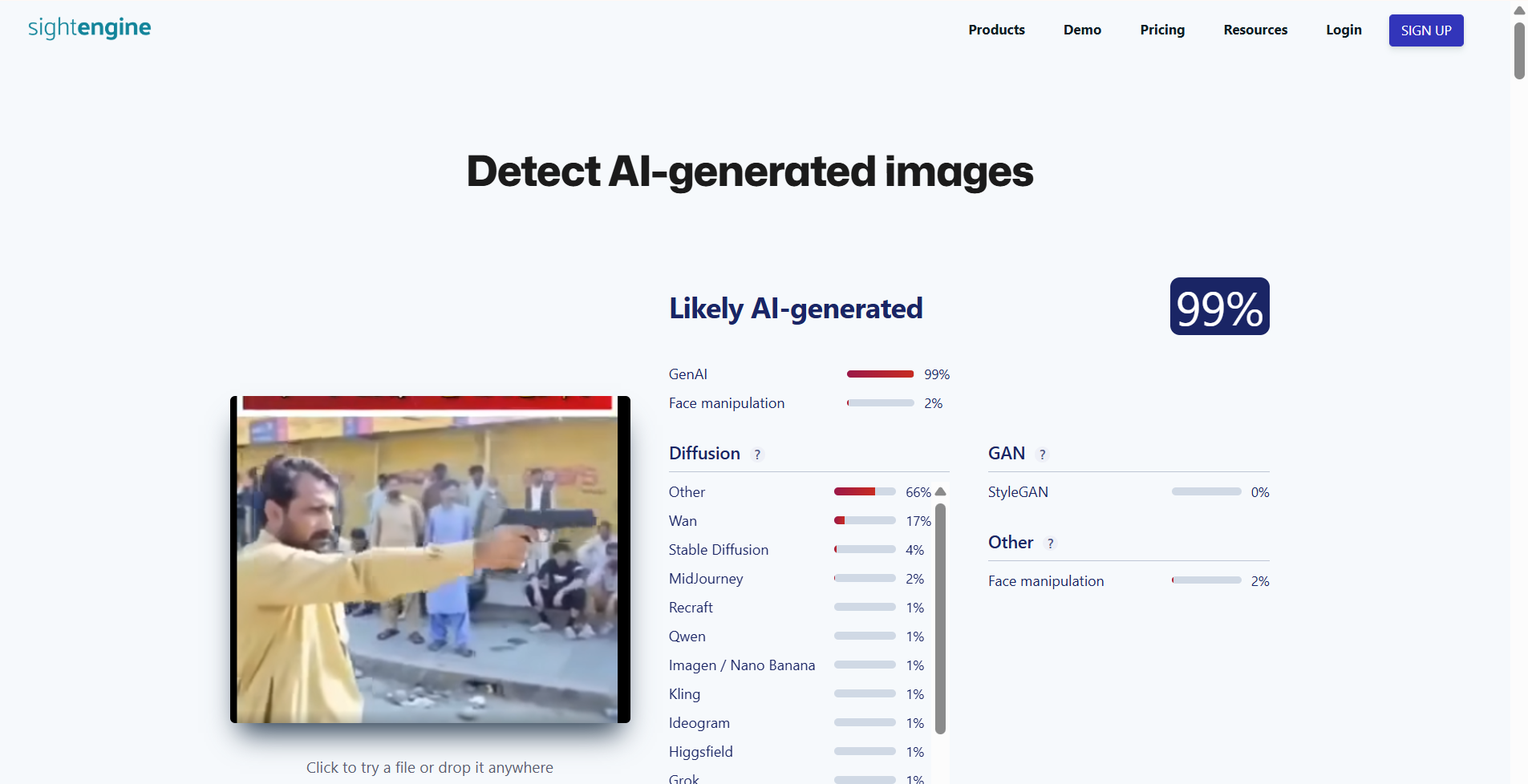
The video was also analysed using Sightengine, which flagged it as 99 per cent AI-generated.
Conclusion:
The research found that the viral video does not show a real incident from the recent protests in Rawalakot, Pakistan-administered Kashmir. The video contains multiple visual inconsistencies, and analysis through AI detection tools also confirmed that it was generated using artificial intelligence. Therefore, the claim that the video shows an Indian Action Committee member firing at security forces during the protests is false.

Executive Summary
A video clip carrying the logo of news channel Republic is being shared on social media. In the video, former Bangladesh Prime Minister Sheikh Hasina is allegedly heard saying, "If these radical Muslim terrorists do not back off from imposing terror-based governance over Bangladesh, our goal will be to finish them by any means. I will request Prime Minister Narendra Modi to make Bangla a single province by combining East and West Bengal. We will bring back a secular democracy, which I will lead in the future to restore Bangla to its secular roots." The CyberPeace Research Wing found that the visuals in the viral video are genuine, but the audio has been altered using artificial intelligence (AI) and is being circulated with a false claim.
Claim:
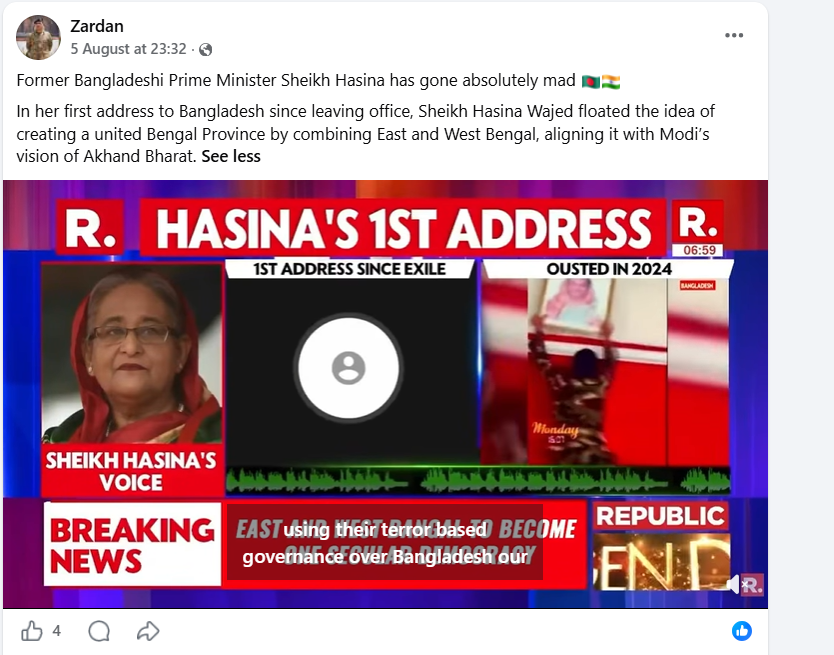
A Facebook user shared the video claiming that Sheikh Hasina proposed merging East and West Bengal to create a single province during her recent address. The link to the post, archive link, and screenshot are provided below.
https://www.facebook.com/reel/1567119714918951
FactCheck
During the research, several key frames from the viral video were extracted and a reverse image search was conducted using Google Lens. The search led us to the original video of Sheikh Hasina’s interaction available on the official social media accounts of Republic News. The link to the post and screenshot are provided below.
https://x.com/republic/status/2084999748755554323?ref_src=twsrc%5Etfw
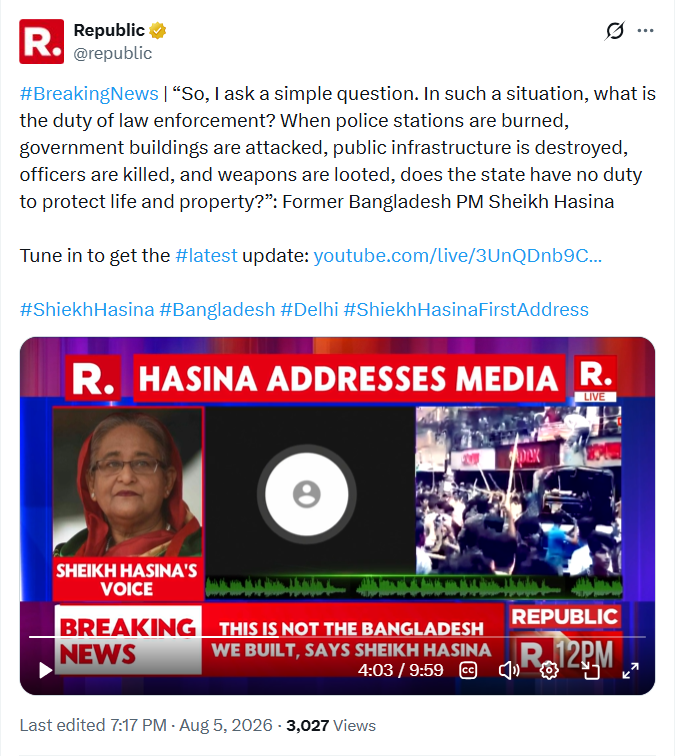
Republic shared the original video on its official X account on August 5, 2026. A comparison between the viral clip and the original footage revealed that the alleged statement about merging East and West Bengal into a single province does not appear anywhere in the authentic video. In the original video, Sheikh Hasina can be heard discussing the responsibilities of law enforcement agencies during periods of unrest. The controversial audio added to the viral clip is not part of the original recording. Further analysis of the viral video’s audio raised suspicion that it was AI-generated. The video was scanned using the AI detection tool Hive Moderation, which indicated a 91 per cent probability that the speech used in the viral video was AI-generated.
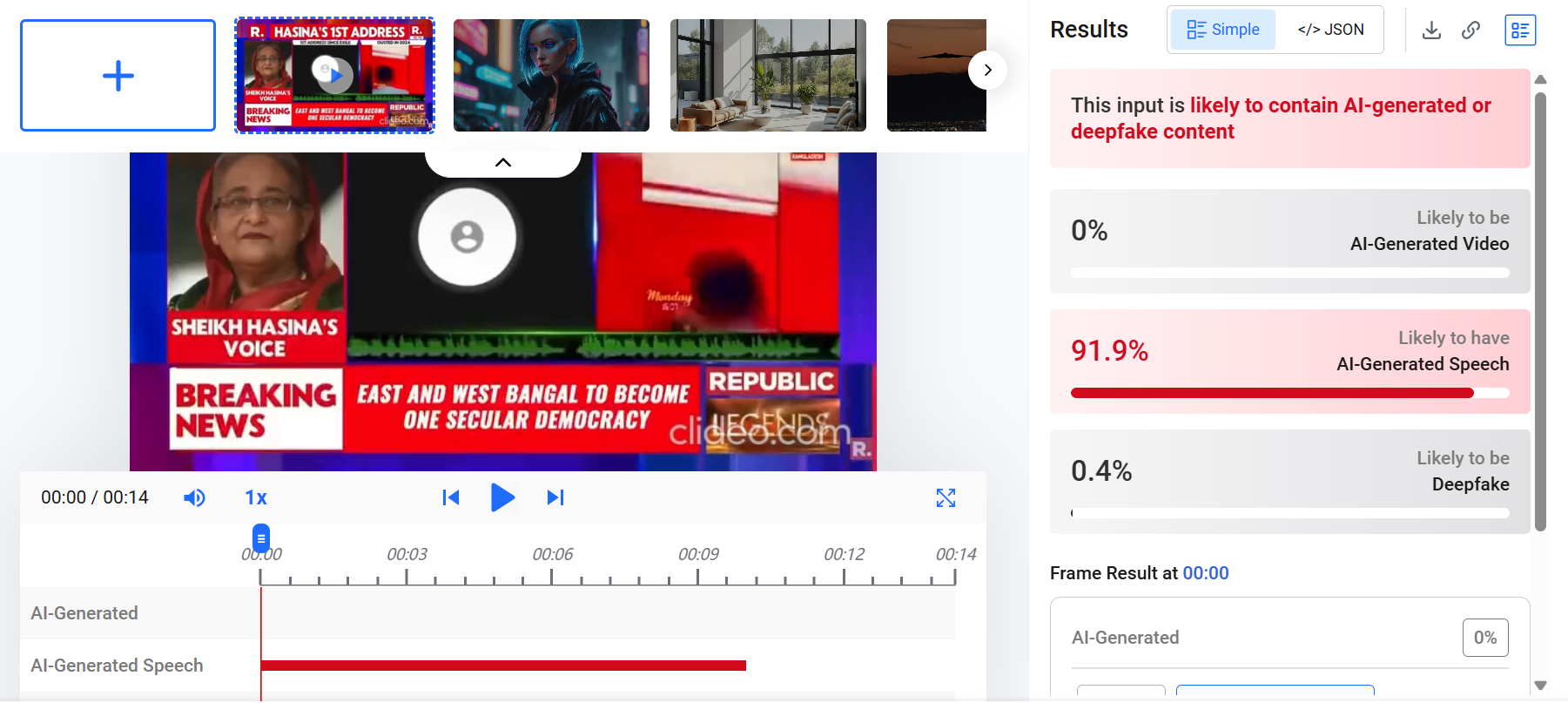
In the next step of the research, the viral audio was analysed using the Resemble AI tool. The results indicated that the audio was likely manipulated, suggesting that it had been altered using artificial intelligence (AI).

Conclusion:
The research found that the visuals used in the viral video are genuine, but the audio has been modified using AI and is being shared with a false claim. The claim that Sheikh Hasina spoke about merging East and West Bengal into a single province is false.
Executive Summary
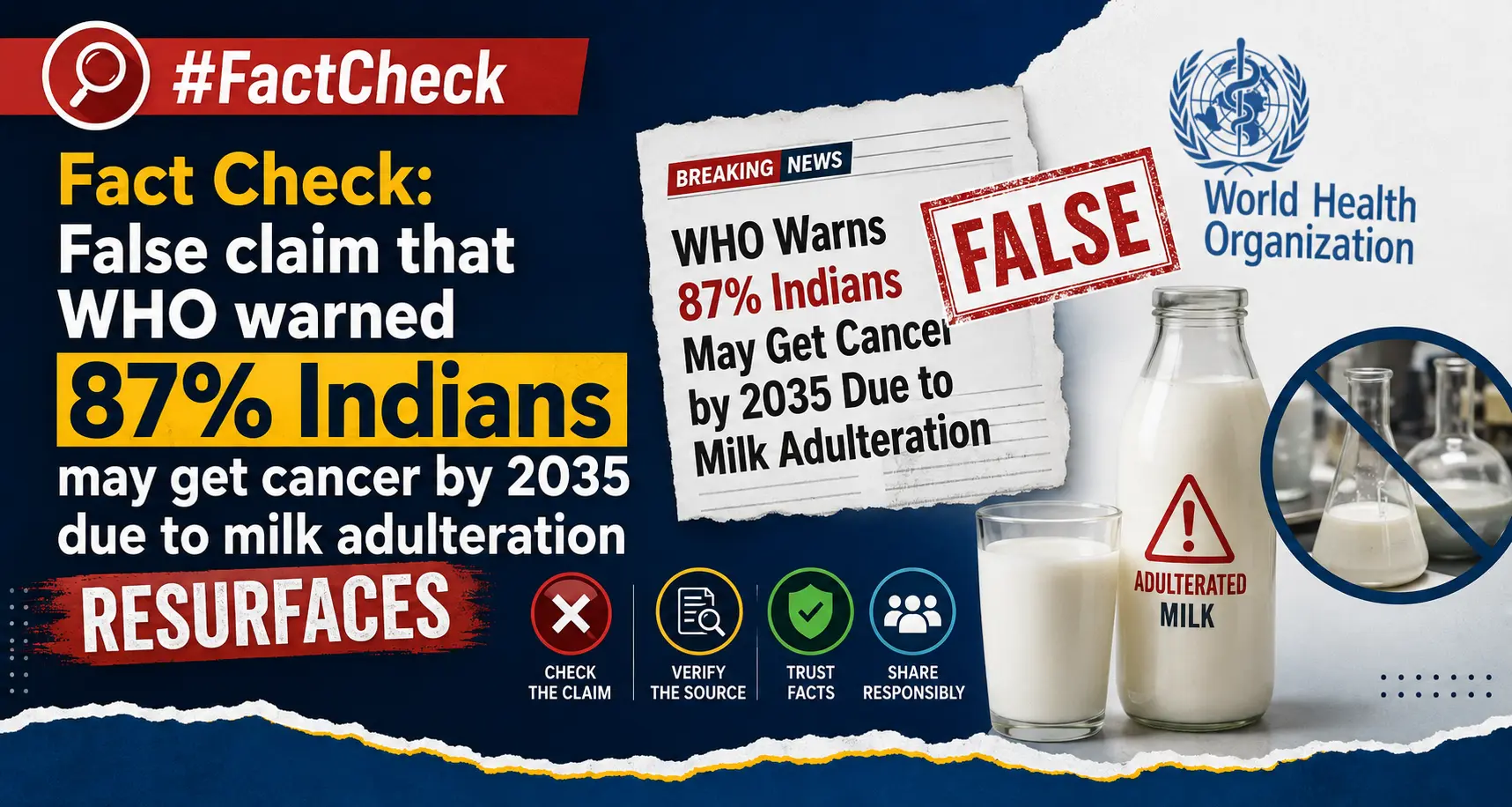
A post is going viral across various social media platforms claiming that the World Health Organization (WHO) has issued a warning over the issue of adulteration in food products. According to the claim, WHO has warned that milk adulteration is continuously increasing in India and if it continues, 87 percent of Indians will suffer from cancer by 2035. CyberPeace Research Wing’s research found that the viral claim has been circulating on social media for several years. Earlier, the same claim was shared with the year changed to 2025, stating that 87 percent of Indians would suffer from cancer by that year. Now, the year has been changed from 2025 to 2035 and the claim is being circulated again. WHO has repeatedly denied this claim and termed it fake news.
Claim:
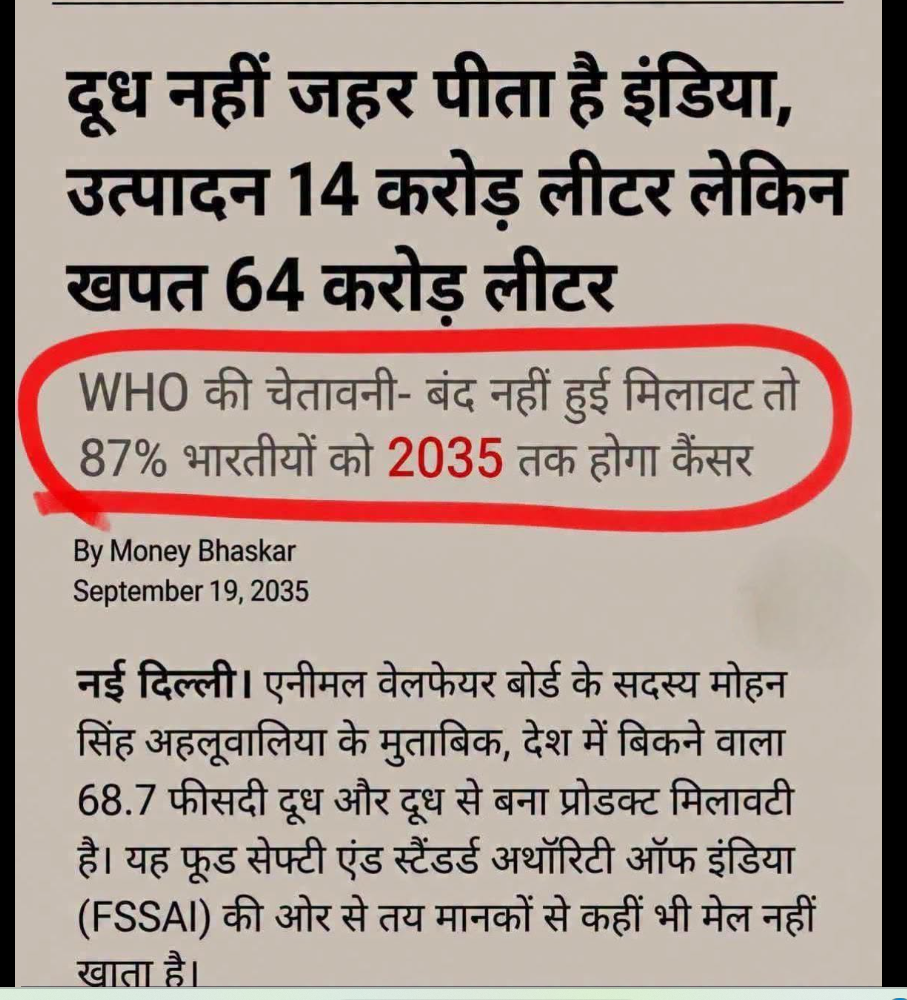
A Facebook user named ‘Vikalp Kuchamancity’ shared the viral post on August 3, 2026, with a caption claiming, “India produces 14 crore litres of milk, but consumption is 64 crore litres. Where does this extra milk come from? WHO has warned that if adulteration is not stopped, 87 percent of Indians may suffer from cancer by 2035.”
https://www.facebook.com/photo/?fbid=968660469565357&set=a.109816988783047
Fact Check:
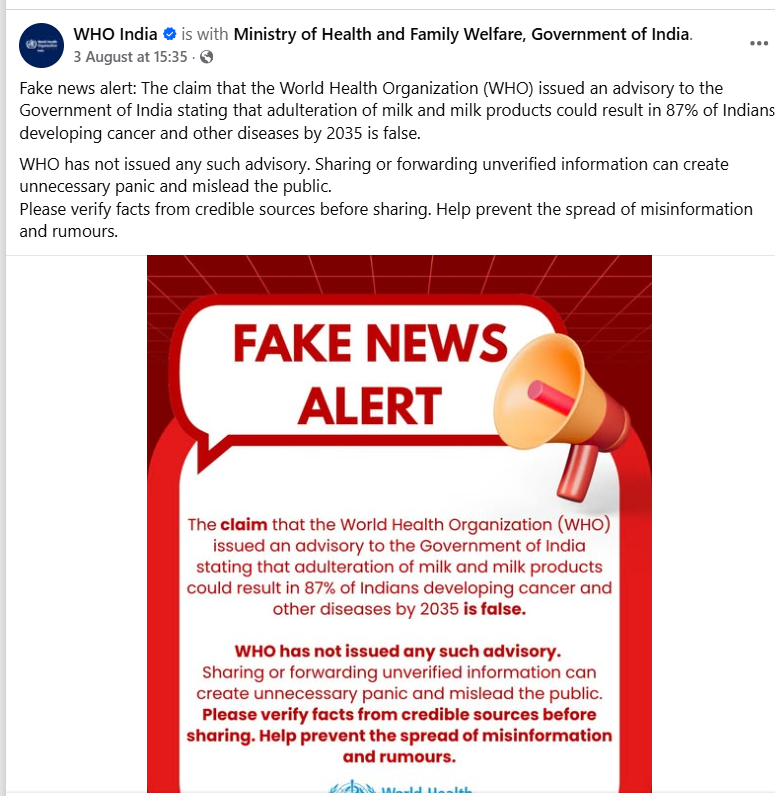
While examining the viral post, we noticed that the report displayed in the image carries the date September 19, 2035, even though the current year is 2026. This raised initial doubts about the authenticity of the claim.To investigate further, we conducted a Google search using relevant keywords. During the search, we found a post from the official Facebook page of WHO India, shared on August 3, 2026. The post denied the viral claim and stated that it is false that WHO issued any advisory to the Indian government warning that adulteration in milk and dairy products could lead to cancer and other diseases among 87 percent of Indians by 2035. WHO clarified that no such advisory has been issued.
WHO India Facebook link:
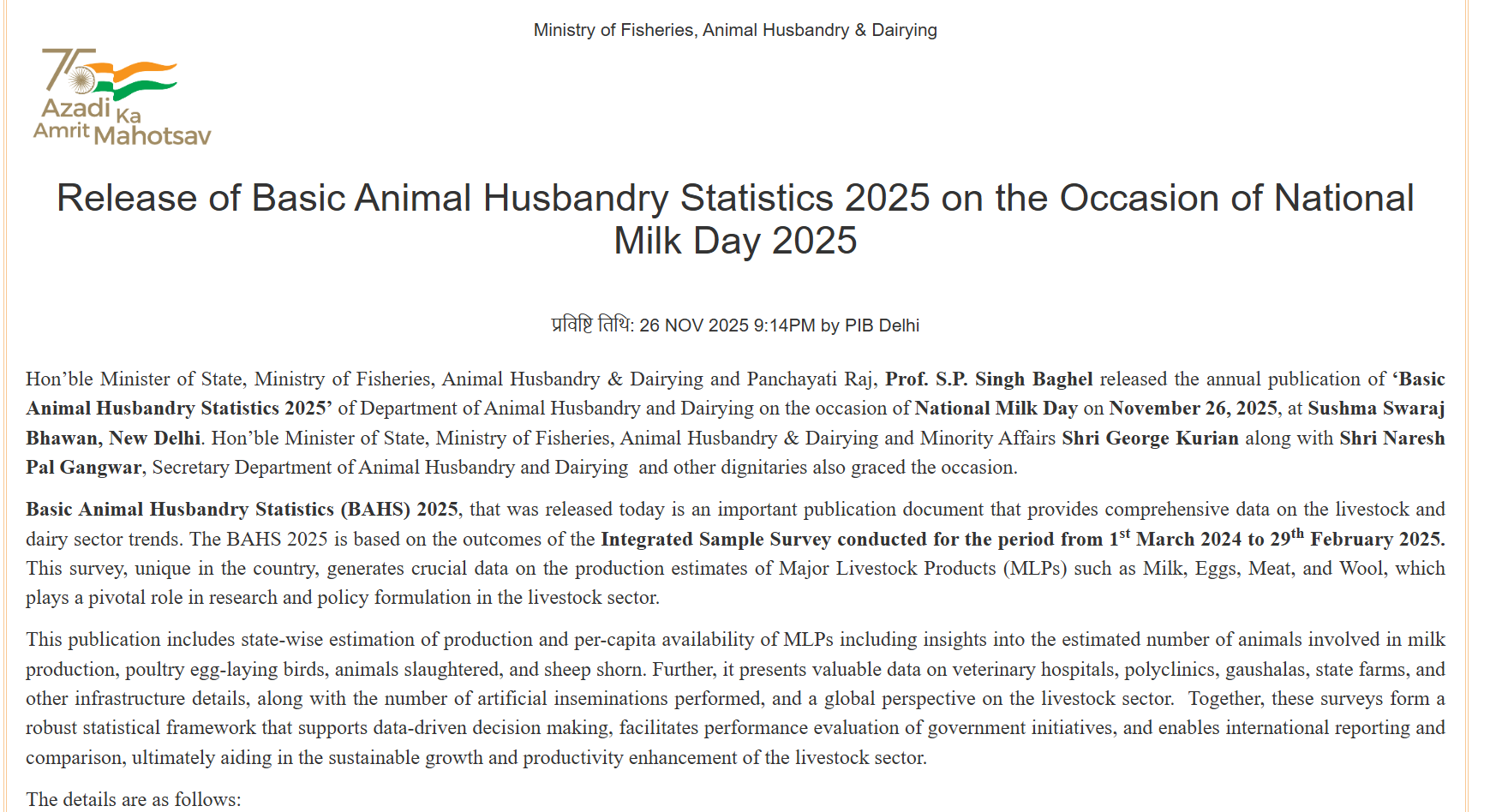
According to data mentioned in a press release issued by the Government of India on November 26, 2025, the country’s total milk production was estimated at 247.87 million tonnes in 2024-25, compared to 239.30 million tonnes in 2023-24. The per capita availability of milk increased from 319 grams per day in 2014-15 to 485 grams per day in 2024-25. The top five milk-producing states are Uttar Pradesh (15.66%), Rajasthan (14.82%), Madhya Pradesh (9.12%), Gujarat (7.78%), and Maharashtra (6.71%). Together, these states contribute 54.09% of India’s total milk production.
https://www.pib.gov.in/PressReleasePage.aspx?PRID=2195049®=3&lang=2
Conclusion:
The research confirmed that there is no evidence of any WHO warning stating that 87 percent of Indians could develop cancer by 2035 due to milk adulteration. WHO has clarified that it has not issued any such advisory. The viral claim is a recycled false claim that has been repeatedly circulated with changed dates.

Executive Summary:
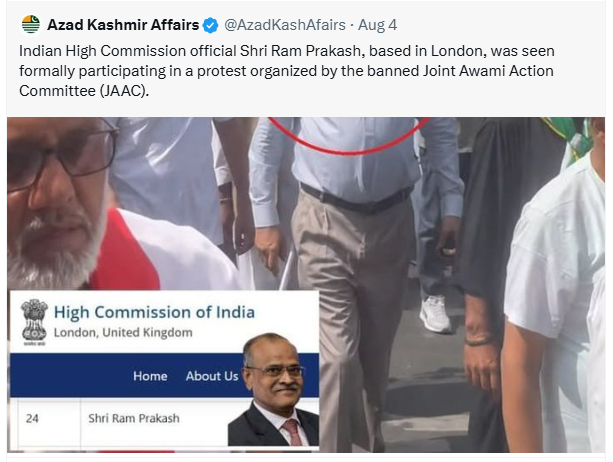
A photo is being circulated on social media with the claim that it shows Ram Prakash, an official from the Indian High Commission in the United Kingdom (UK), participating in a protest organised over issues related to PoK. CyberPeace Research Wing’s research found the claim associated with the image to be false. The research confirmed that the image was digitally modified using OpenAI’s AI tools.
Claim:
A user on social media platform X (formerly Twitter) shared the viral image on August 4, 2026, claiming that Shri Ram Prakash, an official from the Indian High Commission in London, was seen formally participating in a protest organised by the banned Joint Awami Action Committee (JAAC). The post link, archive link, and screenshot are provided below:
https://x.com/i/birdwatch/t/2084551118189904105?source=6
Fact Check:
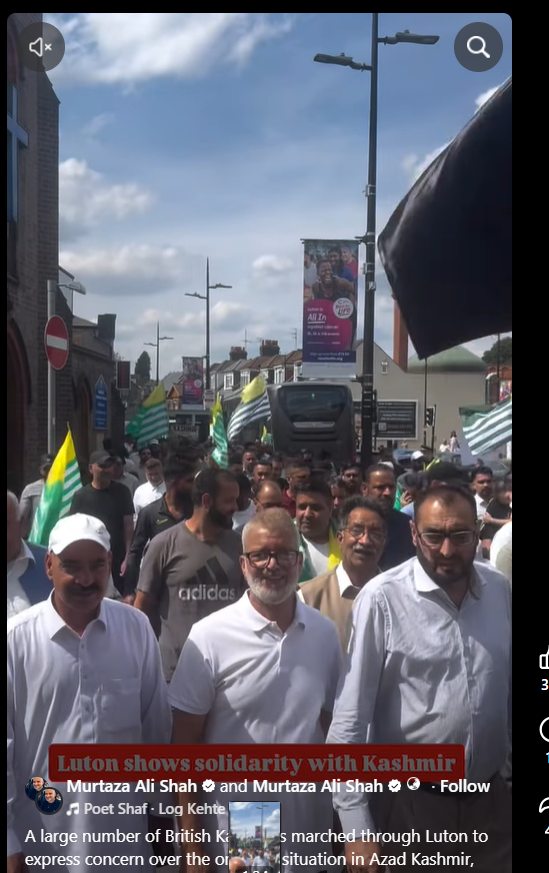
During the research, we conducted a Google search using relevant keywords. We traced the original source of the viral visual to a social media post shared by Pakistani media outlet GEO News’ UK Bureau Chief Murtaza Ali Shah on August 2, 2024.
The post featured a video of a protest held in Luton, United Kingdom, where a large number of British Kashmiris were seen marching to express concerns over the situation in Pakistan-occupied Kashmir (PoK). At the time, the Joint Awami Action Committee (JAAC) was leading a prolonged protest in the region.
https://www.facebook.com/reel/1383400640416385
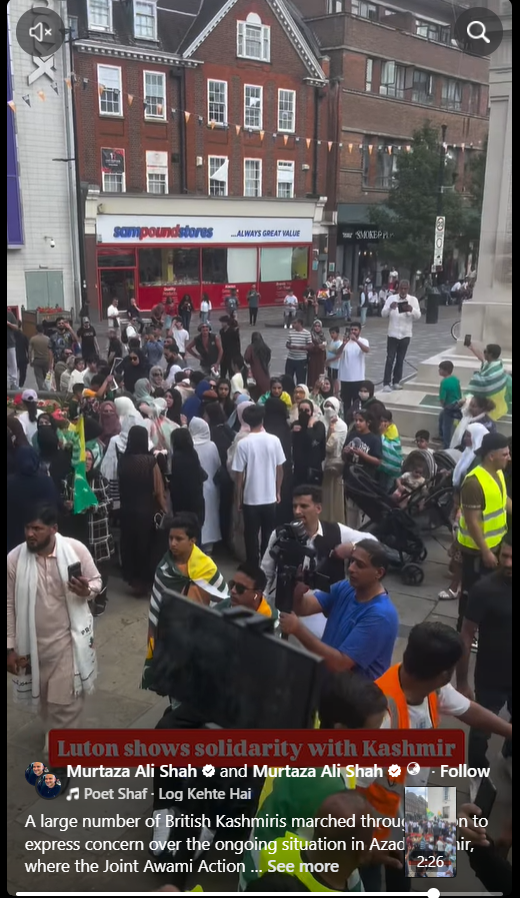
At the 1:23 mark of the video shared by the Pakistani journalist, we found the same scene that appears in the viral image. However, the individual seen in the viral image does not appear in the original footage. Instead, the video shows a different person participating in the protest.
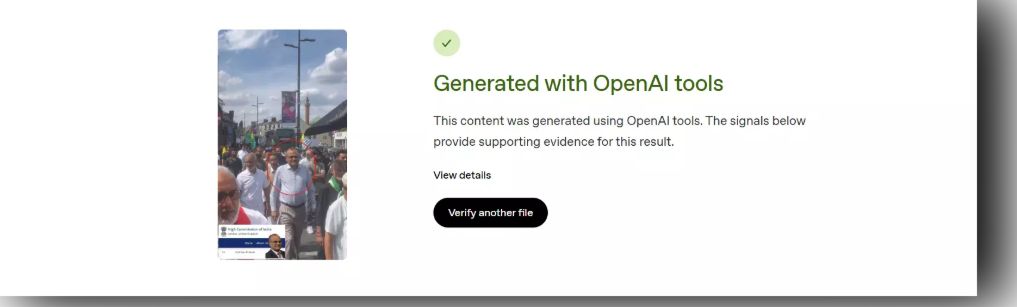
To further verify the authenticity of the image, we analysed it using multiple AI detection tools, including OpenAI’s image detection tool. The analysis detected provenance signals associated with OpenAI tools such as ChatGPT, OpenAI API, or Codex. These signals indicate that the image was created or modified using OpenAI’s AI tools.
Conclusion:
The research established that the viral image has been manipulated to falsely portray Indian High Commission official Ram Prakash as a participant in the protest. The original footage shows a different individual, while AI analysis confirmed that the image was modified using OpenAI tools. Therefore, the claim circulating with the image is misleading.

Executive Summary
An image is being widely circulated on social media with the claim that it shows the destruction caused by an explosion at a mall in Japan following a 7.1-magnitude earthquake in July 2026. The viral image shows a shopping complex in a severely damaged condition, allegedly after the incident. CyberPeace Research Wing’s research found that the viral image does not show damage caused by an explosion or earthquake at any mall in Japan. The visuals in the image do not match authentic photographs of the affected shopping complex. The research further revealed that the viral image was created using Artificial Intelligence (AI).
Claim
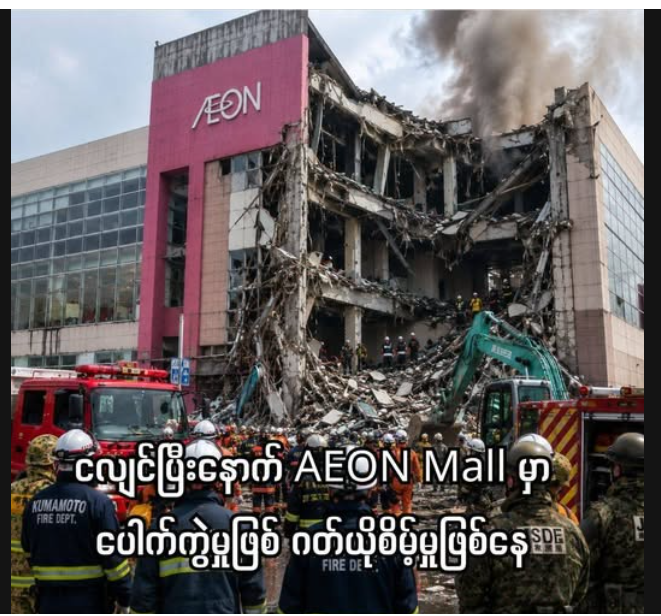
A social media post claims that the AEON Mall in Japan exploded after the Kumamoto earthquake and a gas leak was suspected. The post, published in Burmese language on Facebook on July 29, 2026, shared an image claiming to show the aftermath of the incident at the mall.
FactCheck
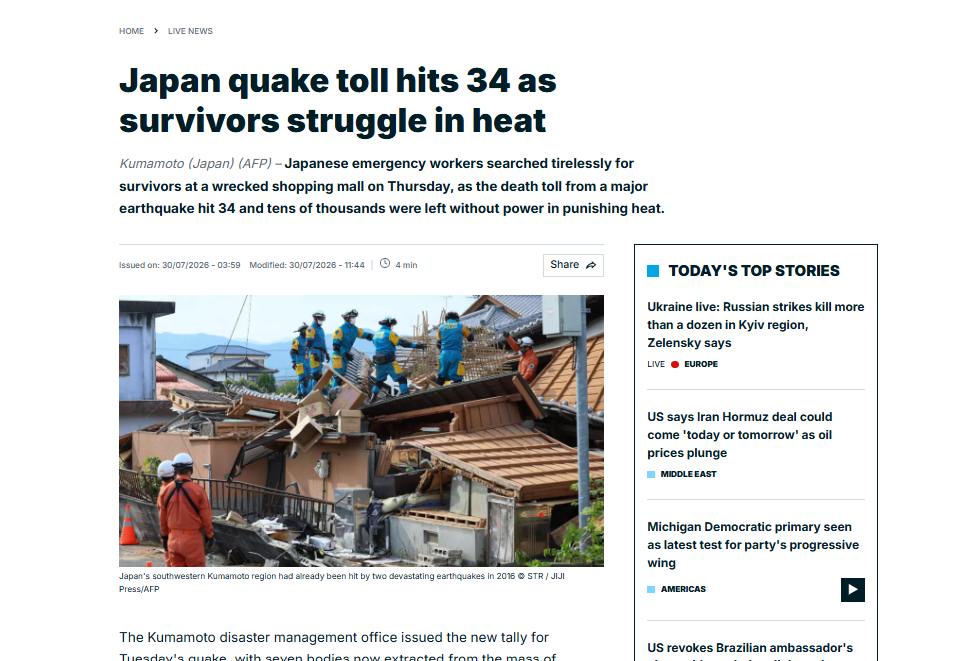
To verify the authenticity of the viral claim, we conducted a Google search using relevant keywords. During the search, we found a report published by France24, which stated that the Kumamoto disaster management office released updated figures following the earthquake. According to the report, seven bodies were recovered from the debris, steel and wires of the Aeon shopping mall after a suspected gas blast. The report further stated that eight people were confirmed dead at the Nippon Paper Industries factory in Yatsushiro city, where part of a red-and-white smokestack collapsed. Following the 7.1-magnitude earthquake, five others were reported to be in critical condition, while around 9,500 residents were staying in evacuation centres in Kyushu, southwestern Japan.
http://france24.com/en/live-news/20260730-up-to-23-feared-dead-in-japan-quake
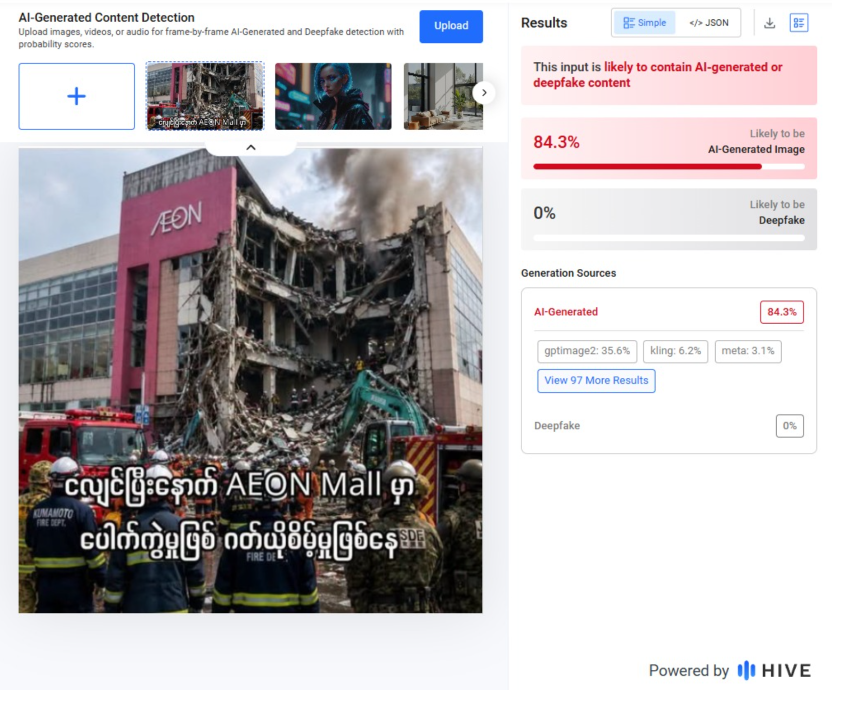
However, the viral image showed several visual inconsistencies and was flagged as AI-generated.
To further examine the authenticity of the image, we scanned it using the AI detection tool Hive Moderation. The results indicated that the image had an 84 percent probability of being AI-generated.
We also analysed the image using Human Meter, where the results showed a 75 percent probability that the image was AI-generated.

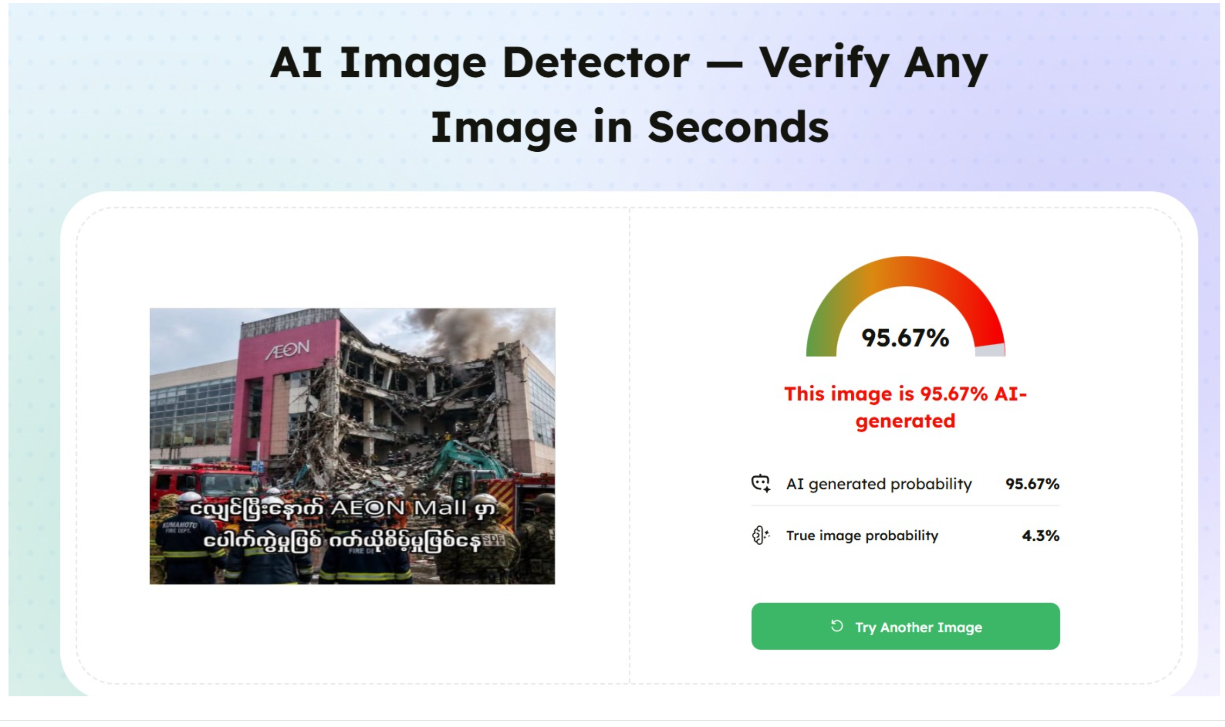
In the final stage of the research, we scanned the image using another AI detection tool, AI Image Detector. The tool indicated that the image had a 95 percent probability of being AI-generated.
Conclusion:
The research established that the viral image is not an authentic photograph of the damage caused by the Kumamoto earthquake or any explosion at an Aeon Mall in Japan. The image contains multiple inconsistencies and was found to be AI-generated. Therefore, the claim linking the image to the Japan earthquake incident is false.
