
#FactCheck -AI-Generated Video Falsely Shared as IAF Pilot Complaining After Sukhoi-30 Crash
Executive Summary
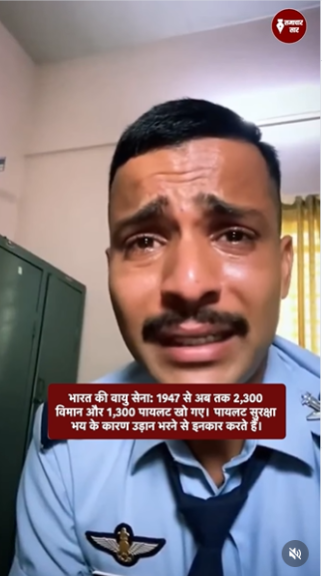
A video circulating widely on social media claims to show a pilot of the Indian Air Force (IAF) crying and expressing fear about flying fighter jets, allegedly citing poor maintenance and frequent crashes. The clip is being linked to the crash of an IAF Sukhoi-30 fighter jet in Assam on March 5, in which two pilots lost their lives. In the viral video, a man dressed like a pilot is seen speaking emotionally, saying that flying fighter jets has become frightening due to lack of maintenance and repeated accidents. Several users are sharing the clip claiming that the man in the video is an IAF pilot revealing the reality behind aircraft crashes. However, research by the CyberPeace found the claim to be false. The video does not depict a real pilot or an actual incident. Instead, it appears to be an AI-generated clip created and circulated with the intent to spread misinformation.
Claim:
An Instagram user, ‘samacharsaar0’, shared the viral video on March 10, 2026, with the English caption: “2300 aircraft crashes, 1300 pilots dead: A major challenge before the IAF.”
- Source: :https://www.instagram.com/reel/DVqa4lNiYJQ
- Archived link::https://perma.cc/EUZ8-DHE3
Fact Check:
The claim was also debunked by PIB Fact Check. While verifying the viral video, PIB clarified that the clip is artificially generated and not related to any real IAF personnel.
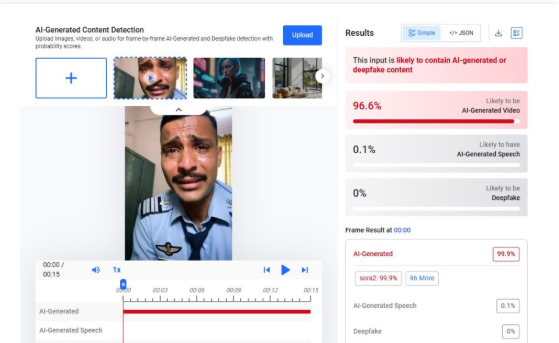
To further verify the authenticity of the video, we analyzed it using AI detection tools. The tool Hive Moderation indicated a 99.9% probability that the video was generated using artificial intelligence.
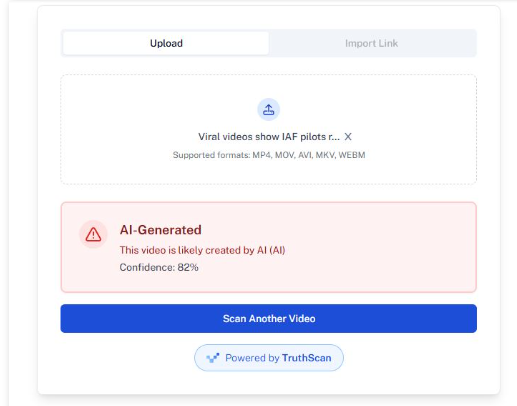
We also examined the clip using another AI detection platform, Undetectable. The analysis suggested an 82% likelihood that the video was created with AI tools. The tool also indicated the possibility that the footage may have been generated using the Sora AI video generation tool.
Conclusion
Our research concludes that the viral video of a crying “pilot” is not authentic. The clip has been created using artificial intelligence and is being misleadingly shared as a real Indian Air Force pilot speaking about aircraft crashes. The government has also denied the claim associated with the video.

Related Blogs

Executive Summary
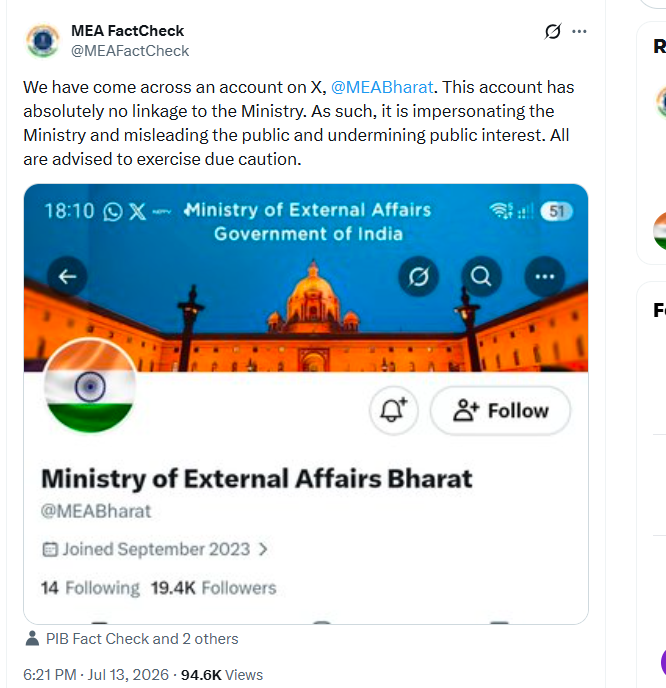
A social media account on X (formerly Twitter) named @MEABharat is being circulated as the official account of India's Ministry of External Affairs (MEA). Many users are sharing posts from the account, believing it to be an authentic government handle and treating the information published there as official communication. CyberPeace Research Wing’s research found the viral claim to be misleading. Our research revealed that @MEABharat is not an official X account of the Ministry of External Affairs. The Ministry has publicly clarified that it has no association with the account and stated that it is impersonating the Ministry, misleading the public, and undermining public interest.
Claim
Social media users are claiming that @MEABharat is the official X account of India's Ministry of External Affairs and that the information posted on the account is officially issued by the Ministry.
https://x.com/MEAFactCheck/status/2076650791453270332

Fact Check
To verify the claim, we conducted a keyword-based search on Google. During the research, we found an official clarification posted by the Ministry of External Affairs' fact-check handle, @MEAFactCheck. In its post, the Ministry clearly stated that the @MEABharat account has no connection whatsoever with the Ministry of External Affairs. It further clarified that the account is impersonating the Ministry, misleading the public, and undermining public interest. The Ministry also advised users to exercise caution and rely only on its verified official social media accounts and website for authentic information.
https://x.com/MEAFactCheck/status/2076650791453270332
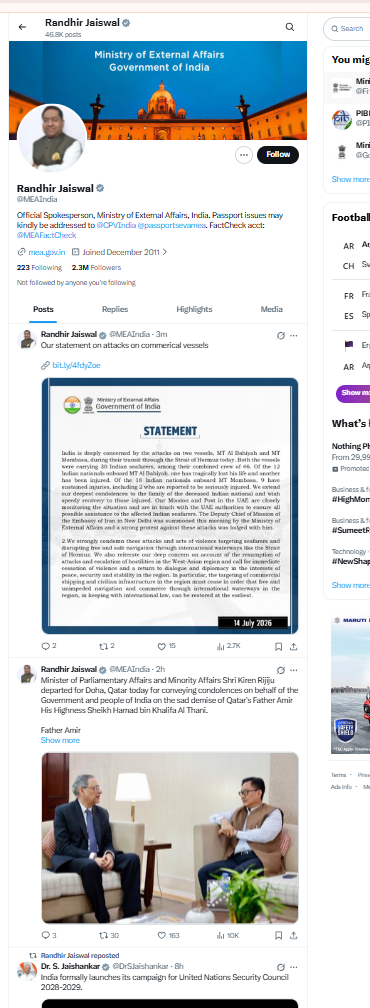
As part of our research, we also examined the Ministry's official X account, @MEAIndia, which carries the verified blue badge. The account regularly publishes official statements, diplomatic updates, press briefings, and other communications related to India's foreign policy. It also serves as the official spokesperson's handle for the Ministry of External Affairs.
https://x.com/MEAIndia
Conclusion
Our research found that @MEABharat is not the official X account of India's Ministry of External Affairs. The Ministry itself has publicly clarified that the account is fake, has no affiliation with the government, and is impersonating the Ministry to mislead the public. Therefore, the claim that @MEABharat is the official MEA handle is misleading. Users should rely only on the Ministry's verified accounts, including @MEAIndia and @MEAFactCheck, for authentic government information.

Executive Summary:
A picture about the April 8 solar eclipse, which was authored by AI and was not a real picture of the astronomical event, has been spreading on social media. Despite all the claims of the authenticity of the image, the CyberPeace’s analysis showed that the image was made using Artificial Intelligence image-creation algorithms. The total solar eclipse on April 8 was observable only in those places on the North American continent that were located in the path of totality, whereas a partial visibility in other places was possible. NASA made the eclipse live broadcast for people who were out of the totality path. The spread of false information about rare celestial occurrences, among others, necessitates relying on trustworthy sources like NASA for correct information.
Claims:
An image making the rounds through social networks, looks like the eclipse of the sun of the 8th of April, which makes it look like a real photograph.


Fact Check:
After receiving the news, the first thing we did was to try with Keyword Search to find if NASA had posted any lookalike image related to the viral photo or any celestial events that might have caused this photo to be taken, on their official social media accounts or website. The total eclipse on April 8 was experienced by certain parts of North America that were located in the eclipse pathway. A part of the sky above Mazatlan, Mexico, was the first to witness it. Partial eclipse was also visible for those who were not in the path of totality.
Next, we ran the image through the AI Image detection tool by Hive moderation, which found it to be 99.2% AI-generated.

Following that, we applied another AI Image detection tool called Isitai, and it found the image to be 96.16% AI-generated.

With the help of AI detection tools, we came to the conclusion that the claims made by different social media users are fake and misleading. The viral image is AI-generated and not a real photograph.
Conclusion:
Hence, it is a generated image by AI that has been circulated on the internet as a real eclipse photo on April 8. In spite of some debatable claims to the contrary, the study showed that the photo was created using an artificial intelligence algorithm. The total eclipse was not visible everywhere in North America, but rather only in a certain part along the eclipse path, with partial visibility elsewhere. Through AI detection tools, we were able to establish a definite fact that the image is fake. It is very important, when you are talking about rare celestial phenomena, to use the information that is provided by the trusted sources like NASA for the accurate reason.
- Claim: A viral image of a solar eclipse claiming to be a real photograph of the celestial event on April 08
- Claimed on: X, Facebook, Instagram, website
- Fact Check: Fake & Misleading

Introduction
When a tragedy strikes, moments are fragile, people are vulnerable, emotions run high, and every second is important. In such critical situations, information becomes as crucial as food, water, shelter, and medication. As soon as any information is received, it often leads to stampedes and chaos. Alongside the tragedy, whether natural or man-made, emerges another threat: misinformation. People, desperate for answers, cling to whatever they can find.
Tragedies can take many forms. These may include natural disasters, mass accidents, terrorist activities, or other emergencies. During the 2023 earthquakes in Turkey, misinformation spread on social media claiming that the Yarseli Dam had cracked and was about to burst. People believed it and began migrating from the area. Panic followed, and search and rescue teams stopped operations in that zone. Precious hours were lost. Later, it was confirmed to be a rumour. By then, the damage was already done.
Similarly, after the recent plane crash in Ahmedabad, India, numerous rumours and WhatsApp messages spread rapidly. One message claimed to contain the investigation report on the crash of Air India flight AI-171. It was later called out by PIB and declared fake.
These examples show how misinformation can take control of already painful moments. During emergencies, when emotions are intense and fear is widespread, false information spreads faster and hits harder. Some people share it unknowingly, while others do so to gain attention or push a certain agenda. But for those already in distress, the effect is often the same. It brings ore confusion, heightens anxiety, and adds to their suffering.
Understanding Disasters and the Role of Media in Crisis
Disaster can be defined as a natural or human-caused situation that causes a transformation from a usual life of society into a crisis that is far beyond its existing response capacity. It can have minimal or maximum effects, from mere disruption in daily life practices to as adverse as inability to meet basic requirements of life like food, water and shelter. Hence, the disaster is not just a sudden event. It becomes a disaster when it overwhelms a community’s ability to cope with it.
To cope with such situations, there is an organised approach called Disaster Management. It includes preventive measures, minimising damages and helping communities recover. Earlier, public institutions like governments used to be the main actors in disaster management, but today, with every small entity having a role, academic institutions, media outlets and even ordinary people are involved.
Communication is an important element in disaster management. It saves lives when done correctly. People who are vulnerable need to know what’s happening, what they should do and where to seek help. It involves risk in today’s instantaneous communication.
Research shows that the media often fails to focus on disaster preparedness. For example, studies found that during the 2019 Istanbul earthquake, the media focused more on dramatic scenes than on educating people. Similar trends were seen during the 2023 Turkey earthquakes. Rather than helping people prepare or stay calm, much of the media coverage amplified fear and sensationalised suffering. This shows a shift from preventive, helpful reporting to reactive, emotional storytelling. In doing so, the media sometimes fails in its duty to support resilience and worse, can become a channel for spreading misinformation during already traumatic events. However, fighting misinformation is not just someone’s liability. It is penalised in the official disaster management strategy. Section 54 of the Disaster Management Act, 2005 mentions that "Whoever makes or circulates a false alarm or warning as to disaster or its severity or magnitude, leading to panic, shall, on conviction, be punishable with imprisonment which may extend to one year or with a fine."
AI as a Tool in Countering Misinformation
AI has emerged as a powerful mechanism to fight against misinformation. AI technologies like Natural Language Processing (NLP) and Machine Learning (ML) are effective in spotting and classifying misinformation with up to 97% accuracy. AI flags unverified content, leading to a 24% decrease in shares and 7% drop in likes on platforms like TikTok. Up to 95% fewer people view content on Facebook when fact-checking labels are used. Facebook AI also eliminates 86% of graphic violence, 96% of adult nudity, 98.5% of fake accounts and 99.5% of content related to terrorism. These tools help rebuild public trust in addition to limiting the dissemination of harmful content. In 2023, support for tech companies acting to combat misinformation rose to 65%, indicating a positive change in public expectations and awareness.
How to Counter Misinformation
Experts should step up in such situations. Social media has allowed many so-called experts to spread fake information without any real knowledge, research, or qualification. In such conditions, real experts such as authorities, doctors, scientists, public health officials, researchers, etc., need to take charge. They can directly address the myths and false claims and stop misinformation before it spreads further and reduce confusion.
Responsible journalism is crucial during crises. In times of panic, people look at the media for guidance. Hence, it is important to fact-check every detail before publishing. Reporting that is based on unclear tips, social media posts, or rumours can cause major harm by inciting mistrust, fear, or even dangerous behaviour. Cross-checking information, depending on reliable sources and promptly fixing errors are all components of responsible journalism. Protecting the public is more important than merely disseminating the news.
Focus on accuracy rather than speed. News spreads in a blink in today's world. Media outlets and influencers often come under pressure to publish it first. But in tragic situations like natural disasters and disease outbreaks, rushing to come first is not as important as accuracy is, as a single piece of misinformation can spark mass-scale panic and can slow down emergency efforts and lead people to make rash decisions. Taking a little more time to check the facts ensures that the information being shared is helpful, not harmful. Accuracy may save numerous lives during tragedies.
Misinformation spreads quickly it can only be prevented if people learn to critically evaluate what they hear and see. This entails being able to spot biased or deceptive headlines, cross-check claims and identify reliable sources. Digital literacy is of utmost importance; it makes people less susceptible to fear-based rumours, conspiracy theories and hoaxes.
Disaster preparedness programs should include awareness about the risks of spreading unverified information. Communities, schools and media platforms must educate people on how to respond responsibly during emergencies by staying calm, checking facts and sharing only credible updates. Spreading fake alerts or panic-inducing messages during a crisis is not only dangerous, but it can also have legal consequences. Public communication must focus on promoting trust, calm and clarity. When people understand the weight their words can carry during a crisis, they become part of the solution, not the problem.
References:
- https://dergipark.org.tr/en/download/article-file/3556152
- https://www.dhs.gov/sites/default/files/publications/SMWG_Countering-False-Info-Social-Media-Disasters-Emergencies_Mar2018-508.pdf
- https://english.mathrubhumi.com/news/india/fake-whatsapp-message-air-india-crash-pib-fact-check-fcwmvuyc
- https://www.dhs.gov/sites/default/files/publications/SMWG_Countering-False-Info-Social-Media-Disasters-Emergencies_Mar2018-508.pdf
