
#FactCheck - Old Wedding Fire Video Misleadingly Shared as Iranian Hypersonic Missile Strike in Tel Aviv
Executive Summary:
Amid the ongoing conflict involving the United States, Israel, and Iran, a video showing a building engulfed in flames is being widely circulated on social media. In the clip, a large fire can be seen inside a building while several people appear to be running in panic. The video is being shared with the claim that Iran fired a hypersonic missile targeting a ceremony in Tel Aviv, Israel, allegedly killing several Israeli military generals and other prominent figures.
However, research by the CyberPeace found that the claim is false. The video being circulated as footage of an attack in Israel actually predates the current conflict and shows a fire that broke out during a wedding ceremony.
Claim
A Facebook user named “Syed Asif Raza Jafri” shared the video on March 13, 2026, claiming that an Iranian hypersonic missile had struck a grand ceremony in Tel Aviv, where several Israeli military officers, generals, soldiers, and other important personalities were present. According to the post, the attack resulted in multiple casualties.
Source:
- https://www.facebook.com/reel/902182825912364
- https://ghostarchive.org/archive/rZryr

Fact Check
To verify the claim, we began our research using the Google Lens reverse image search tool. Several key frames from the viral video were extracted and searched online.
During the search, we found the same video shared earlier on multiple foreign social media accounts. A Facebook user named “Es de Bombero” from Chile had posted the video on January 17, 2026, describing it in Spanish as footage of a fire that broke out during a wedding celebration.

Our research shows that the viral video had been circulating on social media since at least January 15, 2026, well before the escalation of the current conflict. According to a report published on March 1, 2026, by BBC, the large-scale attacks on Iran by the United States and Israel began on February 28, 2026, after which Iran’s Supreme Leader Ali Khamenei was reported dead.
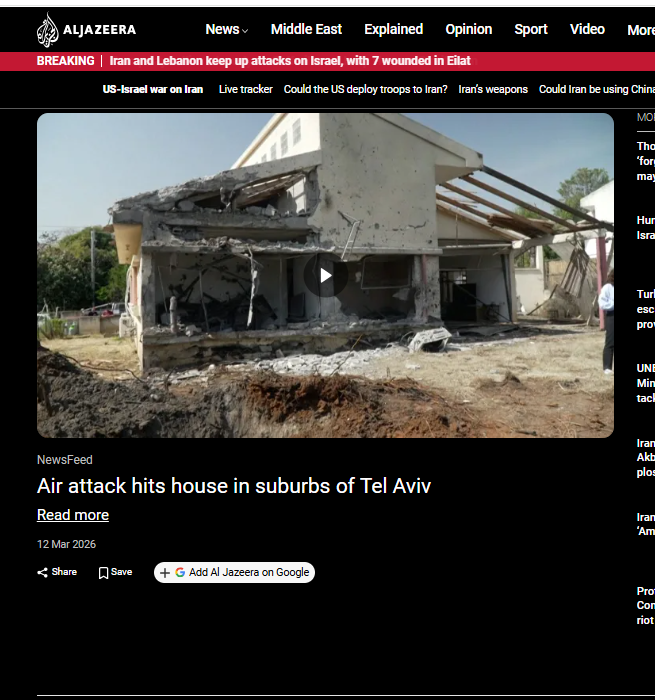
Additionally, a March 12, 2026 report by Al Jazeera stated that a house near Tel Aviv in central Israel was damaged by a rocket reportedly fired by Hezbollah, which has previously carried out joint attacks in coordination with Iran.
Conclusion
The viral video being shared as footage of an Iranian hypersonic missile strike in Tel Aviv is misleading. The clip is an older video of a fire that reportedly broke out during a wedding ceremony and was circulating online before the current conflict began.
While the exact location of the incident shown in the video cannot be independently verified, it is clear that the footage has no connection to the ongoing war between the United States, Israel, and Iran.

Related Blogs

Introduction
In a world where social media dictates public perception and content created by AI dilutes the difference between fact and fiction, mis/disinformation has become a national cybersecurity threat. Today, disinformation campaigns are designed for their effect, with political manipulation, interference in public health, financial fraud, and even community violence. India, with its 900+ million internet users, is especially susceptible to this distortion online. The advent of deep fakes, AI-text, and hyper-personalised propaganda has made disinformation more plausible and more difficult to identify than ever.
What is Misinformation?
Misinformation is false or inaccurate information provided without intent to deceive. Disinformation, on the other hand, is content intentionally designed to mislead and created and disseminated to harm or manipulate. Both are responsible for what experts have termed an "infodemic", overwhelming people with a deluge of false information that hinders their ability to make decisions.
Examples of impactful mis/disinformation are:
- COVID-19 vaccine conspiracy theories (e.g., infertility or microchips)
- Election-related false news (e.g., EVM hacking so-called)
- Social disinformation (e.g., manipulated videos of riots)
- Financial scams (e.g., bogus UPI cashbacks or RBI refund plans)
How Misinformation Spreads
Misinformation goes viral because of both technology design and human psychology. Social media sites such as Facebook, X (formerly Twitter), Instagram, and WhatsApp are designed to amplify messages that elicit high levels of emotional reactions are usually polarising, sensationalistic, or fear-mongering posts. This causes falsehoods or misinformation to get much more attention and activity than authentic facts, and therefore prioritises virality over truth.
Another major consideration is the misuse of generative AI and deep fakes. Applications like ChatGPT, Midjourney, and ElevenLabs can be used to generate highly convincing fake news stories, audio recordings, or videos imitating public figures. These synthetic media assets are increasingly being misused by bad actors for political impersonation, propagating fabricated news reports, and even carrying out voice-based scams.
To this danger are added coordinated disinformation efforts that are commonly operated by foreign or domestic players with certain political or ideological objectives. These efforts employ networks of bot networks on social media, deceptive hashtags, and fabricated images to sway public opinion, especially during politically sensitive events such as elections, protests, or foreign wars. Such efforts are usually automated with the help of bots and meme-driven propaganda, which makes them scalable and traceless.
Why Misinformation is Dangerous
Mis/disinformation is a significant threat to democratic stability, public health, and personal security. Perhaps one of the most pernicious threats is that it undermines public trust. If it goes unchecked, then it destroys trust in core institutions like the media, judiciary, and electoral system. This erosion of public trust has the potential to destabilise democracies and heighten political polarisation.
In India, false information has had terrible real-world outcomes, especially in terms of creating violence. Misleading messages regarding child kidnappers on WhatsApp have resulted in rural mob lynching. As well, communal riots have been sparked due to manipulated religious videos, and false terrorist warnings have created public panic.
The pandemic of COVID-19 also showed us how misinformation can be lethal. Misinformation regarding vaccine safety, miracle cures, and the source of viruses resulted in mass vaccine hesitancy, utilisation of dangerous treatments, and even avoidable deaths.
Aside from health and safety, mis/disinformation has also been used in financial scams. Cybercriminals take advantage of the fear and curiosity of the people by promoting false investment opportunities, phishing URLs, and impersonation cons. Victims get tricked into sharing confidential information or remitting money using seemingly official government or bank websites, leading to losses in crypto Ponzi schemes, UPI scams, and others.
India’s Response to Misinformation
- PIB Fact Check Unit
The Press Information Bureau (PIB) operates a fact-checking service to debunk viral false information, particularly on government policies. In 3 years, the unit identified more than 1,500 misinformation posts across media.
- Indian Cybercrime Coordination Centre (I4C)
Working under MHA, I4C has collaborated with social media platforms to identify sources of viral misinformation. Through the Cyber Tipline, citizens can report misleading content through 1930 or cybercrime.gov.in.
- IT Rules (The Information Technology (Intermediary Guidelines and Digital Media Ethics Code) Rules, 2021 [updated as on 6.4.2023]
The Information Technology (Intermediary Guidelines) Rules were updated to enable the government to following aspects:
- Removal of unlawful content
- Platform accountability
- Detection Tools
There are certain detection tool that works as shields in assisting fact-checkers and enforcement bodies to:
- Identify synthetic voice and video scams through technical measures.
- Track misinformation networks.
- Label manipulated media in real-time.
CyberPeace View: Solutions for a Misinformation-Resilient Bharat
- Scale Digital Literacy
"Think Before You Share" programs for rural schools to teach students to check sources, identify clickbait, and not reshare fake news.
- Platform Accountability
Technology platforms need to:
- Flag manipulated media.
- Offer algorithmic transparency.
- Mark AI-created media.
- Provide localised fact-checking across diverse Indian languages.
- Community-Led Verification
Establish WhatsApp and Telegram "Fact Check Hubs" headed by expert organisations, industry experts, journalists, and digital volunteers who can report at the grassroots level fake content.
- Legal Framework for Deepfakes
Formulate targeted legislation under the Bhartiya Nyaya Sanhita (BNS) and other relevant laws to make malicious deepfake and synthetic media use a criminal offense for:
- Electoral manipulation.
- Defamation.
- Financial scams.
- AI Counter-Misinformation Infrastructure
Invest in public sector AI models trained specifically to identify:
- Coordinated disinformation patterns.
- Botnet-driven hashtag campaigns.
- Real-time viral fake news bursts.
Conclusion
Mis/disinformation is more than just a content issue, it's a public health, cybersecurity, and democratic stability challenge. As India enters the digitally empowered world, making a secure, informed, and resilient information ecosystem is no longer a choice; now, it's imperative. Fighting misinformation demands a whole-of-society effort with AI innovation, public education, regulatory overhaul, and tech responsibility. The danger is there, but so is the opportunity to guide the world toward a fact-first, trust-based digital age. It's time to act.
References
- https://www.pib.gov.in/factcheck.aspx
- https://www.meity.gov.in/static/uploads/2024/02/Information-Technology-Intermediary-Guidelines-and-Digital-Media-Ethics-Code-Rules-2021-updated-06.04.2023-.pdf
- https://www.cyberpeace.org
- https://www.bbc.com/news/topics/cezwr3d2085t
- https://www.logically.ai
- https://www.altnews.in
.webp)
Introduction
In an era where organisations are increasingly interdependent through global supply chains, outsourcing and digital ecosystems, third-party risk has become one of the most vital aspects of enterprise risk management. The SolarWinds hack, the MOVEit vulnerabilities and recent software vendor attacks all serve as a reminder of the necessity to enhance Third-Party Risk Management (TPRM). As cyber risks evolve and become more sophisticated and as regulatory oversight sharpens globally, 2025 is a transformative year for the development of TPRM practices. This blog explores the top trends redefining TPRM in 2025, encompassing real-time risk scoring, AI-driven due diligence, harmonisation of regulations, integration of ESG, and a shift towards continuous monitoring. All of these trends signal a larger movement towards resilience, openness and anticipatory defence in an increasingly dependent world.
Real-Time and Continuous Monitoring becomes the Norm
The old TPRM methods entailed point-in-time testing, which typically was an annual or onboarding process. By 2025, organisations are shifting towards continuous, real-time monitoring of their third-party ecosystems. Now, authentic advanced tools are making it possible for companies to take a real-time pulse of the security of their vendors by monitoring threat indicators, patching practices and digital footprint variations. This change has been further spurred by the growth in cyber supply chain attacks, where the attackers target vendors to gain access to bigger organisations. Real-time monitoring software enables the timely detection of malicious activity, equipping organisations with a faster defence response. It also guarantees dynamic risk rating instead of relying on outdated questionnaire-based scoring.
AI and Automation in Risk Assessment and Due Diligence
Manual TPRM processes aren't sustainable anymore. In 2025, AI and machine learning are reshaping the TPRM lifecycle from onboarding and risk classification to contract review and incident handling. AI technology can now analyse massive amounts of vendor documentation and automatically raise red flags on potential issues. Natural language processing (NLP) is becoming more common for automated contract intelligence, which assists in the detection of risky clauses or liability gaps or data protection obligations. In addition, automation is increasing scalability for large organisations that have hundreds or thousands of third-party relationships, eliminating human errors and compliance fatigue. However, all of this must be implemented with a strong focus on security, transparency, and ethical AI use to ensure that sensitive vendor and organisational data remains protected throughout the process.
Risk Quantification and Business Impact Mapping
Risk scoring in isolation is no longer adequate. One of the major trends for 2025 is the merging of third-party risk with business impact analysis (BIA). Organisations are using tools that associate vendors to particular business processes and assets, allowing better knowledge of how a compromise of a vendor would impact operations, customer information or financial position. This movement has resulted in increased use of risk quantification models, such as FAIR (Factor Analysis of Information Risk), which puts dollar values on risks associated with vendors. By using the language of business value, CISOs and risk officers are more effective at prioritising risks and making resource allocations.
Environmental, Social, and Governance (ESG) enters into TPRM
As ESG keeps growing on the corporate agenda, organisations are taking TPRM one step further than cybersecurity and legal risks and expanding it to incorporate ESG-related factors. In 2025, organisations evaluate if their suppliers have ethical labour practices, sustainable supply chains, DEI (Diversity, Equity, Inclusion) metrics and climate impact disclosures. This growth is not only a reputational concern, but also a third-party non-compliance with ESG can now invoke regulatory or shareholder action. ESG risk scoring software and vendor ESG audits are becoming components of onboarding and performance evaluations.
Shared Assessments and Third-Party Exchanges
With the duplication of effort by having multiple vendors respond to the same security questionnaires, the trend is moving toward shared assessments. Systems such as the SIG Questionnaire (Standardised Information Gathering) and the Global Vendor Exchange allow vendors to upload once and share with many clients. This change not only simplifies the due diligence process but also enhances data accuracy, standardisation and vendor experience. In 2025, organisations are relying more and more on industry-wide vendor assurance platforms to minimise duplication, decrease costs and maximise trust.
Incident Response and Resilience Partnerships
Another trend on the rise is bringing vendors into incident response planning. In 2025, proactive organisations address major vendors as more than suppliers but as resilience partners. This encompasses shared tabletop exercises, communication procedures and breach notification SLAs. With the increasing ransomware attacks and cloud reliance, organisations are now calling for vendor-side recovery plans, RTO and RPO metrics. TPRM is transforming into a comprehensive resilience management function where readiness and not mere compliance takes centre stage.
Conclusion
Third-Party Risk Management in 2025 is no longer about checklists and compliance audits; it's a dynamic, intelligence-driven and continuous process. With regulatory alignment, AI automation, real-time monitoring, ESG integration and resilience partnerships leading the way, organisations are transforming their TPRM programs to address contemporary threat landscapes. As digital ecosystems grow increasingly complex and interdependent, managing third-party risk is now essential. Early adopters who invest in tools, talent and governance will be more likely to create secure and resilient businesses for the AI era.
References
- https://finance.ec.europa.eu/publications/digital-operational-resilience-act-dora_en
- https://digital-strategy.ec.europa.eu/en/policies/nis2-directive
- https://www.meity.gov.in/data-protection-framework
- https://securityscorecard.com
- https://sharedassessments.org/sig/
- https://www.fairinstitute.org/fair-model

A video circulating on social media shows a man allegedly rolling out bhature on his stomach and then frying them in a pan. The clip is being shared with a communal narrative, with users making derogatory remarks while falsely linking the act to a particular community.
CyberPeace Foundation’s research found the viral claim to be false. Our probe confirms that the video is not real but has been created using artificial intelligence (AI) tools and is being shared online with a misleading and communal angle.
Claim
On January 5, 2025, several users shared the viral video on social media platform X (formerly Twitter). One such post carried a communal caption suggesting that the person shown in the video does not belong to a particular community and making offensive remarks about hygiene and food practices..
- The post link and archived version can be viewed here: https://x.com/RightsForMuslim/status/2008035811804291381
- Archive Link: https://archive.ph/lKnX5

Fact Check:
Upon closely examining the viral video, several visual inconsistencies and unnatural movements were observed, raising suspicion about its authenticity. These anomalies are commonly associated with AI-generated or digitally manipulated content.
To verify this, the video was analysed using the AI detection tool HIVE Moderation. According to the tool’s results, the video was found to be 97 percent AI-generated, strongly indicating that it was not recorded in real life but synthetically created.

Conclusion
CyberPeace Foundation’s research clearly establishes that the viral video is AI-generated and does not depict a real incident. The clip is being deliberately shared with a false and communal narrative to mislead users and spread misinformation on social media. Users are advised to exercise caution and verify content before sharing such sensational and divisive material online.
