
#FactCheck - Old Bareilly Lathi-Charge Video Falsely Linked to Lucknow Protest
Executive Summary
A video is being widely shared on social media and linked to protests that allegedly took place in Lucknow after the reported killing of Iran’s Supreme Leader Ali Khamenei.Users claim that police in the capital of Uttar Pradesh baton-charged people who were protesting against the United States and Israel. The video is being widely circulated across social media platforms with this claim. However, research by CyberPeace found the claim to be false. Our verification revealed that the video is not from Lucknow but from Bareilly, and it is related to an incident that took place on September 26, 2025, when Uttar Pradesh Police baton-charged protesters during a rally held in support of the “I Love Mohammad” campaign.
Claim Post:
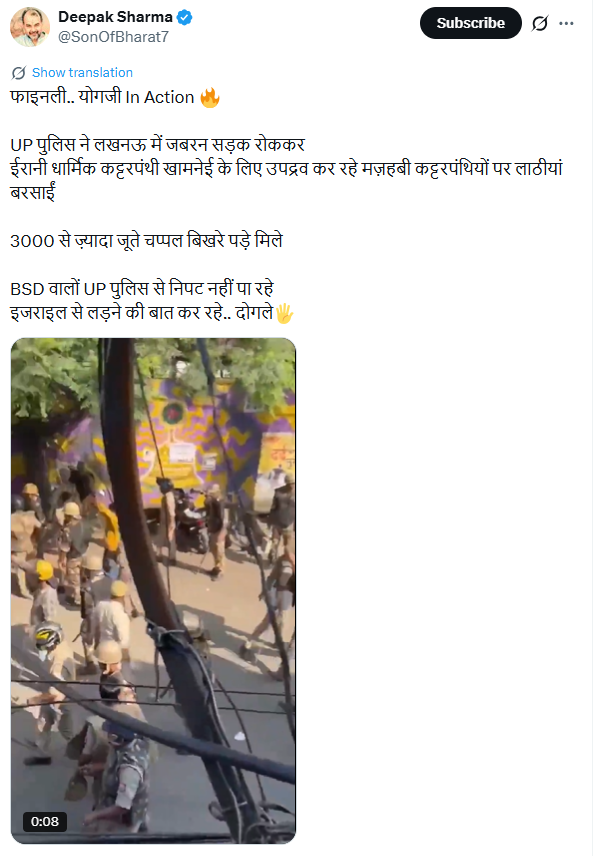
On March 3, 2026, an X (formerly Twitter) user shared the viral video claiming that the Uttar Pradesh Police took action against people blocking roads in Lucknow and creating unrest in support of Ali Khamenei.
Fact Check
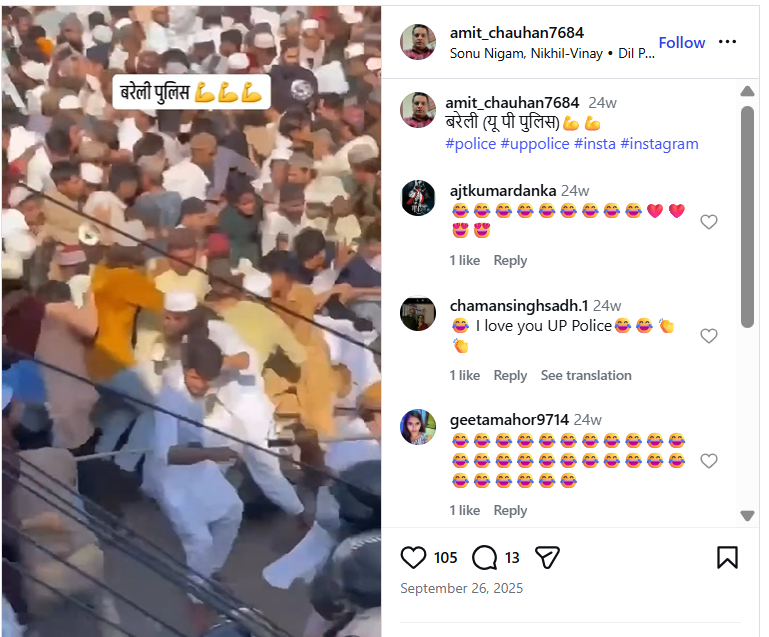
To verify the claim, we extracted key frames from the viral video and conducted a reverse image search using Google Lens. During the search, we found a similar video posted on Instagram on September 26, 2025, indicating that the footage predates the current claim.
Further research led us to the same video on the website of Aaj Tak, where it was published on September 26, 2025.
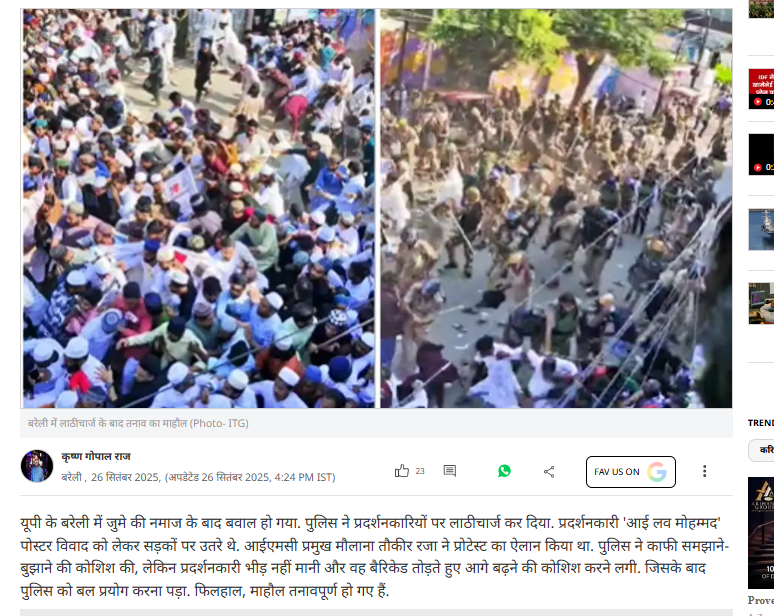
According to the report, protests erupted in Bareilly after Friday prayers over a controversy related to “I Love Mohammad” posters. Hundreds of people took to the streets carrying banners and posters. The report further stated that protesters, responding to a call by cleric Maulana Tauqeer Raza, attempted to break police barricades and move forward. Police initially tried to persuade the crowd to disperse, but when the situation escalated and the crowd refused to back down, officers resorted to baton-charging to control the situation. The incident reportedly led to tension in the area.
Conclusion:
Our research found that the viral video being shared as police action on protesters in Lucknow after the alleged killing of Ali Khamenei is misleading. The footage is actually from Bareilly and shows a police baton-charge during a protest rally held on September 26, 2025 in support of the “I Love Mohammad” campaign.

Related Blogs

Executive Summary
A video is being shared on social media with the claim that it allegedly shows the son of India’s Chief of Defence Staff (CDS) hosting a private birthday party with friends. Several people can be seen wearing women’s clothing in the video and attending what appears to be a birthday celebration. The posts further question how footage from an allegedly restricted Army residence surfaced online. CyberPeace Research found the viral claim to be misleading. Our research found that the video being shared by linking it to an Army residence and the son of the CDS is actually from the birthday celebration of fashion designer Lalit Singh, which was held in Gurugram. Therefore, the claim that the video shows a private birthday party hosted by the CDS’s son inside an Army residence is false.
Claim
A Pakistani handle claimed that the purported leaked footage shows the interior of an Indian Army residence, where the son of India’s CDS allegedly hosted a private birthday party with friends. The handle further questioned how footage from such a restricted location had surfaced online.
https://x.com/OfficialThoka/status/2101591703471988805

Fact Check
To verify the viral claim, we conducted a Google search using relevant keywords. During the search, we did not find any credible media reports related to the claim. A reverse image search and a search using relevant keywords revealed that the event shown in the video was the birthday celebration of fashion designer Lalit Singh. Lalit Singh had shared several photographs from his birthday celebration held in Gurugram on social media, and the visuals in those photographs matched those seen in the viral video.
https://www.instagram.com/lalitsingh159/

We found photographs of the person seen in the viral video on Instagram. He had identified himself as Lalit Singh.

At the end of our research, we also found the YouTube channel of fashion designer Lalit Singh. On the channel, Lalit Singh regularly shares videos related to similar birthday celebrations and other private events. This further confirms that the claim linking the viral video to a birthday party hosted by the son of India’s Chief of Defence Staff is false and fabricated.
https://www.youtube.com/@lalitsingh-159

Conclusion
Our research found that the video being shared on social media with the claim that it shows a birthday party hosted by the son of India’s Chief of Defence Staff (CDS) and footage from an Army residence is being circulated with a false claim. The research revealed that the visuals in the viral video are from the birthday celebration of fashion designer Lalit Singh, which was held in Gurugram. Lalit Singh shared several photographs and videos from the same celebration on his social media accounts. In addition, videos related to similar events are available on his YouTube channel. During our research, we found no credible or official source linking the viral video to the CDS’s son or any Army residence. Therefore, the claim that the viral video shows a private birthday party hosted by the CDS’s son is false and misleading.

The race for global leadership in AI is in full force. As China and the US emerge as the ‘AI Superpowers’ in the world, the world grapples with the questions around AI governance, ethics, regulation, and safety. Some are calling this an ‘AI Arms Race.’ Most of the applications of these AI systems are in large language models for commercial use or military applications. Countries like Germany, Japan, France, Singapore, and India are now participating in this race and are not mere spectators.
The Government of India’s Ministry of Electronics and Information Technology (MeitY) has launched the IndiaAI Mission, an umbrella program for the use and development of AI technology. This MeitY initiative lays the groundwork for supporting an array of AI goals for the country. The government has allocated INR 10,300 crore for this endeavour. This mission includes pivotal initiatives like the IndiaAI Compute Capacity, IndiaAI Innovation Centre (IAIC), IndiaAI Datasets Platform, IndiaAI Application Development Initiative, IndiaAI FutureSkills, IndiaAI Startup Financing, and Safe & Trusted AI.
There are several challenges and opportunities that India will have to navigate and capitalize on to become a significant player in the global AI race. The various components of India’s ‘AI Stack’ will have to work well in tandem to create a robust ecosystem that yields globally competitive results. The IndiaAI mission focuses on building large language models in vernacular languages and developing compute infrastructure. There must be more focus on developing good datasets and research as well.
Resource Allocation and Infrastructure Development
The government is focusing on building the elementary foundation for AI competitiveness. This includes the procurement of AI chips and compute capacity, about 10,000 graphics processing units (GPUs), to support India’s start-ups, researchers, and academics. These GPUs have been strategically distributed, with 70% being high-end newer models and the remaining 30% comprising lower-end older-generation models. This approach ensures that a robust ecosystem is built, which includes everything from cutting-edge research to more routine applications. A major player in this initiative is Yotta Data Services, which holds the largest share of 9,216 GPUs, including 8,192 Nvidia H100s. Other significant contributors include Amazon AWS's managed service providers, Jio Platforms, and CtrlS Datacenters.
Policy Implications: Charting a Course for Tech Sovereignty and Self-reliance
With this government initiative, there is a concerted effort to develop indigenous AI models and reduce tech dependence on foreign players. There is a push to develop local Large Language Models and domain-specific foundational models, creating AI solutions that are truly Indian in nature and application. Many advanced chip manufacturing takes place in Taiwan, which has a looming China threat. India’s focus on chip procurement and GPUs speaks to a larger agenda of self-reliance and sovereignty, keeping in mind the geopolitical calculus. This is an important thing to focus on, however, it must not come at the cost of developing the technological ‘know-how’ and research.
Developing AI capabilities at home also has national security implications. When it comes to defence systems, control over AI infrastructure and data becomes extremely important. The IndiaAI Mission will focus on safe and trusted AI, including developing frameworks that fit the Indian context. It has to be ensured that AI applications align with India's security interests and can be confidently deployed in sensitive defence applications.
The big problem here to solve here is the ‘data problem.’ There must be a focus on developing strategies to mitigate the data problem that disadvantages the Indian AI ecosystem. Some data problems are unique to India, such as generating data in local languages. While other problems are the ones that appear in every AI ecosystem development lifecycle namely generating publicly available data and licensed data. India must strengthen its ‘Digital Public Infrastructure’ and data commons across sectors and domains.
India has proposed setting up the India Data Management Office to serve as India’s data regulator as part of its draft National Data Governance Framework Policy. The MeitY IndiaAI expert working group report also talked about operationalizing the India Datasets Platform and suggested the establishment of data management units within each ministry.
Economic Impact: Growth and Innovation
The government’s focus on technology and industry has far-reaching economic implications. There is a push to develop the AI startup ecosystem in the country. The IndiaAI mission heavily focuses on inviting ideas and projects under its ambit. The investments will strengthen the IndiaAI startup financing system, making it easier for nascent AI businesses to obtain capital and accelerate their development from product to market. Funding provisions for industry-led AI initiatives that promote social impact and stimulate innovation and entrepreneurship are also included in the plan. The government press release states, "The overarching aim of this financial outlay is to ensure a structured implementation of the IndiaAI Mission through a public-private partnership model aimed at nurturing India’s AI innovation ecosystem.”
The government also wants to establish India as a hub for sustainable AI innovation and attract top AI talent from across the globe. One crucial aspect that needs to be worked on here is fostering talent and skill development. India has a unique advantage, that is, top-tier talent in STEM fields. Yet we suffer from a severe talent gap that needs to be addressed on a priority basis. Even though India is making strides in nurturing AI talents, out-migration of tech talent is still a reality. Once the hardware manufacturing “goods-side” of economics transitions to service delivery in the field of AI globally, India will need to be ready to deploy its talent. Several structural and policy interfaces, like the New Education Policy and industry-academic partnership frameworks, allow India to capitalize on this opportunity.
India’s talent strategy must be robust and long-term, focusing heavily on multi-stakeholder engagement. The government has a pivotal role here by creating industry-academia interfaces and enabling tech hubs and innovation parks.
India's Position in the Global AI Race
India’s foreign policy and geopolitical standpoint have been one of global cooperation. This must not change when it comes to AI. Even though this has been dubbed as the “AI Arms Race,” India should encourage worldwide collaboration on AI R&D through collaboration with other countries in order to strengthen its own capabilities. India must prioritise more significant open-source AI development, work with the US, Europe, Australia, Japan, and other friendly countries to prevent the unethical use of AI and contribute to the formation of a global consensus on the boundaries for AI development.
The IndiaAI Mission will have far-reaching implications for India’s diplomatic and economic relations. The unique proposition that India comes with is its ethos of inclusivity, ethics, regulation, and safety from the get-go. We should keep up the efforts to create a powerful voice for the Global South in AI. The IndiaAI Mission marks a pivotal moment in India's technological journey. Its success could not only elevate India's status as a tech leader but also serve as a model for other nations looking to harness the power of AI for national development and global competitiveness. In conclusion, the IndiaAI Mission seeks to strengthen India's position as a global leader in AI, promote technological independence, guarantee the ethical and responsible application of AI, and democratise the advantages of AI at all societal levels.
References
- Ashwini Vaishnaw to launch IndiaAI portal, 10 firms to provide 14,000 GPUs. (2025, February 17). https://www.business-standard.com/. Retrieved February 25, 2025, from https://www.business-standard.com/industry/news/indiaai-compute-portal-ashwini-vaishnaw-gpu-artificial-intelligence-jio-125021700245_1.html
- Global IndiaAI Summit 2024 being organized with a commitment to advance responsible development, deployment and adoption of AI in the country. (n.d.). https://pib.gov.in/PressReleaseIframePage.aspx?PRID=2029841
- India to Launch AI Compute Portal, 10 Firms to Supply 14,000 GPUs. (2025, February 17). apacnewsnetwork.com. https://apacnewsnetwork.com/2025/02/india-to-launch-ai-compute-portal-10-firms-to-supply-14000-gpus/
- INDIAai | Pillars. (n.d.). IndiaAI. https://indiaai.gov.in/
- IndiaAI Innovation Challenge 2024 | Software Technology Park of India | Ministry of Electronics & Information Technology Government of India. (n.d.). http://stpi.in/en/events/indiaai-innovation-challenge-2024
- IndiaAI Mission To Deploy 14,000 GPUs For Compute Capacity, Starts Subsidy Plan. (2025, February 17). www.businessworld.in. Retrieved February 25, 2025, from https://www.businessworld.in/article/indiaai-mission-to-deploy-14000-gpus-for-compute-capacity-starts-subsidy-plan-548253
- India’s interesting AI initiatives in 2024: AI landscape in India. (n.d.). IndiaAI. https://indiaai.gov.in/article/india-s-interesting-ai-initiatives-in-2024-ai-landscape-in-india
- Mehra, P. (2025, February 17). Yotta joins India AI Mission to provide advanced GPU, AI cloud services. Techcircle. https://www.techcircle.in/2025/02/17/yotta-joins-india-ai-mission-to-provide-advanced-gpu-ai-cloud-services/
- IndiaAI 2023: Expert Group Report – First Edition. (n.d.). IndiaAI. https://indiaai.gov.in/news/indiaai-2023-expert-group-report-first-edition
- Satish, R., Mahindru, T., World Economic Forum, Microsoft, Butterfield, K. F., Sarkar, A., Roy, A., Kumar, R., Sethi, A., Ravindran, B., Marchant, G., Google, Havens, J., Srichandra (IEEE), Vatsa, M., Goenka, S., Anandan, P., Panicker, R., Srivatsa, R., . . . Kumar, R. (2021). Approach Document for India. In World Economic Forum Centre for the Fourth Industrial Revolution, Approach Document for India [Report]. https://www.niti.gov.in/sites/default/files/2021-02/Responsible-AI-22022021.pdf
- Stratton, J. (2023, August 10). Those who solve the data dilemma will win the A.I. revolution. Fortune. https://fortune.com/2023/08/10/workday-data-ai-revolution/
- Suri, A. (n.d.). The missing pieces in India’s AI puzzle: talent, data, and R&D. Carnegie Endowment for International Peace. https://carnegieendowment.org/research/2025/02/the-missing-pieces-in-indias-ai-puzzle-talent-data-and-randd?lang=en
- The AI arms race. (2024, February 13). Financial Times. https://www.ft.com/content/21eb5996-89a3-11e8-bf9e-8771d5404543
Executive Summary:
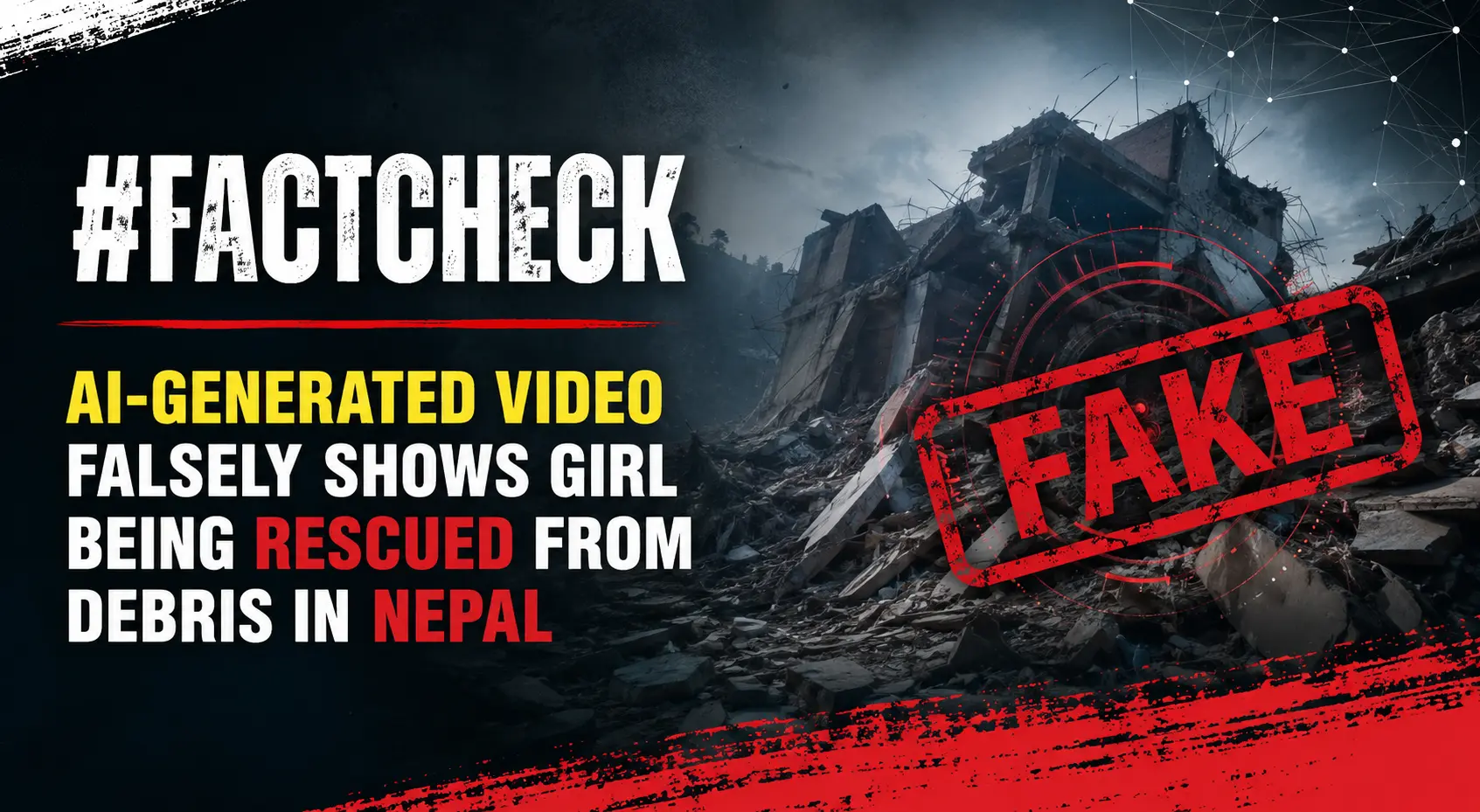
A video is being widely circulated on social media in connection with the relief and rescue operations following the devastating floods in Nepal. The video shows security personnel rescuing a girl trapped under debris and later giving her soup. The video is being shared with the claim that security personnel rescued a girl who had been buried under mud three days after the disaster in Timure village of Nepal’s Rasuwa district. A research by CyberPeace Research Wing found the viral claim to be false. Our research revealed that the viral video does not depict a real incident but is AI-generated.
Claim:
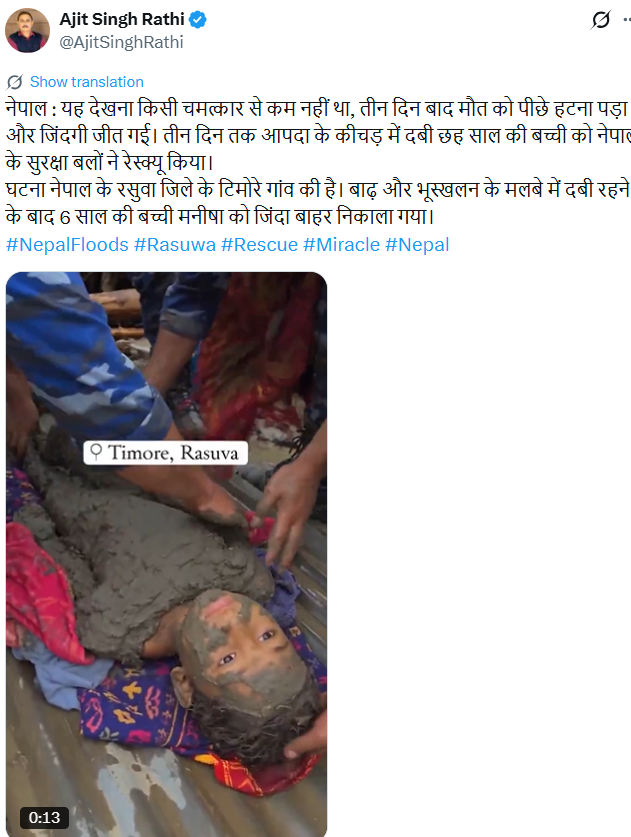
A user on social media platform X (formerly Twitter) shared the viral video with the caption: “Nepal: It was nothing short of a miracle to witness this. After three days, death had to retreat and life emerged victorious. A six-year-old girl, who had been buried under the disaster debris for three days, was rescued by Nepal’s security forces. The incident took place in Timure village of Nepal’s Rasuwa district. Six-year-old Manisha was pulled out alive after being buried under debris caused by floods and landslides.”
https://x.com/AjitSinghRathi/status/2094306889001742826?s=20
Fact Check:
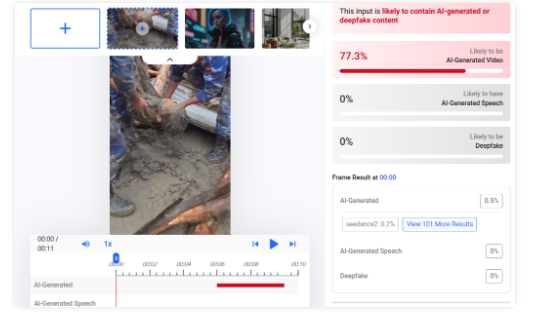
A close examination of the viral video revealed several inconsistencies, raising suspicions that the video was AI-generated. We then scanned the viral video using the AI detection tool Hive Moderation. According to the results, there is a 77 per cent likelihood that the viral video is AI-generated.
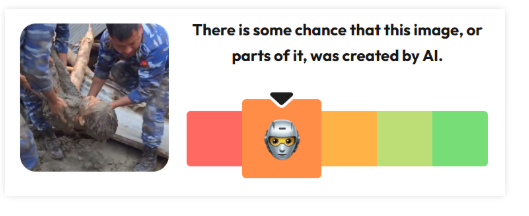
As part of our research, we scanned the video using the AI detection tool Wasitai. According to the results, the viral video is AI-generated.
Conclusion:
Our research found the viral claim to be false. Our findings revealed that the viral video does not depict a real incident but is AI-generated.
