
#FactCheck -AI-Generated Video Falsely Shows Cristiano Ronaldo Chanting “Free Palestine
Executive Summary:
After the reported attacks by Israel and the United States on Iran, a video allegedly showing footballer Cristiano Ronaldo has been widely circulated on social media. In the clip, Ronaldo appears to be holding a Palestinian flag and chanting “Free Palestine.” Several users are sharing the video with the claim that Ronaldo waved the Palestinian flag and raised “Free Palestine” slogans after the death of Iran’s Supreme Leader Ali Khamenei. However, a research by CyberPeace found that the claim is false. The viral clip does not depict a real event and has been generated using artificial intelligence. The fabricated video is being shared online with misleading claims.
Claim
An Instagram user “ham_313_ka_admi” shared the viral video on March 2, 2026. The text on the video reads: “Cristiano Ronaldo waved the Palestinian flag after Khamenei’s death. Mashallah. Free Palestine.”
Fact Check:
To verify the claim, we searched Google using relevant keywords but found no credible news reports supporting the viral claim. We also reviewed the official social media accounts of Cristiano Ronaldo, where no such video or statement was posted. This raised suspicion that the clip might be AI-generated.
To further examine the video, we analyzed it using AI detection tools. The tool Hive Moderation indicated a 99.9% probability that the video was created using artificial intelligence.
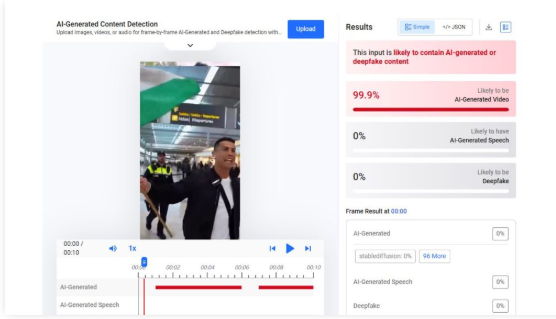
We also analyzed the footage using the Sightengine AI detection tool. The results suggested an 80% likelihood that the video was AI-generated. The tool also indicated that the clip may have been created using Sora, an AI video-generation tool.

Conclusion
The viral video claiming that Cristiano Ronaldo waved the Palestinian flag and chanted “Free Palestine” after the death of Ali Khamenei is AI-generated. It does not depict a real incident and is being shared with a misleading claim.

Related Blogs
.webp)
Overview:
WazirX is the platform for cryptocurrencies, based in India that has been hacked, and it made a loss of more than $230 million in cryptocurrency. This case concerned an unauthorized transaction with a multisignature or multisig, wallet controlled through Liminal’a digital asset management platform. These attacking incidents have thereafter raised more questions on the security of the Cryptocurrency exchanges and efficiency of the existing policies and laws.
Wallet Configuration and Security Measures
This wallet was breached and had a multisig setting meaning that more than one signature was needed to authorize a transaction. Specifically, it had six signatories: five are funded by WazirX and one is funded by Liminal. Every transaction needed the approval of at least three signatories of WazirX, all of whom had addressed security concerns by using Ledger’s hardware wallets; while the Liminal, too, had a signatory, for approval.
To further increase the level of security of the transactions, a whitelisting policy was introduced, only limited addresses were authorized to receive funds. This system was rather vulnerable, and the attackers managed to grasp the discrepancy between the information available through Liminal’s interface and the content of the transaction to seize unauthorized control over the wallet and implement the theft.
Modus Operandi: Attack Mechanics
The cyber attack appears to have been carefully carried out, with preliminary investigations suggesting the following tactics:
- Payload Manipulation: The attackers apparently substituted the transaction’s payload during signing; hence, they can reroute the collected funds into an unrelated wallet.
- Chain Hopping: To make it much harder to track their movements, the attackers split large amounts of money across multiple blockchains and broke tens of thousands of dollars into thousands of transactions involving different cryptocurrencies. This technique makes it difficult to trace people and things.
- Zero Balance Transactions: There were also some instances where it ended up with no Ethereum (ETH) in the balance and such wallets also in use for the purpose of further anonymization of the transactions.
- Analysis of the blockchain data suggested the enemy might have been making the preparations for this attack for several days prior to their attack and involved a high amount of planning.
Actions taken by WazirX:
Following the attack, WazirX implemented a series of immediate actions:
- User Notifications: The users were immediately notified of the occurrence of the breach and the possible risk it posed to them.
- Law Enforcement Engagement: The matters were reported to the National Cyber Crime Reporting Portal and specific authorities of which the Financial Intelligence Unit (FIU) and the Computer Emergency Response Team (CERT-In).
- Service Suspension: WazirX had suspended all its trading operations and user deposits’ and withdrawals’ to minimize further cases and investigate.
- Global Outreach: The exchange contacted more than 500 cryptocurrency exchanges and requested to blacklist the wallet’s addresses linked to the theft.
- Bounty Program: A bounty program was announced to encourage people to share information that can enable the authorities to retrieve the stolen money. A maximum of 23 million dollars was placed on the bounty.
Further Investigations
WazirX stated that it has contracted the services of cybersecurity professionals to help in the prosecution process of identifying and compensating for the losses. The exchange is still investigating the forensic data and working with the police for tracking the stolen assets. Nevertheless, the prospects of full recovery may be quite questionable primarily because of complexity of the attack and the methods used by the attackers.
Precautionary measures:
The WazirX cyber attack clearly implies that there is the necessity to improve the security and the regulation of the cryptocurrency industry. As exchanges become increasingly targeted by hackers, there is a pressing need for:
- Stricter Security Protocols: The commitment to technical innovations, such as integration of MFA, as well as constant monitoring of the users’ wallets’ activities.
- Regulatory Oversight: Formalization of the laws that require proper security for the cryptocurrency exchange platforms to safeguard their users as well as their investments.
- Community Awareness: To bypass such predicaments, there is a need to study on emergent techniques in spreading awareness, particularly in cases of scams or phishing attempts that are likely to follow such breaches.
Conclusion:
The cyber attack on WazirX in the field of cryptocurrency market, shows weaknesses and provides valuable lessons for enhancing the security. This attack highlights critical vulnerabilities in cryptocurrency exchanges, even though employing advanced security measures like multisignature wallets and whitelisting policies. The attack's complexity, involving payload manipulation, chain hopping, and zero balance transactions, underscores the attackers' meticulous planning and the challenges in tracing stolen assets. This case brings a strong message regarding the necessity of solid security measures, and constant attention to security in the rapidly growing world of digital assets. Furthermore, the incident highlights the importance of community awareness and education on emerging threats like scams and phishing attempts, which usually follow such breaches. By fostering a culture of vigilance and knowledge, the cryptocurrency community can better defend against future attacks.
Reference:
https://wazirx.com/blog/important-update-cyber-attack-incident-and-measures-to-protect-your-assets/
https://www.linkedin.com/pulse/wazirx-cyberattack-in-depth-analysis-jyqxf

Executive Summary:
A viral post on X (formerly Twitter) gained much attention, creating a false narrative of recent damage caused by the earthquake in Tibet. Our findings confirmed that the clip was not filmed in Tibet, instead it came from an earthquake that occurred in Japan in the past. The origin of the claim is traced in this report. More to this, analysis and verified findings regarding the evidence have been put in place for further clarification of the misinformation around the video.

Claim:
The viral video shows collapsed infrastructure and significant destruction, with the caption or claims suggesting it is evidence of a recent earthquake in Tibet. Similar claims can be found here and here

Fact Check:
The widely circulated clip, initially claimed to depict the aftermath of the most recent earthquake in Tibet, has been rigorously analyzed and proven to be misattributed. A reverse image search based on the Keyframes of the claimed video revealed that the footage originated from a devastating earthquake in Japan in the past. According to an article published by a Japanese news website, the incident occurred in February 2024. The video was authenticated by news agencies, as it accurately depicted the scenes of destruction reported during that event.

Moreover, the same video was already uploaded on a YouTube channel, which proves that the video was not recent. The architecture, the signboards written in Japanese script, and the vehicles appearing in the video also prove that the footage belongs to Japan, not Tibet. The video shows news from Japan that occurred in the past, proving the video was shared with different context to spread false information.

The video was uploaded on February 2nd, 2024.
Snap from viral video

Snap from Youtube video

Conclusion:
The video viral about the earthquake recently experienced by Tibet is, therefore, wrong as it appears to be old footage from Japan, a previous earthquake experienced by this nation. Thus, the need for information verification, such that doing this helps the spreading of true information to avoid giving false data.
- Claim: A viral video claims to show recent earthquake destruction in Tibet.
- Claimed On: X (Formerly Known As Twitter)
- Fact Check: False and Misleading

Executive Summary:
A viral claim alleges that following the Supreme Court of India’s August 11, 2025 order on relocating stray dogs, authorities in Delhi NCR have begun mass culling. However, verification reveals the claim to be false and misleading. A reverse image search of the viral video traced it to older posts from outside India, probably linked to Haiti or Vietnam, as indicated by the use of Haitian Creole and Vietnamese language respectively. While the exact location cannot be independently verified, it is confirmed that the video is not from Delhi NCR and has no connection to the Supreme Court’s directive. Therefore, the claim lacks authenticity and is misleading
Claim:
There have been several claims circulating after the Supreme Court of India on 11th August 2025 ordered the relocation of stray dogs to shelters. The primary claim suggests that authorities, following the order, have begun mass killing or culling of stray dogs, particularly in areas like Delhi and the National Capital Region. This narrative intensified after several videos purporting to show dead or mistreated dogs allegedly linked to the Supreme Court’s directive—began circulating online.

Fact Check:
After conducting a reverse image search using a keyframe from the viral video, we found similar videos circulating on Facebook. Upon analyzing the language used in one of the posts, it appears to be Haitian Creole (Kreyòl Ayisyen), which is primarily spoken in Haiti. Another similar video was also found on Facebook, where the language used is Vietnamese, suggesting that the post associates the incident with Vietnam.
However, it is important to note that while these posts point towards different locations, the exact origin of the video cannot be independently verified. What can be established with certainty is that the video is not from Delhi NCR, India, as is being claimed. Therefore, the viral claim is misleading and lacks authenticity.


Conclusion:
The viral claim linking the Supreme Court’s August 11, 2025 order on stray dogs to mass culling in Delhi NCR is false and misleading. Reverse image search confirms the video originated outside India, with evidence of Haitian Creole and Vietnamese captions. While the exact source remains unverified, it is clear the video is not from Delhi NCR and has no relation to the Court’s directive. Hence, the claim lacks credibility and authenticity.
Claim: Viral fake claim of Delhi Authority culling dogs after the Supreme Court directive on the ban of stray dogs as on 11th August 2025
Claimed On: Social Media
Fact Check: False and Misleading
