
#FactCheck-Fake X Account Falsely Poses as India’s Ministry of External Affairs
Executive Summary
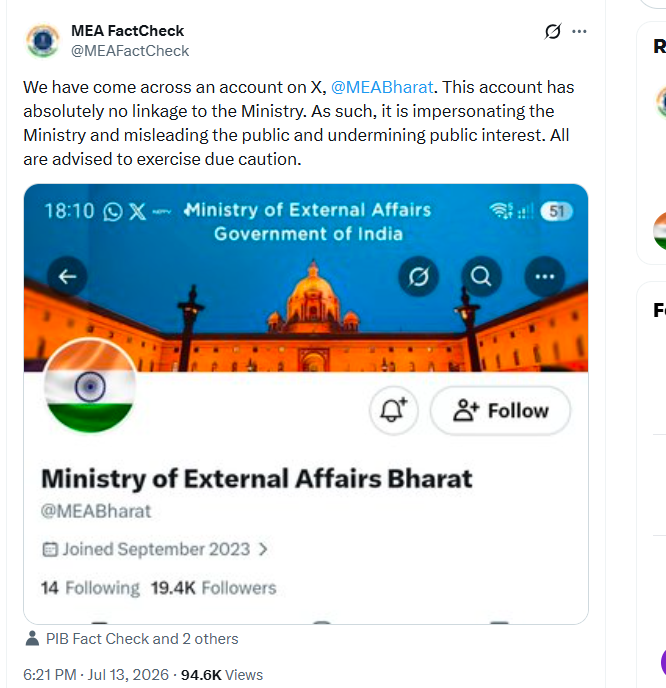
A social media account on X (formerly Twitter) named @MEABharat is being circulated as the official account of India's Ministry of External Affairs (MEA). Many users are sharing posts from the account, believing it to be an authentic government handle and treating the information published there as official communication. CyberPeace Research Wing’s research found the viral claim to be misleading. Our research revealed that @MEABharat is not an official X account of the Ministry of External Affairs. The Ministry has publicly clarified that it has no association with the account and stated that it is impersonating the Ministry, misleading the public, and undermining public interest.
Claim
Social media users are claiming that @MEABharat is the official X account of India's Ministry of External Affairs and that the information posted on the account is officially issued by the Ministry.
https://x.com/MEAFactCheck/status/2076650791453270332

Fact Check
To verify the claim, we conducted a keyword-based search on Google. During the research, we found an official clarification posted by the Ministry of External Affairs' fact-check handle, @MEAFactCheck. In its post, the Ministry clearly stated that the @MEABharat account has no connection whatsoever with the Ministry of External Affairs. It further clarified that the account is impersonating the Ministry, misleading the public, and undermining public interest. The Ministry also advised users to exercise caution and rely only on its verified official social media accounts and website for authentic information.
https://x.com/MEAFactCheck/status/2076650791453270332
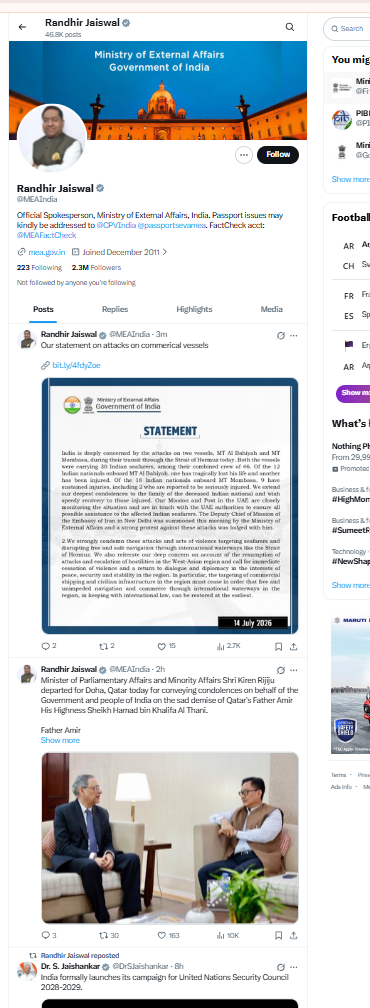
As part of our research, we also examined the Ministry's official X account, @MEAIndia, which carries the verified blue badge. The account regularly publishes official statements, diplomatic updates, press briefings, and other communications related to India's foreign policy. It also serves as the official spokesperson's handle for the Ministry of External Affairs.
https://x.com/MEAIndia
Conclusion
Our research found that @MEABharat is not the official X account of India's Ministry of External Affairs. The Ministry itself has publicly clarified that the account is fake, has no affiliation with the government, and is impersonating the Ministry to mislead the public. Therefore, the claim that @MEABharat is the official MEA handle is misleading. Users should rely only on the Ministry's verified accounts, including @MEAIndia and @MEAFactCheck, for authentic government information.

Related Blogs

Executive Summary:
A video showing poor runway visibility from inside an aircraft cockpit is being widely shared on social media, linking it to an alleged aircraft accident involving Maharashtra Deputy Chief Minister Ajit Pawar in Baramati on January 28, 2025. Users claim that the footage captured the final moments before the crash, suggesting that the runway visibility disappeared just seconds before landing. However, research conducted by the CyberPeace found the viral claim to be misleading. The research revealed that the video has no connection to any aircraft accident involving Deputy Chief Minister Ajit Pawar. In reality, the video dates back to 2013 and shows a pilot attempting to land an aircraft amid heavy rain. During the approach, the runway briefly disappears from the pilot’s view, prompting the pilot to abort the landing and execute a go-around. The aircraft later lands safely after weather conditions improve.
Claim
An Instagram user shared the viral video on January 29, 2026, claiming:“Baramati plane crash: video of the aircraft accident surfaces. Runway disappears just three seconds before landing.” (The link to the post, its archived version, and screenshots are provided below.)

Fact Check
To verify the claim, we extracted keyframes from the viral video and conducted a reverse image search using Google Lens. The search led us to the same video uploaded on a YouTube channel named douglesso, which was published on June 12, 2013. (Footage link and screenshot available below.)

Further research led us to a report published by the American media website CNET, which featured the same visual. According to the report, the video shows a Boeing Business Jet attempting to land during heavy rainfall. The aircraft was conducting a CAT I Instrument Landing System (ILS) approach when a sudden downpour drastically reduced visibility at decision height. As the runway briefly disappeared from view, the pilots aborted the landing and carried out a go-around. The aircraft later landed safely once weather conditions improved. (The link to the CNET report and its screenshot are provided below.)
- https://www.cnet.com/culture/this-is-what-happens-when-a-plane-is-landing-and-the-runway-disappears/

Conclusion
Our research confirms that the video circulating on social media is unrelated to any recent aircraft accident involving Maharashtra Deputy Chief Minister Ajit Pawar. The clip is an old video from 2013, which is now being shared with a false and misleading claim.

Introduction
The Computer Emergency Response Team (CERT-in) is a nodal agency of the government established and appointed as a national agency in respect of cyber incidents and cyber security incidents in terms of the provisions of section 70B of the Information Technology (IT) Act, 2000. CERT-In has issued a cautionary note to Microsoft Edge, Adobe and Google Chrome users. Users have been alerted to many vulnerabilities by the government's cybersecurity agency, which hackers might use to obtain private data and run arbitrary code on the targeted machine. Users are advised by CERT-In to apply a security update right away in order to guard against the problem.
Vulnerability note
Vulnerability notes CIVN-2023-0361, CIVN-2023-0362 and CIVN-2023-0364 for Google Chrome for Desktop, Microsoft Edge and Adobe respectively, include more information on the alert. The problems have been categorized as high-severity issues by CERT-In, which suggests applying a security upgrade right now. According to the warning, there is a security risk if you use Google Chrome versions earlier than v120.0.6099.62 on Linux and Mac, or earlier than 120.0.6099.62/.63 on Windows. Similar to this, the vulnerability may also impact users of Microsoft Edge browser versions earlier than 120.0.2210.61.
Cause of the Problem
These vulnerabilities are caused by "Use after release in Media Stream, Side Panel Search, and Media Capture; Inappropriate implementation in Autofill and Web Browser UI, “according to the explanation in the issue note on the CERT-In website. The alert further warns that individuals who use the susceptible Microsoft Edge and Google Chrome browsers could end up being targeted by a remote attacker using these vulnerabilities to send a specially crafted request.” Once these vulnerabilities are effectively exploited, hackers may obtain higher privileges, obtain sensitive data, and run arbitrary code on the system of interest.
High-security issues: consequences
CERT-In has brought attention to vulnerabilities in Google Chrome, Microsoft Edge, and Adobe that might have serious repercussions and put users and their systems at risk. The vulnerabilities found in widely used browsers, like Adobe, Microsoft Edge, and Google Chrome, present serious dangers that might result in data breaches, unauthorized code execution, privilege escalation, and remote attacks. If these vulnerabilities are taken advantage of, private information may be violated, money may be lost, and reputational harm may result.
Additionally, the confidentiality and integrity of sensitive information may be compromised. The danger also includes the potential to interfere with services, cause outages, reduce productivity, and raise the possibility of phishing and social engineering assaults. Users may become less trusting of the impacted software as a result of the urgent requirement for security upgrades, which might make them hesitant to utilize these platforms until guarantees of thorough security procedures are provided.
Advisory
- Users should update their Google Chrome, Microsoft Edge, and Adobe software as soon as possible to protect themselves against the vulnerabilities that have been found. These updates are supplied by the individual software makers. Furthermore, use caution when browsing and refrain from downloading things from unidentified sites or clicking on dubious links.
- Make use of reliable ad-blockers and strong, often updated antivirus and anti-malware software. Maintain regular backups of critical data to reduce possible losses in the event of an attack, and keep up with best practices for cybersecurity. Maintaining current security measures with vigilance and proactiveness can greatly lower the likelihood of becoming a target for prospective vulnerabilities.
References

Introduction
Cyberwarfare has evolved into one of the most decisive instruments of statecraft and conflict. The increasing digitisation of critical infrastructure like power grids, water systems, transportation systems, healthcare networks, and energy sources has made these systems new targets in the war of algorithms. Military logic is evolving to paralyse the nation’s critical infrastructure to keep its resources engaged in repairing them and thereby break the nation’s ability to deter and counter attacks, all without firing a single bullet.
From Ransomware to an Invisible Sabotage: The changing nature of warfare
The operational technology (OT) landscape has become the epicentre of cyber operations, all around the world. Once, which was insulated, related to industrial systems that controlled turbines, pipelines, or dams, they now stand connected to the Internet through supervisory control and data acquisition (SCADA) and the Internet of Things. These connections have also become gateways for attackers, besides enhancing the efficiency of the infrastructural lifelines of the nation.
Groups like Volt Typhoon, Sandworm, Laurionite, and Cyberavengers have transformed the art of digital infiltration into a strategic shift. Volt Typhoon, which is linked to China, has used “living-off-the-land” techniques to exploit the legitimate administrative tools to remain invisible while scanning the critical infrastructures in the US. Sandworm, which is aligned with Russia’s GRU (Glavnoye Razvedyvatelnoye Upravlenie) or Main Intelligence Directorate (in English), has demonstrated the power of cyber sabotage in real time, as its attacks on Ukraine’s power grids in 2015 and 2021 had left millions in darkness, coinciding with kinetic missile strikes. Meanwhile, the Iranian-affiliated Cyberavengers group, which has weaponised the AI-assisted malware, such as IOCONTROL, that are capable of hijacking water and energy control systems. Each of these systems used in these operations reflects a shift from direct espionage activities to a state of strategic paralysis.
In comparison to the traditional cybercrime activities that are aimed at stealing data and extortion of money, these campaigns repeatedly target the physical systems, which consist of the machinery that sustains civilian life and military preparedness.
The Military Logic behind Cyber Targeting: A Web of Vulnerabilities
A critical infrastructure is a complex ecosystem that covers power generation, transportation, communication, and manufacturing are all interconnected, which means a single compromised node can cascade into a national paralysis. For instance, a breach in the systems of the dam can flood an entire city, a grid shutdown can halt water supply to hospitals, and even affect air traffic. The 2015 Black Energy Malware attack in Ukraine has proved this possibility when three utilities were hacked, plunging thousands of homes into darkness. The Iranian hackers once again gained access to the Bowman Avenue Dam of New York and controlled its floodgates, which gave a chilling demonstration of the destructive reality of digital manipulation.
The systems remain vulnerable mainly for 3 reasons such as-
- Legacy Architectures: Many of these industrial systems were designed decades ago with no built-in cybersecurity mechanisms.
- Slow Patching and Segmentation Gaps: All updates and segmentation between IT and TO networks often lag, providing open entry points for attackers.
- Converging with IoT: The integration of smart sensors and cloud-based management tools has expanded the attack surface exponentially.
This interconnected fragility has turned our critical infrastructures into both a weapon and a target or a tool for coercion in modern hybrid warfare. Between 2023 and 2024, over 420 cyberattacks were witnessed in several critical global infrastructures, which averaged to 13 attacks per second, according to a news report. These were not just random acts of digital vandalism; they were deliberate and coordinated operational attempts by state-led actors from China, Russia, and Iran.
Developing a new Resilience as the new tool of Deterrence
Cyber deterrence no longer rests on the fear of retaliation, it relies on the need for resilience. Nations that can absorb attacks, maintain continuity, and recover rapidly would be the true superpowers of this digital age. Segmentation, real-time threat detection, and AI-assisted recovery models are vital pillars of this model of resilience. The logic of modern cyberwarfare is clear, which means that the more a nation digitizes, the more it will need to defend itself.
However, as the line between war and peace blurs, safeguarding critical infrastructure is no longer just an IT priority; rather, it is a national security doctrine. In this silent theatre of cyberwarfare, survival will depend not only on firepower, but on firewalls.
References
- https://rmcglobal.com/critical-infrastructure-under-siege-the-top-ot-threats-of-2025/
- https://ccdcoe.org/uploads/2018/10/Geers2009_The-Cyber-Threat-to-National-Critical-Infrastructures.pdf
- https://www.researchgate.net/publication/335752979_Cybersecurity_of_Critical_Infrastructure
- https://arxiv.org/html/2510.04118v1
- https://www.anapaya.net/blog/top-5-critical-infrastructure-cyberattacks
