
#FactCheck -AI-Generated Image Falsely Claims Mukesh and Nita Ambani Gifted Luxury Car to Suryakumar Yadav
Executive Summary
A picture circulating on social media allegedly shows Reliance Industries chairman Mukesh Ambani and Nita Ambani presenting a luxury car to India’s T20 team captain Suryakumar Yadav. The image is being widely shared with the claim that the Ambani family gifted the cricketer a luxury car in recognition of his outstanding performance. However, research conducted by the CyberPeace found the viral claim to be false. The research revealed that the image being circulated online is not authentic but generated using artificial intelligence (AI).
Claim
On February 8, 2025, a Facebook user shared the viral image claiming that Mukesh Ambani and Nita Ambani gifted a luxury car to Suryakumar Yadav following his brilliant innings. The post has been widely circulated across social media platforms. In another instance, a user shared a collage in which one image shows Suryakumar Yadav receiving an award, while another depicts him with Nita Ambani, further amplifying the claim.
- https://www.facebook.com/61559815349585/posts/122207061746327178/?rdid=0MukeT6c7WK1uB8m#
- https://archive.ph/wip/UH9Xh

Fact Check:
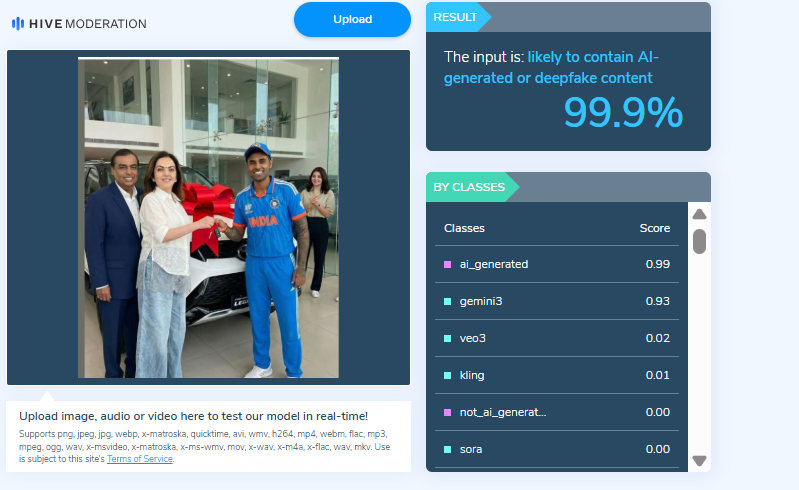
Upon closely examining the viral image, certain visual inconsistencies raised suspicion that it might be AI-generated. To verify its authenticity, the image was analysed using the AI detection tool Hive Moderation, which indicated a 99 percent probability that the image was AI-generated.
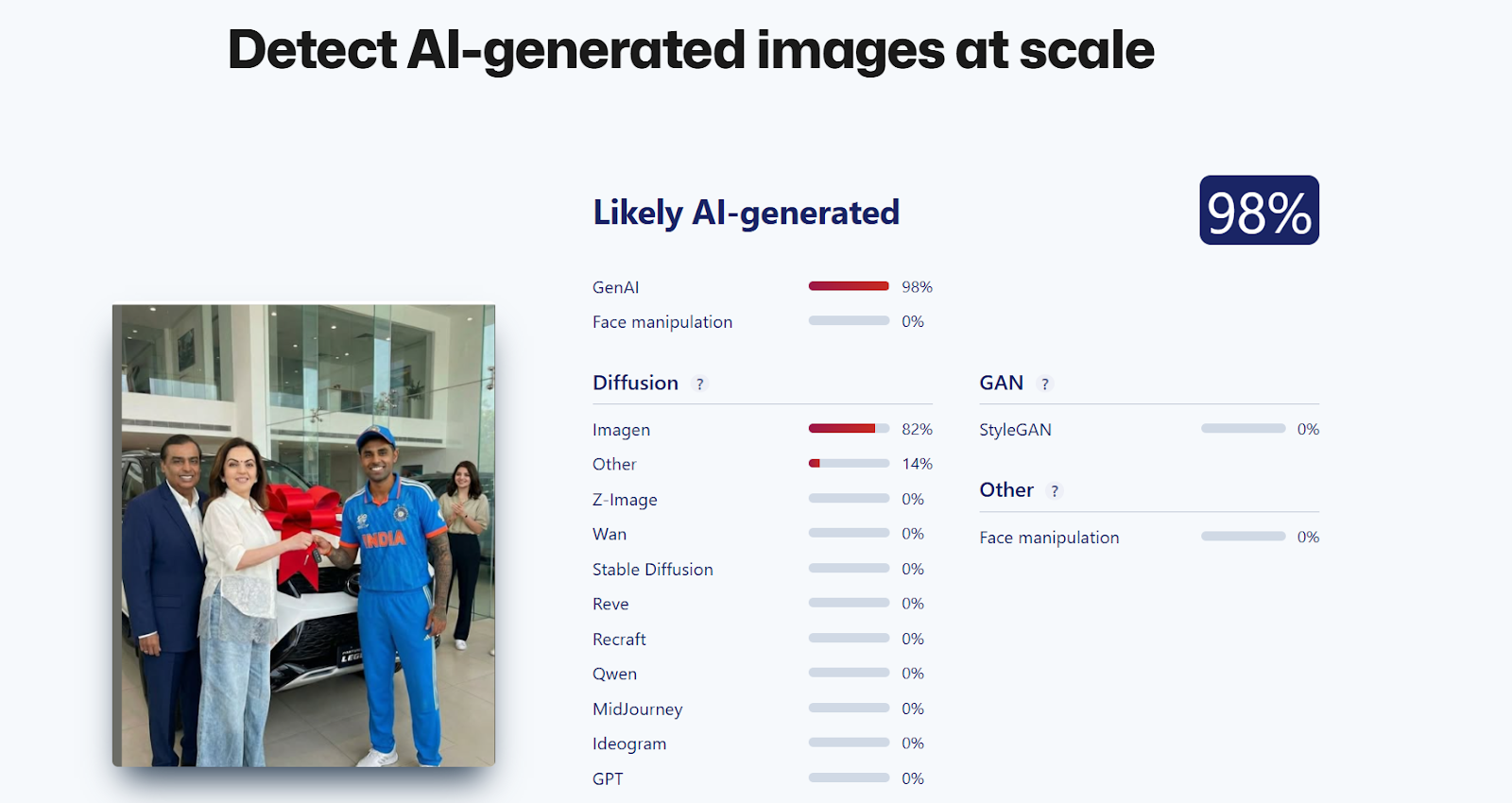
In the next step of the research, the image was also analysed using another AI detection tool, Sightengine, which found a 98 percent likelihood that the image was created using artificial intelligence.
Conclusion
The research clearly establishes that the viral image claiming Mukesh Ambani and Nita Ambani gifted a luxury car to Suryakumar Yadav is misleading. The picture is not real and has been generated using AI.

Related Blogs

Introduction
As the world seemingly shrinks under the vast, ever-stretching canopy of the internet, the channels through which information flows are becoming increasingly enigmatic and tangled. In the digital world, the gulf between fact and fabrication narrows dramatically, with the veracity of information too often lost in the flood. Amidst the torrents of data, platforms like YouTube, a veritable Goliath in the video streaming sphere, are finding themselves at the forefront of a critical battle against the dark forces of fake news and disinformation—a war that is waged with the intensity of any historical conflict over truth and influence.
It is in this volatile theatre that Google's video behemoth, YouTube, under the scrutiny of the global eye, announces its strategic campaign to shield against the onslaught of misinformation. With India, the world's most populous democracy, on the cusp of its monumental general elections, the stakes could hardly be higher. YouTube's involvement thus evolves beyond corporate social responsibility—it becomes a crusade for the integrity of information, a paladin for the democratic process, and a protector of the public’s right to factual reporting.
The Campaign
The campaign envisioned by YouTube India's vanguard is multifaceted and robust, aimed at rooting out the insidious tendrils of fake news where they lie. At the heart of this mission are two pivotal strategies that form the backbone of YouTube's defense. Firstly, a rigorous misinformation policy, which heralds as a bastion against content designed with duplicitous intent. YouTube Indian Head Ishan Chatterjee elucidates, 'Our misinformation policies clearly state that if the content has been technically manipulated with the intent to deceive a user and there's a danger of real-world harm...we will act against that content.' It is an exhortation of YouTube's commitment to a culture of truth and an acknowledgement of the platform's influence and responsibility. This process, however, is more complex than it appears; it is tangled in socio-political nuances and demands an uncompromising vigilance to identify and dispel falsehoods.
Yet, this is merely the foundation upon which YouTube’s strategy rests. The second prong of their stratagem is even more ambitious—intending not only to eradicate the chaff of misinformation but also to till the soil with the seeds of verifiable, authoritative news content. This is an initiative to resuscitate the public's faith in digital information sources. By allying with credible news publishers and fostering a symbiosis with independent journalists, YouTube has taken up the mantle of an institution that not just police content, but cultivates it, transforming the barren desert of online falsehoods into an oasis of enlightenment.
News on YouTube is symbiotic with the larger consciousness of its users, driving content consumption and engaging millions who seek out current affairs, investigative reports, and in-depth analysis on the platform. The democratisation of news, once the hallowed ground of traditional broadcast and print media, now finds its theatre online. Chatterjee insightfully notes the ascending trend of news story engagement on YouTube Shorts and Connected TV (CTV)—two emergent platforms that have revolutionised content delivery and consumption. CTV, in particular, has skyrocketed in popularity within the past five years, boasting over 58 million viewers in India consuming YouTube content from the comfort of their living rooms as of June 2023, per analytics.
This phenomenon is acutely observed by YouTube's Director and Global Head of Responsibility, Tim Katz, who delineates a portrait of the Indian market's distinctive hunger for live content, particularly news, on CTV. Katz's observations carry an air of fascination, 'The other two things that have been exciting to see are that we've seen a lot of growth, particularly during sensitive moments, with large news stories occurring certainly during an election cycle, and we just see very large growth from many of our authoritative partners.'
The Implications of the Campaign
The tapestry of YouTube's news ecosystem is a rich mosaic of diversity, including independent journalists, broadcasters, legacy print publications, and digital-first media organisations. Katz underscores the gravity of nurturing such a broad and dynamic news environment on the platform, a gesture of YouTube's commitment to a holistic information landscape.
An illuminating report from the Google News Initiative, forged in cooperation with Kantar, reiterates the dominance of video as the consummate medium for news consumption across a spectrum of languages and formats in India. It paints a picture of a nation of insatiable news consumers, with nearly every second Indian language internet user engaging with news content, a substantial proportion hailing from urban locales. Of particular resonance is hyperlocal news, which plucks the chords of local interests and concerns, touching the lives of seven out of ten citizens.
Moreover, the economic impetus behind YouTube’s role in the media firmament is brought to light in the Oxford Economics Impact Report, revealing a staggering 70% of Indian media and music companies with a YouTube presence acknowledge the platform as a crucial revenue stream.
Conclusion
Poised upon the sharp edge of an electric election season—a season that will no doubt be drenched in a spectrum of information, both fact and fable—YouTube's convictions stand as a beacon of reliability. Their initiative is more than a method—it's a philosophy, a dedication to purifying the information sphere. In the digital epoch, where the battle lines for truth are drawn in bytes and bandwidth, YouTube’s rallying cry for responsibility, its vow to safeguard democratic ideals, and its unyielding commitment to illuminating the corridors of knowledge are more than strategies; they are pillars on which a well-informed, engaged, and enlightened citizenry can lean.
Reference
Executive Summary
A video circulating on social media claims that Iran’s new Supreme Leader Mojtaba Khamenei has passed away, with users attributing the claim to American sources. However, research by the CyberPeace found the claim to be false. Our research confirms that Mojtaba Khamenei is alive and in good health.
Claim
A Facebook user shared the viral video, claiming that Iran’s new Supreme Leader Mojtaba Khamenei had died.

Fact Check
To verify the claim, we conducted keyword searches on Google but found no credible media reports confirming his death. Further research led us to a report published on April 10, 2026, by ABP News. According to the report, amid discussions around a ceasefire, Mojtaba Khamenei issued a statement saying that Iran does not seek war with the United States or Israel, but as a nation, it must defend its rights.
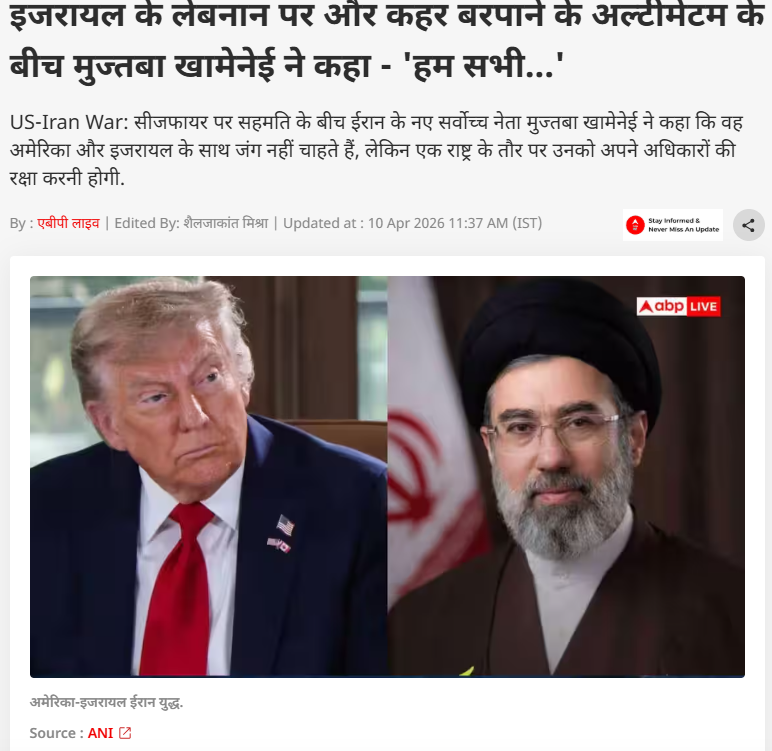
Additionally, the image used in the viral video was analyzed using the AI detection tool HIVE Moderation. The results indicated a 99% probability that the image is AI-generated.
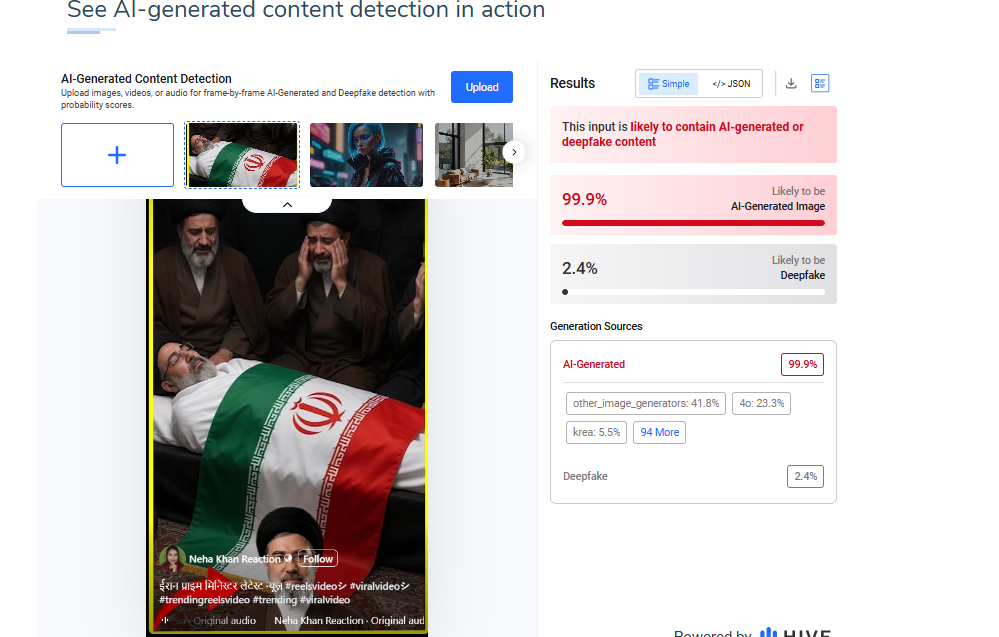
Conclusion
The viral claim is false and misleading. There is no credible evidence to suggest that Mojtaba Khamenei has died. On the contrary, recent verified reports confirm that he is alive and has even issued public statements on ongoing geopolitical developments. The widespread circulation of this claim appears to be driven by misinformation, amplified through social media without verification. The use of AI-generated visuals further adds to the confusion, making the content appear authentic at first glance.

India is the world's largest democracy, and conducting free and fair elections is a mammoth task shouldered by the Election Commission of India. But technology is transforming every aspect of the electoral process in the digital age, with Artificial Intelligence (AI) being integrated into campaigns, voter engagement, and election monitoring. In the upcoming Bihar elections of 2025, all eyes are on how the use of AI will influence the state polls and the precedent it will set for future elections.
Opportunities: Harnessing AI for Better Elections
Breaking Language Barriers with AI:
AI is reshaping political outreach by making speeches accessible in multiple languages. At the Kashi Tamil Sangamam in 2024, the PM’s Hindi address was AI-dubbed in Tamil in real time. Since then, several speeches have been rolled out in eight languages, ensuring inclusivity and connecting with voters beyond Hindi-speaking regions more effectively.
Monitoring and Transparency
During Bihar’s Panchayat polls, the State Election Commission used Staqu’s JARVIS, an AI-powered system that connects with CCTV cameras to monitor EVM screens in real time. By reducing human error, JARVIS brought greater accuracy, speed, and trust to the counting process.
AI for Information Access on Public Service Delivery
NaMo AI is a multilingual chatbot that citizens can use to inquire about the details of public services. The feature aims to make government schemes easy to understand, transparent, and help voters connect directly with the policies of the government.
Personalised Campaigning
AI is transforming how campaigns connect with voters. By analysing demographics and social media activity, AI builds detailed voter profiles. This helps craft messages that feel personal, whether on WhatsApp, a robocall, or a social media post, ensuring each group hears what matters most to them. This aims to make political outreach sharper and more effective.
Challenges: The Dark Side of AI in Elections
Deepfakes and Disinformation
AI-powered deepfakes create hyper-realistic videos and audio that are nearly impossible to distinguish from the real. In elections, they can distort public perception, damage reputations, or fuel disharmony on social media. There is a need for mandatory disclaimers stating when content is AI-generated, to ensure transparency and protect voters from manipulative misinformation.
Data Privacy and Behavioural Manipulation
Cambridge Analytica’s consulting services, provided by harvesting the data of millions of users from Facebook without their consent, revealed how personal data can be weaponised in politics. This data was allegedly used to “microtarget” users through ads, which could influence their political opinions. Data mining of this nature can be supercharged through AI models, jeopardising user privacy, trust, safety, and casting a shadow on democratic processes worldwide.
Algorithmic Bias
AI systems are trained on datasets. If the datasets contain biases, AI-driven tools could unintentionally reinforce stereotypes or favor certain groups, leading to unfair outcomes in campaigning or voter engagement.
The Road Ahead: Striking a Balance
The adoption of AI in elections opens a Pandora's box of uncertainties. On the one hand, it offers solutions for breaking language barriers and promoting inclusivity. On the other hand, it opens the door to manipulation and privacy violations.
To counter risks from deepfakes and synthetic content, political parties are now advised to clearly label AI-generated materials and add disclaimers in their campaign messaging. In Delhi, a nodal officer has even been appointed to monitor social media misuse, including the circulation of deepfake videos during elections. The Election Commission of India constantly has to keep up with trends and tactics used by political parties to ensure that elections remain free and fair.
Conclusion
With Bihar’s pioneering experiments with JARVIS in Panchayat elections to give vote counting more accuracy and speed, India is witnessing both sides of this technological revolution. The challenge lies in ensuring that AI strengthens democracy rather than undermining it. Deepfakes algorithms, bias, and data misuse remind us of the risk of when technology oversteps. The real challenge is to strike the right balance in embracing AI for elections to enhance inclusivity and transparency, while safeguarding trust, privacy, and the integrity of democratic processes.
References
- https://timesofindia.indiatimes.com/india/how-ai-is-rewriting-the-rules-of-election-campaign-in-india/articleshow/120848499.cms#
- https://m.economictimes.com/news/elections/lok-sabha/india/2024-polls-stand-out-for-use-of-ai-to-bridge-language-barriers/articleshow/108737700.cms
- https://www.ndtv.com/india-news/namo-ai-on-namo-app-a-unique-chatbot-that-will-answer-everything-on-pm-modi-govt-schemes-achievements-5426028
- https://timesofindia.indiatimes.com/gadgets-news/staqu-deploys-jarvis-to-facilitate-automated-vote-counting-for-bihar-panchayat-polls/articleshow/87307475.cms
- https://www.drishtiias.com/daily-updates/daily-news-editorials/deepfakes-in-elections-challenges-and-mitigation
- https://internetpolicy.mit.edu/blog-2018-fb-cambridgeanalytica/
- https://www.deccanherald.com/elections/delhi/delhi-assembly-elections-2025-use-ai-transparently-eci-issues-guidelines-for-political-parties-3357978#
