
#FactCheck - Old Ajman Fire Video Falsely Linked to Iran Drone Attack on Dubai Airport
Executive Summary:
The ongoing conflict between Iran and the US-Israel has entered its 19th day. Meanwhile, a video is being widely shared on social media claiming that Iran is carrying out continuous drone attacks at Dubai International Airport. The clip shows visuals of massive fire and explosion However, research by the CyberPeace has found the claim to be misleading. Our research revealed that the video has been available on the internet since 2020. In reality, the footage shows a fire at a market in Ajman, UAE, and not explosions at Dubai Airport in 2026. Although there were recent reports of a fire near DXB (Dubai Airport) following a drone attack, this video is not related to that incident.
Claim:
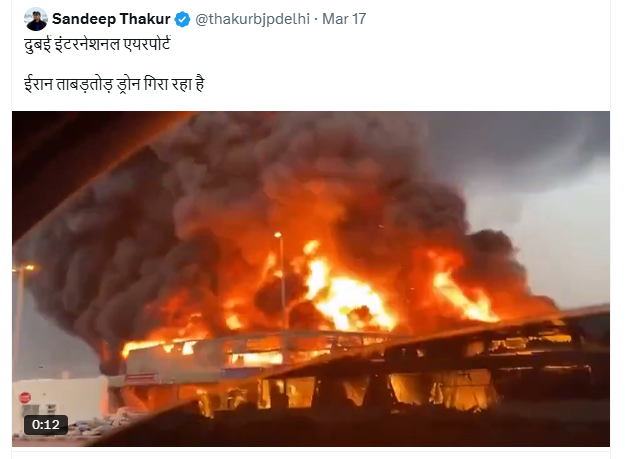
On social media platform X (formerly Twitter), a user shared the viral video on March 17, 2026, writing:
“Dubai International Airport – Iran is dropping drones continuously.”
Post link, archive link, and screenshot are given below:
Fact Check:
To verify the viral claim, we extracted keyframes from the video and conducted a reverse image search using Google Lens. During the research, we found the same video on a YouTube channel, where it was uploaded on August 6, 2020. The caption read: “Ajman fruits and vegetables market caught in fire.”

Based on this clue, it became clear that the viral video has no connection with the ongoing Iran-US-Israel conflict. In the next step, we searched using relevant keywords and found a report published on August 5, 2020, on the website of Gulf News, which contained visuals similar to the viral video.

According to the Gulf News report, a major fire broke out at a public market in the new industrial area of Ajman at around 6:30 pm. The blaze was later brought under control by Ajman Civil Defence with assistance from teams in Dubai, Sharjah, and Umm Al Quwain.
Conclusion:
Our research found that the viral video has been online since 2020 and shows a fire at a market in Ajman, UAE. It is not related to any recent incident at Dubai Airport.

Related Blogs

Introduction
The Data Protection Data Privacy Act 2023 is the most essential step towards protecting, prioritising, and promoting the users’ privacy and data protection. The Act is designed to prioritize user consent in data processing while assuring uninterrupted services like online shopping, intermediaries, etc. The Act specifies that once a user provides consent to the following intermediary platforms, the platforms can process the data until the user withdraws the rights of it. This policy assures that the user has the entire control over their data and is accountable for its usage.
A keen Outlook
The Following Act also provides highlights for user-specific purpose, which is limited to data processing. This step prevents the misuse of data and also ensures that the processed data is being for the purpose for which it was obtained at the initial stage from the user.
- Data Fudiary and Processing of Online Shopping Platforms: The Act Emphasises More on Users’ Consent. Once provided, the Data Fudiary can constantly process the data until it is specifically withdrawn by the Data Principal.
- Detailed Analysis
- Consent as a Foundation: The Act places the user's consent as a backbone to the data processing. It sets clear boundaries for data processing. It can be Collecting, Processing, and Storing, and must comply with users’ consent before being used.
- Uninterrupted Data processing: With the given user consent, the intermediaries are not time-restrained. As long as the user does not obligate their consent, the process will be ongoing.
- Consent and Order Fulfillment: Consent, once provided, encloses all the activities related to the specific purpose for which it was meant to the data it was given for subsequent actions such as order fulfilment.
- Detailed Analysis
- Purpose-Limited Consent: The consent given is purpose-limited. The platform cannot misuse the obtained data for its personal use.
- Seamless User Experience: By ensuring that the user consent covers the full transactions, spared from the unwanted annoyance of repeated consent requests from the actual ongoing activities.
- Data Retention and Rub Out on Online Platforms: Platforms must ensure data minimisation post its utilisation period. This extends to any kind of third-party processors they might take on.
- Detailed Analysis
- Minimization and Security Assurance: By compulsory data removal on post ultization,This step helps to reduce the volume of data platforms hold, which leads to minimizing the risk to data.
- Third-Party Accountability, User Privacy Protection.
Influence from Global frameworks
The impactful changes based on global trends and similar legislation( European Union’s GDPR) here are some fruitful changes in intermediaries and social media platforms experienced after the implementation of the DPDP Act 2023.
- Solidified Consent Mechanism: Platforms and intermediatries need to ensure the users’ consent is categorically given, and informed, and should be specific to which the data is obtained. This step may lead to user-friendly consent forms activities and prompts.
- Data Minimizations: Platforms that tend to need to collect the only data necessary for the specific purpose mentioned and not retain information beyond its utility.
- Transparency and Accountability: Data collecting Platforms need to ensure transparency in data collecting, data processing, and sharing practices. This involves more detailed policy and regular audits.
- Data Portability: Users have the right to request for a copy of their own data used in format, allowing them to switch platforms effectively.
- Right to Obligation: Users can have the request right to deletion of their data, also referred to as the “Right to be forgotten”.
- Prescribed Reporting: Under circumstances of data breaches, intermediary platforms are required to report the issues and instability to the regulatory authorities within a specific timeline.
- Data Protection Authorities: Due to the increase in data breaches, Large platforms indeed appoint data protection officers, which are responsible for the right compliance with data protection guidelines.
- Disciplined Policies: Non-compliance might lead to a huge amount of fines, making it indispensable to invest in data protection measures.
- Third-Party Audits: Intermediaries have to undergo security audits by external auditors to ensure they are meeting the expeditions of the following compliances.
- Third-Party Information Sharing Restrictions: Sharing personal information and users’ data with third parties (such as advertisers) come with more detailed and disciplined guideline and user consent.
Conclusion
The Data Protection Data Privacy Act 2023 prioritises user consent, ensuring uninterrupted services and purpose-limited data processing. It aims to prevent data misuse, emphasising seamless user experiences and data minimisation. Drawing inspiration from global frameworks like the EU's GDPR, it introduces solidified consent mechanisms, transparency, and accountability. Users gain rights such as data portability and data deletion requests. Non-compliance results in significant fines. This legislation sets a new standard for user privacy and data protection, empowering users and holding platforms accountable. In an evolving digital landscape, it plays a crucial role in ensuring data security and responsible data handling.
References:
- https://www.meity.gov.in/writereaddata/files/Digital%20Personal%20Data%20Protection%20Act%202023.pdf
- https://www.mondaq.com/india/privacy-protection/1355068/data-protection-law-in-india-analysis-of-dpdp-act-2023-for-businesses--part-i
- https://www.hindustantimes.com/technology/explained-indias-new-digital-personal-data-protection-framework-101691912775654.html

Executive Summary:
A misleading video claiming to show fireworks at Dubai International Cricket Stadium following India’s 2025 ICC Champions Trophy win has gone viral, causing confusion among viewers. Our investigation confirms that the video is unrelated to the cricket tournament. It actually depicts the fireworks display from the December 2024 Arabian Gulf Cup opening ceremony at Kuwait’s Jaber Al-Ahmad Stadium. This incident underscores the rapid spread of outdated or misattributed content, particularly in relation to significant sports events, and highlights the need for vigilance in verifying such claims.

Claim:
The circulated video claims fireworks and a drone display at Dubai International Cricket Stadium after India's win in the ICC Champions Trophy 2025.

Fact Check:
A reverse image search of the most prominent keyframes in the viral video led it back to the opening ceremony of the 26th Arabian Gulf Cup, which was hosted by Jaber Al-Ahmad International Stadium in Kuwait on December 21, 2024. The fireworks seen in the video correspond to the imagery in this event. A second look at the architecture of the stadium also affirms that the venue is not Dubai International Cricket Stadium, as asserted. Additional confirmation from official sources and media outlets verifies that there was no such fireworks celebration in Dubai after India's ICC Champions Trophy 2025 win. The video has therefore been misattributed and shared with incorrect context.

Fig: Claimed Stadium Picture

Conclusion:
A viral video claiming to show fireworks at Dubai International Cricket Stadium after India's 2025 ICC Champions Trophy win is misleading. Our research confirms the video is from the December 2024 Arabian Gulf Cup opening ceremony at Kuwait’s Jaber Al-Ahmad Stadium. A reverse image search and architectural analysis of the stadium debunk the claim, with official sources verifying no such celebration took place in Dubai. The video has been misattributed and shared out of context.
- Claim: Fireworks in Dubai celebrate India’s Champions Trophy win.
- Claimed On: Social Media
- Fact Check: False and Misleading

Executive Summary:
A video circulating on social media falsely claims that India’s Finance Minister, Smt. Nirmala Sitharaman, has endorsed an investment platform promising unusually high returns. Upon investigation, it was confirmed that the video is a deepfake—digitally manipulated using artificial intelligence. The Finance Minister has made no such endorsement through any official platform. This incident highlights a concerning trend of scammers using AI-generated videos to create misleading and seemingly legitimate advertisements to deceive the public.

Claim:
A viral video falsely claims that the Finance Minister of India Smt. Nirmala Sitharaman is endorsing an investment platform, promoting it as a secure and highly profitable scheme for Indian citizens. The video alleges that individuals can start with an investment of ₹22,000 and earn up to ₹25 lakh per month as guaranteed daily income.
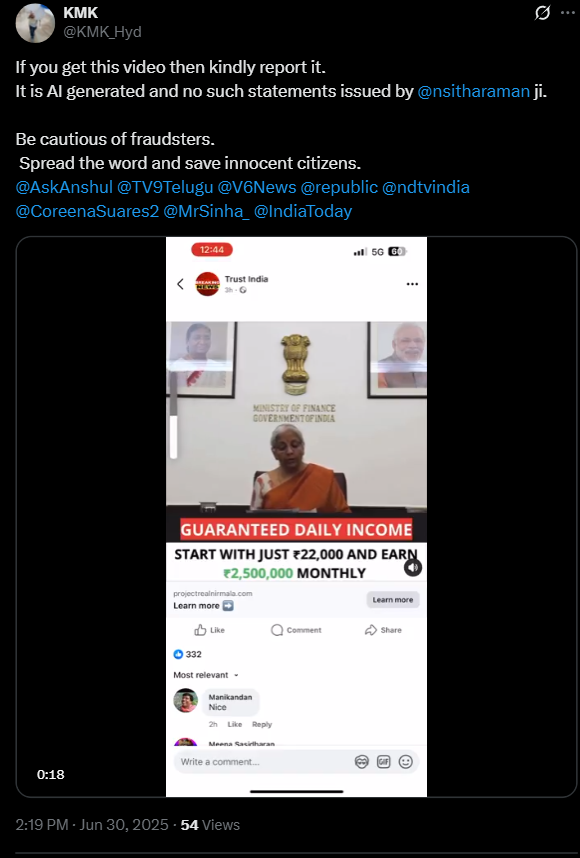
Fact check:
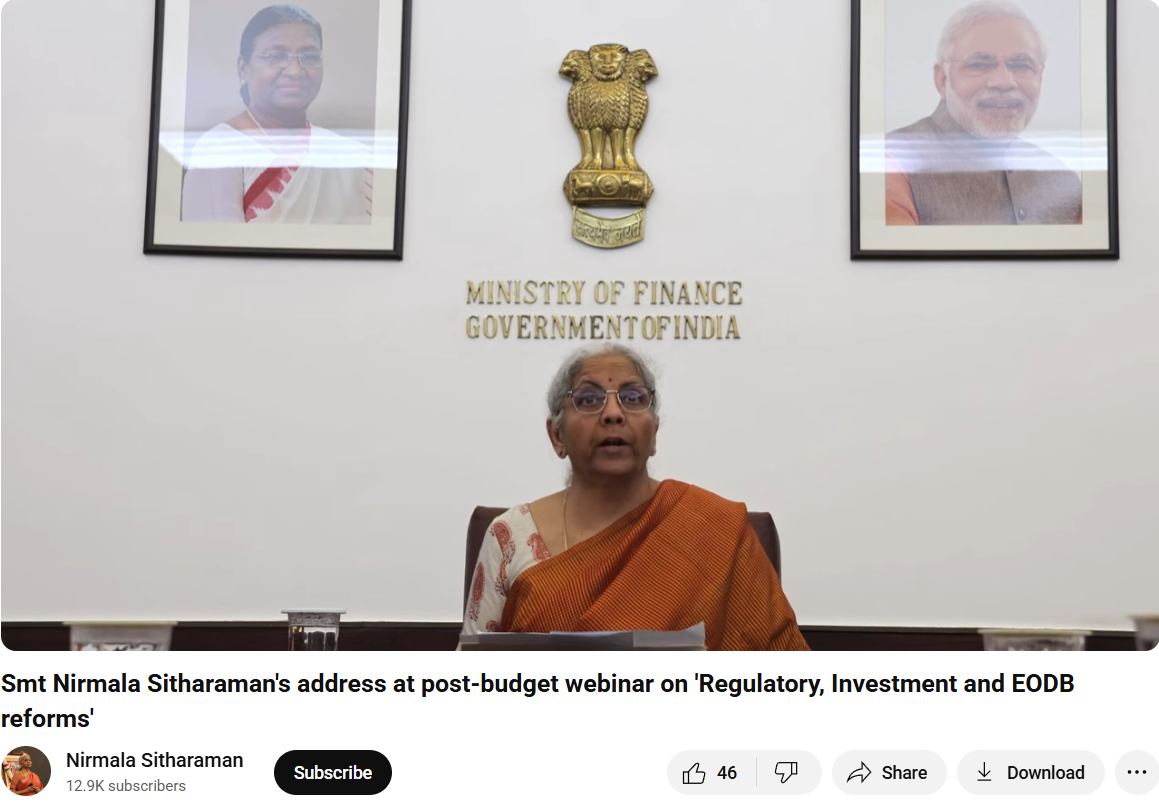
By doing a reverse image search from the key frames of the viral fake video we found an original YouTube clip of the Finance Minister of India delivering a speech on the webinar regarding 'Regulatory, Investment and EODB reforms'. Upon further research we have not found anything related to the viral investment scheme in the whole video.
The manipulated video has had an AI-generated voice/audio and scripted text injected into it to make it appear as if she has approved an investment platform.
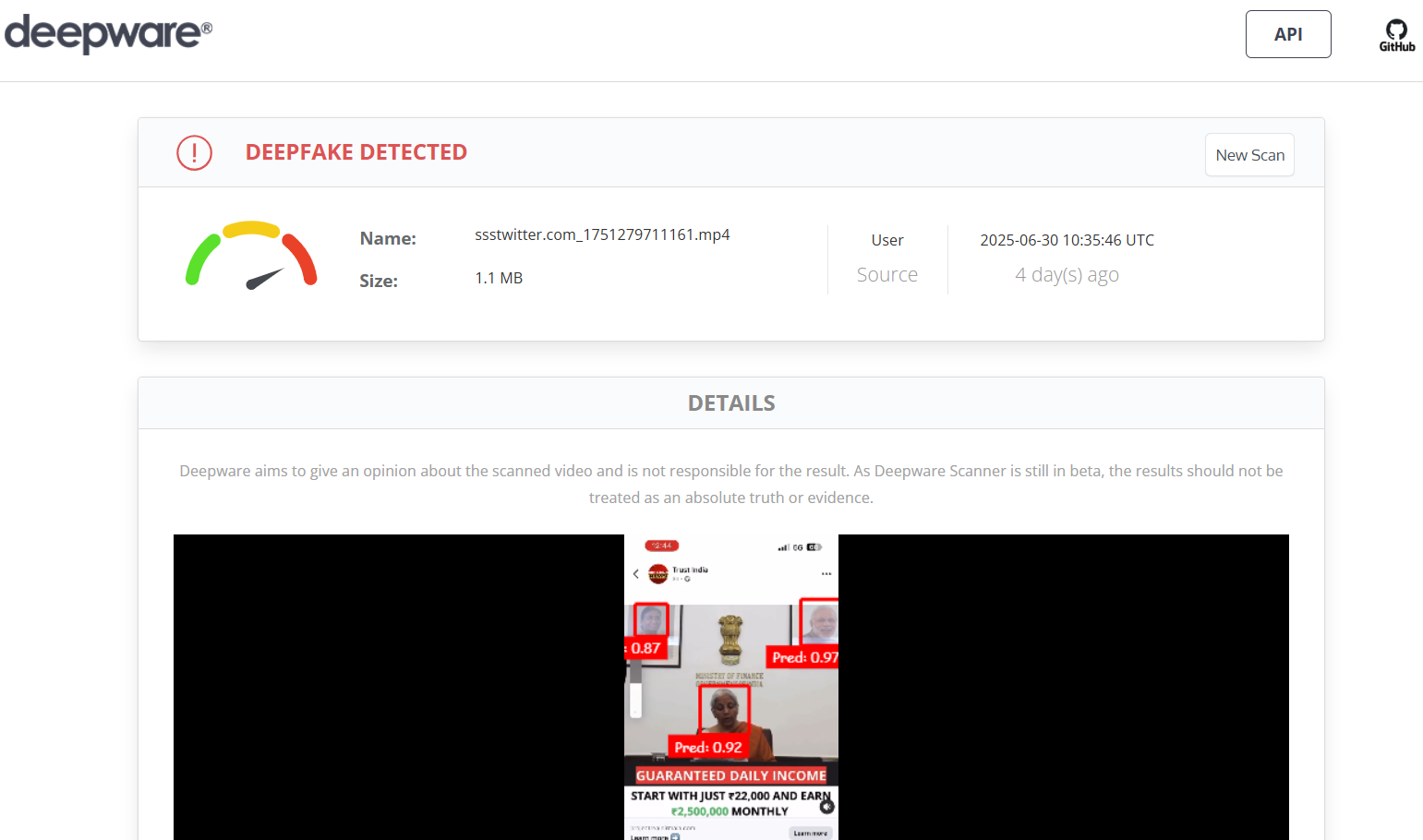
The key to deepfakes is that they seem relatively realistic in their facial movement; however, if you look closely, you can see that there are mismatched lip-syncing and visual transitions that are out of the ordinary, and the results prove our point.
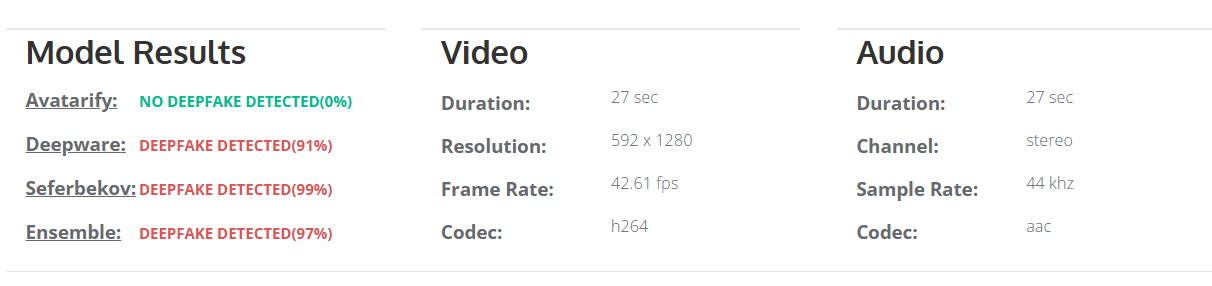
Also, there doesn't appear to be any acknowledgment of any such endorsement from a legitimate government website or a credible news outlet. This video is a fabricated piece of misinformation to attempt to scam the viewers by leveraging the image of a trusted public figure.
Conclusion:
The viral video showing the Finance Minister of India, Smt. Nirmala Sitharaman promoting an investment platform is fake and AI-generated. This is a clear case of deepfake misuse aimed at misleading the public and luring individuals into fraudulent schemes. Citizens are advised to exercise caution, verify any such claims through official government channels, and refrain from clicking on unknown investment links circulating on social media.
- Claim: Nirmala Sitharaman promoted an investment app in a viral video.
- Claimed On: Social Media
- Fact Check: False and Misleading
