
#FactCheck:Czech PM Andrej Babiš Did Not Refuse to Shake Hands with Netanyahu; Incomplete Video Shared Out of Context
Executive Summary
A video featuring Israeli Prime Minister Benjamin Netanyahu and Czech Prime Minister Andrej Babiš is being widely shared on social media. In the video, Netanyahu can be seen extending his hand to greet Babiš, but the Czech prime minister continues speaking. Based on this scene, social media users are claiming that Babiš refused to shake hands with Netanyahu. However, CyberPeace Research found the claim to be misleading. The video being shared on social media does not show the entire sequence of the meeting but only an incomplete portion of it. Longer versions of the meeting show both leaders shaking hands with each other on multiple occasions.The footage clearly shows that Czech Prime Minister Andrej Babiš shook hands with Benjamin Netanyahu after finishing his remarks. Thus, an incomplete clip of the meeting is being shared out of context to falsely claim that Babiš refused to shake hands with Netanyahu.
Claim:
Social media users are claiming that Czech Prime Minister Andrej Babiš refused to shake hands with Israeli Prime Minister Benjamin Netanyahu and accused him of committing serious crimes against children and innocent civilians.
https://www.instagram.com/reels/Df4x8NtlCqd/

Fact Check
To verify the viral claim, we conducted a Google search using relevant keywords. However, we did not find any credible media reports supporting the claim. To investigate the viral video, we first extracted its keyframes and conducted a reverse image search using Google Lens.
During this process, we found the full video of the meeting on the official Facebook page of the Israeli Prime Minister. The video was posted on November 17, 2026. The portion featured in the viral clip can be seen at around 11 minutes and 52 seconds in the full video.
However, towards the end of the footage, Andrej Babiš and Benjamin Netanyahu can be seen smiling and warmly shaking hands with each other. This confirms that an incomplete portion of the meeting is being shared to make a misleading claim.
https://www.facebook.com/reel/1697100875087566

Taking our research further, we found another extended video of the meeting on the official YouTube channel of news agency ANI. The video was uploaded on November 17, 2026. At the 1-minute-and-23-second mark, Israeli Prime Minister Benjamin Netanyahu can be seen welcoming Andrej Babiš, saying, “Welcome, my friend.” The two leaders then shake hands. The portion featured in the viral clip can also be seen at the 3-minute mark in the same video.
http://youtube.com/watch?v=h5PevJWfjBQ

Conclusion:
Our research found the viral claim to be misleading. The video being shared on social media does not show the entire sequence of the meeting but only an incomplete portion of it. Longer versions of the meeting show both leaders shaking hands with each other on multiple occasions. The footage clearly shows that Czech Prime Minister Andrej Babiš shook hands with Benjamin Netanyahu after finishing his remarks. Therefore, an incomplete clip of the meeting is being shared out of context to falsely claim that Babiš refused to shake hands with Netanyahu.

Related Blogs
Introduction
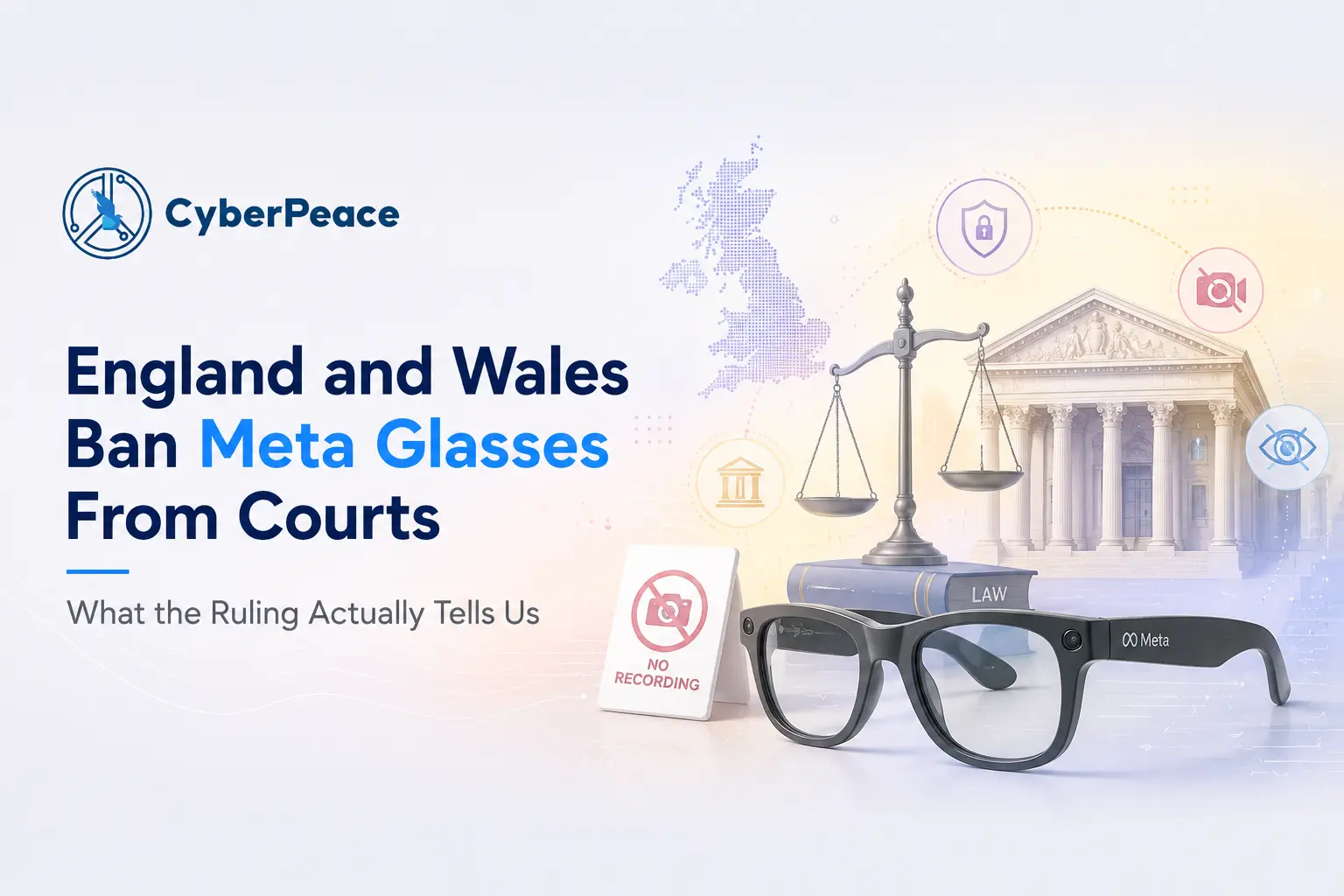
Meta smart glasses are now banned from courts across England and Wales. His Majesty's Courts and Tribunals Service (HMCTS), the body responsible for criminal, civil, and family courts throughout the jurisdiction, has confirmed that anyone entering a court building wearing the devices will have them confiscated at the door and returned only when they leave. The decision follows a comparable restriction introduced by New York's court system weeks earlier, and it lands at a moment when Meta's artificial intelligence (AI) powered eyewear, now sold in more than seven million pairs worldwide, has already been turned away from a wide range of British venues, from pubs and restaurants to theatres and members' clubs, over the same underlying worry: that a camera built into an ordinary looking pair of glasses can record people who have no way of knowing it is happening. Courts occupy a category of their own in this debate. Photography and recording inside a courtroom have been prohibited for the better part of a century, precisely because the integrity of witness testimony, jury deliberation, and the dignity of the proceedings depend on people being able to speak and be observed only by those the law intends. Smart glasses do not just test that rule. They expose a gap in how it was ever meant to be enforced.
What actually changed, and why smartphones were never the real problem
Unauthorised filming inside a courtroom can be prosecuted as contempt of court. Smartphones, despite carrying multiple cameras, have always been let through security on a kind of implicit social contract: everyone understands that the device could record, everyone understands that using it to do so is a punishable offence, and the visible act of holding a phone up to film someone is itself a signal that can be seen and stopped. As per reports citing an HMCTS spokesperson, "There are clear restrictions on taking images or videos within courts and tribunals which is why the use of Meta glasses is prohibited."
Smart glasses dissolve that social contract. A person wearing them looks, to everyone around them, exactly like a person not recording anything at all.
The wider pattern this fits into
England and Wales did not act in isolation. New York's court system introduced a comparable restriction weeks earlier, following an incident during a trial in which a presiding judge warned Meta's own legal team, present in court wearing the company's glasses, that recording proceedings would be treated as contempt. Reports note that the same device has already been shut out of a striking range of everyday venues across Britain, including a major pub chain, high end restaurants, private members' clubs, theatres, music venues, and comic book conventions, with critics giving the product the unflattering nickname "pervert glasses" well before any court got involved.
That pattern matters analytically because it shows this is not really a story about courts distrusting one particular gadget. It is a story about physical spaces everywhere recalibrating what "no recording" can plausibly mean once recording no longer requires a visible object pointed at someone. Meta, for its part, has said the glasses carry a pulsing light-emitting diode (LED) indicator that activates during recording and tamper detection technology intended to stop wearers covering the light, and the company has shipped more than seven million pairs, commanding, according to reports, more than 80 percent of the global AI eyewear market. None of that changes how the device is experienced by the person being recorded, who typically has no reliable way of noticing a small light on the side of someone's face across a room.
There is a genuine innovation story sitting underneath this controversy, and it deserves to be told honestly rather than dismissed. Wearable AI devices that layer translation, navigation, accessibility support, and hands free computing onto ordinary looking eyewear represent one of the more interesting consumer hardware categories to emerge in years, and the underlying engineering, fitting a camera, microphones, speakers, and AI processing into frames that look like Ray-Bans, is a legitimate technical achievement. The court ban is not a verdict on that achievement. It is a verdict on a specific gap between what the hardware makes physically possible and what existing social and legal norms were designed to detect and police. Those are two different conversations, and collapsing them into one tends to produce worse policy on both sides.
Reading the legal architecture underneath the ban
What HMCTS has effectively done is draw a bright line around function rather than form. Smartphones stay in because the courts are relying on deterrence, the near certainty of visible detection and prosecution if someone is caught filming, to manage the risk they pose. Smart glasses are excluded because that deterrence model breaks down when the recording apparatus is invisible by design. Clara Westbrook, a privacy law partner quoted in coverage of the decision, framed the underlying issue as a gap between the technology and the rules meant to govern it, rather than a simple case of institutional overreaction. That framing holds up under scrutiny. Courtroom rules were written for an era in which recording devices announced themselves. Smart glasses were engineered, whatever the stated intent, to do the opposite.
The view from India
Photography and videography are already prohibited inside Indian court premises as a general rule. Filming inside courtrooms has long been treated as a threat to witness candour, judicial dignity, and the orderly conduct of proceedings, and the principle has been reinforced recently. The Supreme Court, in a circular issued in September 2025, imposed a strict ban on photography, videography, and the creation of social media content within its High Security Zone, prohibiting mobile phones, cameras, tripods, and similar equipment except for official use. More recently, in an interim order passed in 2026, the Court went further, restricting the extraction, editing, and re-dissemination of audio-video recordings of judicial proceedings on social media or digital platforms without prior written permission from the Registrar General of the concerned High Court or the Secretary General of the Supreme Court.
Read together, these rules already prohibit the underlying act that smart glasses would enable inside a courtroom, unauthorized capture and circulation of what happens during a hearing. In that sense, Meta glasses are indirectly covered the moment someone wears a pair inside an Indian court, since using them to record would fall squarely within conduct the existing circulars already forbid. What has not happened, and this distinction matters, is any explicit order naming smart glasses as a class of device to be confiscated or barred at entry, the way HMCTS has now done in England and Wales. Indian courts have regulated the act of recording. They have not yet regulated the device that makes covert recording structurally easier to commit without detection.
It remains to be seen whether Indian courts will explicitly name and ban Meta glasses, rather than relying on existing photography rules to cover them indirectly. If that happens, the reasoning will be drawn on constitutional privacy jurisprudence or courtroom security concerns already in play.
Conclusion
What courts owe the people who appear before them is not hostility toward innovation, but a firm defence of the trust a courtroom is built on, that witnesses can speak freely, that proceedings remain what they are meant to be, and that privacy inside those walls is not negotiable. The question worth asking is not what smart glasses can see, but what courts must protect. Innovation earns its place by respecting the spaces it enters, not by outrunning their rules.
References
- The Guardian, "Meta glasses banned from courts in England and Wales," 11 August 2026 https://www.theguardian.com/technology/2026/aug/11/meta-glasses-banned-from-courts-in-england-and-wales
- Engadget, "England and Wales ban Meta Glasses from courtrooms.” https://www.engadget.com/2234606/england-and-wales-ban-meta-glasses-from-courtrooms/
- TechRepublic, "England and Wales Courts Ban Meta Smart Glasses Over Recording Risks." https://www.techrepublic.com/article/news-meta-smart-glasses-ban-england-wales-courts/
- BM Magazine, "Meta glasses banned from courts across England and Wales." https://bmmagazine.co.uk/legal/meta-glasses-banned-courts-england-wales/
- IBTimes UK" UK Court Service Bans Meta Smart Glasses After Restaurants, Theatres and Pubs Lead 'Spyware' Privacy Push." https://www.ibtimes.co.uk/uk-courts-ban-meta-smart-glasses-privacy-concerns-18141
- 97 Boing Boing, "English courts ban Meta glasses and other spyware." https://boingboing.net/2026/08/11/english-courts-ban-meta-glasses-and-other-spywear.html
- MediaPost, "Meta Smart Glasses Banned In England, Wales Courtrooms." https://www.mediapost.com/publications/article/417180/meta-smart-glasses-banned-in-england-wales-courtr.html
- LiveLaw, "When Seeing Becomes Recording: Invisible Bystander And Limits Of Indian Privacy Law." https://www.livelaw.in/lawschool/articles/invisible-bystander-limits-indian-privacy-law-545517
- PCQuest "B by Lenskart AI Glasses: India's Privacy Laws May Not Be Ready." https://www.pcquest.com/tech-trends/b-by-lenskart-ai-smart-glasses-india-privacy-dpdp-act-12141827
- MediaNama, "Meta tightens AI glasses security as questions over bystander privacy persist." https://www.medianama.com/2026/07/223-meta-tightens-ai-glasses-security-questions-bystander-privacy-persist/
- India Legal, "The State Of Surveillance." https://indialegallive.com/cover-story-articles/il-feature-news/surveillance-jantar-mantar-protests-delhi-police-wearable-recording-devices/
- Feminism In India, "AI Glasses: Is India Ready To Handle The Privacy Implications?" https://feminisminindia.com/2026/07/29/is-india-ready-to-handle-ai-glasses-social-ethical-and-regulatory-governance/
- LiveLaw, "Supreme Court Bans Photography, Videography In Court's High Security Zone." https://www.livelaw.in/top-stories/supreme-court-bans-photography-videography-in-courts-high-security-zone-after-bars-concerns-over-reels-selfies-in-court-premises-303682
- LiveLaw, "Supreme Court Bans Uploading and Sharing Of Audio-Video Recordings Of Court Hearings Without Prior Permission." https://www.livelaw.in/amp/top-stories/breaking-supreme-court-bans-uploading-sharing-of-audio-video-recordings-of-court-hearings-without-prior-permission-542719
- Deccan Herald, "SC bans clicking photos, making reels in its high security zone." https://www.deccanherald.com/amp/story/india%2Fdelhi%2Fsc-bans-clicking-photos-making-reels-in-its-high-security-zone-3724668

Executive Summary:
A viral social media claim suggested that India Post would discontinue all red post boxes across the country from 1 September 2025, attributing the move to the government’s Digital India initiative. However, fact-checking revealed this claim to be false. India Post’s official X (formerly Twitter) and Instagram handles clarified on 7 August 2025 that red letterboxes remain operational, calling them timeless symbols of connection and memories. No official notice or notification regarding their discontinuation exists on the Department of Posts’ website. This indicates the viral posts were misleading and aimed at creating confusion among the public.
Claim:
A claim is circulating on social media stating that India Post will discontinue all red post boxes across the country effective 1 September 2025. According to the viral posts,[archived link] the move is being linked to the government’s push towards Digital India, suggesting that traditional post boxes have lost their relevance in the digital era.

Fact Check:
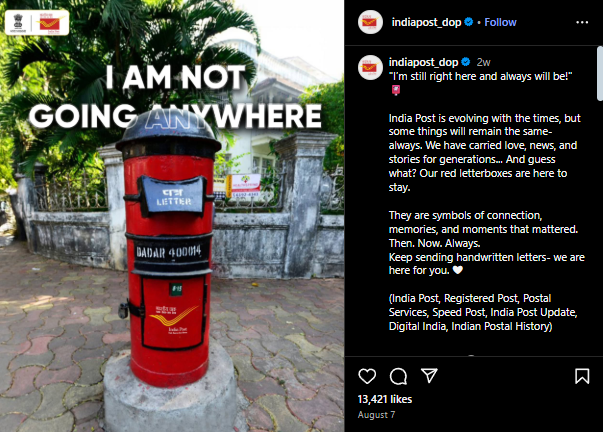
After conducting a reverse image analysis, we found that the official X handle of India Post, in a post dated 7 August 2025, clarified that the viral claim was incorrect and misleading. The post was shared with the caption:
I’m still right here and always will be!"
India Post is evolving with the times, but some things will remain the same- always. We have carried love, news, and stories for generations... And guess what? Our red letterboxes are here to stay.
They are symbols of connection, memories, and moments that mattered. Then. Now. Always.
Keep sending handwritten letters- we are here for you.
This directly refutes the viral claim about the discontinuation of the red post box from 1 September 2025. A similar clarification was also posted on the official Instagram handle @indiapost_dop on the same date.

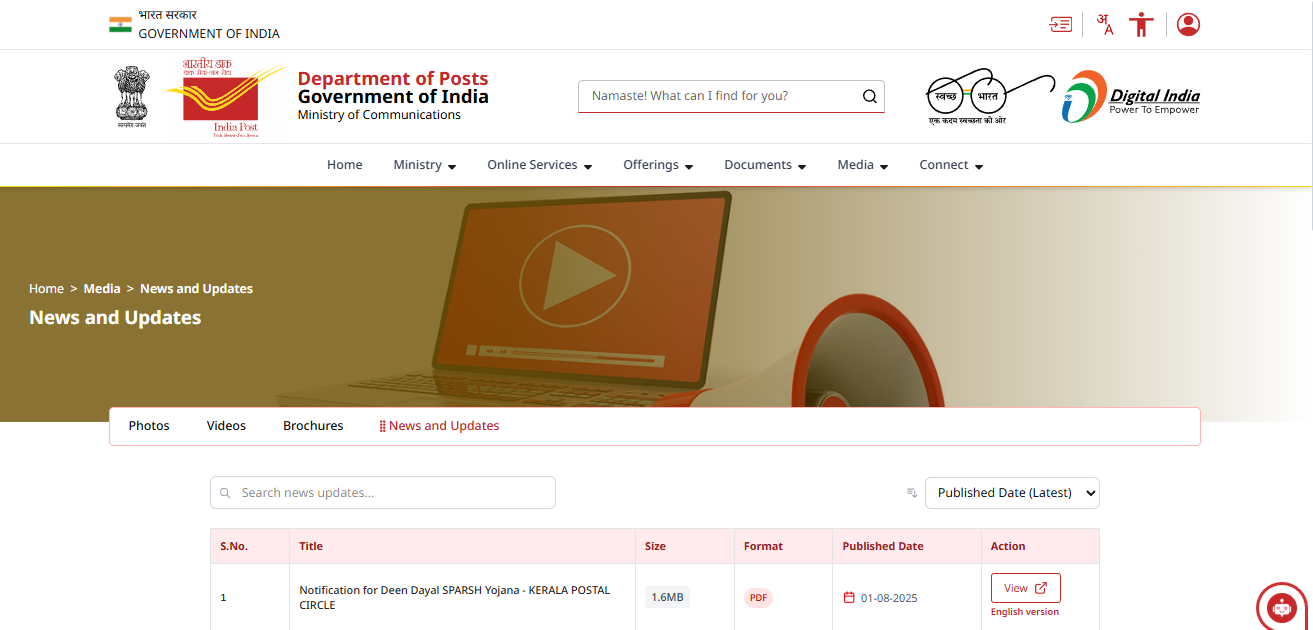
Furthermore, after thoroughly reviewing the official website of the Department of Posts, Government of India, we found absolutely no trace, notice, or even the slightest mention of any plan to discontinue the iconic red post boxes. This complete absence of official communication strongly reinforces the fact that the viral claim is nothing more than a baseless and misleading rumour.
Conclusion:
The claim about the discontinuation of red post boxes from 1 September 2025 is false and misleading. India Post has officially confirmed that the iconic red letterboxes will continue to function as before and remain an integral part of India’s postal services.
- Claim: A viral claim suggests that India Post will remove all red letter boxes across the country beginning 1 September 2025.
- Claimed On: Social Media
- Fact Check: False and Misleading

Introduction
The most significant change seen in the Indian cyber laws this year was the passing of the Digital Personal Data Protection Act, 2023, in the parliament. DPDP Act is the first concrete form of legislation focusing on the protection of Digital Personal Data of Indian netizens in all aspects; the act is analogous to what GDPR is for Europe. The act lays down heavy compliance mandates for the intermediaries and data fiduciaries, this has made it difficult for the tech companies a lot of policy, legal and technical changes have to be made in order to implement the act to its complete efficiency. Recently, the big techs have addressed a letter to the Minister and Minister of State of Meity to extend the implementation timeline of the act. In other news, the union cabinet has given the green light for the much-awaited MoC with Japan focused on establishing a long-term Semiconductor Supply Chain Partnership.
Letter to Meity
The lobby of the big techs represented by a Trade Body named the Big Tech Asia Internet Coalition (AIC) this week wrote to the Ministry of Electronics and Information Technology (Meity), addressing it to the Minister Ashwini Vaishnav and Minister of State (MoS) Rajeev Chandershekhra recommending a 12-18 month extension on the implementation of the Digital Personal Data Protection Act. This request comes at a time when the government has been voicing its urgency to implement the act in order to safeguard Indian data at the earliest. The trade body represented big names, including Meta, Google, Microsoft, Apple and many more. These big techs essentially comprise the segment recognised under the DPDP as the Significant Data Fiduciaries due to the sheer volume of data processed, hosted, stored, etc. In the protective sense, the act has been designed to focus on preventing the exploitation of personal data of Indian netizens by the big techs, hence, they form an integral part of the Indian Data Ecosystem. The following reasons/complications concerning the implementation of the act were highlighted in the letter:
- Unrealistic Timelines: The AIC expressed that the current timeline for the implementation of the act seems unrealistic for the big techs to establish technological, policy and legal mechanisms to be in compliance with section 5 of the act, which talks about the Obligations of a Data Fiduciary and the particular notice to be shared with the data principles in accordance with the act.
- Technical Requirements: Members of AIC expressed that the duration for the implementation of the act is much less in comparison to the time required by the tech companies to set up/deploy relevant technical critical infrastructure, SoPs and capacity building for the same. This will cause a major hindrance in establishing the efficiency of the act.
- Data Rights: Right to Erasure, Correction, Deletion, Nominate, etc., are guaranteed under the DPDP, but the big techs are not sure about the efficient implementation of these rights and hence will need fundamental changes in the technology architecture of their platform, thus expressing concern of the early implementation of the act.
- Equivalency to GDPR: The DPDP is taken to be congruent to the European GDPR, but the DPDP focuses on a few more aspects, such as cross-border data flow and compliance mandates for the right to erasure, hence a lot of GDPR-compliant big techs also need to establish more robust mechanisms to maintain compliance to Indian DPDP.
Indo-Japan MoC
A Memorandum of Cooperation (MoC) on the Japan-India Semiconductor Supply Chain Partnership was signed in July 2023 between the Ministry of Electronics and Information Technology (MeitY) of India and the Ministry of Economy, Trade and Industry (METI) of Japan. This information was shared with the Union Cabinet, which is led by Prime Minister Narendra Modi. The Ministry of Commerce (MoC) aims to expand collaboration between Japan and India in order to improve the semiconductor supply chain. This is because semiconductors are critical to the development of industries and digital technologies. The Parties agree that the MoC will take effect on the date of signature and be in effect for five years. Bilateral cooperation on business-to-business and G2G levels on ways to develop a robust semiconductor supply chain and make use of complementary skills. The cooperation is aimed at harnessing indigenous talent and creating opportunities for higher employment avenues.
MeitY's purpose also includes promoting international cooperation within bilateral and regional frameworks in the frontier and emerging fields of information technology. MeitY has engaged in Memorandums of Understanding (MoUs), Memorandums of Covenants (MoCs), and Agreements with counterpart organisations/agencies of other nations with the aim of fostering bilateral collaboration and information sharing. Additionally, MeitY aims to establish supply chain resilience, which would enable India to become a reliable partner. An additional step towards mutually advantageous semiconductor-related commercial prospects and collaborations between India & Japan is the strengthening of mutual collaboration between Japanese and Indian enterprises through this Memorandum of Understanding. The “India-Japan Digital Partnership” (IJDP), which was introduced during PM Modi's October 2018 visit to Japan, was created in light of the two countries' complementary and synergistic efforts. Its goal is to advance both current areas of cooperation and new initiatives within the scope of S&T/ICT cooperation, with a particular emphasis on “Digital ICT Technologies."
Conclusion
As we move ahead into the digital age, it is pertinent to be aware and educated about the latest technological advancements, new forms of cybercrimes and threats and legal aspects of digital rights and responsibilities, whether it is the recommendation to extend the implementation of DPDP or the Indo-Japan MoC, both of these instances impact the Indian netizen and his/her interests. Hence, the indigenous netizen needs to develop a keen interest in the protection of the Indian cyber-ecosystem to create a safer future. In our war against technology, our best weapon is technology and awareness, thus implementing the same in our daily digital lifestyles and routines is a must.
References
- https://www.eetindia.co.in/cabinet-approves-moc-on-japan-india-semiconductor-supply-chain-partnership/
- https://www.moneycontrol.com/news/business/startup/trade-body-representing-big-tech-urges-govt-to-extend-dpdp-act-implementation-by-1-5-years-11605431.html
- https://www.google.com/url?rct=j&sa=t&url=https://www.eetindia.co.in/cabinet-approves-moc-on-japan-india-semiconductor-supply-chain-partnership/&ct=ga&cd=CAEYACoTOTI3Mzg4NzEyODgwMjI2ODk0MDIaOTBiYzUxNmI5YTRjYTE1NTpjb206ZW46VVM&usg=AOvVaw2lEO7-cIBZ_ox1xV39LGLs
