
England and Wales Ban Meta Glasses From Courts | What the Ruling Actually Tells Us
Introduction
Meta smart glasses are now banned from courts across England and Wales. His Majesty's Courts and Tribunals Service (HMCTS), the body responsible for criminal, civil, and family courts throughout the jurisdiction, has confirmed that anyone entering a court building wearing the devices will have them confiscated at the door and returned only when they leave. The decision follows a comparable restriction introduced by New York's court system weeks earlier, and it lands at a moment when Meta's artificial intelligence (AI) powered eyewear, now sold in more than seven million pairs worldwide, has already been turned away from a wide range of British venues, from pubs and restaurants to theatres and members' clubs, over the same underlying worry: that a camera built into an ordinary looking pair of glasses can record people who have no way of knowing it is happening. Courts occupy a category of their own in this debate. Photography and recording inside a courtroom have been prohibited for the better part of a century, precisely because the integrity of witness testimony, jury deliberation, and the dignity of the proceedings depend on people being able to speak and be observed only by those the law intends. Smart glasses do not just test that rule. They expose a gap in how it was ever meant to be enforced.
What actually changed, and why smartphones were never the real problem
Unauthorised filming inside a courtroom can be prosecuted as contempt of court. Smartphones, despite carrying multiple cameras, have always been let through security on a kind of implicit social contract: everyone understands that the device could record, everyone understands that using it to do so is a punishable offence, and the visible act of holding a phone up to film someone is itself a signal that can be seen and stopped. As per reports citing an HMCTS spokesperson, "There are clear restrictions on taking images or videos within courts and tribunals which is why the use of Meta glasses is prohibited."
Smart glasses dissolve that social contract. A person wearing them looks, to everyone around them, exactly like a person not recording anything at all.
The wider pattern this fits into
England and Wales did not act in isolation. New York's court system introduced a comparable restriction weeks earlier, following an incident during a trial in which a presiding judge warned Meta's own legal team, present in court wearing the company's glasses, that recording proceedings would be treated as contempt. Reports note that the same device has already been shut out of a striking range of everyday venues across Britain, including a major pub chain, high end restaurants, private members' clubs, theatres, music venues, and comic book conventions, with critics giving the product the unflattering nickname "pervert glasses" well before any court got involved.
That pattern matters analytically because it shows this is not really a story about courts distrusting one particular gadget. It is a story about physical spaces everywhere recalibrating what "no recording" can plausibly mean once recording no longer requires a visible object pointed at someone. Meta, for its part, has said the glasses carry a pulsing light-emitting diode (LED) indicator that activates during recording and tamper detection technology intended to stop wearers covering the light, and the company has shipped more than seven million pairs, commanding, according to reports, more than 80 percent of the global AI eyewear market. None of that changes how the device is experienced by the person being recorded, who typically has no reliable way of noticing a small light on the side of someone's face across a room.
There is a genuine innovation story sitting underneath this controversy, and it deserves to be told honestly rather than dismissed. Wearable AI devices that layer translation, navigation, accessibility support, and hands free computing onto ordinary looking eyewear represent one of the more interesting consumer hardware categories to emerge in years, and the underlying engineering, fitting a camera, microphones, speakers, and AI processing into frames that look like Ray-Bans, is a legitimate technical achievement. The court ban is not a verdict on that achievement. It is a verdict on a specific gap between what the hardware makes physically possible and what existing social and legal norms were designed to detect and police. Those are two different conversations, and collapsing them into one tends to produce worse policy on both sides.
Reading the legal architecture underneath the ban
What HMCTS has effectively done is draw a bright line around function rather than form. Smartphones stay in because the courts are relying on deterrence, the near certainty of visible detection and prosecution if someone is caught filming, to manage the risk they pose. Smart glasses are excluded because that deterrence model breaks down when the recording apparatus is invisible by design. Clara Westbrook, a privacy law partner quoted in coverage of the decision, framed the underlying issue as a gap between the technology and the rules meant to govern it, rather than a simple case of institutional overreaction. That framing holds up under scrutiny. Courtroom rules were written for an era in which recording devices announced themselves. Smart glasses were engineered, whatever the stated intent, to do the opposite.
The view from India
Photography and videography are already prohibited inside Indian court premises as a general rule. Filming inside courtrooms has long been treated as a threat to witness candour, judicial dignity, and the orderly conduct of proceedings, and the principle has been reinforced recently. The Supreme Court, in a circular issued in September 2025, imposed a strict ban on photography, videography, and the creation of social media content within its High Security Zone, prohibiting mobile phones, cameras, tripods, and similar equipment except for official use. More recently, in an interim order passed in 2026, the Court went further, restricting the extraction, editing, and re-dissemination of audio-video recordings of judicial proceedings on social media or digital platforms without prior written permission from the Registrar General of the concerned High Court or the Secretary General of the Supreme Court.
Read together, these rules already prohibit the underlying act that smart glasses would enable inside a courtroom, unauthorized capture and circulation of what happens during a hearing. In that sense, Meta glasses are indirectly covered the moment someone wears a pair inside an Indian court, since using them to record would fall squarely within conduct the existing circulars already forbid. What has not happened, and this distinction matters, is any explicit order naming smart glasses as a class of device to be confiscated or barred at entry, the way HMCTS has now done in England and Wales. Indian courts have regulated the act of recording. They have not yet regulated the device that makes covert recording structurally easier to commit without detection.
It remains to be seen whether Indian courts will explicitly name and ban Meta glasses, rather than relying on existing photography rules to cover them indirectly. If that happens, the reasoning will be drawn on constitutional privacy jurisprudence or courtroom security concerns already in play.
Conclusion
What courts owe the people who appear before them is not hostility toward innovation, but a firm defence of the trust a courtroom is built on, that witnesses can speak freely, that proceedings remain what they are meant to be, and that privacy inside those walls is not negotiable. The question worth asking is not what smart glasses can see, but what courts must protect. Innovation earns its place by respecting the spaces it enters, not by outrunning their rules.
References
- The Guardian, "Meta glasses banned from courts in England and Wales," 11 August 2026 https://www.theguardian.com/technology/2026/aug/11/meta-glasses-banned-from-courts-in-england-and-wales
- Engadget, "England and Wales ban Meta Glasses from courtrooms.” https://www.engadget.com/2234606/england-and-wales-ban-meta-glasses-from-courtrooms/
- TechRepublic, "England and Wales Courts Ban Meta Smart Glasses Over Recording Risks." https://www.techrepublic.com/article/news-meta-smart-glasses-ban-england-wales-courts/
- BM Magazine, "Meta glasses banned from courts across England and Wales." https://bmmagazine.co.uk/legal/meta-glasses-banned-courts-england-wales/
- IBTimes UK" UK Court Service Bans Meta Smart Glasses After Restaurants, Theatres and Pubs Lead 'Spyware' Privacy Push." https://www.ibtimes.co.uk/uk-courts-ban-meta-smart-glasses-privacy-concerns-18141
- 97 Boing Boing, "English courts ban Meta glasses and other spyware." https://boingboing.net/2026/08/11/english-courts-ban-meta-glasses-and-other-spywear.html
- MediaPost, "Meta Smart Glasses Banned In England, Wales Courtrooms." https://www.mediapost.com/publications/article/417180/meta-smart-glasses-banned-in-england-wales-courtr.html
- LiveLaw, "When Seeing Becomes Recording: Invisible Bystander And Limits Of Indian Privacy Law." https://www.livelaw.in/lawschool/articles/invisible-bystander-limits-indian-privacy-law-545517
- PCQuest "B by Lenskart AI Glasses: India's Privacy Laws May Not Be Ready." https://www.pcquest.com/tech-trends/b-by-lenskart-ai-smart-glasses-india-privacy-dpdp-act-12141827
- MediaNama, "Meta tightens AI glasses security as questions over bystander privacy persist." https://www.medianama.com/2026/07/223-meta-tightens-ai-glasses-security-questions-bystander-privacy-persist/
- India Legal, "The State Of Surveillance." https://indialegallive.com/cover-story-articles/il-feature-news/surveillance-jantar-mantar-protests-delhi-police-wearable-recording-devices/
- Feminism In India, "AI Glasses: Is India Ready To Handle The Privacy Implications?" https://feminisminindia.com/2026/07/29/is-india-ready-to-handle-ai-glasses-social-ethical-and-regulatory-governance/
- LiveLaw, "Supreme Court Bans Photography, Videography In Court's High Security Zone." https://www.livelaw.in/top-stories/supreme-court-bans-photography-videography-in-courts-high-security-zone-after-bars-concerns-over-reels-selfies-in-court-premises-303682
- LiveLaw, "Supreme Court Bans Uploading and Sharing Of Audio-Video Recordings Of Court Hearings Without Prior Permission." https://www.livelaw.in/amp/top-stories/breaking-supreme-court-bans-uploading-sharing-of-audio-video-recordings-of-court-hearings-without-prior-permission-542719
- Deccan Herald, "SC bans clicking photos, making reels in its high security zone." https://www.deccanherald.com/amp/story/india%2Fdelhi%2Fsc-bans-clicking-photos-making-reels-in-its-high-security-zone-3724668

Related Blogs
.webp)
Executive Summary
A post is being shared on social media claiming that retired Chief of Defence Staff (CDS) General Anil Chauhan was arrested from his residence in connection with a 51.5-kg drug case. The post states that official confirmation of the case is awaited. Some Army personnel can also be seen in the video, which is being shared as evidence to support the claim. CyberPeace Research found the viral claim to be false. We found that General Anil Chauhan had retired as CDS in May 2026. According to the Ministry of Defence, his tenure ended on May 30, 2026. However, we did not find any credible report confirming General Anil Chauhan’s arrest in connection with a 51.5-kg drug case. Therefore, the claim being shared on social media is misleading and false. Furthermore, according to the available information, the video is related to the December 2021 terrorist attack on a Jammu and Kashmir Police bus in the Pantha Chowk area of Srinagar.
Claim:
On September 18, 2026, a user on the social media platform X claimed that retired CDS General Anil Chauhan was arrested from his residence in connection with a 51.5-kg drug case.
https://x.com/i/birdwatch/t/2100860615887892915?source=6
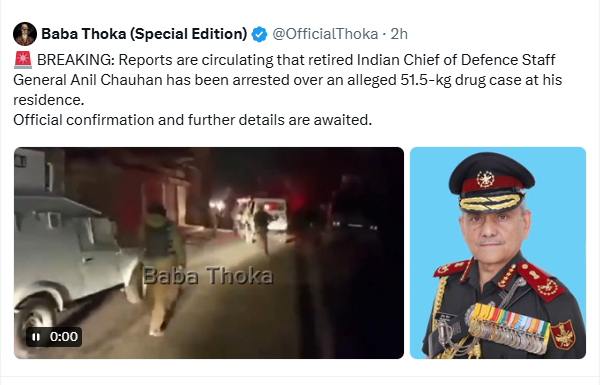
Fact Check:
To verify the viral claim, we conducted a Google search using relevant keywords. During the search, we did not find any credible media report supporting the claim. As part of our research, we conducted a reverse image search of keyframes from the video. During the search, we found the same video on the Facebook page of The Kashmir Today, where it was posted on December 13, 2021. The 58-second video also contains the portion seen in the viral video in its final six seconds. According to the information accompanying the video, militants attacked a police bus near Aripora Zewan on the Srinagar-Jammu highway in the outskirts of Srinagar on Monday afternoon. At least 14 police personnel were injured in the attack, three of whom were reported to be in critical condition.
According to official sources cited in the report, the gunmen’s attack injured 14 police personnel, who were subsequently admitted to a hospital. The area was cordoned off and a search operation was underway to apprehend the attackers. At the time, there were no reports of any arrests.
https://www.facebook.com/watch/?v=422219106288318

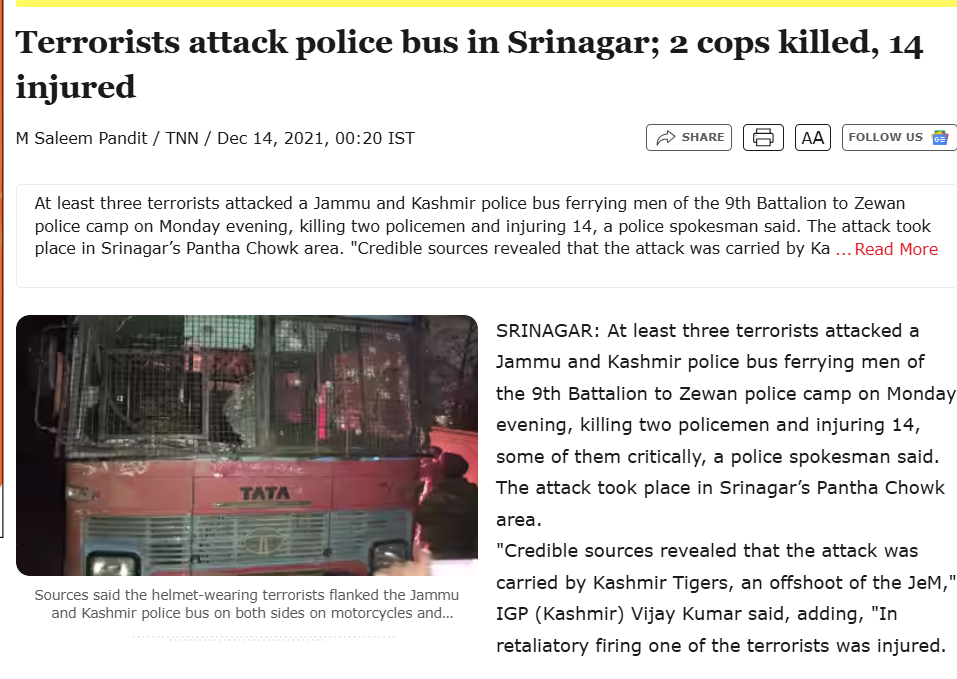
Based on the clue found on Facebook, we conducted a Google search using relevant keywords. During the search, we found a report published on The Times of India website on December 14, 2021, carrying the same claim.
Conclusion
Our research found that the video being shared on social media is not recent but dates back to December 2021. During the reverse image search, we found the same video on The Kashmir Today’s Facebook page, where it was posted on December 13, 2021. The viral portion of the video is also present in the original 58-second clip. According to the available information, the video is related to the December 2021 terrorist attack on a Jammu and Kashmir Police bus in the Pantha Chowk area of Srinagar. The attack resulted in the deaths of two police personnel, while 14 others were injured. Therefore, the old video is being shared with a misleading claim by linking it to a recent incident.

Introduction
Public infrastructure has traditionally served as the framework for civilisation, transporting people, money, and ideas across time and space, from the iron veins of transcontinental railroads to the unseen arteries of the internet. In democracies where free markets and public infrastructure co-exist, this framework has not only facilitated but also accelerated progress. Digital Public Infrastructure (DPI), which powers inclusiveness, fosters innovation, and changes citizens from passive recipients to active participants in the digital age, is emerging as the new civic backbone as we move away from highways and towards high-speed data.
DPI makes it possible for innovation at the margins and for inclusion at scale by providing open-source, interoperable platforms for identities, payments, and data exchange. Examples of how the Global South is evolving from a passive consumer of technology to a creator of globally replicable governance models are India’s Aadhaar (digital identification), UPI (real-time payments), and DigiLocker (data empowerment). As the ‘digital commons’ emerges, DPI does more than simply link users; it also empowers citizens, eliminates inefficiencies from the past, and reimagines the creation and distribution of public value in the digital era.
Securing the Digital Infrastructure: A Contemporary Imperative
As humans, we are already the inhabitants of the future, we stand at the temporal threshold for reform. Digital Infrastructure is no longer just a public good. It’s now a strategic asset, akin to oil pipelines in the 20th century. India is recognised globally for the introduction of “India Stack”, through which the face of digital payments has also been changed. The economic value contributed by DPIs to India’s GDP is predicted to reach 2.9-4.2 percent by 2030, having already reached 0.9% in 2022. Its role in India’s economic development is partly responsible for its success; among emerging market economies, it helped propel India to the top of the revenue administrations’ digitalisation index. The other portion has to do with how India’s social service delivery has changed across the board. By enabling digital and financial inclusion, it has increased access to education (DIKSHA) and is presently being developed to offer agricultural (VISTAAR) and digital health (ABDM) services.
Securing the Foundations: Emerging Threats to Digital Public Infrastructure
The rising prominence of DPI is not without its risks, as adversarial forces are developing with comparable sophistication. The core underpinnings of public digital systems are the target of a new generation of cyber threats, ranging from hostile state actors to cybercriminal syndicates. The threats pose a great risk to the consistent development endeavours of the government. To elucidate, targeted attacks on Biometric databases, AI-based Misinformation and Psychological Warfare, Payment System Hacks, State-sponsored malware, cross-border phishing campaigns, surveillance spyware and Sovereign Malware are modern-day examples of cyber threats.
To secure DPI, a radical rethink beyond encryption methods and perimeter firewalls is needed. It requires an understanding of cybersecurity that is systemic, ethical, and geopolitical. Democracy, inclusivity, and national integrity are all at risk from DPI. To preserve the confidence and promise of digital public infrastructure, policy frameworks must change from fragmented responses to coordinated, proactive and people-centred cyber defence policies.
CyberPeace Recommendations
Powering Progress, Ignoring Protection: A Precarious Path
The Indian government is aware that cyberattacks are becoming more frequent and sophisticated in the nation. To address the nation’s cybersecurity issues, the government has implemented a number of legislative, technical, and administrative policy initiatives. While the initiatives are commendable, there are a few Non-Negotiables that need to be in place for effective protection:
- DPIs must be declared Critical Information Infrastructure. In accordance with the IT Act, 2000, the DPI (Aadhaar, UPI, DigiLocker, Account Aggregator, CoWIN, and ONDC) must be designated as Critical Information Infrastructure (CII) and be supervised by the NCIIPC, just like the banking, energy, and telecom industries. Give NCIIPC the authority to publish required security guidelines, carry out audits, and enforce adherence to the DPI stack, including incident response protocols tailored to each DPI.
- To solidify security, data sovereignty, and cyber responsibility, India should spearhead global efforts to create a Global DPI Cyber Compact through the “One Future Alliance” and the G20. To ensure interoperable cybersecurity frameworks for international DPI projects, promote open standards, cross-border collaboration on threat intelligence, and uniform incident reporting guidelines.
- Establish a DPI Threat Index to monitor vulnerabilities, including phishing attacks, efforts at biometric breaches, sovereign malware footprints, spikes in AI misinformation, and patterns in payment fraud. Create daily or weekly risk dashboards by integrating data from state CERTs, RBI, UIDAI, CERT-In, and NPCI. Use machine learning (ML) driven detection systems.
- Make explainability audits necessary for AI/ML systems used throughout DPI to make sure that the decision-making process is open, impartial, and subject to scrutiny (e.g., welfare algorithms, credit scoring). Use the recently established IndiaAI Safety Institute in line with India’s AI mission to conduct AI audits, establish explanatory standards, and create sector-specific compliance guidelines.
References
- https://orfamerica.org/newresearch/dpi-catalyst-private-sector-innovation?utm_source=chatgpt.com
- https://www.institutmontaigne.org/en/expressions/indias-digital-public-infrastructure-success-story-world
- https://www.pib.gov.in/PressReleasePage.aspx?PRID=2116341
- https://www.pib.gov.in/PressReleaseIframePage.aspx?PRID=2033389
- https://www.governancenow.com/news/regular-story/dpi-must-ensure-data-privacy-cyber-security-citizenfirst-approach
Introduction
In an extensive order of 144 pages passed on May 29, 2026, Justice Sachin Datta of the Delhi High Court inter alia affirmed the right of an acquitted or discharged person to reinstate their digital identity. In a batch of more than 30 petitions relating to acquittals, family dispute cases, quashed criminal cases, and parties to proceedings, the petitioners argued that court documents and accusations, having lost their purpose, have kept occupying the search engine, leading to infringement of dignity, privacy, and career and personal life of these individuals. Citing Article 21 of the Indian Constitution as its foundation, the court affirmed that a right to life and personal liberty also includes a right to privacy and to leave behind failed proceedings and adopted wide de-indexing policies, including, where necessary, global de-indexing, thereby ushering in India's "right to be forgotten."
The Constitutional Argument: Article 21 and the Digital Self
The constitutional basis of the right to be forgotten in India rests on the landmark nine-judge bench ruling in Justice K.S. Puttaswamy v. Union of India. In 2017, the Supreme Court ruled privacy to be a fundamental right under Article 21 of the Constitution and stated informational privacy is a facet of personal liberty. The Supreme Court observed that individuals have an interest in determining how the information concerning them is gathered, disseminated, and accessed.
Building upon this precedent, Justice Sachin Datta held that the right to be forgotten flows naturally from the constitutional guarantee of informational privacy. The judgment represents one of the most significant judicial applications of the Puttaswamy principles, particularly in the context of search engines and online judicial records. Noting the absence of a fully operational statutory framework despite the enactment of the Digital Personal Data Protection Act, 2023, the court exercised its constitutional jurisdiction to protect individuals from enduring digital harm caused by continued public accessibility of outdated or irrelevant personal information.
INDIAN APPLICATION OF THE GLOBAL PRECEDENT
Tracing back the genesis of this right, it lies in the worldwide jurisdiction on privacy, especially the European Court of Justice's landmark ruling of 2014 in Google Spain SL v. AEPD and Mario Costeja Gonzlez, where it ruled that it is within one's power to ask search engines to de-list links that show personal information that is found to be outdated or irrelevant. This led to a legislated right to erasure by the inclusion of Article 17 in the General Data Protection Regulation (GDPR), creating the right throughout the EU. India, on the other hand, saw a slow process of evolution when it came to this right. The Madras High Court acknowledged the right to be forgotten partially in 2021 when it directed a petitioner's name to be deleted from an acquittal judgment, which was affirmed by a Division Bench in 2024. Nevertheless, the above were merely judgments confined to the facts of a particular case. However, the decision of the Delhi High Court dated May 2026 proves to be the benchmark in laying down a comprehensive constitutional framework under Article 21 with guiding principles on when a request for de-linking would be entertained and, if warranted, would be extended throughout the world.
Anatomy of the Framework by the Delhi High Court
While Justice Sachin Datta’s ruling recognizes the right to be forgotten, its actual import lies in devising an operative framework. The Court noted that it would maintain judicial records indefinitely in keeping with open justice principles, but an individual's name may not act as a perennial search key with respect to private entities' search engines. Thus, courts will be allowed to de-index judicial records (except their legal reasoning, findings, and ratio decidendi, which will continue to be accessible) from the names appearing therein from search engines and legal databases. While personally identifying data will be obfuscated, the underlying legal reasoning will not be rendered unusable, as access to unredacted records will continue to be available to courts, parties, and authorities. Such orders are also possible to be effective internationally, rendering avoidance difficult. However, the right cannot be absolute, as it is largely unavailable for convicted individuals (particularly if convicted of offenses against women or children or crimes of breach of trust). Courts must pass a proportionality test in considering the balance between privacy and the public right to know. By stating that masking information has an impact on discoverability, not access, it achieves a reconciliation between informational privacy and open justice so that acquitted accused are not held hostage to past accusations forever in the online age.
The Road to Implementation
However, the judgment presents a thick knot of practical issues, the solution to which may take considerable time to untangle. How will petitions for masking orders be filed by those who need them? Will there be a prescribed form? How will legal database systems such as Indian Kanoon and SCC Online operationalize name-based de-indexing while keeping their vast archives usable for lawyers? More significantly, what kind of legal force will global directions for de-indexing hold over those search engines whose main servers lie outside of Indian territory?
This is not to say the judgment isn't important. It simply presents a predictable, almost mundane set of issues that all ambitious pronouncements on constitutional rights face when translated into the world of administration issues that came up even when the EU was first struggling with enforcing the GDPR in 2018. India now has its framework, and the details of its implementation will undoubtedly come through future rounds of litigation, guidelines, and perhaps even legislation.
What remains abundantly clear, though, is the message conveyed by the Delhi High Court that digital permanency is a crime, especially when it causes the most incriminating of a person's legal actions to follow them perpetually, even long after they have been given due process by the system. As Justice Datta eloquently put it, privacy in the digital age is 'not about secrecy but about an individual's control over the dissemination of personal information.' "Now an element of constitutional law in India, the verdict is a declaration that will resonate long beyond the thirty-odd petitions that called it into being.
Conclusion
The ultimate finding of the 2026 right-to-be-forgotten judgment in Delhi High Court reinforces human dignity in the digital era. The Court has acknowledged the need for acquittals and exonerations to have meaningful implications offline, ensuring an individual is not eternally punished through online searches for alleged wrongdoing. Building on the right to privacy established by K.S. Puttaswamy v. Union of India, informational privacy now stands at the core of constitutional guarantees, and India joins the nations establishing precedents to balance openness with dignity.
