
#FactCheck-AI-Generated Video Falsely Shows Mishandling of Baggage at Indian Airport
Executive Summary
A video is being widely shared on social media claiming to show baggage handlers in India carelessly unloading passenger luggage from an aircraft cargo hold. The clip allegedly shows a handler ignoring standard procedures and throwing bags directly onto the tarmac instead of placing them on a motorized conveyor belt. CyberPeace Research Wing research found the video to be entirely fake. The clip has been generated using artificial intelligence (AI) and is being falsely shared as a real incident from India.
Claim
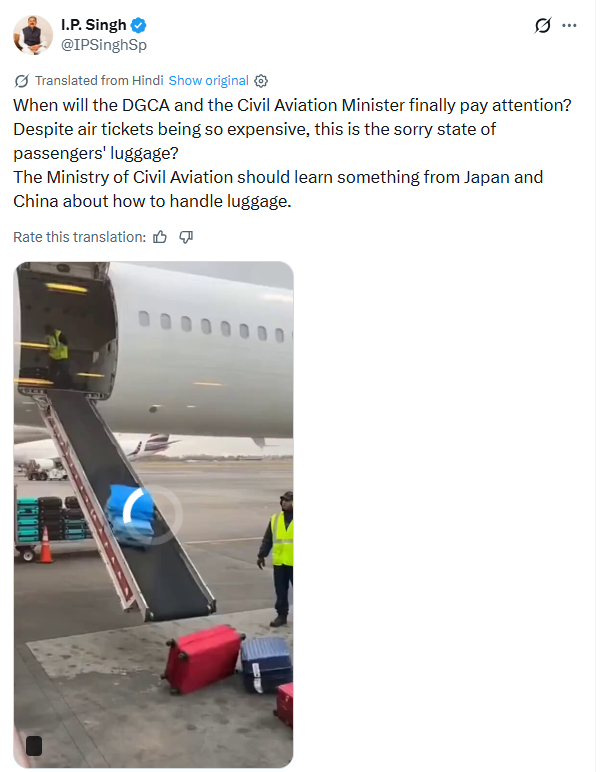
An X user, I.P. Singh (@IPSinghSp), shared the video on June 25, claiming it shows baggage handlers unloading luggage from an aircraft in India. The post criticized the alleged mishandling of passenger baggage and questioned aviation authorities over poor service standards.
The accompanying post read:
“When will the DGCA and the Civil Aviation Minister finally pay attention? Despite high airfares, this is the state of passengers’ luggage. The Ministry of Civil Aviation should learn from Japan and China how luggage should be handled.” https://x.com/IPSinghSp/status/2070164107551273109?s=20 , https://archive.ph/heiHA
Fact Check
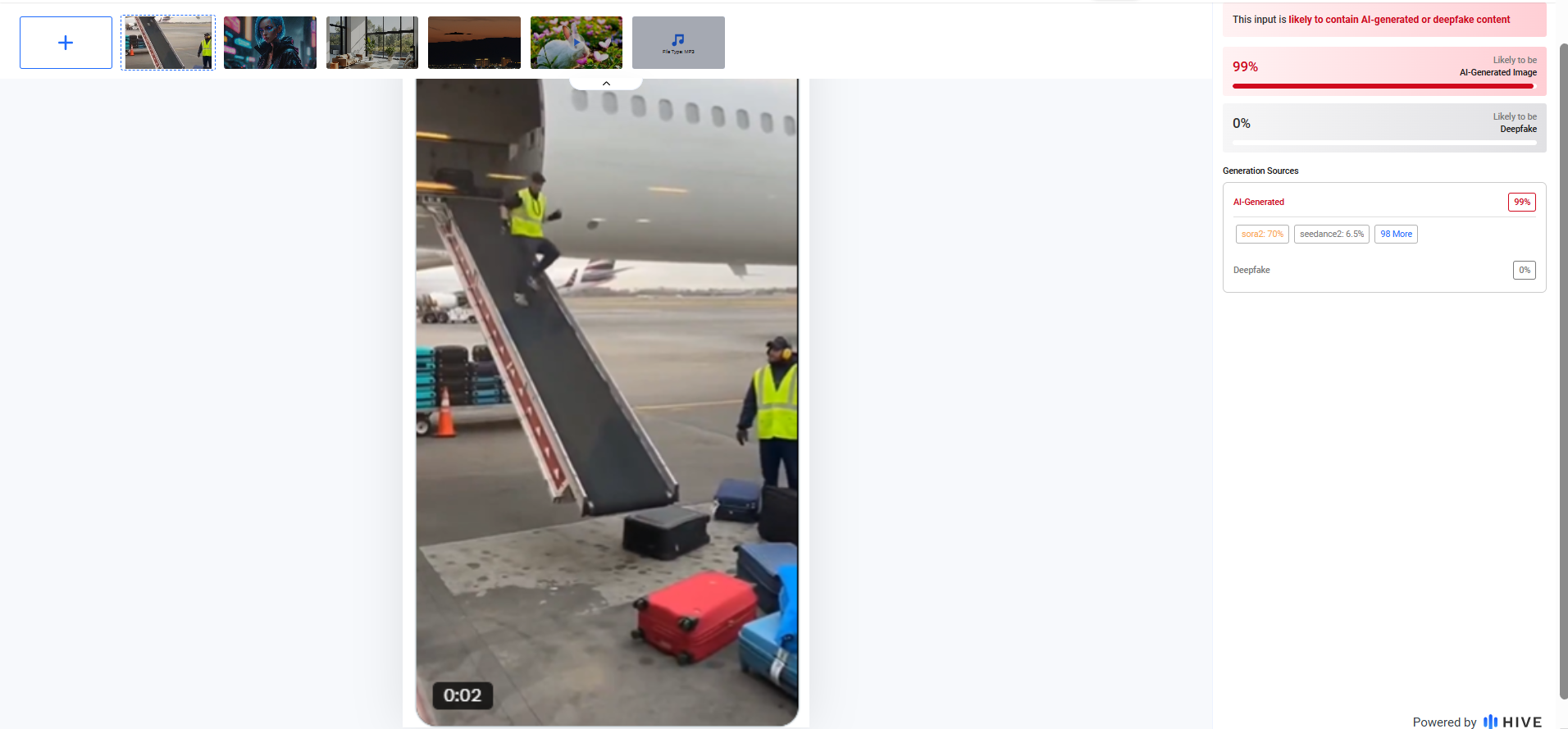
A detailed analysis of the footage revealed multiple visual inconsistencies suggesting AI generation. Notably, even after the baggage handler seen initially tossing the luggage exits via the conveyor belt, bags continue to emerge from the cargo hold and fall onto the tarmac on their own. This physically impossible sequence strongly indicates digital manipulation. To verify these findings, the video was analyzed using the AI detection tool Hive Moderation. The results indicated that a significant portion of the footage was generated using artificial intelligence.
Conclusion
Our research confirms that the viral video is entirely fake. It has been generated using AI and is being misrepresented as a real incident from India involving baggage handling at an airport.

Related Blogs
Introduction
In January 2026, the Basic Act on the Development of Artificial Intelligence and the Establishment of a Foundation for Trustworthiness came into effect in South Korea, establishing one of the first national AI laws in the world. The bill, enacted by the National Assembly of Korea in December 2024 and implemented from January 22, 2026, aims to strike a balance between the rapid advancement of technology and clear safeguards against risks, as well as transparency, accountability, and responsible AI use. It puts Seoul and the European Union on the frontline of developing legal systems for artificial intelligence and indicates a long-term goal of becoming an AI power on the global stage.
What the AI Basic Act Covers
The AI Basic Act consists of 19 separate AI bills that are merged into a single piece of legislation that covers the lifecycle of AI, including research and development, deployment, and utilisation. It is very wide in its coverage: it refers to any AI system that influences the Korean market or users inside the country, irrespective of the country in which it is created. The law does not apply to national defence and security applications.
The law defines key concepts like artificial intelligence, generative AI, and high-impact AI and establishes the principles of ethical AI, safety, user rights, industry support, and national policy coordination. It also offers a legal foundation for the activities of the government to promote AI innovation without jeopardising the common good.
Fundamentally, the AI Basic Act is designed to establish a culture of trust between businesses and the government/citizens. It does not prohibit AI technologies and does not excessively limit innovation. Instead, it creates the framework of responsible development and economic growth.
Guardrails for Safety and Accountability
One of the defining features of the AI Basic Act is its risk-based approach. Rather than considering all AI systems as similar, it makes a distinction between ordinary and high-impact AI systems, the ones applied in sectors where the wrong or unsafe decision can have a major impact on the safety, rights, or critical infrastructure of the population. Some of them can be seen in healthcare, transportation, financial services, education, and public services.
The high-impact AI operators must integrate risk management plans, human controls, and surveillance systems. In critical decision-making situations, human control should be available at all times; that is, machines can help but not override human control where human safety or other human rights are involved.
The law enables the regulators to perform on-site checks, demand documentation, and conduct compliance investigations. Fines for breaches may go up to 30 million Korean won (approximately 21,000 US dollars). It has a one-year period of transition that is based on guidance but not enforcement, thus allowing companies time to implement compliance measures before imposing fines.
These requirements contribute to enhancing accountability by defining who is accountable for the safety outcomes. The law in South Korea is placed in the ecosystem, as opposed to the methods in which industry self-governance alone is utilised.
Transparency and Labelling Requirements
The AI Basic Act is based on transparency. The legislation ensures that users are notified before an AI system is operating, particularly with the generation of AI outputs that could be confused with human-created material. As an example, AI-generated text, images, video, or audio that may be difficult to distinguish between reality and fake must have obvious labels or watermarks to allow users to understand the source of the content.
The necessity to label is meant to fight misinformation, misleading activities, and unintended influence on the perception of the people. It is based on international anxiety regarding AI-generated content, such as deepfakes, manipulated media, and misleading online advertisements that have already been addressed separately in policy by South Korea, as well as discussions of data governance.
The transparency is also applied to the process of decision-making in AI systems. Developers and operators should be able to give explicit information about the way in which high-impact systems make their conclusions so that those who are victims of automated decisions can seek meaningful explanations. Although specific explainability criteria are in the process of being developed, the law grounds the principle that AI cannot act behind the scenes in situations where crucial decisions are being made.
Data Privacy and User Protection
The AI governance practice in South Korea is complementary to its current data protection laws, the Personal Information Protection Act (PIPA), which is broadly regarded as equivalent to major international data protection regulations like the GDPR in regard to personal data laws. The AI Basic Act provides an explanation as to how the data can be gathered, processed, and utilised within AI systems with regard to privacy rights, particularly in areas of high impact.
The law does not supersede the personal data protection policies, but it sets certain conditions on how AI developers must address the data to be utilised in training, testing, and running AIs. Operators will be required to document their data workflows and demonstrate how they guard the privacy of their users, including by transparency and consent mechanisms where necessary. This can assist in ensuring that the information that is utilised in AI functions is regulated by definite norms, and it is more difficult to avoid privacy requirements in the name of innovation.
Accountability and Governance Infrastructure
The AI Basic Act establishes a national policy framework of AI governance. The National Artificial Intelligence Strategy Committee, chaired by the President, is at the top and proposes the overall AI policy and aligns it with national objectives. The organisations that would support this are the specialised organisations that deal with safety, risk assessment, and research and the policy centre that would analyse the effects of AI on society and assist in its adoption by the industry.
This institutional structure facilitates strategic guidance as well as operational control. It is through incorporating AI governance in the administration of the people, but not into the market forces, that South Korea wishes to have the ethical and societal concerns become part of the sectors and agencies.
Promoting Innovation and Industrial Support
Although the AI Basic Act does not disregard regulation, it is not a law of restrictions. It also offers legal justification for research and development, human capital, and the growth of the AI industry, with special consideration for startups and small and medium-sized businesses. The legislation promotes AI clusters, long-term funding programmes, and policies to bring foreign talent to the Korean AI ecosystem.
This bidimensional approach of compliance and support is indicative of the broader desire of Korea to become one of the leading AI powers in the world, along with the US and China. The government has pointed out that it will encourage trust by having clear and predictable rules that will attract investment and maintain innovation and not stifle it.
What This Means Globally
The AI Basic Act of South Korea is not only interesting in its contents but also in its timing. It is also among the first thorough AI legislations to come into force in the world, and it beats the gradual regulatory implementations in other parts of the globe, like the European Union. Its system incorporates a principle-based framework, transparency requirements, accountability regulations, and industrial support, which reflects a contrasting model to either pure prescriptive risk regulation or lax self-regulation models elsewhere.
Other critics, such as industry groups and civil society organisations, have suggested that some of the protections may be more explicit, in particular to those who are harmed by AI systems, or to establish high-impact categories. Nonetheless, the framework sets a benchmark upon which most nations will pay close attention when they establish their own AI regimes.
Conclusion
The AI Basic Act puts South Korea at the forefront of national AI regulation, including very well-developed guardrails that enforce transparency, ethical control, accountability, and data protection in addition to fostering innovation. It recognises that AI could lead to economic and social advantages, yet also actual risks, particularly when systems are opaque, autonomous, or widely implemented. South Korea has gone holistically in responsible AI governance by integrating human oversight, labelling requirements, risk management planning, and governance infrastructure into law to be emulated by other countries in the years to come.
Sources
- https://www.theguardian.com/world/2026/jan/29/south-korea-world-first-ai-regulation-laws
- https://www.oecd.org/content/dam/oecd/en/publications/reports/2025/10/artificial-intelligence-and-the-labour-market-in-korea_af668423/68ab1a5a-en.pdf
- https://asianintelligence.ai/south-korea
- https://aibasicact.kr/
- https://aibusinessweekly.net/p/south-korea-ai-basic-act-takes-effect-jan22-2026
- https://asiadaily.org/news/12112/
Introduction
Parliament is about to begin its Monsoon Session from July 20, 2026 to August 13, 2026, and the mood in Delhi already feels charged. Ahead of the opening bell, the government has flagged five new bills for introduction, alongside a couple of pending pieces of legislation it may take up for passage. Predictably, the political oxygen in the run-up has gone almost entirely to what isn't on that list — reports this week noted the conspicuous absence of the long-anticipated Delimitation Bill and a Constitutional amendment for women's reservation in the Lok Sabha, a gap that has already drawn sharp reactions from Congress leaders. What is on the list has generated its own share of noise: a Foreign Contribution (Regulation) Amendment Bill that NGOs are watching warily, a Prevention of Insults to National Honour (Amendment) Bill tied to safeguards for the National Flag and Anthem, and a Supreme Court (Number of Judges) Amendment Bill proposing to raise the Court's sanctioned strength from 33 to 37. Every one of these will command its share of prime-time debate. But tucked quietly among the five is a bill that, headline for headline, may end up mattering more to the everyday Indian economy than all the others combined: the Micro, Small and Medium Enterprises Development (Amendment) Bill, 2026.
MSMEs play a foundational role in India’s economic engine, powering employment, entrepreneurship and growth across the country. That makes this Bill one worth watching closely, because even seemingly technical changes to the MSME framework could have very real consequences for millions of businesses and the people whose livelihoods depend on them.
What the Bill Actually Does
The MSME sector hasn't seen a structural legal update since the original MSMED Act of 2006 nearly two decades in an economy that looks nothing like it did back then. The new amendment is designed to close that gap. According to the government's own description of the bill, it aims to align the 2006 law with the sector's changed realities, improve ease of doing business, and shift toward what officials are calling "trust-based" regulation rather than a purely compliance-driven approach.
Three provisions stand out.
- First, it strengthens the mechanism for resolving delayed payments to micro and small enterprises, arguably the single biggest complaint MSME owners have voiced for years.
- Second, it creates a pathway to enforce arbitral awards specifically for micro and small units, giving smaller suppliers real teeth when a dispute is decided in their favor.
- Third, it gives states more flexibility in deciding the composition of Micro and Small Enterprises Facilitation Councils (MSEFCs) , the bodies that adjudicate payment disputes which should allow more councils to be formed and cut down on case backlogs.
The Delayed Payment Crisis, in Numbers
To understand why this matters, look at the scale of the problem the bill is trying to fix. The MSME Ministry's Samadhaan portal, which lets small enterprises file delayed-payment complaints online, had received close to 2.57 lakh applications as of June 2026, involving claimed dues of roughly ₹55,244 crore. Of these, only about 58,000 cases had actually been resolved by facilitation councils. That's a resolution rate that leaves the vast majority of small businesses waiting often for money already owed to them for goods or services delivered.
The government did tighten the screws somewhat in 2024 through Section 43B(h) of the Income Tax Act, which denies large buyers a tax deduction if they don't pay MSME suppliers within the 15-to-45-day window mandated by law. Enforcement, however, has remained patchy, and industry bodies like Assocham have continued to flag delayed payments including from PSUs and government departments as a core source of financial stress for small firms, with high interest charges on overdue statutory dues compounding the problem.
Why This Is Bigger Than One Bill
A regulation targeting the payments practices of India's micro, small, and medium-sized enterprises is more than just paperwork and procedural wrangling; the stakes for the Indian economy and society are enormous. According to the 2025-26 Economic Survey, MSMEs now contribute about 31.1% of India’s GDP, 35.4% of its manufacturing output, and 48.58% of its exports, while employing 33 to 39 crore people and providing India’s second largest source of employment after agriculture. The official Udyam database of MSMEs crossed the 8.7 crore mark by June 2026, underscoring a clear trend towards the sector’s formalisation in the last few years. Access to finance is the second pillar of MSME empowerment. The Credit Guarantee Fund Trust for Micro and Small Enterprises has authorised several lakh crores in guarantees, and most recently, the government increased its loan guarantee cover ceiling from Rs 5 crore to Rs 10 crore to facilitate more collateral-free loans to businesses. However, the actual credit gap remains estimated in the tens of lakh crores, with the biggest gaps faced by women-led and medium enterprises. While the MSME Bill doesn’t directly address access to finance, improved and quicker payment settlement mechanisms are expected to relieve some working-capital stress and dissuade small firms from falling into expensive informal credit markets. The MSME Bill also adds to a wave of recent measures to de-regulate smaller enterprises, such as the Jan Vishwas (Amendment of Provisions) Bill that was passed earlier in 2026. That Bill modified or deleted criminal offences with a more lenient civil equivalent across numerous central acts, a change industry lobby FISME called a significant move towards ease of doing business.
The Data Protection Clock Is Already Ticking - The Gap Payment Reform Won't Close
It's also worth noting that India's Digital Personal Data Protection (DPDP) Act, 2023 is now in force, with rules notified in November 2025 and full compliance — including breach notification, security safeguards. With nearly half of Indian small businesses already reporting cyber incidents each year, MSMEs have a narrowing runway to build the security practices this regime will expect of them. Given that scale of exposure, there's a real case for the MSME Amendment Bill, or a companion policy, to go further — mandating baseline cyber-hygiene standards for Udyam-registered firms or tying credit-guarantee schemes to demonstrated security practices. Payment reform alone protects an MSME's right to be paid; it does little to protect what happens to that money, or that data, once it arrives.Payment reform alone protects an MSME's right to be paid; it does little to protect what happens to that money, or that data, once it arrives. CyberPeace calls on relevant agencies to issue clearer advisories and introduce additional, cost-friendly cybersecurity safeguards tailored to MSMEs' limited budgets and IT capacity.
What to Watch For
Whether the MSME Bill gets the attention it deserves during this session is an open question. With the Opposition expected to spend political capital on delimitation, the Vande Mataram bill, unemployment, inflation, and the NEET paper-leak controversy, a technical amendment to an enterprise development law is unlikely to dominate floor debate even though it may end up affecting more households than any single headline bill this session.
Conclusion
For India's roughly 7-8 crore MSMEs, most of them family-run and thinly capitalised, the details that get finalised in the coming weeks how MSEFCs are reconstituted, how arbitral awards get enforced, how "trust-based" regulation is actually defined will matter far more than who wins the argument over delimitation. It's worth watching this one closely, even if the cameras are pointed elsewhere.
Sources
- https://www.business-standard.com/india-news/vande-mataram-bill-among-five-new-legislations-listed-for-monsoon-session-126071601319_1.html
- https://www.prokerala.com/news/articles/a1780267.html

Executive Summary
A video is being shared on social media showing several people breaking iron barricades installed along the banks of a water body. The video is being shared with the claim that people broke the barricades after the Karnataka government imposed a ban on idol immersion to prevent pollution in the river. CyberPeace Research found the viral claim to be misleading. Our Research revealed that the video is not from Karnataka but from Hyderabad, Telangana. The video shows members of The Bhagyanagar Ganesh Utsav Committee (BGUS) removing barricades installed at Tank Bund to prevent the immersion of Plaster of Paris (PoP) idols in the water body. The barricades had been installed following the High Court’s directions. Therefore, the claim linking the video to Karnataka is incorrect.
Claim:
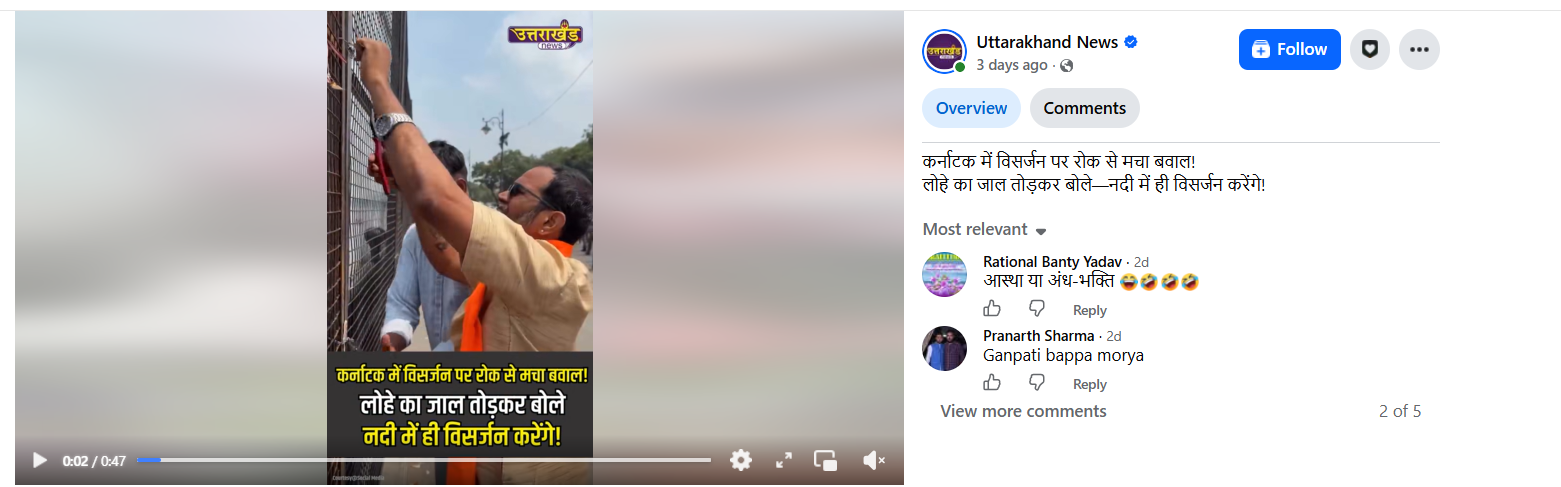
A Facebook user shared the video with the caption: “Chaos erupts in Karnataka over the ban on idol immersion! Breaking the iron barricades, they said — ‘We will immerse the idols in the river itself!’” The post link, archive link, and screenshot are provided below.
https://www.facebook.com/watch/?v=1523733916224661
https://ghostarchive.org/archive/SJgmD
Fact Check
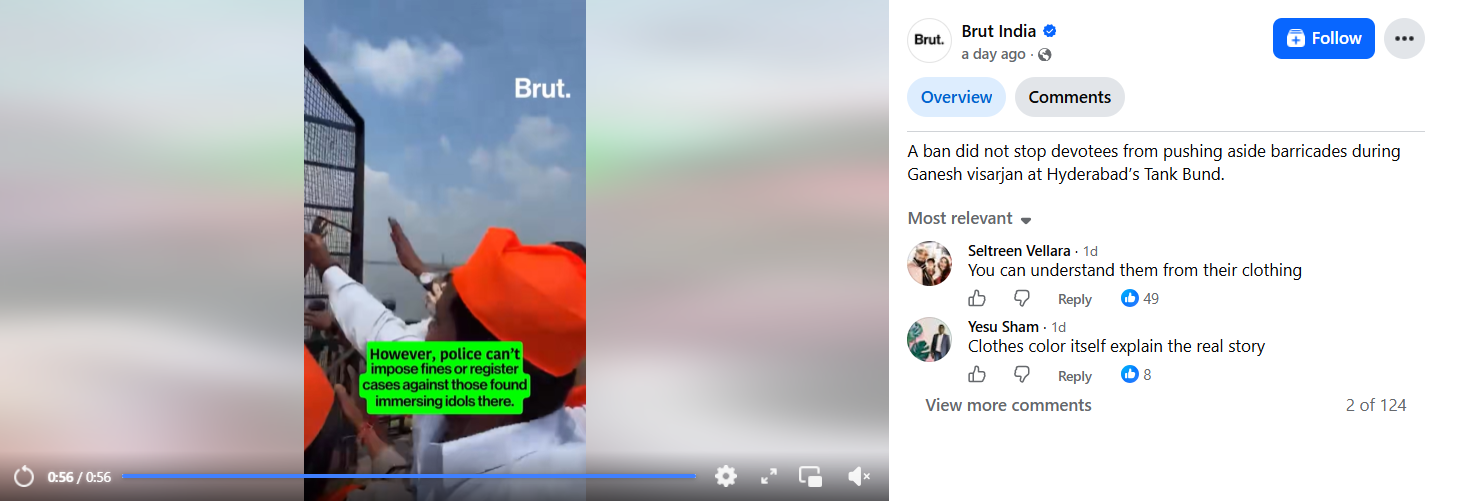
To verify the authenticity of the viral claim, we conducted a reverse image search of keyframes from the video. During the search, we found the same video on the Facebook page of Brut India. According to the post, the video is from Hyderabad. The caption states that despite the restrictions, devotees removed the barricades and made way during the Ganesh idol immersion at Hyderabad’s Tank Bund. The post link and screenshot are provided below.
https://www.facebook.com/watch/?v=2220012475615416
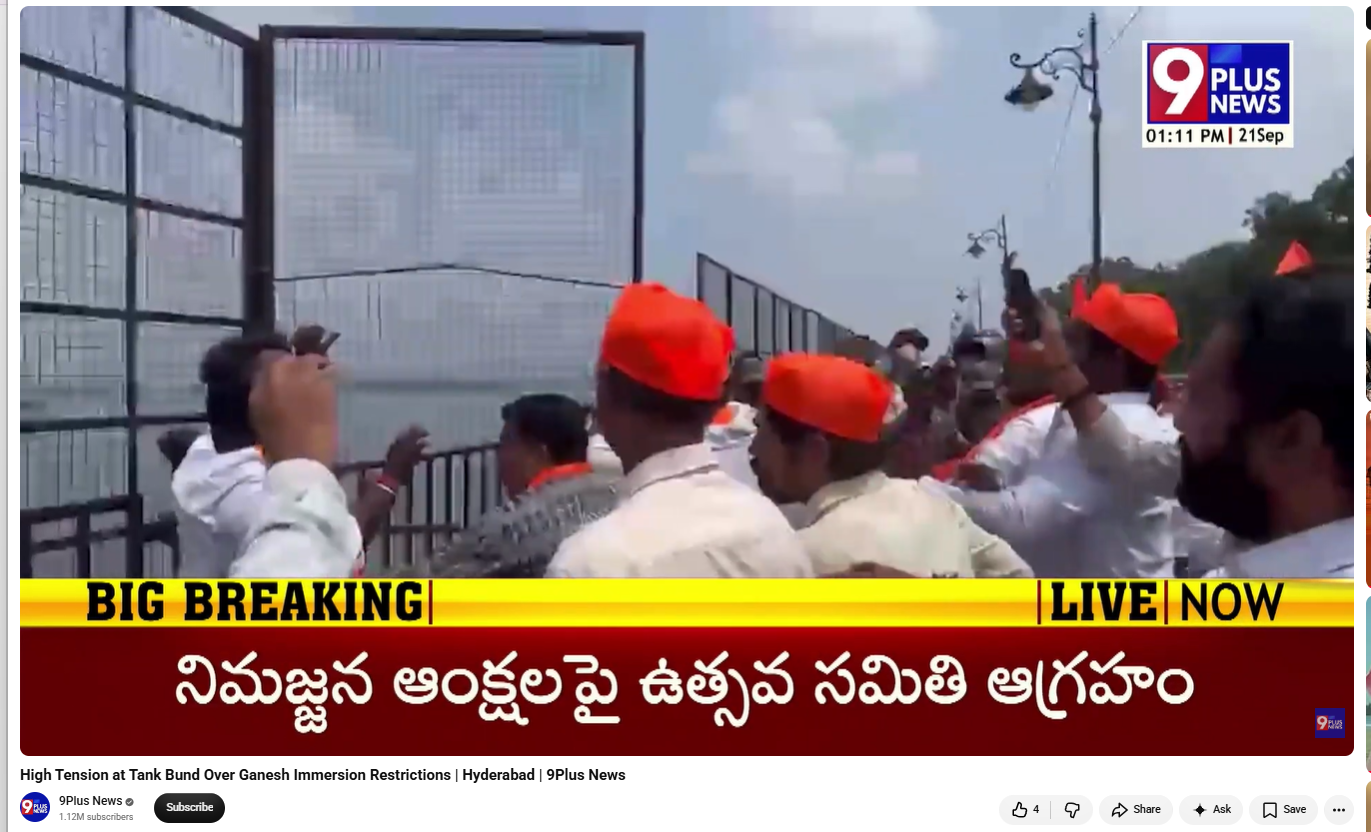
Taking the Research forward, we found the same video in a news report uploaded on the YouTube channel of ‘9Plus News’ on September 21, 2026. The report also includes the portion of the viral clip in which people can be seen breaking the barricades. According to the report, the incident took place in the Tank Bund area of Hyderabad. The post link and screenshot are provided below.
https://www.youtube.com/watch?v=l7GRELjqAwY
Conclusion
Our Research found that the viral video is not from Karnataka but from Hyderabad, Telangana. The video shows members of the Bhagyanagar Ganesh Utsav Committee (BGUS) removing barricades installed at Tank Bund to prevent the immersion of Plaster of Paris (PoP) idols in the water body. These barricades had been installed following the High Court’s directions. Therefore, the claim linking the video to Karnataka is false.
