
#FactCheck- Viral Image Falsely Claims RBI Has Issued New ₹500 Plastic Note Replacing Gandhi With Ashoka Pillar
Executive Summary
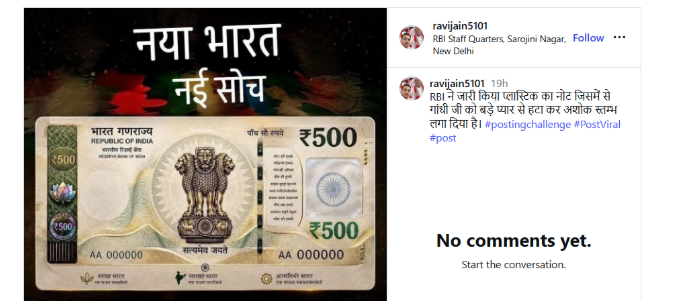
An image of a purported new ₹500 plastic banknote is being widely shared on social media. Users claim that the Reserve Bank of India (RBI) has issued the new note and replaced Mahatma Gandhi’s portrait with the Ashoka Pillar.The CyberPeace Research Wing research found the claim to be misleading. The probe revealed that RBI has not issued any new ₹500 plastic banknote. Furthermore, no official announcement or decision has been made regarding the removal of Mahatma Gandhi’s portrait from Indian currency and its replacement with the Ashoka Pillar.
Claim
An Instagram user shared the viral image with the claim: “RBI has issued a ₹500 plastic note in which Mahatma Gandhi’s image has been removed and replaced with the Ashoka Pillar.” The claim has been widely circulated on social media, with many users sharing the image as genuine. The post link, archived version, and screenshot can be seen below.
Fact Check
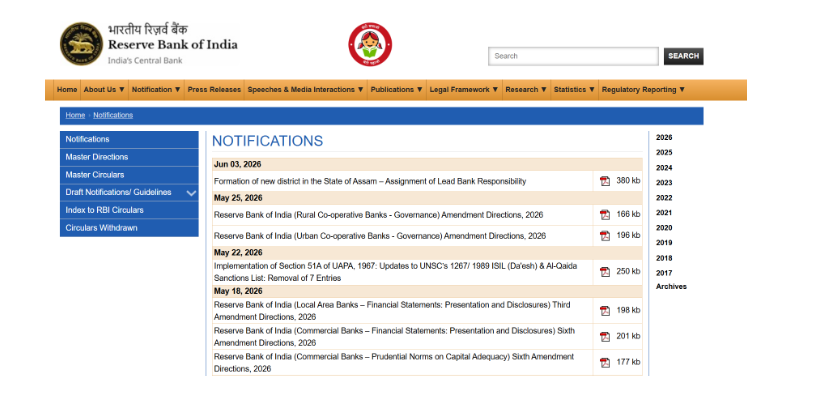
To verify the claim, we conducted a keyword search on Google. However, we found no credible media reports suggesting that RBI had issued a new ₹500 plastic note featuring the Ashoka Pillar in place of Mahatma Gandhi. We then searched the official RBI website for any notification or announcement related to the claim. Our search yielded no official communication supporting the viral claim.
During the research, we also came across a report published by Business Standard. According to the report, the Reserve Bank of India is exploring the possibility of introducing polymer (plastic) currency notes in the future. The report states that RBI is studying and discussing the proposal in view of the growing global adoption of polymer notes and their greater durability. However, the report does not state that RBI has already issued a new ₹500 plastic note. Nor does it mention any decision to remove Mahatma Gandhi’s portrait from existing currency notes and replace it with the Ashoka Pillar.
- https://www.business-standard.com/finance/news/rbi-set-to-unveil-polymer-rupee-notes-amid-rising-currency-demand-126052801725_1.html

Conclusion
The research found that the viral claim is misleading. RBI has not issued any new ₹500 plastic banknote, and there has been no official announcement or decision to replace Mahatma Gandhi’s portrait on Indian currency with the Ashoka Pillar.

Related Blogs

Executive Summary:
In the recent advisory the Indian Computer Emergency Response Team (CERT-In) has released a high severity warning in the older versions of the software across Apple devices. This high severity rating is because of the multiple vulnerabilities reported in Apple products which could allow the attacker to unfold the sensitive information, and execute arbitrary code on the targeted system. This warning is extremely useful to remind of the necessity to have the software up to date to prevent threats of a cybernature. It is important to update the software to the latest versions and cyber hygiene practices.
Devices Affected:
CERT-In advisory highlights significant risks associated with outdated software on the following Apple devices:
- iPhones and iPads: iOS versions that are below 18 and the 17.7 release.
- Mac Computers: All macOS builds before 14.7 (20G71), 13.7 (20H34), and earlier 20.2 for Sonoma, Ventura, Sequoia, respectively.
- Apple Watches: watchOS versions prior to 11
- Apple TVs: tvOS versions prior to 18
- Safari Browsers: versions prior to 18
- Xcode: versions prior to 16
- visionOS: versions prior to 2
Details of the Vulnerabilities:
The vulnerabilities discovered in these Apple products could potentially allow attackers to perform the following malicious activities:
- Access sensitive information: The attackers could easily access the sensitive information stored in other parts of the violated gadgets.
- Execute arbitrary code: The web page could be compromised with malcode and run on the targeted system which in the worst scenario would give the intruder full Administrator privileges on the device.
- Bypass security restrictions: Measures agreed to safeguard the device and information contained on it may be easily bypassed and the system left open to more proliferation.
- Cause denial-of-service (DoS) attacks: The vulnerabilities could be used to cause the targeted device or service to be unavailable to the rightful users.
- Perform spoofing attacks: There could be a situation where the attackers created fake entities or users or accounts to have a way into important information or do other unauthorized activities.
- Elevate privileges: It is also stated that weaknesses might be exploited to authorize the attacker a higher level of privileges in the system they are targets.
- Engage in cross-site scripting (XSS) attacks: Some of them make the associated Web applications/sites prone to XSS attacks by injecting hostile scripts into Web page code.
Vulnerabilities:
CVE-2023-42824
- Attack vector could allow a local attacker to elevate their privileges and potentially execute arbitrary code.
Affected System
- Apple's iOS and iPadOS software
CVE-2023-42916
- To improve the out of bounds read it was mitigated with improved input validation which was resolved later.
Affected System
- Safari, iOS, iPadOS, macOS, and Apple Watch Series 4 and later devices running watchOS 10.2
CVE-2023-42917
- leads to arbitrary code execution, and there have been reports of it being exploited in earlier versions of iOS.
Affected System
- Apple's Safari browser, iOS, iPadOS, and macOS Sonoma systems
Recommended Actions for Users:
To mitigate these risks, that users take immediate action:
- Update Software: Ensure all your devices are on the most current version of the operating systems they use. Repetitive updates have important security updates that fix identified weaknesses or flaws within the system.
- Monitor Device Activity: Stay vigilant if something doesn’t seem right; if your gadgets are accessed by someone who isn’t you.
- Always use strong, distinct passwords and use two-factor authentication.
- Install and update the antivirus and Firewall softwares.
- Avoid downloading any applications or clicking link from unknown sources
Conclusion:
The advisory from CERT-In, clearly demonstrates the fundamental need of keeping the software on all Apple devices up to date. Consumers need to act right away to patch their devices and apply best security measures like using multiple factors for login and system scanning. This advisory has come out when Apple has just released new products into the market such as the iPhone 16 series in India. When consumers embrace new technologies it is important for them to observe relevant measures of security precautions. Maintaining good cyber hygiene is a critical process for the protection against new threats.
Reference:
- https://www.cert-in.org.in/s2cMainServlet?pageid=PUBVLNOTES02&VLCODE=CIAD-2023-0043
- https://www.cve.org/CVERecord?id=CVE-2023-42916
- https://www.cve.org/CVERecord?id=CVE-2023-42917
- https://www.bizzbuzz.news/technology/gadjets/cert-in-issues-advisory-on-vulnerabilities-affecting-iphones-ipads-and-macs-1337253#google_vignette
- https://www.wionews.com/videos/india-warns-apple-users-of-high-severity-security-risks-in-older-software-761396
Introduction
Meta has announced that E2EE in Instagram direct messages is ending entirely. Every day, billions of people send messages they consider private. A medical update to a family member. A photograph meant for one person. A conversation they would never have in public. For years, end-to-end encryption (E2EE) was the technology that made that privacy possible: the digital equivalent of a sealed envelope that only the sender and receiver could open. After May 8, 2026, this will change.
Understanding the Adoption Gap
Meta pointed to low user adoption as the reason for this change. Few people were using encrypted messaging on Instagram, the company said, so the feature was not worth keeping. That explanation raises some questions. Encryption was never switched on by default. Users had to find it and turn it on themselves. It was not advertised. And it was only available in certain regions to begin with, something Meta noted on its own Help Centre page. Features that require users to actively seek them out tend to get used far less than those that simply work from the start. WhatsApp demonstrates this clearly; encryption has been on by default since 2016, for every user, with no action required. Back in 2019, Mark Zuckerberg spoke publicly about building privacy into Meta’s messaging platforms as a core direction for the company. The current decision shows a different vision for the company.
The Commercial Dimension
Encrypted message content is not accessible for advertising purposes by design. In December 2025, Meta updated its privacy policy to allow interactions with its Meta AI assistant to inform personalized advertising recommendations across its platforms. With encryption removed from Instagram direct messages, the content of those conversations enters a data environment that already serves Meta’s advertising systems. Meta has not made a direct public statement connecting these two decisions, but technology analysts and privacy researchers have noted the commercial implications of making previously inaccessible message content available within that ecosystem.
What This Means for Users
From May 8, 2026, the content of Instagram direct messages will be accessible to Meta’s systems. This includes messages relating to personal matters that users may have previously sent under the assumption of encryption. A related concern is the question of data security. Unencrypted message content stored on platform servers creates a larger surface area of sensitive information that could be exposed in the event of a security breach. As platforms collect and retain greater volumes of personal data, the potential consequences of unauthorised access grow correspondingly.
But, there is an argument on the other side. Law enforcement agencies and child safety organisations have long maintained that end-to-end encryption limits their ability to detect and act on harmful content. Removing encryption does make certain forms of platform-level content moderation technically feasible where they were not before.
India’s Supreme Court: The Warning Nobody Heeded
India’s Supreme Court said it plainly when hearing the case against Meta’s 2021 WhatsApp privacy policy, which forced hundreds of millions of users to accept data sharing with Facebook or lose access entirely. Chief Justice Surya Kant called it “a decent way of committing theft of private information” and asked how ordinary people could meaningfully consent to policies written in language they cannot understand. He made it human with one line: “A poor woman selling fruits on the streets — will she understand the terms of your policy?” The court ordered Meta not to share a single word of user data until the case is resolved. When Meta’s lawyers argued that encryption protects users anyway, the bench pushed back: encryption protects message content, not the metadata surrounding it. Who you talk to, how often, at what time, from where: all of it is still harvested. The Competition Commission’s own advocate summarised the entire arrangement in four words: “We are the products.”
WhatsApp: A Question Worth Asking
Instagram, Messenger, and WhatsApp are three products inside one ecosystem, owned by Meta, serving one business model. Instagram’s encryption is already gone. Is WhatsApp next in line ?
WhatsApp has over 850 million monthly active users in India alone. People do not use it for entertainment, it is how families talk, how businesses run, how essential daily communication happens. It is infrastructure, not an app. Meta acquired it in 2014 promising no ads, no data exploitation. By 2021 that promise was already bending. By 2025 ads appeared in the Status section. Both original co-founders had long since left the company over exactly these concerns. Instagram’s encryption survived until it conflicted with revenue and regulation. WhatsApp’s encryption exists today under the same ownership, the same business model, and the same tightening global regulatory pressure. That is not a reason to panic. It is a reason to pay attention.
Conclusion
Encryption is not permanent. It is a design choice, and like any design choice, it can be undone when priorities shift. After May 8, 2026, Instagram direct messages will no longer be protected the way they once were. For most users, this change will pass unnoticed. But the data those conversations contain will now be accessible in ways it previously was not. What platforms do with user data is rarely announced loudly. Paying attention to the quiet changes matters.
References
- https://help.instagram.com/491565145294150
- https://www.theguardian.com/technology/2026/mar/18/instagram-to-remove-end-to-end-encryption-for-private-messages-in-may
- https://www.androidpolice.com/why-meta-is-getting-rid-of-e2ee/
- https://digitalpolicyalert.org/change/13307
- https://www.skadden.com/insights/publications/2025/06/take-it-down-act
- https://timesofindia.indiatimes.com/india/you-cant-play-with-right-of-privacy-of-citizens-scs-big-warning-to-whatsapp-meta-over-take-it-or-leave-it-policy/articleshow/127878524.cms#
- https://proton.me/blog/instagram-end-to-end-encryption
- https://www.forbes.com/sites/parmyolson/2018/09/26/exclusive-whatsapp-cofounder-brian-acton-gives-the-inside-story-on-deletefacebook-and-why-he-left-850-million-behind/
Introduction
In a world where Artificial Intelligence (AI) is already changing the creation and consumption of content at a breathtaking pace, distinguishing between genuine media and false or doctored content is a serious issue of international concern. AI-generated content in the form of deepfakes, synthetic text and photorealistic images is being used to disseminate misinformation, shape public opinion and commit fraud. As a response, governments, tech companies and regulatory bodies are exploring ‘watermarking’ as a key mechanism to promote transparency and accountability in AI-generated media. Watermarking embeds identifiable information into content to indicate its artificial origin.
Government Strategies Worldwide
Governments worldwide have pursued different strategies to address AI-generated media through watermarking standards. In the US, President Biden's 2023 Executive Order on AI directed the Department of Commerce and the National Institute of Standards and Technology (NIST) to establish clear guidelines for digital watermarking of AI-generated content. This action puts a big responsibility on large technology firms to put identifiers in media produced by generative models. These identifiers should help fight misinformation and address digital trust.
The European Union, in its Artificial Intelligence Act of 2024, requires AI-generated content to be labelled. Article 50 of the Act specifically demands that developers indicate whenever users engage with synthetic content. In addition, the EU is a proponent of the Coalition for Content Provenance and Authenticity (C2PA), an organisation that produces secure metadata standards to track the origin and changes of digital content.
India is currently in the process of developing policy frameworks to address AI and synthetic content, guided by judicial decisions that are helping shape the approach. In 2024, the Delhi High Court directed the central government to appoint members for a committee responsible for regulating deepfakes. Such moves indicate the government's willingness to regulate AI-generated content.
China, has already implemented mandatory watermarking on all deep synthesis content. Digital identifiers must be embedded in AI media by service providers, and China is one of the first countries to adopt stern watermarking legislation.
Understanding the Technical Feasibility
Watermarking AI media means inserting recognisable markers into digital material. They can be perceptible, such as logos or overlays or imperceptible, such as cryptographic tags or metadata. Sophisticated methods such as Google's SynthID apply imperceptible pixel-level changes that remain intact against standard image manipulation such as resizing or compression. Likewise, C2PA metadata standards enable the user to track the source and provenance of an item of content.
Nonetheless, watermarking is not an infallible process. Most watermarking methods are susceptible to tampering. Aforementioned adversaries with expertise, for instance, can use cropping editing or AI software to delete visible watermarks or remove metadata. Further, the absence of interoperability between different watermarking systems and platforms hampers their effectiveness. Scalability is also an issue enacting and authenticating watermarks for billions of units of online content necessitates huge computational efforts and routine policy enforcement across platforms. Scientists are currently working on solutions such as blockchain-based content authentication and zero-knowledge watermarking, which maintain authenticity without sacrificing privacy. These new techniques have potential for overcoming technical deficiencies and making watermarking more secure.
Challenges in Enforcement
Though increasing agreement exists for watermarking, implementation of such policies is still a major issue. Jurisdictional constraints prevent enforceability globally. A watermarking policy within one nation might not extend to content created or stored in another, particularly across decentralised or anonymous domains. This creates an exigency for international coordination and the development of worldwide digital trust standards. While it is a welcome step that platforms like Meta, YouTube, and TikTok have begun flagging AI-generated content, there remains a pressing need for a standardised policy that ensures consistency and accountability across all platforms. Voluntary compliance alone is insufficient without clear global mandates.
User literacy is also a significant hurdle. Even when content is properly watermarked, users might not see or comprehend its meaning. This aligns with issues of dealing with misinformation, wherein it's not sufficient just to mark off fake content, users need to be taught how to think critically about the information they're using. Public education campaigns, digital media literacy and embedding watermarking labels within user-friendly UI elements are necessary to ensure this technology is actually effective.
Balancing Privacy and Transparency
While watermarking serves to achieve digital transparency, it also presents privacy issues. In certain instances, watermarking might necessitate the embedding of metadata that will disclose the source or identity of the content producer. This threatens journalists, whistleblowers, activists, and artists utilising AI tools for creative or informative reasons. Governments have a responsibility to ensure that watermarking norms do not violate freedom of expression or facilitate surveillance. The solution is to achieve a balance by employing privacy-protection watermarking strategies that verify the origin of the content without revealing personally identifiable data. "Zero-knowledge proofs" in cryptography may assist in creating watermarking systems that guarantee authentication without undermining user anonymity.
On the transparency side, watermarking can be an effective antidote to misinformation and manipulation. For example, during the COVID-19 crisis, misinformation spread by AI on vaccines, treatments and public health interventions caused widespread impact on public behaviour and policy uptake. Watermarked content would have helped distinguish between authentic sources and manipulated media and protected public health efforts accordingly.
Best Practices and Emerging Solutions
Several programs and frameworks are at the forefront of watermarking norms. Adobe, Microsoft and others' collaborative C2PA framework puts tamper-proof metadata into images and videos, enabling complete traceability of content origin. SynthID from Google is already implemented on its Imagen text-to-image model and secretly watermarks images generated by AI without any susceptibility to tampering. The Partnership on AI (PAI) is also taking a leadership role by building out ethical standards for synthetic content, including standards around provenance and watermarking. These frameworks become guides for governments seeking to introduce equitable, effective policies. In addition, India's new legal mechanisms on misinformation and deepfake regulation present a timely point to integrate watermarking standards consistent with global practices while safeguarding civil liberties.
Conclusion
Watermarking regulations for synthetic media content are an essential step toward creating a safer and more credible digital world. As artificial media becomes increasingly indistinguishable from authentic content, the demand for transparency, origin, and responsibility increases. Governments, platforms, and civil society organisations will have to collaborate to deploy watermarking mechanisms that are technically feasible, compliant and privacy-friendly. India is especially at a turning point, with courts calling for action and regulatory agencies starting to take on the challenge. Empowering themselves with global lessons, applying best-in-class watermarking platforms and promoting public awareness can enable the nation to acquire a level of resilience against digital deception.
References
- https://artificialintelligenceact.eu/
- https://www.cyberpeace.org/resources/blogs/delhi-high-court-directs-centre-to-nominate-members-for-deepfake-committee
- https://c2pa.org
- https://www.cyberpeace.org/resources/blogs/misinformations-impact-on-public-health-policy-decisions
- https://deepmind.google/technologies/synthid/
- https://www.imatag.com/blog/china-regulates-ai-generated-content-towards-a-new-global-standard-for-transparency
