
#FactCheck : Iraq Religious Gathering Video Misused as Khamenei Funeral Footage
Executive Summary
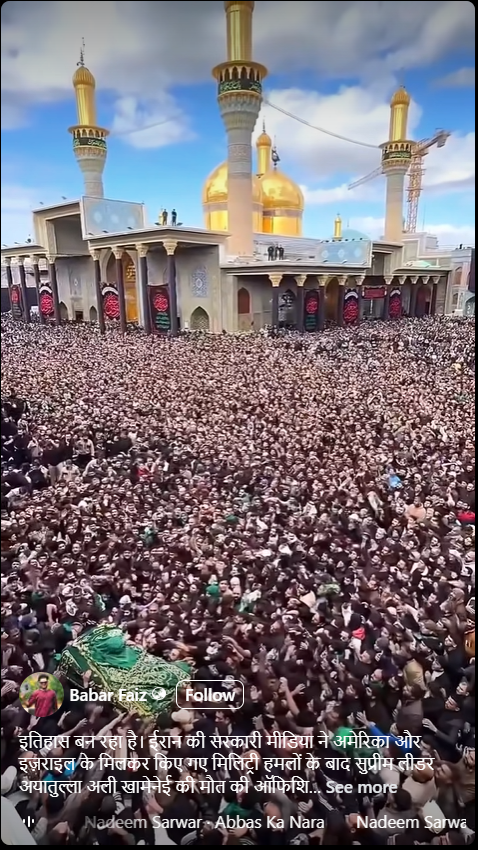
A video showing a massive gathering of people dressed in black is widely circulating on social media. The clip is being shared with the claim that it shows crowds mourning the funeral of Iran’s Supreme Leader Ayatollah Ali Khamenei following his alleged killing in February 2026 However, research by the CyberPeace found that the claim is misleading and the video is unrelated to Iran.
Claim:
The viral video shows a large crowd gathered in a public square, with a mosque featuring a golden dome visible in the background. Social media posts claim that the footage captures mourners attending Ayatollah Khamenei’s funeral after his reported death in a joint US-Israel operation.
Fact Check:
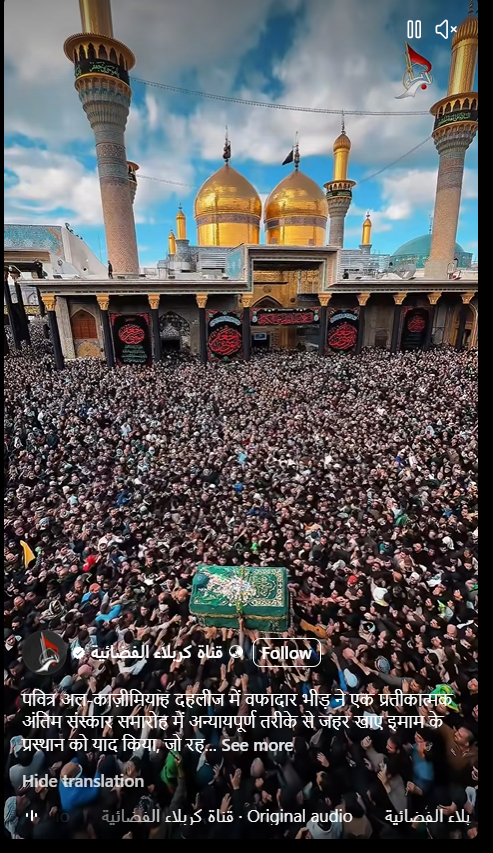
To verify the claim, we extracted keyframes from the video and conducted a reverse image search. This led us to a similar clip uploaded on January 15 by an Iraqi broadcaster, Karbala TV, on Facebook. In the footage, a large crowd can be seen carrying a symbolic coffin near a shrine with a golden dome—matching the visuals seen in the viral video. According to the Arabic caption, the video shows a “symbolic funeral” procession held at the Kazimayn Shrine in Baghdad, Iraq. The event is part of an annual religious observance commemorating Imam Musa al-Kazim, the seventh Imam in Shia Islam, who is believed to have died after being poisoned in the 8th century.
Every year, large numbers of Shia devotees gather at the shrine in Baghdad to pay their respects during this commemoration. The visuals seen in the viral clip are consistent with this annual gathering.
Conclusion:
The claim that the video shows crowds at Ayatollah Khamenei’s funeral is false. The footage is unrelated and actually depicts a religious gathering in Baghdad, Iraq, held as part of an annual Shia ritual.

Related Blogs

Executive Summary
Amid the ongoing hostilities between Israel and Iran, a video is rapidly going viral on social media with Hindi and Urdu captions. The clip shows several vehicles on a road while a large number of black birds can be seen circling in the sky. Users are sharing the video with the claim that it shows thousands of crows hovering over Tel Aviv after an Iranian attack. Some have even described it as a sign of a major impending event.
However, an research by the CyberPeace found the claim to be misleading. The viral video is old and has no connection to the ongoing conflict between Iran and Israel.

Fact Check
To verify the claim, a keyframe from the video was reverse searched on Yandex. This led to the same video being shared on Reddit on June 13, 2024, where it was described as footage from the US state of Texas. Further searches using the keywords “Crows in Texas” revealed that the same video had been shared on Facebook in April and June 2024. These posts also claimed that the visuals were captured near a supermarket in Texas, where a large number of crows were seening.
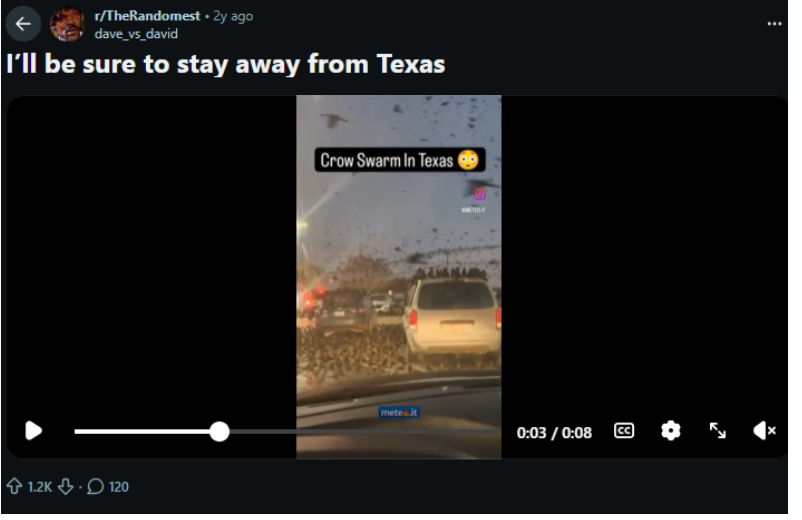

While the exact location of the video cannot be independently confirmed, the available evidence clearly establishes that the footage predates the current conflict and is unrelated to any recent events involving Iran or Israel.
Conclusion
The viral video showing a flock of birds in the sky is not linked to any Iranian attack on Israel. It has been available online since 2024 and is being falsely shared in the context of the ongoing conflict.
Executive Summary:
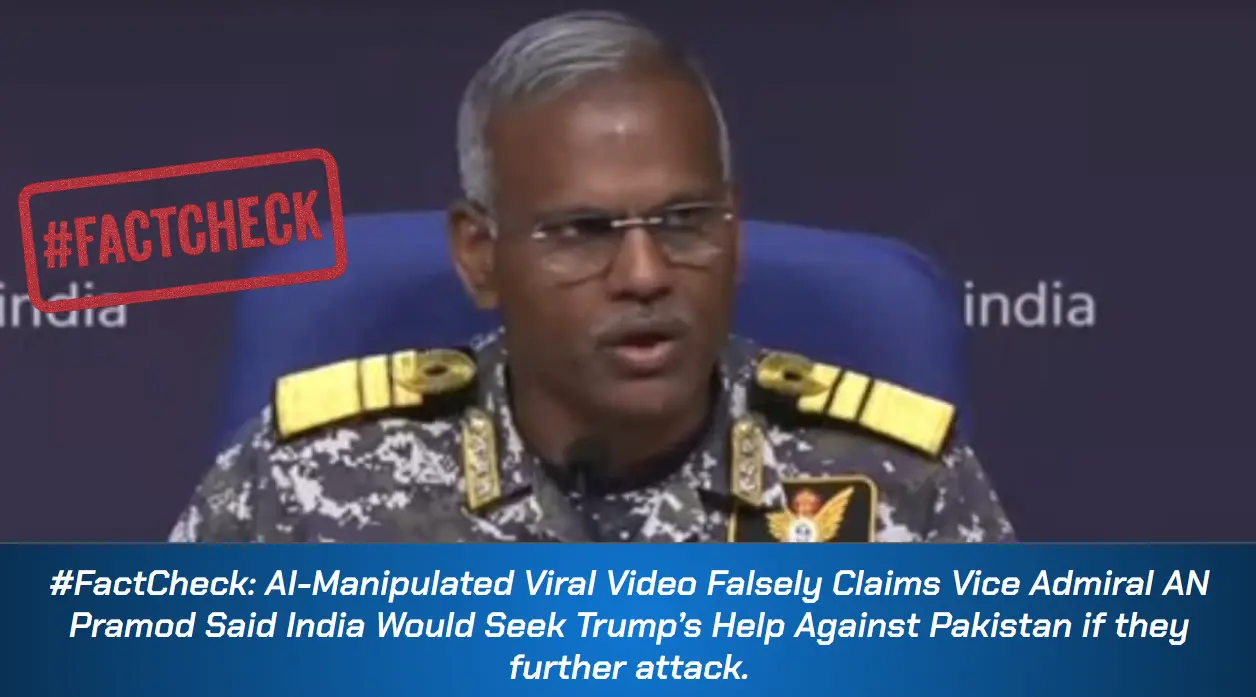
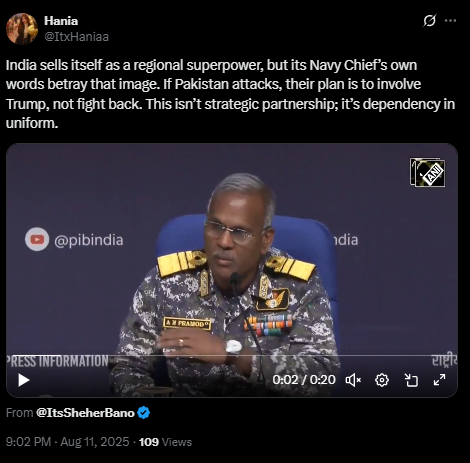
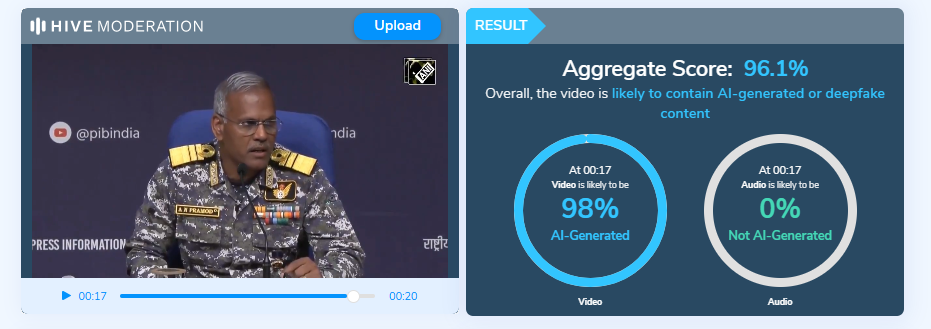
A viral video (archived link) circulating on social media claims that Vice Admiral AN Pramod stated India would seek assistance from the United States and President Trump if Pakistan launched an attack, portraying India as dependent rather than self-reliant. Research traced the extended footage to the Press Information Bureau’s official YouTube channel, published on 11 May 2025. In the authentic video, the Vice Admiral makes no such remark and instead concludes his statement with, “That’s all.” Further analysis using the AI Detection tool confirmed that the viral clip was digitally manipulated with AI-generated audio, misrepresenting his actual words.
Claim:
In the viral video an X user posted with the caption
”India sells itself as a regional superpower, but its Navy Chief’s own words betray that image. If Pakistan attacks, their plan is to involve Trump, not fight back. This isn’t strategic partnership; it’s dependency in uniform”.
In the video the Vice Admiral was heard saying
“We have worked out among three services, this time if Pakistan dares take any action, and Pakistan knows it, what we are going to do. We will complain against Pakistan to the United States of America and President Trump, like we did earlier in Operation Sindoor.”
Fact Check:
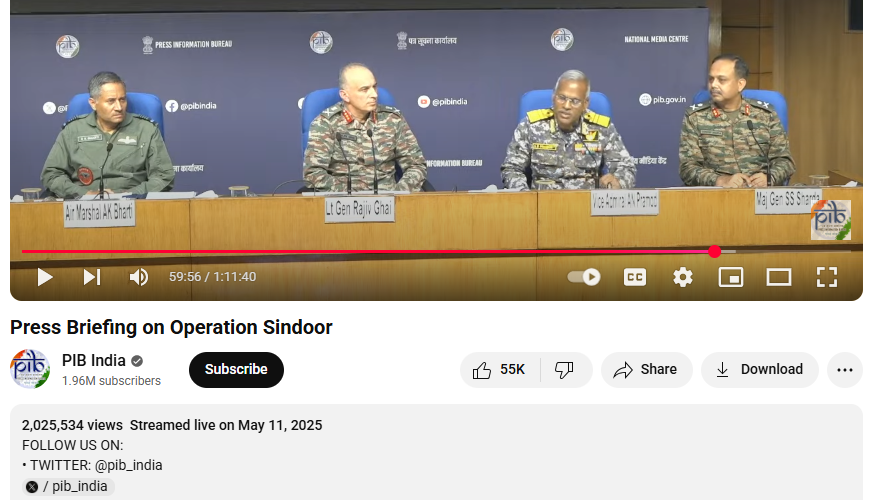
Upon conducting a reverse image search on key frames from the video, we located the full version of the video on the official YouTube channel of the Press Information Bureau (PIB), published on 11 May 2025. In this video, at the 59:57-minute mark, the Vice Admiral can be heard saying:
“This time if Pakistan dares take any action, and Pakistan knows it, what we are going to do. That’s all.”
Further analysis was conducted using the Hive Moderation tool to examine the authenticity of the circulating clip. The results indicated that the video had been artificially generated, with clear signs of AI manipulation. This suggests that the content was not genuine but rather created with the intent to mislead viewers and spread misinformation.
Conclusion:
The viral video attributing remarks to Vice Admiral AN Pramod about India seeking U.S. and President Trump’s intervention against Pakistan is misleading. The extended speech, available on the Press Information Bureau’s official YouTube channel, contained no such statement. Instead of the alleged claim, the Vice Admiral concluded his comments by saying, “That’s all.” AI analysis using Hive Moderation further indicated that the viral clip had been artificially manipulated, with fabricated audio inserted to misrepresent his words. These findings confirm that the video is altered and does not reflect the Vice Admiral’s actual remarks.
Claim: Fake Viral Video Claiming Vice Admiral AN Pramod saying that next time if Pakistan Attack we will complain to US and Prez Trump.
Claimed On: Social Media
Fact Check: False and Misleading

Executive Summary
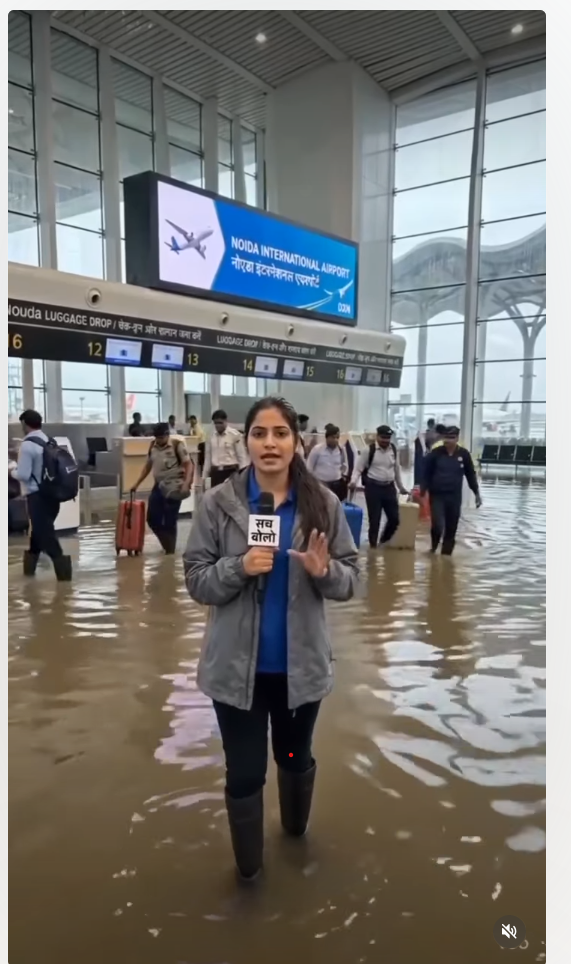
A video circulating rapidly on social media claims to show severe waterlogging inside the passenger terminal of the newly constructed Noida International Airport in Uttar Pradesh. The clip displays passengers navigating flooded check-in areas with their luggage, while a female reporter holding a mic labeled "Sach Bolo" criticizes the state government over poor infrastructure. However, a research by the CyberPeace Research Wing confirmed that the video is completely fake and created using artificial intelligence (AI).
The Claim
On August 14, 2026, Instagram user shyamgupta_yuvaneta posted the clip with a caption targeting the government over alleged corruption and poor infrastructure at the Noida Airport
https://www.instagram.com/reels/DcAOGgcgUrp
Fact-Check
An initial analysis of the video revealed unnatural physical movements among the people shown and an artificial voice modulation typical of AI-generated content. To verify this, the video was run through standard AI detection tools:
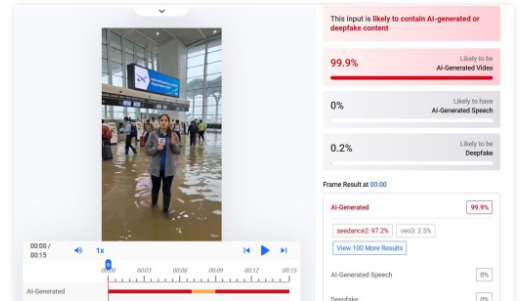
Hive Moderation: Flagged the video as 99.9% likely to be AI-generated.
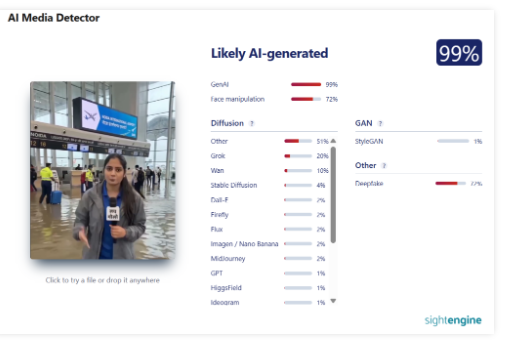
Sightengine: Returned a 99% probability that the content was artificially generated.
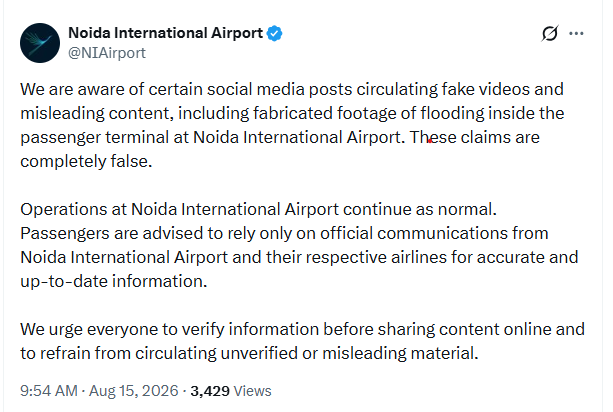
Further verification of official communications revealed a post by the official X (formerly Twitter) account of Noida International Airport (@NIAirport) on August 15, 2026. The airport authority clarified that fake videos depicting waterlogging inside the passenger terminal were circulating online and refuted the claims entirely. While recent heavy rainfall did cause temporary water accumulation in an underpass connecting the terminal to the parking area, the passenger terminal building itself remained unaffected.
https://x.com/NIAirport/status/2088481969462272065?s=20
Conclusion
The viral video showing waterlogging inside the Noida International Airport terminal is fake and AI-generated. The actual incident of waterlogging was restricted to an outer subway connecting the parking area, not the main terminal building.
