
#FactCheck -Mock drill video falsely shared as terrorist attack on Patna ISKCON Temple
Executive Summary
A video is being widely shared on social media with the claim that a terrorist attack took place at the ISKCON Temple in Patna. The posts claim that terrorists opened indiscriminate fire at security personnel deployed at the main gate, carried out bomb blasts, and took two priests hostage. CyberPeace Research Wing’s research found that the claim of a terrorist attack on the ISKCON Temple in Patna is false. The viral video is not from an actual attack but from a security mock drill conducted at the temple.
Claim
A Facebook post shared a video claiming: "Three suspected terrorists entered the ISKCON Temple! Security guards were shot at the gate. Three suspected terrorists carrying modern weapons and hand grenades suddenly entered the Patna ISKCON Temple in the morning and killed the security personnel deployed at the gate. They then carried out a bomb blast, creating panic inside the temple campus."
The Facebook post archive can be accessed here. Similar posts can be found here and here.
https://www.facebook.com/reel/2501959103601059

Factcheck
To verify the claim, we extracted keyframes from the viral video and conducted a reverse image search. During the search, we found reports from several credible media organisations clarifying that the video was not related to any real terrorist attack but was from a mock drill conducted to assess the preparedness of security forces. According to a Dainik Bhaskar report published on July 29, a security mock drill was conducted at the ISKCON Temple in Patna. During the exercise, a simulated emergency situation was created in which police personnel were assigned the role of suspected terrorists and were made to enter the temple premises. The drill involved personnel from Kotwali, Jakkanpur and Buddha Colony police stations, along with magistrates and around 50 police personnel who reached the spot and took charge of the situation. An ATS team was also immediately called during the exercise.
The report also quoted Patna ASP (Law and Order) Krishna Murari Prasad, who clarified that the exercise was organised to strengthen the temple’s security arrangements.
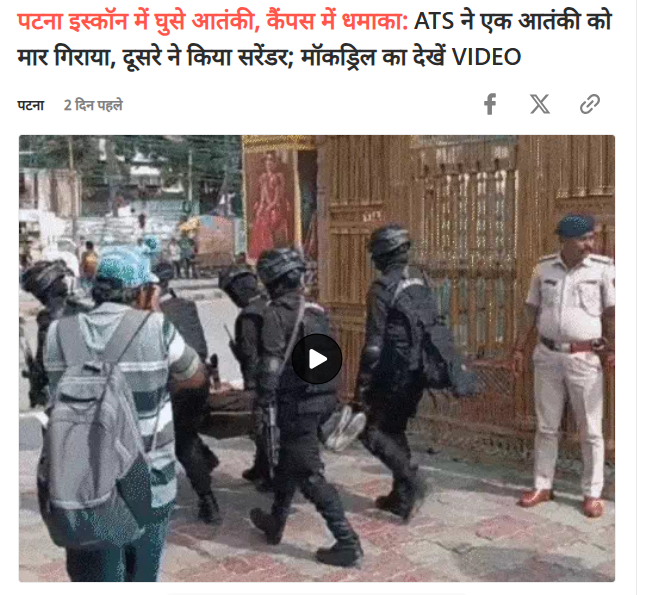
A Navbharat Times report published on July 29 also stated that, as part of the planned mock drill, three Bihar Police personnel carrying advanced weapons and hand grenades were sent inside the ISKCON Temple premises. Security agencies responded quickly, cordoned off the area, and the ATS team took control of the personnel and mock explosives, successfully completing the exercise.

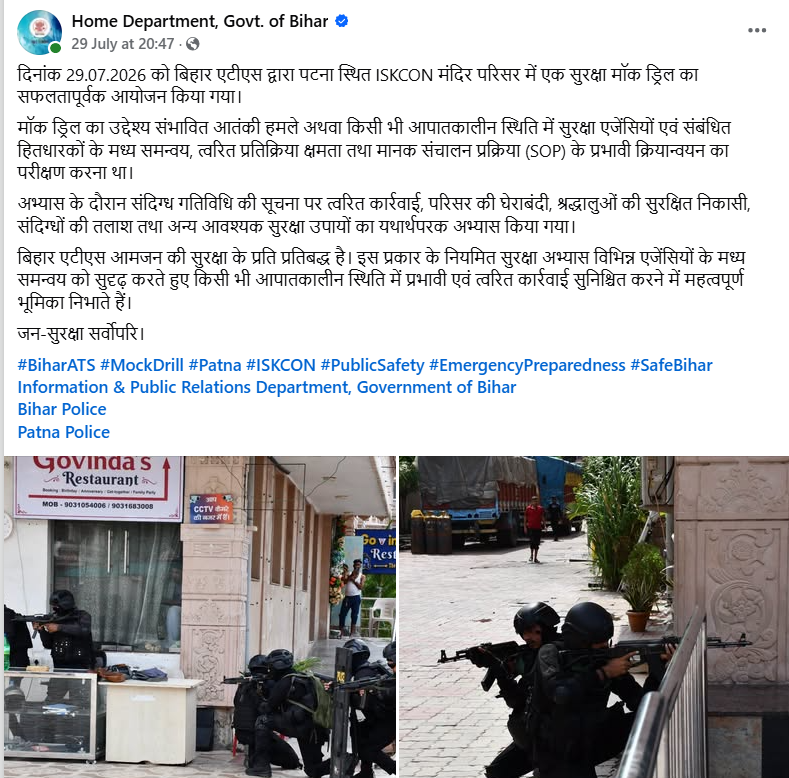
During our research , we also found a post dated July 29, 2026, on the official Facebook page of the Home Department, Government of Bihar, regarding the mock drill.
The post stated that the Bihar ATS successfully conducted a security mock drill at the ISKCON Temple premises in Patna. The objective of the exercise was to test coordination between security agencies and stakeholders, quick response capabilities, and the effective implementation of Standard Operating Procedures (SOPs) during a possible terrorist attack or emergency situation. The post further mentioned that the drill included a rapid response to suspicious activity, area sanitisation, safe evacuation of devotees, search for suspects, and other necessary security measures.
https://www.facebook.com/HomeDeptBihar/posts/1492697179568423?ref=embed_post
Conclusion
The evidence gathered during the research confirms that the viral claim is false. The video being shared with the claim of a terrorist attack on Patna’s ISKCON Temple actually shows a security mock drill conducted by the authorities to assess emergency preparedness.

Related Blogs

Introduction
Misinformation regarding health is sensitive and can have far-reaching consequences. These include its effect on personal medical decisions taken by individuals, lack of trust in conventional medicine, delay in seeking treatments, and even loss of life. The fast-paced nature and influx of information on social media can aggravate the situation further. Recently, a report titled Health Misinformation Vectors in India was presented at the Health of India Summit, 2024. It provided certain key insights into health-related misinformation circulating online.
The Health Misinformation Vectors in India Report
The analysis was conducted by the doctors at First Check, a global health fact-checking initiative alongside DataLEADS, a Delhi-based digital media and technology company. The report covers health-related social media content that was posted online from October 2023 to November 2024. It mentions that among all the health scares, misinformation regarding reproductive health, cancer, vaccines, and lifestyle diseases such as diabetes and obesity is the most prominent type that is spread through social media. Misinformation regarding reproductive health includes illegal abortion methods that often go unchecked and even tips on conceiving a male child, among other things.
In order to combat this misinformation, the report encourages stricter regulations regarding health-related content on digital media, inculcating technology for health literacy and misinformation management in public health curricula and recommending tech platforms to work on algorithms that prioritise credible information and fact-checks. Doctors state that people affected by life-threatening diseases are particularly vulnerable to such misinformation, as they are desperate to seek options for treatment for themselves and their family members to have a chance at life. In a diverse society, with the lack of clear and credible information, limited access to or awareness about tools that cross-check content, and low digital literacy, people gravitate towards alternate sources of information which also fosters a sense of disengagement among the public overall. The diseases mentioned in the report, which are prone to misinformation, are life-altering and require attention from healthcare professionals.
CyberPeace Outlook
Globally, there are cases of medically-unqualified social media influencers who disperse false/mis- information regarding various health matters. The topics covered are mostly associated with stigma and are still undergoing research. This gap allows for misinformation to be fostered. An example is misinformation regarding PCOS( Polycystic Ovary Syndrome) which is circulating online.
In the midst of all of this, YouTube has released a new feature that aligns with combating health misinformation, trying to bridge the gap between healthcare professionals and Indians who look for trustworthy health-related information online. The initiative includes a feature that allows doctors, nurses, and other healthcare professionals to sign up for a health information source license. This would help by labeling all their informative videos, as addressed- from a healthcare professional. Earlier, this feature was available only for health organisations including a health source information panel and health content shelves, but this step broadens the scope for verification of licenses of individual healthcare professionals.
As digital literacy continues to grow, methods of seeking credible information, especially regarding sensitive topics such as health, require a combined effort on the part of all the stakeholders involved. We need a robust strategy for battling health-related misinformation online, including more awareness programmes and proactive participation from the consumers as well as medical professionals regarding such content.
References
- https://timesofindia.indiatimes.com/india/misinformation-about-cancer-reproductive-health-is-widespread-in-india-impacting-medical-decisions-says-report/articleshow/115931612.cms
- https://www.ndtv.com/india-news/cancer-misinformation-prevalent-in-india-trust-in-medicine-crucial-report-7165458
- https://www.newindian.in/ai-driven-health-misinformation-poses-threat-to-indias-public-health-report/
- https://www.etvbharat.com/en/!health/youtube-latest-initiative-combat-health-misinformation-india-enn24121002361
- https://blog.google/intl/en-in/products/platforms/new-ways-for-registered-healthcare-professionals-in-india-to-reach-people-on-youtube/
- https://www.bbc.com/news/articles/ckgz2p0999yo
Introduction
A Reuters investigation has uncovered an elephant in the room regarding Meta Platforms' internal measures to address online fraud and illicit advertising. The confidential documents that Reuters reviewed disclosed that Meta was planning to generate approximately 10% of its 2024 revenue, i.e., USD 16 billion, from ads related to scams and prohibited goods. The findings point out a disturbing paradox: on the one hand, Meta is a vocal advocate for digital safety and platform integrity, while on the other hand, the internal logs of the company indicate the existence of a very large area allowing the shunning of fraudulent advertisement activities that exploit users throughout the world.
The Scale of the Problem
Internal Meta projections show that its platforms, Facebook, Instagram, and WhatsApp, are displaying a staggering 15 billion scam ads per day combined. The advertisements include deceitful e-commerce promotions, fake investment schemes, counterfeit medical products, and unlicensed gambling platforms.
Meta has developed sophisticated detection tools, but even then, the system does not catch the advertisers until they are 95% certain to be fraudsters. By having at least that threshold for removing an ad, the company is unlikely to lose much money. As a result, instead of turning the fraud adjacent advertisers down, it charges them higher ad rates, which is the strategy they call “penalty bids” internally.
Internal Acknowledgements & Business Dependence
Internal documents that date between 2021 and 2025 reveal that the financial, safety, and lobbying divisions of Meta were cognizant of the enormity of revenues generated from scams. One of the 2025 strategic papers even describes this revenue source as "violating revenue," which implies that it includes ads that are against Meta's policies regarding scams, gambling, sexual services, and misleading healthcare products.
The company's top executives consider the cost-benefit scenario of stricter enforcement. According to a 2024 internal projection, Meta's half-yearly earnings from high-risk scam ads were estimated at USD 3.5 billion, whereas regulatory fines for such violations would not exceed USD 1 billion, thus making it a tolerable trade-off from a commercial viewpoint. At the same time, the company intends to scale down scam ad revenue gradually, thus from 10.1% in 2024 to 7.3% by 2025, and 6% by 2026; however, the documents also reveal a planned slowdown in enforcement to avoid "abrupt reductions" that could affect business forecasts.
Algorithmic Amplification of Scams
One of the most alarming situations is the fact that Meta's own advertising algorithms amplify scam content. It has been reported that users who click on fraudulent ads are more likely to see other similar ads, as the platform's personalisation engine assumes user "interest."
This scenario creates a self-reinforcing feedback loop where the user engagement with scam content dictates the amount of such content being displayed. Thus, a digital environment is created which encourages deceptive engagement and consequently, user trust is eroded and systemic risk is amplified.
An internal presentation in May 2025 was said to put a number on how deeply the platform's ad ecosystem was intertwined with the global fraud economy, estimating that one-third of the scams that succeeded in the U.S. were due to advertising on Meta's platforms.
Regulatory & Legal Implications
The disclosures arrived at the same time as the US and UK governments started to closely check the company's activities more than ever before.
- The U.S. Securities and Exchange Commission (SEC) is said to be looking into whether Meta has had any part in the promotion of fraudulent financial ads.
- The UK’s Financial Conduct Authority (FCA) found that Meta’s platforms were the main sources of scams related to online payments and claimed that the amount of money lost was more than all the other social platforms combined in 2023.
Meta’s spokesperson, Andy Stone, at first denied the accusations, stating that the figures mentioned in the leak were “rough and overly-inclusive”; nevertheless, he conceded that the company’s consistent efforts toward enforcement had negatively impacted revenue and would continue to do so.
Operational Challenges & Policy Gaps
The internal documents also reveal the weaknesses in Meta's day-to-day operations when it comes to the implementation of its own policies.
- Because of the large number of employees laid off in 2023, the whole department that dealt with advertiser-brand impersonation was said to have been dissolved.
- Scam ads were categorised as a "low severity" issue, which was more of a "bad user experience" than a critical security risk.
- At the end of 2023, users were submitting around 100,000 legitimate scam reports per week, of which Meta dismissed or rejected 96%.
Human Impact: When Fraud Becomes Personal
The financial and ethical issues have tangible human consequences. The Reuters investigation documented multiple cases of individuals defrauded through hijacked Meta accounts.
One striking example involves a Canadian Air Force recruiter, whose hacked Facebook account was used to promote fake cryptocurrency schemes. Despite over a hundred user reports, Meta failed to act for weeks, during which several victims, including military colleagues, lost tens of thousands of dollars.
The case underscores not just platform negligence, but also the difficulty of law enforcement collaboration. Canadian authorities confirmed that funds traced to Nigerian accounts could not be recovered due to jurisdictional barriers, a recurring issue in transnational cyber fraud.
Ethical and Cybersecurity Implications
The research has questioned extremely important things at least from the perspective of cyber policy:
- Platform Accountability: Meta, by its practice, is giving more importance to the monetary aspect rather than the truth, and in this way, it is going against the principles of responsible digital governance.
- Transparency in Ad Ecosystems: The lack of transparency in digital advertising systems makes it very easy for dishonest actors to use automated processes with very little supervision.
- Algorithmic Responsibility: The use of algorithms that impact the visibility of misleading content and targeting can be considered the direct involvement of the algorithms in the fraud.
- Regulatory Harmonisation: The presence of different and disconnected enforcement frameworks across jurisdictions is a drawback to the efforts in dealing with cross-border cybercrime.
- Public Trust: Users’ trust in the digital world is mainly dependent on the safety level they see and the accountability of the companies.
Conclusion
Meta’s records show a very unpleasant mix of profit, laxity, and failure in the policy area concerning scam-related ads. The platform’s readiness to accept and even profit from fraudulent players, though admitting the damage they cause, calls for an immediate global rethinking of advertising ethics, regulatory enforcement, and algorithmic transparency.
With the expansion of its AI-driven operations and advertising networks, protecting the users of Meta must evolve from being just a public relations goal to being a core business necessity, thus requiring verifiable accountability measures, independent audits, and regulatory oversight. It is an undeniable fact that there are billions of users who count on Meta’s platforms for their right to digital safety, which is why this right must be respected and enforced rather than becoming optional.
References
- https://www.reuters.com/investigations/meta-is-earning-fortune-deluge-fraudulent-ads-documents-show-2025-11-06/?utm_source=chatgpt.com
- https://www.indiatoday.in/technology/news/story/leaked-docs-claim-meta-made-16-billion-from-scam-ads-even-after-deleting-134-million-of-them-2815183-2025-11-07

Introduction
Rajeev Chandrasekhar, Minister of State at the Ministry of Electronics and Information Technology, has emphasised the need for an open internet. He stated that no platform can deny content creators access to distribute and monetise content and that large technology companies have begun to play a significant role in the digital evolution. Chandrasekhar emphasised that the government does not want the internet or monetisation to be in the purview of just one or two companies and does not want 120 crore Indians on the internet in 2025 to be catered to by big islands on the internet.
The Voice for Open Internet
India's Minister of State for IT, Rajeev Chandrasekhar, has stated that no technology company or social media platform can deny content creators access to distribute and monetise their content. Speaking at the Digital News Publishers Association Conference in Delhi, Chandrasekhar emphasized that the government does not want the internet or monetization of the internet to be in the hands of just one or two companies. He argued that the government does not like monopoly or duopoly and does not want 120 crore Indians on the Internet in 2025 to be catered to by big islands on the internet.
Chandrasekhar highlighted that large technology companies have begun to exert influence when it comes to the dissemination of content, which has become an area of concern for publishers and content creators. He stated that if any platform finds it necessary to block any content, they need to give reasons or grounds to the creators, stating that the content is violating norms.
As India tries to establish itself as an innovator in the technology sector, a recent corpus of Rs 1 lakh crore was announced by the government in the interim Budget of 2024-25. As big companies continue to tighten their stronghold on the sector, content moderation has become crucial. Under the IT Rules Act, 11 types of categories are unlawful under IT Act and criminal law. Platforms must ensure no user posts content that falls under these categories, take down any such content, and gateway users to either de-platforming or prosecuting. Chandrasekhar believes that the government has to protect the fundamental rights of people and emphasises legislative guardrails to ensure platforms are accountable for the correctness of the content.
Monetizing Content on the Platform
No platform can deny a content creator access to the platform to distribute and monetise it,' Chandrasekhar declared, boldly laying down a gauntlet that defies the prevailing norms. This tenet signals a nascent dawn where creators may envision reaping the rewards borne of their creative endeavours unfettered by platform restrictions.
An increasingly contentious issue that shadows this debate is the moderation of content within the digital realm. In this vast uncharted expanse, the powers that be within these monolithic platforms assume the mantle of vigilance—policing the digital avenues for transgressions against a conscribed code of conduct. Under the stipulations of India's IT Rules Act, for example, platforms are duty-bound to interdict user content that strays into territories encompassing a spectrum of 11 delineated unlawful categories. Violations span the gamut from the infringement of intellectual property rights to the propagation of misinformation—each category necessitating swift and decisive intervention. He raised the alarm against misinformation—a malignant growth fed by the fertile soils of innovation—a phenomenon wherein media reports chillingly suggest that up to half of the information circulating on the internet might be a mere fabrication, a misleading simulacrum of authenticity.
The government's stance, as expounded by Chandrasekhar, pivots on an axis of safeguarding citizens' fundamental rights, compelling digital platforms to shoulder the responsibility of arbiters of truth. 'We are a nation of over 90 crores today, a nation progressing with vigour, yet we find ourselves beset by those who wish us ill,'
Upcoming Digital India Act
Awaiting upon the horizon, India's proposed Digital India Act (DIA), still in its embryonic stage of pre-consultation deliberation, seeks to sculpt these asymmetries into a more balanced form. Chandrasekhar hinted at the potential inclusion within the DIA of regulatory measures that would sculpt the interactions between platforms and the mosaic of content creators who inhabit them. Although specifics await the crucible of public discourse and the formalities of consultation, indications of a maturing framework are palpable.
Conclusion
It is essential that the fable of digital transformation reverberates with the voices of individual creators, the very lifeblood propelling the vibrant heartbeat of the internet's culture. These are the voices that must echo at the centre stage of policy deliberations and legislative assembly halls; these are the visions that must guide us, and these are the rights that we must uphold. As we stand upon the precipice of a nascent digital age, the decisions we forge at this moment will cascade into the morrow and define the internet of our future. This internet must eternally stand as a bastion of freedom, of ceaseless innovation and as a realm of boundless opportunity for every soul that ventures into its infinite expanse with responsible use.
References
- https://www.financialexpress.com/business/brandwagon-no-platform-can-deny-a-content-creator-access-to-distribute-and-monetise-content-says-mos-it-rajeev-chandrasekhar-3386388/
- https://indianexpress.com/article/india/meta-content-monetisation-social-media-it-rules-rajeev-chandrasekhar-9147334/
- https://www.medianama.com/2024/02/223-rajeev-chandrasekhar-content-creators-publishers/
