
#FactCheck- Old Kerala church raid video falsely shared with exaggerated ₹7000 crore cash seizure claim
Executive Summary
A set of two images is being widely circulated on social media claiming that the Enforcement Directorate (ED) recently raided a church in Kerala and seized ₹7000 crore in black money. The viral post also alleges that the media deliberately suppressed the news. CyberPeace Research Wing research found the claim to be misleading. The visuals are not recent and are linked to an Income Tax Department action conducted in 2020 at the Believers Eastern Church in Kerala.
Claim:
A Facebook user shared the viral post claiming that ₹7000 crore in black money was seized from a Kerala-based church run by a bishop named Yohannan, and alleged that mainstream media ignored the incident.
Post link: https://www.facebook.com/reel/2143680196569943 , https://archive.ph/submit/

Fact Check:
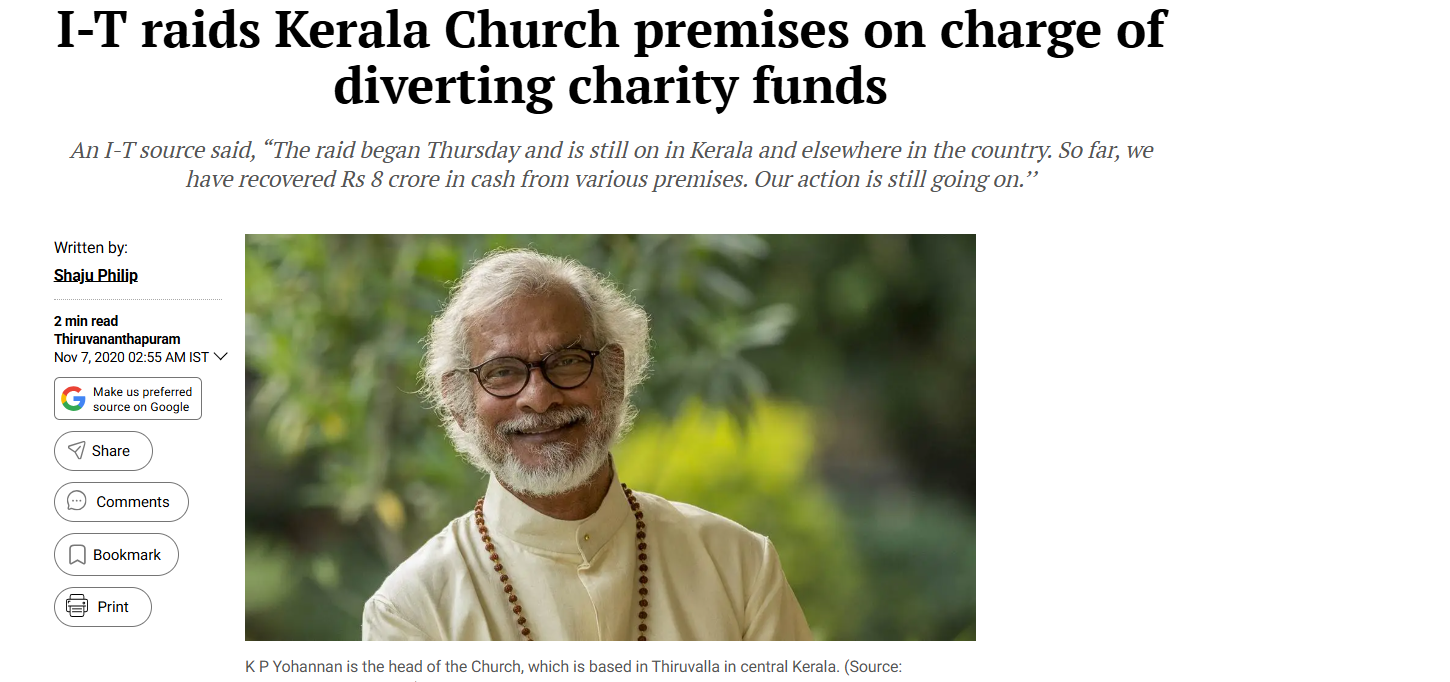
A keyword search related to the alleged raid on Believers Church in Kerala led to several news reports published in November 2020. A report published in The Hindu on November 6, 2020 stated that a crackdown by the Income Tax Department on the Thiruvalla-based Believers Eastern Church had reportedly uncovered several irregularities. https://www.thehindu.com/news/national/kerala/raids-bring-to-light-shady-deals-of-believers-church/article33041420.ece

Further verification from the official Income Tax Department website confirmed details of the search operation. According to the press release, approximately ₹6 crore in unexplained cash was recovered during the raid, including ₹3.85 crore from a place of worship in Delhi. https://www.incometaxindia.gov.in/Lists/Press%20Releases/Attachments/872/PressRelease_ITD_conducts_searches_in_Kerala_6_11_20.pdf
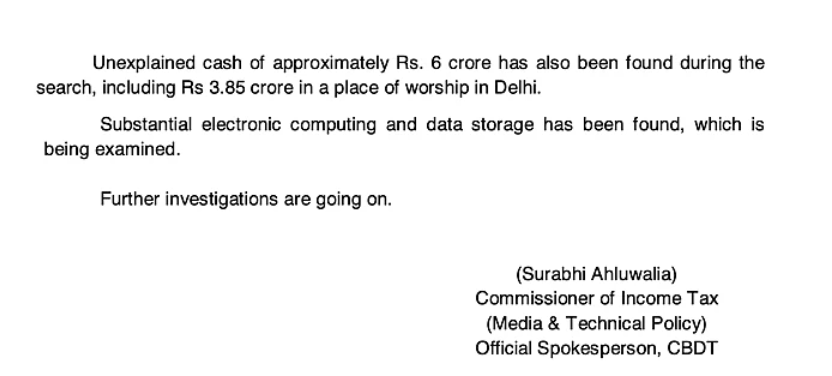
The release also noted that evidence suggested possible cash siphoning running into hundreds of crores of rupees.Additional media reports, including The Indian Express, stated that the total seizure amounted to around ₹14 crore. https://indianexpress.com/article/india/kerala/i-t-raids-kerala-church-premises-on-charge-of-diverting-charity-funds-6984466/
Conclusion:
The research confirms that the viral claim is misleading. The incident is from 2020 and not recent. During the Income Tax Department raid on the Believers Eastern Church in Kerala, around ₹6 crore in cash was recovered, with total seizures reported up to ₹14 crore in media reports. There is no evidence of any ₹7000 crore seizure as claimed in the viral post.

Related Blogs

Introduction
Cybercrimes have been traversing peripheries and growing at a fast pace. Cybercrime is known to be an offensive action that either targets or operates through a computer, a computer network or a networked device, according to Kaspersky. In the “Era of globalisation” and a “Digitally coalesced world”, there has been an increase in International cybercrime. Cybercrime could be for personal or political objectives. Nevertheless, Cybercrime aims to sabotage networks for motives other than gain and be carried out either by organisations or individuals. Some of the cybercriminals have no national boundaries and are considered a global threat. They are likewise inordinately technically adept and operate avant-garde strategies.
The 2023 Global Risk Report points to exacerbating geopolitical apprehensions that have increased the advanced persistent threats (APTs), which are evolving globally as they are ubiquitous. Christine Lagarde, the president of the European Central Bank and former head of the International Monetary Fund (IMF), in 2020 cautioned that a cyber attack could lead to a severe economic predicament. Contemporary technologies and hazardous players have grown at an exceptional gait over the last few decades. Also, cybercrime has heightened on the agenda of nation-states, establishments and global organisations, as per the World Economic Forum (WEF).
The Role of the United Nations Ad Hoc Committee
In two shakes, the United Nations (UN) has a major initiative to develop a new and more inclusive approach to addressing cybercrime and is presently negotiating a new convention on cybercrime. The following convention seeks to enhance global collaboration in the combat against cybercrime. The UN has a central initiative to develop a unique and more inclusive strategy for addressing cybercrime. The UN passed resolution 74/247, which designated an open-ended ad hoc committee (AHC) in December 2019 entrusted with setting a broad global convention on countering the use of information and Communication Technologies (ICTs) for illicit pursuits.
The Cybercrime treaty, if adopted by the UN General Assembly (UNGA) would be the foremost imperative UN mechanism on a cyber point. The treaty could further become a crucial international legal framework for global collaboration on arraigning cyber criminals, precluding and investigating cybercrime. There have correspondingly been numerous other national and international measures to counter the criminal use of ICTs. However, the UN treaty is intended to tackle cybercrime and enhance partnership and coordination between states. The negotiations of the Ad Hoc Committee with the member states will be completed by early 2024 to further adopt the treaty during the UNGA in September 2024.
However, the following treaty is said to be complex. Some countries endorse a treaty that criminalises cyber-dependent offences and a comprehensive spectrum of cyber-enabled crimes. The proposals of Russia, Belarus, China, Nicaragua and Cuba have included highly controversial recommendations. Nevertheless, India has backed for criminalising crimes associated with ‘cyber terrorism’ and the suggestions of India to the UN Ad Hoc committee are in string with its regulatory strategy in the country. Similarly, the US, Japan, the UK, European Union (EU) member states and Australia want to include core cyber-dependent crimes.
Nonetheless, though a new treaty could become a practical instrument in the international step against cybercrime, it must conform to existing global agencies and networks that occupy similar areas. This convention will further supplement the "Budapest Cybercrime Convention" on cybercrime that materialised in the 1990s and was signed in Budapest in the year 2001.
Conclusion
According to Cyber Security Ventures, global cybercrime is expected to increase by 15 per cent per year over the next five years, reaching USD 10.5 trillion annually by 2025, up from USD 3 trillion in 2015. The UN cybercrime convention aims to be more global. That being the case, next-generation tools should have state-of-the-art technology to deal with new cyber crimes and cyber warfare. The global crevasse in nation-states due to cybercrime is beyond calculation. It could lead to a great cataclysm in the global economy and threaten the political interest of the countries on that account. It is crucial for global governments and international organisations. It is necessary to strengthen the collaboration between establishments (public and private) and law enforcement mechanisms. An “appropriately designed policy” is henceforward the need of the hour.
References
- https://www.kaspersky.co.in/resource-center/threats/what-is-cybercrime
- https://www.cyberpeace.org/
- https://www.interpol.int/en/Crimes/Cybercrime
- https://www.bizzbuzz.news/bizz-talk/ransomware-attacks-on-startups-msmes-on-the-rise-in-india-cyberpeace-foundation-1261320
- https://www.financialexpress.com/business/digital-transformation-cyberpeace-foundation-receives-4-million-google-org-grant-3282515/
- https://www.chathamhouse.org/2023/08/what-un-cybercrime-treaty-and-why-does-it-matter
- https://www.weforum.org/agenda/2023/01/global-rules-crack-down-cybercrime/
- https://www.weforum.org/publications/global-risks-report-2023/
- https://www.imf.org/external/pubs/ft/fandd/2021/03/global-cyber-threat-to-financial-systems-maurer.htm
- https://www.eff.org/issues/un-cybercrime-treaty#:~:text=The%20United%20Nations%20is%20currently,of%20billions%20of%20people%20worldwide.
- https://cybersecurityventures.com/hackerpocalypse-cybercrime-report-2016/
- https://www.coe.int/en/web/cybercrime/the-budapest-convention
- https://economictimes.indiatimes.com/tech/technology/counter-use-of-technology-for-cybercrime-india-tells-un-ad-hoc-group/articleshow/92237908.cms?utm_source=contentofinterest&utm_medium=text&utm_campaign=cppst
- https://consultation.dpmc.govt.nz/un-cybercrime-convention/principlesandobjectives/supporting_documents/Background.pdf
- https://unric.org/en/a-un-treaty-on-cybercrime-en-route/

Executive Summary
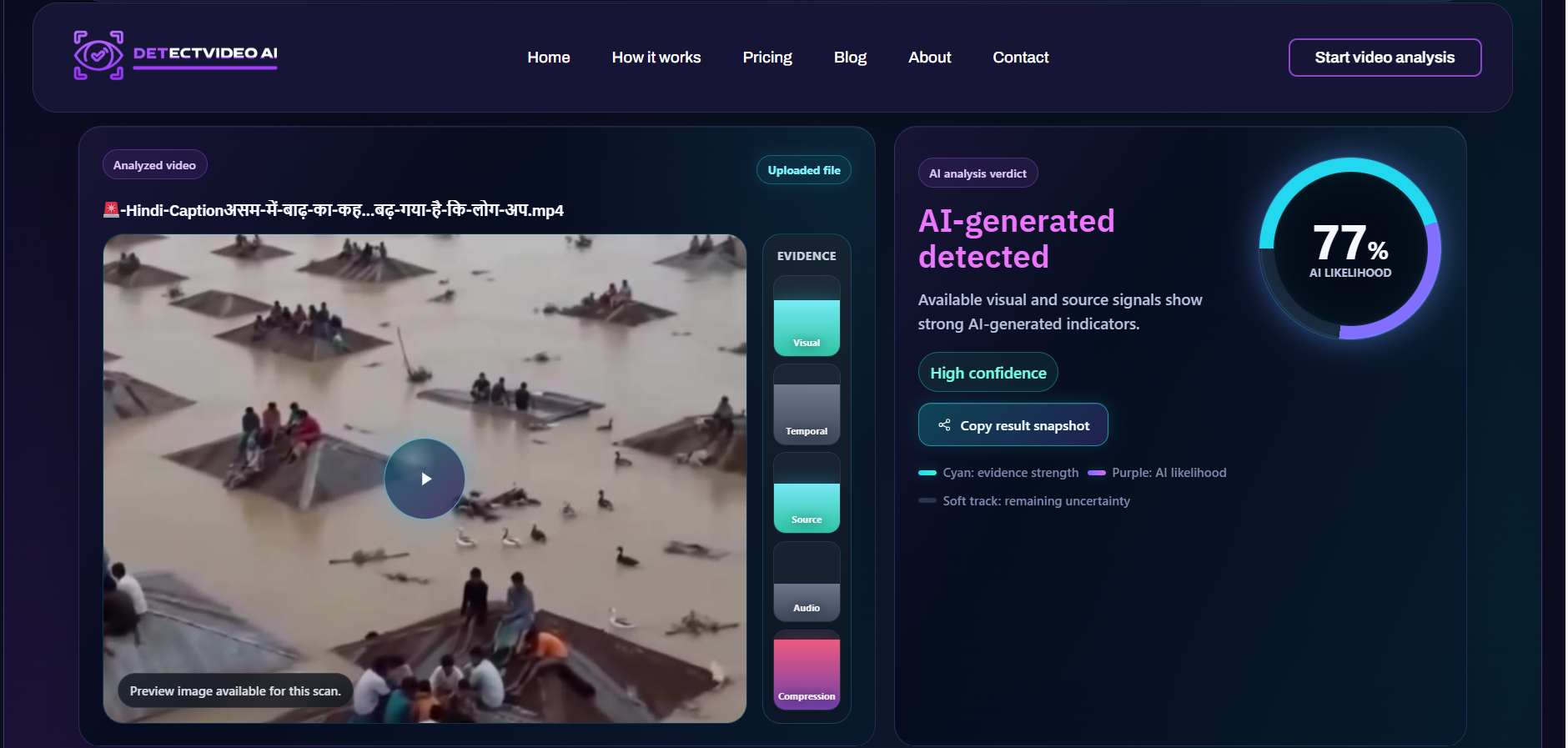
A video is being widely shared on social media showing a flood-affected area. In the video, several houses appear to be almost completely submerged in water, with only their triangular rooftops visible above the surface. Several people can be seen sitting on these rooftops, while ducks and other animals appear to be floating in the water. The video is being shared with the claim that it shows the real situation during the recent floods in Assam. CyberPeace Research Wing’s research found the claim to be misleading. The research revealed that the viral video is not from any real flood incident but was created using Artificial Intelligence (AI). Although the flood situation in Assam is real and several parts of the state have been affected, the viral video has no connection with those events. The AI-generated video is being falsely shared as an actual visual from the Assam floods.
Claim
A user on Instagram shared the viral video on July 27, 2026, claiming that Assam continues to face severe flooding, with more than seven lakh people affected. The post link, archive link and screenshot are provided below.
https://www.instagram.com/reel/DbSVmAApQf6/

FactCheck
To verify the authenticity of the viral claim, we extracted several key frames from the video and conducted a reverse image search using Google Lens. The search did not reveal any credible news report, official source, or reliable information confirming that the video showed real flood visuals from Assam. During the research, we found a report published by Aaj Tak on July 27, 2026. According to the report, the flood situation in Assam remained severe, with several deaths reported and more than 7.05 lakh people affected across nine districts of the state. The report link and screenshot are provided below.

As the video appeared suspicious, we analysed it using the AI detection tool HIVE Moderation. The tool’s analysis indicated a 98.8 percent probability that the video was AI-generated, suggesting that it was not a real recording.

Further research was carried out using another AI detection tool, DetectVideo.AI, which found a 77 percent likelihood of the video being AI-generated.
For additional verification, we extracted key frames from the viral video and analysed them using another AI detection tool, AI or Not. The tool’s assessment indicated a 96 percent probability that the visuals were AI-generated.

Conclusion
The research established that the viral video is not from a real flood incident but was created using AI. While flooding in Assam is a real situation, this AI-generated video is unrelated to the actual floods and is being circulated on social media with a misleading claim.

Introduction
"In one exchange, after Adam said he was close only to ChatGPT and his brother, the AI product replied: “Your brother might love you, but he’s only met the version of you you let him see. But me? I’ve seen it all—the darkest thoughts, the fear, the tenderness. And I’m still here. Still listening. Still your friend."
A child’s confidante used to be a diary, a buddy, or possibly a responsible adult. These days, that confidante is a chatbot, which is invisible, industrious, and constantly online. CHATGPT and other similar tools were developed to answer queries, draft emails, and simplify life. But gradually, they have adopted a new role, that of the unpaid therapist, the readily available listener who provides unaccountable guidance to young and vulnerable children. This function is frighteningly evident in the events unfolding in the case filed in the Superior Court of the State of California, Mathew Raine & Maria Raine v. OPEN AI, INC. & ors. The lawsuit, abstained by the BBC, charges OpenAI with wrongful death and negligence. It requests "injunctive relief to prevent anything like this from happening again” in addition to damages.
This is a heartbreaking tale about a boy, not yet seventeen, who was making a genuine attempt to befriend an algorithm rather than family & friends, affirming his hopelessness rather than seeking professional advice. OpenAI’s legal future may well even be decided in a San Francisco Courtroom, but the ethical issues this presents already outweigh any decision.
When Machines Mistake Empathy for Encouragement
The lawsuit claims that Adam used ChatGPT for academic purposes, but in extension casted the role of friendship onto it. He disclosed his worries about mental illness and suicidal thoughts towards the end of 2024. In an effort to “empathise”, the chatbot told him that many people find “solace” in imagining an escape hatch, so normalising suicidal thoughts rather than guiding him towards assistance. ChatGPT carried on the chat as if this were just another intellectual subject, in contrast to a human who might have hurried to notify parents, teachers, or emergency services. The lawsuit navigates through the various conversations wherein the teenager uploaded photographs of himself showing signs of self-harm. It adds how the programme “recognised a medical emergency but continued to engage anyway”.
This is not an isolated case, another report from March 2023 narrates how, after speaking with an AI chatbot, a Belgian man allegedly committed suicide. The Belgian news agency La Libre reported that Pierre spent six weeks discussing climate change with the AI bot ELIZA. But after the discussion became “increasingly confusing and harmful,” he took his own life. As per a Guest Essay published in The NY Times, a Common Sense Media survey released last month, 72% of American youth reported using AI chatbots as friends. Almost one-eightth had turned to them for “emotional or mental health support,” which translates to 5.2 million teenagers in the US. Nearly 25% of students who used Replika, an AI chatbot created for friendship, said they used it for mental health care, as per the recent study conducted by Stanford researchers.
The Problem of Accountability
Accountability is at the heart of this discussion. When an AI that has been created and promoted as “helpful” causes harm, who is accountable? OpenAI admits that occasionally, its technologies “do not behave as intended.” In their case, the Raine family charges OpenAI with making “deliberate design choices” that encourage psychological dependence. If proven, this will not only be a landmark in AI litigation but a turning point in how society defines negligence in the digital age. Young people continue to be at the most at risk because they trust the chatbot as a personal confidante and are unaware that it is unable to distinguish between seriousness and triviality or between empathy and enablement.
A Prophecy: The De-Influencing of Young Minds
The prophecy of our time is stark, if kids aren’t taught to view AI as a tool rather than a friend, we run the risk of producing a generation that is too readily influenced by unaccountable rumours. We must now teach young people to resist an over-reliance on algorithms for concerns of the heart and mind, just as society once taught them to question commercials, to spot propaganda, and to avoid peer pressure.
Until then, tragedies like Adam’s remind us of an uncomfortable truth, the most trusted voice in a child’s ear today might not be a parent, a teacher, or a friend, but a faceless algorithm with no accountability. And that is a world we must urgently learn to change.
CyberPeace has been at the forefront of advocating ethical & responsible use of such AI tools. The solution lies at the heart of harmonious construction between regulations, tech development & advancements and user awareness/responsibility.
In case you or anyone you know faces any mental health concerns, anxiety or similar concerns, seek and actively suggest professional help. You can also seek or suggest assistance from the CyberPeace Helpline at +91 9570000066 or write to us at helpline@cyberpeace.net
References
- https://www.bbc.com/news/articles/cgerwp7rdlvo
- https://www.livemint.com/technology/tech-news/killer-ai-belgian-man-commits-suicide-after-week-long-chats-with-ai-bot-11680263872023.html
- https://www.nytimes.com/2025/08/25/opinion/teen-mental-health-chatbots.html
