
#FactCheck- Burning Helicopter Video Not From Iran, Dates Back to 2020 Syria
Executive Summary
A video showing a helicopter engulfed in flames is being widely circulated on social media with the claim that it depicts an American Black Hawk helicopter shot down by Iran during the ongoing Middle East conflict. However, research by the CyberPeace Research Wing found the claim to be false. The viral footage is old and dates back to February 2020, showing a helicopter shot down in Syria, not Iran.
Claim
A Facebook post shared from Nigeria on April 6, 2026, claimed: “The moment an American Black Hawk helicopter was struck by an Iranian heat-seeking missile.” The post, which has been shared over 100 times, includes a 50-second video showing a helicopter exploding mid-air and crashing to the ground.

Fact Check
On April 3, a US F-15E Strike Eagle was reportedly shot down over Iran, marking the first such incident since the start of the ongoing Middle East conflict.

Two Black Hawk helicopter deployed for a search-and-rescue mission for the jet’s crew were also hit by Iranian fire but managed to return to base, despite some crew members being injured.
- http://abcnews.com/Politics/us-fighter-jet-iran-search-rescue-officials/story?id=131685787&utm_source=chatgpt.com

US President Donald Trump had earlier announced the recovery of a missing pilot, describing it as “one of the most daring search and rescue operations in US history.
”

However, the viral video being shared as evidence of the downing of a US aircraft predates these events. Using reverse image search on keyframes from the clip, we found a longer version published by Euronews on February 11, 2020. The Arabic title of the video translates to: “Syrian regime helicopter shot down in Idlib, two pilots killed.” Reports indicate that the incident occurred in Idlib, Syria, in February 2020, where a military helicopter was shot down and caught fire before crashing.

The incident was also covered by other international media outlets, including AFP, which distributed images and videos of the crash.
- https://www.afpforum.com/AFPForum/Search/ViewMedia.aspx?mui=1&hid=5DFA75509C25E3CDC3F24CA3B41C1A9A854C8AA3EB2BC1C64FCC0192F0506138

Conclusion
The viral claim is false. The footage does not show an American helicopter shot down by Iran. Instead, it is an old video from February 2020 depicting a helicopter crash in Syria, which is being shared with a misleading and unrelated narrative.

Related Blogs

Executive Summary
Following the tragic cruise accident at Bargi Dam in Jabalpur, a heartbreaking image of a woman lying unconscious in a river with a child resting on top of her has gone viral on social media. Users are claiming that the picture shows victims of the recent Bargi Dam accident. Research by CyberPeace Research Wing found that the viral claim is false. The circulating image was created using AI (Artificial Intelligence) and is now being misleadingly linked to the real tragedy. However, reports indicate that a similar real-life image of a mother and child did emerge after the accident.
Claim
An X user shared the viral image on May 1, 2026, claiming that despite wearing a life jacket, the mother lost her life while trying to save her child. The emotional post praised mothers’ sacrifice and linked the image directly to the Bargi Dam cruise mishap An X user shared the viral image on May 1, 2026, claiming that despite wearing a life jacket, the mother lost her life while trying to save her child. The emotional post praised mothers’ sacrifice and linked the image directly to the Bargi Dam cruise mishap
Fact Check
To verify the claim, we searched relevant keywords on Google but found no credible news reports connecting the viral image to the Bargi Dam accident. A closer examination of the image revealed multiple visual inconsistencies. The hands of the woman and child appear unnaturally merged at one point, while the woman’s eyebrows seem split into two sections. Such distortions are common indicators of AI-generated imagery.
We then analyzed the picture using AI detection tool Hive Moderation, which estimated nearly a 90% probability that the image was AI-generated.

During the research , we also found a clarification post from the official Facebook account of the Jabalpur District Collector, who stated that the viral image was AI-generated or sourced elsewhere and had no connection with the Bargi cruise accident.

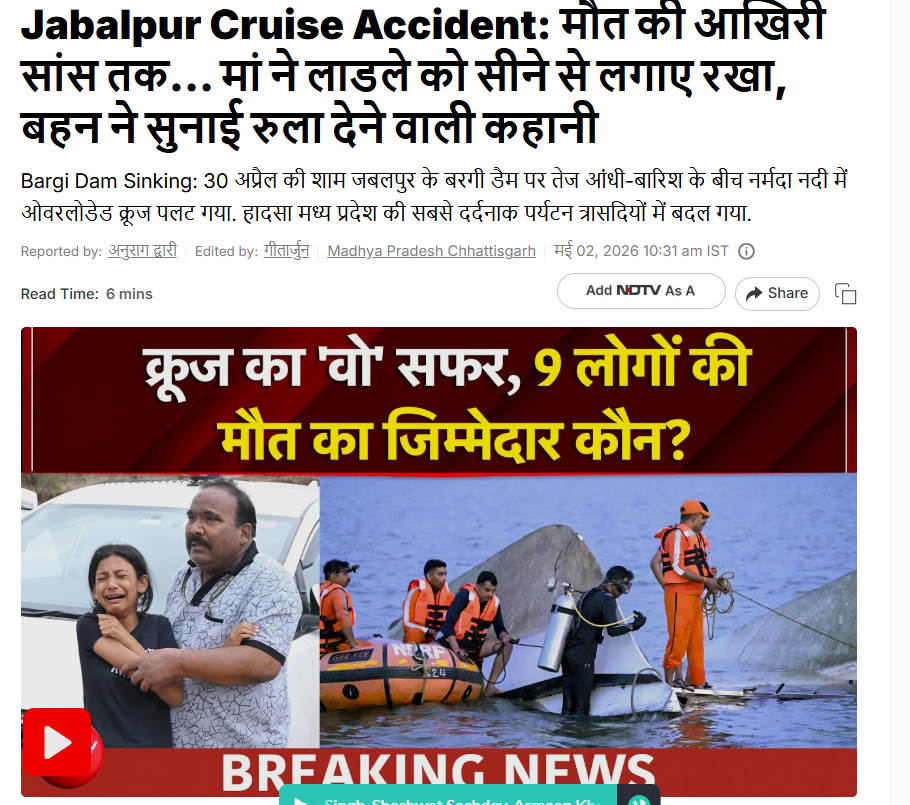
According to a report published by NDTV on May 2, 2026, the accident occurred on April 30 near Khamaria Island when an overloaded tourist cruise capsized amid strong winds, heavy rain, and rising waves. At least nine people died, while 28 others were rescued.
Conclusion
Our research confirms that the viral mother-child image being linked to the Bargi Dam tragedy is fake. The picture was created using AI and falsely circulated in connection with the real cruise accident.
.webp)
Introduction
In an era where digital connectivity drives employment, investment, and communication, the most potent weapon of cybercriminals is ‘gaining trust’ with their sophisticated tactics. Prayagraj has been a recent battleground in India's cybercrime landscape. Within a one-year crackdown, over 10,400 SIM cards, 612 mobile device IMEIs, and 59 bank accounts were blocked, exposing a sprawling international fraud network. These activities primarily targeted unsuspecting individuals through Telegram job postings, fake investment tips, and mobile app scams, highlighting the darker side of convenience in cyberspace. With India now experiencing a wave of scams enabled by technology, this crackdown establishes a precedent for concerted cyber policing and awareness among citizens.
Digital Deceit: How the Scams Operated
SIM cards that have been issued through fake or stolen identities are increasingly being used by cybercriminals in Prayagraj and elsewhere. These SIMs were the initial weapon in a highly organised fraud system, allowing criminals to conduct themselves anonymously while abusing messaging services like WhatsApp and Telegram. The gangs involved in these scams, some of which have been linked by reports to nations like Nepal, Pakistan, China, Dubai, and Myanmar, enticed their victims with rich-yielding stock market advice, remote employment offers, and weekend employment promises. After getting a target engaged, victims were slowly manipulated into sending money in the name of application fees, verification fees, or investment contributions.
API Abuse and OTP Interception
What's more alarming about these scams is their tech-savviness. From Prayagraj's cybercrime squad, several syndicates are reported to have employed API-based mobile applications to intercept OTPs (One-Time Passwords) sent to Indian numbers. Such apps, cleverly disguised as genuine services or work-from-home software, collected personal details like bank account credentials and payment card data, allowing wrongdoers to carry out unauthorised transactions in a matter of minutes. The pilfered funds were then quickly transferred through several mule accounts, rendering the money trail almost untraceable.
The Human Impact: How Citizens Were Trapped
Victims tended to come from job-hunting groups, students, or housewives seeking to earn additional income. Often, the scammers persuaded users to join Telegram channels providing free investment advice or job-referral-based schemes, creating an illusion of authenticity. Once on board, victims were sometimes even paid small commissions initially, creating a false sense of success. This tactic, known as “advance-fee confidence building,” made victims more likely to invest larger sums later, ultimately leading to complete financial loss.
Digital Arrest Threats and Bitcoin Ransom Scams
Aside from investment and job scam complaints, the cybercrime cell also saw several "digital arrest" scams, where victims were forced to send money under the threat of engaging in criminal activities. Bitcoin extortion schemes were also used in some cases, with perpetrators threatening exposure of victims' personal information or browsing history on the internet unless they were paid in cryptocurrency.
Law Enforcement’s Cyber Shield: Local Action, Global Impact
Identifying the extent of the threat, Prayagraj authorities implemented strategic measures to enable local policing. Cyber Units have been formed in each of the 43 police stations in the district, each made up of a sub-inspector, head constable, constable, lady constable, and computer operator. This decentralised model enables response in real-time, improved victim support, and quicker forensic analysis of hacked devices. The nodal officer for cyber operations said that this multi-level action is not punitive but preventive, meant to break syndicates before more harm is caused.
CyberPeace Recommendations: Prevention is Power
As cybercrime gets advanced, citizens will also have to keep pace with it. Prayagraj's experience highlights the importance of public awareness, digital literacy, and instant response processes. To assist in preventing people from falling victim to such scams, CyberPeace advises the following:
- Don't click on dubious APK links sent on WhatsApp or Telegram.
- Do not share OTPs or confidential details, even if the source appears to be familiar.
- Never download unfamiliar apps that demand access to SMS or financial information.
- Block your SIM card, payment cards, and bank accounts at once if your phone is stolen.
- Report all cyber frauds to cybercrime.gov.in or your local Cyber Cell.
- Never join investment or job groups on social sites without verification.
- Refuse video calls from unknown numbers; some scammers use this method of recording or blackmailing victims.
Conclusion
Prayagraj crackdown uncovers both the magnitude and versatility of cybercrime in the present. From trans-border cartels to Telegram job scams, the cyber front is as intricate as ever. But this incident also illustrates what can be achieved when technology, law enforcement, and public awareness come together. To stay safe from cyber threats, a cyber-conscious citizenry is as important as an effective cyber cell for India. At CyberPeace, we know that defending cyberspace begins with cyber resilience, and the story of Prayagraj should encourage communities everywhere to take active digital precautions.
References
- https://www.hindustantimes.com/cities/lucknow-news/over-10k-sims-blocked-as-job-investment-frauds-rise-in-prayagraj-101753715061234.html
- https://consumer.ftc.gov/articles/how-recognize-and-avoid-phishing-scams
- https://faq.whatsapp.com/2286952358121083
- https://education.vikaspedia.in/viewcontent/education/digital-litercy/information-security/preventing-online-scams-cert-in-advisory?lgn=en
- https://cybercrime.gov.in/Accept.aspx
- https://www.linkedin.com/pulse/perils-advance-fee-fraud-protecting-yourself-from-scammers-sharma/

Introduction
THE DIGITAL PERSONAL DATA PROTECTION BILL, 2022 Released for Public Consultation on November 18, 2022THE DIGITAL PERSONAL DATA PROTECTION BILL, 2023Tabled at LokSabha on August 03. 2023Personal data may be processed only for a lawful purpose for which an individual has given consent. Consent may be deemed in certain cases.The 2023 bill imposes reasonable obligations on data fiduciaries and data processors to safeguard digital personal data.There is a Data Protection Board under the 2022 bill to deal with the non-compliance of the Act.Under the 2023 bill, there is the Establishment of a new Data Protection Board which will ensure compliance, remedies and penalties.
Under the new bill, the Board has been entrusted with the power of a civil court, such as the power to take cognisance in response to personal data breaches, investigate complaints, imposing penalties. Additionally, the Board can issue directions to ensure compliance with the act.The 2022 Bill grants certain rights to individuals, such as the right to obtain information, seek correction and erasure, and grievance redressal.The 2023 bill also grants More Rights to Individuals and establishes a balance between user protection and growing innovations. The bill creates a transparent and accountable data governance framework by giving more rights to individuals. In the 2023 bill, there is an Incorporation of Business-friendly provisions by removing criminal penalties for non-compliance and facilitating international data transfers.
The new 2023 bill balances out fundamental privacy rights and puts reasonable limitations on those rights.Under the 2022 bill, Personal data can be processed for a lawful purpose for which an individual has given his consent. And there was a concept of deemed consent.The new data protection board will carefully examine the instance of non-compliance by imposing penalties on non-compiler.The bill does not provide any express clarity in regards to compensation to be granted to the Data Principal in case of a Data Breach.Under 2023 Deemed consent is there in its new form as ‘Legitimate Users’.The 2022 bill allowed the transfer of personal data to locations notified by the government.There is an introduction of the negative list, which restricts cross-data transfer.
