
#FactCheck - Viral video attributed to the Australian Prime Minister is AI-generated; claim of cancelling Pakistani visas is false
A video is being shared on social media, falsely attributing it to Australian Prime Minister Anthony Albanese. The video claims that following the Bondi Beach attack, he decided to cancel the visas of Pakistani citizens.
An investigation by the Cyber Peace Foundation revealed that the viral video was created using AI. In the original video, Anthony Albanese was answering questions related to the Climate Change Bill during a press conference. It is important to note that in the attack that took place last Sunday (14 December) at Bondi Beach in Sydney, New South Wales, Australia, 15 people were killed. According to Australian police, the attack targeted the Jewish community. New South Wales Police Commissioner Mal Lanyon stated that the two accused involved in the attack were father and son—one aged 50 and the other 24. Media reports identified them as Sajid and Naved Akram.
Claim:
On 14 December 2025, a user on the social media platform X shared a video claiming, “After the attack by a Pakistani Islamic terrorist, the Australian Prime Minister has decided to cancel the visas of all Pakistanis. The whole world is troubled by this community, and in India it is said that Abdul cannot buy a house in a Hindu neighbourhood.”
The link to the related post, its archived version, and screenshots can be seen below:
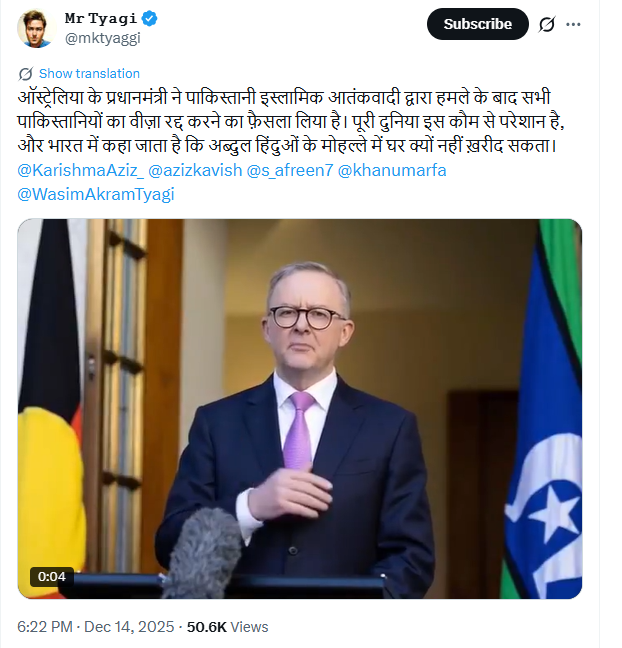
Investigation:Upon closely examining the viral video, we suspected it to be AI-generated. Subsequently, we scanned the video using the AI detection tool aurigin.ai. According to the results provided by the tool, the video was found to be AI-generated.

Related Blogs

Disclaimer:
This report is based on extensive research conducted by CyberPeace Research using publicly available information, and advanced analytical techniques. The findings, interpretations, and conclusions presented are based on the data available at the time of study and aim to provide insights into global ransomware trends.
The statistics mentioned in this report are specific to the scope of this research and may vary based on the scope and resources of other third-party studies. Additionally, all data referenced is based on claims made by threat actors and does not imply confirmation of the breach by CyberPeace. CyberPeace includes this detail solely to provide factual transparency and does not condone any unlawful activities. This information is shared only for research purposes and to spread awareness. CyberPeace encourages individuals and organizations to adopt proactive cybersecurity measures to protect against potential threats.
CyberPeace Research does not claim to have identified or attributed specific cyber incidents to any individual, organization, or nation-state beyond the scope of publicly observable activities and available information. All analyses and references are intended for informational and awareness purposes only, without any intention to defame, accuse, or harm any entity.
While every effort has been made to ensure accuracy, CyberPeace Research is not liable for any errors, omissions, subsequent interpretations and any unlawful activities of the findings by third parties. The report is intended to inform and support cybersecurity efforts globally and should be used as a guide to foster proactive measures against cyber threats.
Executive Summary:
The 2024 ransomware landscape reveals alarming global trends, with 166 Threat Actor Groups leveraging 658 servers/underground resources and mirrors to execute 5,233 claims across 153 countries. Monthly fluctuations in activity indicate strategic, cyclical targeting, with peak periods aligned with vulnerabilities in specific sectors and regions. The United States was the most targeted nation, followed by Canada, the UK, Germany, and other developed countries, with the northwestern hemisphere experiencing the highest concentration of attacks. Business Services and Healthcare bore the brunt of these operations due to their high-value data, alongside targeted industries such as Pharmaceuticals, Mechanical, Metal, Electronics, and Government-related professional firms. Retail, Financial, Technology, and Energy sectors were also significantly impacted.
This research was conducted by CyberPeace Research using a systematic modus operandi, which included advanced OSINT (Open-Source Intelligence) techniques, continuous monitoring of Ransomware Group activities, and data collection from 658 servers and mirrors globally. The team utilized data scraping, pattern analysis, and incident mapping to track trends and identify hotspots of ransomware activity. By integrating real-time data and geographic claims, the research provided a comprehensive view of sectoral and regional impacts, forming the basis for actionable insights.
The findings emphasize the urgent need for proactive Cybersecurity strategies, robust defenses, and global collaboration to counteract the evolving and persistent threats posed by ransomware.
Overview:
This report provides insights into ransomware activities monitored throughout 2024. Data was collected by observing 166 Threat Actor Groups using ransomware technologies across 658 servers/underground resources and mirrors, resulting in 5,233 claims worldwide. The analysis offers a detailed examination of global trends, targeted sectors, and geographical impact.
Top 10 Threat Actor Groups:
The ransomware group ‘ransomhub’ has emerged as the leading threat actor, responsible for 527 incidents worldwide. Following closely are ‘lockbit3’ with 522 incidents and ‘play’ with 351. Other Groups are ‘akira’, ‘hunters’, ‘medusa’, ‘blackbasta’, ‘qilin’, ‘bianlian’, ‘incransom’. These groups usually employ advanced tactics to target critical sectors, highlighting the urgent need for robust cybersecurity measures to mitigate their impact and protect organizations from such threats.

Monthly Ransomware Incidents:
In January 2024, the value began at 284, marking the lowest point on the chart. The trend rose steadily in the subsequent months, reaching its first peak at 557 in May 2024. However, after this peak, the value dropped sharply to 339 in June. A gradual recovery follows, with the value increasing to 446 by August. September sees another decline to 389, but a sharp rise occurs afterward, culminating in the year’s highest point of 645 in November. The year concludes with a slight decline, ending at 498 in December 2024 (till 28th of December).

Top 10 Targeted Countries:
- The United States consistently topped the list as the primary target probably due to its advanced economic and technological infrastructure.
- Other heavily targeted nations include Canada, UK, Germany, Italy, France, Brazil, Spain, and India.
- A total of 153 countries reported ransomware attacks, reflecting the global scale of these cyber threats

Top Affected Sectors:
- Business Services and Healthcare faced the brunt of ransomware threat due to the sensitive nature of their operations.
- Specific industries under threats:
- Pharmaceutical, Mechanical, Metal, and Electronics industries.
- Professional firms within the Government sector.
- Other sectors:
- Retail, Financial, Technology, and Energy sectors were also significant targets.

Geographical Impact:
The continuous and precise OSINT(Open Source Intelligence) work on the platform, performed as a follow-up action to data scraping, allows a complete view of the geography of cyber attacks based on their claims. The northwestern region of the world appears to be the most severely affected by Threat Actor groups. The figure below clearly illustrates the effects of this geographic representation on the map.

Ransomware Threat Trends in India:
In 2024, the research identified 98 ransomware incidents impacting various sectors in India, marking a 55% increase compared to the 63 incidents reported in 2023. This surge highlights a concerning trend, as ransomware groups continue to target India's critical sectors due to its growing digital infrastructure and economic prominence.

Top Threat Actors Group Targeted India:
Among the following threat actors ‘killsec’ is the most frequent threat. ‘lockbit3’ follows as the second most prominent threat, with significant but lower activity than killsec. Other groups, such as ‘ransomhub’, ‘darkvault’, and ‘clop’, show moderate activity levels. Entities like ‘bianlian’, ‘apt73/bashe’, and ‘raworld’ have low frequencies, indicating limited activity. Groups such as ‘aps’ and ‘akira’ have the lowest representation, indicating minimal activity. The chart highlights a clear disparity in activity levels among these threats, emphasizing the need for targeted cybersecurity strategies.

Top Impacted Sectors in India:
The pie chart illustrates the distribution of incidents across various sectors, highlighting that the industrial sector is the most frequently targeted, accounting for 75% of the total incidents. This is followed by the healthcare sector, which represents 12% of the incidents, making it the second most affected. The finance sector accounts for 10% of the incidents, reflecting a moderate level of targeting. In contrast, the government sector experiences the least impact, with only 3% of the incidents, indicating minimal targeting compared to the other sectors. This distribution underscores the critical need for enhanced cybersecurity measures, particularly in the industrial sector, while also addressing vulnerabilities in healthcare, finance, and government domains.

Month Wise Incident Trends in India:
The chart indicates a fluctuating trend with notable peaks in May and October, suggesting potential periods of heightened activity or incidents during these months. The data starts at 5 in January and drops to its lowest point, 2, in February. It then gradually increases to 6 in March and April, followed by a sharp rise to 14 in May. After peaking in May, the metric significantly declines to 4 in June but starts to rise again, reaching 7 in July and 8 in August. September sees a slight dip to 5 before the metric spikes dramatically to its highest value, 24, in October. Following this peak, the count decreases to 10 in November and then drops further to 7 in December.

CyberPeace Advisory:
- Implement Data Backup and Recovery Plans: Backups are your safety net. Regularly saving copies of your important data ensures you can bounce back quickly if ransomware strikes. Make sure these backups are stored securely—either offline or in a trusted cloud service—to avoid losing valuable information or facing extended downtime.
- Enhance Employee Awareness and Training: People often unintentionally open the door to ransomware. By training your team to spot phishing emails, social engineering tricks, and other scams, you empower them to be your first line of defense against attacks.
- Adopt Multi-Factor Authentication (MFA): Think of MFA as locking your door and adding a deadbolt. Even if attackers get hold of your password, they’ll still need that second layer of verification to break in. It’s an easy and powerful way to block unauthorized access.
- Utilize Advanced Threat Detection Tools: Smart tools can make a world of difference. AI-powered systems and behavior-based monitoring can catch ransomware activity early, giving you a chance to stop it in its tracks before it causes real damage.
- Conduct Regular Vulnerability Assessments: You can’t fix what you don’t know is broken. Regularly checking for vulnerabilities in your systems helps you identify weak spots. By addressing these issues proactively, you can stay one step ahead of attackers.
Conclusion:
The 2024 ransomware landscape reveals the critical need for proactive cybersecurity strategies. High-value sectors and technologically advanced regions remain the primary targets, emphasizing the importance of robust defenses. As we move into 2025, it is crucial to anticipate the evolution of ransomware tactics and adopt forward-looking measures to address emerging threats.
Global collaboration, continuous innovation in cybersecurity technologies, and adaptive strategies will be imperative to counteract the persistent and evolving threats posed by ransomware activities. Organizations and governments must prioritize preparedness and resilience, ensuring that lessons learned in 2024 are applied to strengthen defenses and minimize vulnerabilities in the year ahead.
Executive Summary
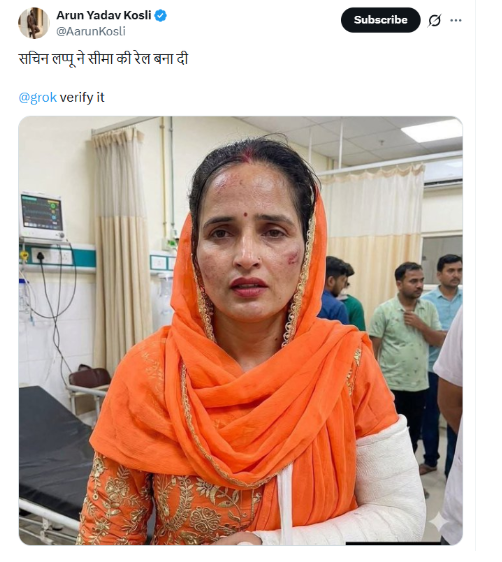
A photo allegedly showing injuries to Seema Haider has been widely circulated on social media. Users are claiming that her husband Sachin Meena assaulted her. However, a fact-check by CyberPeace Research Wing has found the claim to be false. The research reveals that the viral image is AI-generated and is being shared with a misleading narrative.
Claim
On X (formerly Twitter), a user shared the image on May 14, 2026, claiming that Sachin Meena assaulted Seema Haider.
Fact Check
A keyword-based search on Google did not return any credible media reports supporting the viral claim.
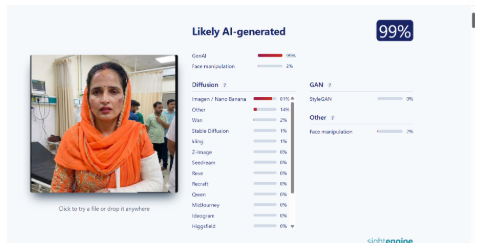
A closer visual examination of the image raised suspicions of AI generation. The image was first analysed using the AI detection tool Hive Moderation, which indicated a 99% probability that the image is AI-generated.
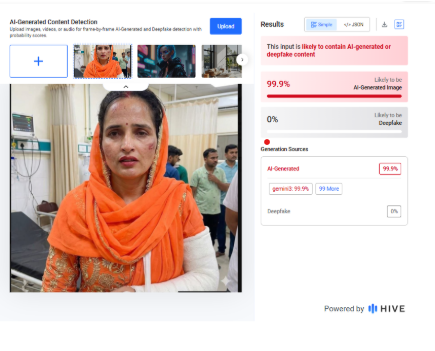
Further analysis using another AI detection tool, Sightengine, also produced similar results, confirming a 99% likelihood that the image was generated using AI tools.
Conclusion
The viral image is AI-generated and misleading. The claim that Sachin Meena assaulted Seema Haider is false and has no factual basis.

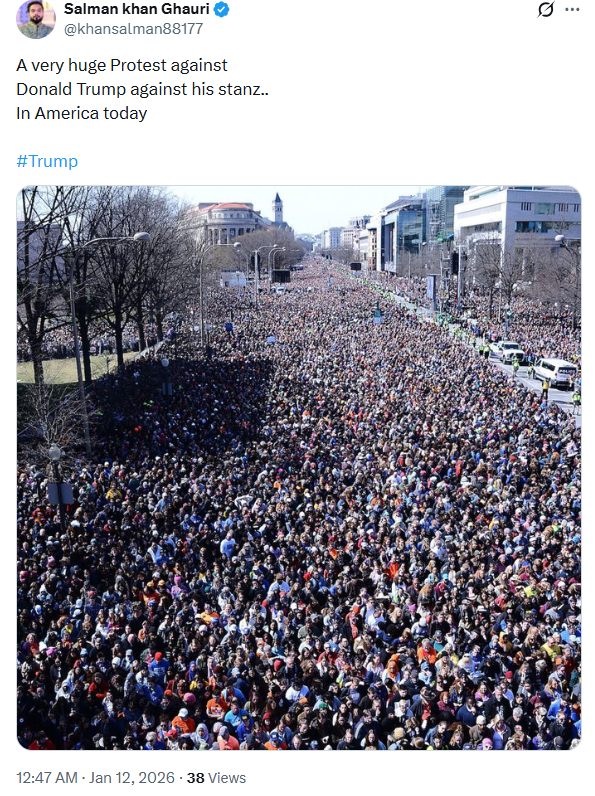
A photograph showing a massive crowd on a road is being widely shared on social media. The image is being circulated with the claim that people in the United States are staging large-scale protests against President Donald Trump.
However, CyberPeace Foundation’s research has found this claim to be misleading. Our fact-check reveals that the viral photograph is nearly eight years old and has been falsely linked to recent political developments.
Claim:
Social media users are sharing a photograph and claiming that it shows people protesting against US President Donald Trump.An X (formerly Twitter) user, Salman Khan Gauri (@khansalman88177), shared the image with the caption:“Today, a massive protest is taking place in America against Donald Trump.”
The post can be viewed here, and its archived version is available here.
FactCheck:
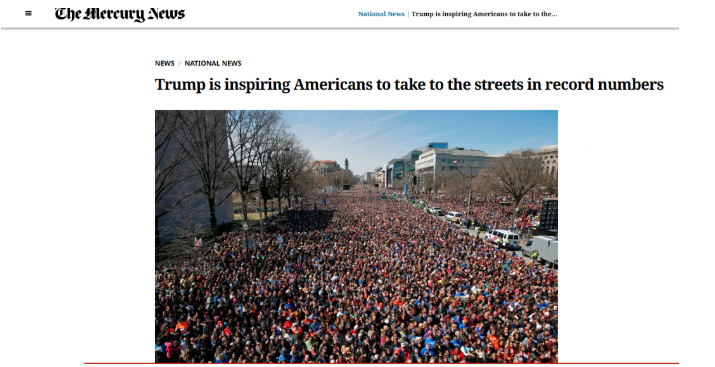
To verify the claim, we conducted a reverse image search of the viral photograph using Google. This led us to a report published by The Mercury News on April 6, 2018.
The report features the same image and states that the photograph was taken on March 24, 2018, during the ‘March for Our Lives’ rally in Washington, DC. The rally was organized to demand stricter gun control laws in the United States. The image shows a large crowd gathered on Pennsylvania Avenue in support of gun reform.
The report further notes that the Associated Press, on March 30, 2018, debunked false claims circulating online which alleged that liberal billionaire George Soros and his organizations had paid protesters $300 each to participate in the rally.
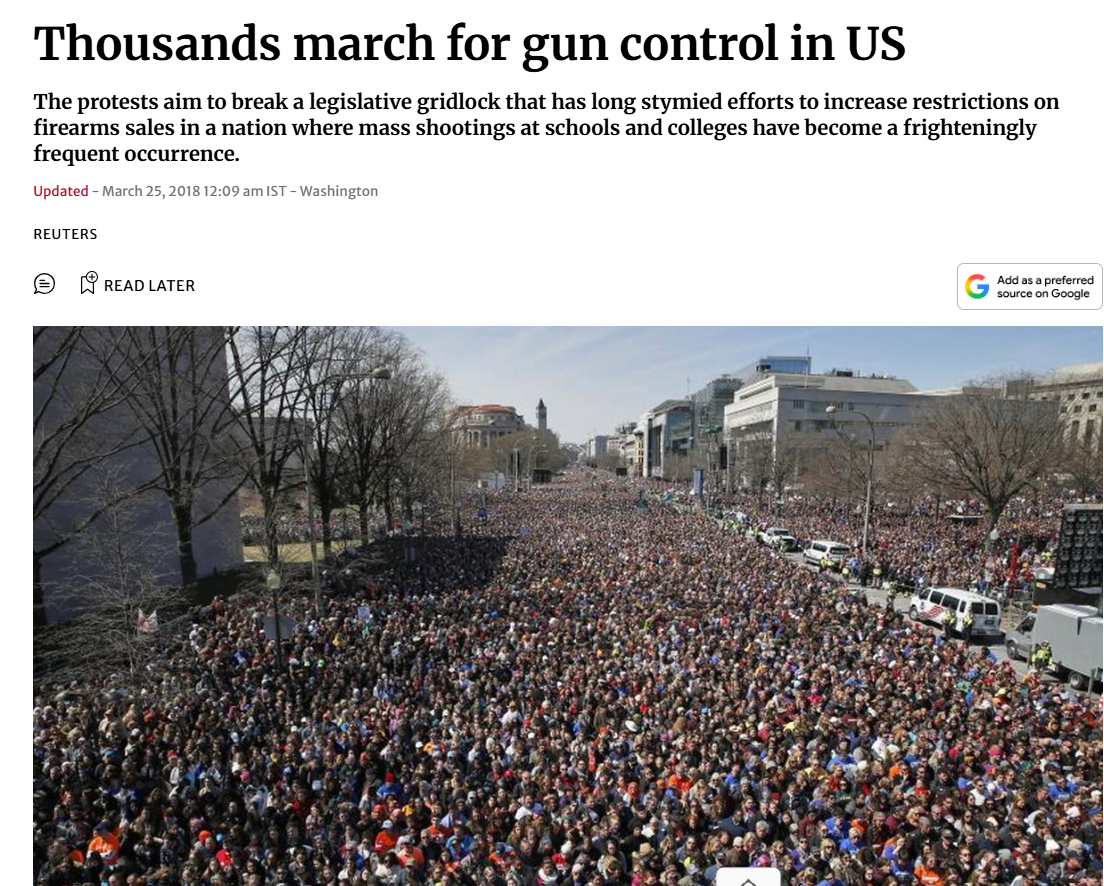
Further research led us to a report published by The Hindu on March 25, 2018, which also carries the same photograph. According to the report, thousands of Americans across the country participated in ‘March for Our Lives’ rallies following a mass shooting at a school in Florida. The protests were led by survivors and victims, demanding stronger gun laws.
The objective of these demonstrations was to break the legislative deadlock that has long hindered efforts to tighten firearm regulations in a country frequently rocked by mass shootings in schools and colleges.
Conclusion
The viral photograph is nearly eight years old and is unrelated to any recent protests against President Donald Trump.The image actually depicts a gun control protest held in 2018 and is being falsely shared with a misleading political claim.By circulating this outdated image with an incorrect context, social media users are spreading misinformation.
