#FactCheck -AI-Generated Image Falsely Claims Mohan Bhagwat Laid Foundation of ‘52nd Shakti Peeth’
Executive Summary
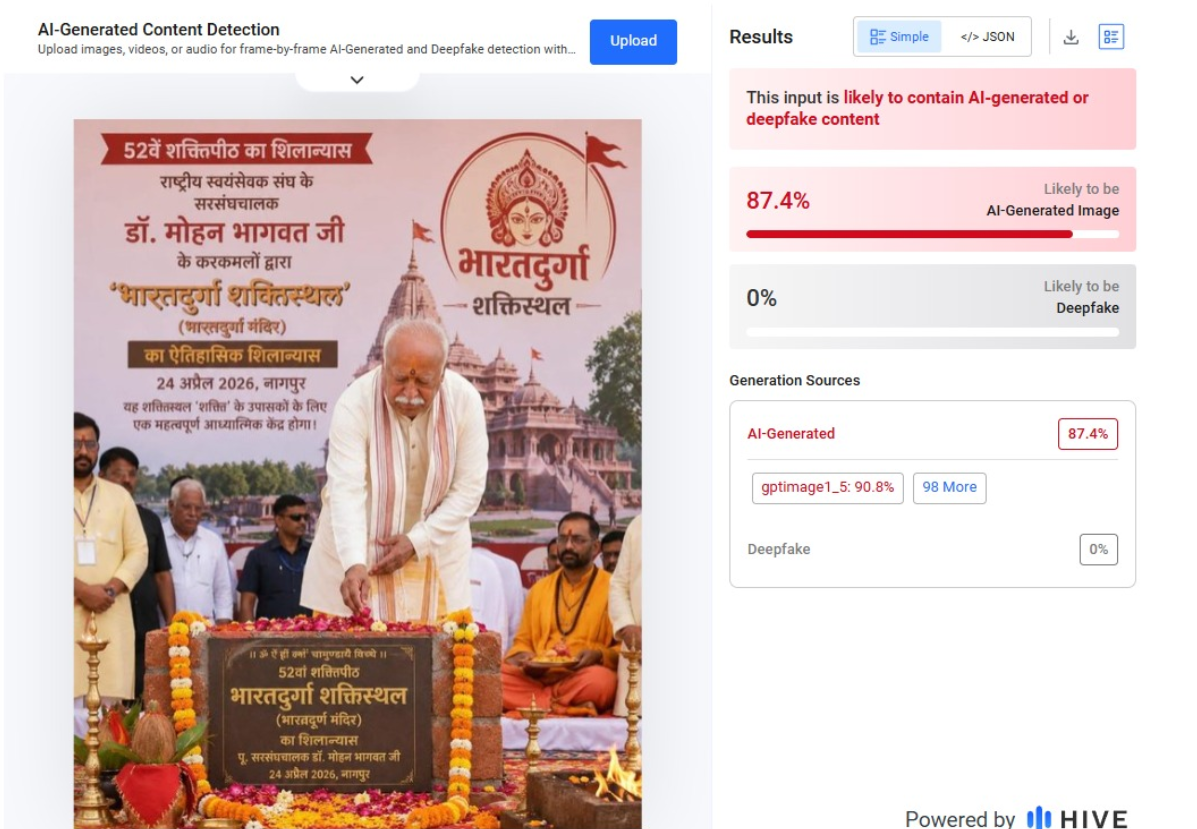
A picture of Mohan Bhagwat is going viral on social media, showing him allegedly laying the foundation stone of a so-called “52nd Shakti Peeth” named Bharatdurga. Users are claiming that the RSS chief insulted Sanatan Dharma by creating a new Shakti Peeth in Nagpur. Research by CyberPeace Research Wing found that the claim is false. The viral image is AI-generated, and Mohan Bhagwat did not inaugurate any “52nd Shakti Peeth.” In reality, he laid the foundation stone of the Bharatdurga Temple.
Claim
An X user named Sandeep Dev shared the viral image and alleged that after creating “fake Shankaracharyas,” the RSS had now introduced a new form of Goddess Durga called “Bharat Durga” and declared it the 52nd Shakti Peeth. The post further claimed that the RSS was redefining Hinduism and creating new religious sites.

Fact Check
To verify the claim, we searched relevant keywords and found reports published on April 24, 2026, by India TV and Navbharat Times. According to these reports, Mohan Bhagwat laid the foundation stone of the world’s first Bharatdurga Temple in Nagpur during a ceremony organized at the Jamtha campus of Dr. Abaji Thatte Seva and Research Institute. Several prominent saints and religious leaders attended the event. Importantly, none of the reports described the temple as the “52nd Shakti Peeth.”


Further research led us to the full video of the foundation ceremony uploaded on the YouTube channel of Devendra Fadnavis. The stage backdrop and video thumbnail clearly mention “Bharatdurga Temple Foundation Ceremony.” However, the viral image frame was not visible anywhere in the authentic footage.

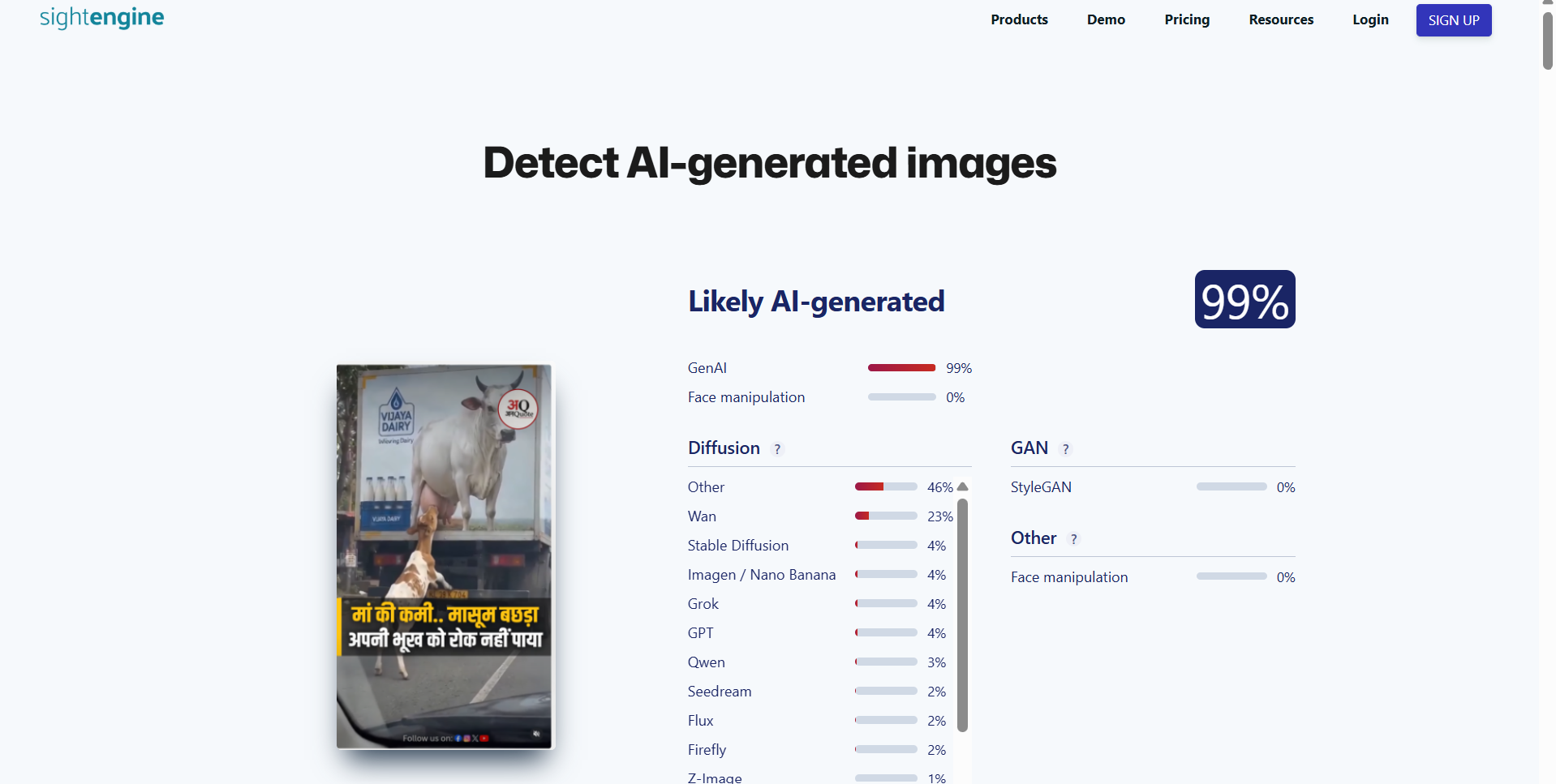
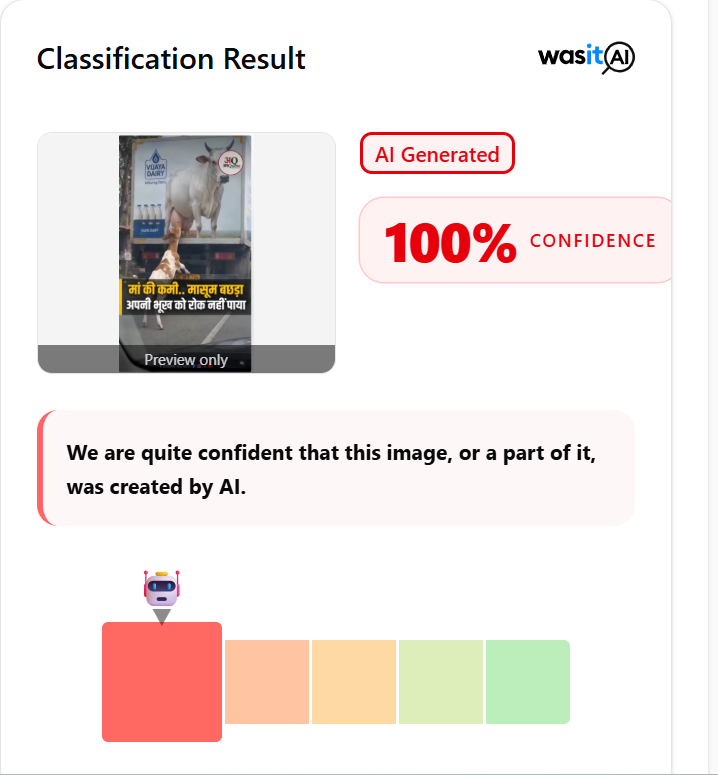
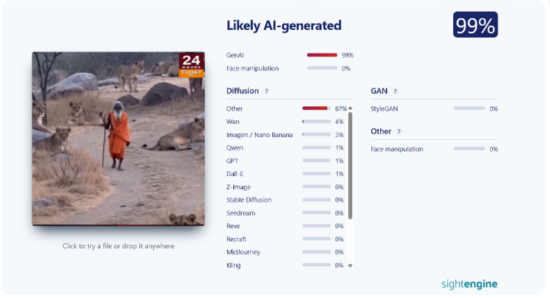
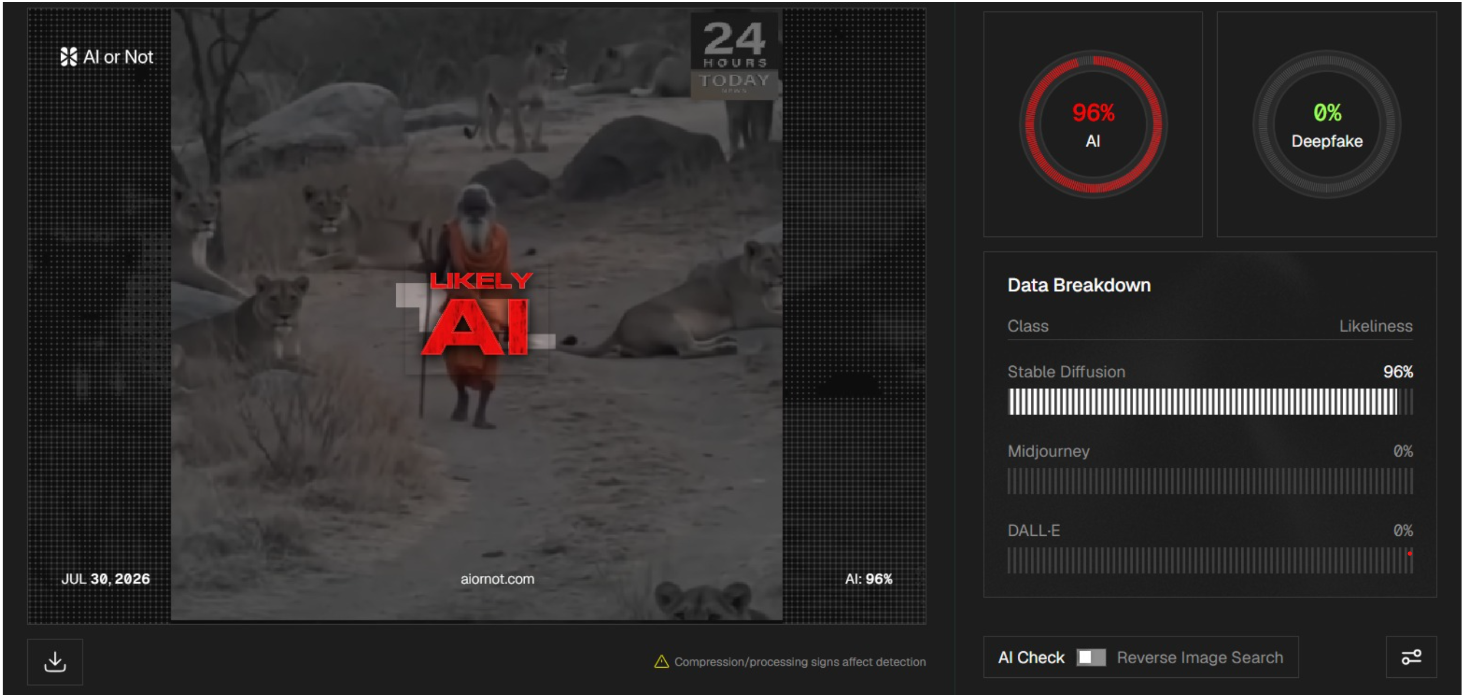
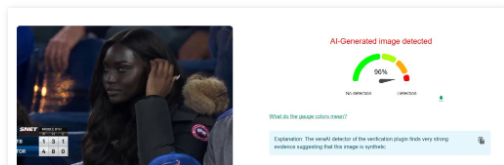
We also analyzed the viral image using AI detection tools, which indicated that the image was AI-generated.
Conclusion
Our research confirms that the claim about Mohan Bhagwat laying the foundation of a “52nd Shakti Peeth” is false. The viral image is AI-generated. In reality, he participated in the foundation ceremony of the Bharatdurga Temple in Nagpur.
Related Blogs

Introduction
According to a new McAfee survey, 88% of American customers believe that cybercriminals will utilize artificial intelligence to "create compelling online scams" over the festive period. In the meanwhile, 31% believe it will be more difficult to determine whether messages from merchants or delivery services are genuine, while 57% believe phishing emails and texts will be more credible. The study, which was conducted in September 2023 in the United States, Australia, India, the United Kingdom, France, Germany, and Japan, yielded 7,100 responses. Some people may decide to cut back on their online shopping as a result of their worries about AI; among those surveyed, 19% stated they would do so this year.
In 2024, McAfee predicts a rise in AI-driven scams on social media, with cybercriminals using advanced tools to create convincing fake content, exploiting celebrity and influencer identities. Deepfake technology may worsen cyberbullying, enabling the creation of realistic fake content. Charity fraud is expected to rise, leveraging AI to set up fake charity sites. AI's use by cybercriminals will accelerate the development of advanced malware, phishing, and voice/visual cloning scams targeting mobile devices. The 2024 Olympic Games are seen as a breeding ground for scams, with cybercriminals targeting fans for tickets, travel, and exclusive content.
AI Scams' Increase on Social Media
Cybercriminals plan to use strong artificial intelligence capabilities to control social media by 2024. These applications become networking goldmines because they make it possible to create realistic images, videos, and audio. Anticipate the exploitation of influencers and popular identities by cybercriminals.
AI-powered Deepfakes and the Rise in Cyberbullying
The negative turn that cyberbullying might take in 2024 with the use of counterfeit technology is one trend to be concerned about. This cutting-edge technique is freely accessible to youngsters, who can use it to produce eerily convincing synthetic content that compromises victims' privacy, identities, and wellness.
In addition to sharing false information, cyberbullies have the ability to alter public photographs and re-share edited, detailed versions, which exacerbates the suffering done to children and their families. The study issues a warning, stating that deepfake technology would probably cause online harassment to take a negative turn. With this sophisticated tool, young adults may now generate frighteningly accurate synthetic content in addition to using it for fun. The increasing severity of these deceptive pictures and phrases can cause serious, long-lasting harm to children and their families, impairing their identity, privacy, and overall happiness.
Evolvement of GenAI Fraud in 2023
We simply cannot get enough of these persistent frauds and fake emails. People in general are now rather adept at [recognizing] those that are used extensively. But if they become more precise, such as by utilizing AI-generated audio to seem like a loved one's distress call or information that is highly personal to the person, users should be much more cautious about them. The rise in popularity of generative AIs brings with it a new wrinkle, as hackers can utilize these systems to refine their attacks:
- Writing communications more skillfully in order to deceive consumers into sending sensitive information, clicking on a link, or uploading a file.
- Recreate emails and business websites as realistically as possible to prevent arousing concern in the minds of the perpetrators.
- People's faces and voices can be cloned, and deepfakes of sounds or images can be created that are undetectable to the target audience. a problem that has the potential to greatly influence schemes like CEO fraud.
- Because generative AIs can now hold conversations, and respond to victims efficiently.
- Conduct psychological manipulation initiatives more quickly, with less money spent, and with greater complexity and difficulty in detecting them. AI generative already in use in the market can write texts, clone voices, or generate images and program websites.
AI Hastens the Development of Malware and Scams
Even while artificial intelligence (AI) has many uses, cybercriminals are becoming more and more dangerous with it. Artificial intelligence facilitates the rapid creation of sophisticated malware, illicit web pages, and plausible phishing and smishing emails. As these risks become more accessible, mobile devices will be attacked more frequently, with a particular emphasis on audio and visual impersonation schemes.
Olympic Games: A Haven for Scammers
The 2024 Olympic Games are seen as a breeding ground for scams, with cybercriminals targeting fans for tickets, travel, and exclusive content. Cybercriminals are skilled at profiting from big occasions, and the buzz that will surround the 2024 Olympic Games around the world will make it an ideal time for scams. Con artists will take advantage of customers' excitement by focusing on followers who are ready to purchase tickets, arrange travel, obtain special content, and take part in giveaways. During this prominent event, vigilance is essential to avoid an invasion of one's personal records and financial data.
Development of McAfee’s own bot to assist users in screening potential scammers and authenticators for messages they receive
Precisely such kind of technology is under the process of development by McAfee. It's critical to emphasize that solving the issue is a continuous process. AI is being manipulated by bad actors and thus, one of the tricksters can pull off is to exploit the fact that consumers fall for various ruses as parameters to train advanced algorithms. Thus, the con artists may make use of the gadgets, test them on big user bases, and improve with time.
Conclusion
According to the McAfee report, 88% of American customers are consistently concerned about AI-driven internet frauds that target them around the holidays. Social networking poses a growing threat to users' privacy. By 2024, hackers hope to take advantage of AI skills and use deepfake technology to exacerbate harassment. By mimicking voices and faces for intricate schemes, generative AI advances complex fraud. The surge in charitable fraud affects both social and financial aspects, and the 2024 Olympic Games could serve as a haven for scammers. The creation of McAfee's screening bot highlights the ongoing struggle against developing AI threats and highlights the need for continuous modification and increased user comprehension in order to combat increasingly complex cyber deception.
References
- https://www.fonearena.com/blog/412579/deepfake-surge-ai-scams-2024.html
- https://cxotoday.com/press-release/mcafee-reveals-2024-cybersecurity-predictions-advancement-of-ai-shapes-the-future-of-online-scams/#:~:text=McAfee%20Corp.%2C%20a%20global%20leader,and%20increasingly%20sophisticated%20cyber%20scams.
- https://timesofindia.indiatimes.com/gadgets-news/deep-fakes-ai-scams-and-other-tools-cybercriminals-could-use-to-steal-your-money-and-personal-details-in-2024/articleshow/106126288.cms
- https://digiday.com/media-buying/mcafees-cto-on-ai-and-the-cat-and-mouse-game-with-holiday-scams/

Introduction
In the contemporary information environment, misinformation has emerged as a subtle yet powerful force capable of shaping public perception, influencing behavior, and undermining institutional credibility. Unlike overt falsehoods, misinformation often gains traction because it appears authentic, familiar, and authoritative. The rapid circulation of content through digital platforms has intensified this challenge, allowing altered or misleading material to reach wide audiences before verification mechanisms can respond. When misinformation mimics official communication, its impact becomes especially concerning, as citizens tend to place implicit trust in documents that carry the appearance of state authority. This growing vulnerability of public information systems was illustrated by the calendar incident in Himachal Pradesh in January 2026.
The calendar incident of Himachal Pradesh in January 2026 shows how a small lie can lead to large social and governance problems. A person whose identity is still unknown posted a modified version of the Government Calendar 2026, changing the official dates and resulting in public confusion and reputational damage to the Printing and Stationery Department. The incident may not appear very serious at first sight, but it indicates a deeper systemic issue. Misinformation is posing increasing dangers to public information ecosystems, especially when official documents are misrepresented and disseminated through digital platforms.
Misinformation as a Governance Challenge
Government calendars and official documents are necessary for public awareness and administrative coordination, and their manipulation impedes the credibility of institutions and the trustworthiness of governance. In Himachal Pradesh, modified dates might have led to confusion regarding public holidays, interference in school and administrative planning, and misinformation among the people. Such misinformation is a direct interference in the social contract that exists between the citizens and the State, where accurate information is the foundation of trust, compliance, and participation.
Impact on Citizens: Confusion, Distrust, and Digital Fatigue
For the general public, the dissemination of fake government information leads to a situation where people are confused and, at the same time, lose their trust in the government communication channels. If someone continuously gets to see the changed or misleading information misrepresented as credible, that person will find it hard to differentiate the truth from lies in the end.
This results in:
- Decision paralysis occurs when the public cannot make up their minds and either postpones or refrains from action due to the doubts they have
- Erosion of trust, not only in one department but also in the whole government communications department
- Digital fatigue occurs when people stop following public information completely, since they think that all content can be unreliable
Misinformation in a digital society is not limited to one platform only. It spreads quickly through direct messaging apps, community groups, and social networks, thus creating greater confusion among people before the official clarifications can reach the same audience.
Institutional Harm and Reputational Damage
The intentional tampering with official documents is not only a violation of ethics but also a crime and an immoral act from a governance perspective. The Printing and Stationery Department noted that such practices tarnish the public image of government bodies, which are based on accuracy, neutrality, and trust.
When untrue material gets to be known as official content:
- Departments have to communicate reactively.
- Money and manpower that could have been used for the normal administrative work are now spent on the control of the situation.
The registration of a First Information Report (FIR) in this matter is an indication of the gradual shift in the perception of law enforcement agencies that misinformation is not a playful act but rather a technology-assisted crime with serious consequences.
The Role of Verifiable Information and Trusted Sources
Such occurrences stress the need for trustworthy information as well as confirmed sources to be at the centre of the digital era. It should be the responsibility of the authorities to lead the citizens to practice and ENABLING to depend on official websites, verified social media accounts, government portals, and press releases for authentication.
Platform Responsibility and Digital Literacy
The spread of misinformation poses a significant challenge for social media platforms, which frequently amplify highly engaging content. There are some ways that the social media networks can try to limit the damage, and these are: tagging of non-verified material, limiting the sharing and working with authorities in the area of fact-checking support. However, one more thing which is crucial here is ‘public knowledge’ about digital platforms, as even unintentional dissemination of fake “official” materials can lead to legal and social repercussions. The advice of the Himachal state government is a good thing, but constantly informing the public is still a requirement.
Legal Accountability as a Deterrent
The active participation of the Cyber Crime Cells unequivocally indicates that digital misinformation, especially involving government documents, will face severe consequences. The establishment of legal responsibility acts as a preventive measure and reiterates the notion that the right to speak one's mind does not cover the right to lie or undermine public institutions. Nonetheless, to have an effective enforcement, it has to be accompanied by preventive actions such as good communication, strong governance, and public trust-building. Consistent enforcement against digital misinformation can contribute to greater accountability within society. Digital Literacy programs should be conducted periodically for netizens and institutions.
Conclusion
The incident of the creation of fake calendars in Himachal Pradesh served as a signal for the authorities to adopt accurate communication strategies. The ratification of misinformation can be achieved only if there is shared participation of governments, digital platforms, citizens and civil societies. The main goal of all this is to maintain public trust and the dissemination of information in democratic processes.
.webp)
Introduction
Against the dynamic backdrop of Mumbai, where the intersection of age-old markets and cutting-edge innovation is a daily reality, an initiative of paramount importance has begun to take shape within the hallowed walls of the Reserve Bank of India (RBI). This is not just a tweak, a nudge in policy, or a subtle refinement of protocols. What we're observing is nothing short of a paradigmatic shift, a recalibration of systemic magnitude, that aims to recalibrate the way India's financial monoliths oversee, manage, and secure their informational bedrock – their treasured IT systems.
On the 7th of November, 2023, the Reserve Bank of India, that bastion of monetary oversight and national fiscal stability, unfurled a new doctrine – the 'Master Direction on Information Technology Governance, Risk, Controls, and Assurance Practices.' A document comprehensive in its reach, it presents not merely an update but a consolidation of all previously issued guidelines, instructions, and circulars relevant to IT governance, plaited into a seamless narrative that extols virtues of structured control and unimpeachable assurance practices. Moreover, it grasps the future potential of Business Continuity and Disaster Recovery Management, testaments to RBI's forward-thinking vision.
This novel edict has been crafted with a target audience that spans the varied gamut of financial entities – from Scheduled Commercial Banks to Non-Banking Financial Companies, from Credit Information Companies to All India Financial Institutions. These are the juggernauts that keep the economic wheels of the nation churning, and RBI's precision-guided document is an unambiguous acknowledgment of the vital role IT holds in maintaining the heartbeat of these financial bodies. Here lies a riveting declaration that robust governance structures aren't merely preferred but essential to manage the landscape of IT-related risks that balloon in an era of ever-proliferating digital complexity.
Directive Structure
The directive's structure is a combination of informed precision and intuitive foresight. Its seven chapters are not simply a grouping of topics; they are the seven pillars upon which the temple of IT governance is to be erected. The introductory chapter does more than set the stage – it defines the very reality, the scope, and the applicability of the directive, binding the reader in an inextricable covenant of engagement and anticipation. It's followed by a deep dive into the cradle of IT governance in the second chapter, drawing back the curtain to reveal the nuanced roles and defiant responsibilities bestowed upon the Board of Directors, the IT Strategy Committee, the clairvoyant Senior Management, the IT Steering Committee, and the pivotal Head of IT Function.
As we move along to the third chapter, we encounter the nuts and bolts of IT Infrastructure & Services Management. This is not just a checklist; it is an orchestration of the management of IT services, third-party liaisons, the calculus of capacity management, and the nuances of project management. Here terms like change and patch management, cryptographic controls, and physical and environmental safeguards leap from the page – alive with earnest practicality, demanding not just attention but action.
Transparency deepens as we glide into the fourth chapter with its robust exploration of IT and Information Security Risk Management. Here, the demand for periodic dissection of IT-related perils is made clear, along with the edifice of an IT and Information Security Risk Management Framework, buttressed by the imperatives of Vulnerability Assessment and Penetration Testing.
The fifth chapter presents a tableau of circumspection and preparedness, as it waxes eloquent on the necessity and architecture of a well-honed Business Continuity Plan and a disaster-ready DR Policy. It is a paean to the anticipatory stance financial institutions must employ in a world fraught with uncertainty.
Continuing the narrative, the sixth chapter places the spotlight on Information Systems Audit, delineating the precise role played by the Audit Committee of the Board in ushering in accountability through an exhaustive IS Audit of the institution's virtual expanse.
And as we perch on the final chapter, we're privy to the 'repeal and other provisions' of the directive, underscoring the interplay of other applicable laws and the interpretation a reader may yield from the directive's breadth.
Conclusion
To proclaim that this directive is a mere step forward in the RBI's exhaustive and assiduous efforts to propel India's financial institutions onto the digital frontier would be a grave understatement. What we are witnessing is the inception of a more adept, more secure, and more resilient financial sector. This directive is nothing less than a beacon, shepherding in an epoch of IT governance marked by impervious governance structures, proactive risk management, and an unyielding commitment to the pursuit of excellence and continuous improvement. This is no ephemeral shift - this is, indisputably, a revolutionary stride into a future where confidence and competence stand as the watchwords in navigating the digital terra incognita.