
#FactCheck- AI-Generated Video Falsely Claims Iran Attack on Apple, Microsoft in Israel
Executive Summary:
Amid the ongoing conflict in West Asia involving the United States, Israel and Iran, a video is being widely circulated on social media with the claim that Iran attacked the headquarters of tech giants Apple and Microsoft in Israel. The clip shows a building engulfed in flames, with firefighters attempting to douse the fire. However, research by the CyberPeace found that the viral video is AI-generated and is being falsely linked to the ongoing conflict to spread misinformation.
Claim:
An Instagram user ‘bharat_updatenews’ shared the video on March 19, 2026, claiming that Iran had launched an attack on major tech company headquarters, including Apple and Microsoft, in Israel. The post suggested that the incident had raised serious security concerns and was being widely reported by international media.
Link: https://www.instagram.com/bharat_updatenews/reel/DWEUhLEAKaw

Fact Check:
To verify the claim, we extracted keyframes from the viral video and conducted a reverse search using Google Lens. During this process, we found the same video on a TikTok account named ‘dailyupdate122’, where it had been uploaded on March 15, 2026.

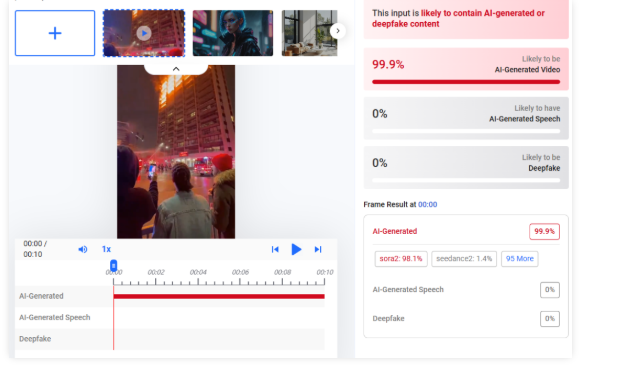
The video on this account was clearly labelled as “AI-generated media.” The account also featured several other AI-generated videos, raising doubts about the authenticity of the viral clip. Following this, we analysed the video using the AI detection tool Hive Moderation. The results indicated that the video is nearly 100 percent AI-generated. The tool further suggested with over 98 percent probability that the clip may have been created using OpenAI’s Sora or a similar AI video generation model.
Conclusion:
The viral claim that Iran attacked Apple and Microsoft headquarters in Israel is false. The video circulating online is AI-generated and has no connection to the ongoing conflict in West Asia.

Related Blogs

The digital ecosystem of India has experienced rapid growth, which has created numerous opportunities for economic development, better governance and increased social connections. The increasing use of digital technology has resulted in a higher incidence of cyber-enabled crimes, which include online fraud and cyber harassment, child exploitation and the spread of misinformation. The Government of India has established multiple initiatives to enhance a complete and unified framework that will help in combatting cybercrime more effectively. The latest updates presented to Parliament demonstrate how different institutional frameworks and legal provisions, capacity building efforts, and public awareness programs work together to handle new cyber threats.
A Coordinated Institutional Framework
The Indian system for investigating and prosecuting cybercrimes assigns responsibility to States and Union Territories, which operate their own Law Enforcement Agencies. The central government established the Indian Cyber Crime Coordination Centre (I4C) to support these operations through its Ministry of Home Affairs.
The I4C functions as a central hub that allows various stakeholders in cybercrime prevention and investigation to share intelligence and build their operational capacities. The initiative establishes a cybersecurity system that will improve its organisational structure through better central and state agency collaboration.
The National Cyber Crime Reporting Portal (NCCRP) serves as a primary project of this framework by providing online cyber incident reporting for citizens. The portal enables users to register complaints more efficiently while enhancing access to crime reporting, which particularly benefits victims of crimes against women and children. The system offers special channels which allow users to report Child Sexual Exploitative and Abuse Material (CSEAM) and rape-related materials while providing options for anonymous reporting and case tracking. After a complaint is lodged, the appropriate state authorities initiate the process to investigate the matter and proceed with legal procedures.
Capacity Building and Cyber Forensics
The response to cybercrime requires both expert investigators and advanced forensic technology systems. The Cyber Crime Prevention against Women and Children (CCPWC) Scheme, which provides financial backing and technical training to states and union territories, was instituted by the Ministry of Home Affairs to address this requirement.
The scheme has authorised the release of ₹132.93 crore for developing cyber forensic facilities and investigative technologies. The funding has supported the establishment of cyber forensic-cum-training laboratories across multiple states and union territories. The total number of operational laboratories has reached 33 at this time.
The organisation has prioritised its training initiatives together with its infrastructure development projects. More than 24,600 law enforcement personnel, prosecutors, and judicial officers have received training on cybercrime investigation, digital evidence handling, and forensic analysis. The capacity-building initiatives were designed to provide investigators and judicial authorities with essential skills needed to handle advanced cyber incidents.
International Cooperation for Child Protection
International cooperation is essential for addressing online child exploitation because these crimes utilise digital networks that connect multiple countries. The National Crime Records Bureau (NCRB) established a partnership with the National Centre for Missing and Exploited Children (NCMEC) of the United States in 2019 through a Memorandum of Understanding, which aims to enhance regional collaboration in this field.
The partnership enables the sharing of tipline reports about online child exploitation, which Indian authorities use for their investigative work. Under the Information Technology Act provisions, NCRB has received official powers to issue removal notices to intermediaries because they oversee child sexual abuse material and other dangerous content.
Promoting Online Safety Awareness
Cybercrime prevention requires two essential elements, which are public knowledge and digital expertise. The National Commission for Protection of Child Rights (NCPCR) has developed several resources to educate children, parents, teachers, and school administrators about online safety. The guidelines include Being Safe Online, together with school safety manuals that protect against cyberbullying and the 2024 updates, which provide new recommendations for cyberbullying prevention. The commission has established multiple conferences and training sessions throughout various states to educate both educators and school administrators about child protection regulations and school security measures, and cyber protection standards.
The digital responsibility programs educate communities about proper online conduct and teach them how to recognise and handle cybersecurity threats.
Legal Framework for Digital Safety
The Information Technology Act of 2000, together with the Information Technology Intermediary Guidelines and Digital Media Ethics Code Rules of 2021, (Updated as of 2026) serve as the core legal foundation through which India combats cybercrime. The laws establish penalties for online distribution of obscene and sexually explicit material while requiring digital intermediaries to block access to illegal content.
The Bharatiya Nyaya Sanhita 2023 contains additional legal provisions that deal with two types of offences that involve disseminating obscene material and spreading dangerous misinformation.
The regulatory framework requires intermediaries to eliminate illegal content within specified timeframes, while they must prevent their platforms from being used to conduct dangerous or unlawful activities.
Conclusion
India establishes its cybercrime response strategy through a multi-layered method that uses different institutional systems, technological systems, legal systems, and public education programs. Cyber threats develop through technological progress, yet authorities must establish effective cybersecurity, which depends on their ability to investigate, their systems for reporting incidents, and their dedication to maintaining proper online conduct.
India needs continuous cooperation among government bodies, police forces, technology companies, and community organisations to maintain secure and strong digital networks that provide equal access to all citizens.
References
- https://www.pib.gov.in/PressReleasePage.aspx?PRID=2238260®=3&lang=2
- https://www.policyedge.in/p/rajya-sabha-strengthening-indias-coordinated-response-to-cyber-crimes
.webp)
Introduction
In today's digital economy, data is not only a business asset but also the fuel for innovation, decision-making, and consumer trust. However, the digitisation of services has made personal or sensitive data a top target for cybercriminals. The stakes are high: a data breach can cost millions of fines, cause damage to reputation and devastate the confidence of consumers. Therefore, regulatory compliance and data protection have become a strategic imperative.
From the General Data Protection Regulation (GDPR) in the EU to the Digital Personal Data Protection (DPDP) Act of India, various sector-specific regulations like HIPAA for healthcare in the US, companies are now subject to a web of data protection and compliance laws. The challenge is to balance compliance efforts with strong security, a balance that demands both policy restraint and technical resilience. This blog examines pivotal pillars, shifting trends and actionable best practices for dominating data protection and compliance in 2025 and beyond.
Why Data Protection and Compliance Matter More Than Ever
Data protection isn't just about keeping fines at bay, it's about preserving the relationship with customers, partners and regulators. A 2024 IBM report says the average data-breach cost has now exceeded USD 4.5 million, with regulatory fines constituting a large portion of the cost. In addition to economics, breaches tend to result in intellectual property loss, customer loss and long-term brand attenuation. Compliance ensures organisations remain within certain legislative necessities for collecting, holding, transferring and setting of personal and sensitive information. Failure to conformity can lead to serious penalties: under GDPR, fines could be up to 4% of the company's annual turnover or €20 million, whichever is higher. In regulated sectors like banking and healthcare, compliance breaches can also lead to the suspension of licenses.
Important Regulatory Frameworks Informing 2025
- GDPR and Its Global Ripple Effect
GDPR was enacted in 2018 and continues to have a ripple effect on privacy legislation worldwide. Its tenets of lawfulness, transparency, data minimisation and purpose limitation have been replicated in many jurisdictions such as Brazil's LGPD and South Korea's PIPA.
- India's DPDP Act
The DPDP Act, 2023, gives high importance to consent-based processing of data, transparent notice rules and fiduciary responsibilities for data. With a penalty for default of up to INR 250 crore, it's amongst the most impactful laws for digital personal data protection.
- Sectoral Regulations
- HIPAA for healthcare information in the US.
- PCI DSS for payment card security.
- DORA (Digital Operational Resilience Act) in the EU for financial organisations.
- These industry-specific models generate overlapping compliance responsibilities, making cross-enterprise compliance programs vital.
Key Pillars of a Sound Data Protection & Compliance Program
- Data Governance and Classification
Having insight into what data you have to store, where it is stored and who can have access to it is the keystone of compliance. Organisations need to have data classification policies in place to group information based on sensitivity and impose more rigorous controls on sensitive data.
- Security Controls and Privacy by Design
Strong technical defences, encryption, multi-factor authentication, and intrusion detection are the initial defences. Privacy by design integrated in product development guarantees compliance is thought through from the initial stage, not added on afterwards.
- Consent and Transparency
Contemporary data legislation highlights informed consent. This entails simple, non-technical privacy notices, detailed opt-in choices, and straightforward withdrawal options. Transparency produces trust and lessens legal danger.
- Incident Response and Breach Notification
Most laws demand timely breach notifications, and GDPR insists on reporting within 72 hours. Having a documented incident response plan maintains legal deadlines and reduces harm.
- Employee Training and Awareness
Human mistake is the top source of data breaches. Ongoing training in prevention of phishing, password management, basic cyber hygiene and compliance requirements is crucial.
Upcoming Trends in 2025
- AI-Powered Compliance Monitoring
Organisations are embracing AI-powered solutions to systematically monitor data flows, identify policy breaches and auto-create compliance reports. The solutions assist in closing the loop between IT security teams and compliance officers.
- Cross-Border Data Transfer Mechanisms
With increasingly severe regulations, companies are spending more on secure cross-border data transfer frameworks like Standard Contractual Clauses (SCCs) and Binding Corporate Rules (BCRs).
- Privacy-Enhancing Technologies (PETs)
Methods such as homomorphic encryption and differential privacy are picking up steam, enabling organisations to sift through datasets without revealing sensitive personal data.
- ESG and Data Ethics
Data handling is increasingly becoming a part of Environmental, Social and Governance (ESG) reporting. Ethical utilisation of customer data, not just compliance, has become a reputational differentiator.
Challenges in Implementation
Despite having transparent frameworks, data protection plans encounter challenges like jurisdictions having competing needs, and global compliance is becoming expensive. The emerging technologies, such as generative AI, often bring privacy threats that haven’t been fully covered by legislation. Small and micro enterprises have neither the budget nor the skills to implement enterprise-level compliance programs. Qualifying these challenges often needs a risk-based strategy, allocations of resources to top areas of impact and automating the compliance chores wherever possible.
Best Practices for 2025 and Beyond
In 2025, regulatory compliance and data protection are no longer a precaution or a response to a breach but are strategic drivers of resilience and trust. As regulatory analysis rises, cyber threats evolve, and consumer expectations grow, administrations need to integrate compliance into the very fabric of their actions. By bringing governance and technology together, organisations can break free from a "checklist" mentality and instead adopt a proactive and risk-sensitive approach. Eventually, data protection is not just about not getting in trouble; it's about developing a kind that succeeds in the digital era.
References
- GDPR – Official EU Regulation Page: https://gdpr.eu
- India’s DPDP Act Overview – MeitY: https://www.meity.gov.in/data-protection-framework
- HIPAA – US Department of Health & Human Services: https://www.hhs.gov/hipaa
- PCI DSS Standards: https://www.pcisecuritystandards.org
- IBM Cost of a Data Breach Report 2024: https://www.ibm.com/reports/data-breach
- OECD – Privacy Guidelines: https://www.oecd.org/sti/privacy-guidelines

Executive Summary:
A video is circulating on social media claiming to be footage of the aftermath of Iran's missile strikes on Israel. The video shows destruction, damaged infrastructure, and panic among civilian casualties. After our own digital verification, visual inspection, and frame-by-frame inspection, we have determined that the video is fake. The video is just AI-generated clips and not related to any incident.

Claim:
The viral video claims that a recent military strike by Iran resulted in the destruction of parts of Israel, following an initial missile attack launched by Iran. The footage appears current and depicts significant destruction of buildings and widespread chaos in the streets.

FACT CHECK:
We conducted our research on the viral video to determine if it was AI-generated. During the research we broke the video into individual still frames, and upon closely examining the frames, several of the visuals he showed us had odd-shaped visual features, abnormal body proportions, and flickering movements that don't occur in real footage. We took several still frames and checked them in image search sites to see if they had appeared before. The search results revealed that several clips in the video had appeared previously, in separate and unrelated circumstances, which indicates that they are neither recent nor original.

While examining the Instagram profile, we noticed that the account frequently shares visually dramatic AI content that appears digitally created. Many earlier posts from the same page include scenes that are unrealistic, such as wrecked aircraft in desolate areas or buildings collapsing in unnatural ways. In the current video, for instance, the fighter jets shown have multiple wings, which is not technically or aerodynamically possible in real life. The profile’s bio, which reads "Resistance of Artificial Intelligence," suggests that the page intentionally focuses on sharing AI-generated or fictional content.

We also ran the viral post through Tenorshare.AI for Deep-Fake detection, and the result came 94% AI. All findings resulting from our research established that the video is synthetic and unrelated to any event occurring in Israel, and therefore debunked a false narrative propagated on social media.

Conclusion:
Our research found that the video is fake and contains AI-generated images and is not related to any real missile strike or destruction occurring in Israel. The source is specific to fuel the panic and misinformation in a context of already-heightened geopolitical tension. We call on viewers not to share this unverified information and to rely on trusted sources. When there are sensitive international developments, the dissemination of fake imagery can promote fear, confusion, and misinformation on a global scale.
- Claim: Real Footage of Iran’s Missile Strikes on Israel
- Claimed On: Social Media
- Fact Check: False and Misleading
