
#FactCheck- AI-Generated Video Falsely Claims Iran Shot Down US F-35 Fighter Jet
Executive Summary:
Amid the ongoing conflict involving the US-Israel and Iran, Tehran has claimed that it shot down a US F-35 fighter jet. In this context, a video is going viral on social media showing a crashed American fighter aircraft on the ground. It is being claimed that the footage shows Iran downing a US F-35 jet. However, an research by the CyberPeace found that the viral video is a deepfake and not real. The clip appears to have been created using Google AI tools.
Claim:
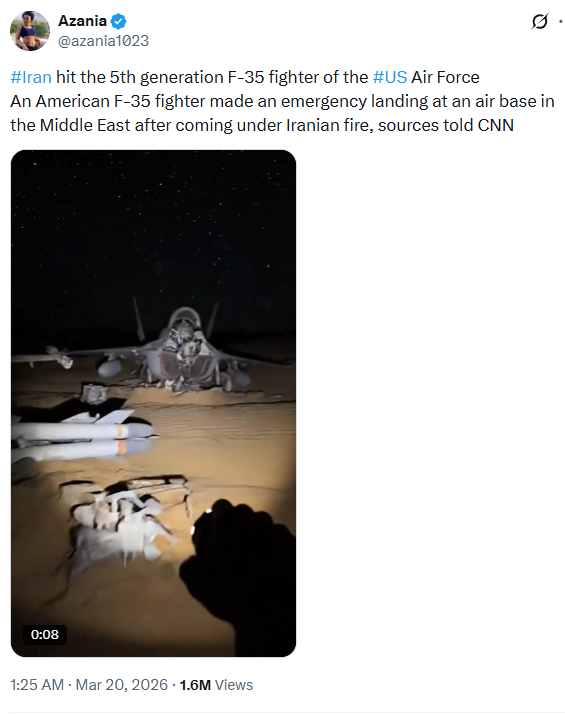
A social media user “Azania” shared the viral video on March 20, 2026, with the caption,“#Iran hit the 5th generation F-35 fighter of the #US Air Force… An American F-35 fighter made an emergency landing at an air base in the Middle East after coming under Iranian fire, sources told CNN.”
Fact Check:
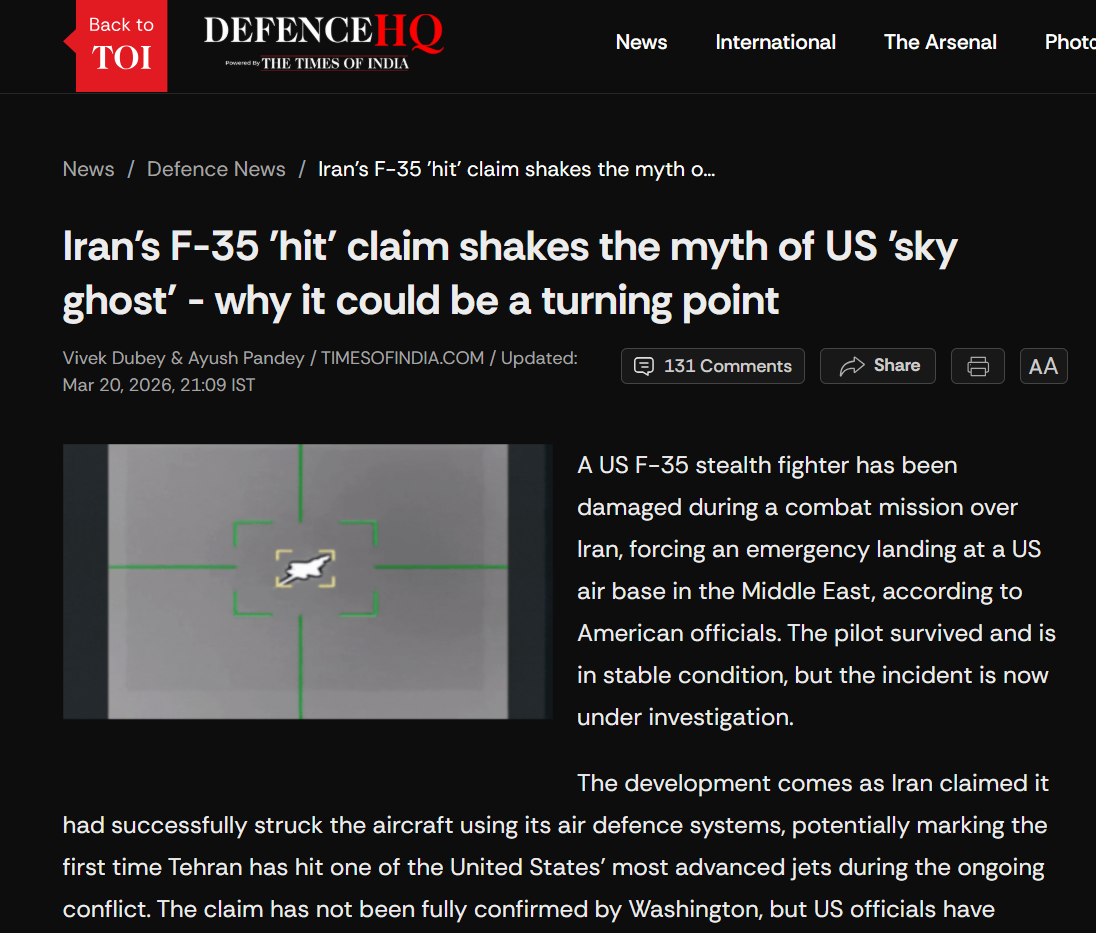
We began our research with a news search and found multiple reports stating that a US F-35 fighter jet was damaged during a combat mission over Iran. According to reports, Iran’s Islamic Revolutionary Guard Corps (IRGC) claimed to have damaged a US F-35 jet and also released a video. As per a CNN report, US officials confirmed that an American F-35 was damaged during a mission over Iran, forcing it to make an emergency landing at a US airbase in the Middle East. The pilot was safe and in stable condition, and the incident is currently under research .
A spokesperson for the US Central Command, Captain Tim Hawkins, also acknowledged that an F-35 made an emergency landing during the mission. However, the US has not officially confirmed that the damage was caused by an Iranian attack.Reports by Fox News and The Times of India also mention the emergency landing of the aircraft.
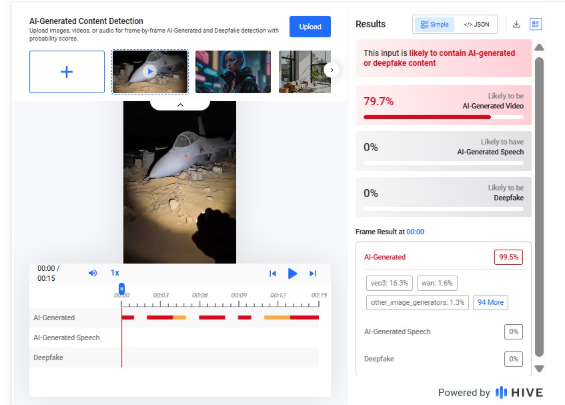
Upon closely examining the viral video, we noticed several inconsistencies indicating possible AI manipulation. We then analyzed the clip using Hive Moderation, which indicated nearly a 79 percent probability that the video is AI-generated. The analysis also suggests that it was likely created using Google’s AI video generation tools (Veo).
Conclusion:
The viral video claiming to show Iran shooting down a US F-35 fighter jet is AI-generated and not real. While Iran has claimed to have targeted a US F-35, and the US has confirmed an emergency landing during a mission, there is no official confirmation that the aircraft was shot down by Iran.

Related Blogs

Executive Summary
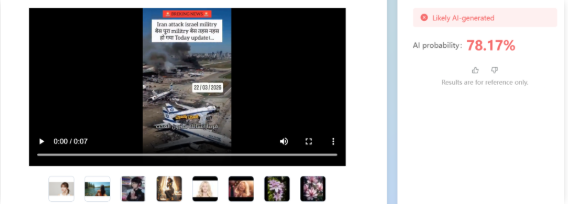
Amid the ongoing conflict involving the US-Israel and Iran in West Asia, a video showing destroyed aircraft at an airport is going viral on social media. The clip is being shared with the claim that it shows an Israeli military base destroyed in an Iranian attack. However, an research by the CyberPeacen found that the viral video is not real but AI-generated.
Claim:
An Instagram user “sakirali8064” shared the video on March 22, 2026, claiming that Iran had demonstrated its military strength by deploying advanced missiles capable of long-range precision strikes.The video also carries a “Breaking News” overlay stating:“Iran attack Israel military base… the entire base destroyed.
Post link and archive link:

Fact Check:
To verify the claim, we extracted keyframes from the viral clip and conducted a reverse image search using Google Lens. We found a longer version of the same video posted on March 5, 2026, by a Facebook user named “With INC,” where it was also falsely linked to an Iranian attack on Israel’s Ben Gurion Airport.

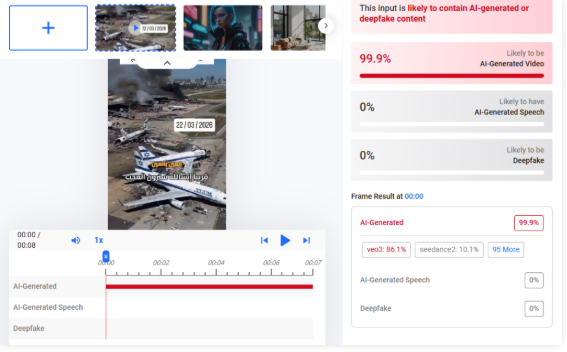
Upon closely examining the video, we observed inconsistencies such as fire changing positions unnaturally, which raised suspicion of AI manipulation. We then analyzed the video using Hive Moderation, which indicated a probability of over 99% that the content is AI-generated.
Additionally, analysis using Tencent’s “Zhuque AI” detection tool suggested more than 78% likelihood of the video being AI-generated.
Conclusion:
The viral video claiming that an Iranian attack destroyed an Israeli military base is AI-generated and misleading. While Iran has claimed to have targeted Israel’s Ben Gurion International Airport using drones, the viral footage does not depict a real event.
Introduction
For years, when Meta's automated systems flagged suspected child sexual abuse material on Facebook or Instagram involving an Indian child, that information did not go straight to an Indian police station. It went first to a private, US based nonprofit, the National Center for Missing & Exploited Children (NCMEC), which would then decide how and when to route the relevant details back to law enforcement in the country where the crime actually happened. That indirect chain has now been shortened. In mid September 2026, senior Indian government officials confirmed that Meta had agreed, for the first time among major social media platforms operating in India, to report child sexual abuse cases and details of repeat offenders directly to the cybercrime division of the Indian Cyber Crime Coordination Centre, commonly known as I4C, under the Ministry of Home Affairs. Google followed within days with a similar commitment of its own.
How the reporting actually worked before this
Under US federal law, Meta and every other American headquartered platform is legally obligated to report CSAM instances to NCMEC, facing criminal liability, financial penalties, and the loss of legal safe harbour protections if they fail to do so. NCMEC would then coordinate with law enforcement agencies in the relevant country. In India's case, that meant a 2019 memorandum of understanding between NCMEC and the National Crime Records Bureau, through which more than 69 lakh CyberTipline reports had reportedly been shared with Indian states and union territories by early 2024. The structural problem was not the volume of reports; it was the layer of institutional distance built into every single one of them. As one government official put it plainly, an Indian law enforcement agency was, in effect, made to wait on a private American nonprofit for information about a crime committed on Indian soil against an Indian child, and NCMEC itself has little to no operational presence in India to manage that handoff quickly.
That distance had real, documented costs. Officials directly linked slow data sharing to delayed CSAM investigations, describing situations where exploitation was actively ongoing while Indian agencies remained one step removed from the account level details, IP addresses, and identifying information that could have accelerated a rescue or an arrest.
What actually changed, and why now
This shift did not emerge from a routine policy review. It followed sustained government pressure through 2026, including a formal inquiry launched by the National Commission for Protection of Child Rights into Meta India's child safety policies, multiple summons issued to Meta India head, and a July 2026 controversy in which Meta was found to have run paid Instagram advertisements allegedly directing users toward Telegram channels distributing CSAM.
Union Minister Ashwini Vaishnaw directly raised the direct reporting demand with Meta's Chief of Global Affairs, Joel Kaplan, during a visit to New Delhi in August 2026, and separately questioned whether Meta could still claim to be a "simple intermediary" given that it profits from advertisement placement and exercises systems level control over ad distribution. Under the new arrangement, account level details, including names, associated email addresses, and IP addresses, will now flow directly to I4C, which officials say should meaningfully compress the time between detection and actionable law enforcement response.
Why this is a welcome step, but not a solved problem
There is genuine reason to treat this as meaningful progress. For years, reporting routed through NCMEC meant Indian agencies were effectively once removed from data concerning crimes committed on Indian soil, against Indian children. Direct reporting to I4C shortens that distance and gives investigators quicker access to information that matters most in time sensitive cases, where every day of delay can mean continued access, continued distribution, or a victim who remains unidentified.
That said, this should not be described as a finished problem, and its real value will depend on at least three things.
The first is the depth of data actually shared. Account level details, a name, an email address, an IP address, are a starting point for an investigation, not an end point. Whether the new arrangement includes the kind of contextual detail investigators actually need to build a prosecutable case, rather than simply a faster version of the same limited data packet previously routed through NCMEC, remains to be seen in practice rather than in the announcement itself.
The second is institutional capacity on the receiving end. I4C and state cyber cells will now be positioned to receive a higher volume of reports arriving faster than before, but a faster pipeline only produces better outcomes if the infrastructure receiving it can actually convert that inflow into timely, actionable results on the ground. India's cyber cells have historically been understaffed and unevenly resourced across states, with some districts operating with only a handful of trained personnel handling cybercrime alongside a broad range of other digital offences. A genuinely improved reporting channel could, in that context, simply shift the bottleneck downstream from Washington to a district cyber cell rather than eliminate it, unless the surge in report volume is matched by a corresponding investment in trained staff, forensic capacity, and case management systems capable of prioritising the most time sensitive reports first.
The third is consistency across the industry. Meta and Google have now committed to this model, but whether it extends reliably across every major platform operating in India, rather than remaining an arrangement secured through targeted pressure on one or two companies at a time, will determine whether this becomes a systemic fix or a set of isolated exceptions.
The quieter tension nobody has fully resolved
There is also a more technical reality worth naming honestly. As platforms adopt end to end encryption more broadly, extending it across messaging services and, in some cases, considering it for other content types, the pool of CSAM content that can actually be automatically detected narrows, even as the reporting pipeline for whatever is detected improves. WhatsApp itself has argued in Indian courts, including in its ongoing challenge to the IT Rules' traceability requirements, that end to end encryption and message traceability are close to mutually exclusive, a position echoed by cryptography experts including Signal's Moxie Marlinspike, who has stated plainly that identifying a message's originator at the very least undermines, and likely breaks, the purpose of end to end encryption altogether. Faster reporting channels do not, by themselves, compensate for reduced visibility into content that a platform's own encryption prevents it from scanning in the first place. That tension, between strengthening user privacy through encryption and strengthening child safety through detection, sits underneath this entire announcement and deserves sustained attention from technologists, platforms, and child safety practitioners alike, rather than being treated as resolved simply because reporting speed has improved.
India's National Human Rights Commission has already flagged this directly in its own advisory, recommending that platforms using end to end encryption be required to devise additional protocols or technology specifically to monitor CSAM circulation, an unresolved and technically difficult ask that sits alongside, rather than instead of, the reporting improvements announced this month.
What this actually represents
The most accurate way to characterise this development is as a meaningful first step in platform accountability toward children in India, not a finish line. Meta agreeing to report directly, rather than through a private American intermediary, closes a real structural gap that officials say genuinely delayed investigations. But the task now shifts to India itself: building the institutional capacity at I4C and in state cyber cells to make full use of what is finally being offered, extending the same commitment across the rest of the industry rather than platform by platform, and confronting the encryption question honestly rather than treating faster reporting as a substitute for solving it.
A judicial note worth remembering
It is worth noting that Indian courts pushed for this same sensitivity well before it became routine practice. The Supreme Court, in Just Rights for Children Alliance v. S. Harish, 2024, directed that the term "child pornography" be replaced with "child sexual abuse and exploitation material" across legal and public usage, holding that the word "pornography" wrongly implies consent and normalises what is, in fact, a recorded act of abuse. That judicial insistence on precise language is a useful reminder that reporting frameworks like this one will ultimately be judged not just on speed, but on whether they treat the material, and the children in it, with the gravity courts have already demanded.
References
- https://www.business-standard.com/industry/news/meta-agrees-to-share-csam-details-with-indian-law-enforcement-agencies-125091500052_1.html
- https://www.business-standard.com/technology/tech-news/google-india-to-share-csam-case-details-with-govt-cybercrime-division-126092101062_1.html
- https://www.storyboard18.com/advertising/ncpcr-summons-meta-india-md-again-over-child-abuse-ads-ws-l-110781.htm
- https://www.superprep.io/current-affairs/meta-report-csam-directly-to-indias-cybercrime-portal
- https://theprint.in/india/specialised-central-police-unit-use-of-technology-to-proactively-detect-csam-nhrc-advisory/1822223/
- https://www.livelaw.in/news-updates/whatsapp-delhi-high-court-traceability-end-to-end-encryption-privacy-risk-174743
- https://www.forbesindia.com/article/take-one-big-story-of-the-day/traceability-and-endtoend-encryption-cannot-coexist-on-digital-messaging-platforms-experts/66969/1

Executive Summary
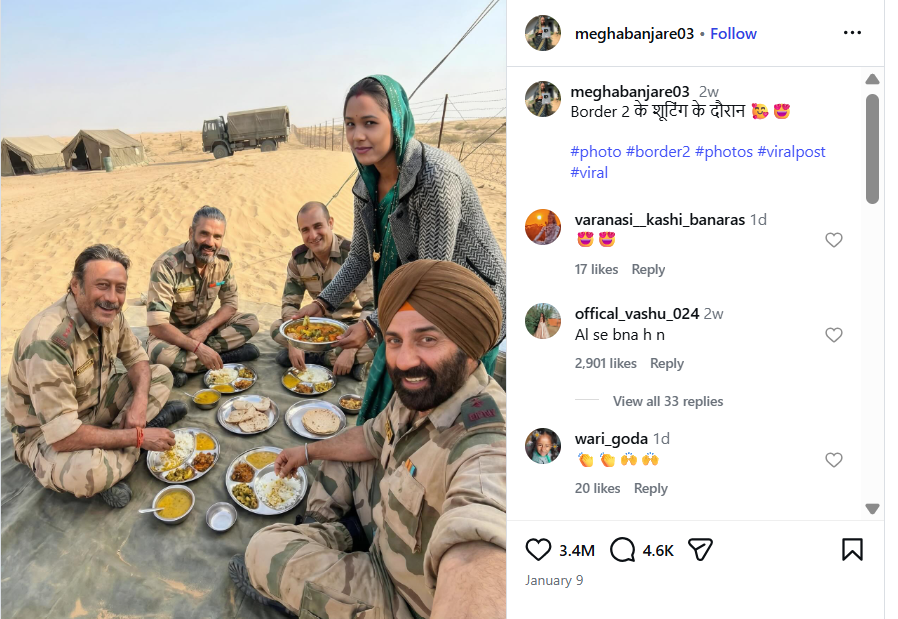
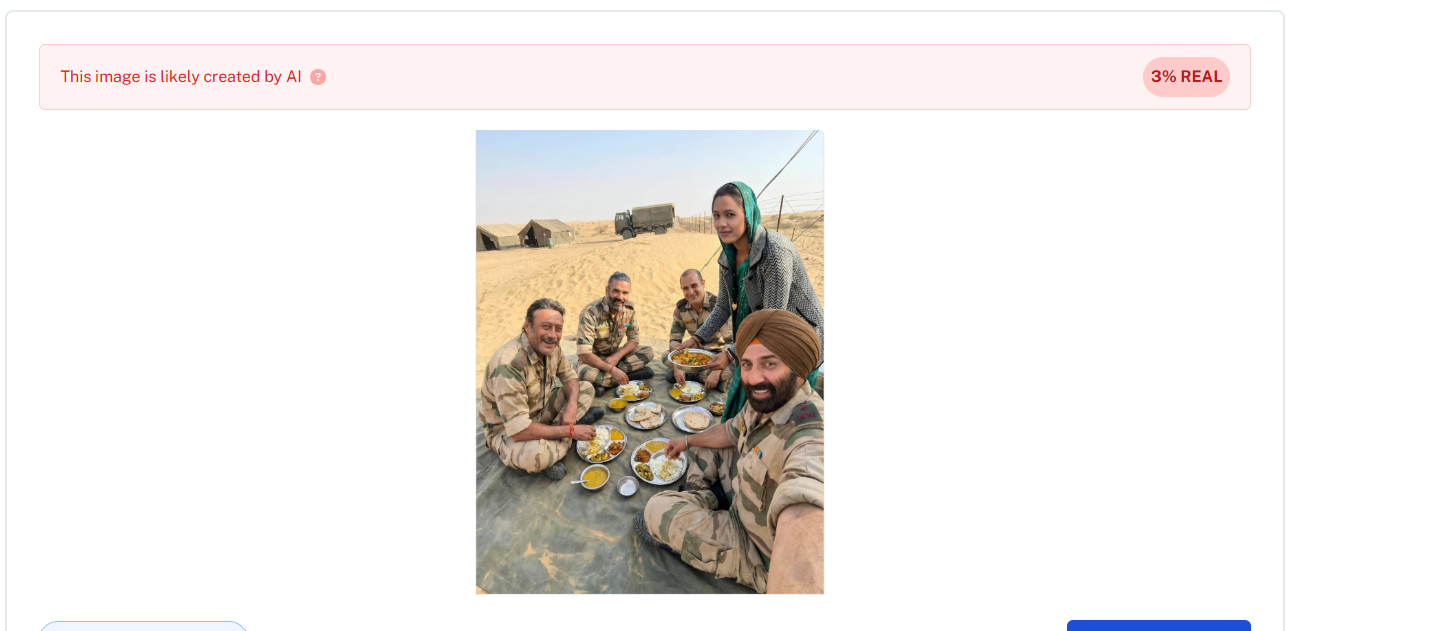
Border 2 is set to hit theatres today, January 23. Meanwhile, a photograph is going viral on social media showing actors Sunny Deol, Suniel Shetty, Akshaye Khanna and Jackie Shroff sitting together and having a meal, while a woman is seen serving food to them. Social media users are sharing this image claiming that it was taken during the shooting of Border 2. It is being alleged that the photograph shows a moment from the film’s set, where the actors were having food during a break in shooting. However, Cyber Peace research has found the viral claim to be false. Our investigation revealed that users are sharing an AI-generated image with a misleading claim.
Claim
On Instagram, a user shared the viral image on January 9, 2026, with the caption: “During the shooting of Border 2.” The link to the post, its archive link and screenshots can be seen below.
Fact Check:
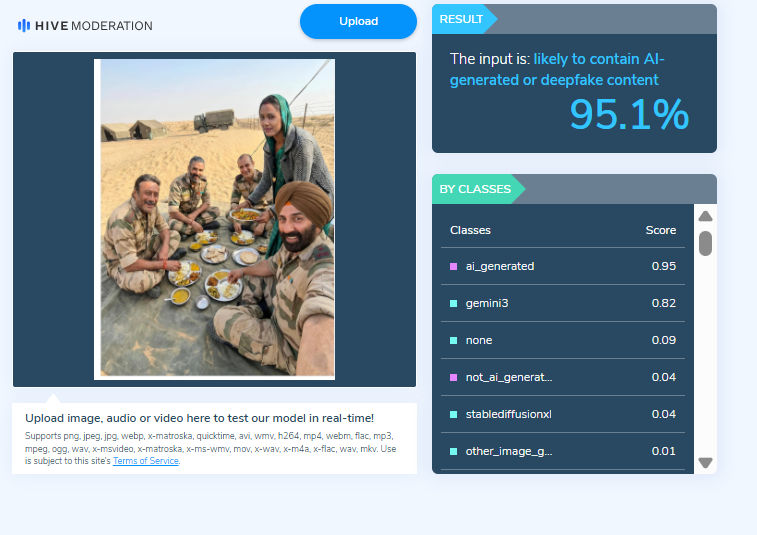
To verify the claim, we first checked Google for the official star cast of the film Border 2. Our search showed that the names of the actors seen in the viral image are not part of the film’s officially announced cast. Next, upon closely examining the image, we noticed that the facial structure and expressions of the actors appeared unnatural and distorted. The facial features did not look realistic, raising suspicion that the image might have been created using Artificial Intelligence (AI). We then scanned the viral image using the AI-generated content detection tool HIVE Moderation. The results indicated that the image is 95 per cent AI-generated.
In the final step of our investigation, we analysed the image using another AI-detection tool, Undetectable AI. According to the results, the viral image was confirmed to be AI-generated.
Conclusion:
Our research confirms that social media users are sharing an AI-generated image while falsely claiming that it is from the shooting of Border 2. The viral claim is misleading and false.
Our research revealed that users are sharing an AI-generated image along with misleading claims
