
#FactCheck-Viral Image of ‘New Iranian Banknote’ Featuring Khamenei Is Misleading; Likely AI-Generated
Executive Summary
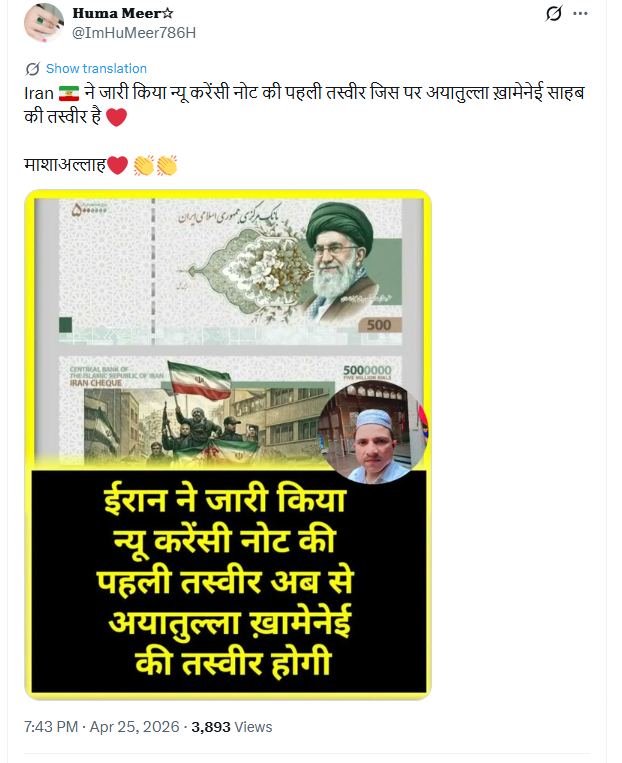
An image of a banknote featuring Iran’s Supreme Leader Ayatollah Khamenei is going viral on social media, with claims that Iran’s central bank has issued a newly designed 5 million rial note bearing his portrait. However, a fact-check by the CyberPeace Research Wing has found the claim to be misleading.
Claim
The image was shared by a verified user, “Sprinter Press Agency,” on X (formerly Twitter), claiming that the Central Bank had introduced a new banknote design featuring the leader of the Islamic Revolution.
Fact Check
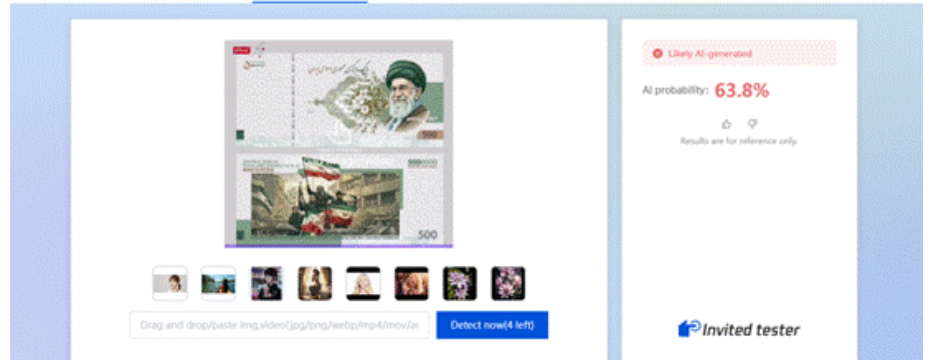
To verify the claim, relevant keywords were searched across multiple credible sources. No reports were found from any reputable international media outlet, Iranian government platform, or the Central Bank of Iran confirming the release of such a banknote. A technical analysis of the viral image was also conducted. According to the AI detection tool Zhuque AI Detection Assistant, there is a 63.8% probability that the image is AI-generated, raising further doubts about its authenticity.
Conclusion:
The claim that Iran’s central bank has issued a new 5 million rial banknote featuring Ayatollah Khamenei is misleading. There is no official confirmation of such a release, and available evidence suggests that the viral image is either edited or AI-generated.

Related Blogs

What are Wi-Fi attacks?
Wi-fi is an important area of cyber security and there is no need for physical cable for the network. Wi-Fi has access to a network signal radius everywhere. The devices and systems can have a network without physical access due to Wi-fi. But everything comes with cons and pros, and if we talk about cybersecurity, it has been established that Wi-fi networks are extremely vulnerable to security breaches and it is very easy to be hacked by hackers. Wi-Fi can be accessed by almost every device in the modern day: it can be smartphones, tablets, computers, and laptops. To know whether someone has been tampering with your personal Wi-Fi there are certain signs that can prove it. The first and most important sign is that your internet speed gets slower, as someone else is using your Wi-Fi surf.
Why would anyone hack someone’s Wi-Fi network?
Usually, hackers hack the network because they want access to the confidential data of someone and they can observe all the online activities and data that have been sent through a network. An unauthorize hacker will pretty much be able to see everything you do online. Wi-Fi allows hackers o view information on sites. Any financial information which is saved in the browser can be accessed by hackers and they can alter it and can alter the content you see online. And all the information saved in Wi-fi networks can be used by hackers for their own benefit, they can sell it, impersonate you, or even take money out of your bank through Wi-Fi.
Avoiding vulnerable Wi-Fi networks
The first and foremost rule of protection is that you should not use public networks if that network is easily open to you then that is also available to others and from others, and someone can who wishes to use your confidential and sensitive information, can access that. If you really need to access the public network in an urgent situation, then you must make sure to limit your activities while connected. And avoid accessing your online banking or pages that require login information. Also, a good measure to take as well is to always delete your cookies after using public WIFI.
How To Secure Your Home Wi-Fi Network
Your home’s wireless internet connection is your Wi-Fi network. Typically, a wireless router is used, which broadcasts a signal into the atmosphere. You can connect to the internet using that signal. However, if your network is not password-protected, any nearby device can grab the signal off the air and connect to your internet. The benefit of Wi-Fi? Wireless access to the internet is possible. The negative? Your internet activity, including your personal information, may be visible to neighboring users who connect to your unprotected network. Furthermore, if someone uses your network to conduct a crime or send out unauthorized spam, you might be held accountable.
Wi-Fi or Li-Fi? –
The common consensus is that Li-Fi technology is more secure than Wi-Fi. Li-Fi systems can be made more secure by integrating a variety of security features. Although these qualities might appear when Li-Fi is widely used in the near future, it is already thought to be safer because of a number of security features. Since the connection’s characteristics make it simpler to lock connections, limit access, and track users even in the absence of encryption and other security features, Li-Fi is seen as being safer. Li-Fi systems will be able to support new security protocols, which will not only enable high-speed networking but also open the door for innovative security techniques to strengthen connections.
Conclusion
A hacker can sniff the network packets without having to be in the same building where the network is located. As wireless networks communicate through radio waves, a hacker can easily sniff the network from a nearby location. Most attackers use network sniffing to find the SSID and hack a wireless network.
Any wireless network can theoretically be attacked in a number of different ways. Use of the default SSID or password, WPS pin authentication, insufficient access control, and leaving the access point available in open locations are all examples of potential vulnerabilities that could allow for the theft of sensitive data. Kismet’s architecture in WIDS mode may guard against DOS, MiTM, and MAC spoofing attacks. routine software updates on the other hand, the use of firewalls may help defend the network against outside intrusion. The act of finding infrastructure issues that could allow harmful code to be injected into a service, system, or organization is known as ethical hacking. They use this technique to prevent invasions by lawfully breaking into networks and looking for weak spots.

Executive Summary
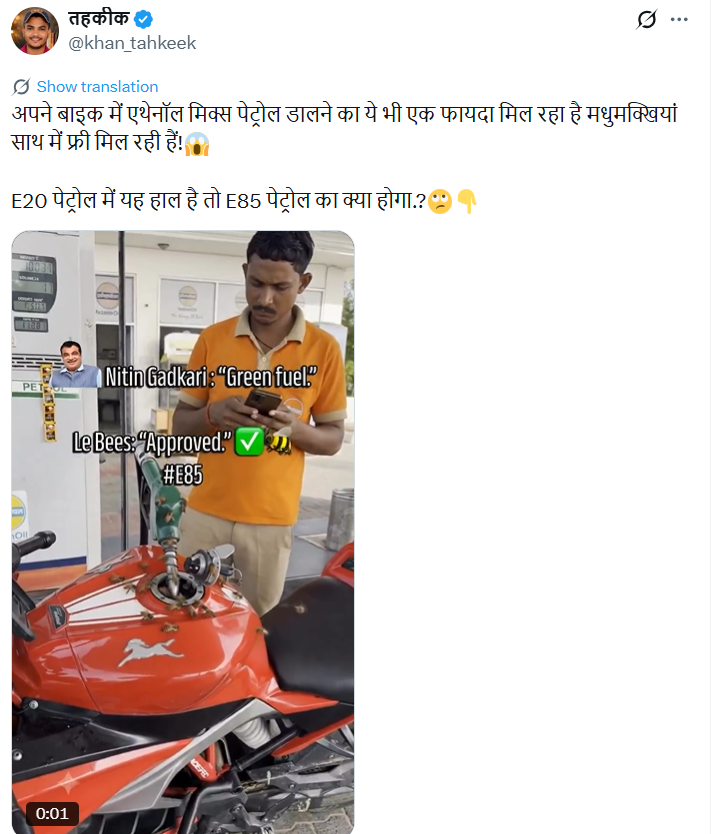
Following the official launch of E85 petrol in India on June 5, 2026, several videos have surfaced on social media claiming unusual side effects of ethanol-blended fuel. One such viral clip alleges that a swarm of bees gathers on a motorcycle fuel tank due to the use of ethanol mixed petrol. CyberPeace Research Wing research found the claim to be false and misleading. The viral video has been identified as AI-generated and does not depict any real-world incident related to ethanol-blended fuel.
Claim:
An X user shared an 11-second video on June 13, 2026, claiming that bees are being attracted to vehicles using ethanol-blended petrol. The post sarcastically suggested that E20 fuel is causing such unusual effects and questioned the impact of E85 petrol. https://x.com/khan_tahkeek/status/2065751435451437185?s=20, https://archive.ph/bMsL7
Fact Check:
A Google search using relevant keywords did not return any credible media reports supporting the claim, raising initial doubts about its authenticity. Closer inspection of the viral video revealed multiple visual inconsistencies suggesting digital manipulation. The video was further analysed using AI detection tools. Hive Moderation flagged the content as having a 98% probability of being AI-generated, indicating strong likelihood of synthetic creation.
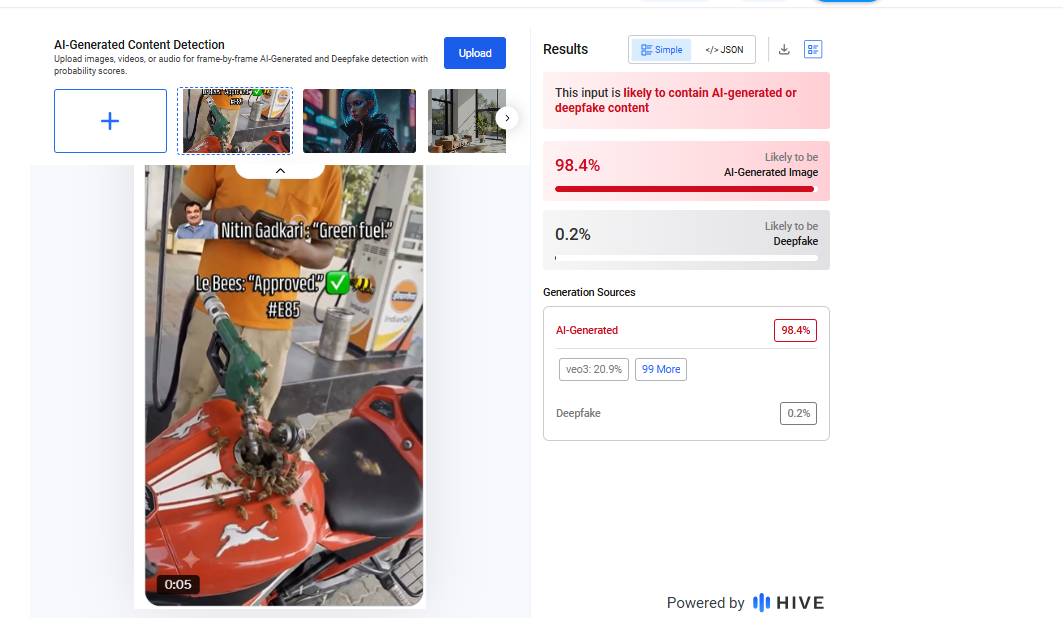
In addition, analysis using the AI detection tool “WasItAI” also confirmed that the video is AI-generated.
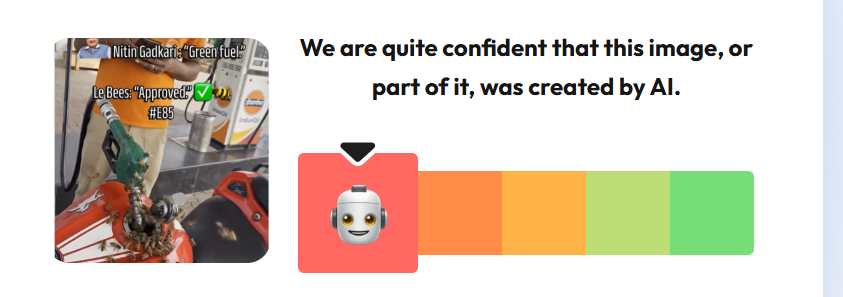
Further verification found an official post by Bharat Petroleum Corporation Limited (BPCL) dated June 17, 2026, debunking similar misinformation circulating around ethanol-blended petrol https://x.com/BPCLimited/status/2067167037710020929?s=20

Conclusion:
The research confirms that the viral video showing bees swarming on a motorcycle fuel tank is AI-generated. The claim linking it to ethanol-blended petrol (E85/E20) is false and misleading, with no real-world basis.

Executive Summary
A video showing a building engulfed in flames is going viral on social media, with users claiming it depicts an attack by Hezbollah on Israel’s military headquarters. The clip is being shared with assertions that several Israeli soldiers were killed and many remain trapped inside the burning structure. However, a research by the CyberPeace Research Wing found that the claim is false. The viral video is not from Israel but from New York City in the Manhattan area, where a residential building caught fire.
Claim
A Facebook user, ‘Nazim Khan Tirwadiya’, shared the video on April 15, 2026, claiming that Hezbollah had targeted an Israeli military headquarters, resulting in heavy casualties and ongoing fire.
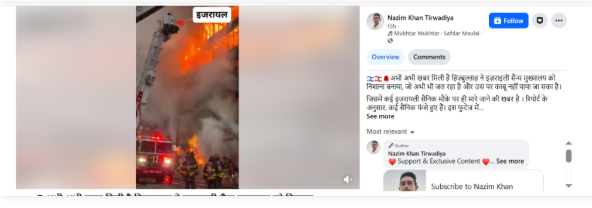
Fact Check
To verify the claim, we extracted keyframes from the viral video and conducted a reverse image search. This led us to a longer version of the same clip uploaded on the YouTube channel “FDNY Response Videos” on April 12, 2026. The video description identified the location as Manhattan, New York City.

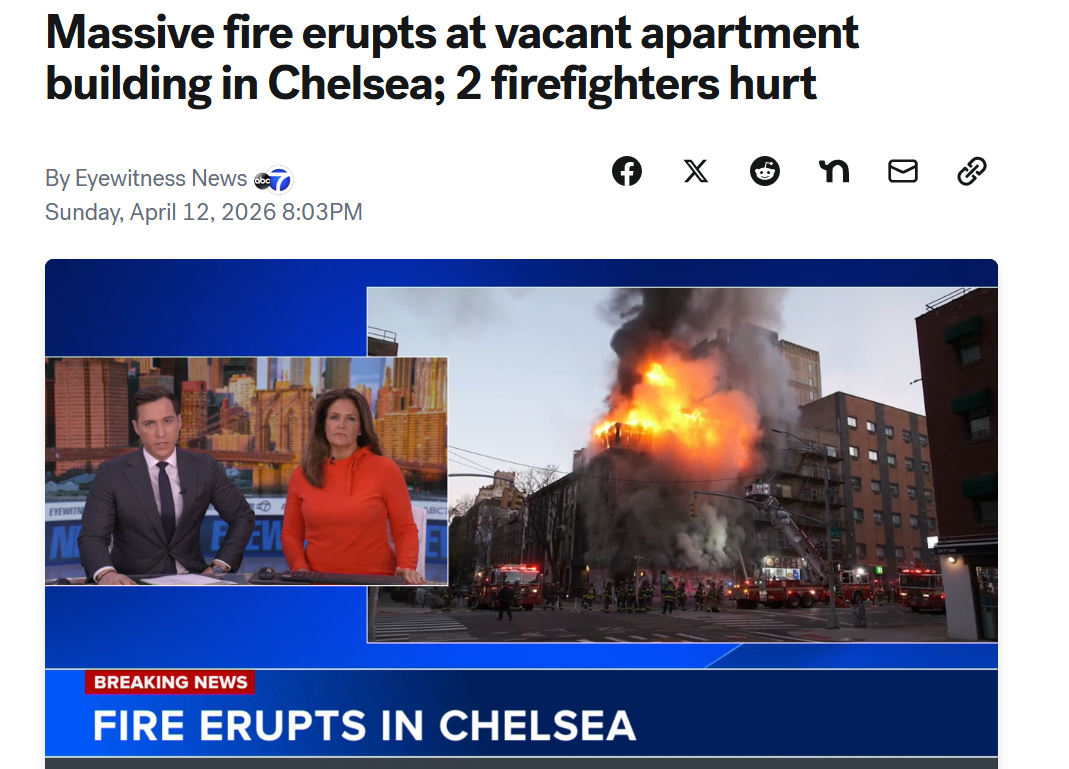
Further keyword searches led us to a report published by ABC7NY on April 12, 2026. According to the report, a massive fire broke out in a six-storey apartment building in Manhattan’s Midtown area around 6 a.m. Firefighters worked extensively to control the blaze, and two firefighters sustained minor injuries. No fatalities were reported.
Conclusion
The viral claim is false. The video does not show an attack on Israel by Hezbollah. Instead, it captures a fire incident in a residential building in Manhattan, New York City. The clip has been shared with a misleading narrative unrelated to the actual event.
