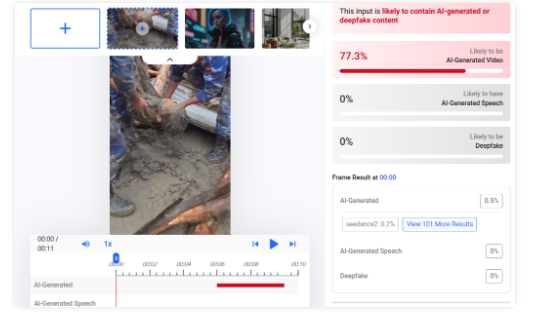
#FactCheck -AI-Generated Protest Video Falsely Linked to ‘Yadav Ji Ki Love Story’ Controversy
Executive Summary
The film ‘Yadav Ji Ki Love Story’, scheduled to release on February 27, has become embroiled in controversy over its title. Several organizations have expressed objections, registering their displeasure regarding the name of the film. Amid the row, a video is being widely circulated on social media. The footage shows a large crowd holding banners and posters while staging a protest. Users sharing the clip claim that it is from South India, where members of the Yadav community have allegedly launched a large-scale agitation against the film. However, research conducted by the CyberPeace found the viral claim to be false. Our research revealed that the video is not authentic but AI-generated, and is being shared with a misleading narrative.
Claim
On February 22, 2026, a Facebook user shared the viral video claiming it depicts protests by the Yadav community in South India against the film. The original and archived links to the post are provided below

Fact Check:
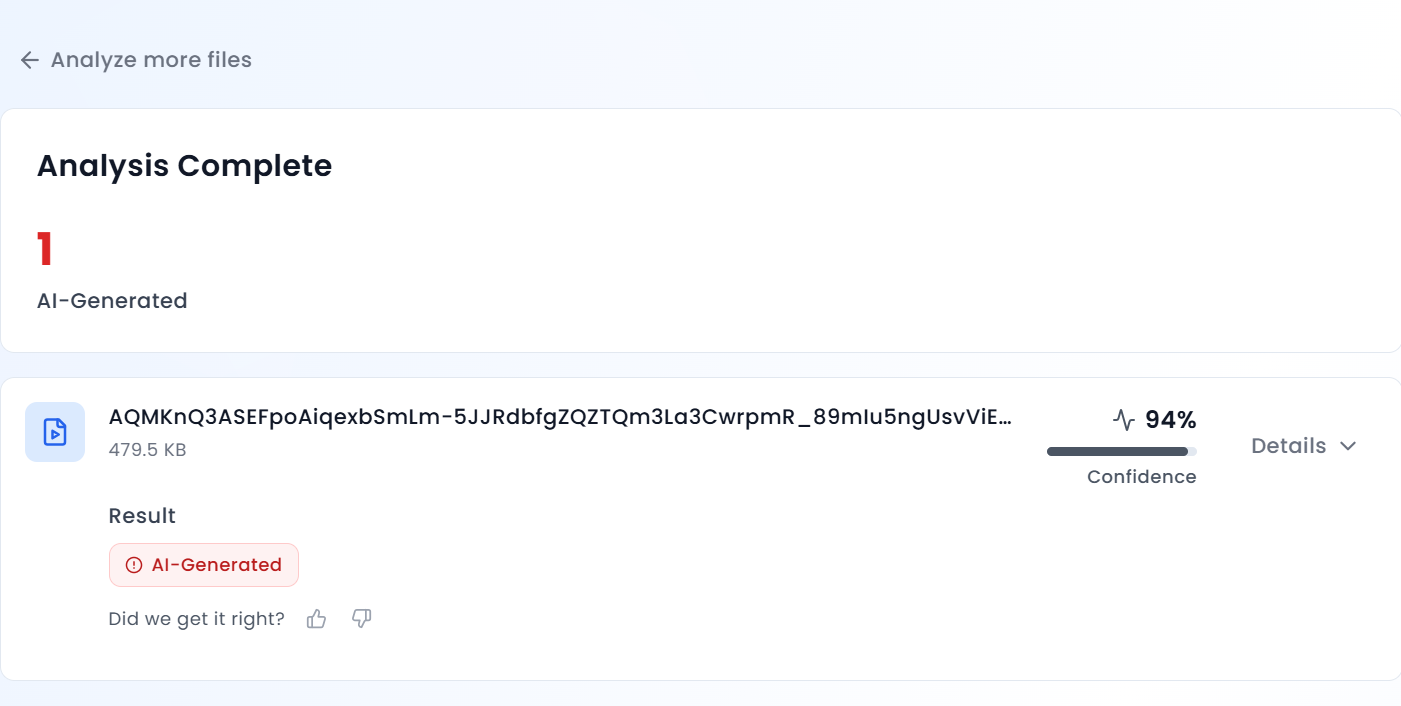
Upon closely examining the viral video, we noticed several anomalies in the visuals, crowd movements, and certain frames. The unnatural patterns and inconsistencies raised suspicions that the footage may have been generated using artificial intelligence. To verify this, we analyzed the video using the AI detection tool Aurigin AI, which indicated that the footage was AI-generated.
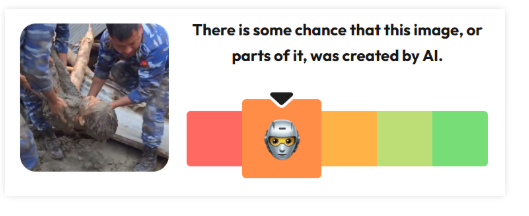
We further scanned the clip using another AI detection platform, Hive Moderation. The results showed a 99 percent probability that the video was AI-generated.

Conclusion
Our findings confirm that the viral video is not real. It has been artificially created using AI technology and is being circulated with a false and misleading claim.
Related Blogs

The race for global leadership in AI is in full force. As China and the US emerge as the ‘AI Superpowers’ in the world, the world grapples with the questions around AI governance, ethics, regulation, and safety. Some are calling this an ‘AI Arms Race.’ Most of the applications of these AI systems are in large language models for commercial use or military applications. Countries like Germany, Japan, France, Singapore, and India are now participating in this race and are not mere spectators.
The Government of India’s Ministry of Electronics and Information Technology (MeitY) has launched the IndiaAI Mission, an umbrella program for the use and development of AI technology. This MeitY initiative lays the groundwork for supporting an array of AI goals for the country. The government has allocated INR 10,300 crore for this endeavour. This mission includes pivotal initiatives like the IndiaAI Compute Capacity, IndiaAI Innovation Centre (IAIC), IndiaAI Datasets Platform, IndiaAI Application Development Initiative, IndiaAI FutureSkills, IndiaAI Startup Financing, and Safe & Trusted AI.
There are several challenges and opportunities that India will have to navigate and capitalize on to become a significant player in the global AI race. The various components of India’s ‘AI Stack’ will have to work well in tandem to create a robust ecosystem that yields globally competitive results. The IndiaAI mission focuses on building large language models in vernacular languages and developing compute infrastructure. There must be more focus on developing good datasets and research as well.
Resource Allocation and Infrastructure Development
The government is focusing on building the elementary foundation for AI competitiveness. This includes the procurement of AI chips and compute capacity, about 10,000 graphics processing units (GPUs), to support India’s start-ups, researchers, and academics. These GPUs have been strategically distributed, with 70% being high-end newer models and the remaining 30% comprising lower-end older-generation models. This approach ensures that a robust ecosystem is built, which includes everything from cutting-edge research to more routine applications. A major player in this initiative is Yotta Data Services, which holds the largest share of 9,216 GPUs, including 8,192 Nvidia H100s. Other significant contributors include Amazon AWS's managed service providers, Jio Platforms, and CtrlS Datacenters.
Policy Implications: Charting a Course for Tech Sovereignty and Self-reliance
With this government initiative, there is a concerted effort to develop indigenous AI models and reduce tech dependence on foreign players. There is a push to develop local Large Language Models and domain-specific foundational models, creating AI solutions that are truly Indian in nature and application. Many advanced chip manufacturing takes place in Taiwan, which has a looming China threat. India’s focus on chip procurement and GPUs speaks to a larger agenda of self-reliance and sovereignty, keeping in mind the geopolitical calculus. This is an important thing to focus on, however, it must not come at the cost of developing the technological ‘know-how’ and research.
Developing AI capabilities at home also has national security implications. When it comes to defence systems, control over AI infrastructure and data becomes extremely important. The IndiaAI Mission will focus on safe and trusted AI, including developing frameworks that fit the Indian context. It has to be ensured that AI applications align with India's security interests and can be confidently deployed in sensitive defence applications.
The big problem here to solve here is the ‘data problem.’ There must be a focus on developing strategies to mitigate the data problem that disadvantages the Indian AI ecosystem. Some data problems are unique to India, such as generating data in local languages. While other problems are the ones that appear in every AI ecosystem development lifecycle namely generating publicly available data and licensed data. India must strengthen its ‘Digital Public Infrastructure’ and data commons across sectors and domains.
India has proposed setting up the India Data Management Office to serve as India’s data regulator as part of its draft National Data Governance Framework Policy. The MeitY IndiaAI expert working group report also talked about operationalizing the India Datasets Platform and suggested the establishment of data management units within each ministry.
Economic Impact: Growth and Innovation
The government’s focus on technology and industry has far-reaching economic implications. There is a push to develop the AI startup ecosystem in the country. The IndiaAI mission heavily focuses on inviting ideas and projects under its ambit. The investments will strengthen the IndiaAI startup financing system, making it easier for nascent AI businesses to obtain capital and accelerate their development from product to market. Funding provisions for industry-led AI initiatives that promote social impact and stimulate innovation and entrepreneurship are also included in the plan. The government press release states, "The overarching aim of this financial outlay is to ensure a structured implementation of the IndiaAI Mission through a public-private partnership model aimed at nurturing India’s AI innovation ecosystem.”
The government also wants to establish India as a hub for sustainable AI innovation and attract top AI talent from across the globe. One crucial aspect that needs to be worked on here is fostering talent and skill development. India has a unique advantage, that is, top-tier talent in STEM fields. Yet we suffer from a severe talent gap that needs to be addressed on a priority basis. Even though India is making strides in nurturing AI talents, out-migration of tech talent is still a reality. Once the hardware manufacturing “goods-side” of economics transitions to service delivery in the field of AI globally, India will need to be ready to deploy its talent. Several structural and policy interfaces, like the New Education Policy and industry-academic partnership frameworks, allow India to capitalize on this opportunity.
India’s talent strategy must be robust and long-term, focusing heavily on multi-stakeholder engagement. The government has a pivotal role here by creating industry-academia interfaces and enabling tech hubs and innovation parks.
India's Position in the Global AI Race
India’s foreign policy and geopolitical standpoint have been one of global cooperation. This must not change when it comes to AI. Even though this has been dubbed as the “AI Arms Race,” India should encourage worldwide collaboration on AI R&D through collaboration with other countries in order to strengthen its own capabilities. India must prioritise more significant open-source AI development, work with the US, Europe, Australia, Japan, and other friendly countries to prevent the unethical use of AI and contribute to the formation of a global consensus on the boundaries for AI development.
The IndiaAI Mission will have far-reaching implications for India’s diplomatic and economic relations. The unique proposition that India comes with is its ethos of inclusivity, ethics, regulation, and safety from the get-go. We should keep up the efforts to create a powerful voice for the Global South in AI. The IndiaAI Mission marks a pivotal moment in India's technological journey. Its success could not only elevate India's status as a tech leader but also serve as a model for other nations looking to harness the power of AI for national development and global competitiveness. In conclusion, the IndiaAI Mission seeks to strengthen India's position as a global leader in AI, promote technological independence, guarantee the ethical and responsible application of AI, and democratise the advantages of AI at all societal levels.
References
- Ashwini Vaishnaw to launch IndiaAI portal, 10 firms to provide 14,000 GPUs. (2025, February 17). https://www.business-standard.com/. Retrieved February 25, 2025, from https://www.business-standard.com/industry/news/indiaai-compute-portal-ashwini-vaishnaw-gpu-artificial-intelligence-jio-125021700245_1.html
- Global IndiaAI Summit 2024 being organized with a commitment to advance responsible development, deployment and adoption of AI in the country. (n.d.). https://pib.gov.in/PressReleaseIframePage.aspx?PRID=2029841
- India to Launch AI Compute Portal, 10 Firms to Supply 14,000 GPUs. (2025, February 17). apacnewsnetwork.com. https://apacnewsnetwork.com/2025/02/india-to-launch-ai-compute-portal-10-firms-to-supply-14000-gpus/
- INDIAai | Pillars. (n.d.). IndiaAI. https://indiaai.gov.in/
- IndiaAI Innovation Challenge 2024 | Software Technology Park of India | Ministry of Electronics & Information Technology Government of India. (n.d.). http://stpi.in/en/events/indiaai-innovation-challenge-2024
- IndiaAI Mission To Deploy 14,000 GPUs For Compute Capacity, Starts Subsidy Plan. (2025, February 17). www.businessworld.in. Retrieved February 25, 2025, from https://www.businessworld.in/article/indiaai-mission-to-deploy-14000-gpus-for-compute-capacity-starts-subsidy-plan-548253
- India’s interesting AI initiatives in 2024: AI landscape in India. (n.d.). IndiaAI. https://indiaai.gov.in/article/india-s-interesting-ai-initiatives-in-2024-ai-landscape-in-india
- Mehra, P. (2025, February 17). Yotta joins India AI Mission to provide advanced GPU, AI cloud services. Techcircle. https://www.techcircle.in/2025/02/17/yotta-joins-india-ai-mission-to-provide-advanced-gpu-ai-cloud-services/
- IndiaAI 2023: Expert Group Report – First Edition. (n.d.). IndiaAI. https://indiaai.gov.in/news/indiaai-2023-expert-group-report-first-edition
- Satish, R., Mahindru, T., World Economic Forum, Microsoft, Butterfield, K. F., Sarkar, A., Roy, A., Kumar, R., Sethi, A., Ravindran, B., Marchant, G., Google, Havens, J., Srichandra (IEEE), Vatsa, M., Goenka, S., Anandan, P., Panicker, R., Srivatsa, R., . . . Kumar, R. (2021). Approach Document for India. In World Economic Forum Centre for the Fourth Industrial Revolution, Approach Document for India [Report]. https://www.niti.gov.in/sites/default/files/2021-02/Responsible-AI-22022021.pdf
- Stratton, J. (2023, August 10). Those who solve the data dilemma will win the A.I. revolution. Fortune. https://fortune.com/2023/08/10/workday-data-ai-revolution/
- Suri, A. (n.d.). The missing pieces in India’s AI puzzle: talent, data, and R&D. Carnegie Endowment for International Peace. https://carnegieendowment.org/research/2025/02/the-missing-pieces-in-indias-ai-puzzle-talent-data-and-randd?lang=en
- The AI arms race. (2024, February 13). Financial Times. https://www.ft.com/content/21eb5996-89a3-11e8-bf9e-8771d5404543

Introduction
CyberPeace Chronicles is a one-stop for the latest edition of news, updates, and findings in global cyberspace. As we step into the cyberage, it is pertinent that we need to incorporate cybersecurity practices in our day-to-day activities. From laptops to automated homes and cars, we are all surrounded by technology in some form or another. Thus, with the increased dependency, we need to eradicate the scope of vulnerabilities and threats around us and create robust and sustainable safety mechanisms for us and future generations.
What, When and How?
- WIN-RAR Update: CVE-2023-33831, a serious vulnerability, was identified in WinRAR versions prior to 6.23 in April 2023. When users attempted to access seemingly harmless files inside ZIP archives, this vulnerability allowed attackers to run arbitrary code. Cybercriminals transmitted malware families like DarkMe, GuLoader, and Remcos RAT by taking advantage of this vulnerability. It is essential to update WinRAR to version 6.23 or later in order to protect your computer and your data. Follow the following steps to secure your device -
- Checking Your Current WinRAR Version
- Downloading the Latest WinRAR Version
- Installing the Updated WinRAR
- Completing the Installation
- Verifying the Update
- Cleaning Up
- Indonesian Hacker Groups Target Indian Digital Infrastructure: As India geared up to host the G20 delegation as part of the Leadership Summit, various reports pointed towards different forms and intensity-based cyber attacks on Indian organisations and digital infrastructure. Tech firms in India have been successful in tracing the origination of the attacks to be from Indonesia. It is believed that hacker groups backed by anti-India elements have been trying to target the digital resources of India. Organisations and central agencies like Computer Emergency Response Team (CERT-In), National Critical Information Infrastructure Protection Centre (NCIIPC), I4C (Indian Cybercrime Coordination Centre), Delhi Police, Intelligence Bureau (IB), Research and Analysis Wing (R&AW), National Investigation Agency (NIA) and Central Bureau of Investigation (CBI) have constantly been working in keeping the Digital interests of India safe and secure, and with the ongoing G20 summit, it is very pertinent to be mindful of potential threats prevailing to prepare counter tactics for the same.
- CLOP Ransomware: The CL0P ransomware is thought to have initially surfaced in 2019 and was developed by a cybercriminal organisation that spoke Russian. The threat actor FIN11 (also known as TA505 and Snakefly), who is notorious for being financially driven, is frequently connected to the CL0P ransomware, which had its roots at the beginning of 2019. By utilising this technique, CL0P has targeted businesses utilising the "Accellion FTA" file transfer appliance's vulnerable version. Accordingly, it has been asserted that the following vulnerabilities have been used to access victim data and maybe switch to victim networks. Numerous well-publicized attacks carried out by CL0P have had an impact on organisations all across the world. Especially for Managed File Transfer (MFT) programmes, the CL0P performers are well known for their talent in developing zero-day vulnerabilities. The gang went after Accellion File Transfer Appliance (FTA) devices in both 2020 and 2021, then early in 2023, they went after Fortran/Linoma GoAnywhere MFT servers, and then later in June, they went after MOVEit transfer deployments. Up to 500 organisations are thought to have been harmed by this aggressive operation. Some of the ways to mitigate the risk are as follows:
- Regular Software Updates: Updating programmes and systems helps prevent known security flaws that fraudsters frequently exploit.
- Employee Training: Employee training can significantly lower the likelihood of successful penetration by educating staff members about phishing scams and safe internet conduct.
- Network Segmentation: By separating networks and restricting lateral movement, a ransomware attack's potential effects can be reduced.
- Regular Data backups: Data backups can lessen the effects of encryption and deter payment by regularly backing up data and storing it offsite.
- Security solutions: Putting in place effective cybersecurity measures like firewalls, intrusion detection systems, and cutting-edge endpoint protection can greatly improve an organisation's defences.
- Increased scrutiny for SIM card vendors: As phishing and smishing scams are on the rise in India, the Telecom Regulatory Authority of India (TRAI) has repeatedly issued notifications and consultation papers to address this growing concern. Earlier this year, TRAI notified that promotional calling will not be continued from 10-digit personal numbers. Instead, companies will now have to take authorised 9-digit numbers for promotional calls and SMSs. Similarly, to increase the efficiency of the same, TRAI has laid down that all the SIM card vendors will now have to be verified again, and any discrepancy found against any of the vendors will lead to blacklisting and penal actions against the vendor.
Conclusion
In conclusion, the digital landscape in 2023 is rife with both opportunities and challenges. The recent discovery of a critical vulnerability in WinRAR underscores the importance of regularly updating software to protect against malicious attacks. It is imperative for users to follow the provided steps to secure their devices and safeguard their data. Furthermore, the cyber threat landscape continues to evolve, with Indonesian hacker groups targeting Indian digital infrastructure, particularly during significant events like the G20 summit. Indian organisations and cybersecurity agencies are working diligently to defend against these threats and ensure the security of digital assets. The emergence of ransomware attacks, exemplified by the CL0P ransomware, serves as a stark reminder of the need for robust cybersecurity measures. Regular software updates, employee training, network segmentation, data backups, and advanced security solutions are crucial components of a comprehensive defence strategy against ransomware and other cyber threats. Additionally, the Telecom Regulatory Authority of India's efforts to enhance security in the telecommunications sector, such as stricter verification of SIM card vendors, demonstrate a proactive approach to addressing the rising threat of phishing and smishing scams. In this dynamic digital landscape, staying informed and implementing proactive cybersecurity measures is essential for individuals, organisations, and nations to protect their digital assets and maintain a secure online environment. Vigilance, collaboration, and ongoing adaptation are key to meeting the challenges posed by cyber threats in 2023 and beyond.

Introduction
The Ministry of Communications, Department of Telecommunications notified the Telecommunications (Telecom Cyber Security) Rules, 2024 on 22nd November 2024. These rules were notified to overcome the vulnerabilities that rapid technological advancements pose. The evolving nature of cyber threats has contributed to strengthening and enhancing telecom cyber security. These rules empower the central government to seek traffic data and any other data (other than the content of messages) from service providers.
Background Context
The Telecommunications Act of 2023 was passed by Parliament in December, receiving the President's assent and being published in the official Gazette on December 24, 2023. The act is divided into 11 chapters 62 sections and 3 schedules. The said act has repealed the old legislation viz. Indian Telegraph Act of 1885 and the Indian Wireless Telegraphy Act of 1933. The government has enforced the act in phases. Sections 1, 2, 10-30, 42-44, 46, 47, 50-58, 61, and 62 came into force on June 26, 2024. While, sections 6-8, 48, and 59(b) were notified to be effective from July 05, 2024.
These rules have been notified under the powers granted by Section 22(1) and Section 56(2)(v) of the Telecommunications Act, 2023.
Key Provisions of the Rules
These rules collectively aim to reinforce telecom cyber security and ensure the reliability of telecommunication networks and services. They are as follows:
The Central Government agency authorized by it may request traffic or other data from a telecommunication entity through the Central Government portal to safeguard and ensure telecom cyber security. In addition, the Central Govt. can instruct telecommunication entities to establish the necessary infrastructure and equipment for data collection, processing, and storage from designated points.
● Obligations Relating To Telecom Cybersecurity:
Telecom entities must adhere to various obligations to prevent cyber security risks. Telecommunication cyber security must not be endangered, and no one is allowed to send messages that could harm it. Misuse of telecommunication equipment such as identifiers, networks, or services is prohibited. Telecommunication entities are also required to comply with directions and standards issued by the Central Govt. and furnish detailed reports of actions taken on the government portal.
● Compulsory Measures To Be Taken By Every Telecommunication Entity:
Telecom entities must adopt and notify the Central Govt. of a telecom cyber security policy to enhance cybersecurity. They have to identify and mitigate risks of security incidents, ensure timely responses, and take appropriate measures to address such incidents and minimize their impact. Periodic telecom cyber security audits must be conducted to assess network resilience against potential threats for telecom entities. They must report security incidents promptly to the Central Govt. and establish facilities like a Security Operations Centre.
● Reporting of Security Incidents:
- Telecommunication entities must report the detection of security incidents affecting their network or services within six hours.
- 24 hours are provided for submitting detailed information about the incident, including the number of affected users, the duration, geographical scope, the impact on services, and the remedial measures implemented.
The Central Govt. may require the affected entity to provide further information, such as its cyber security policy, or conduct a security audit.
CyberPeace Policy Analysis
The notified rules reflect critical updates from their draft version, including the obligation to report incidents immediately upon awareness. This ensures greater privacy for consumers while still enabling robust cybersecurity oversight. Importantly, individuals whose telecom identifiers are suspended or disconnected due to security concerns must be given a copy of the order and a chance to appeal, ensuring procedural fairness. The notified rules have removed "traffic data" and "message content" definitions that may lead to operational ambiguities. While the rules establish a solid foundation for protecting telecom networks, they pose significant compliance challenges, particularly for smaller operators who may struggle with costs associated with audits, infrastructure, and reporting requirements.
Conclusion
The Telecom Cyber Security Rules, 2024 represent a comprehensive approach to securing India’s communication networks against cyber threats. Mandating robust cybersecurity policies, rapid incident reporting, and procedural safeguards allows the rules to balance national security with privacy and fairness. However, addressing implementation challenges through stakeholder collaboration and detailed guidelines will be key to ensuring compliance without overburdening telecom operators. With adaptive execution, these rules have the potential to enhance the resilience of India’s telecom sector and also position the country as a global leader in digital security standards.
References
● Telecommunications Act, 2023 https://acrobat.adobe.com/id/urn:aaid:sc:AP:767484b8-4d05-40b3-9c3d-30c5642c3bac
● CyberPeace First Read of the Telecommunications Act, 2023 https://www.cyberpeace.org/resources/blogs/the-government-enforces-key-sections-of-the-telecommunication-act-2023
● Telecommunications (Telecom Cyber Security) Rules, 2024