
#FactCheck -AI-Generated Video Falsely Shared as BJP-Led Border Fencing on West Bengal-Bangladesh Border
Executive Summary
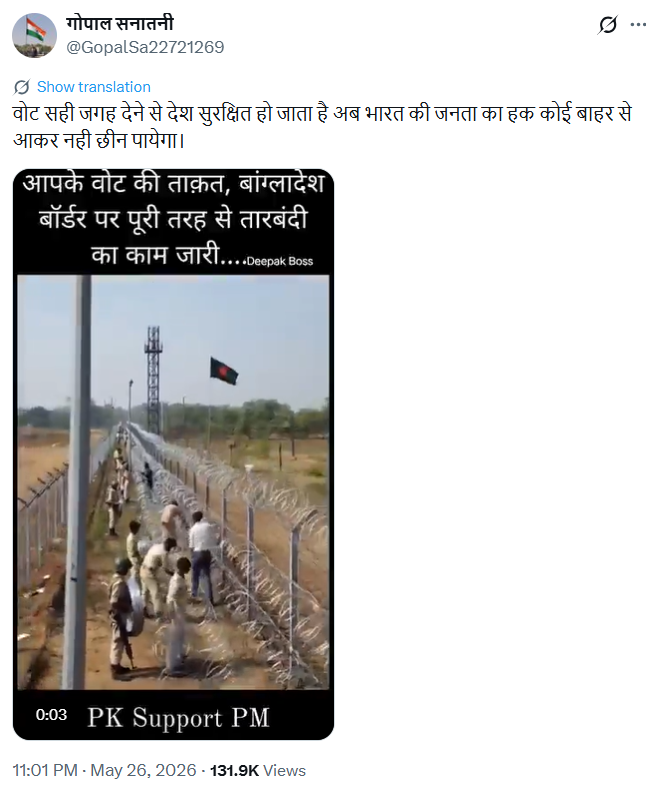
A video showing people installing fencing along a border has gone viral on social media. In the clip, several individuals along with security personnel can be seen laying barbed wire fencing near a border area. The video is being shared with the claim that it shows fencing work underway on the India-Bangladesh border in West Bengal after the Bharatiya Janata Party (BJP) allegedly came to power in the state.
However, CyberPeace Research Wing investigation found the viral claim to be false. The video is not from a real incident and has been created using Artificial Intelligence (AI).
Claim
An X user named “Gopal Sanatani” shared the viral video on May 26, 2026, with the caption:“Voting in the right place keeps the country secure. Now no outsider will be able to snatch the rights of Indian citizens.”The archived link to the post is provided below.
Fact Check
To verify the authenticity of the viral claim, we extracted several key frames from the video and conducted reverse image searches using Google. However, we could not find any credible information or authentic reports related to the visuals shown in the clip. We also searched using relevant keywords on Google, but no trustworthy news reports connected to the claim were found.
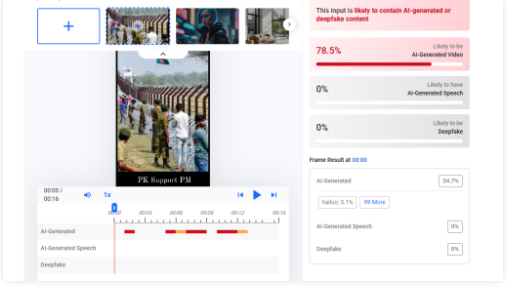
Upon closely examining the video, several visual inconsistencies became noticeable. At one point, an object resembling a piece of paper suddenly appears in a soldier’s hand and then disappears moments later. In another scene, a man installing the fencing appears to pass directly through the barbed wire and emerges unharmed, despite the sharp wires visible in the video. These irregularities raised suspicion that the clip had been artificially generated. To further investigate, we analysed the video using AI detection tools. The analysis conducted through Hive Moderation indicated a high probability — around 80 percent — that the video was AI-generated.
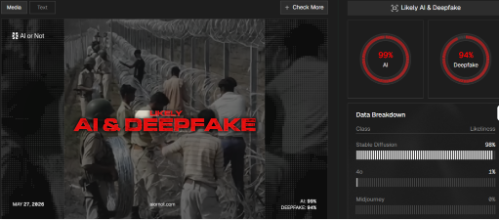
Additionally, the video was examined using another AI detection platform, “AI or Not,” which indicated nearly a 99 percent likelihood that the clip had been created using artificial intelligence.
Conclusion
Our investigation found that the viral video claiming to show fencing work along the West Bengal-Bangladesh border is fake. The footage does not depict a real incident and was generated using Artificial Intelligence (AI).

Related Blogs
Executive Summary
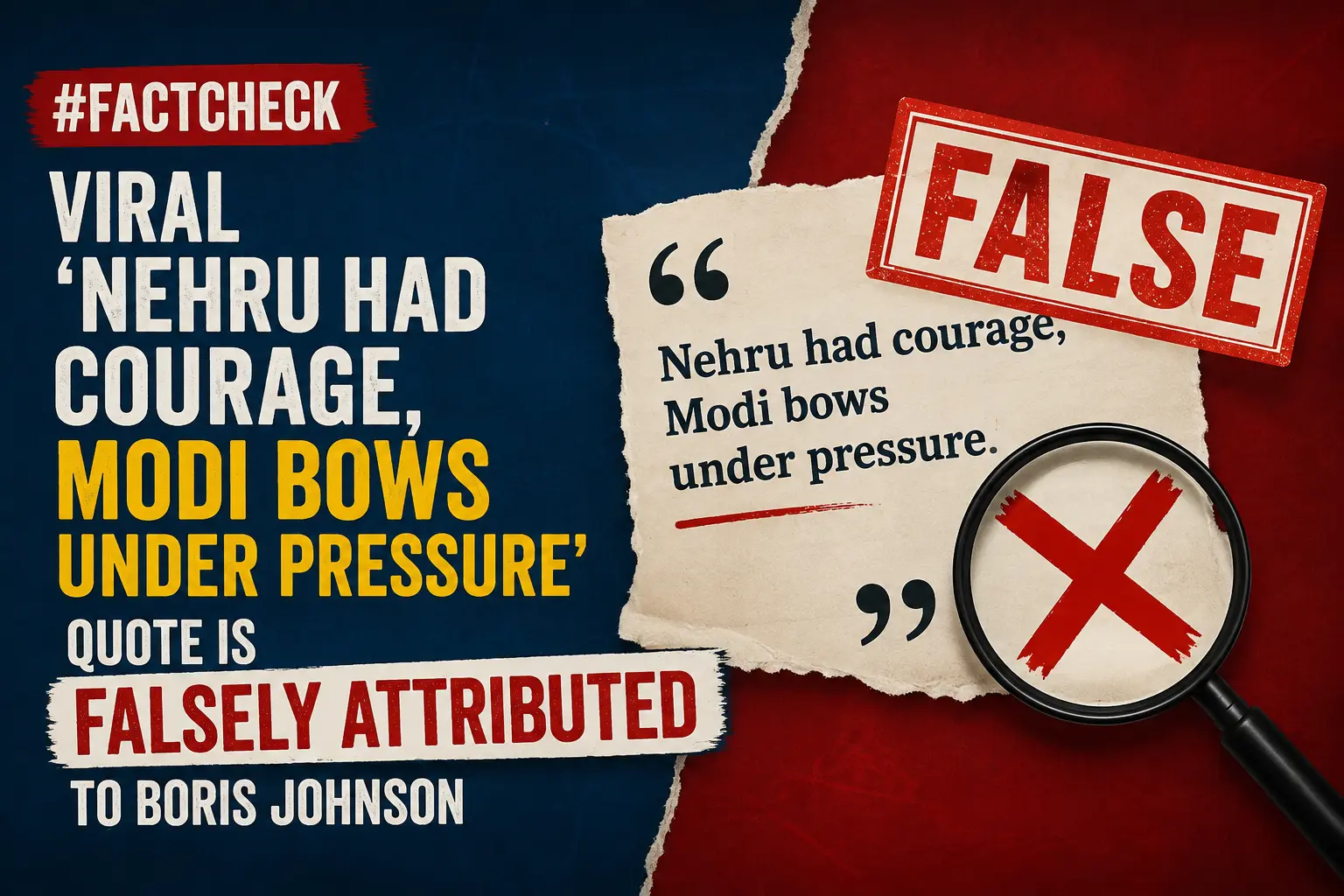
A purported statement attributed to former British Prime Minister Boris Johnson is going viral on social media. The post claims that Johnson said about Prime Minister Narendra Modi, “Modi bows under pressure.” It also attributes a comparison between Jawaharlal Nehru and Modi to Johnson, portraying Nehru as more courageous. A research done by the Research Wing of the CyberPeace found the viral claim to be false. During the research, the team examined Boris Johnson’s interview at the ET World Leaders Forum 2026, along with media reports related to the interview. The available transcript contains no remark by Johnson saying “Modi bows under pressure” or anything similar. On the contrary, he praised the changes and development taking place in India.
Claim:
A user on Instagram shared the viral claim, writing: “The purported statement by former British Prime Minister Boris Johnson has intensified the debate over India’s foreign policy and Prime Minister Narendra Modi’s leadership. The viral claim describes Nehru’s foreign policy as visionary while accusing the Modi government of bowing under pressure and taking shortcuts. The statement has triggered political reactions on social media.” The link to the post, its archive link, and a screenshot are provided below.
https://www.instagram.com/p/Dcdo_TGy-W0/
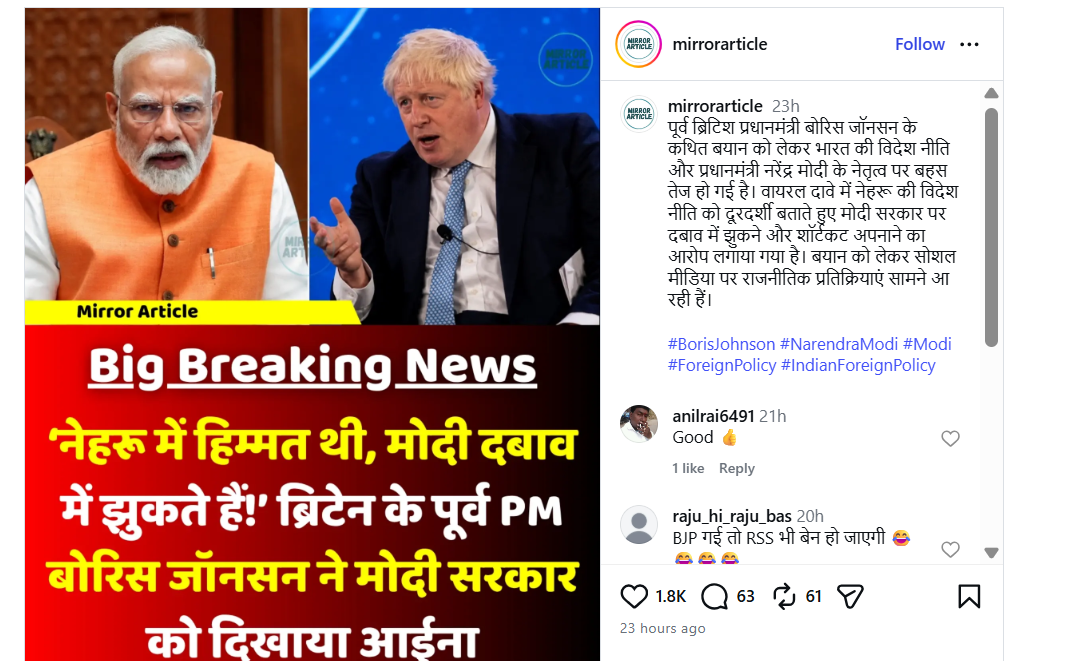
Fact Check
To verify the authenticity of the viral claim, the Desk examined the available transcript and reports of Boris Johnson’s interview at the ET World Leaders Forum 2026. The Desk found that Johnson also praised India’s current situation. He said that India is going through a “very good period under very strong and stable leadership.” He described India’s progress as “a really wonderful story” and expressed optimism about the country’s future.
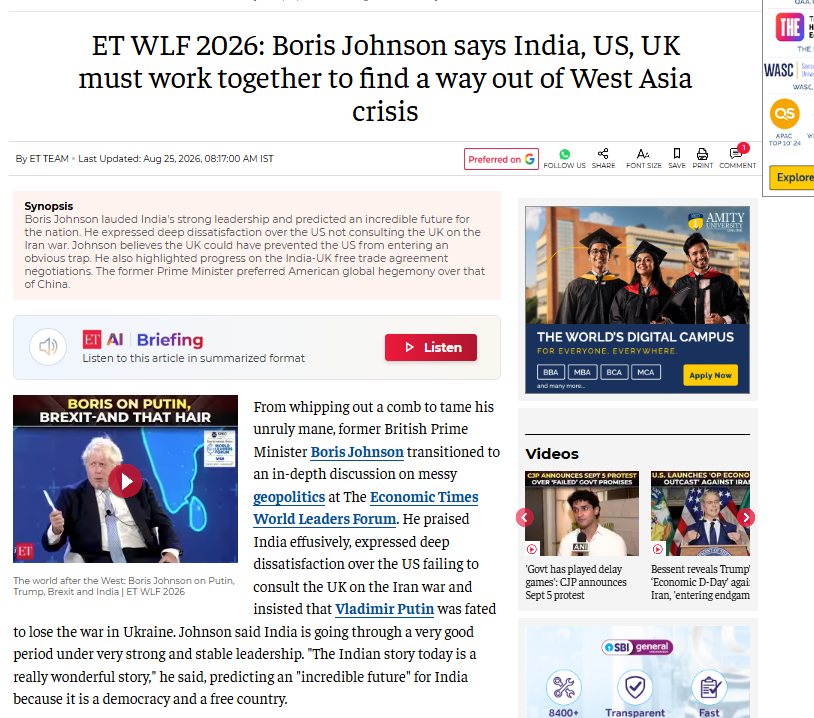
During the interview, Johnson discussed several international issues, including India-UK relations, US-UK ties, NATO defence spending, the Iran war and the Ukraine war. The available interview transcript contains no statement from him saying that “Modi bows under pressure” or that Nehru was more courageous than Modi. Johnson also referred to Jawaharlal Nehru in the context of India-Russia relations. He recalled that the late Queen Elizabeth II had once shared an anecdote about a conversation she had with Nehru in the 1950s, during which Nehru reportedly told her that India would always stand by Russia and that some things never change.

Conclusion
Boris Johnson did not make any statement at the ET World Leaders Forum 2026 suggesting that “Modi bows under pressure” or that “Nehru had courage.” On the contrary, he praised India’s progress and spoke positively about Prime Minister Narendra Modi’s leadership. Johnson did mention Nehru during the conversation, but his reference was in the context of India-Russia relations and an old conversation between Nehru and the late Queen Elizabeth II. He did not compare Nehru with Modi, nor did he criticise Modi. Therefore, the claim circulating on social media attributing the statement “Nehru had courage, Modi bows under pressure” to Boris Johnson is false.
.webp)
The concept of web accessibility (i.e., access to the internet) stems from the recognition of internet access as an inalienable right. In 2016, the United Nations Human Rights Commission (UNHRC) General Assembly referred to the access to Internet as an essential human right. The Supreme Court of India also declared such internet access as a fundamental right under the Constitution of India. Various international instruments of which India is a signatory, such as the United Nations Convention on Rights of Persons with Disabilities (UNCRPD) mandate access to information. The heavy reliance on the internet and websites necessitates making the web space inclusive, navigational and accessible to all individuals, including persons with disabilities.
Various laws mandate web accessibility:
- Right of Persons with Disability Act, 2016: The Right of Persons with Disability Act 2016 Is the primary document for the protection of the rights of persons with disabilities to ensure their full participation. The Act provides several direct and indirect provisions (such as Section 2(y) “Reasonable Accommodation”, Section 40 on “Accessibility”, and Section 42 on “Access to Information and Communication Technology”) to ensure that technology products and services are accessible to a person with disabilities.
- Rights of Persons with Disabilities Rules 2017: The 2017 rules under Rule 15 (2) task the respective Ministries and Departments to ensure compliance with accessibility standards.
- Guidelines for Indian Government Websites (GIGW): The GIGW provide a framework for websites to be designed in accordance with Web Content Accessibility Guidelines (WCAG) 2.0 standards. The GIGW enables websites to obtain certification by the Standardisation Testing and Quality Certification Directorate, after audit.
Various other policies include;
- National Policy on Universal Electronic Accessibility, 2013: The National Policy ("Policy") on Electronic Accessibility recognizes the need to eliminate discrimination on the basis of disabilities and to facilitate equal access to Electronics & ICTs. The National Policy also recognizes the diversity of differently-abled persons and provides for their specific needs. The Policy covers accessibility requirements in the area of Electronics & ICT by different stakeholders. It recognizes the need to ensure that accessibility standards, guidelines and universal design concepts are adopted and adhered to.
- Web Content Accessibility Guidelines (WCAG): The WCAG defines how to make web content more accessible to persons with disabilities. While adhering to these guidelines is optional, various versions of the WCAG have been issued. It operates on four principles; perceivable, operable, understandable and robust. It provides a path to ensuring compliance and demonstrating reasonable accommodation for persons with disabilities.
However, despite the laws, web accessibility remains a challenge. A vast majority of Indian websites, especially e-commerce entities and several government websites remain inaccessible to persons with disabilities and most often do not conform with international accessibility standards. A report by the Centre of Internet and Society states that out of the 7800 websites of the Government of India, 5815 had accessibility barriers and 1985 websites failed to open. The report also notes that more than half of the websites had no navigation markup and only 52 websites had the option to change colours. The Ministry of Electronics and Information Technology (MeITy), during the 258th Session of the Rajya Sabha on 9 December 2022 noted that 95 websites of the Central Government have been made accessible to persons with disabilities during the COVID-19 pandemic, however, only 45 websites of the Central Government have been certified as compliant under the Guidelines for Indian Government Websites (GIGW). As of that date, certification of the remaining governmental websites remains incomplete due to the pandemic. Meity also stated that the Department of Empowerment of Persons with Disabilities in 2017 sanctioned a project to be implemented by ERNET India for making 917 websites of State and Union territories. Under the project, a total of 647 websites have been made accessible as of that date.
Conclusion
While India has established a robust legal framework and policies emphasizing the importance of web accessibility as a fundamental right, the existing gap between legislation and effective implementation poses a significant challenge. The reported accessibility barriers on numerous government and e-commerce websites indicate a pressing need for heightened efforts in enforcing and enhancing accessibility standards.
In addressing these challenges, continued collaboration between government agencies, private entities and advocacy groups can play a crucial role. Ongoing monitoring, regular audits and public awareness campaigns may contribute to improving accessibility for persons with disabilities to ensure an inclusive environment and compliance with fundamental laws.
References:
- https://www.legalserviceindia.com/legal/article-2967-right-to-internet-and-fundamental-rights.html
- https://www.indiacode.nic.in/bitstream/123456789/15939/1/the_rights_of_persons_with_disabilities_act%2C_2016.pdf
- https://www.meity.gov.in/writereaddata/files/National%20Policy%20on%20Universal%20Electronics%281%29_0.pdf
- https://www.meity.gov.in/writereaddata/files/National%20Policy%20on%20Universal%20Electronics%281%29_0.pdf
- https://www.w3.org/TR/WCAG21/#:~:text=Web%20Content%20Accessibility%20Guidelines%20(WCAG)%202.1%20defines%20how%20to%20make,%2C%20learning%2C%20and%20neurological%20disabilities.
- https://www.boia.org/blog/india-digital-accessibility-laws-an-overview
- https://cis-india.org/accessibility/accessibility-of-govt-websites.pdf/view
- https://sansad.in/rs/questions/questions-and-answers
Executive Summary
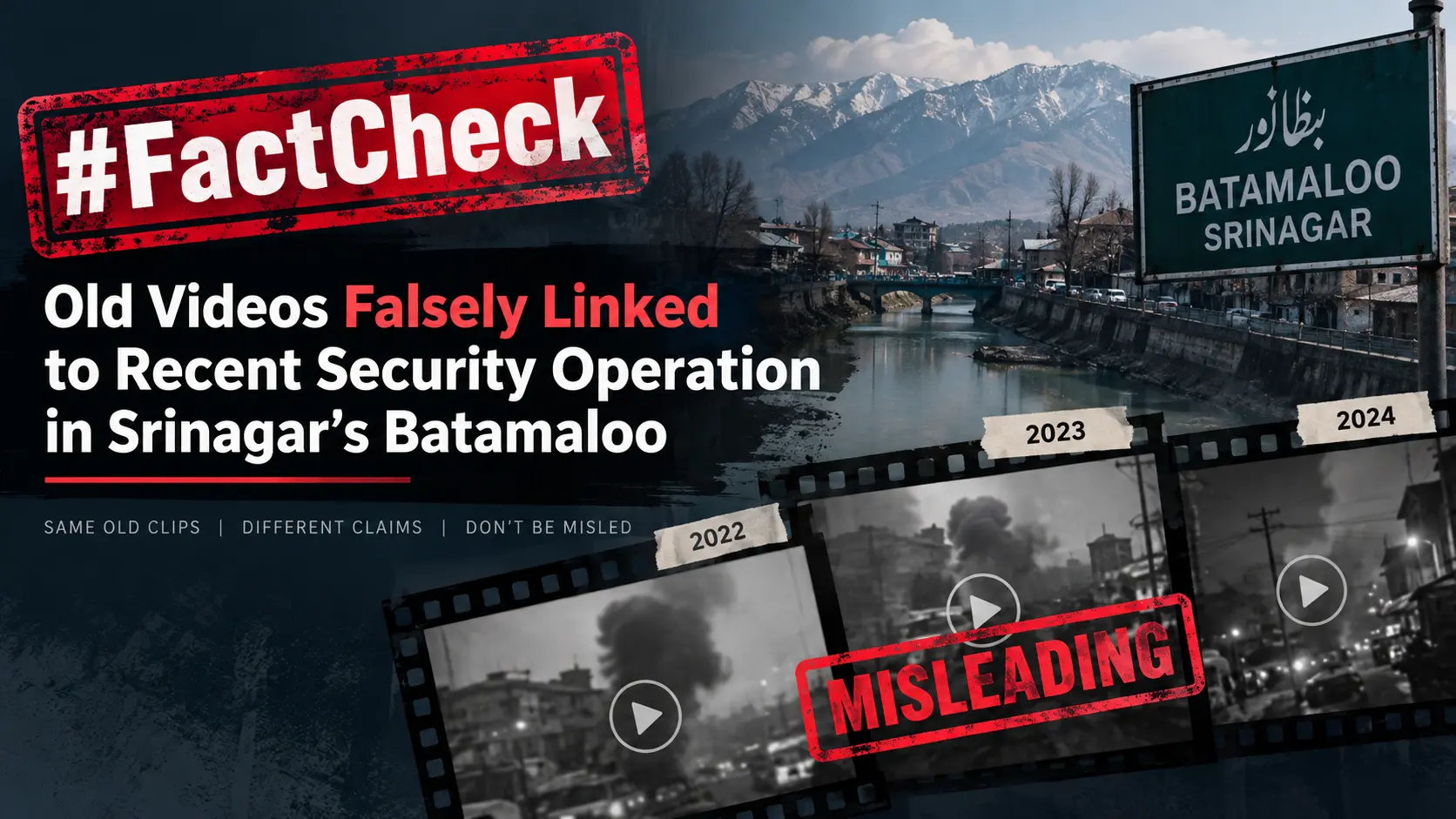
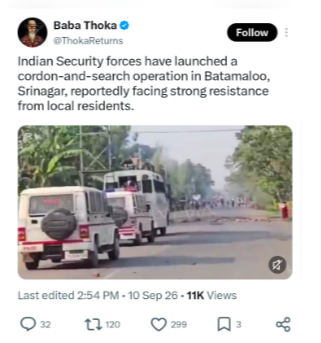
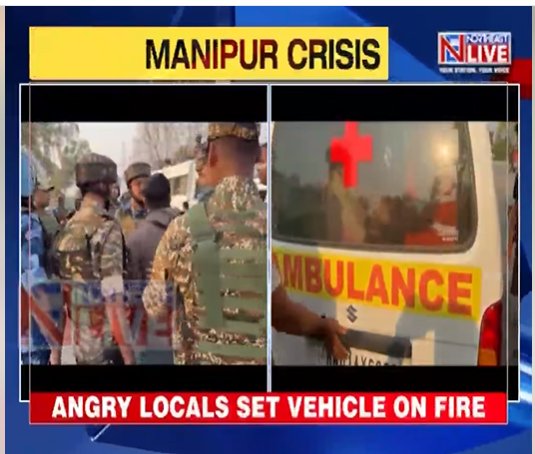
A video is being shared on social media with the claim that Indian security forces faced resistance from local residents during a cordon-and-search operation in the Batamaloo area of Srinagar. Some Pakistani propaganda accounts are sharing the video in an attempt to link it to the recent security operation. Research by CyberPeace found that the viral video is old and unrelated to the recent security operation in the Batamaloo area of Srinagar. The research revealed that the video is actually from Bishnupur, Manipur. It is being falsely presented as footage from Jammu and Kashmir, with claims that local residents were strongly resisting security forces. Similarly, a second video is also being shared with a misleading claim linking it to the recent security operation. The video shows some militants greeting and congratulating one another. However, these visuals are also unrelated to the recent security operation in Batamaloo, Srinagar.
Claim:
An X user shared the viral video with the caption: “Indian security forces have launched a cordon-and-search operation in the Batamaloo area of Srinagar. It is being reported that local residents are strongly resisting the operation.”
https://x.com/ThokaReturns/status/2097979588223930651
FactCheck
As part of our research, we also examined other sources and available reports related to the viral video. However, we did not find any credible report linking the incident shown in the viral video to the recent security operation in Batamaloo, Srinagar. To verify the viral claim, we conducted a reverse image search of the keyframes from the video. During the search, we found similar visuals on the DNA India website, which were published on November 16, 2017.
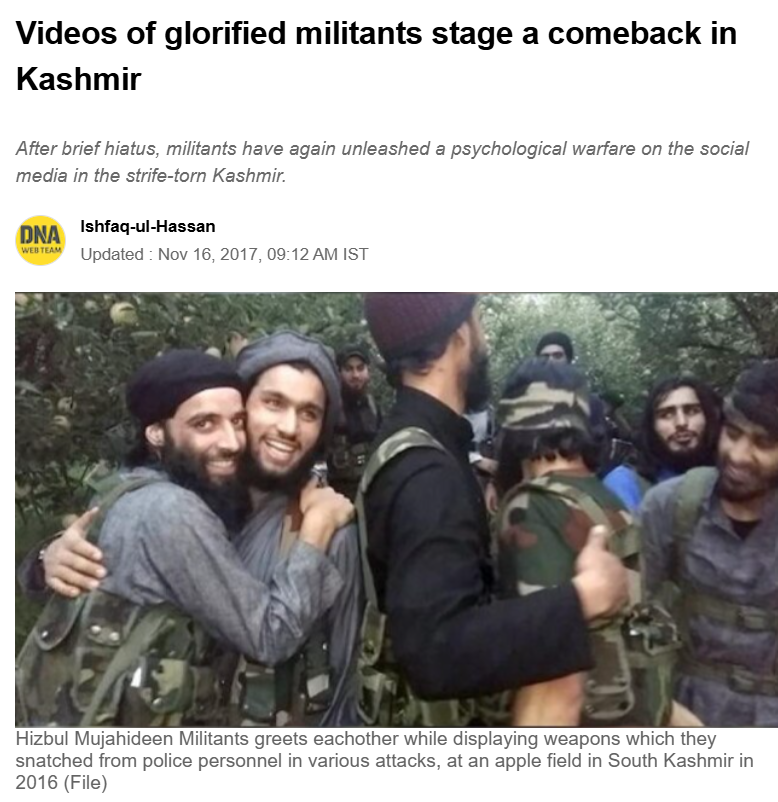
It is being claimed that the militants are congratulating one another and claiming territorial gains in several areas in response to the Indian Army’s security operation in Batamaloo. However, these claims could not be substantiated. According to the available evidence, the visuals are old and unrelated to the recent security operation. As part of the next step in our research, we found similar visuals on the Northeast Live Facebook page. According to the report, tension had escalated in Manipur’s Bishnupur district after an angry mob set a vehicle on fire on suspicion that the occupants were carrying arms and ammunition. The incident reportedly left 20 people injured.
The incident took place along Tidim Road in the Ningthoukhong and Thinungei areas of Bishnupur district, where locals were observing a bandh. During the protest, people became suspicious of two vehicles and stopped them to check them.
https://www.facebook.com/watch/?v=1446641790532433
Conclusion
No credible evidence was found to substantiate these claims. Our research found that the visuals shown in the videos are old and unrelated to the recent security operation in Batamaloo, Srinagar. Security forces had conducted a cordon-and-search operation in the Batamaloo area as part of routine counter-terrorism measures. However, no credible report or other concrete evidence was found linking the videos being shared on social media to this operation.
