
#FactCheck - Old Rajnath Singh Video Falsely Linked To NEET-UG 2026 Paper Leak Controversy
Executive Summary
The Central Bureau of research (CBI) is currently probing the alleged leak of the NEET-UG 2026 examination paper, and several accused persons have already been arrested in connection with the case. Amid this, a video of senior BJP leader and Defence Minister Rajnath Singh is being widely shared on social media. In the clip, he is heard saying, “There will be no resignations. This is not a UPA government, this is an NDA government.” Several users linked the video to the NEET controversy and claimed that Rajnath Singh made the remark while responding to demands for Education Minister Dharmendra Pradhan’s resignation over the alleged paper leak. However, research by the CyberPeace Research Wing found the viral claim to be false. An old video of Rajnath Singh is being misleadingly shared with a false context.
Claim
A Facebook user named “Ravi Kumar Huddi Baba” shared the viral clip on May 13, 2026, claiming that Rajnath Singh was defending the Modi government over demands for the resignation of the education minister in the NEET-UG paper leak case.

Fact Check
To verify the claim, relevant keyword searches were carried out using Google Open Search tools. No credible news reports were found confirming that Rajnath Singh had made any such statement regarding the NEET controversy or demands for Dharmendra Pradhan’s resignation. Had such a statement been made recently, it would likely have been widely reported by mainstream media outlets. A review of Rajnath Singh’s official social media accounts also yielded no such statement or video related to the NEET issue.
During the research, the full version of the viral clip was traced to an old press conference held on June 24, 2015, where Rajnath Singh and then Union Minister Ravi Shankar Prasad were briefing the media about Cabinet decisions. During the interaction, a journalist questioned them regarding resignations linked to controversies at the time. Responding to the question, Rajnath Singh made the now-viral remark. The complete press conference video is available on the BJP’s official YouTube channel and was streamed on June 24, 2015 itself. The viral portion can be heard after the 23-minute mark in the video.

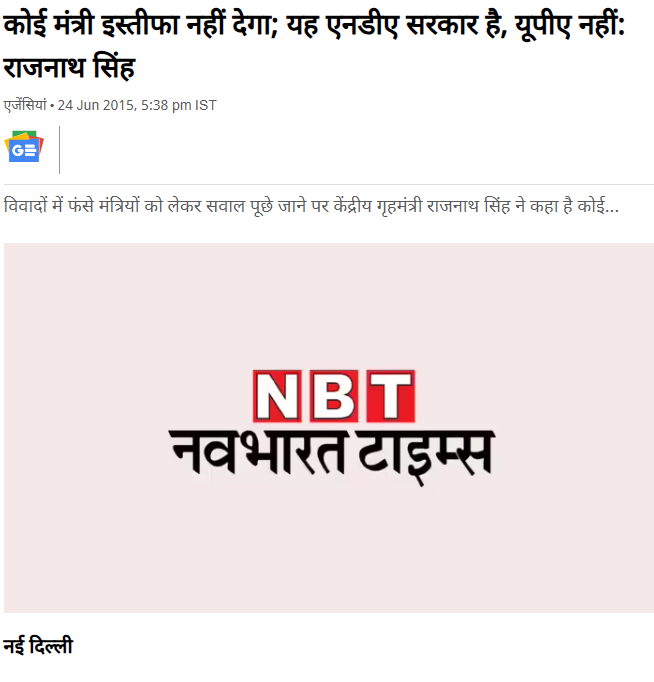
Further searches led to an old report published by Navbharat Times on June 24, 2015. The report stated that Rajnath Singh had made the “NDA, not UPA” remark while responding to questions regarding ministers embroiled in controversies at that time.
Conclusion
The viral claim is false. Rajnath Singh has not made any recent statement linking the NEET-UG 2026 paper leak case with demands for the education minister’s resignation. The viral clip is actually from a 2015 press conference and is being shared with misleading and false context.

Related Blogs
Executive Summary
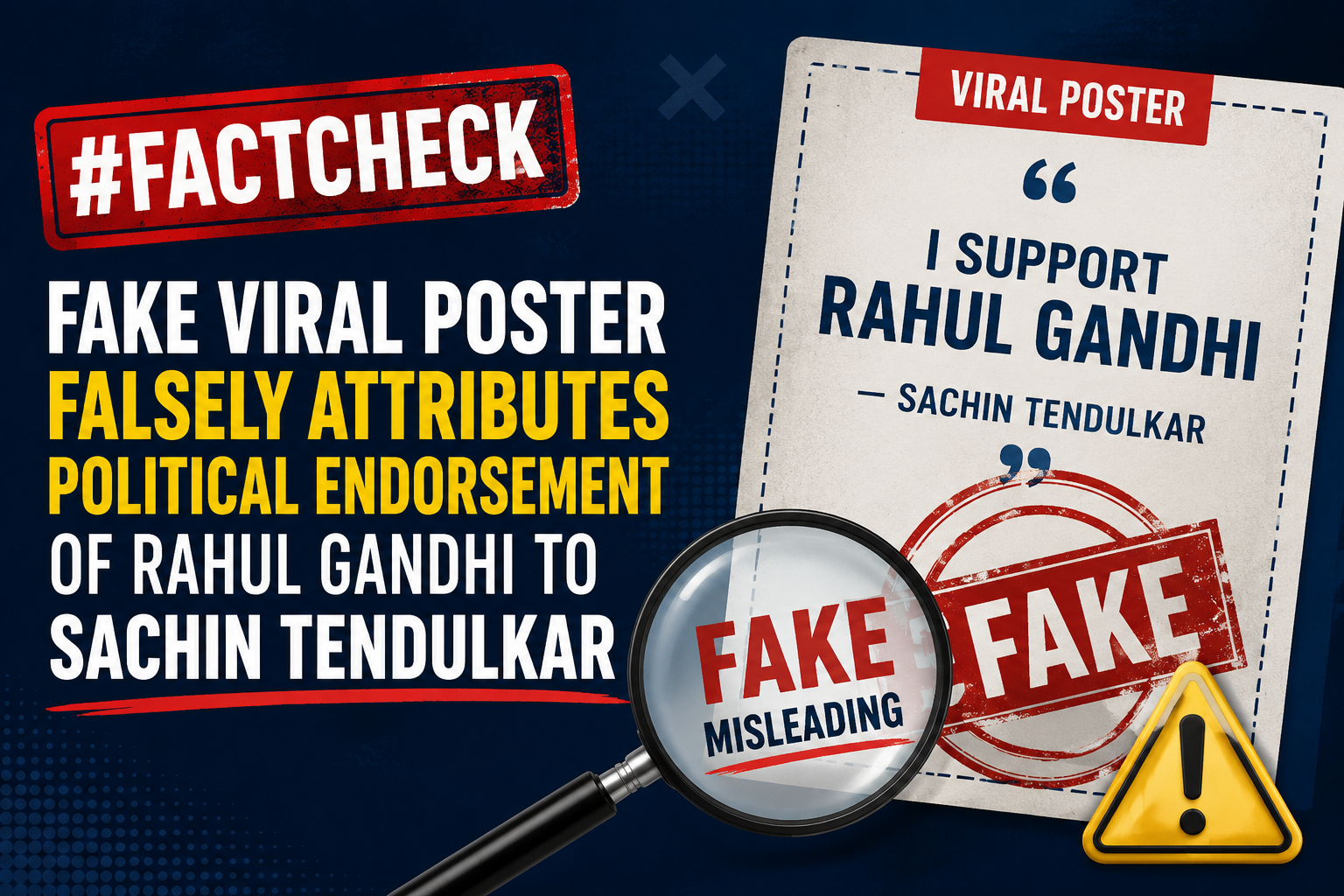
A post claiming that former Indian cricketer Sachin Tendulkar praised Congress leader Rahul Gandhi and urged people to elect him as Prime Minister is being widely circulated on social media.The viral poster falsely attributes a political statement to Sachin Tendulkar, suggesting that he has endorsed Rahul Gandhi for the post of Prime Minister. However, CyberPeace Research Wing research found the claim to be fake. Sachin Tendulkar has not made any such appeal or statement supporting Rahul Gandhi for Prime Minister.
Claim
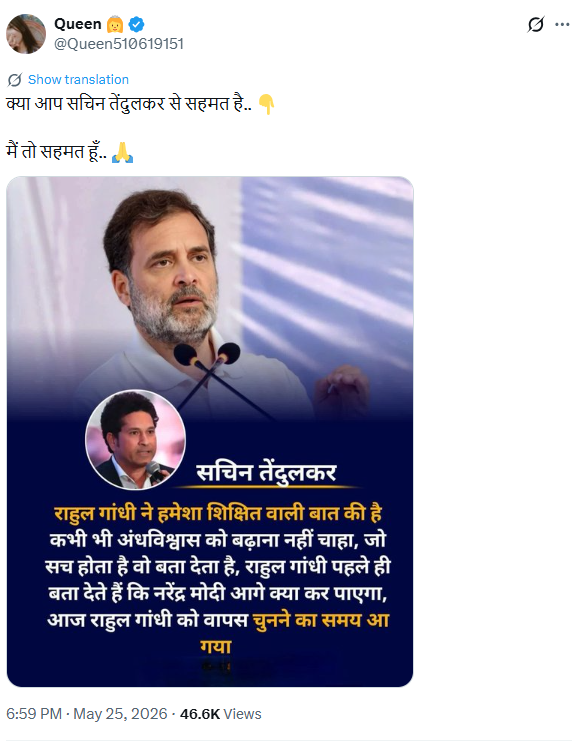
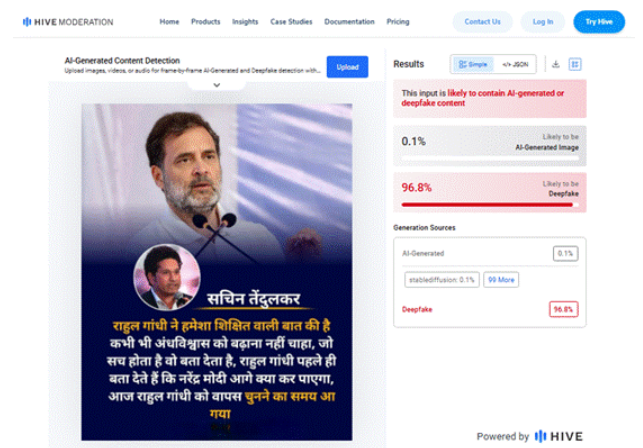
On X (formerly Twitter), a verified user “Queen” shared a viral poster claiming:“Sachin Tendulkar has always supported education and never promoted superstition. Rahul Gandhi always predicts what Narendra Modi will do next. It is time to choose Rahul Gandhi again.”
Fact Check
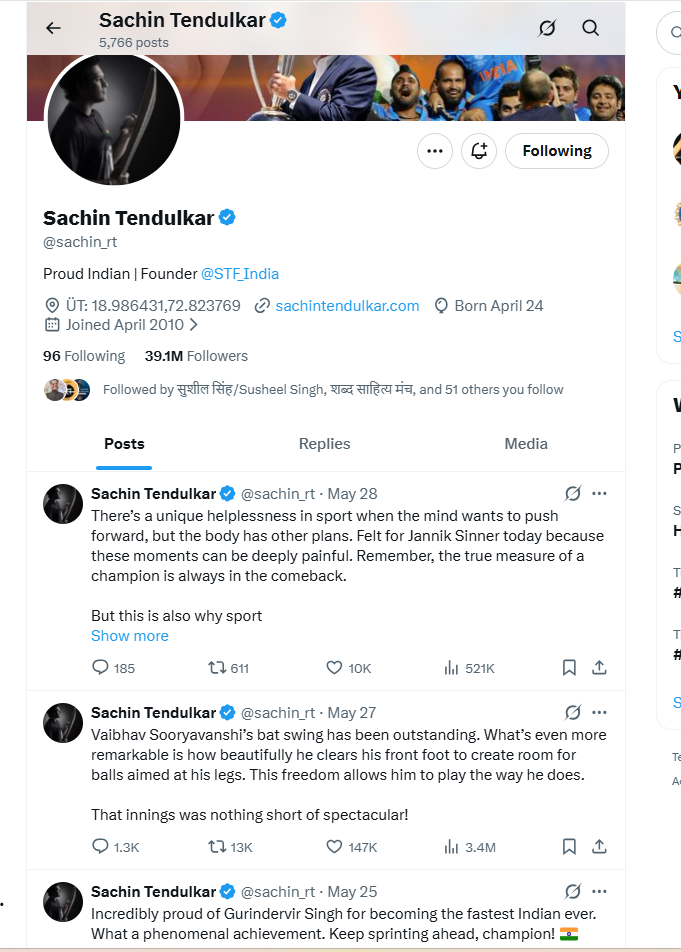
To verify the claim, we first searched for any news reports, interviews, or credible references linking Sachin Tendulkar to such a political statement. However, we found no evidence in any reliable media source or public record suggesting that he made any such remark about Rahul Gandhi or the Prime Ministership. We also reviewed Sachin Tendulkar’s official social media accounts, but found no post, video, or statement endorsing any political leader in this manner.
Finally, the viral poster was analysed using the AI detection tool Hive Moderation. The analysis indicated a 96.8% probability that the poster was digitally created or manipulated, suggesting possible AI-generated or edited content.
Conclusion
CyberPeace Research Wing research found the claim to be fake. Sachin Tendulkar has not made any appeal to elect Rahul Gandhi as Prime Minister. The viral poster appears to be digitally fabricated and is being shared to spread misinformation.
%20(1).webp)
Introduction
Bumble’s launch of its ‘Opening Move’ feature has sparked a new narrative on safety and privacy within the digital dating sphere and has garnered mixed reactions from users. It was launched against the backdrop of women stating that the ‘message first’ policy of Bumble was proving to be tedious. Addressing the large-scale review, Bumble launched its ‘Opening Move’ feature, whereby users can either craft or select from pre-set questions which potential matches may choose to answer to start the conversation at first glance. These questions are a segue into meaningful and insightful conversation from the get-go and overstep the traditional effort to start engaging chats between matched users. This feature is an optional feature that users may enable and as such does not prevent a user from exercising the autonomy previously in place.
Innovative Approach to Conversation Starters
Many users consider this feature as innovative; not only does it act as a catalyst for fluid conversation but also cultivates insightful dialogue, fostering meaningful interactions that are devoid of the constraint of superficial small talk. The ‘Opening Moves’ feature may also be aligned with unique scientific research indicating that individuals form their initial attractions within 3-seconds of intimate interaction, thereby proving to be a catalyst to the decision-making process of an individual in the attraction time frame.
Organizational Benefits and Data Insights
From an organisational standpoint, the feature is a unique solution towards localisation challenges faced by apps; the option of writing a personalised ‘Opening Move’ implies setting prompts that are culturally relevant and appropriate in a specific area. Moreover, it is anticipated that Bumble may enhance and improve user experience within the platform through data analysis. Data from responses to an ‘Opening Move’ may provide valuable insights into user preferences and patterns by analysing which pre-set prompts garner more responses over others and how often is a user-written ‘Opening Move’ successful in obtaining a response in comparison with Bumble’s pre-set prompts. A quick glance at Bumble’s privacy policy[1] shows that data storing and transferring of chats between users are not shared with third parties, further safeguarding personal privacy. However, Bumble does use the chat data for its own internal purposes after removing personally identifiable information from chats. The manner of such review and removal of data has not been specified, which may raise challenges depending upon whether the reviewer is a human or an algorithm.
However, some users perceive the feature as counterproductive to the company’s principle of ‘women make the first move’. While Bumble aims to market the feature as a neutral ground for matched users based on the exercise of choice, users see it as a step back into the heteronormative gender expectations that most dating apps conform to, putting the onus of the ‘first move’ on men. Many male users have complained that the feature acts as a catalyst for men to opt out of the dating app and would most likely refrain from interacting with profiles enabled with the ‘Opening Move’ feature, since the pressure to answer in a creative manner is disproportionate with the likelihood their response actually being entertained.[2] Coupled with the female users terming the original protocol as ‘too much effort’, the preset questions of the ‘Opening Move’ feature may actively invite users to categorise potential matches according to arbitrary questions that undermine real-life experiences, perspectives and backgrounds of each individual.[3]
Additionally, complications are likely to arise when a notorious user sets a question that indirectly gleans personal or sensitive, identifiable information. The individual responding may be bullied or be subjected to hateful slurs when they respond to such carefully crafted conversation prompts.
Safety and Privacy Concerns
On the corollary, the appearance of choice may translate into more challenges for women on the platform. The feature may spark an increase in the number of unsolicited, undesirable messages and images from a potential match. The most vulnerable groups at present remain individuals who identify as females and other sexual minorities.[4] At present, there appears to be no mechanism in place to proactively monitor the content of responses, relying instead on user reporting. This approach may prove to be impractical given the potential volume of objectionable messages, necessitating a more efficient solution to address this issue. It is to be noted that in spite of a user reporting, the current redressal systems of online platforms remain lax, largely inadequate and demonstrate ineffectiveness in addressing user concerns or grievances. This lack of proactiveness is violative of the right to redressal provided under the Digital Personal Data Protection Act, 2023. It is thought that the feature may actually take away user autonomy that Bumble originally aimed to grant since Individuals who identify as introverted, shy, soft-spoken, or non-assertive may refrain from reporting harassing messages altogether, potentially due to discomfort or reluctance to engage in confrontation. Resultantly, it is anticipated that there would be a sharp uptake in cases pertaining to cyberbullying, harassment and hate speech (especially vulgar communications) towards both the user and the potential match.
From an Indian legal perspective, dating apps have to adhere to the Information Technology Act, 2000 [5], the Information Technology (Intermediary and Digital Media Ethics) Rules 2021 [6] and the Digital Personal Data Protection Act, 2023, that regulates a person’s digital privacy and set standards on the kind of content an intermediary may host. An obligation is cast upon an intermediary to uprise its users on what content is not allowed on its platform in addition to mandating intimation of the user’s digital rights. The lack of automated checks, as mentioned above, is likely to make Bumble non-compliant with the ethical guidelines.
The optional nature of the ‘Opening Move’ grants users some autonomy. However, some technical updates may enhance the user experience of this feature. Technologies like AI are an effective aid in behavioural and predictive analysis. An upgraded ‘matching’ algorithm can analyse the number of un-matches a profile receives, thereby identifying and flagging a profile having multiple lapsed matches. Additionally, the design interface of the application bearing a filter option to filter out flagged profiles would enable a user to be cautious while navigating through the matches. Another possible method of weeding out notorious profiles is by deploying a peer-review system of profiles whereby a user has a singular check-box that enables them to flag a profile. Such a checkbox would ideally be devoid of any option for writing personal comments and would bear a check box stating whether the profile is most or least likely to bully/harass. This would ensure that a binary, precise response is recorded and any coloured remarks are avoided. [7]
Governance and Monitoring Mechanisms
From a governance point of view, a monitoring mechanism on the manner of crafting questions is critical. Systems should be designed to detect certain words/sentences and a specific manner of framing sentences to disallow questions contrary to the national legal framework. An onscreen notification having instructions on generally acceptable manner of conversations as a reminder to users to maintain cyber hygiene while conversing is also proposed as a mandated requirement for platforms. The notification/notice may also include guidelines on what information is safe to share in order to safeguard user privacy. Lastly, a revised privacy policy should establish the legal basis for processing responses to ‘Opening Moves’, thereby bringing it in compliance with national legislations such as the Digital Personal Data Protection Act, 2023.
Conclusion
Bumble's 'Opening Move' feature marks the company’s ‘statement’ step to address user concerns regarding initiating conversations on the platform. While it has been praised for fostering more meaningful interactions, it also raises not only ethical concerns but also concerns over user safety. While the 'Opening Move' feature can potentially enhance user experience, its success is largely dependent on Bumble's ability to effectively navigate the complex issues associated with this feature. A more robust monitoring mechanism that utilises newer technology is critical to address user concerns and to ensure compliance with national laws on data privacy.
Endnotes:
- [1] Bumble’s privacy policy https://bumble.com/en-us/privacy
- [2] Discussion thread, r/bumble, Reddit https://www.reddit.com/r/Bumble/comments/1cgrs0d/women_on_bumble_no_longer_have_to_make_the_first/?share_id=idm6DK7e0lgkD7ZQ2TiTq&utm_content=2&utm_medium=ios_app&utm_name=ioscss&utm_source=share&utm_term=1&rdt=65068
- [3] Mcrea-Hedley, Olivia, “Love on the Apps: When did Dating Become so Political?”, 8 February 2024 https://www.service95.com/the-politics-of-dating-apps/
- [4] Gewirtz-Meydan, A., Volman-Pampanel, D., Opuda, E., & Tarshish, N. (2024). ‘Dating Apps: A New Emerging Platform for Sexual Harassment? A Scoping Review. Trauma, Violence, & Abuse, 25(1), 752-763. https://doi.org/10.1177/15248380231162969
- [5] Information Technology Act, 2000 https://www.indiacode.nic.in/bitstream/123456789/13116/1/it_act_2000_updated.pdf
- [6] Information Technology (Intermediary Guidelines and Digital Media Ethics) Rules 2021 https://www.meity.gov.in/writereaddata/files/Information%20Technology%20%28Intermediary%20Guidelines%20and%20Digital%20Media%20Ethics%20Code%29%20Rules%2C%202021%20%28updated%2006.04.2023%29-.pdf
- [7] Date Confidently: Engaging Features in a Dating App (Use Cases), Consaguous, 10 July 2023 https://www.consagous.co/blog/date-confidently-engaging-features-in-a-dating-app-use-cases
Introduction
WhatsApp has become the new platform for scams, and the number of cases of WhatsApp scams is increasing daily. Just like that, a new WhatsApp scam has been started, and many WhatsApp users in India have reported receiving missed calls from unknown international numbers. Worse, one does not even have to answer the call to be scammed. A missed call is sufficient to be scammed.
Millions of populations switch from normal SMS to WhatsApp, usually, people used to get fake messages and marketing messages, but the trend of scamming has been evolving now. Most people get calls from different countries, and they are concerned about how these scammers got the numbers. WhatsApp works through VoIP networks, so no extra charges from any country exist. And about 500 million WhatsApp users are getting these scam calls, the calls are mainly on job-scams of promising part-time employment and opportunities. These types of job scam calls have been started reporting in 2023.
People reporting missed calls from countries like Ethiopia (+251), Malaysia (+60), Indonesia (+62), Vietnam (+84), etc.
The agenda of these calls are still unclear. Still, in some cases, the scammers ask for confidential information from WhatsApp users, like bank details, so the users must not reveal their personal information. Also, it is important to note that if you get any calls from a particular country, it necessarily does not mean it is from that country. Various agencies sell international numbers for WhatsApp calls.
Why has WhatsApp become a hub scam?
The generation has evolved and dumped the old SMS into WhatsApp. From school to college and offices, people use WhatsApp for their official work, as it is very easy and user-friendly, so people avoid safety measures. Generally, users need to understand the consequences of technology and use it with safeguards and awareness. Many people lose money and become victims of scams on WhatsApp as they share their confidential information. And the worse is that one does not even have to answer the call to be scammed. A missed call is sufficient to be scammed.
Before these international calls scam, the user received a call from the scam that they were from KBC, and the user won something. Then sought confidential information by the excuse that they would transfer the money to the user, and because of that user got scammed by the scammers. These scams have risen rapidly lately.
Safeguards users can use against these scam calls
WhatsApp responds to complaints regarding international calls to “block and report.”
If you have already received such calls, the best thing you can do is report and block them right away. As a result, the same number does not return to your phone, and numerous identical reports may persuade WhatsApp to delete the number entirely.
WhatsApp is also working on an update allowing users to block calls from unknown numbers on the service.

Users must modify their phone’s and app’s fundamental privacy settings to protect themselves from data breaches. The calls are directed toward app users who are actively using the app. However, by modifying the account’s appearance, a user can lessen the likelihood of being added to the scammers’ attack lists.
Limit Privacy
Begin by modifying WhatsApp’s ‘who can see’ settings. If your profile photo, last seen, and online status are visible to anybody, restrict them to persons on your contact list only. Change the About and Groups options as well.
Turn on two-factor authentication
Enabling two-factor authentication on WhatsApp adds more security to your data. In addition, the app also supports biometric protection in case of theft or loss.
Active Reporting
The users should report as soon as they see something odd or suspicious activity.
A typical question that users have is, ‘Where do the scammers acquire my phone number from?’
The answer is a little more complicated than we thought. Your data is retained on the company database from the time you sign up on a website or reveal your phone number at a store in order to take advantage of promotional offers and promotions. Due to a lack of technological infrastructure and legislation to protect personal data, a scammer can simply obtain your information.
According to Palo Alto research, India is the second most vulnerable country in the APAC region in terms of cyberattacks and data breaches. A data protection law is essential in the face of increasing calls and data breaches.
The Digital Personal Data Protection bill is set to be introduced in the parliament’s monsoon session. The bill has the potential to protect data, which will help to eliminate scams.
Conclusion
Several people had tweeted on tweeter about receiving fake calls on WhatsApp from international numbers more than once. WhatsApp encrypts calls and messages, making it difficult to track the person, and it appears that hackers are taking advantage of this to swindle customers. If you receive a WhatsApp call from any of the above ISD codes, we strongly advise you not to answer it and to block the number so the bad actors do not call you again. Report & block immediately that’s what WhatsApp has been responding to the complainants.
