
#FactCheck-Viral Video of Indian Flag Desecration is from Karachi, Pakistan, Not Tehran
Executive Summary
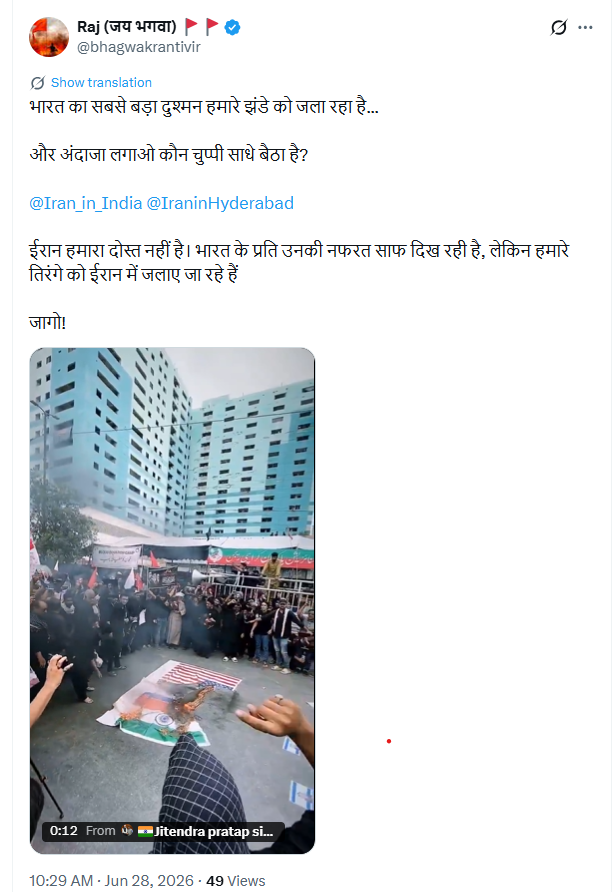
A video showing a large crowd disrespecting the Indian tricolor along with American and Israeli flags is being widely shared on social media. Users sharing the video claim that the incident recently took place in Iran's capital, Tehran, showcasing "Iran's hatred towards India." However, a fact-check done by the CyberPeace Research Wing has revealed that this claim is misleading. The viral video was not filmed in Iran, but rather during a procession in Karachi, Pakistan.
The Claim
A user on the social media platform X (formerly Twitter) shared the video with the caption: "India’s biggest enemy is burning our flag and guess who is sitting silently? Iran is not our friend. Their hatred towards India is clearly visible, but our tricolor is being burnt in Iran." https://x.com/bhagwakrantivir/status/2071096021183246667 , https://archive.ph/6mGE8
Factcheck
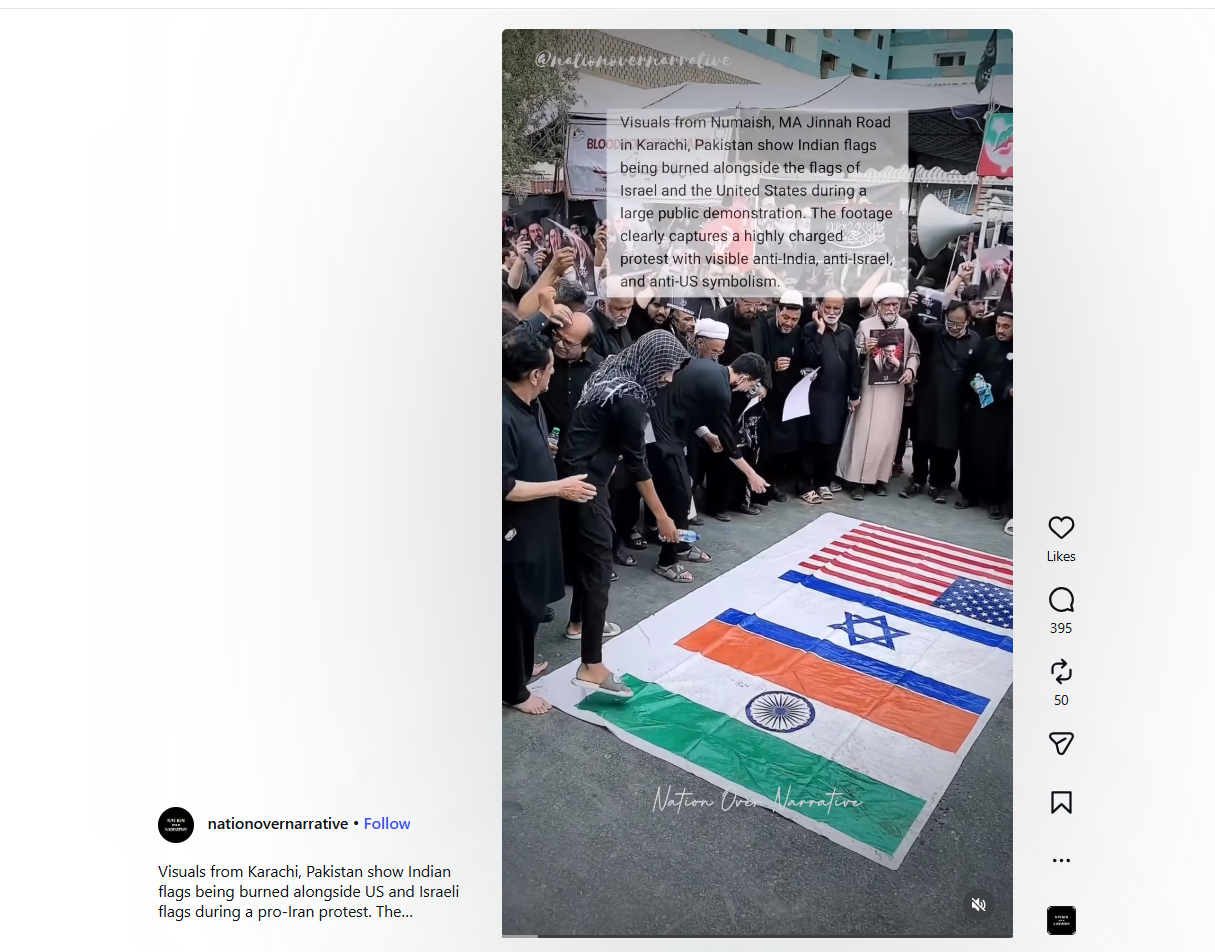
Keyframes extracted from the viral video were searched using Google Lens. This led to an Instagram post containing the exact same footage. The caption of this post identified the location as Karachi, Pakistan, noting that the demonstration was held in support of Iran, during which flags of India, the US, and Israel were burnt.
https://www.instagram.com/reels/DaDLQO6obcK/
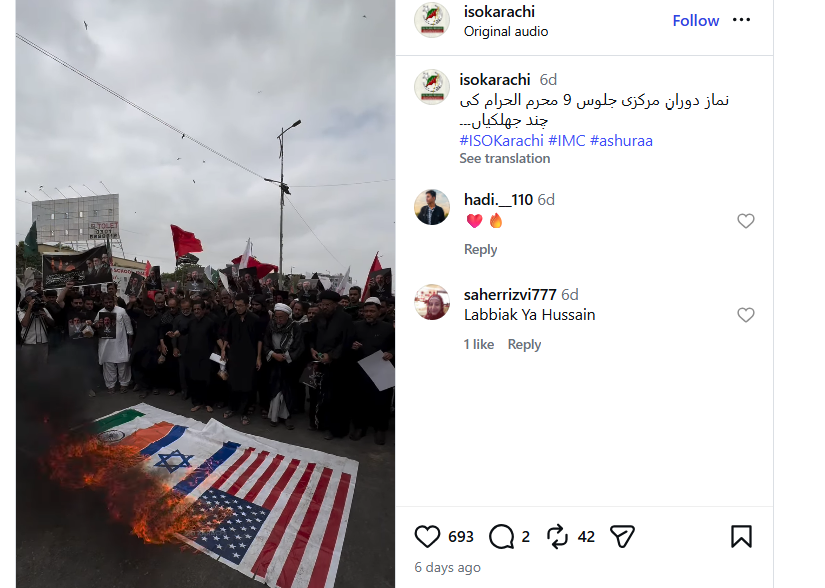
Further keyword searches led to the official Instagram account of the 'Imamia Students Organization Karachi'. A video uploaded on June 25, 2026, showed the same event captured from a different camera angle. According to the caption, the footage is from a '9th Muharram' procession in Karachi.
https://www.instagram.com/p/DaApSBfIpNQ/
To conclusively establish the location, Google Maps Street View was used to cross-reference the physical landmarks seen in the video.The visual elements perfectly match Mohammad Ali Jinnah Road in Karachi, Pakistan.A distinct blue building named 'Mid Town', visible in the viral video, matches the Google Street View imagery of the location.

Conclusion
The research confirms that the video showing the burning and desecration of the Indian national flag is from Karachi, Pakistan, and not Tehran, Iran. The social media claims linking this incident to Iran are false and contextually misleading.

Related Blogs
Executive Summary
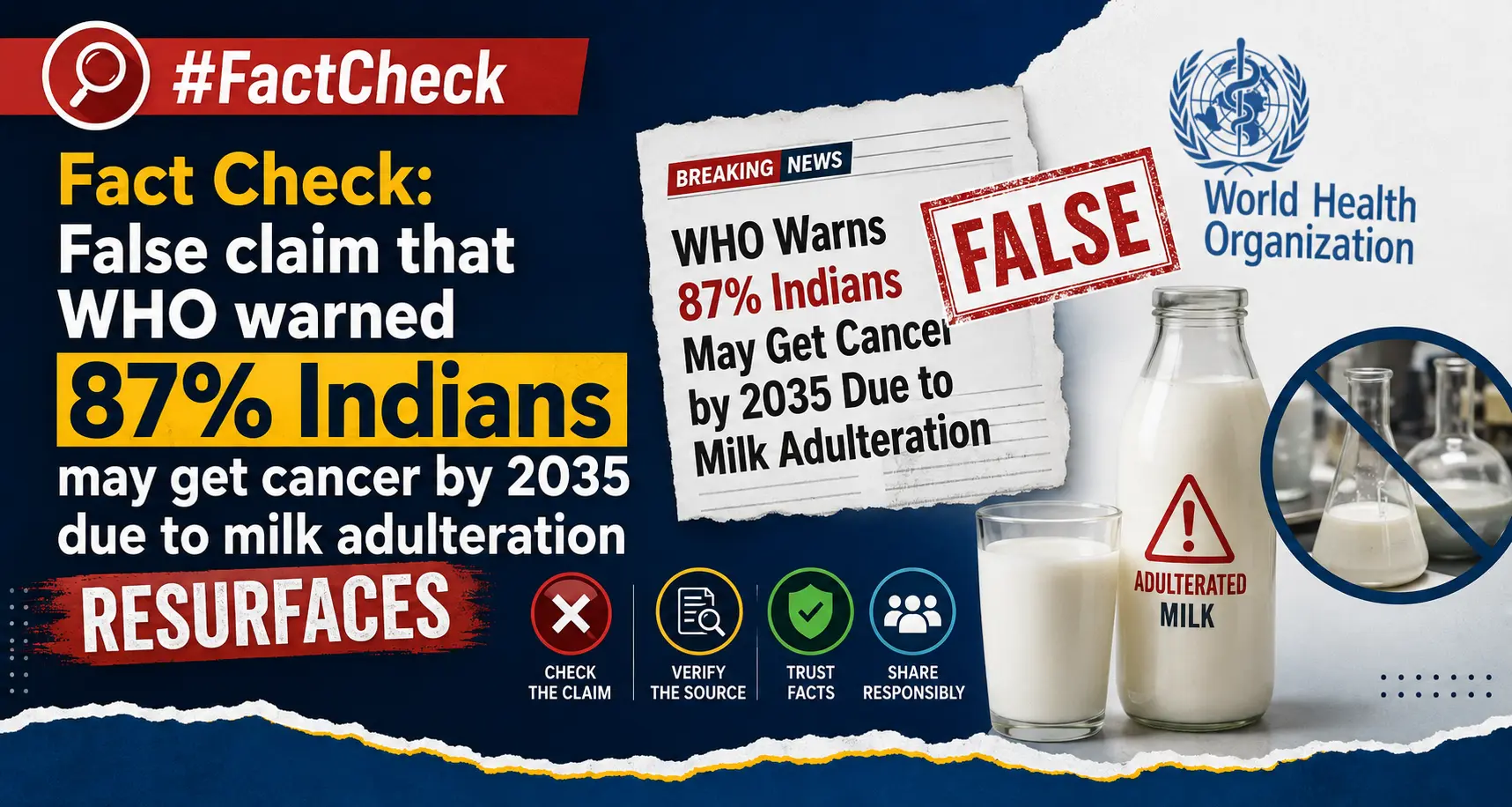
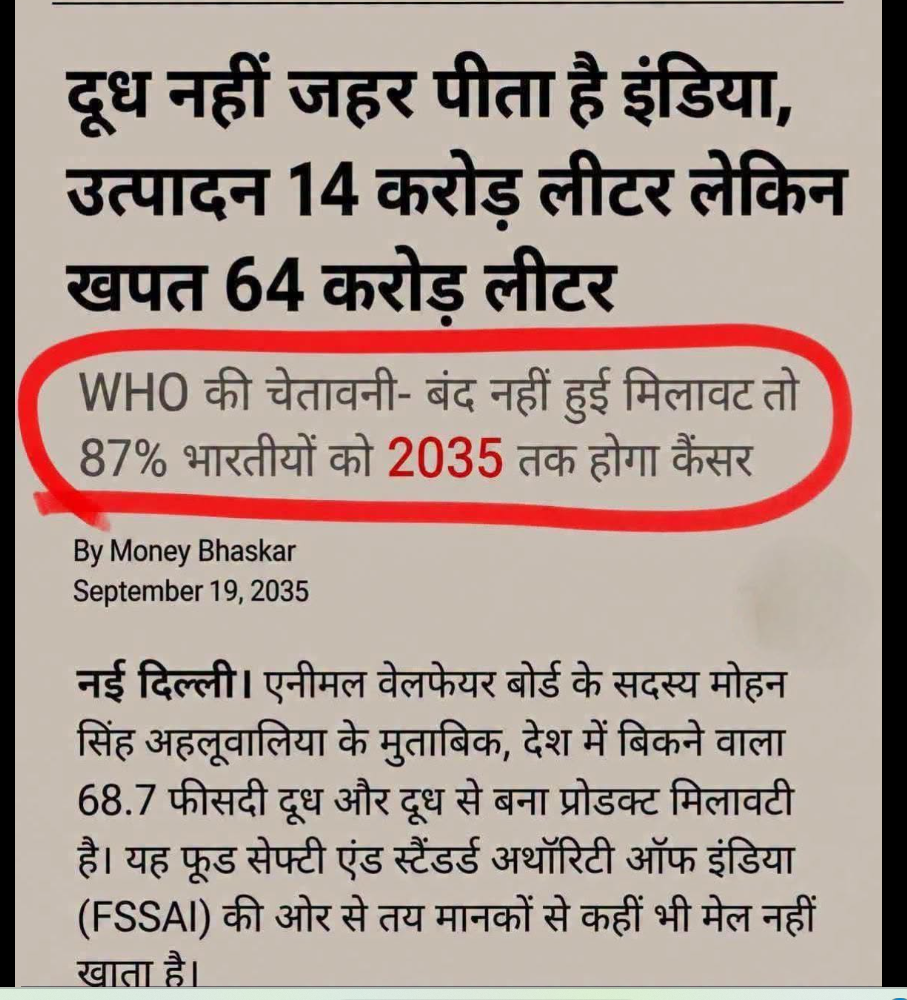
A post is going viral across various social media platforms claiming that the World Health Organization (WHO) has issued a warning over the issue of adulteration in food products. According to the claim, WHO has warned that milk adulteration is continuously increasing in India and if it continues, 87 percent of Indians will suffer from cancer by 2035. CyberPeace Research Wing’s research found that the viral claim has been circulating on social media for several years. Earlier, the same claim was shared with the year changed to 2025, stating that 87 percent of Indians would suffer from cancer by that year. Now, the year has been changed from 2025 to 2035 and the claim is being circulated again. WHO has repeatedly denied this claim and termed it fake news.
Claim:
A Facebook user named ‘Vikalp Kuchamancity’ shared the viral post on August 3, 2026, with a caption claiming, “India produces 14 crore litres of milk, but consumption is 64 crore litres. Where does this extra milk come from? WHO has warned that if adulteration is not stopped, 87 percent of Indians may suffer from cancer by 2035.”
https://www.facebook.com/photo/?fbid=968660469565357&set=a.109816988783047
Fact Check:
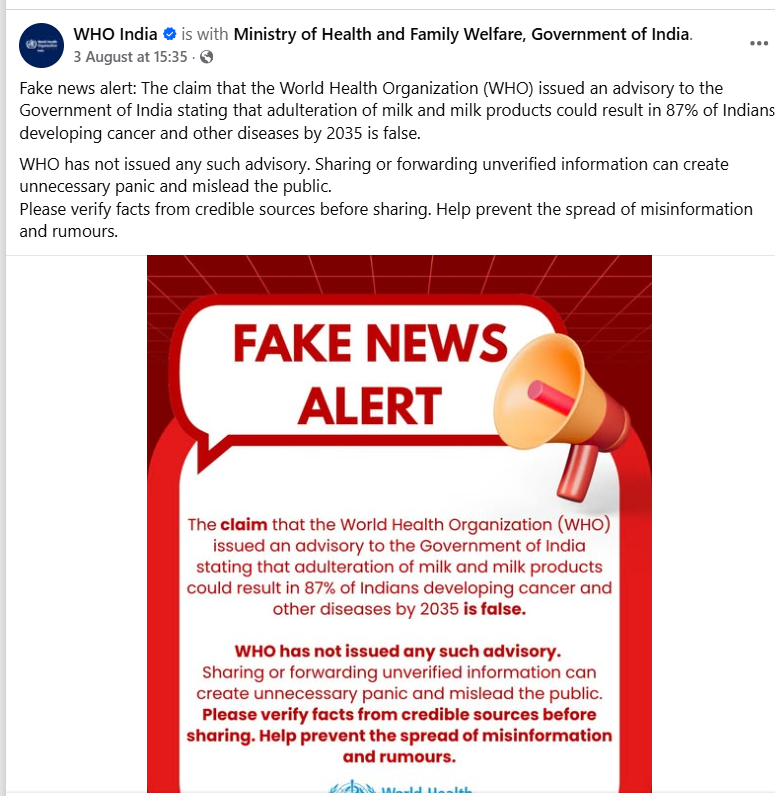
While examining the viral post, we noticed that the report displayed in the image carries the date September 19, 2035, even though the current year is 2026. This raised initial doubts about the authenticity of the claim.To investigate further, we conducted a Google search using relevant keywords. During the search, we found a post from the official Facebook page of WHO India, shared on August 3, 2026. The post denied the viral claim and stated that it is false that WHO issued any advisory to the Indian government warning that adulteration in milk and dairy products could lead to cancer and other diseases among 87 percent of Indians by 2035. WHO clarified that no such advisory has been issued.
WHO India Facebook link:
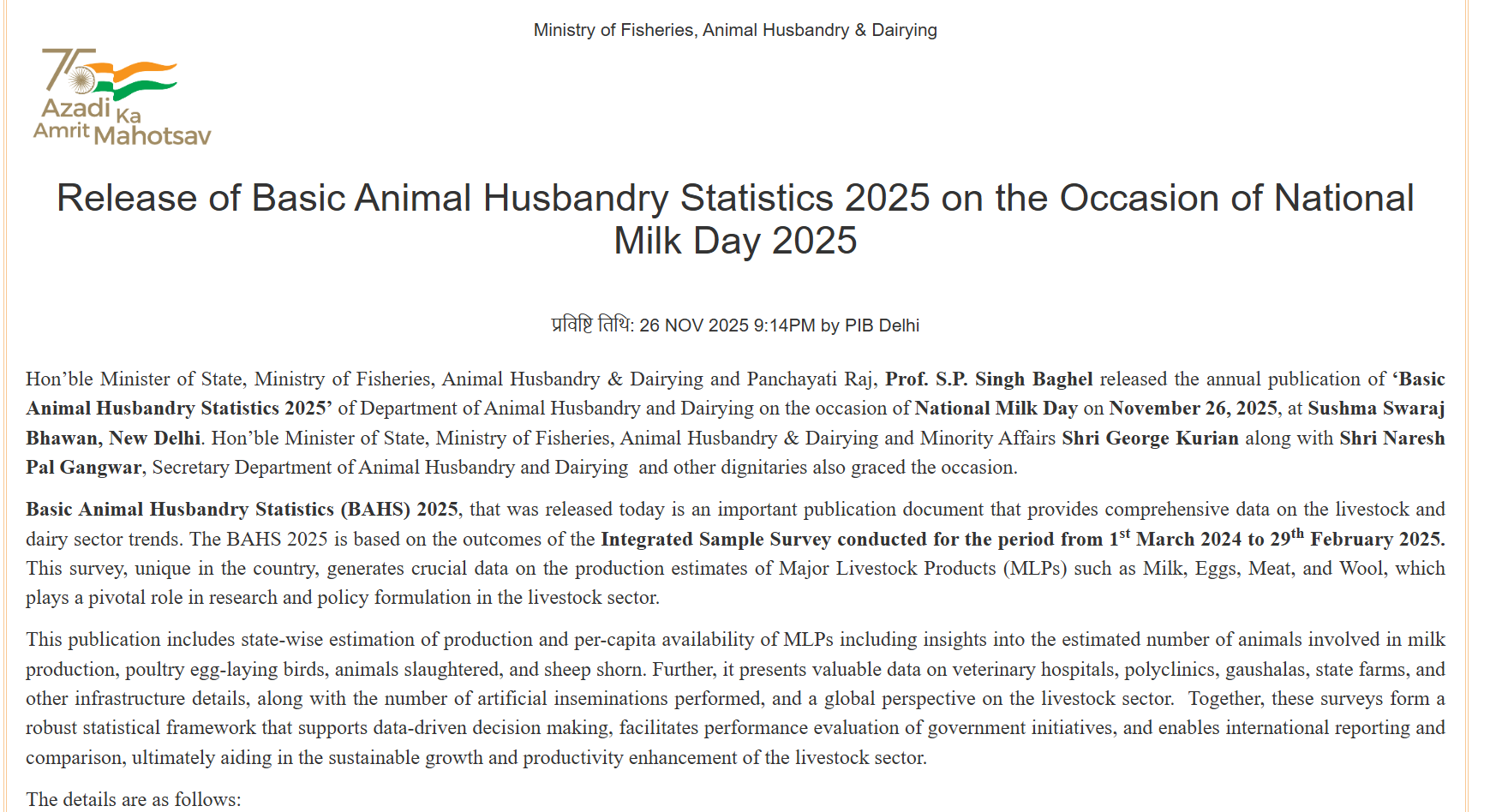
According to data mentioned in a press release issued by the Government of India on November 26, 2025, the country’s total milk production was estimated at 247.87 million tonnes in 2024-25, compared to 239.30 million tonnes in 2023-24. The per capita availability of milk increased from 319 grams per day in 2014-15 to 485 grams per day in 2024-25. The top five milk-producing states are Uttar Pradesh (15.66%), Rajasthan (14.82%), Madhya Pradesh (9.12%), Gujarat (7.78%), and Maharashtra (6.71%). Together, these states contribute 54.09% of India’s total milk production.
https://www.pib.gov.in/PressReleasePage.aspx?PRID=2195049®=3&lang=2
Conclusion:
The research confirmed that there is no evidence of any WHO warning stating that 87 percent of Indians could develop cancer by 2035 due to milk adulteration. WHO has clarified that it has not issued any such advisory. The viral claim is a recycled false claim that has been repeatedly circulated with changed dates.

Executive Summary:
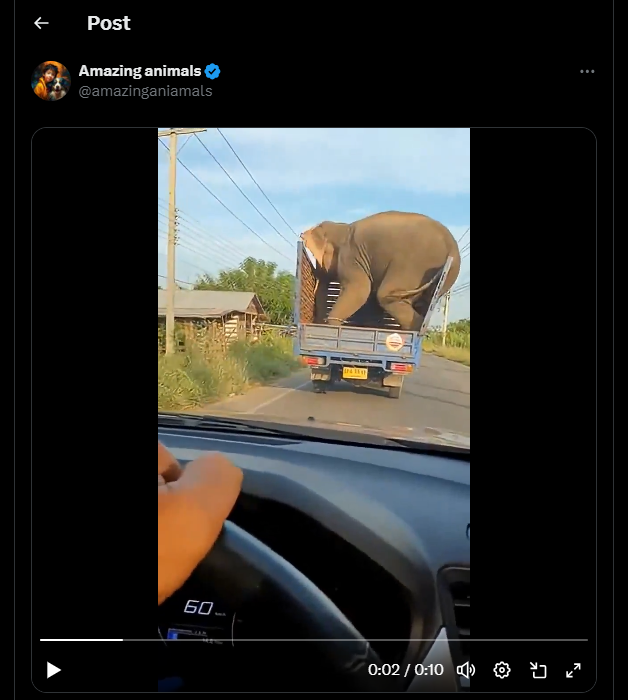
A video circulating on social media claims to show a live elephant falling from a moving truck due to improper transportation, followed by the animal quickly standing up and reacting on a public road. The content may raise concerns related to animal cruelty, public safety, and improper transport practices. A detailed examination using AI content detection tools, visual anomaly analysis indicates that the video is not authentic and is likely AI generated or digitally manipulated.
Claim:
The viral video (archive link) shows a disturbing scene where a large elephant is allegedly being transported in an open blue truck with barriers for support. As the truck moves along the road, the elephant shifts its weight and the weak side barrier breaks. This causes the elephant to fall onto the road, where it lands heavily on its side. Shortly after, the animal is seen getting back on its feet and reacting in distress, facing the vehicle that is recording the incident. The footage may raise serious concerns about safety, as elephants are normally transported in reinforced containers, and such an incident on a public road could endanger both the animal and people nearby.
Fact Check:
After receiving the video, we closely examined the visuals and noticed some inconsistencies that raised doubts about its authenticity. In particular, the elephant is seen recovering and standing up unnaturally quickly after a severe fall, which does not align with realistic animal behavior or physical response to such impact.
To further verify our observations, the video was analyzed using the Hive Moderation AI Detection tool, which indicated that the content is likely AI generated or digitally manipulated.
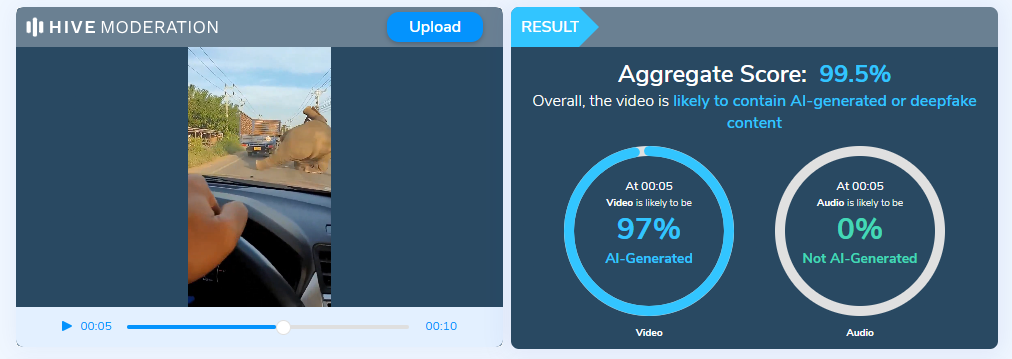
Additionally, no credible news reports or official sources were found to corroborate the incident, reinforcing the conclusion that the video is misleading.
Conclusion:
The claim that the video shows a real elephant transport accident is false and misleading. Based on AI detection results, observable visual anomalies, and the absence of credible reporting, the video is highly likely to be AI generated or digitally manipulated. Viewers are advised to exercise caution and verify such sensational content through trusted and authoritative sources before sharing.
- Claim: The viral video shows an elephant allegedly being transported, where a barrier breaks as it moves, causing the animal to fall onto the road before quickly getting back on its feet.
- Claimed On: X (Formally Twitter)
- Fact Check: False and Misleading

Introduction
AI has revolutionized the way we look at growing technologies. AI is capable of performing complex tasks in fasten time. However, AI’s potential misuse led to increasing cyber crimes. As there is a rapid expansion of generative AI tools, it has also led to growing cyber scams such as Deepfake, voice cloning, cyberattacks targeting Critical Infrastructure and other organizations, and threats to data protection and privacy. AI is empowered by giving the realistic output of AI-created videos, images, and voices, which cyber attackers misuse to commit cyber crimes.
It is notable that the rapid advancement of technologies such as generative AI(Artificial Intelligence), deepfake, machine learning, etc. Such technologies offer convenience in performing several tasks and are capable of assisting individuals and business entities. On the other hand, since these technologies are easily accessible, cyber-criminals leverage AI tools and technologies for malicious activities or for committing various cyber frauds. By such misuse of advanced technologies such as AI, deepfake, and voice clones. Such new cyber threats have emerged.
What is Deepfake?
Deepfake is an AI-based technology. Deepfake is capable of creating realistic images or videos which in actuality are created by machine algorithms. Deepfake technology, since easily accessible, is misused by fraudsters to commit various cyber crimes or deceive and scam people through fake images or videos that look realistic. By using the Deepfake technology, cybercriminals manipulate audio and video content which looks very realistic but, in actuality, is fake. Voice cloning is also a part of deepfake. To create a voice clone of anyone's, audio can be deepfaked too, which closely resembles a real one but, in actuality, is a fake voice created through deepfake technology.
How Deepfake Can Harm Organizations or Enterprises?
- Reputation: Deepfakes have a negative impact on the reputation of the organization. It’s a reputation which is at stake. Fake representations or interactions between an employee and user, for example, misrepresenting CEO online, could damage an enterprise’s credibility, resulting in user and other financial losses. To be protective against such incidents of deepfake, organisations must thoroughly monitor online mentions and keep tabs on what is being said or posted about the brand. Deepfake-created content can also be misused to Impersonate leaders, financial officers and officials of the organisation.
- Misinformation: Deepfake can be used to spread misrepresentation or misinformation about the organisation by utilising the deepfake technology in the wrong way.
- Deepfake Fraud calls misrepresenting the organisation: There have been incidents where bad actors pretend to be from legitimate organisations and seek personal information. Such as helpline fraudsters, fake representatives from hotel booking departments, fake loan providers, etc., where bad actors use voice clones or deepfake-oriented fake video calls in order to propose themselves as belonging to legitimate organisations and, in actuality, they are deceiving people.
How can organizations combat AI-driven cybercrimes such as deepfake?
- Cybersecurity strategy: Organisations need to keep in place a wide range of cybersecurity strategies or use advanced tools to combat the evolving disinformation and misrepresentation caused by deepfake technology. Cybersecurity tools can be utilised to detect deepfakes.
- Social media monitoring: Social media monitoring can be done to detect any unusual activity. Organisations can select or use relevant tools and implement technologies to detect deepfakes and demonstrate media provenance. Real-time verification capabilities and procedures can be used. Reverse image searches, like TinEye, Google Image Search, and Bing Visual Search, can be extremely useful if the media is a composition of images.
- Employee Training: Employee education on cybersecurity will also play a significant role in strengthening the overall cybersecurity posture of the organisation.
Conclusion
There have been incidents where AI-driven tools or technology have been misused by cybercriminals or bad actors. Synthetic videos developed by AI are used by bad actors. Generative AI has gained significant popularity for many capabilities that produce synthetic media. There are concerns about synthetic media, such as its misuse of disinformation operations designed to influence the public and spread false information. In particular, synthetic media threats that organisations most often face include undermining the brand, financial gain, threat to the security or integrity of the organisation itself and Impersonation of the brand’s leaders for financial gain.
Synthetic media attempts to target organisations intending to defraud the organisation for financial gain. Example includes fake personal profiles on social networking sites and deceptive deepfake calls, etc. The organisation needs to have the proper cyber security strategy in place to combat such evolving threats. Monitoring and detection should be performed by the organisations and employee training on empowering on cyber security will also play a crucial role to effectively deal with evolving threats posed by the misuse of AI-driven technologies.
References:
- https://media.defense.gov/2023/Sep/12/2003298925/-1/-1/0/CSI-DEEPFAKE-THREATS.PDF
- https://www.securitymagazine.com/articles/98419-how-to-mitigate-the-threat-of-deepfakes-to-enterprise-organizations
