
#FactCheck - Misleading Video of Dubai Airport Attack Circulates Online, Found AI-Generated
Executive Summary
Amid rising tensions in the Middle East following attacks on Iran by the United States and Israel, a video is being shared on social media claiming that it shows a recent attack at Dubai International Airport. Research by the CyberPeace found the viral claim to be false. Our research revealed that the viral video is not real but has been created using artificial intelligence technology.
Claim:
An Instagram user shared the viral video on March 1, 2026, claiming it shows an attack at Dubai Airport. The link to the post, the archive link, and a screenshot are provided below.

Fact Check:
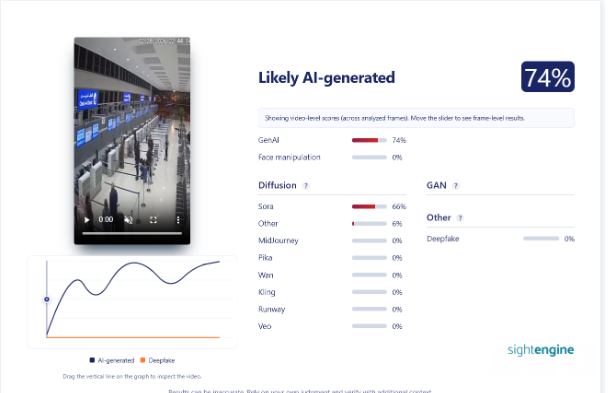
To verify the viral claim, we searched Google using relevant keywords. However, we did not find any credible media report confirming the claim.On closely examining the viral video, we noticed several unusual visuals and technical inconsistencies, raising suspicion that it might be AI-generated. To verify this, we scanned the video using the AI detection tool Sightengine. According to the results, around 74 percent of the video shows the likelihood of being AI-generated.
Conclusion:
Our research found that the viral video is not real but has been created using artificial intelligence technology.

Related Blogs
Executive Summary
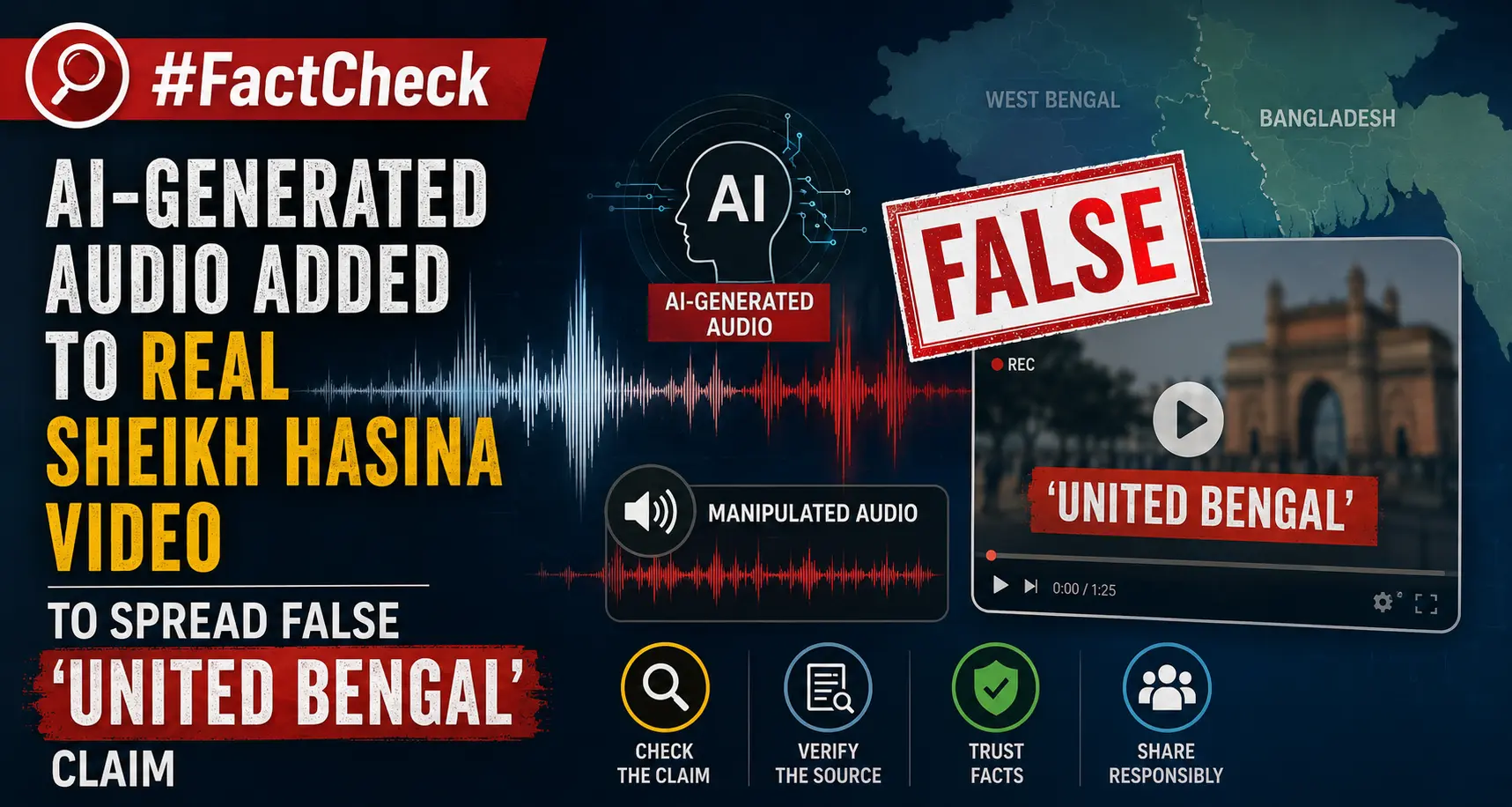
A video clip carrying the logo of news channel Republic is being shared on social media. In the video, former Bangladesh Prime Minister Sheikh Hasina is allegedly heard saying, "If these radical Muslim terrorists do not back off from imposing terror-based governance over Bangladesh, our goal will be to finish them by any means. I will request Prime Minister Narendra Modi to make Bangla a single province by combining East and West Bengal. We will bring back a secular democracy, which I will lead in the future to restore Bangla to its secular roots." The CyberPeace Research Wing found that the visuals in the viral video are genuine, but the audio has been altered using artificial intelligence (AI) and is being circulated with a false claim.
Claim:
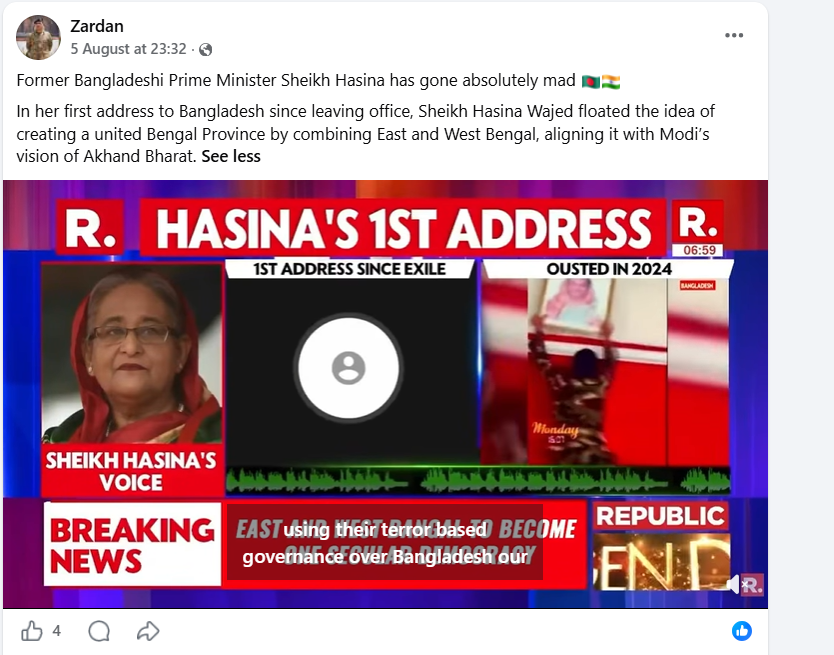
A Facebook user shared the video claiming that Sheikh Hasina proposed merging East and West Bengal to create a single province during her recent address. The link to the post, archive link, and screenshot are provided below.
https://www.facebook.com/reel/1567119714918951
FactCheck
During the research, several key frames from the viral video were extracted and a reverse image search was conducted using Google Lens. The search led us to the original video of Sheikh Hasina’s interaction available on the official social media accounts of Republic News. The link to the post and screenshot are provided below.
https://x.com/republic/status/2084999748755554323?ref_src=twsrc%5Etfw
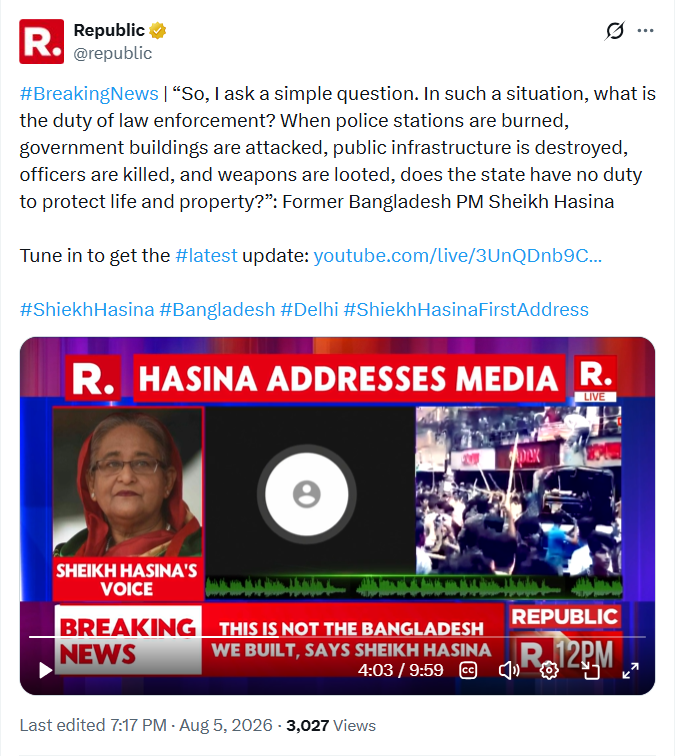
Republic shared the original video on its official X account on August 5, 2026. A comparison between the viral clip and the original footage revealed that the alleged statement about merging East and West Bengal into a single province does not appear anywhere in the authentic video. In the original video, Sheikh Hasina can be heard discussing the responsibilities of law enforcement agencies during periods of unrest. The controversial audio added to the viral clip is not part of the original recording. Further analysis of the viral video’s audio raised suspicion that it was AI-generated. The video was scanned using the AI detection tool Hive Moderation, which indicated a 91 per cent probability that the speech used in the viral video was AI-generated.
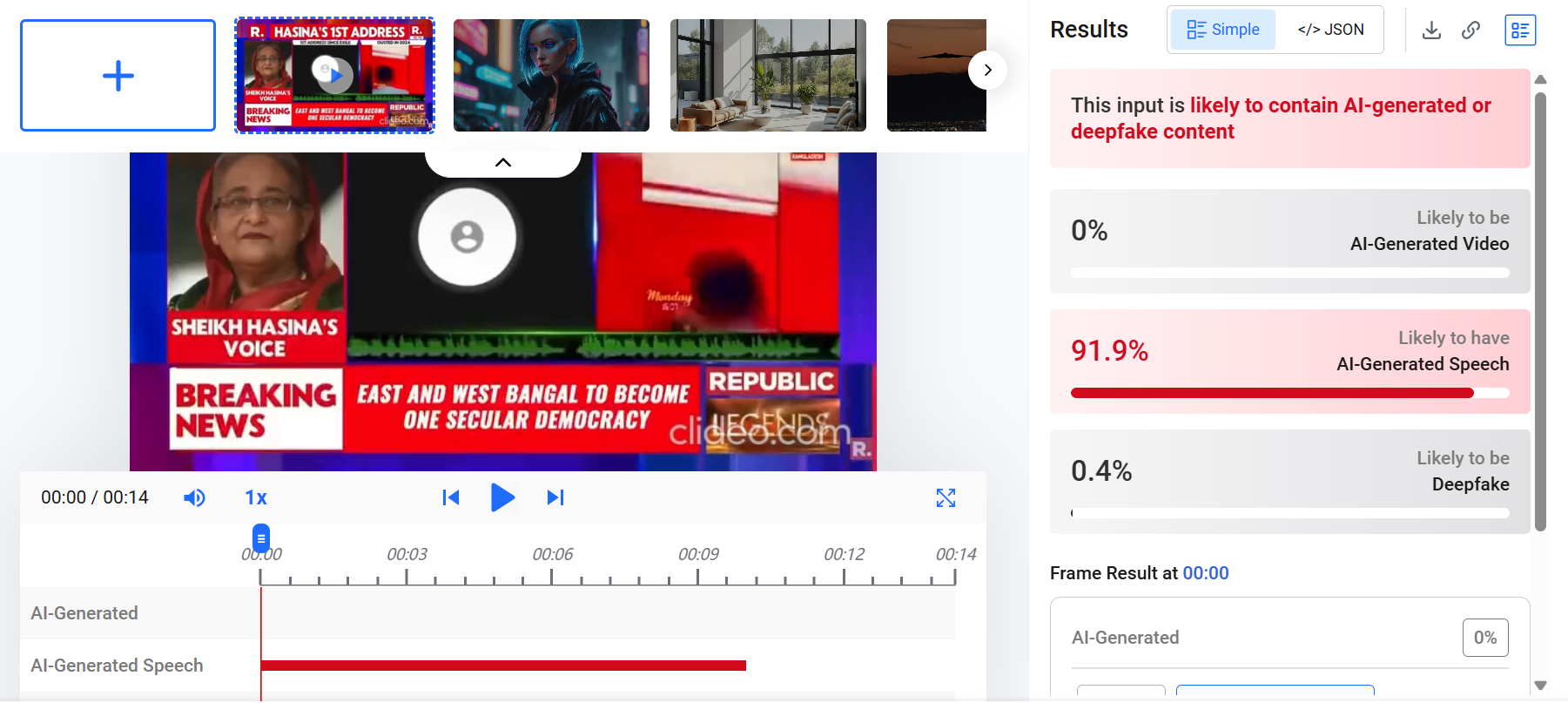
In the next step of the research, the viral audio was analysed using the Resemble AI tool. The results indicated that the audio was likely manipulated, suggesting that it had been altered using artificial intelligence (AI).
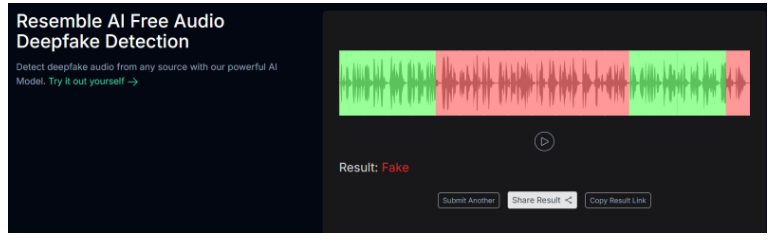
Conclusion:
The research found that the visuals used in the viral video are genuine, but the audio has been modified using AI and is being shared with a false claim. The claim that Sheikh Hasina spoke about merging East and West Bengal into a single province is false.

Introduction
The rise in start-up culture, increasing investments, and technological breakthroughs are being encouraged alongside innovations and the incorporation of generative Artificial Intelligence elements. Witnessing the growing focus on human-centred AI, its potential to transform industries like education remains undeniable. Enhancing experiences and inculcating new ways of learning, there is much to be explored. Recently, a Delhi-based non-profit called Rocket Learning, in collaboration with Google.org, launched Appu- a personalised AI educational tool providing a multilingual and conversational learning experience for kids between 3 and 6.
AI Appu
Developed in 6 months, along with the help of dedicated Google.org fellows, interactive Appu has resonated with those the founders call “super-users,” i.e. parents and caregivers. Instead of redirecting students to standard content and instructional videos, it operates on the idea of conversational learning, one equally important for children in the targeted age bracket. Designed in the form of an elephant, Appu is supposed to be a personalised tutor, helping both children and parents understand concepts through dialogue. AI enables the generation of different explanations in case of doubt, aiding in understanding. If children were to answer in mixed languages instead of one complete sentence in a single language (eg, Hindi and English), the AI would still consider it as a response. The AI lessons are two minutes long and are inculcated with real-world examples. The emphasis on interactive and fun learning of concepts through innovation enhances the learning experience. Currently only available in Hindi, it is being worked on to include 20 other languages such as Punjabi and Marathi.
UNESCO, AI, and Education
It is important to note that such innovations also find encouragement in UNESCO’s mandate as AI in education contributes to achieving the 2030 Agenda of Sustainable Development Goals (here; SDG 4- focusing on quality education). Within the ambit of the Beijing Consensus held in 2019, UNESCO encourages a human-centred approach to AI, and has also developed the “Artificial Intelligence and Education: Guidance for Policymakers” aiming towards understanding its potential and opportunities in education as well as the core competencies it needs to work on. Another publication was launched during one of the flagship events of UNESCO- (Digital Learning Week, 2024) - AI competency frameworks for both, students and teachers which provide a roadmap for assessing the potential and risks of AI, each covering common aspects such as AI ethics, and human-centred mindset and even certain distinct options such as AI system design for students and AI pedagogy for teachers.
Potential Challenges
While AI holds immense promise in education, innovation with regard to learning is contentious as several risks must be carefully managed. Depending on the innovation, AI’s struggle with multitasking beyond the classroom, such as administrative duties and tedious grading, which require highly detailed role descriptions could prove to be a challenge. This can become exhausting for developers managing innovative AI systems, as they would have to fit various responses owing to the inherent nature of AI needing to be trained to produce output. Security concerns are another major issue, as data breaches could compromise sensitive student information. Implementation costs also present challenges, as access to AI-driven tools depends on financial resources. Furthermore, AI-driven personalised learning, while beneficial, may inadvertently reduce student motivation, also compromising students' soft skills, such as teamwork and communication, which are crucial for real-world success. These risks highlight the need for a balanced approach to AI integration in education.
Conclusion
Innovations related to education, especially the ones that focus on a human-centred AI approach, have immense potential in not only enhancing learning experiences but also reshaping how knowledge is accessed, understood, and applied. Untapped potential using other services is also encouraged in this sector. However, maintaining a balance between fostering intrigue and ensuring the inculcation of ethical and secure AI remains imperative.
References
- https://www.unesco.org/en/articles/what-you-need-know-about-unescos-new-ai-competency-frameworks-students-and-teachers?hub=32618
- https://www.unesco.org/en/digital-education/artificial-intelligence
- https://www.deccanherald.com/technology/google-backed-rocket-learning-launches-appu-an-ai-powered-tutor-for-kids-3455078
- https://indianexpress.com/article/technology/artificial-intelligence/how-this-google-backed-ai-tool-is-reshaping-education-appu-9896391/
- https://www.thehindu.com/business/ai-appu-to-tutor-children-in-india/article69354145.ece
- https://www.velvetech.com/blog/ai-in-education-risks-and-concerns/

Introduction
Misinformation regarding health is sensitive and can have far-reaching consequences. These include its effect on personal medical decisions taken by individuals, lack of trust in conventional medicine, delay in seeking treatments, and even loss of life. The fast-paced nature and influx of information on social media can aggravate the situation further. Recently, a report titled Health Misinformation Vectors in India was presented at the Health of India Summit, 2024. It provided certain key insights into health-related misinformation circulating online.
The Health Misinformation Vectors in India Report
The analysis was conducted by the doctors at First Check, a global health fact-checking initiative alongside DataLEADS, a Delhi-based digital media and technology company. The report covers health-related social media content that was posted online from October 2023 to November 2024. It mentions that among all the health scares, misinformation regarding reproductive health, cancer, vaccines, and lifestyle diseases such as diabetes and obesity is the most prominent type that is spread through social media. Misinformation regarding reproductive health includes illegal abortion methods that often go unchecked and even tips on conceiving a male child, among other things.
In order to combat this misinformation, the report encourages stricter regulations regarding health-related content on digital media, inculcating technology for health literacy and misinformation management in public health curricula and recommending tech platforms to work on algorithms that prioritise credible information and fact-checks. Doctors state that people affected by life-threatening diseases are particularly vulnerable to such misinformation, as they are desperate to seek options for treatment for themselves and their family members to have a chance at life. In a diverse society, with the lack of clear and credible information, limited access to or awareness about tools that cross-check content, and low digital literacy, people gravitate towards alternate sources of information which also fosters a sense of disengagement among the public overall. The diseases mentioned in the report, which are prone to misinformation, are life-altering and require attention from healthcare professionals.
CyberPeace Outlook
Globally, there are cases of medically-unqualified social media influencers who disperse false/mis- information regarding various health matters. The topics covered are mostly associated with stigma and are still undergoing research. This gap allows for misinformation to be fostered. An example is misinformation regarding PCOS( Polycystic Ovary Syndrome) which is circulating online.
In the midst of all of this, YouTube has released a new feature that aligns with combating health misinformation, trying to bridge the gap between healthcare professionals and Indians who look for trustworthy health-related information online. The initiative includes a feature that allows doctors, nurses, and other healthcare professionals to sign up for a health information source license. This would help by labeling all their informative videos, as addressed- from a healthcare professional. Earlier, this feature was available only for health organisations including a health source information panel and health content shelves, but this step broadens the scope for verification of licenses of individual healthcare professionals.
As digital literacy continues to grow, methods of seeking credible information, especially regarding sensitive topics such as health, require a combined effort on the part of all the stakeholders involved. We need a robust strategy for battling health-related misinformation online, including more awareness programmes and proactive participation from the consumers as well as medical professionals regarding such content.
References
- https://timesofindia.indiatimes.com/india/misinformation-about-cancer-reproductive-health-is-widespread-in-india-impacting-medical-decisions-says-report/articleshow/115931612.cms
- https://www.ndtv.com/india-news/cancer-misinformation-prevalent-in-india-trust-in-medicine-crucial-report-7165458
- https://www.newindian.in/ai-driven-health-misinformation-poses-threat-to-indias-public-health-report/
- https://www.etvbharat.com/en/!health/youtube-latest-initiative-combat-health-misinformation-india-enn24121002361
- https://blog.google/intl/en-in/products/platforms/new-ways-for-registered-healthcare-professionals-in-india-to-reach-people-on-youtube/
- https://www.bbc.com/news/articles/ckgz2p0999yo
