
Privacy v/s Regulation: Apple’s Advanced Data Protection Rollback in the UK
Recently, Apple has pushed away the Advanced Data Protection feature for its customers in the UK. This was done due to a request by the UK’s Home Office, which demanded access to encrypted data stored in its cloud service, empowered by the Investigatory Powers Act (IPA). The Act compels firms to provide information to law enforcement. This move and its subsequent result, however, have raised concerns—bringing out different perspectives regarding the balance between privacy and security, along with the involvement of higher authorities and tech firms.
What is Advanced Data Protection?
Advanced Data Protection is an opt-in feature and doesn’t necessarily require activation. It is Apple’s strongest data tool, which provides end-to-end encryption for the data that the user chooses to protect. This is different from the standard (default) encrypted data services that Apple provides for photos, back-ups, and notes, among other things. The flip side of having such a strong security feature from a user perspective is that if the Apple account holder were to lose access to the account, they would lose their data as well since there are no recovery paths.
Doing away with the feature altogether, the sign-ups have been currently halted, and the company is working on removing existing user access at a later date (which is yet to be confirmed). For the UK users who hadn’t availed of this feature, there would be no change. However, for the ones who are currently trying to avail it are met with a notification on the Advanced Data Protection settings page that states that the feature cannot be enabled anymore. Consequently, there is no clarity whether the data stored by the UK users who availed the former facility would now cease to exist as even Apple doesn’t have access to it. It is important to note that withdrawing the feature does not ensure compliance with the Investigative Powers Act (IPA) as it is applicable to tech firms worldwide that have a UK market. Similar requests to access data have been previously shut down by Apple in the US.
Apple’s Stand on Encryption and Government Requests
The Tech giant has resisted court orders, rejecting requests to write software that would allow officials to access and enable identification of iPhones operated by gunmen (made in 2016 and 2020). It is said that the supposed reasons for such a demand by the UK Home Office have been made owing to the elusive role of end-to-end encryption in hiding criminal activities such as child sexual abuse and terrorism, hampering the efforts of security officials in catching them. Over the years, Apple has emphasised time and again its reluctance to create a backdoor to its encrypted data, stating the consequences of it being more vulnerable to attackers once a pathway is created. The Salt Typhoon attack on the US Telecommunication system is a recent example that has alerted officials, who now encourage the use of end-to-end encryption. Barring this, such requests could set a dangerous precedent for how tech firms and governments operate together. This comes against the backdrop of the Paris AI Action Summit, where US Vice President J.D. Vance raised concerns regarding regulation. As per reports, Apple has now filed a legal complaint against the Investigatory Powers Tribunal, the UK’s judicial body that handles complaints with respect to surveillance power usage by public authorities.
The Broader Debate on Privacy vs. Security
This standoff raises critical questions about how tech firms and governments should collaborate without compromising fundamental rights. Striking the right balance between privacy and regulation is imperative, ensuring security concerns are addressed without dismantling individual data protection. The outcome of Apple’s legal challenge against the IPA may set a significant precedent for how encryption policies evolve in the future.
References
- https://www.bbc.com/news/articles/c20g288yldko
- https://www.bbc.com/news/articles/cgj54eq4vejo
- https://www.bbc.com/news/articles/cn524lx9445o
- https://www.yahoo.com/tech/apple-advanced-data-protection-why-184822119.html
- https://indianexpress.com/article/technology/tech-news-technology/apple-advanced-data-protection-removal-uk-9851486/
- https://www.techtarget.com/searchsecurity/news/366619638/Apple-pulls-Advanced-Data-Protection-in-UK-sparking-concerns
- https://www.computerweekly.com/news/366619614/Apple-withdraws-encrypted-iCloud-storage-from-UK-after-government-demands-back-door-access?_gl=1*1p1xpm0*_ga*NTE3NDk1NzQxLjE3MzEzMDA2NTc.*_ga_TQKE4GS5P9*MTc0MDc0MTA4Mi4zMS4xLjE3NDA3NDEwODMuMC4wLjA.
- https://www.theguardian.com/technology/2025/feb/21/apple-removes-advanced-data-protection-tool-uk-government
- https://proton.me/blog/protect-data-apple-adp-uk#:~:text=Proton-,Apple%20revoked%20advanced%20data%20protection%20
- https://www.theregister.com/2025/03/05/apple_reportedly_ipt_complaint/
- https://www.computerweekly.com/news/366616972/Government-agencies-urged-to-use-encrypted-messaging-after-Chinese-Salt-Typhoon-hack

Related Blogs

Executive Summary:
A widely circulated claim on social media, including a post from the official X account of Pakistan, alleges that the Pakistan Air Force (PAF) carried out an airstrike on India, supported by a viral video. However, according to our research, the video used in these posts is actually footage from the video game Arma-3 and has no connection to any real-world military operation. The use of such misleading content contributes to the spread of false narratives about a conflict between India and Pakistan and has the potential to create unnecessary fear and confusion among the public.

Claim:
Viral social media posts, including the official Government of Pakistan X handle, claims that the PAF launched a successful airstrike against Indian military targets. The footage accompanying the claim shows jets firing missiles and explosions on the ground. The video is presented as recent and factual evidence of heightened military tensions.


Fact Check:
As per our research using reverse image search, the videos circulating online that claim to show Pakistan launching an attack on India under the name 'Operation Sindoor' are misleading. There is no credible evidence or reliable reporting to support the existence of any such operation. The Press Information Bureau (PIB) has also verified that the video being shared is false and misleading. During our research, we also came across footage from the video game Arma-3 on YouTube, which appears to have been repurposed to create the illusion of a real military conflict. This strongly indicates that fictional content is being used to propagate a false narrative. The likely intention behind this misinformation is to spread fear and confusion by portraying a conflict that never actually took place.


Conclusion:
It is true to say that Pakistan is using the widely shared misinformation videos to attack India with false information. There is no reliable evidence to support the claim, and the videos are misleading and irrelevant. Such false information must be stopped right away because it has the potential to cause needless panic. No such operation is occurring, according to authorities and fact-checking groups.
- Claim: Viral social media posts claim PAF attack on India
- Claimed On: Social Media
- Fact Check: False and Misleading

Executive Summary
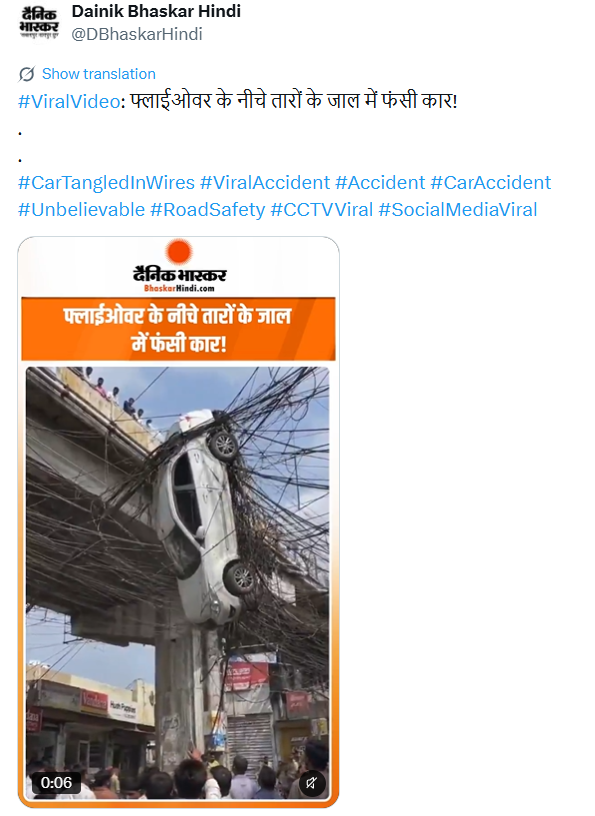
A video showing a car caught in a web of electrical wires beneath a flyover is being widely shared on social media. In the viral video, the car appears to be suspended in mid-air, while a large number of people can be seen gathered below, watching the astonishing scene. People standing on the flyover also appear shocked as they look at the scene below. However, CyberPeace Research found that the video is not authentic but AI-generated and is being circulated with a misleading claim.
Claim:
An X user shared the viral video with the caption: “#ViralVideo: Car caught in a web of wires beneath a flyover!”
https://x.com/DBhaskarHindi/status/2107022982258553245
.
Fact Check
To verify the authenticity of the viral video showing a car caught in electrical wires beneath a flyover, we conducted a reverse image search of its keyframes using Google Lens. During the search, we found the same video uploaded on August 28, 2026, on the Instagram account of an AI content creator, @bhau_mitra_mandal_parbhani. The caption accompanying the video read: “Everyone is shocked to see this sight of a car caught in a web of electrical wires beneath a flyover! The car is dangerously stuck in the wires, drawing the attention of everyone gathered below. How did the car get here? The reason is yet to be revealed.” The caption also clearly mentioned that the visuals were AI-generated. In addition, the words “AI News” and “AI Generated Visuals” were displayed on the video itself, further indicating that the footage was artificially generated.
https://www.instagram.com/reels/DclpJHfgqXr/

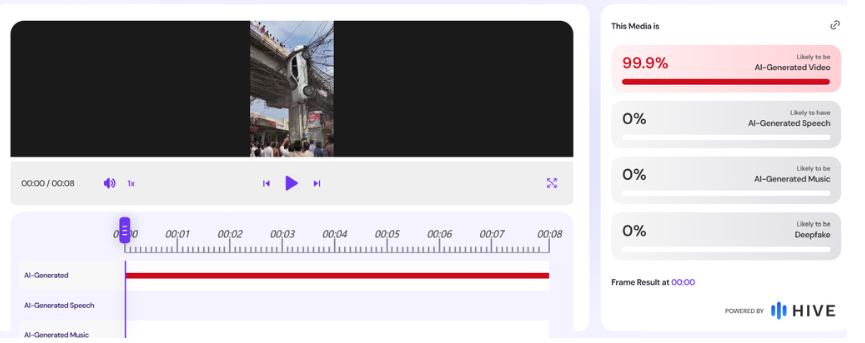
To further verify the authenticity of the viral video, we analysed it using the AI detection tool Hive Detect. The tool’s analysis identified the video as AI-generated with a 99.9 per cent probability.
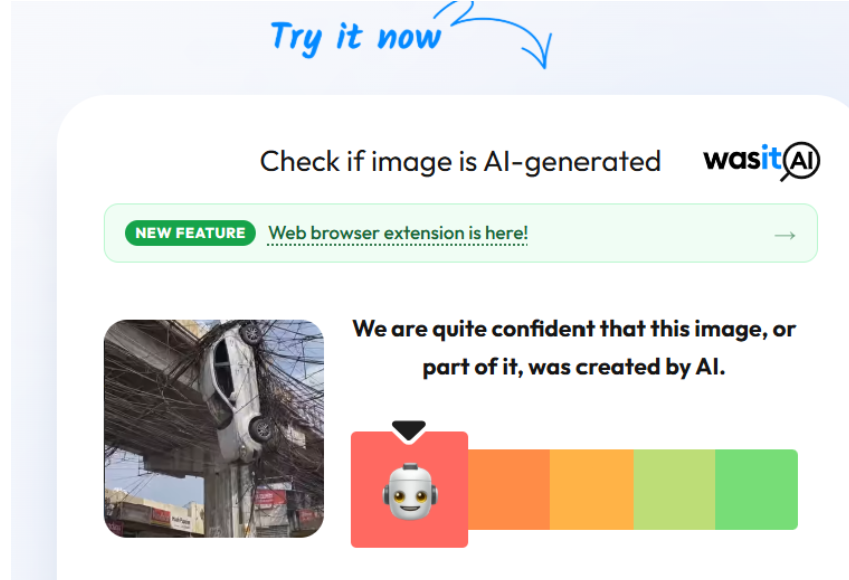
Another AI detection platform, WasitAI, also identified the visuals in the video as highly likely to be AI-generated.
Conclusion
The evidence gathered during our research makes it clear that the viral video showing a car caught in electrical wires beneath a flyover is not authentic but AI-generated. Our research found that the same video was originally uploaded by an AI content creator, where it was clearly labelled as AI-generated. The findings were further supported by AI detection tools, including Hive Detect and WasitAI, which also identified the visuals as highly likely to be AI-generated. Therefore, the viral video is being circulated on social media with a misleading claim, presenting AI-generated visuals as a real incident.

Executive Summary:
Microsoft rolled out a set of major security updates in August, 2024 that fixed 90 cracks in the MS operating systems and the office suite; 10 of these had been exploited in actual hacker attacks and were zero-days. In the following discussion, these vulnerabilities are first outlined and then a general analysis of the contemporary cyber security threats is also undertaken in this blog. This blog seeks to give an acquainted and non-acquainted audience about these updates, the threat that these exploits pose, and prevent measures concerning such dangers.
1. Introduction
Nowadays, people and organisations face the problem of cybersecurity as technologies develop and more and more actions take place online. These cyber threats have not ceased to mutate and hence safeguarding organisations’ digital assets requires a proactive stand. This report is concerned with the vulnerabilities fixed by Microsoft in August 2024 that comprised a cumulative of 90 security weaknesses where six of them were zero-day exploits. All these make a terrible risk pose and thus, it is important to understand them as we seek to safeguard virtual properties.
2. Overview of Microsoft’s August 2024 Security Updates
August 2024 security update provided by Microsoft to its products involved 90 vulnerabilities for Windows, Office, and well known programs and applications. These updates are of the latest type which are released by Microsoft under its Patch Tuesday program, a regular cum monthly release of all Patch updates.
- Critical Flaws: As expected, seven of the 90 were categorised as Critical, meaning that these are flaws that could be leveraged by hackers to compromise the targeted systems or bring operations to a halt.
- Zero-Day Exploits: A zero-day attack can be defined as exploits, which are as of now being exploited by attackers while the software vendor has not yet developed a patch for the same. It had managed 10 zero-days with the August update, which underlines that Microsoft and its ecosystems remain at risk.
- Broader Impact: These are not isolated to the products of Microsoft only They still persist Despite this, these vulnerabilities are not exclusive to the Microsoft products only. Other vendors such as Adobe, Cisco, Google, and others also released security advisories to fix a variety of issues which proves today’s security world is highly connected.
3. Detailed Analysis of Key Vulnerabilities
This section provides an in-depth analysis of some of the most critical vulnerabilities patched in August 2024. Each vulnerability is explained in layman’s terms to ensure accessibility for all readers.
3. 1 CVE-2024-38189: Microsoft Project Remote Code Execution Vulnerability (CVSS score:8. 8) :
The problem is in programs that belong to the Microsoft Project family which is known to be a popular project management system. The vulnerability enables an attacker to produce a file to entice an user into opening it and in the process execute code on the affected system. This could possibly get the attacker full control of the user’s system as mentioned in the following section.
Explanation for Non-Technical Readers: Let us assume that one day you received a file which appears to be a normal word document. When it is opened, it is in a format that it secretly downloads a problematic program in the computer and this goes unnoticed. This is what could happen with this vulnerability, that is why it is very dangerous.
3. 2 CVE-2024-38178: Windows Scripting Engine Memory Corruption Vulnerability (CVSS score: 7.5):
Some of the risks relate to a feature known as the Windows Scripting Engine, which is an important system allowing a browser or an application to run scripts in a web page or an application. The weak point can result in corruption of memory space and an attacker can perform remote code execution with the possibility to affect the entire system.
Explanation for Non-Technical Readers: For the purpose of understanding how your computer memory works, imagine if your computer’s memory is a library. This vulnerability corrupts the structure of the library so that an intruder can inject malicious books (programs) which you may read (execute) on your computer and create havoc.
3. 3 CVE-2024-38193: WinSock Elevation of Privilege Vulnerability (CVSS score: 7. 8 )
It opens up a security weakness in the Windows Ancillary Function Driver for WinSock, which is an essential model that masks the communication between the two. It enables the attacker to gain new privileges on the particular system they have attacked, in this case they gain some more privileges on the attacked system and can access other higher activities or details.
Explanation for Non-Technical Readers: This flaw is like somebody gaining access to the key to your house master bedroom. They can also steal all your valuable items that were earlier locked and could only be accessed by you. It lets the attacker cause more havoc as soon as he gets inside your computer.
3. 4 CVE-2024-38106: Windows Kernel Elevation of Privilege Vulnerability (CVSS score: 7. 0)
This vulnerability targets what is known as the Windows Kernel which forms the heart or main frameworks of the operating system that controls and oversees the functions of the computer components. This particular weakness can be exploited and an opponent will be able to get high-level access and ownership of the system.
Explanation for Non-Technical Readers: The kernel can be compared to the brain of your computer. It is especially dangerous that if someone can control the brain he can control all the rest, which makes it a severe weakness.
3. 5 CVE-2024-38213: Windows Mark of the Web Security Feature Bypass Vulnerability (CVSS score: 6.5).
This vulnerability enables the attackers to evade the SmartScreen component of Windows which is used to safeguard users from accessing unsafe files. This weakness can be easily used by the attackers to influence the users to open files that are otherwise malicious.
Explanation for Non-Technical Readers: Usually, before opening a file your computer would ask you in advance that opening the file may harm your computer. This weak point makes your computer believe that this dangerous file is good and then no warning will be given to you.
4. Implications of the Vulnerabilities
These vulnerabilities, importantly the zero-day exploits, have significant implications on all users.
- Data Breaches: These weaknesses can therefore be manipulated to cause exposures of various data, occasioning data leaks that put individual and corporate information and wealth.
- System Compromise: The bad guys could end up fully compromising the impacted systems meaning that they can put in malware, pilfer data or simply shut down a program.
- Financial Loss: The organisations that do not patch these vulnerabilities on the shortest notice may end up experiencing a lot of losses because of having to deal with a lot of downtimes on their systems, having to incur the costs of remediating the systems that have been breached and also dealing with legal repercussions.
- Reputation Damage: Security breaches and IT system corruptions can result in loss of customer and partner confidence in an organisation’s ability to protect their information affecting its reputation and its position in the market.
5. Recommendations for Mitigating Risks
Immediate measures should be taken regarding the risks linked to these issues since such weaknesses pose a rather high threat. The following are recommendations suitable for both technical and non-technical users.
5. 1 Regular Software Updates
Make it a point that all the software, particularly operating systems and all Microsoft applications are updated. Any system out there needs to update it from Microsoft, and its Patch Tuesday release is crucial.
For Non-Technical Users: As much as possible, reply ‘yes’ to updates whenever your computer or smartphone prompts for it. These updates correct security matters and secure your instruments.
5. 2 Realisation of Phishing Attacks
Most of the risks are normally realised through phishing techniques. People should be taught diversifiable actions that come with crazy emails like clicking on links and opening attachments.
For Non-Technical Users: Do not respond to emails from unknown people and if they make you follow a link or download a file, do not do it. If it looks like spam, do not click on it.
5. 3 Security Software
Strong and reliable antivirus and anti-malware software can be used to identify and avoid the attacks that might have high chances of using these vulnerabilities.
For Non-Technical Users: Ensure you download a quality antivirus and always update it. This works like a security guard to your computer by preventing bad programs.
5. 4 Introduce Multi Factor Authentication (MFA)
MFA works in a way to enforce a second factor of authentication before the account can be accessed; for instance, a user will be asked to input a text message or an authentication application.
For Non-Technical Users: NS is to make use of two-factor authentication on your accounts. It is like increasing the security measures that a man who has to burgle a house has to undergo by having to hammer an additional lock on the door.
5. 5 Network segmentations and Privileges management
Network segmentation should be adopted by organisations to prevent the spread of attacks while users should only be granted the privileges required to do their activities.
For Non- Technical Users: Perform the assessments of user privileges and the networks frequently and alter them in an effort of reducing the extent of the attacks.
6. Global Cybersecurity Landscape and Vendor Patches
The other major vendors have also released patches to address security vulnerabilities in their products. The interdependent nature of technology has the effect on the entire digital ecosystem.
- Adobe, Cisco, Google, and Others: These companies have released updates to address the weaknesses in their products that are applied in different sectors. These patches should be applied promptly to enhance cybersecurity.
- Collaboration and Information Sharing:Security vendors as well as researchers and experts in the cybersecurity domain, need to remain vigilant and keep on sharing information on emerging threats in cyberspace.
7. Conclusion
The security updates companies such as Microsoft and other vendors illustrate the present day fight between cybersecurity experts and cybercriminals. All the vulnerabilities addressed in this August 2024 update cycle are a call for prudence and constant protection of digital platforms. These vulnerabilities explain the importance of maintaining up-to-date systems, being aware of potential threats, and implementing robust security practices. Therefore, it is important to fortify our shield in this ever expanding threat domain, in order to be safe from attackers who use this weakness for their malicious purposes.
