
#FactCheck: Viral Video of Woman in Saree Driving a Train Is AI-Generated, Not Real
Executive Summary
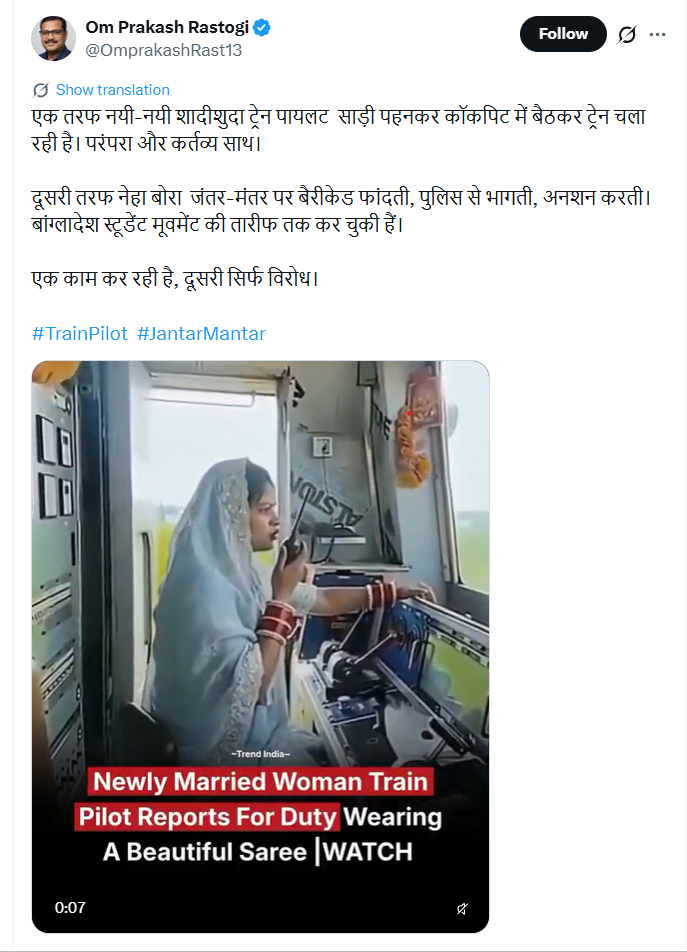
A video showing a woman dressed in a saree and appearing to work as a locomotive pilot is being widely shared on social media. The video is being circulated with the claim that she is a newly married woman who reported for duty after her wedding. The post praises the woman, presenting her as an example of balancing tradition, culture and career. Several media outlets have also published the viral video with the same claim. CyberPeace Research found the viral video to be false. The video has been created using AI and is being circulated with a misleading narrative. The claim has no basis in reality.
Claim
On October 26, 2026, X user Om Prakash Rastogi (@OmprakashRast13) shared the video with the claim: “On one hand, a newly married woman train pilot is sitting in the cockpit wearing a saree and driving a train, balancing tradition and duty. On the other hand, Neha Bora is seen jumping barricades, running from the police and staging a hunger strike at Jantar Mantar. She has even praised the Bangladesh student movement. One is doing her duty, while the other is only protesting.”
https://x.com/OmprakashRast13/status/2114665027735359627?a=3Pt242_7yXT7rAVP5oI&s=20
https://archive.ph/Se6Bg
Fact Check
We first extracted several keyframes from the viral video and then conducted a reverse search using Google Lens. We found the original video uploaded as a YouTube Short. It was uploaded on October 6, 2026. According to the information provided with the video on the YouTube channel “kumkum Kumari”, the video was created using AI.
https://www.youtube.com/shorts/ToBRXdPVn2Y
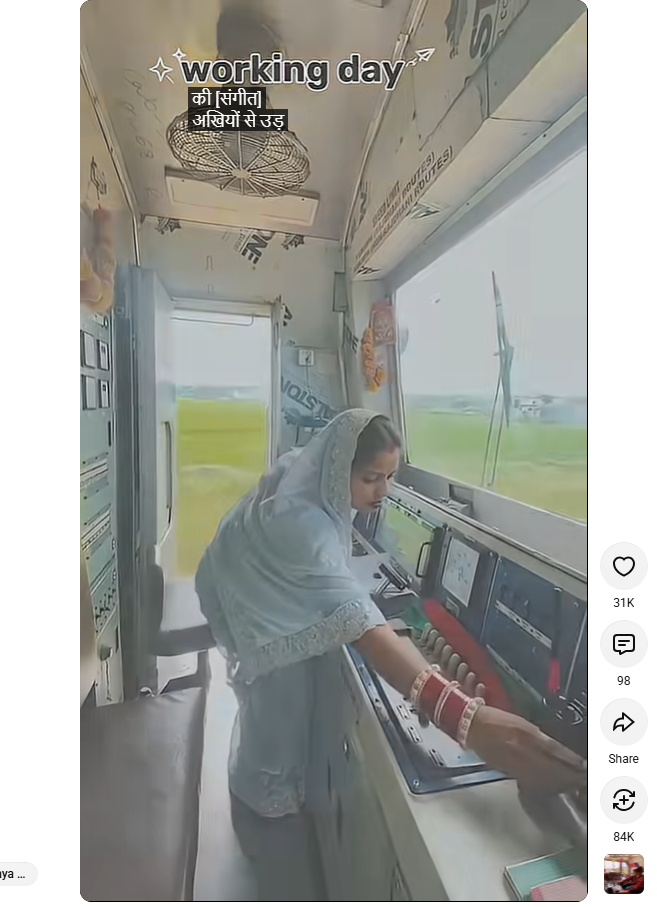
Upon examining the channel, we found several other AI-generated videos featuring women operating trains. This confirmed that the viral video is not authentic and was created using AI.

We then used the Hive Moderation tool to analyse the viral video. The results indicated that the video was AI-generated, with Hive Moderation identifying it as more than 63.3 per cent likely to be AI-generated.
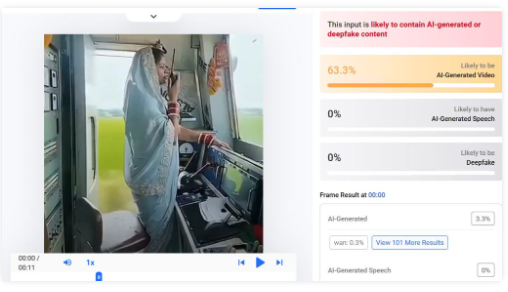
Another AI detection tool, Undetectable AI, also identified the video as 79 per cent likely to be AI-generated.

Conclusion
The evidence gathered during our research clearly establishes that the viral video showing a woman in a saree performing her duties as a locomotive pilot was created using AI.

Related Blogs
Introduction
In today's interconnected world, a mobile phone number is an inseparable element of digital identity. By this number, digital identity is connected to the user's bank and social media accounts among other digital services. Unfortunately, this dependence has created a possibility for criminal use of the mobile connection and conducting digital frauds.
One of such new threats is SIM muling, when SIM cards are acquired and used in someone else's name. By using it, SIM cards can be used as SIM farms and used for committing scams and other digital frauds such as phishing, impersonation, or OTP fraud. Another concern of SIM muling is the registered SIM owner is not always the user of the SIM.
Understanding SIM Muling and the Rise of SIM Farms
SIM muling refers to the disjunction between the registered user and the SIM subscription. Criminals pay a fee to individuals to get a SIM or rent an existing SIM. Alternatively, they buy several SIM cards using fabricated identification documents. In contrast, SIM farms are a coordinated structure of many SIMs that use devices to send messages, make voice calls, and communicate via data.
Sometimes the two are interdependent: SIM farms can include SIM cards procured using SIM muling. With SIM farms, the problem that fraudsters create for users is creation of several phone numbers so that people do not try to identify the fraud
How SIM Farms are Enabling Cybercrime
One problem mobile connections at a larger scale provides to cybercriminals is the scale at which Phishing/impersonation can take place.
- Fraudsters can create several different fraudulent accounts using many mobile connections to create fraudulent messages to bank customers, government officials, or others.
- Multiple mobile connections provide more opportunities for OTP fraud and other crimes to be conducted with fraudulent mobile accounts. Some of the OTP fraud mechanisms require users to gain control over a fraudulent SIM to be able to capture and/or verify an OTP message, or to gain access to an account or other information.
- Several fake accounts and scams can be created by registering a number of fake mobile accounts. The account and scams can also be verified and cross-verified through multiple mobile accounts.
- When fraudsters use a number to register mobile connections to conduct fraudulent calls, it creates difficulties for authorities when trying to verify the identity of the person who committed the fraudulent communication.
This use of SIM cards by cybercriminals helps to facilitate multiple types of cybercrimes and scams, so telecom abuses at a smaller scale may be a symptom of a larger, more coordinated effort.
Digital Identity Abuse
The fact that people's identities are misused is the most problematic part of SIM muling. A person can think that they are helping others and making some quick cash. Once they open these connections for other people, they lose the ability to manage them. Fraudulent PoS agents can open a connection in a person’s name without their knowledge, by using their ID documents.
For example, in 2026, the Chhattisgarh Department of Telecommunications discovered that a PoS agent had used the IDs of 25 unsuspecting customers to activate 25 mobile numbers. That PoS agent was put on a blacklist, and their association with the department was re-investigated. Identity theft in the digital era can be simple, with low tech methods of stealing ID information, as well as an abuse of access to such information, having devastating consequences.
India's Legal & Regulatory Response
It should be noted that the Indian legislature has made provisions that address the issues relating to the misuse of identity especially within the telecom sector. One such statutory provision is contained in the Telecommunications Act 2023. Section 42(3)(e) provides for penalization for acquiring of SIMs or other telecommunication identifiers through means of fraud, cheating or impersonation. Section 42(3)(c) on the other hand addresses the issue of tampering with the telecommunication identifiers. The Telecommunications Act, 2023 provides for an imprisonment of up to three years and/or fine of up to rupees fifty lakh or both for offences under section 42(3). The concept of abetment has been dealt with separately in section 42(6). Moreover, section 66C and 66D of the Information Technology Act 2000 might apply where the facts show that there has been identity theft and/or cheating by impersonation using computer resources.
Measures for prevention adopted by the Department of Telecommunications:
- Sanchar Saathi: Allows them to see which mobile connections are registered in their names and report the mobile connections that they did not get or need.
- ASTR (Artificial Intelligence and Facial Recognition Powered Solution for Telecom SIM Subscriber Verification): leverages analytics to detect suspicious mobile connections and to re-verify.
- SIM-binding directions: In November 2025, DoT issued directions for communicating apps to maintain a linkage with the SIM which has been issued to the user bearing the mobile number with a requirement of periodic logout from web sessions as well.
These measures are indicative of a commitment to enhancing accountability and traceability in the telecom industry in India.
Challenges and the Way Forward
Despite these measures, tackling SIM muling requires more than simply increasing the number of verification checks. First, accountability needs to be extended further out from the registered subscriber to the intermediaries and Point of Sale (PoS) agents who enable the fraudulent activations. Secondly, there is a need to have good monitoring systems in place to detect expensive bulk SIM acquisitions and suspicious SIM use activity. Third, citizens' awareness is a must.
Users need to be aware that an SIM registered in their name can cause legal and financial hassles if it is shared or rented out. Meanwhile, investigations need to differentiate between knowingly participating in a fraud scheme and the use of an individual's identity without his or her consent. A balanced approach needs to be a combination of better verification, responsible data management, timely reporting systems and the cooperation between telecom operators, law-enforcement and digital platforms.
Conclusion
The existence of SIM farms in India is one of the numerous security problems which have been affecting India. There are many security problems related to India, but SIM farms and the abuse of mobile connections often do not receive the attention they deserve. Although the users of digital communication devices view mobile numbers as yet another medium to communicate, there is so much more to them. A mobile number is more than that. It is the means of linking to the online activities and banking of the user. It is also a tool for connecting to online services. Therefore, this is an urgent need to take measures to combat SIM muling.
As any digital security initiative worth its name, the users are also important here. The users should never sell, rent or lend their SIM cards while service providers and the regulatory authorities must exercise more surveillance and supervision. What is important is that those people whose names were used improperly should not be treated as criminals without any evidence pointing at them, even if the SIM card is more than just a card. In fact, keeping it secure is essential for digital security.
References
1. Department of Telecommunications, Ministry of Communications, Department of Telecommunications (DoT) Cautions About Misuse of Telecom Resources, Press Information Bureau (Mar. 4, 2025).
2. Telecommunications Act, 2023, § 42, Government of India.
3. Information Technology Act, 2000, §§ 66C–66D, Government of India.
4. Department of Telecommunications, Measures to Combat Telecom-Related Frauds, Press Information Bureau (Feb. 6, 2025).
5. Department of Telecommunications, DoT's Directions for SIM Binding for Prevention of Misuse of Telecommunication Identifiers, Press Information Bureau (Dec. 1, 2025).
6. Ministry of Communications, Measures Taken to Tackle Cyber Frauds, Press Information Bureau (July 23, 2026).
7. Department of Telecommunications, DoT Mumbai Cautions Citizens Against Fraudulent SIM Issuance, Misuse of Telecom Identifiers and IMEI Tampering, Press Information Bureau (Sept. 22, 2026).
8. Sanchar Saathi Portal, Department of Telecommunications, Government of India.
Introduction
A mass of people gathered in public is a common scene. All are eager for the same information, official estimates are delayed, and the space is then filled by whatever is earliest. In Delhi the gap was partially filled by old videos being described as new footage and by reports of injuries and deaths which police and fact-checkers have rejected. This report investigates what was claimed, by whom, and what has been validated. It does not take sides in the protests. It is focused on a small issue: how this false information travelled, why it was effective, and what the reader can do to combat it.
What was reported
India Today claimed that the ISI, the spy agency of Pakistan, posted a false injury report of a senior opposition leader, as well as fake reports of deaths, during the Delhi protests. That is what the publication's own headline says, and the claim of ISI links is based on sources, not an established fact.
Delhi Police has filed at least four FIRs against social media handles for creating fake content and attempts at building an "anti-India narrative", according to a report by The Week, quoting news agency ANI. Police said multiple Pakistani handlers reported deaths in the 10 October protest and shared fake videos while impersonating Indians. India TV reported that around 500 posts and 100 handles had been removed, citing unidentified sources and the police. There is no independent verification of those numbers in the material we reviewed.
What has been verified, and what has not
The strongest piece is from News Meter, a fact-checking organisation. It found two videos posted on X on 12 October. The first was purportedly a video of police firing on a rally and killing five workers. When searching the video for the beginning of its footage, NewsMeter found it on Facebook from 5 March 2020 and in a Times of India report about the February 2020 riots in Delhi's Chand Bagh locality. The second video, which was reportedly of soldiers beating a protester, has been posted on YouTube since 2019 and on news websites reports as early as 2017, according to News Meter. There is no evidence of firing at the rally. Another of the original fact checkers, NewsMeter, traced a video alleging an attack on a politician's residence to December 2019 rallies. The Delhi Police also labelled the claim of firing at the rally as a rumour on 12 October.
A few items still require substantiation. The ISI's direction is unconfirmed, and the accounts' source is police and other sources. News Meter identified the location data of one account as "South Asia" with a slight possibility of VPN use, and it examined its earlier report of Pakistan-based propaganda accounts' pattern, but nothing is definitive. Location tags are weak evidence. The death claims were deemed false by police, but no external investigation of either accusation exists in the information looked at.
How fabricated visuals travel
Recycled footage is effective because it is footage. The crowd, the violence – all of that is real; they just got the date and place wrong. Writer Claire Wardle and researcher Hossein Derakhshan have dubbed this entirely different genre of falsehood as a form of "misinformation" – where the lie is in the caption, but the pixels still tell the truth.
That's where the urgency comes in. The article published by News Meter closed with the plea to 'people to come on the road and block the city'. Short, scary and sensational messages are among the easiest to share. A 2018 Science paper by Soroush Vosoughi, Deb Roy and Sinan Aral found false news stories are about 70 per cent more likely to be retweeted than accurate stories and spread more rapidly, primarily because humans (not bots) retweeted them.
And platform design does, too. Recommendation algorithms tend to incentivise content engagement, and there's a tonne of engagement to be driven from anger. The credibility of accounts using pseudonyms or pretending to be local seems to come from the community they claim.
Why injury and death claims are different
The most powerful piece of rumour is the one in which a person has been killed or injured. It stirs mourning and fury, inflames crowds to violence, and leaves the rumour-monger little room for denial. Even in cases of retraction, the original story is often the one to stay. Delhi Police in its post cautioned that "malicious rumours" are an offence.
If false reports drown out the conversation, true reports of harm are then easier to write off. Official messaging needs the same due care as a viral post for the same reason: Public officials are party to the events they describe. Tone is no guarantee, not even "certainty". Multiple independent tellings can demonstrate it.
The damage extends further than the audience as well. If people are searching for loved ones, they might find a rumour; before they get confirmation from the individual, helplines can become overwhelmed, and reporters have all their time wasted following up claims that were planned to be followed up.
What responsible sharing looks like
But most of it is a run-of-the-mill habit. Put the brakes on before you forward something that fuels your fear or anger. Investigate who created the post, when the account was created. Reverse image search the videos with Google Lens or Tin Eye (that's how the Delhi videos were dated). Find the same report on outlets that credit their sources. Choose fact checkers that follow clear standards, like signatories of the International Fact-Checking Network code of principles.
If you've already posted something false, admit it and include the correction. Even quoting a rumour to ridicule it may publicise it, so if you can, describe the rumour instead.
Headlines that treat an allegation as fact or that post an initial report of a viral claim without verifying it lend the rumour a second platform. Pachyphonus warned against grabbing on to supposed "hedge words" like "alleged", "according to police" and "sources said" just to lighten the blow - they reveal how much a statement is worth.
Conclusion
The Delhi story highlights a trend that defies borders or specific occurrences. Old footage, solicitous captions and unproven reports of damage are constantly propagated because they seem meaningful. The claims of well-planned foreign accounts are "unsubstantiated allegations", and the proven age of the returned content is "old archive footage". The real stickler is maintaining those categories. Before rushing to share the next scary footage, consider who's sharing it, when it was shot and who else has verified it.
Sources
- India Today: Anti-CEC protests, ISI-linked Pakistan accounts and false claims (report this piece is based on)
- The Week: Several Pakistani social media handles under scanner for fake content
- India TV: Delhi Police takes down 500 social media posts
- NewsMeter: Videos are old, unrelated to anti-CEC protests
- NewsMeter: Video of alleged attack on residence is from 2019
- Times of India (2020): How Delhi cops tried to rescue their colleagues
- Delhi Police statement on X, 12 October 2026
- Vosoughi, Roy and Aral (2018), The spread of true and false news online, Science
- Wardle and Derakhshan (2017), Information Disorder, Council of Europe
- International Fact-Checking Network, Code of Principles

Introduction
DDoS – Distributed Denial of Service Attack is one of the cyber-attacks which has been evolving at the fastest pace, the new technologies have created a blanket of vulnerability for the victim which allows the cyber criminals to stay under the radar and keep launching small scale high intensity cyber attacks. A distributed denial-of-service (DDoS) attack is a malicious attempt to disrupt the normal traffic of a targeted server, service, or network by overwhelming the target or its surrounding infrastructure with a flood of Internet traffic. DDoS attacks achieve effectiveness by utilizing multiple compromised computer systems as sources of attack traffic. Exploited machines can include computers and other networked resources such as IoT devices. From a high level, a DDoS attack is like an unexpected traffic jam clogging up the highway, preventing regular traffic from arriving at its destination.
Op Power Off
In a recent Operation by Law enforcement agencies known as Op Power Off, LEAs from United Kingdom, United States of America, Netherlands, Poland, and Germany joined hands to target the cybergroups committing such large-scale attacks which can paralyse the Internet become inaccessible for a large faction of netizens. The services collectively seized were by far the most popular DDoS booter services on the market, receiving top billing on search engines. One such service taken down had been used to carry out over 30 million attacks. As part of this action, seven administrators have been arrested so far in the United States and the United Kingdom, with further actions planned against the users of these illegal services. International police cooperation was central to the success of this operation as the administrators, users, critical infrastructure, and victims were scattered across the world. Europol’s European Cybercrime Centre coordinated the activities in Europe through its Joint Cybercrime Action Taskforce (J-CAT).
Participating Authorities
- United States: US Department of Justice (US DOJ), Federal Bureau of Investigation (FBI)
- United Kingdom: National Crime Agency (NCA)
- The Netherlands: National High Tech Crime Unit Landelijke Eenheid, Cybercrime team Midden-Nederland, Cybercrime team Noord-Holland and Cybercrime team Den Haag
- Germany: Federal Criminal Police Office (Bundeskriminalamt), Hanover Police Department (Polizeidirektion Hannover), Public Prosecutor’s Office Verden (Staatsanwaltschaft Verden)
- Poland: National Police Cybercrime Bureau (Biuro do Walki z Cyber-przestępczością)
Issue related to DDoS Attacks
DDoS booter services have effectively lowered the entry barrier into cybercrime: for a fee as low as EUR 10, any low-skilled individual can launch DDoS attacks with the click of a button, knocking offline whole websites and networks by barraging them with traffic. The damage they can do to victims can be considerable, crippling businesses financially and depriving people of essential services offered by banks, government institutions, and police forces. Emboldened by perceived anonymity, many young IT enthusiasts get involved in this seemingly low-level crime, unaware of the consequences that such online activities can carry. The influence of toolkits available on the dark net has made it easier for criminals to commit such crimes and at times even get away with it as well.
Recent examples of DDoS Attacks
- In February 2020, Amazon Web Services (AWS) suffered a DDoS attack sophisticated enough to keep its incident response teams occupied for several days also affecting customers worldwide.
- In February 2021, the EXMO Cryptocurrency exchange fell victim to a DDoS attack that rendered the organization inoperable for almost five hours.
- Recently, Australia experienced a significant, sustained, state-sponsored DDoS attack.
- Belgium also became a victim of a DDoS attack that targeted the country’s parliament, police services, and universities.
DDoS vs. DoS Attacks: What’s the Difference?
It’s important to avoid confusing a DDoS (distributed denial of service) attack with a DoS (denial of service) attack. Although only one word separates the two, these attacks vary significantly in nature.
- Strictly defined, a typical DDoS attack manipulates many distributed network devices between the attacker and the victim into waging an unwitting attack, exploiting legitimate behavior.
- A traditional DoS attack doesn’t use multiple, distributed devices, nor does it focus on devices between the attacker and the organization. These attacks also tend not to use multiple internet devices.
Conclusion
In this era of cyberspace, it is of paramount importance to maintain digital safety and security equivalent to physical safety, the cybercriminals will not stop at anything and can stoop to any level to target netizens and critical infrastructures in order to commit ransomware and malware attacks. As we can see DDoS-ing is taken seriously by law enforcement, at all levels of users, and are on the radar of law enforcement, be it a gamer booting out the competition out of a video game, or a high-level hacker carrying out DDoS attacks against commercial targets for financial gain.
