#FactCheck- AI-Generated Deepfake Falsely Shows Lt Gen Devendra Sharma Speaking About Missing Aviators in Operation Sindoor
Executive Summary
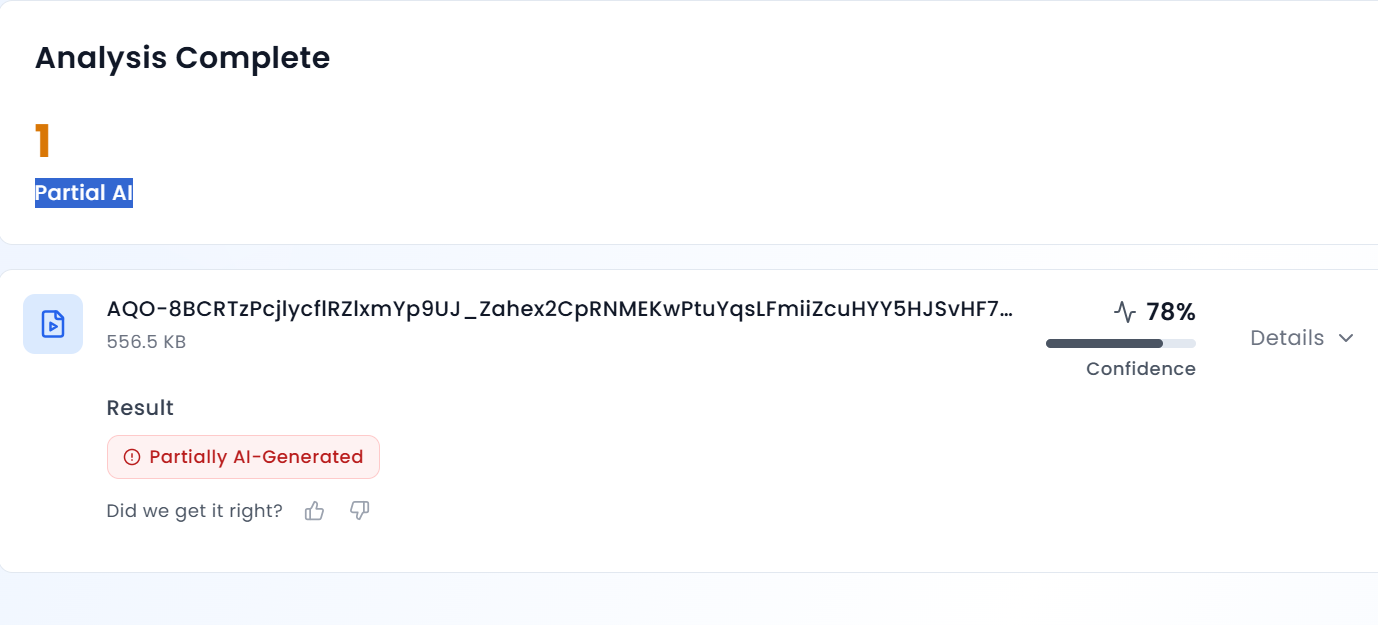
A purported video of Lieutenant General Devendra Sharma is being shared on social media, falsely portraying him as saying that “five aviators who participated in Operation Sindoor are missing from our training list. CyberPeace Research Wingresearch found that the viral video is completely fabricated and generated using artificial intelligence. The Ministry of Defence has also dismissed the clip as an AI-generated deepfake. The investigation found that Lieutenant General Devendra Sharma, Commander of the Army Training Command, never made any such statement. The viral clip has been manipulated by inserting fake audio into footage from his original speech to spread a misleading narrative.
Claim
A user on social media platform X shared the viral video with the caption:“Fifty-nine officers were listed at the Combat Army Aviation Training School, but five officers are missing. They were involved in Operation Sindoor as pilots of four Rafale jets and one Su-30 aircraft…”

Fact Check
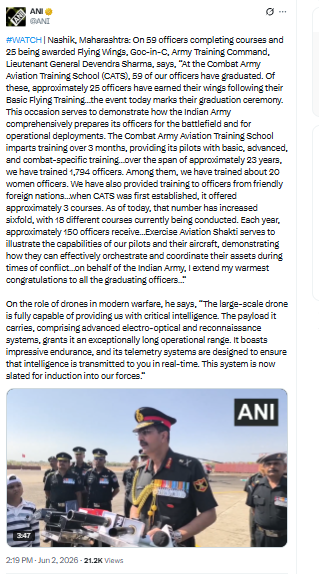
To verify the claim, we extracted several keyframes from the viral video and conducted a reverse-image search. During the investigation, we found the original video on ANI’s official X account. In the authentic footage, Lt Gen Sharma is seen speaking at a routine event at a training institution. His remarks focused on regular training-related matters, and he made no reference to missing pilots, Operation Sindoor, or any alleged losses.
https://x.com/ANI/status/2061731994971881667
In the next stage of the investigation, we found a post by the Ministry of Defence, Government of India, which also identified the viral clip as a deepfake.
https://www.facebook.com/watch/?v=1697698548109000
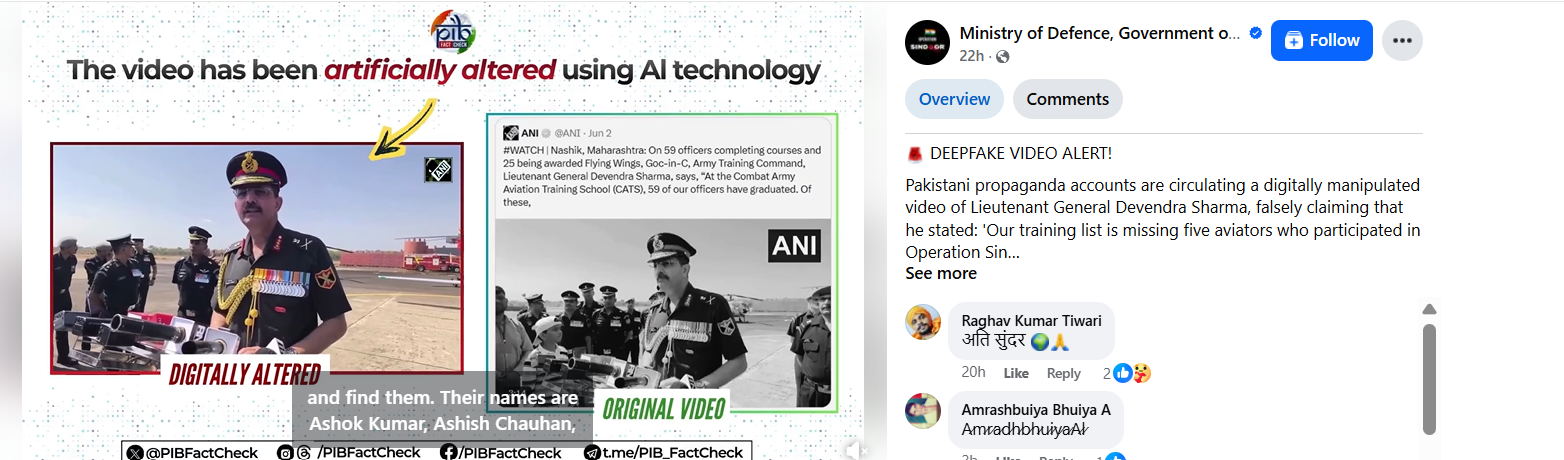
The ministry clarified that the video had been manipulated using AI-generated audio and did not reflect any genuine statement made by Lt Gen Devendra Sharma.
Conclusion
The viral video is a fabricated AI-generated deepfake. Lieutenant General Devendra Sharma never made the statement attributed to him about five missing aviators linked to Operation Sindoor. The original video was altered by inserting fake audio into authentic footage. The manipulated clip is being circulated online to spread misinformation and create confusion regarding the Indian Armed Forces.
Related Blogs

Introduction
Cybercrimes have been traversing peripheries and growing at a fast pace. Cybercrime is known to be an offensive action that either targets or operates through a computer, a computer network or a networked device, according to Kaspersky. In the “Era of globalisation” and a “Digitally coalesced world”, there has been an increase in International cybercrime. Cybercrime could be for personal or political objectives. Nevertheless, Cybercrime aims to sabotage networks for motives other than gain and be carried out either by organisations or individuals. Some of the cybercriminals have no national boundaries and are considered a global threat. They are likewise inordinately technically adept and operate avant-garde strategies.
The 2023 Global Risk Report points to exacerbating geopolitical apprehensions that have increased the advanced persistent threats (APTs), which are evolving globally as they are ubiquitous. Christine Lagarde, the president of the European Central Bank and former head of the International Monetary Fund (IMF), in 2020 cautioned that a cyber attack could lead to a severe economic predicament. Contemporary technologies and hazardous players have grown at an exceptional gait over the last few decades. Also, cybercrime has heightened on the agenda of nation-states, establishments and global organisations, as per the World Economic Forum (WEF).
The Role of the United Nations Ad Hoc Committee
In two shakes, the United Nations (UN) has a major initiative to develop a new and more inclusive approach to addressing cybercrime and is presently negotiating a new convention on cybercrime. The following convention seeks to enhance global collaboration in the combat against cybercrime. The UN has a central initiative to develop a unique and more inclusive strategy for addressing cybercrime. The UN passed resolution 74/247, which designated an open-ended ad hoc committee (AHC) in December 2019 entrusted with setting a broad global convention on countering the use of information and Communication Technologies (ICTs) for illicit pursuits.
The Cybercrime treaty, if adopted by the UN General Assembly (UNGA) would be the foremost imperative UN mechanism on a cyber point. The treaty could further become a crucial international legal framework for global collaboration on arraigning cyber criminals, precluding and investigating cybercrime. There have correspondingly been numerous other national and international measures to counter the criminal use of ICTs. However, the UN treaty is intended to tackle cybercrime and enhance partnership and coordination between states. The negotiations of the Ad Hoc Committee with the member states will be completed by early 2024 to further adopt the treaty during the UNGA in September 2024.
However, the following treaty is said to be complex. Some countries endorse a treaty that criminalises cyber-dependent offences and a comprehensive spectrum of cyber-enabled crimes. The proposals of Russia, Belarus, China, Nicaragua and Cuba have included highly controversial recommendations. Nevertheless, India has backed for criminalising crimes associated with ‘cyber terrorism’ and the suggestions of India to the UN Ad Hoc committee are in string with its regulatory strategy in the country. Similarly, the US, Japan, the UK, European Union (EU) member states and Australia want to include core cyber-dependent crimes.
Nonetheless, though a new treaty could become a practical instrument in the international step against cybercrime, it must conform to existing global agencies and networks that occupy similar areas. This convention will further supplement the "Budapest Cybercrime Convention" on cybercrime that materialised in the 1990s and was signed in Budapest in the year 2001.
Conclusion
According to Cyber Security Ventures, global cybercrime is expected to increase by 15 per cent per year over the next five years, reaching USD 10.5 trillion annually by 2025, up from USD 3 trillion in 2015. The UN cybercrime convention aims to be more global. That being the case, next-generation tools should have state-of-the-art technology to deal with new cyber crimes and cyber warfare. The global crevasse in nation-states due to cybercrime is beyond calculation. It could lead to a great cataclysm in the global economy and threaten the political interest of the countries on that account. It is crucial for global governments and international organisations. It is necessary to strengthen the collaboration between establishments (public and private) and law enforcement mechanisms. An “appropriately designed policy” is henceforward the need of the hour.
References
- https://www.kaspersky.co.in/resource-center/threats/what-is-cybercrime
- https://www.cyberpeace.org/
- https://www.interpol.int/en/Crimes/Cybercrime
- https://www.bizzbuzz.news/bizz-talk/ransomware-attacks-on-startups-msmes-on-the-rise-in-india-cyberpeace-foundation-1261320
- https://www.financialexpress.com/business/digital-transformation-cyberpeace-foundation-receives-4-million-google-org-grant-3282515/
- https://www.chathamhouse.org/2023/08/what-un-cybercrime-treaty-and-why-does-it-matter
- https://www.weforum.org/agenda/2023/01/global-rules-crack-down-cybercrime/
- https://www.weforum.org/publications/global-risks-report-2023/
- https://www.imf.org/external/pubs/ft/fandd/2021/03/global-cyber-threat-to-financial-systems-maurer.htm
- https://www.eff.org/issues/un-cybercrime-treaty#:~:text=The%20United%20Nations%20is%20currently,of%20billions%20of%20people%20worldwide.
- https://cybersecurityventures.com/hackerpocalypse-cybercrime-report-2016/
- https://www.coe.int/en/web/cybercrime/the-budapest-convention
- https://economictimes.indiatimes.com/tech/technology/counter-use-of-technology-for-cybercrime-india-tells-un-ad-hoc-group/articleshow/92237908.cms?utm_source=contentofinterest&utm_medium=text&utm_campaign=cppst
- https://consultation.dpmc.govt.nz/un-cybercrime-convention/principlesandobjectives/supporting_documents/Background.pdf
- https://unric.org/en/a-un-treaty-on-cybercrime-en-route/

Executive Summary:
Given that AI technologies are evolving at a fast pace in 2024, an AI-oriented phishing attack on a large Indian financial institution illustrated the threats. The documentation of the attack specifics involves the identification of attack techniques, ramifications to the institution, intervention conducted, and resultant effects. The case study also turns to the challenges connected with the development of better protection and sensibilisation of automatized threats.
Introduction
Due to the advancement in AI technology, its uses in cybercrimes across the world have emerged significant in financial institutions. In this report a serious incident that happened in early 2024 is analysed, according to which a leading Indian bank was hit by a highly complex, highly intelligent AI-supported phishing operation. Attack made use of AI’s innate characteristic of data analysis and data persuasion which led into a severe compromise of the bank’s internal structures.
Background
The chosen financial institution, one of the largest banks in India, had a good background regarding the extremity of its cybersecurity policies. However, these global cyberattacks opened up new threats that AI-based methods posed that earlier forms of security could not entirely counter efficiently. The attackers concentrated on the top managers of the bank because it is evident that controlling such persons gives the option of entering the inner systems as well as financial information.
Attack Execution
The attackers utilised AI in sending the messages that were an exact look alike of internal messages sent between employees. From Facebook and Twitter content, blog entries, and lastly, LinkedIn connection history and email tenor of the bank’s executives, the AI used to create these emails was highly specific. Some of these emails possessed official formatting, specific internal language, and the CEO’s writing; this made them very realistic.
It also used that link in phishing emails that led the users to a pseudo internal portal in an attempt to obtain the login credentials. Due to sophistication, the targeted individuals thought the received emails were genuine, and entered their log in details easily to the bank’s network, thus allowing the attackers access.
Impact
It caused quite an impact to the bank in every aspect. Numerous executives of the company lost their passwords to the fake emails and compromised several financial databases with information from customer accounts and transactions. The break-in permitted the criminals to cease a number of the financial’s internet services hence disrupting its functions and those of its customers for a number of days.
They also suffered a devastating blow to their customer trust because the breach revealed the bank’s weakness against contemporary cyber threats. Apart from managing the immediate operations which dealt with mitigating the breach, the financial institution was also toppling a long-term reputational hit.
Technical Analysis and Findings
1. The AI techniques that are used in generation of the phishing emails are as follows:
- The attack used powerful NLP technology, which was most probably developed using the large-scaled transformer, such as GPT (Generative Pre-trained Transformer). Since these models are learned from large data samples they used the examples of the conversation pieces from social networks, emails and PC language to create quite credible emails.
Key Technical Features:
- Contextual Understanding: The AI was able to take into account the nature of prior interactions and thus write follow up emails that were perfectly in line with prior discourse.
- Style Mimicry: The AI replicated the writing of the CEO given the emails of the CEO and then extrapolated from the data given such elements as the tone, the language, and the format of the signature line.
- Adaptive Learning: The AI actively adapted from the mistakes, and feedback to tweak the generated emails for other tries and this made it difficult to detect.
2. Sophisticated Spear-Phishing Techniques
Unlike ordinary phishing scams, this attack was phishing using spear-phishing where the attackers would directly target specific people using emails. The AI used social engineering techniques that significantly increased the chances of certain individuals replying to certain emails based on algorithms which machine learning furnished.
Key Technical Features:
- Targeted Data Harvesting: Cyborgs found out the employees of the organisation and targeted messages via the public profiles and messengers were scraped.
- Behavioural Analysis: The latest behaviour pattern concerning the users of the social networking sites and other online platforms were used by the AI to forecast the courses of action expected to be taken by the end users such as clicking on the links or opening of the attachments.
- Real-Time Adjustments: These are times when it was determined that the response to the phishing email was necessary and the use of AI adjusted the consequent emails’ timing and content.
3. Advanced Evasion Techniques
The attackers were able to pull off this attack by leveraging AI in their evasion from the normal filters placed in emails. These techniques therefore entailed a modification of the contents of the emails in a manner that would not be easily detected by the spam filters while at the same time preserving the content of the message.
Key Technical Features:
- Dynamic Content Alteration: The AI merely changed the different aspects of the email message slightly to develop several versions of the phishing email that would compromise different algorithms.
- Polymorphic Attacks: In this case, polymorphic code was used in the phishing attack which implies that the actual payloads of the links changed frequently, which means that it was difficult for the AV tools to block them as they were perceived as threats.
- Phantom Domains: Another tactic employed was that of using AI in generating and disseminating phantom domains, that are actual web sites that appear to be legitimate but are in fact short lived specially created for this phishing attack, adding to the difficulty of detection.
4. Exploitation of Human Vulnerabilities
This kind of attack’s success was not only in AI but also in the vulnerability of people, trust in familiar language and the tendency to obey authorities.
Key Technical Features:
- Social Engineering: As for the second factor, AI determined specific psychological principles that should be used in order to maximise the chance of the targeted recipients opening the phishing emails, namely the principles of urgency and familiarity.
- Multi-Layered Deception: The AI was successfully able to have a two tiered approach of the emails being sent as once the targeted individuals opened the first mail, later the second one by pretext of being a follow up by a genuine company/personality.
Response
On sighting the breach, the bank’s cybersecurity personnel spring into action to try and limit the fallout. They reported the matter to the Indian Computer Emergency Response Team (CERT-In) to find who originated the attack and how to block any other intrusion. The bank also immediately started taking measures to strengthen its security a bit further, for instance, in filtering emails, and increasing the authentication procedures.
Knowing the risks, the bank realised that actions should be taken in order to enhance the cybersecurity level and implement a new wide-scale cybersecurity awareness program. This programme consisted of increasing the awareness of employees about possible AI-phishing in the organisation’s info space and the necessity of checking the sender’s identity beforehand.
Outcome
Despite the fact and evidence that this bank was able to regain its functionality after the attack without critical impacts with regards to its operations, the following issues were raised. Some of the losses that the financial institution reported include losses in form of compensation of the affected customers and costs of implementing measures to enhance the financial institution’s cybersecurity. However, the principle of the incident was significantly critical of the bank as customers and shareholders began to doubt the organisation’s capacity to safeguard information in the modern digital era of advanced artificial intelligence cyber threats.
This case depicts the importance for the financial firms to align their security plan in a way that fights the new security threats. The attack is also a message to other organisations in that they are not immune from such analysis attacks with AI and should take proper measures against such threats.
Conclusion
The recent AI-phishing attack on an Indian bank in 2024 is one of the indicators of potential modern attackers’ capabilities. Since the AI technology is still progressing, so are the advances of the cyberattacks. Financial institutions and several other organisations can only go as far as adopting adequate AI-aware cybersecurity solutions for their systems and data.
Moreover, this case raises awareness of how important it is to train the employees to be properly prepared to avoid the successful cyberattacks. The organisation’s cybersecurity awareness and secure employee behaviours, as well as practices that enable them to understand and report any likely artificial intelligence offences, helps the organisation to minimise risks from any AI attack.
Recommendations
- Enhanced AI-Based Defences: Financial institutions should employ AI-driven detection and response products that are capable of mitigating AI-operation-based cyber threats in real-time.
- Employee Training Programs: CYBER SECURITY: All employees should undergo frequent cybersecurity awareness training; here they should be trained on how to identify AI-populated phishing.
- Stricter Authentication Protocols: For more specific accounts, ID and other security procedures should be tight in order to get into sensitive ones.
- Collaboration with CERT-In: Continued engagement and coordination with authorities such as the Indian Computer Emergency Response Team (CERT-In) and other equivalents to constantly monitor new threats and valid recommendations.
- Public Communication Strategies: It is also important to establish effective communication plans to address the customers of the organisations and ensure that they remain trusted even when an organisation is facing a cyber threat.
Through implementing these, financial institutions have an opportunity for being ready with new threats that come with AI and cyber terrorism on essential financial assets in today’s complex IT environments.

Introduction
Netizens across the globe have been enjoying the fruits of technological advancements in the digital century. Our personal and professional life has been impacted deeply by the new technologies. The previous year we saw an exponential rise in blockchain integration and the applications of Web 3.0. There is no denying that the Covid-19 pandemic caused a rapid rise in technology and internet penetration all across the globe, bringing the world closer with respect to connectivity and the exchange of ideas and knowledge. Tech advancements have definitely made our lives easier, but the same has also opened the doors to various vulnerabilities and new potential threats. As cyberspace expands, so do the vulnerabilities associated with it, and it is critical we take note of such issues and create safeguards to the extent that such incidents are prevented before they occur. We need to create sustainable and secure cyberspace for future generations.MetaVerse in 2023The metaverse was introduced by Facebook (now Meta) in 2021 as a peak into the future of cyberspace. Since then, tech developers have been working towards arming the metaverse with extraordinary innovations and applications. Netizens came across news like someone bought a house or a plot in the metaverse, someone bought a car in the metaverse, and so on, these news were taken to be the evidence of the netizen’s transition towards the new digital age as we have seen in sci-fi movies. But today this type of news has become history and the metaverse is expanding faster than ever. Let us look at the latest developments and trends in the metaverse-
- Avatar creation - The avatar creation in the metaverse will be a pivotal move as the avatars will represent the user, and essentially it will be the digital, version of the user and will be similar to the user's personal and physical traits to maintain realism in the metaverse.
- Architecture firms - Metaverse has its own set of architects who will be working towards creating your dream home or pro[erty in the metaverse, the heavy code-based services are now being sold just as if they were in the physical space.
- Mining - The metaverse already has companies who are mining gold, silver, petroleum, and other resources for the avatars in the metaverse, for instance, if someone has bought a car in the metaverse, it will still need fuel to run.
- Security firms - These firms are the first line of defenders in the metaverse as they provide tech-based solutions and protocols to secure one’s avatar and belongings in the metaverse.
- Metaverse Police - Interpol, along with its global partner organization has created the metaverse police, who will be working towards creating a safe cyber ecosystem by maintaining compliance with digital laws and ethics.
Advancements beyond metaverse in 2023
Technology continues to be a critical force for change in the world. Technology breakthroughs give enterprises more possibilities to lift their productivity and invent offerings. And while it remains difficult to forecast how technology trends will play out, business leaders can plan ahead better by watching the development of new technologies, anticipating how companies could utilize them, and understanding the factors that impact innovation and adoption.
- Applied observability
It advances the practice of pattern recognition. To foresee and identify abnormalities and offer solutions, one must have the capacity to delve deeply into complicated systems and a stream of data. Data fuels this aspect of tech growth in the future.
- Digital Immune System
To ensure that all major systems operate round-the-clock to deliver uninterrupted services, Digital Immune System will combine observability, AI-augmented testing, chaos engineering, site reliability engineering (SRE), and software supply chain security. This will take the efficiency of the systems to a new level.
- Super apps
These represent the upcoming shift in application usage, design, and development, where consumers will utilise a single app to manage most systems in an enterprise ecosystem. Over 50% of the world’s population will utilise super apps on a daily basis to fulfill their daily personal and professional needs.
- AR/VR and BlockChain technology
A combination of better interconnected, safe, and immersive virtual environments where people and businesses may recreate real-life scenarios will be created by combining AR/VR, AI/ML, IoT, and Blockchain, thus creating a new vertical of innovation with keen technologies of Web 3.0.
- AAI
The next level of AI, i.e., Advanced Artificial Intelligence (AI), will revolutionise machine learning, pattern recognition, and computing. It aims to fully automate processes without requiring any manual input, thus eradicating the issues of human error and bad actor influence completely.
- Corporate Metaverse
Aside from its power as a marketing tool, the metaverse promises to provide platforms, tools, and entire virtual worlds where business can be done remotely, efficiently, and intelligently. We can expect to see the metaverse concept merge with the idea of the “digital twin” – virtual simulations of real-world products, processes, or operations that can be used to test and prototype new ideas in the safe environment of the digital domain. From wind farms to Formula 1 cars, designers are recreating physical objects inside virtual worlds where their efficiency can be stress-tested under any conceivable condition without the resource costs that would be incurred by testing them in the physical world.ConclusionIn 2023, we will see more advanced use cases for technology such as motion capture, which will mean that as well as looking and sounding more like us, our avatars will adopt our own unique gestures and body language. We may even start to see further developments in the fields of autonomous avatars – meaning they won't be under our direct control but will be enabled by AI to act as our representatives in the digital world while we ourselves get on with other, completely unrelated tasks. As we go deeper into cyberspace, we need to remember the basic safety practices and inculcate them with respect to cyberspace and work towards creating string policies and legislations to safeguard the digital rights and duties of the netizen to create a wholesome and interdependent cyber ecosystem.