
#FactCheck: Viral letter allegedly issued by PMO on reservation is fake, AI-generated document
Executive Summary
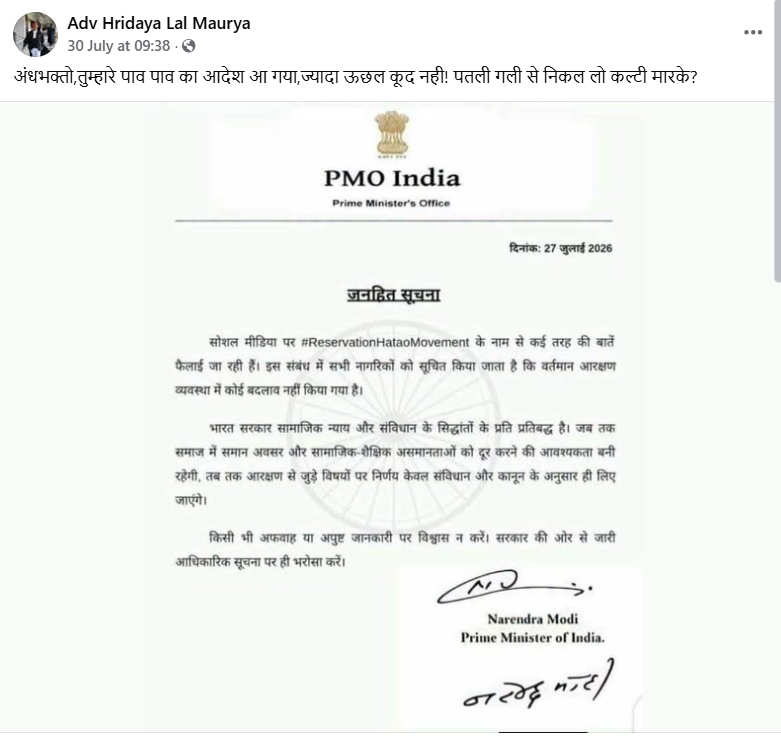
A purported letter issued in the name of the Prime Minister’s Office (PMO) is being widely shared on social media. The letter claims that the government has not made any changes to the reservation system regarding the “Remove Reservation Movement” and appeals to people not to pay attention to rumours. The viral letter is dated July 27, 2026, and also carries what appear to be Prime Minister Narendra Modi’s signatures in both Hindi and English.
CyberPeace Research Wing’s research found the viral claim to be false. The research revealed that the Prime Minister’s Office (PMO) has neither issued any official statement regarding reservation nor released any such letter. No credible media reports related to the alleged letter were found. The research further revealed that the purported reservation-related letter circulating on social media was a fake document created with the help of AI.
Claim:
A Facebook user shared the alleged letter issued in the name of the Prime Minister’s Office on July 30, 2026, claiming that the government has not made any changes to the reservation system in connection with the “Remove Reservation Movement” and appealed to citizens not to believe rumours. The viral letter bears the date July 27, 2026, and displays signatures of Prime Minister Narendra Modi in both Hindi and English. The archived link and screenshot of the post are provided below:
https://www.facebook.com/share/p/1b9nD5k3As/
Factcheck
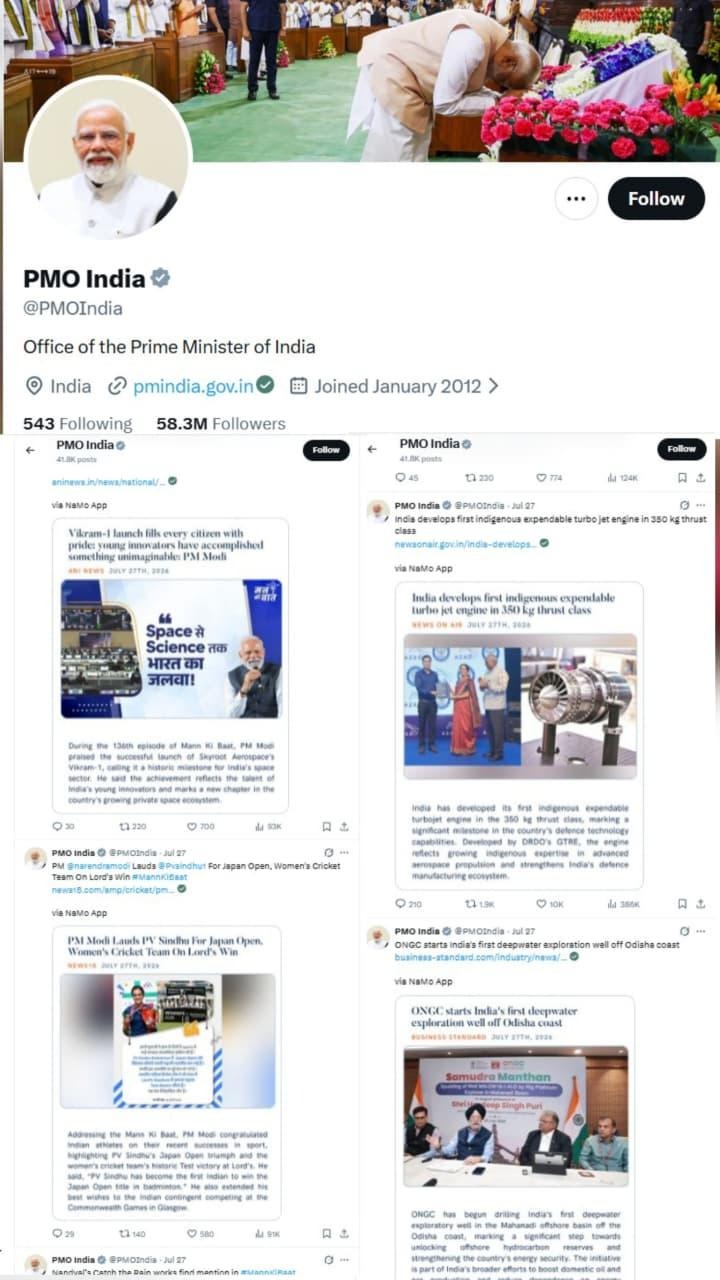
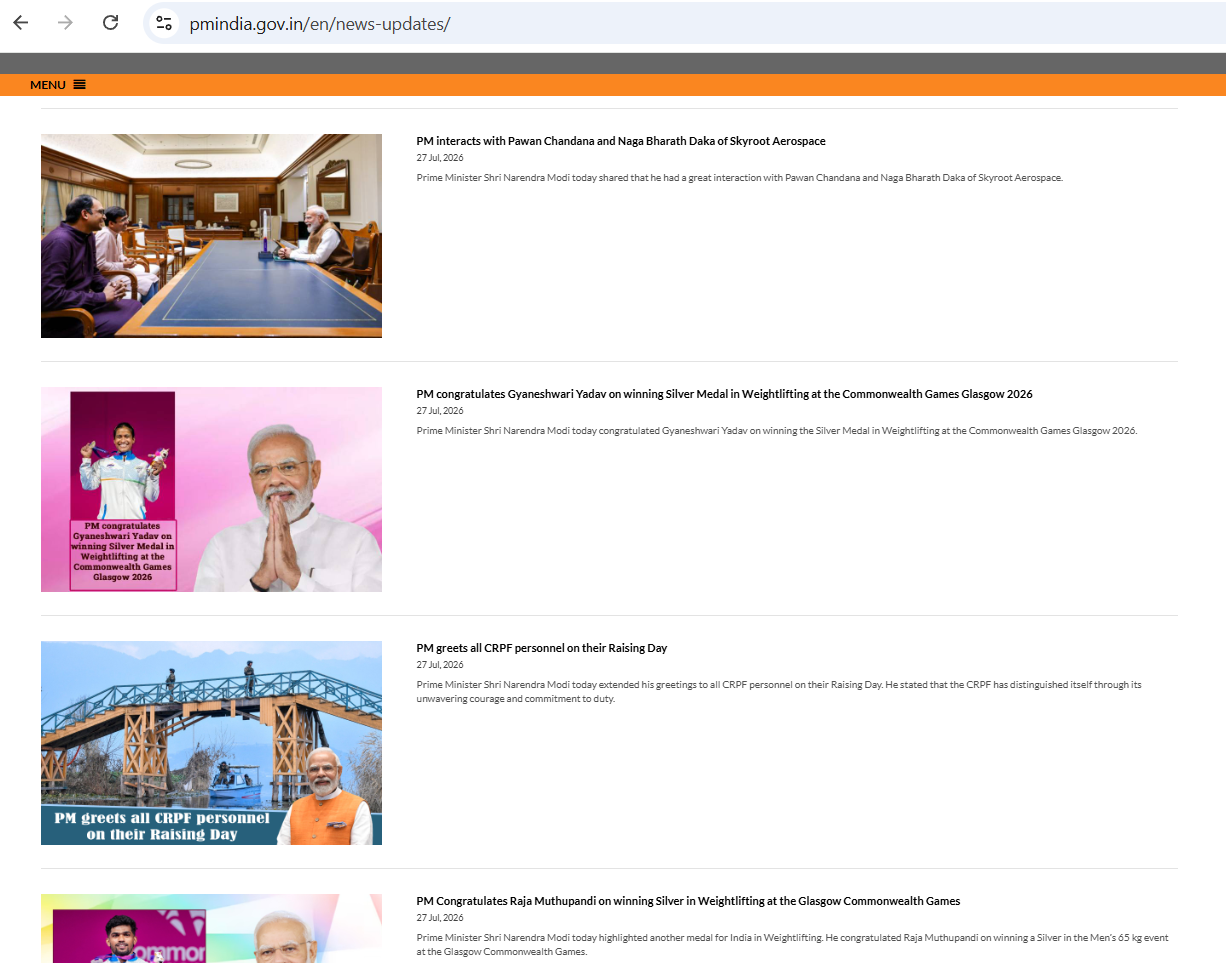
To verify the authenticity of the viral claim, we conducted a Google search using relevant keywords. However, no credible media reports related to the alleged letter were found. During the next stage of the research, we scanned the official X account (formerly Twitter) of PMO India. We did not find any such letter posted on July 27 or around that date. Continuing the research, we checked the official website of PMO India. No such letter was found in the news updates section or anywhere else on the website that could confirm the viral claim.
Further, we reviewed the press releases issued by the Prime Minister’s Office on July 27 available on the official website of the Press Information Bureau (PIB). We found no press release or official communication related to reservation or matching the viral letter.
https://www.pmindia.gov.in/en/
As part of the research, we scanned the viral letter using the AI detection tool Image Detector. The results indicated that the document was 93 percent likely to be AI-generated.

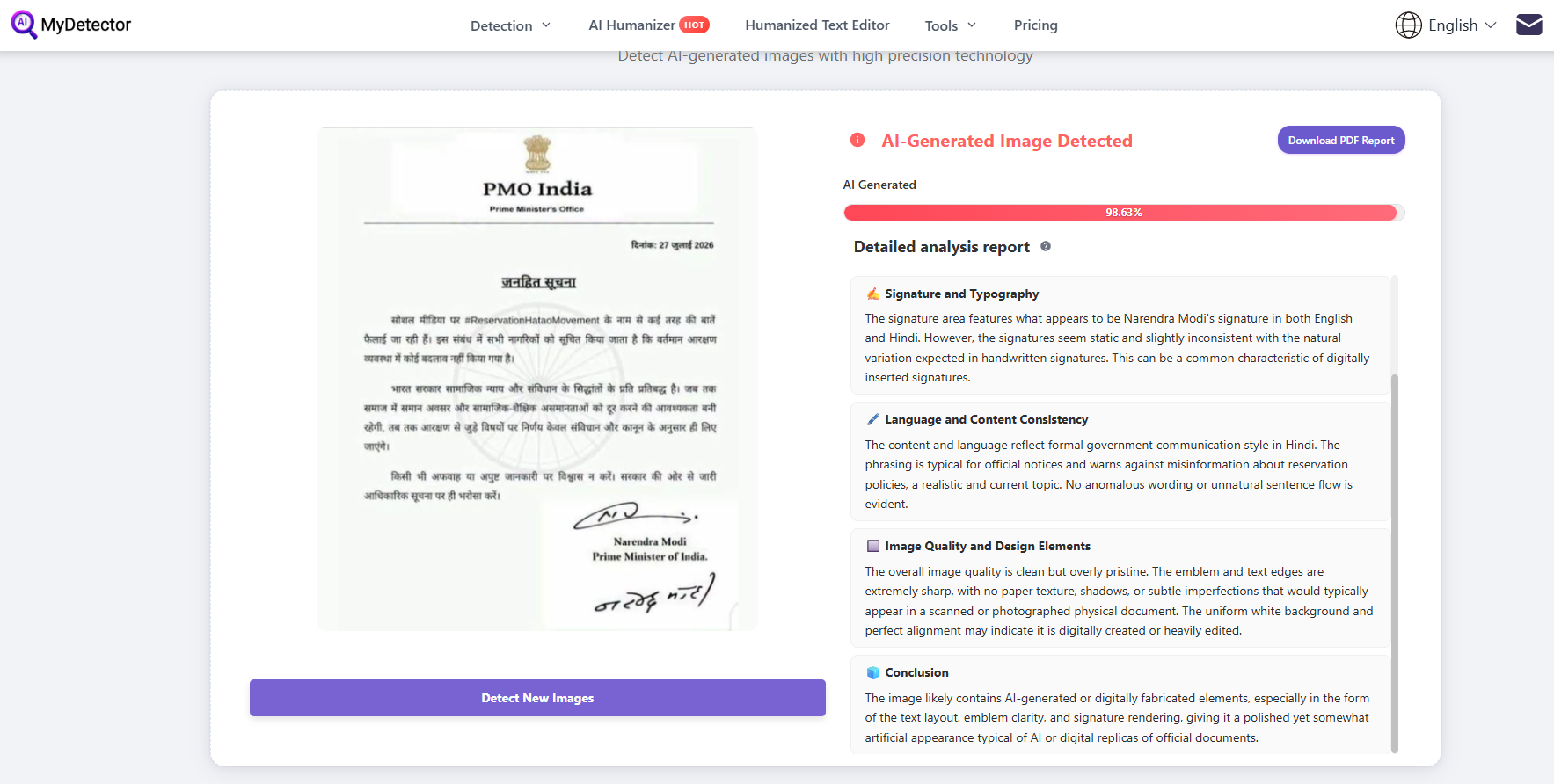
We also analysed the viral letter using another AI detection tool, My Detector. The results showed a 98 percent probability that the letter was created using AI.
Conclusion:
Our research found no official evidence confirming that the Prime Minister’s Office issued the viral letter. The purported PMO letter regarding reservation was found to be fake and AI-generated.

Related Blogs

Introduction
Mr Rajeev Chanderashekhar, MoS, Ministry of Electronics and Information Technology, on 09 March 2023, held a stakeholder consultation on the Digital India Bill. This bill will be the successor to the Information technology Act 2000 and provide a set of regulations and laws which will govern cyberspace in times to come. The consultation was held in Bangalore and was the first of many such consultations where the Digital India bill is to be discussed. These public stakeholder consultations will provide direct public feedback to the ministry, and this will help create a safe and secure ecosystem of Indian Cyber Laws.
What is the Digital India Act?
Cyberspace has evolved the fastest as compared to any other industry, and the evolution of the growth cannot be presumed to be stagnant or stuck as we see new technologies and gadgets being invented all across the globe. The ease created by using technology has changed how we live and function. However, bad actors often use these advantages or fruits of technology to wreak havoc upon the nation’s cyberspace. The use of technology is always governed by the application of usage and safeguard policies and laws. As technology is growing exponentially, it is pertinent that we have laws which are in congruence with today’s time and technology. This is keenly addressed by the Digital India Act, which will be the legislation governing Indian Cyberspace in times to come. This was the need of the hour in order to have the judiciary, legislature and law enforcement agencies ahead of the curve when it comes to cyber crimes and laws.
What is the Digital India Bill’s primary goal?
The Digital India Bill’s goal is to guarantee an institutional structure for accountability and that the internet in India is accessible, unhindered by user harm or criminal activity. The law will apply to new technologies, algorithmic social media platforms, artificial intelligence, user risks, the diversity of the internet, and the regulation of intermediaries. The diversity of the internet, user hazards, artificial intelligence, social media platforms, and intermediary regulation are all discussed.
Why is the Digital India Bill necessary?
The number of internet users in the country currently exceeds 760 million; in the upcoming years, this number will reach 1.2 billion. Despite the fact that the internet is useful and promotes connectivity, there are a number of user damages nearby. Thus, it is crucial to enact legislation to set forth new guidelines for individuals’ rights and responsibilities and mention the requirement to gather data.
Major Elements of the Digital India Act
Major Elements of the Digital India Bill, which will eventually become an Act, which will contribute massively towards a safe cyber-ecosystem, some of these elements aim towards the following-
- The legislation attempts to establish an internet regulator.
- Women and Child safety.
- Safe harbour for intermediaries.
- The right of the individual to secure his information and the requirement to utilise personal data for legal purposes provide the main obstacles to data protection or regulation. The law tries to deal with this difficulty.
- A limit will be placed on how far a person’s personal information can be accessed for legal reasons.
- The majority of the bill’s characteristics are contrasted with the EU’s General Data Protection Regulation.
The Way Ahead
As we ride the wave of developments in cyberspace regarding emerging technologies and automated gadgets, it becomes pertinent that the state takes due note of such technologies and the courts take cognisance of offences committed by using technology. Law enforcement agencies must also train police personnel who can effectively and efficiently investigate cybercrime cases. The ministry also released a few bills last year, such as – the Telecommunication Bill, 2022, Intermediary Rules and the Digital Personal Data Protection Bill, 2022, to better address the shortcomings and the issues in cyberspace and how to safeguard the netizens. The Digital India Act will essentially create a synergy between the current bills and the new ones to come in order to create a wholesome, safe and secure Indian cyber ecosystem.
Conclusion
Digital India Bill is necessary to address the challenges of cyberspace, like personal data and privacy, and policies related to online child and women safety to create a and create a modern and comprehensive legal framework that aligns with global standards of cyber laws. The draft of the bill is expected to come out by July. The ministry looks forward to maximising the impact of the bill through such continuous and effective public consultation to understand and fulfil the expectations and requirements of the Indian netizen, thus empowering him/her equivalent to the netizen of a developed country.

Introduction
In a major policy shift aimed at synchronizing India's fight against cyber-enabled financial crimes, the government has taken a landmark step by bringing the Indian Cyber Crime Coordination Centre (I4C) under the ambit of the Prevention of Money Laundering Act (PMLA). In the notification released in the official gazette on 25th April, 2025, the Department of Revenue, Ministry of Finance, included the Indian Cyber Crime Coordination Centre (I4C) under Section 66 of the Prevention of Money Laundering Act, 2002 (hereinafter referred to as “PMLA”). The step comes as a significant attempt to resolve the asynchronous approach of different agencies (Enforcement Directorate (ED), State Police, CBI, CERT-In, RBI) set up under the government responsible for preventing and often possessing key information regarding cyber crimes and financial crimes. As it is correctly put, "When criminals sprint and the administration strolls, the finish line is lost.”
The gazetted notification dated 25th April, 2025, read as follows:
“In exercise of the powers conferred by clause (ii) of sub-section (1) of section 66 of the Prevention of Money-laundering Act, 2002 (15 of 2003), the Central Government, on being satisfied that it is necessary in the public interest to do so, hereby makes the following further amendment in the notification of the Government of India, in the Ministry of Finance, Department of Revenue, published in the Gazette of India, Extraordinary, Part II, section 3, sub-section (i) vide number G.S.R. 381(E), dated the 27th June, 2006, namely:- In the said notification, after serial number (26) and the entry relating thereto, the following serial number and entry shall be inserted, namely:— “(27) Indian Cyber Crime Coordination Centre (I4C).”.
Outrunning Crime: Strengthening Enforcement through Rapid Coordination
The usage of cyberspace to commit sophisticated financial crimes and white-collar crimes is a one criminal parallel passover that no one was looking forward to. The disenchanted reality of today’s world is that the internet is used for as much bad as it is for good. The internet has now entered the financial domain, facilitating various financial crimes. Money laundering is a financial crime that includes all processes or activities that are in connection with the concealment, possession, acquisition, or use of proceeds of crime and projecting it as untainted money. In the offence of money laundering, there is an intricate web and trail of financial transactions that are hard to track, as they are, and with the advent of the internet, the transactions are often digital, and the absence of crucial information hampers the evidentiary chain. With this new step, the Enforcement Directorate (ED) will now make headway into the investigation with the information exchange under PMLA from and to I4C, removing the obstacles that existed before this notification.
Impact
The decision of the finance ministry has to be seen in terms of all that is happening around the globe, with the rapid increase in sophisticated financial crimes. By formally empowering the I4C to share and receive information with the Enforcement Directorate under PMLA, the government acknowledges the blurred lines between conventional financial crime and cybercrime. It strengthens India’s financial surveillance, where money laundering and cyber fraud are increasingly two sides of the same coin. The assessment of the impact can be made from the following facilitations enabled by the decision:
- Quicker internet detection of money laundering
- Money trail tracking in real time across online platforms
- Rapid freeze of cryptocurrency wallets or assets obtained fraudulently
Another important aspect of this decision is that it serves as a signal that India is finally equipping itself and treating cyber-enabled financial crimes with the gravitas that is the need of the hour. This decision creates a two-way intelligence flow between cybercrime detection units and financial enforcement agencies.
Conclusion
To counter the fragmented approach in handling cyber-enabled white-collar crimes and money laundering, the Indian government has fortified its legal and enforcement framework by extending PMLA’s reach to the Indian Cyber Crime Coordination Centre (I4C). All the decisions and the brainstorming that led up to this notification are crucial at this point in time for the cybercrime framework that India needs to be on par with other countries. Although India has come a long way in designing a robust cybercrime intelligence structure, as long as it excludes and works in isolation, it will be ineffective. So, the current decision in discussion should only be the beginning of a more comprehensive policy evolution. The government must further integrate and devise a separate mechanism to track “digital footprints” and incorporate a real-time red flag mechanism in digital transactions suspected to be linked to laundering or fraud.
Executive Summary
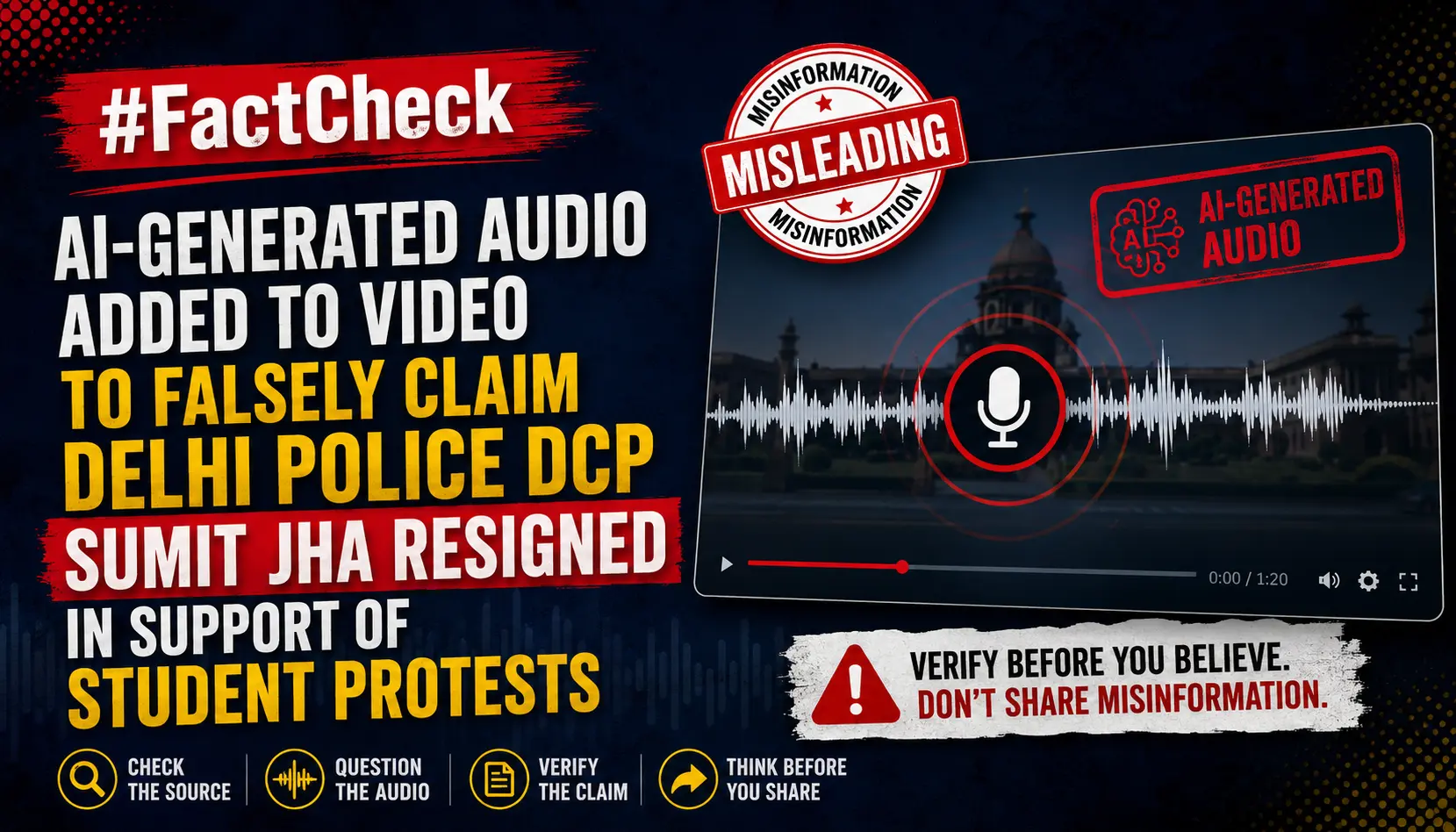
Even after the conclusion of the Cockroach Janata Party (CJP) protest at Delhi’s Jantar Mantar, several misleading claims related to the demonstration continue to circulate on social media. In a similar instance, a video of Delhi Police DCP Sumit Jha is being widely shared, claiming that he resigned from the Indian Police Service in support of the student movement. In the viral video, DCP Sumit Jha is allegedly heard saying that he is resigning from his post with immediate effect and cannot be part of a system that forces him to spread false information against students. The video is being shared with the claim that Delhi Police DCP Sumit Jha resigned from his position in support of protesting students.
CyberPeace Research Wing’s research found the claim to be false. The research revealed that DCP Sumit Jha has not resigned. The viral video was digitally altered by adding AI-generated audio to an original video shared by the Delhi Police on its official X (formerly Twitter) account on July 23, 2026. The manipulated video is being circulated with a false claim.
Claim
A user on Instagram shared the viral video on July 28, 2026, claiming that Delhi Police DCP Sumit Jha had resigned from his post in support of the student protest. The post link, archive link, and screenshot are provided below.
https://www.instagram.com/reel/DbUr6CPoB13/

Another Instagram user also shared the same video with a similar claim. The post link, archive link, and screenshot are provided below.
https://www.instagram.com/reel/DbUr6CPoB13/

Fact Check
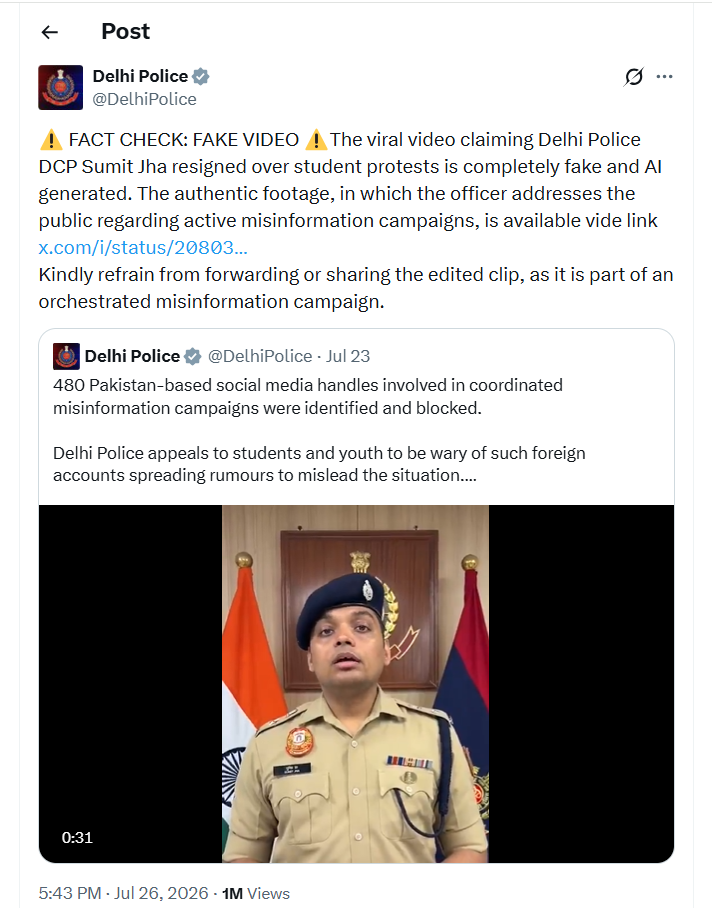
To verify the authenticity of the viral claim, we conducted a Google search using relevant keywords. However, we did not find any credible news report or official information confirming that Delhi Police DCP Sumit Jha had resigned in support of the student protest. During the research, we found a post shared by the official X account of Delhi Police on July 26, 2026. In the post, Delhi Police clarified that a fake and AI-generated video of DCP Sumit Jha was being circulated on social media, falsely showing him resigning in support of the student protest.
Delhi Police also reshared the original video of DCP Sumit Jha, which was posted on July 23, 2026. According to the caption, 480 Pakistan-based social media handles involved in coordinated disinformation campaigns were identified and blocked. Delhi Police appealed to students and young people to remain cautious of such foreign accounts attempting to spread rumours and misinformation. In the 54-second original video, DCP Sumit Jha can be seen warning people against misinformation circulating on social media. He stated that more than 400 Pakistan-based social media handles had been identified for spreading fake content and rumours. He said the objective of such accounts was to provoke people and mislead students.
DCP Sumit Jha appealed to citizens not to trust fake posts, edited videos, or content shared by anonymous social media accounts without verification. He also said that peaceful protest is a democratic right and that Delhi Police respects this right.
The original post and screenshot can be accessed below:
https://x.com/DelhiPolice/status/2081352316767396053?s=20
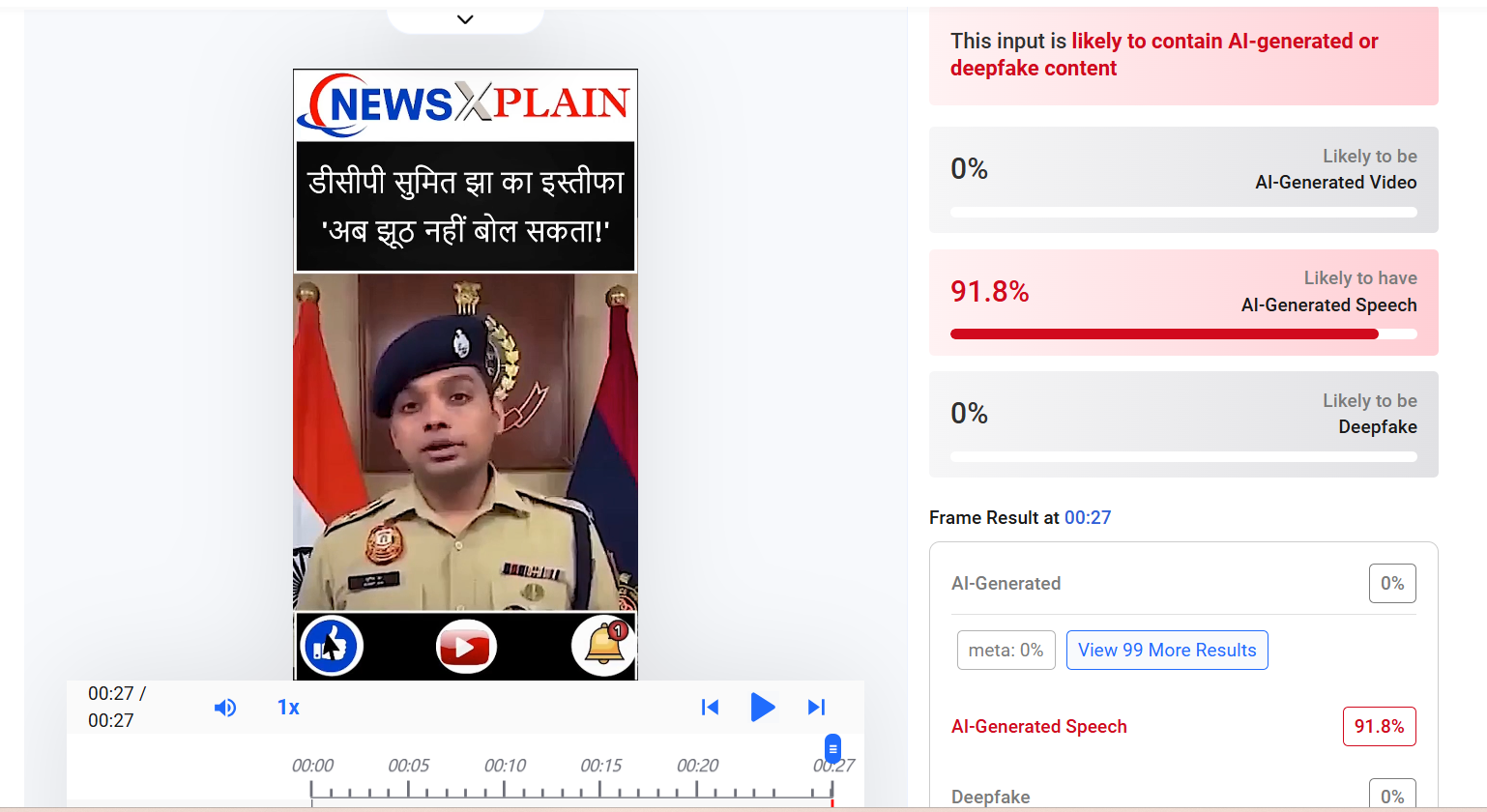
A comparison between the original video and the viral video showed that the statements in both videos are completely different. The original video of DCP Sumit Jha does not contain any statement related to his resignation or support for the student protest, as claimed in the viral video. Further, the viral video was analysed using the AI detection tool HIVE Moderation. The tool’s analysis indicated that the audio used in the video had a 91.8% probability of being AI-generated, confirming that the audio was not authentic and had been artificially created.
Conclusion
The research found that Delhi Police DCP Sumit Jha has not resigned from his post. The viral video has been digitally manipulated by adding AI-generated audio to an original video and is being shared with a false claim on social media.
