
#FactCheck: Video of Zepto Store Manager Being Assaulted in Mira Road Falsely Linked to CJP Spokesperson Ashutosh Ranka
Executive Summary
A video is being shared on Facebook with the claim that it shows CJP spokesperson Ashutosh Ranka being assaulted. The video shows several people beating a man. A picture of Ashutosh Ranka has been overlaid on the video along with the text, “CJP Private Video.” Some users commenting on the post also believe that the video genuinely shows Ranka being assaulted. CyberPeace Research found that the video is from Mira Road, where MNS workers had assaulted store manager Jay Pathak.
Claim
A video is being shared on Facebook claiming that it shows a private video of CJP.
https://www.facebook.com/reel/1405149115120742

Fact Check
We first searched Google using keywords such as “CJP spokesperson Ashutosh Ranka assaulted.” However, we did not find any credible media reports mentioning the incident described in the claim.
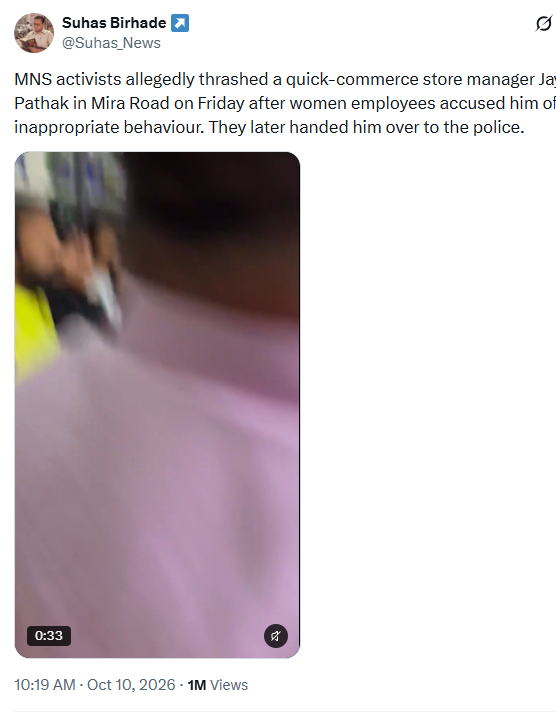
We then conducted a reverse image search of a frame from the viral video using Google Lens. This led us to a longer version of the same video, which was shared on October 10, 2026, by the X account @Suhas_News. According to the accompanying information, Maharashtra Navnirman Sena (MNS) workers assaulted store manager Jay Pathak in Mira Road after female employees alleged that they had been treated inappropriately.
https://www.facebook.com/reel/1405149115120742

https://x.com/Suhas_News/status/2108782017391525953
We also found the same video shared with the same information on the official Facebook page of news agency Midday India on October 10, 2026.
https://www.facebook.com/reel/4737845496451020

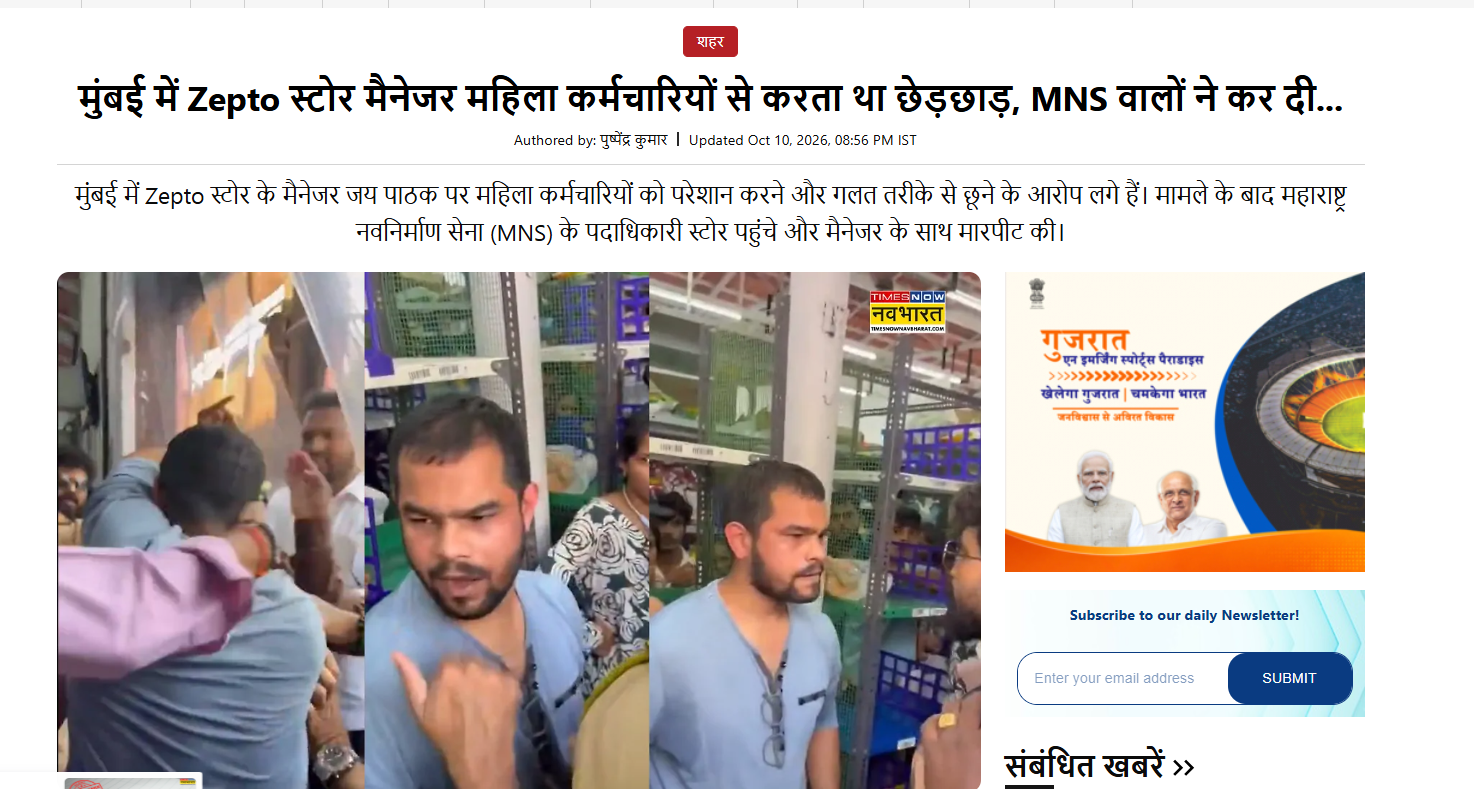
In the next stage of our research, we found a report published by Times Now on October 10, 2026, related to the viral video. According to the report, five female employees of a Zepto store located in the Shivar Garden area of Mira Road had accused their manager, Jai Pathak, of repeatedly touching them inappropriately and sexually harassing them.
Conclusion
Our research found that a video showing the assault of store manager Jai Pathak in Mira Road is being shared with the misleading claim that it shows CJP spokesperson Ashutosh Ranka being beaten.

Related Blogs

What are Deepfakes?
A deepfake is essentially a video of a person in which their face or body has been digitally altered so that they appear to be someone else, typically used maliciously or to spread false information. Deepfake technology is a method for manipulating videos, images, and audio utilising powerful computers and deep learning. It is used to generate fake news and commit financial fraud, among other wrongdoings. It overlays a digital composite over an already-existing video, picture, or audio; cybercriminals use Artificial Intelligence technology. The term deepfake was coined first time in 2017 by an anonymous Reddit user, who called himself deepfake.
Deepfakes works on a combination of AI and ML, which makes the technology hard to detect by Web 2.0 applications, and it is almost impossible for a layman to see if an image or video is fake or has been created using deepfakes. In recent times, we have seen a wave of AI-driven tools which have impacted all industries and professions across the globe. Deepfakes are often created to spread misinformation. There lies a key difference between image morphing and deepfakes. Image morphing is primarily used for evading facial recognition, but deepfakes are created to spread misinformation and propaganda.
Issues Pertaining to Deepfakes in India
Deepfakes are a threat to any nation as the impact can be divesting in terms of monetary losses, social and cultural unrest, and actions against the sovereignty of India by anti-national elements. Deepfake detection is difficult but not impossible. The following threats/issues are seen to be originating out of deep fakes:
- Misinformation: One of the biggest issues of Deepfake is misinformation, the same was seen during the Russia-Ukraine conflict, where in a deepfake of Ukraine’s president, Mr Zelensky, surfaced on the internet and caused mass confusion and propaganda-based misappropriation among the Ukrainians.
- Instigation against the Union of India: Deepfake poses a massive threat to the integrity of the Union of India, as this is one of the easiest ways for anti-national elements to propagate violence or instigate people against the nation and its interests. As India grows, so do the possibilities of anti-national attacks against the nation.
- Cyberbullying/ Harassment: Deepfakes can be used by bad actors to harass and bully people online in order to extort money from them.
- Exposure to Illicit Content: Deepfakes can be easily used to create illicit content, and oftentimes, it is seen that it is being circulated on online gaming platforms where children engage the most.
- Threat to Digital Privacy: Deepfakes are created by using existing videos. Hence, bad actors often use photos and videos from Social media accounts to create deepfakes, this directly poses a threat to the digital privacy of a netizen.
- Lack of Grievance Redressal Mechanism: In the contemporary world, the majority of nations lack a concrete policy to address the aspects of deepfake. Hence, it is of paramount importance to establish legal and industry-based grievance redressal mechanisms for the victims.
- Lack of Digital Literacy: Despite of high internet and technology penetration rates in India, digital literacy lags behind, this is a massive concern for the Indian netizens as it takes them far from understanding the tech, which results in the under-reporting of crimes. Large-scale awareness and sensitisation campaigns need to be undertaken in India to address misinformation and the influence of deepfakes.
How to spot deepfakes?
Deepfakes look like the original video at first look, but as we progress into the digital world, it is pertinent to establish identifying deepfakes in our digital routine and netiquettes in order to stay protected in the future and to address this issue before it is too late. The following aspects can be kept in mind while differentiating between a real video and a deepfake
- Look for facial expressions and irregularities: Whenever differentiating between an original video and deepfake, always look for changes in facial expressions and irregularities, it can be seen that the facial expressions, such as eye movement and a temporary twitch on the face, are all signs of a video being a deepfake.
- Listen to the audio: The audio in deepfake also has variations as it is imposed on an existing video, so keep a check on the sound effects coming from a video in congruence with the actions or gestures in the video.
- Pay attention to the background: The most easiest way to spot a deepfake is to pay attention to the background, in all deepfakes, you can spot irregularities in the background as, in most cases, its created using virtual effects so that all deepfakes will have an element of artificialness in the background.
- Context and Content: Most of the instances of deepfake have been focused towards creating or spreading misinformation hence, the context and content of any video is an integral part of differentiating between an original video and deepfake.
- Fact-Checking: As a basic cyber safety and digital hygiene protocol, one should always make sure to fact-check each and every piece of information they come across on social media. As a preventive measure, always make sure to fact-check any information or post sharing it with your known ones.
- AI Tools: When in doubt, check it out, and never refrain from using Deepfake detection tools like- Sentinel, Intel’s real-time deepfake detector - Fake catcher, We Verify, and Microsoft’s Video Authenticator tool to analyze the videos and combating technology with technology.
Recent Instance
A deepfake video of actress Rashmika Mandanna recently went viral on social media, creating quite a stir. The video showed a woman entering an elevator who looked remarkably like Mandanna. However, it was later revealed that the woman in the video was not Mandanna, but rather, her face was superimposed using AI tools. Some social media users were deceived into believing that the woman was indeed Mandanna, while others identified it as an AI-generated deepfake. The original video was actually of a British-Indian girl named Zara Patel, who has a substantial following on Instagram. This incident sparked criticism from social media users towards those who created and shared the video merely for views, and there were calls for strict action against the uploaders. The rapid changes in the digital world pose a threat to personal privacy; hence, caution is advised when sharing personal items on social media.
Legal Remedies
Although Deepfake is not recognised by law in India, it is indirectly addressed by Sec. 66 E of the IT Act, which makes it illegal to capture, publish, or transmit someone's image in the media without that person's consent, thus violating their privacy. The maximum penalty for this violation is ₹2 lakh in fines or three years in prison. The DPDP Act's applicability in 2023 means that the creation of deepfakes will directly affect an individual's right to digital privacy and will also violate the IT guidelines under the Intermediary Guidelines, as platforms will be required to exercise caution while disseminating and publishing misinformation through deepfakes. The indirect provisions of the Indian Penal Code, which cover the sale and dissemination of derogatory publications, songs and actions, deception in the delivery of property, cheating and dishonestly influencing the delivery of property, and forgery with the intent to defame, are the only legal remedies available for deepfakes. Deep fakes must be recognized legally due to the growing power of misinformation. The Data Protection Board and the soon-to-be-established fact-checking body must recognize crimes related to deepfakes and provide an efficient system for filing complaints.
Conclusion
Deepfake is an aftermath of the advancements of Web 3.0 and, hence is just the tip of the iceberg in terms of the issues/threats from emerging technologies. It is pertinent to upskill and educate the netizens about the keen aspects of deepfakes to stay safe in the future. At the same time, developing and developed nations need to create policies and laws to efficiently regulate deepfake and to set up redressal mechanisms for victims and industry. As we move ahead, it is pertinent to address the threats originating out of the emerging techs and, at the same time, create a robust resilience for the same.
References
Introduction
Given the era of digital trust and technological innovation, the age of artificial intelligence has provided a new dimension to how people communicate and how they create and consume content. However, like all borrowed powers, the misuse of AI can lead to terrible consequences. One recent dark example was a cybercrime in Brazil: a sophisticated online scam using deepfake technology to impersonate celebrities of global stature, including supermodel Gisele Bündchen, in misleading Instagram ads. Luring in millions of reais in revenue, this crime clearly brings forth the concern of AI-generative content having rightfully set on the side of criminals.
Scam in Motion
Lately, the federal police of Brazil have stated that this scheme has been in circulation since 2024, when the ads were already being touted as apparently very genuine, using AI-generated video and images. The ads showed Gisele Bündchen and other celebrities endorsing skincare products, promotional giveaways, or time-limited discounts. The victims were tricked into making petty payments, mostly under 100 reais (about $19) for these fake products or were lured into paying "shipping costs" for prizes that never actually arrived.
The criminals leveraged their approach by scaling it up and focusing on minor losses accumulated from every victim, thus christening it "statistical immunity" by investigators. Victims being pocketed only a couple of dollars made most of them stay on their heels in terms of filing a complaint, thereby allowing these crooks extra limbs to shove on. Over time, authorities estimated that the group had gathered over 20 million reais ($3.9 million) in this elaborate con.
The scam was detected when a victim came forth with the information that an Instagram advertisement portraying a deepfake video of Gisele Bündchen was indeed false. With Anna looking to be Gisele and on the recommendation of a skincare company, the deepfake video was the most well-produced fake video. On going further into the matter, it became apparent that the investigations uncovered a whole network of deceptive social media pages, payment gateways, and laundering channels spread over five states in Brazil.
The Role of AI and Deepfakes in Modern Fraud
It is one of the first few large-scale cases in Brazil where AI-generated deepfakes have been used to perpetrate financial fraud. Deepfake technology, aided by machine learning algorithms, can realistically mimic human appearance and speech and has become increasingly accessible and sophisticated. Whereas before a level of expertise and computer resources were needed, one now only requires an online tool or app.
With criminals gaining a psychological advantage through deepfakes, the audiences would be more willing to accept the ad as being genuine as they saw a familiar and trusted face, a celebrity known for integrity and success. The human brain is wired to trust certain visual cues, making deepfakes an exploitation of this cognitive bias. Unlike phishing emails brimming with spelling and grammatical errors, deepfake videos are immersive, emotional, and visually convincing.
This is the growing terrain: AI-enabled misinformation. From financial scams to political propaganda, manipulated media is killing trust in the digital ecosystem.
Legalities and Platform Accountability
The Brazilian government had taken a proactive stance on the issue. In June 2025, the country's Supreme Court held that social media platforms could be held liable for failure to expeditiously remove criminal content, even in the absence of a formal order from a court. The icing on the cake is that that judgment would go a long way in architecting platform accountability in Brazil and potentially worldwide as jurisdictions adopt processes to deal with AI-generated fraud.
Meta, the parent company of Instagram, had said its policies forbid "ads that deceptively use public figures to scam people." Meta claims to use advanced detection mechanisms, trained review teams, and user tools to report violations. The persistence of such scams shows that the enforcement mechanisms still lag the pace and scale of AI-based deception.
Why These Scams Succeed
There are many reasons for the success of these AI-powered scams.
- Trust Due to Familiarity: Human beings tend to believe anything put forth by a known individual.
- Micro-Fraud: Keeping the money laundered from victims small prevents any increase in the number of complaints about these crimes.
- Speed To Create Content: New ads are being generated by criminals faster than ads can be checked for and removed by platforms via AI tools.
- Cross-Platform Propagation: A deepfake ad is then reshared onto various other social networking platforms once it starts gaining some traction, thereby worsening the problem.
- Absence of Public Awareness: Most users still cannot discern manipulated media, especially when high-quality deepfakes come into play.
Wider Implications on Cybersecurity and Society
The Brazilian case is but a microcosm of a much bigger problem. With deepfake technology evolving, AI-generated deception threatens not only individuals but also institutions, markets, and democratic systems. From investment scams and fake charters to synthetic IDs for corporate fraud, the possibilities for abuse are endless.
Moreover, with generative AIs being adopted by cybercriminals, law enforcement faces obstructions to properly attributing, validating evidence, and conducting digital forensics. Determining what is actual and what is manipulated has now given rise to the need for a forensic AI model that has triggered the deployment of the opposite on the other side, the attacker, thus initiating a rising tech arms race between the two parties.
Protecting Citizens from AI-Powered Scams
Public awareness has remained the best defence for people in such scams. Gisele Bündchen's squad encouraged members of the public to verify any advertisement through official brand or celebrity channels before engaging with said advertisements. Consumers need to be wary of offers that appear "too good to be true" and double-check the URL for authenticity before sharing any kind of personal information
Individually though, just a few acts go so far in lessening some of the risk factors:
- Verify an advertisement's origin before clicking or sharing it
- Never share any monetary or sensitive personal information through an unverifiable link
- Enable two-factor authentication on all your social accounts
- Periodically check transaction history for any unusual activity
- Report any deepfake or fraudulent advertisement immediately to the platform or cybercrime authorities
Collaboration will be the way ahead for governments and technology companies. Investing in AI-based detection systems, cooperating on international law enforcement, and building capacity for digital literacy programs will enable us to stem this rising tide of synthetic media scams.
Conclusion
The deepfake case in Brazil with Gisele Bündchen acts as a clarion for citizens and legislators alike. This shows the evolution of cybercrime that profited off the very AI technologies that were once hailed for innovation and creativity. In this new digital frontier that society is now embracing, authenticity stands closer to manipulation, disappearing faster with each dawn.
While keeping public safety will certainly still require great cybersecurity measures in this new environment, it will demand equal contributions on vigilance, awareness, and ethical responsibility. Deepfakes are not only a technology problem but a societal one-crossing into global cooperation, media literacy, and accountability at every level throughout the entire digital ecosystem.

Brief Overview of the EU AI Act
The EU AI Act, Regulation (EU) 2024/1689, was officially published in the EU Official Journal on 12 July 2024. This landmark legislation on Artificial Intelligence (AI) will come into force just 20 days after publication, setting harmonized rules across the EU. It amends key regulations and directives to ensure a robust framework for AI technologies. The AI Act, a set of EU rules governing AI, has been in development for two years and now, the EU AI Act enters into force across all 27 EU Member States on 1 August 2024, with certain future deadlines tied up and the enforcement of the majority of its provisions will commence on 2 August 2026. The law prohibits certain uses of AI tools, including those that threaten citizens' rights, such as biometric categorization, untargeted scraping of faces, and systems that try to read emotions are banned in the workplace and schools, as are social scoring systems. It also prohibits the use of predictive policing tools in some instances. The law takes a phased approach to implementing the EU's AI rulebook, meaning there are various deadlines between now and then as different legal provisions will start to apply.
The framework puts different obligations on AI developers, depending on use cases and perceived risk. The bulk of AI uses will not be regulated as they are considered low-risk, but a small number of potential AI use cases are banned under the law. High-risk use cases, such as biometric uses of AI or AI used in law enforcement, employment, education, and critical infrastructure, are allowed under the law but developers of such apps face obligations in areas like data quality and anti-bias considerations. A third risk tier also applies some lighter transparency requirements for makers of tools like AI chatbots.
In case of failure to comply with the Act, the companies in the EU providing, distributing, importing, and using AI systems and GPAI models, are subject to fines of up to EUR 35 million or seven per cent of the total worldwide annual turnover, whichever is higher.
Key highlights of EU AI Act Provisions
- The AI Act classifies AI according to its risk. It prohibits Unacceptable risks such as social scoring systems and manipulative AI. The regulation mostly addresses high-risk AI systems.
- Limited-risk AI systems are subject to lighter transparency obligations and according to the act, the developers and deployers must ensure that the end-users are aware that the interaction they are having is with AI such as Chatbots and Deepfakes. The AI Act allows the free use of minimal-risk AI. This includes the majority of AI applications currently available in the EU single market like AI-enabled video games, and spam filters, but with the advancement of Gen AI changes with regards to this might be done. The majority of obligations fall on providers (developers) of high-risk AI systems that intend to place on the market or put into service high-risk AI systems in the EU, regardless of whether they are based in the EU or a third country. And also, a third-country provider where the high-risk AI system’s output is used in the EU.
- Users are natural or legal persons who deploy an AI system in a professional capacity, not affected end-users. Users (deployers) of high-risk AI systems have some obligations, though less than providers (developers). This applies to users located in the EU, and third-country users where the AI system’s output is used in the EU.
- General purpose AI or GPAI model providers must provide technical documentation, and instructions for use, comply with the Copyright Directive, and publish a summary of the content used for training. Free and open license GPAI model providers only need to comply with copyright and publish the training data summary, unless they present a systemic risk. All providers of GPAI models that present a systemic risk – open or closed – must also conduct model evaluations, and adversarial testing, and track and report serious incidents and ensure cybersecurity protections.
- The Codes of Practice will account for international approaches. It will cover but not necessarily be limited to the obligations, particularly the relevant information to include in technical documentation for authorities and downstream providers, identification of the type and nature of systemic risks and their sources, and the modalities of risk management accounting for specific challenges in addressing risks due to the way they may emerge and materialize throughout the value chain. The AI Office may invite GPAI model providers, and relevant national competent authorities to participate in drawing up the codes, while civil society, industry, academia, downstream providers and independent experts may support the process.
Application & Timeline of Act
The EU AI Act will be fully applicable 24 months after entry into force, but some parts will be applicable sooner, for instance the ban on AI systems posing unacceptable risks will apply six months after the entry into force. The Codes of Practice will apply nine months after entry into force. Rules on general-purpose AI systems that need to comply with transparency requirements will apply 12 months after the entry into force. High-risk systems will have more time to comply with the requirements as the obligations concerning them will become applicable 36 months after the entry into force. The expected timeline for the same is:
- August 1st, 2024: The AI Act will enter into force.
- February 2025: Prohibition of certain AI systems - Chapters I (general provisions) & II (prohibited AI systems) will apply; Prohibition of certain AI systems.
- August 2025: Chapter III Section 4 (notifying authorities), Chapter V (general purpose AI models), Chapter VII (governance), Chapter XII (confidentiality and penalties), and Article 78 (confidentiality) will apply, except for Article 101 (fines for General Purpose AI providers); Requirements for new GPAI models.
- August 2026: The whole AI Act applies, except for Article 6(1) & corresponding obligations (one of the categories of high-risk AI systems);
- August 2027: Article 6(1) & corresponding obligations apply.
The AI Act sets out clear definitions for the different actors involved in AI, such as the providers, deployers, importers, distributors, and product manufacturers. This means all parties involved in the development, usage, import, distribution, or manufacturing of AI systems will be held accountable. Along with this, the AI Act also applies to providers and deployers of AI systems located outside of the EU, e.g., in Switzerland, if output produced by the system is intended to be used in the EU. The Act applies to any AI system within the EU that is on the market, in service, or in use, covering both AI providers (the companies selling AI systems) and AI deployers (the organizations using those systems).
In short, the AI Act will apply to different companies across the AI distribution chain, including providers, deployers, importers, and distributors (collectively referred to as “Operators”). The EU AI Act also has extraterritorial application and can also apply to companies not established in the EU, or providers outside the EU if they -make an AI system or GPAI model available on the EU market. Even if only the output generated by the AI system is used in the EU, the Act still applies to such providers and deployers.
CyberPeace Outlook
The EU AI Act, approved by EU lawmakers in 2024, is a landmark legislation designed to protect citizens' health, safety, and fundamental rights from potential harm caused by AI systems. The AI Act will apply to AI systems and GPAI models. The Act creates a tiered risk categorization system with various regulations and stiff penalties for noncompliance. The Act adopts a risk-based approach to AI governance, categorizing potential risks into four tiers: unacceptable, high, limited, and low. Violations of banned systems carry the highest fine: €35 million, or 7 percent of global annual revenue. It establishes transparency requirements for general-purpose AI systems. The regulation also provides specific rules for general-purpose AI (GPAI) models and lays down more stringent requirements for GPAI models with 'high-impact capabilities' that could pose a systemic risk and have a significant impact on the internal market. For high-risk AI systems, the AI Act addresses the issues of fundamental rights impact assessment and data protection impact assessment.
The EU AI Act aims to enhance trust in AI technologies by establishing clear regulatory standards governing AI. We encourage regulatory frameworks that strive to balance the desire to foster innovation with the critical need to prevent unethical practices that may cause user harm. The legislation can be seen as strengthening the EU's position as a global leader in AI innovation and developing regulatory frameworks for emerging technologies. It sets a global benchmark for regulating AI. The companies to which the act applies will need to make sure their practices align with the same. The act may inspire other nations to develop their own legislation contributing to global AI governance. The world of AI is complex and challenging, the implementation of regulatory checks, and compliance by the concerned companies, all pose a conundrum. However, in the end, balancing innovation with ethical considerations is paramount.
At the same hand, the tech sector welcomes regulatory progress but warns that overly-rigid regulations could stifle innovation. Hence flexibility and adaptability are key to effective AI governance. The journey towards robust AI regulation has begun in major countries, and it is important that we find the right balance between safety and innovation and also take into consideration the industry reactions.
References:
- https://eur-lex.europa.eu/legal-content/EN/TXT/PDF/?uri=OJ:L_202401689
- https://www.theverge.com/2024/7/12/24197058/eu-ai-act-regulations-bans-deadline
- https://techcrunch.com/2024/07/12/eus-ai-act-gets-published-in-blocs-official-journal-starting-clock-on-legal-deadlines/
- https://www.wsgr.com/en/insights/eu-ai-act-to-enter-into-force-in-august.html
- https://www.techtarget.com/searchenterpriseai/tip/Is-your-business-ready-for-the-EU-AI-Act
- https://www.simmons-simmons.com/en/publications/clyimpowh000ouxgkw1oidakk/the-eu-ai-act-a-quick-guide
