
#FactCheck: Old videos falsely shared as alleged rape of Dalit woman inside Ayodhya’s Ram Temple
Executive Summary
A video is being shared on social media with the claim that a Dalit woman was raped inside the Ram Temple in Ayodhya. In the video, two women can be seen crying, while some people around them appear to be consoling them. CyberPeace Research Wing’s research found the viral claim to be false. Our research found that the viral video has been created by combining two separate clips. In the first part of the video, a woman can be seen staging a protest at Buddha Park in Haldwani and raising issues related to her in-laws. The second part shows a girl expressing her anger. Our research found that this clip has been available on the internet since December 27, 2025. Neither of the two videos is related to the alleged rape of a Dalit woman inside the Ram Temple in Ayodhya.
Claim:
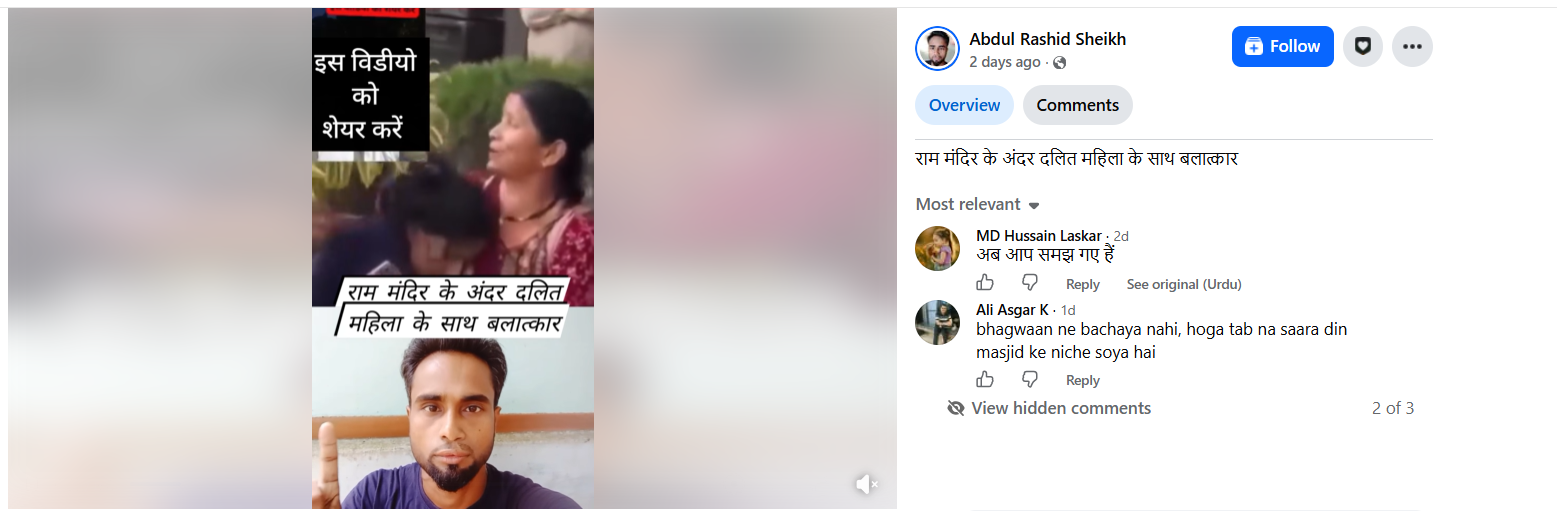
A Facebook user shared the viral video on September 21, 2026, with the caption, “Dalit woman raped inside the Ram Temple.”The post link, archive link and screenshot are provided below.
https://www.facebook.com/watch/?v=1420442086956519
Fact Check
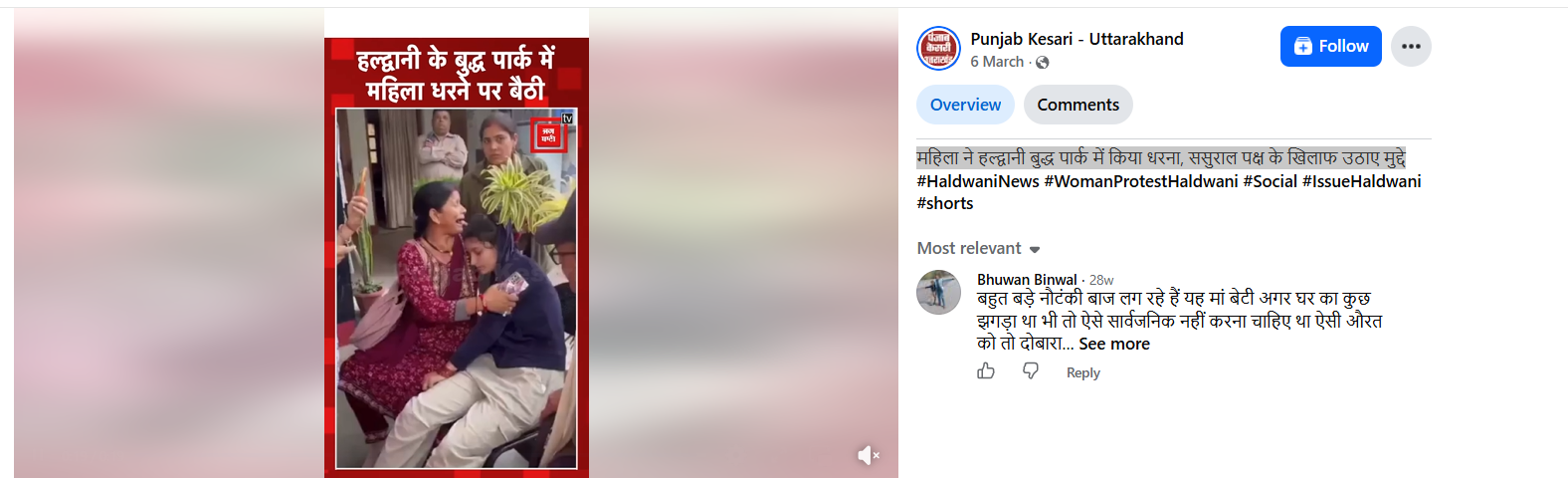
To verify the authenticity of the viral image, we conducted a Google search using relevant keywords. However, we did not find any credible media report related to the viral image during the search. To verify the claim, we conducted a reverse image search of the keyframes from the video. During the search, we found the same video on the Facebook page of Punjab Kesari - Uttarakhand, where it was published on March 6, 2026. According to the post, the woman staged a protest at Buddha Park in Haldwani and raised issues related to her in-laws. The link and screenshot of the relevant post are provided below.
https://www.facebook.com/watch/?v=897776589732940
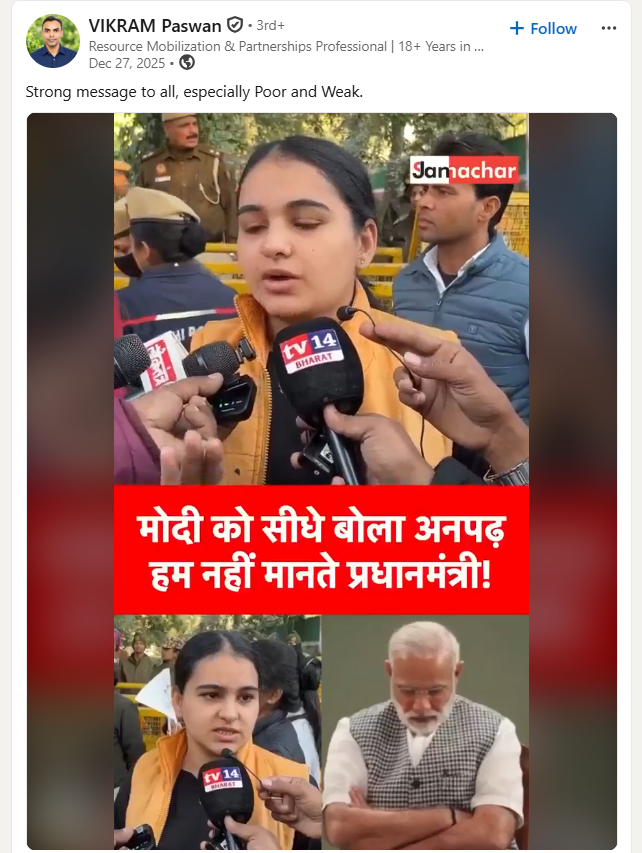
Meanwhile, we found the second part of the viral video on LinkedIn, where the video was published on December 27, 2025.
Our research makes it clear that two old and unrelated videos are being shared with a misleading claim linking them to the Ram Temple in Ayodhya. The videos have no connection with the alleged incident on the temple premises, and based on the available evidence, there is no confirmation of any such incident taking place at the Ram Temple. Our research found that the viral video was created by combining two separate clips. In the first part of the video, a woman can be seen staging a protest at Buddha Park in Haldwani and raising issues related to her in-laws. In the second part, a girl can be seen expressing her anger. Our research found that this clip has been available on the internet since December 27, 2025. Neither of the two videos is related to the alleged rape of a Dalit woman inside the Ram Temple in Ayodhya.

Related Blogs

Executive Summary:
An old video dated 2023 showing the arrest of a Bangladeshi migrant for murdering a Polish woman has been going viral massively on social media claiming that he is an Indian national. This viral video was fact checked and debunked.
Claim:
The video circulating on social media alleges that an Indian migrant was arrested in Greece for assaulting a young Christian girl. It has been shared with narratives maligning Indian migrants. The post was first shared on Facebook by an account known as “Voices of hope” and has been shared in the report as well.

Facts:
The CyberPeace Research team has utilized Google Image Search to find the original source of the claim. Upon searching we find the original news report published by Greek City Times in June 2023.


The person arrested in the video clip is a Bangladeshi migrant and not of Indian origin. CyberPeace Research Team assessed the available police reports and other verifiable sources to confirm that the arrested person is Bangladeshi.
The video has been dated 2023, relating to a case that occurred in Poland and relates to absolutely nothing about India migrants.
Neither the Polish government nor authorized news agency outlets reported Indian citizens for the controversy in question.

Conclusion:
The viral video falsely implicating an Indian migrant in a Polish woman’s murder is misleading. The accused is a Bangladeshi migrant, and the incident has been misrepresented to spread misinformation. This highlights the importance of verifying such claims to prevent the spread of xenophobia and false narratives.
- Claim: Video shows an Indian immigrant being arrested in Greece for allegedly assaulting a young Christian girl.
- Claimed On: X (Formerly Known As Twitter) and Facebook.
- Fact Check: Misleading.
.webp)
Introduction
Imagine spending two years , 730 days of early mornings, missed social events, and relentless mock tests preparing for a single examination. Now imagine that on the morning of that exam, your phone buzzes with a forwarded video claiming the question paper has already leaked. Your heart sinks. You do not know whether to trust it or ignore it. You have about forty minutes before you must enter the hall. This was the reality for a section of the 22 lakh students who sat for the NEET UG 2026 re-examination on June 21, 2026, when a fabricated video alleging a paper leak on Telegram began circulating across WhatsApp groups and X within hours of the exam commencing. The National Testing Agency (NTA) swiftly and categorically denied the claims, activated the Indian Cyber Crime Coordination Centre (I4C), and appealed to the public not to amplify unverified content. The examination concluded without incident. But the episode laid bare a challenge that no security perimeter or surveillance camera can fully address: the weaponisation of misinformation against India's high-stakes examination ecosystem.
The Anatomy of Examination Misinformation
Why Examinations Are a Prime Target
India's national examinations are uniquely fertile ground for misinformation. With over 22 lakh candidates registered for NEET UG 2026 alone, the audience is vast, anxious, and hungry for any update verified or otherwise. Research by MIT has found that false stories spread six times faster than accurate ones on social media, and are seventy percent more likely to be reshared. In India, where over 535 million people use WhatsApp and studies show that most users tend to trust messages forwarded by family and friends, the conditions for viral misinformation are near-ideal. According to a 2020 Microsoft survey, 52 percent of Indian respondents encountered misinformation at least once a day, the highest rate globally.
What makes examination-related misinformation especially dangerous is its timing. Fabricated content is almost always released on examination day itself, the precise moment when candidates are most emotionally vulnerable, official channels are stretched thin, and the window for effective rebuttal is narrowest. The NEET UG 2026 fake video, circulated on Telegram and amplified across closed WhatsApp groups, fits this pattern precisely. It was engineered not to inform, but to destabilise.
A History That Sharpens the Anxiety
This misinformation did not emerge in a vacuum. The shadow of the 2024 NEET UG controversy in which the Supreme Court of India confirmed that at least 155 students had directly benefited from a genuine paper leak, and which triggered nationwide protests, CBI investigations, and a parliamentary uproar — still looms large. Students and parents conditioned by that experience are primed to believe the worst, even when claims are entirely false. In 2026, that residual anxiety became the very vulnerability that bad actors sought to exploit. The government's response which included temporarily restricting access to Telegram in the lead-up to the re-examination underscored just how seriously the threat of examination misinformation is now being taken at the highest levels.
The NTA's Response: Why It Matters
- Speed and Transparency as Governance Tools: In crisis communication, the first credible voice usually wins. The NTA's near-immediate public denial posted on official social media handles and amplified by the Press Information Bureau's PIB Fact Check unit was a meaningful departure from the delayed, defensive responses that characterised earlier examination controversies. By directly labelling the video "FAKE" in capital letters, describing its creation as "a serious offence," and simultaneously appealing to students to rely only on official sources at neet.nta.nic.in, the NTA left little room for the false narrative to consolidate. NTA Director General Abhishek Singh went further, publicly stating that the agency was "100 per cent confident" in the integrity of the process and that no complaints of a genuine paper leak had been received. This matters beyond crisis management. Public trust in examination systems is not rebuilt through official statements alone , it is rebuilt through the consistent, transparent exercise of institutional authority. A swift, fact-based rebuttal, deployed before rumour hardens into public belief, is as much a governance act as it is a communications strategy.
- Cybercrime Coordination as a Structural Shift: Perhaps the most significant development in the NTA's response was its coordination with I4C and law enforcement agencies to trace the origin of the fabricated video. This signals a structural evolution: examination misinformation is no longer being treated as an administrative inconvenience but as cybercrime with legal consequences under the Information Technology Act, 2000. The announcement that legal action would follow also carries a deterrent message to potential future actors — that the machinery of cybercrime enforcement will be activated, and that fabricating content to mislead examination candidates is a prosecutable offence.
The Human and Institutional Cost
The costs of examination misinformation are neither abstract nor trivial. Mental health experts have warned that controversies surrounding national-level examinations can have serious long-term psychological consequences for aspirants. Dr. Mustafa Nadeem Kirmani of Amity University has noted that such crises increase the risk of students taking "extreme steps like suicide attempts, anger toward the system, and hopelessness," and can, in the long run, lead to clinical depression. In the wake of the 2026 paper leak controversy, multiple reports of student deaths by suicide were linked to the compounded pressures of exam cancellation and uncertainty a grim reminder of the real human stakes behind governance failures in this domain. For institutions, every viral misinformation episode generates an avoidable administrative crisis. Helplines are overwhelmed, examination centre staff face panicked queries, and senior officials are pulled into damage control rather than exam administration. The credibility of clarifications issued under pressure is itself questioned by a public already primed for suspicion. This administrative burden, multiplied across 5,440 examination centres in India and 14 abroad, represents a significant and entirely unnecessary cost.
Building a Resilient Ecosystem: What Needs to Change
- Proactive Communication and Platform Coordination: Institutional credibility is built before a crisis, not during one. Examination bodies must invest in sustained pre-examination communication that educates candidates and parents about the existence of misinformation campaigns and tells them exactly where to look for verified updates. This means highly visible, verified social media presences with large followings, real-time update protocols, and formal escalation channels with platforms like WhatsApp, Telegram, X, and YouTube to enable rapid takedown of false examination-related content. The IT Amendment Rules of 2023, which require significant social media intermediaries to act on government-flagged content, provide a legal basis for such coordination but the operational infrastructure to activate it at speed must be built in advance, not improvised on the day.
- Fact-Checking Partnerships and Digital Literacy: Independent organisations such as BOOM Live, Alt News, and Vishvas News have proven their capacity to rapidly debunk examination misinformation. Formalising their role through a structured public-private partnership where examination authorities share real-time verified information with empanelled fact-checkers could close the window during which false content circulates unchallenged. Equally critical is investment in digital media literacy among students and parents. A 2018 survey found that nearly 45 percent of Indian respondents were unaware of any fact-checking organisations. Addressing this gap through school curricula, coaching networks, and the Ministry of Education's DIKSHA platform is a preventive investment far less costly than repeated crisis management.
Conclusion
The NTA's handling of the NEET UG 2026 fake video was, by recent standards, exemplary. It was fast, transparent, authoritative, and backed by the activation of cybercrime enforcement. But a single well-managed episode does not constitute a resilient system. India runs some of the world's largest entrance examinations, and the stakes medical seats, livelihoods, and the aspirations of crores of young people are too high for crisis response alone to suffice. Combating examination misinformation requires permanent structural investment: dedicated rapid-response cells within examination bodies, formalised fact-checking pipelines, proactive platform coordination, and a sustained public education effort around digital verification. Protecting the integrity of India's examination ecosystem is not merely an administrative responsibility. It is a commitment to the millions of students who give everything they have to compete fairly and who deserve a system that protects them not only from cheating, but from the fear of it.
References
- https://timesofindia.indiatimes.com/articleshow/131900261.cms
- https://www.india.com/education/neet-ug-2026-re-exam-paper-leak-claim-goes-viral-nta-says-video-is-fake-and-false-fabricated-examination-conducted-successfully-8453620/
- https://www.republicworld.com/education/neet-ug-re-exam-nta-says-paper-leak-video-fake-test-conducted-successfully-2026-06-22-129346
- https://thefederal.com/category/education/neet-re-exam-paper-leak-admission-system-crisis-247410
- https://www.outlookindia.com/healthcare-spotlight/beyond-the-paper-leak-emotional-trauma-among-neet-aspirants-raises-concern
- https://en.wikipedia.org/wiki/2024_NEET_controversy
- https://kaval.chat/blog/misinformation-scam-statistics-india-2026/
- https://www.ijert.org/the-virality-gap-political-misinformation-and-the-information-crisis-in-india-s-digital-democracy-ijertv15is050041
- https://www.science.org/doi/10.1126/science.aap9559 https://www.microsoft.com/en-us/digital-skills/digital-civility
- https://www.meity.gov.in/content/information-technology-intermediary-guidelines-and-digital-media-ethics-code-amendment
- https://www.indiacode.nic.in/handle/123456789/1999
- https://pib.gov.in/PressReleasePage.aspx
- https://www.careerindia.com/news/addressing-the-mental-health-crisis-sparked-by-net-and-neet-paper-leaked-in-india-041963.html
- https://thediplomat.com/2025/03/indias-growing-misinformation-crisis-a-threat-to-democracy/

Introduction
The Central Board of Secondary Education (CBSE) has issued a warning to students about fake social media accounts that spread false information about the CBSE. The board has warned students not to trust the information coming from these accounts and has released a list of 30 fake accounts. The board has expressed concern that these handles are misleading students and parents by spreading fake information with the name and logo of the CBSE. The board has has also clarified that it is not responsible for the information being spread from these fake accounts.
The Central Board of Secondary Education (CBSE), a venerable institution in the realm of Indian education, has found itself ensnared in the web of cyber duplicity. Impersonation attacks, a sinister facet of cybercrime, have burgeoned, prompting the Board to adopt a vigilant stance against the proliferation of counterfeit social media handles that masquerade under its esteemed name and emblem.
The CBSE, has revealed a list of approximately 30 spurious handles that have been sowing seeds of disinformation across the social media landscape. These digital doppelgängers, cloaked in the Board's identity, have been identified and exposed. The Board's official beacon in this murky sea of falsehoods is the verified handle '@cbseindia29', a lighthouse guiding the public to the shores of authentic information.
This unfolding narrative signifies the Board's unwavering commitment to tackle the scourge of misinformation and to fortify the bulwarks safeguarding the sanctity of its official communications. By spotlighting the rampant growth of fake social media personas, the CBSE endeavors to shield the public from the detrimental effects of misleading information and to preserve the trust vested in its official channels.
CBSE Impersonator Accounts
The list of identified malefactors, parading under the CBSE banner, serves as a stark admonition to the public to exercise discernment while navigating the treacherous waters of social media platforms. The CBSE has initiated appropriate legal manoeuvres against these unauthorised entities to stymie their dissemination of fallacious narratives.
The Board has previously unfurled comprehensive details concerning the impending board examinations for both Class 10 and Class 12 in the year 2024. These academic assessments are slated to commence from February 15 to April 2, 2024, with a uniform start time of 10:30 AM (IST) across all designated dates.
The CBSE has made it unequivocally clear that there are nefarious entities lurking in the shadows of social media, masquerading in the guise of the CBSE. It has implored students and the general public not to be ensnared by the siren songs emanating from these fraudulent accounts and has also unfurled a list of these imposters. The Board's warning is a beacon of caution, illuminating the path for students as they navigate the digital expanse with the impending commencement of the CBSE Class X and XII exams.
Sounding The Alarm
The Central Board of Secondary Education (CBSE) has sounded the alarm, issuing an advisory to schools, students, and their guardians about the existence of fake social media platform handles that brandish the board’s logo and mislead the academic community. The board has identified about 30 such accounts on the microblogging site 'X' (formerly known as Twitter) that misuse the CBSE logo and acronym, sowing confusion and disarray.
The board is in the process of taking appropriate action against these deceptive entities. CBSE has also stated that it bears no responsibility for any information disseminated by any other source that unlawfully appropriates its name and logo on social media platforms.
Sources reveal that these impostors post false information on various updates, including admissions and exam schedules. After receiving complaints about such accounts on 'X', the CBSE issued the advisory and has initiated action against those operating these accounts, sources said.
The Brute Nature of Impersonation
In the contemporary digital epoch, cybersecurity has ascended to a position of critical importance. It is the bulwark that ensures the sanctity of computer networks is maintained and that computer systems are not marked as prey by cyber predators. Cyberattacks are insidious stratagems executed with the intent of expropriating, manipulating, or annihilating authenticated user or organizational data. It is imperative that cyberattacks be mitigated at their roots so that users and organizations utilizing internet services can navigate the digital domain with a sense of safety and security. Knowledge about cyberattacks thus plays a pivotal role in educating cyber users about the diverse types of cyber threats and the preventive measures to counteract them.
Impersonation Attacks are a vicious form of cyberattack, characterised by the malicious intent to extract confidential information. These attacks revolve around a process where cyber attackers eschew the use of malware or bots to perpetrate their crimes, instead wielding the potent tactic of social engineering. The attacker meticulously researches and harvests information about the legitimate user through platforms such as social media and then exploits this information to impersonate or masquerade as the original, legitimate user.
The threats posed by Impersonation Attacks are particularly insidious because they demand immediate action, pressuring the victim to act without discerning between the authenticated user and the impersonated one. The very nature of an Impersonation Attack is a perilous form of cyber assault, as the original user who is impersonated holds rights to private information. These attacks can be executed by exploiting a resemblance to the original user's identity, such as email IDs. Email IDs with minute differences from the legitimate user are employed in this form of attack, setting it apart from the phishing cyber mechanism. The email addresses are so similar and close to each other that, without paying heed or attention to them, the differences can be easily overlooked. Moreover, the email addresses appear to be correct, as they generally do not contain spelling errors.
Strategies to Prevent
To prevent Impersonation Attacks, the following strategies can be employed:
- Proper security mechanisms help identify malicious emails and thereby filter spamming email addresses on a regular basis.
- Double-checking sensitive information is crucial, especially when important data or funds need to be transferred. It is vital to ensure that the data is transferred to a legitimate user by cross-verifying the email address.
- Ensuring organizational-level security is paramount. Organizations should have specific domain names assigned to them, which can help employees and users distinguish their identity from that of cyber attackers.
- Protection of User Identity is essential. Employees must not publicly share their private identities, which can be exploited by attackers to impersonate their presence within the organization.
Conclusion
The CBSE's struggle against the masquerade of misinformation is a reminder of the vigilance required to safeguard the legitimacy of our digital interactions. As we navigate the complex and uncharted terrain of the internet, let us arm ourselves with the knowledge and discernment necessary to unmask these digital charlatans and uphold the sanctity of truth.
References
- https://timesofindia.indiatimes.com/city/ahmedabad/cbse-warns-against-misuse-of-its-name-by-fake-social-media-handles/articleshow/107644422.cms
- https://www.timesnownews.com/education/cbse-releases-list-of-fake-social-media-handles-asks-not-to-follow-article-107632266
- https://www.etvbharat.com/en/!bharat/cbse-public-advisory-enn24021205856
