
#FactCheck : Old Video of Birds Misleadingly Linked to Iran’s Attack on Israel Goes Viral
Executive Summary
Amid the ongoing hostilities between Israel and Iran, a video is rapidly going viral on social media with Hindi and Urdu captions. The clip shows several vehicles on a road while a large number of black birds can be seen circling in the sky. Users are sharing the video with the claim that it shows thousands of crows hovering over Tel Aviv after an Iranian attack. Some have even described it as a sign of a major impending event.
However, an research by the CyberPeace found the claim to be misleading. The viral video is old and has no connection to the ongoing conflict between Iran and Israel.

Fact Check
To verify the claim, a keyframe from the video was reverse searched on Yandex. This led to the same video being shared on Reddit on June 13, 2024, where it was described as footage from the US state of Texas. Further searches using the keywords “Crows in Texas” revealed that the same video had been shared on Facebook in April and June 2024. These posts also claimed that the visuals were captured near a supermarket in Texas, where a large number of crows were seening.
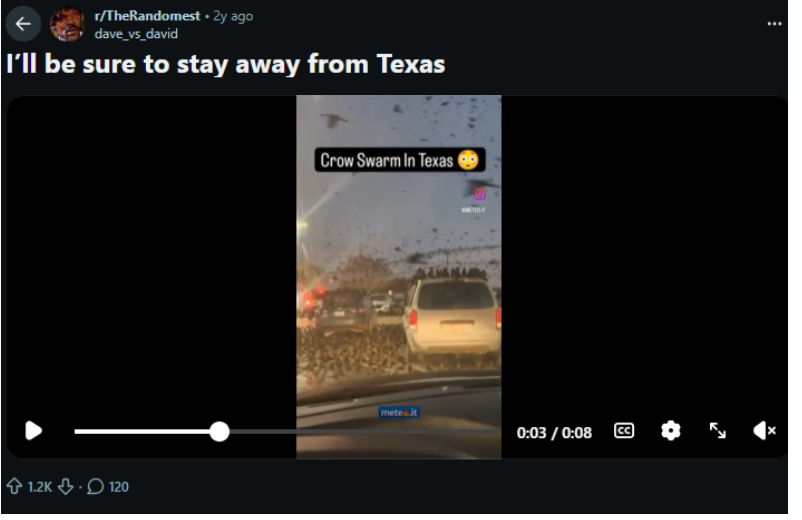

While the exact location of the video cannot be independently confirmed, the available evidence clearly establishes that the footage predates the current conflict and is unrelated to any recent events involving Iran or Israel.
Conclusion
The viral video showing a flock of birds in the sky is not linked to any Iranian attack on Israel. It has been available online since 2024 and is being falsely shared in the context of the ongoing conflict.

Related Blogs
.webp)
Introduction
India is confronting a wake-up call as a recent cyber incident aimed at the aviation sector underscores the fragile nature of digital systems that guide national air travel. The disclosure in Parliament has pushed the conversation on flight safety, signal integrity, and cyber readiness back into urgent focus. In a written response to a Parliamentary question, Civil Aviation Minister Ram Mohan Naidu acknowledged that GPS spoofing, a malicious method employed to alter navigation signals, had been noticed at seven major airports of the country. New Delhi flights had not been affected during the incident, but still, it was an event that again made air travel's safety, GNSS interference, and the overall cyber threat to India's airspace an issue of concern.
The Incident: What Happened?
Initial notices came from Indira Gandhi International Airport in Delhi, where the pilots of the different inbound flights talked about GPS spoofing as the reason for their landing. Spoofing is the process of sending counterfeit GPS signals which mislead the aircraft's navigation systems and may cause a wrong measure of the altitude, the position or the runway alignment. In Delhi, pilots operating under GPS-based landing procedures over Runway 10 experienced errors in their approaches and promptly switched to the alternative procedures without any delay.
The Minister said that apart from Delhi, other airports, viz. Kolkata, Amritsar, Mumbai, Hyderabad, Bengaluru, and Chennai were the 6 airports that recorded similar GNSS interference patterns consisting of both jamming and spoofing. Though no major interruptions or incidents occurred, these occurrences are a sign of a steady and enlarging threat.
Why Is GPS Spoofing So Dangerous?
Satellite navigation and communication systems are the backbone of modern aviation, which is now a matter of great precision. Signal jamming by malicious actors comes with a bunch of risks:
- Diversions and Delays: Pilots may be forced to either give up attempts to land or divert flights, which translates into higher consumption of fuel and more complicated operations due to the case of jamming.
- Threat of Safety Issue: Pilots are trained to deal with such incidents by following the prescribed fallback procedures, but still they depend very much on the GNSS signals that are accurate for safe manoeuvring, especially in low visibility situations.
- Pressure on Old Systems: Indian airports are still in the process of completely converting from ground-based navigation aids to GNSS. Signal disruptions entail the use of older technologies, which results in putting additional pressure on the already overburdened air traffic control systems.
- Opening Up Possibilities for Direct Attacks: Signal jamming can be made a tool for more clever tactics of operation that can include causing confusion during the busy traffic period or performing coordinated attacks to create chaos.
Aviation and Cyber Threats
The disturbances that have been mentioned at the seven airports are not unique. The civil aviation regulators all over the world have already reported an increase in GNSS jamming. The exemplary cases in the Middle East, Eastern Europe, and East Asia have revealed that the safety of airspace has turned into a tactical issue.
Moreover, India's quick adoption of digital technology in the aviation sector could open threat vulnerabilities from state-sponsored groups, hackers. In this instance, the government has not yet announced who was responsible for the spoofing, but the trend points to an adversary with advanced technology.
Government and Regulatory Response
The confirmation from the Civil Aviation Minister underscores a proactive stance by agencies such as:
- Directorate General of Civil Aviation (DGCA)
- Ministry of Civil Aviation
- Airports Authority of India (AAI)
The involved entities are collaborating now to do an inquiry into the cases and set up preventive measures.
The main steps that are taken in response are:
- More thorough observation of GNSS signal anomalies
- More pilot briefings and training on dealing with spoofing situations
- Improving navigation aids to set up a backup
- Working with IT security experts to find out the sources of interference
- Communicating with other global aviation authorities to share the best practices
India, being a significant player in the world aviation market, is not allowed to relax its guard. Cyberattacks on airports show how digital as well as physical security are becoming more and more intertwined.
The Bigger Picture: Protecting Critical Infrastructure
Aviation is a sector that very clearly shows that threats from cyberspace can easily translate into security issues for a nation. The airport system not only becomes more vulnerable to attacks but also the whole aviation industry as the digital ecosystems gain more complex forms together with integrated telecommunications networks, the Internet of Things (IoT)-enabled systems, and cloud-based services.
One of the many threats in the form of GNSS spoofing demonstrates so-called:
- Ransomware attacks on airport systems
- Contamination of air traffic control infrastructure
- Data breaches conducted by insiders
- Passenger data attacks
- Hinderance of airport logistics and baggage systems
What Needs to Happen Next?
India is compelled to embrace a multi-faceted approach in order to manage the intricacies of GNSS interference risk:
- Cybersecurity Measures in Aviation Enforced: New monitoring tools, anomaly detection systems, and instant response plans will be put into service.
- Redundant Technology: The non-GNSS-based navigation system will be expanded to guarantee the continuity of operations in the event of jamming.
- Cyber Drills Across all Sectors: To get pilots, air traffic control personnel, and airport operators ready, the aviation cyber drills will be conducted at the national level.
- Global Cooperation: International organisations will be approached to share the information and standardise the procedures.
- R&D and Innovations: Funding will be directed towards anti-spoofing technology, stronger satellite signals, and the domestic navigation system, like NavIC.
Conclusion
The cyberattack that targeted the seven airports serves as a clear reminder that aviation cybersecurity should not be considered a secondary issue anymore. Even though the quick reaction from the authorities managed to averted any disruptions, the event still shows the vulnerabilities of modern aviation systems. India's air travel infrastructure expansion will be a good time for the country to install its strong cybersecurity frameworks to protect its passengers, maintain the continuity of operations, and secure the airspace of its territory. At CyberPeace, we believe that a coordinated, proactive, and technology-driven approach is no longer an option, it is the new fundamental of aviation security in the digital age.
Reference
Introduction
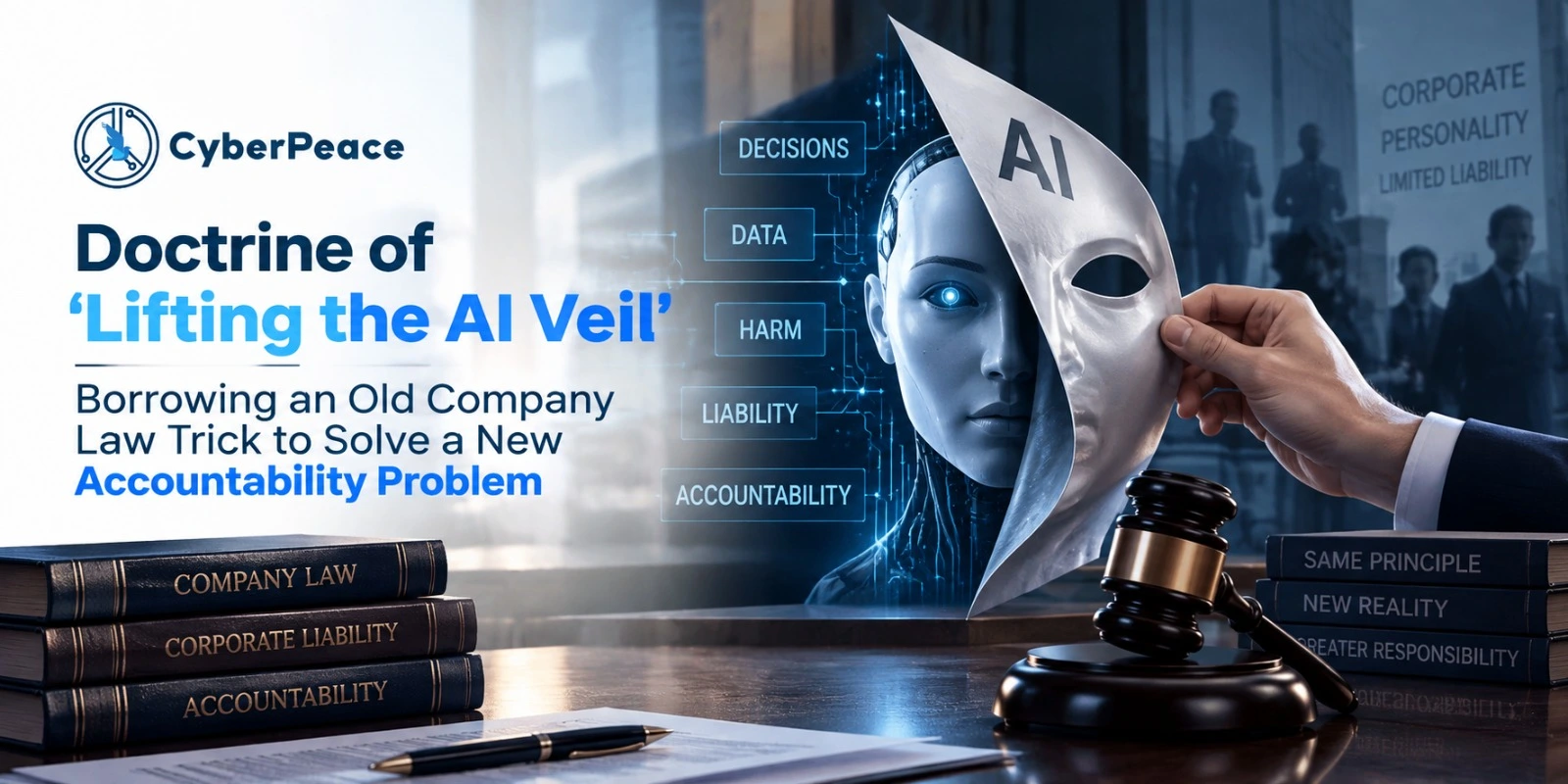
Company law solved a version of this problem more than a century ago, and artificial intelligence regulation is now quietly borrowing the solution. When something goes wrong inside a company, the law generally cannot reach past the corporate entity to punish the people who ran it, because the company is treated as a legal person entirely separate from its shareholders and directors. Courts developed an exception for exactly the cases where that separation becomes a shield for wrongdoing, and lawyers now call it lifting, or piercing, the corporate veil. A growing body of legal scholarship argues that AI systems present a strikingly similar problem, and needs a strikingly similar fix. That emerging idea has come to be called lifting the AI veil.
Where the original doctrine comes from
The doctrine of lifting the corporate veil traces directly to the House of Lords decision in Salomon v. Salomon & Co. Ltd. in 1897. Aron Salomon, a leather and boot manufacturer, incorporated his existing business, sold it to the new company, and structured share ownership so that he and his family held nearly all the shares. When the company later failed, creditors argued Salomon should be held personally liable, since the company was effectively just him operating under a different name. The House of Lords disagreed, holding decisively that once validly incorporated, a company is a person in law entirely distinct from its subscribers, with its own rights and liabilities. That ruling established what remains company law's foundational principle: separate legal personality.
Separate personality is not, however, unconditional. Courts across common law jurisdictions, including India, carved out an exception for cases where the corporate form is used as a facade for fraud, to evade a statutory obligation, or to circumvent a legal duty that would otherwise apply to the individuals behind it. In such cases, a court will "lift the veil," looking past the company's separate legal identity to attribute liability directly to the directors or shareholders actually in control. India's Supreme Court, in Life Insurance Corporation of India v. Escorts Ltd., reaffirmed that this remains an exception applied only in narrow, exceptional circumstances, generally where a statute contemplates it, or fraud or improper conduct needs to be prevented. The doctrine has since found application well beyond fraud alone, including in tax matters, as seen in cases like State of U.P. v. Renusagar Power Co., where courts treated closely related corporate entities as one for the purpose of a specific statutory benefit.
Why AI creates the same structural problem
Scholarship examining AI liability has increasingly pointed to a near identical structural gap. As AI systems take on functions once reserved for human decision makers, board level analytics, automated lending decisions, algorithmic hiring, even proposed "robo-director" advisory roles, a familiar question resurfaces: who answers for the outcome when the AI system, rather than a named individual, produced the decision. A 2025 academic paper titled Lifting the AI Veil in Company Law argues explicitly that AI liability should be approached through an extension of existing doctrines, including directors' duty of care and precisely the piercing of the veil doctrine traditionally reserved for shareholders, rather than inventing an entirely new liability regime from scratch.
The concern driving this argument is not abstract. Commentary in outlets like MIT Technology Review has warned that granting AI systems anything resembling legal personhood risks handing companies a genuinely dangerous new shield, allowing a company to argue that a harmful outcome was the AI's autonomous decision, disconnected from any human actor's intent or negligence, much as a company might once have argued a harmful outcome was simply "the company's" doing and not any individual's. Critics of AI personhood proposals, writing in journals examining AI as legal persons, make the parallel explicit: while corporate veil piercing exists precisely to stop the corporate form being misused as a liability shield, the justification for extending similar legal personhood to AI is considerably weaker, since corporate personhood serves a clear economic purpose, enabling investment and risk pooling, that AI personhood does not obviously replicate.
How regulators have actually responded
The European Union's experience is instructive precisely because it shows the doctrine's underlying logic being adopted through legislation rather than judicial precedent. The European Commission originally proposed a dedicated AI Liability Directive in September 2022, intended to ease the burden of proof on claimants harmed by AI systems, including a rebuttable presumption of causality where a claimant could show an AI system breached EU AI Act obligations. That proposal was formally withdrawn in 2025, with the withdrawal notice published in the Official Journal on 6 October 2025, after member states failed to reach agreement. In its place, the revised EU Product Liability Directive now does much of the same underlying work through a different legal mechanism, explicitly treating AI software as a "product" for the purposes of manufacturer liability, meaning AI providers face strict liability for defective AI products without claimants needing to prove fault, applicable to AI products placed on the EU market from 9 December 2026 onward. Functionally, this achieves something close to piercing the AI veil by statute: instead of allowing a company to attribute harm to an autonomous algorithmic process and stop the inquiry there, liability is anchored back to the entity that built, trained, or deployed the system.
The Indian angle, and why it matters here
India has no AI specific liability statute at present, and no reported judicial decision has yet applied the corporate veil piercing doctrine by analogy to an AI system. But the underlying legal architecture is already familiar territory for Indian courts. India's jurisprudence on lifting the corporate veil, built through Escorts, Renusagar, and subsequent cases, already establishes the judicial comfort with looking past a formal legal structure to find the real, controlling actor when justice demands it. Indian courts have been consistently clear that this remains an exceptional remedy rather than a routine one, generally invoked where a statute contemplates it, where fraud or improper conduct needs to be prevented, or where a taxing or beneficial statute would otherwise be defeated by rigid adherence to corporate form. That same cautious, fact specific posture is likely to shape how any future Indian AI liability doctrine develops, applied sparingly rather than as a blanket rule.
As AI systems increasingly mediate lending decisions, insurance claims processing, and algorithmic hiring in Indian companies, the same reasoning that let Indian courts see through a corporate facade could plausibly extend to seeing through an "AI made the decision" defence, attributing responsibility to whichever human actor, developer, deployer, or governing board, exercised actual control over how that system was built and used. Given how central technology sector employment and AI deployment already are to India's economy, the absence of a clear domestic answer to this question is unlikely to remain untested for long.
The larger point
The doctrine of lifting the AI veil is less a wholly new legal invention and more a recognition that AI systems and corporations create the same essential problem: a formally separate entity that can, if left unchecked, absorb blame that properly belongs to the humans directing it. Company law solved this by refusing to let the corporate form become an alibi. AI law, whether through judicial doctrine, statute, or a hybrid of both as the EU's experience suggests, will likely need to reach the same conclusion, because the alternative is allowing genuine harm to disappear into a system nobody can be made to answer for.
References
- Bird & Bird, "Proposed EU AI liability rules withdrawn." https://www.twobirds.com/en/insights/2025/proposed-eu-ai-liability-rules-withdrawn
- LegalClarity, "AI Liability Directive: What It Was and Why It Was Withdrawn." https://legalclarity.org/ai-liability-directive-what-it-was-and-why-it-was-withdrawn/
- WCR Legal, "EU AI Liability Directive: Withdrawn, What Now Applies?" https://wcr.legal/eu-ai-liability-directive-withdrawn-pld/
- Verfassungsblog, "Anatomy of a Fall: On the Anticipated Withdrawal of the AI Liability Directive Proposal." https://verfassungsblog.de/anatomy-of-a-fall-aiact-aild-pld/
- MIT Technology Review, "Debates over AI consciousness are a trap." https://www.technologyreview.com/2026/08/20/1142571/ai-consciousness-debate-trap/
- ResearchGate, "Lifting the AI Veil in Company Law." https://www.researchgate.net/publication/393305638_Lifting_the_AI_veil_in_company_law
- Review of Law and Regulation, "Lifting the AI Veil in Company Law." https://rlr.iup.rs/wp-content/uploads/2025/07/04.pdf
- Bhatt & Joshi Associates, "Decoding the Jurisprudence on Lifting the Corporate Veil in Indian Court. https://bhattandjoshiassociates.com/decoding-the-jurisprudence-on-lifting-the-corporate-veil-in-indian-court/
- Mondaq, "Analysis Of Standard Of Proof For Lifting Of The Corporate Veil In Cases Of Fraud." https://www.mondaq.com/india/corporate-and-company-law/1259382/analysis-of-standard-of-proof-for-lifting-of-the-corporate-veil-in-cases-of-fraud
- Record Of Law, "Analysis of the theory of corporate veil lifting." https://recordoflaw.in/analysis-of-the-theory-of-corporate-veil-lifting/
- Suren Uppal Offices, "Lifting of Corporate Veil: Navigating Judicial Precedents." https://www.suolaw.com/lifting-of-corporate-veil-navigating-judicial-precedents/

Overview:
A recent addition to the list of cybercrime is SharpRhino, a RAT (Remote Access Trojan) actively used by Hunters International ransomware group. SharpRhino is highly developed and penetrates into the network mask of IT specialists, primarily due to the belief in the tools’ legitimacy. Going under the genuine software installer, SharpRhino started functioning in mid-June 2024. However, Quorum Cyber discovered it in early August 2024 while investigating ransomware.
About Hunters International Group:
Hunters International emerged as one of the most notorious groups focused on ransomware attacks, having compromised over 134 targets worldwide in the first seven months of 2024. It is believed that the group is the rebranding of Hive ransomware group that was previously active, and there are considerable similarities in the code. Its focus on IT employees in particular demonstrates the fact that they move tactically in gaining access to the organizations’ networks.
Modus Operandi:
1. Typosquatting Technique
SharpRhino is mainly distributed by a domain that looks like the genuine Angry IP Scanner, which is a popular network discovery tool. The malware installer, labeled as ipscan-3.9.1-setup. It is a 32-bit Nullsoft installer which embeds a password protected 7z archive in it.
2. Installation Process
- Execution of Installer: When the victim downloads and executes the installer and changes the windows registry in order to attain persistence. This is done by generating a registry entry that starts a harmful file, Microsoft. AnyKey. exe, are fakes originating from fake versions of true legitimate Microsoft Visual Studio tools.
- Creation of Batch File: This drops a batch file qualified as LogUpdate at the installer.bat, that runs the PowerShell scripts on the device. These scripts are to compile C# code into memory to serve as a means of making the malware covert in its operation.
- Directory Creation: The installer establishes two directories that allow the C2 communication – C:\ProgramData\Microsoft: WindowsUpdater24 and LogUpdateWindows.
3. Execution and Functionality:
- Command Execution: The malware can execute PowerShell commands on the infected system, these actions may involve privilege escalation and other extended actions such as lateral movement.
- C2 Communication: SharpRhino interacts with command and control servers located on domains from platforms such as Cloudflare. This communication is necessary for receiving commands from the attackers and for returning any data of interest to the attackers.
- Data Exfiltration and Ransomware Deployment: Once SharpRhino has gained control, it can steal information and then proceed to encrypt it with a .locked extension. The procedure generally concludes with a ransom message, which informs users on how to purchase the decryption key.
4. Propagation Techniques:
Also, SharpRhino can spread through the self-copying method, this is the virus may copy itself to other computers using the network account of the victim and pretending to be trustworthy senders such as emails or network-shared files. Moreover, the victim’s machine may then proceed to propagate the malware to other systems like sharing in the company with other employees.
Indicators of Compromise (IOCs):
- LogUpdate.bat
- Wiaphoh7um.t
- ipscan-3.9.1-setup.exe
- kautix2aeX.t
- WindowsUpdate.bat
Command and Control Servers:
- cdn-server-1.xiren77418.workers.dev
- cdn-server-2.wesoc40288.workers.dev
- Angryipo.org
- Angryipsca.com
Analysis:

Graph:

Precautionary measures to be taken:
To mitigate the risks posed by SharpRhino and similar malware, organizations should implement the following measures:
- Implement Security Best Practices: It is important only to download software from official sites and avoid similar sites to confuse the user by changing a few letters.
- Enhance Detection Capabilities: Use technology in detection that can detect the IOCs linked to Sharp Rhino.
- Educate Employees: Educate IT people and employees on phishing scams and the requirement to check the origin of the application.
- Regular Backups: It is also important to back up important files from systems and networks in order to minimize the effects of ransomware attacks on a business.
Conclusion:
SharpRhino could be deemed as the evolution of the strategies used by organizations like Hunters International and others involved in the distribution of ransomware. SharpRhino primarily focuses on the audience of IT professionals and employs complex delivery and execution schemes, which makes it an extremely serious threat for corporate networks. To do so it is imperative that organizations have an understanding of its inner workings in order to fortify their security measures against this relatively new threat. Through the enforcement of proper security measures and constant enlightenment of organizations on the importance of cybersecurity, firms can prevent the various risks associated with SharpRhino and related malware. Be safe, be knowledgeable, and most importantly, be secure when it comes to cyber security for your investments.
Reference:
https://cybersecuritynews.com/sharprhino-ransomware-alert/
https://cybersecsentinel.com/sharprhino-explained-key-facts-and-how-to-protect-your-data/
https://www.dataprivacyandsecurityinsider.com/2024/08/sharprhino-malware-targeting-it-professionals/
