
#FactCheck-Fake Frontline Cover Claiming ‘Vijay Wave’ Goes Viral During Tamil Nadu Polls
Executive Summary
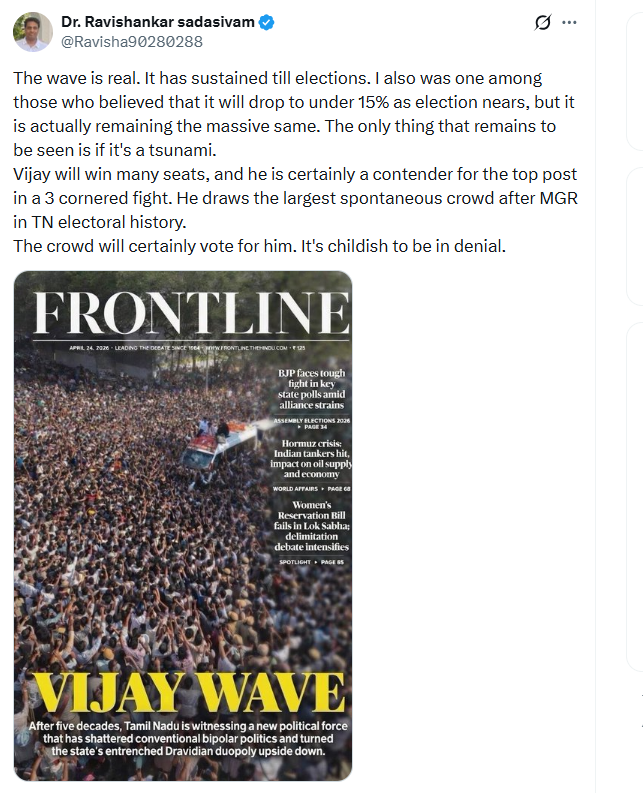
As Tamil Nadu voted in the 2026 Assembly elections, with 84.69 percent polling recorded on April 23, a purported cover page of Frontline magazine began circulating on social media. The viral image featured a massive rally crowd of South Indian actor and Tamilaga Vetri Kazhagam (TVK) chief Joseph Vijay, claiming that a “Vijay Wave” had emerged in the state. The alleged cover also stated that Tamil Nadu was witnessing a new political force after five decades, one that had challenged the dominance of Dravida Munnetra Kazhagam (DMK) and All India Anna Dravida Munnetra Kazhagam (AIADMK).
However, research by the CyberPeace Research Wing found that the viral cover page is fake. Frontline magazine has not published any such edition, and its latest issue is related to health.
Claim:
X user “Dr. Ravishankar Sadasivam” shared the viral image on April 22, 2026, claiming the “wave is real” and suggesting that Vijay could emerge as a top contender in a three-cornered contest. The post further claimed that after MGR, Vijay was drawing the largest spontaneous crowds in Tamil Nadu politics.
Fact Check:
To verify the claim, relevant keyword searches were conducted online. During the research, a clarification post from Frontline magazine’s official X account, shared on April 22, 2026, was found. In the post, the publication clearly stated that the viral cover page was fake and had not been published by the magazine. It further said that the fabricated cover was being circulated online by supporters of TVK.

A review of the official Frontline website also found no edition carrying such a cover page.

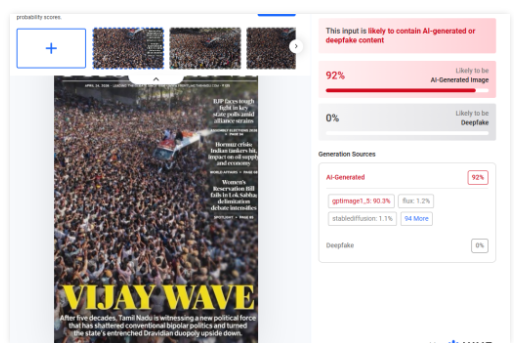
Additionally, the viral image was analyzed using the AI detection tool Hive Moderation, which rated it as 92 percent likely to be AI-generated.
Conclusion:
The claim that Frontline magazine published a cover story on a “Vijay Wave” during the Tamil Nadu Assembly elections is false. The viral cover page is fake and is being circulated online to mislead people.

Related Blogs
Introduction
We live in a time where technological change is no longer slow or subtle. Robotics, automation, artificial intelligence, and digital systems are transforming the way we work, think, and even imagine the future. This is often celebrated as great progress. But a deeper question quietly waits behind the noise. Is every advancement truly an uplift when seen through the lens of scriptures, culture, and Indian philosophical thought? Are we creating for the good of humanity, or are we only chasing convenience and speed? And what kind of future are we actually preparing, not just for ourselves, but for those who will be born into this world shaped by these tools from the very beginning?
India has long been seen as a land that values balance, purity, and harmony with nature. Its rivers, mountains, forests, and traditions are not just geography or history, they are part of a civilizational way of thinking that connects life, duty, and responsibility. In this context, it becomes important to ask what the long-term cost of our technological appetite might be. Every invention has a footprint. Industries change landscapes. Energy demands reshape ecosystems. Convenience today often hides consequences that only appear years later. Progress, when measured only in speed and output, forgets to ask what it takes away in silence.
There is also a quieter change happening inside the human mind. As tools become smarter, humans begin to feel more powerful. The thought slowly shifts from “I can use this” to “I control this.” With artificial intelligence, the language becomes even bolder. We start hearing phrases like “we can create worlds, faces, voices, even minds.” But history have always warned us about ‘overreach’. Not because power is evil, but because pride blinds judgment. When ability grows faster than wisdom, imbalance follows. We can already see early signs of this in concerns about shrinking attention spans, weakening cognitive habits, and a growing dependence on systems that think for us before we learn to think for ourselves deeply.
None of this is an argument to reject innovation. The idea is not to blacklist technology or romanticise the past. The real question is about direction and responsibility. Advancements are not only for the comfort of the present generation. They shape the mental, moral, and emotional world of future generations who will grow up surrounded by these systems as something normal and unavoidable. What values will guide that world? What habits will it encourage? What will it quietly take away?
This is where the richness of Indian thought becomes relevant, not as nostalgia, but as guidance. Ideas of dharma, restraint, balance, and ethical action were never anti-progress. They were reminders that power without responsibility becomes dangerous, and that ability without humility leads to decline. In modern terms, we talk about safety by design, ethical innovation, and human-centred technology. In older language, we talked about duty, limits, and the consequences of unchecked desire. The words have changed, but the concern is the same.
Perhaps the real question is not whether we are becoming creators, but whether we remember that we are also caretakers. We do not bring existence out of nothing. We reshape what already exists. And in that reshaping, the line between wisdom and arrogance, between progress and pride, becomes the most important line of all.
The futuristic impact of AI, robotics, and technologies
In every yuga, humans have extended the limits of what they can do. What changes is not the desire, but the form it takes. Our ancient history speak of extraordinary abilities, not as fantasies, but as reminders of how power tests character. Figures like Naradmuni (a prominent divine sage (Rishiraja) in Hinduism) are described as moving from one place to another in moments. Others gained immense strength, knowledge, or influence through years of discipline and tapasya. Ravana (Figure from Ramayana) himself was learned and powerful, far beyond ordinary human measure. Sanjaya (the charioteer and advisor of King Dhritarashtra in the Mahabharata) receives the gift of divya drishti and narrates the events of the battlefield without being physically present there, seeing and speaking across distance in a way that still feels remarkable even today.
In this yuga, that ancient search for power and reach has not disappeared, it has only changed its language, and today it speaks through robotics, artificial intelligence, and advanced technologies, making us ask whether we are truly creators or only very advanced arrangers of what already exists.
In this age, science and technology are attempting something similar in a different language. We may not travel like Naradmuni, but we send our voices, images, and thoughts across the world in seconds. We build machines that can see, listen, respond, and even imitate human thinking. Artificial intelligence and robotics promise comfort, speed, and efficiency, and in many ways, they truly improve human life. Yet the old question remains. Not just what can we do, but how far should we go, and at what cost.
When we primarily build for human convenience, we often fail to thoroughly examine the long-term consequences. The environmental impact of large-scale technology is already visible in the pressure on resources, the growth of waste, and the slow damage to air, water, and soil. Nature does not recover at the pace of human ambition. What feels like small compromises today can become heavy burdens for tomorrow.
There is also the impact on the human mind. As systems become more capable, humans risk becoming more dependent. When answers arrive instantly, patience weakens. When machines start deciding for us, the habit of deep thinking slowly fades. Over time, this can affect attention, memory, and judgment. Knowledge becomes easier to reach, but wisdom becomes harder to build. Just as in old stories, the danger is not in having power, but in losing clarity while using it.
Future generations will not encounter these technologies as new inventions. They will be born into them. What we treat today as tools, they will experience as the normal environment of life. This makes responsibility unavoidable. The real question is not only whether these systems work, but what kind of humans they will shape.
The purpose of this reflection is not to reject progress. It is to ask for balance. Building for human comfort is important, but building without studying long-term impact is risky. If this age has the power to create intelligent systems, it must also have the wisdom to protect the environment, care for future generations, and preserve the depth of the human mind. Otherwise, advancement becomes speed without direction, and power without responsibility.
The Acceleration of the Technological Age
The current era has reached a state where technological progress now occurs through instantaneous changes which transform our methods of working and decision-making and future planning. People often view robotics and automation and artificial intelligence as signs of progress yet a less audible inquiry persists through time which asks whether every technological advancement enhances human existence or whether we merely pursue efficient and easy solutions without thinking about their implications. Indian philosophical thought offers a useful lens here, one that does not reject progress but asks whether it aligns with balance, responsibility, and long-term harmony. The definition of intelligence according to this perspective extends beyond computational skills and pattern imitation because it requires people to achieve awareness and intent and their complete understanding. Current machines possess the ability to mimic human reasoning and produce language while they can replicate decision-making processes, but they lack both consciousness and personal experience.
Power, Responsibility, and Ethical Imbalance
The development of new technological capabilities brings with it ethical responsibilities which every society must handle. Human beings must take on new ethical duties which match their increasing capabilities according to historical evidence. The current situation shows that people create new things at a speed which exceeds their ability to think about those innovations. Systems exist to enhance operational performance while they determine human actions and extend their power but they do not always evaluate their complete impact. Indian traditions emphasize dharma, the principle of balance and rightful action, which shows that power without ethical grounding creates destructive human force. The state of imbalance exists without showing its presence at all times. The process of imbalance development takes place through three channels: environmental degradation, social inequalities, and the gradual decline of human control.
The current society demonstrates this transformation through its existing results. The algorithms now determine our consumption choices and our methods of understanding everything around us. The system provides users with personalized comfort, but it also creates hidden patterns that determine their preferences. The process starts with decision assistance before it progresses to decision influence which eventually leads to decision conditioning. The concept of swatantrata as inner freedom becomes more complicated within such an environment. People stop making freedom choices when they find it easier to select between things that exist in their surroundings because they lose their ability to choose. People start to measure their work activities and personal identity through systems that use optimization techniques and digital validation systems, which leads to a decrease of space that exists for individuals to think and consider matters independently.
Technology, Ecology, and Civilizational Values
The environmental impact of technological demand exists together with social transformations. All systems need power while all infrastructure creates environmental effects and all products, we use contain unknown expenses which become apparent after many years. India's civilizational values maintain their dedication to nature because people see rivers and forests and ecosystems as essential parts of existence. Success in modern society measures output as the main achievement while actual value disappears through the evaluation process. The future requires us to create new things but we must also decide which things to keep intact.
The current situation requires progress to be defined differently because it needs to be measured through precise management instead of continuous rapid development. The question now extends beyond technological advancement to include the need for technologies to be operated through intelligent guidance. The increasing abilities of machines create a greater need for people to maintain their essential human characteristics. Human beings must actively maintain their capacity to make ethical decisions and understand their life's meaning and purpose. The future depends on two factors: the “innovations that will emerge and the values that will guide their development.”
Conclusion
It is high time we pause and honestly examine the path we are taking. The question is not whether technology should grow, but whether its overreach should be allowed to shape the future without restraint. We are building faster than ever, developing systems that touch every part of life. That makes it even more important to study their long-term impact, not only on markets or productivity, but on nature, on the human mind, and on the generations who will inherit this tech-driven world.
Progress should benefit those who come after us, not quietly weaken them. A future where people are born into pure convenience, surrounded by tools that think, decide, and act for them, may look comfortable, but comfort alone does not build strong, aware, or responsible human beings. Growth without effort and ease without discipline slowly takes away depth, resilience, and clarity. Technology should support human potential, not replace it.
This is why morality, ethics, and balance cannot be treated as optional ideas. They must guide innovation, not follow it. We do not need to overcreate. We need to create ‘wisely’. We need to build systems that remain under human control, not systems that slowly train humans to surrender their judgment, attention, and responsibility. Tools should remain tools. They should serve life, not define it.
Indian thought has always placed intention at the centre of action. Karma is not judged only by outcome, but by the spirit in which an act is performed. A tool in itself is neither pure nor impure. It becomes one or the other through the hand that uses it. This is a lens through which modern technology can also be examined. Artificial intelligence can help doctors read scans faster, help farmers predict weather patterns, and help students in remote areas access knowledge. At the same time, it can be used to watch, to sort, to exclude, and to reduce human beings to data points that fit neatly into a system. The difference lies not in the machine, but in the values of those who design and deploy it.
The purpose of this reflection is simple. We should build, but we should build with responsibility. We should innovate, but with awareness of consequences. True progress is not just about what is possible today. It is about what remains healthy, meaningful, and sustainable tomorrow. If this age can combine intelligence with humility, and power with restraint, then technology will not become a symbol of overreach. It will become a sign of maturity.

Executive Summary:
A viral social media video falsely claims that Meta AI reads all WhatsApp group and individual chats by default, and that enabling “Advanced Chat Privacy” can stop this. On performing reverse image search we found a blog post of WhatsApp which was posted in the month of April 2025 which claims that all personal and group chats remain protected with end to end (E2E) encryption, accessible only to the sender and recipient. Meta AI can interact only with messages explicitly sent to it or tagged with @MetaAI. The “Advanced Chat Privacy” feature is designed to prevent external sharing of chats, not to restrict Meta AI access. Therefore, the viral claim is misleading and factually incorrect, aimed at creating unnecessary fear among users.
Claim:
A viral social media video [archived link] alleges that Meta AI is actively accessing private conversations on WhatsApp, including both group and individual chats, due to the current default settings. The video further claims that users can safeguard their privacy by enabling the “Advanced Chat Privacy” feature, which purportedly prevents such access.

Fact Check:
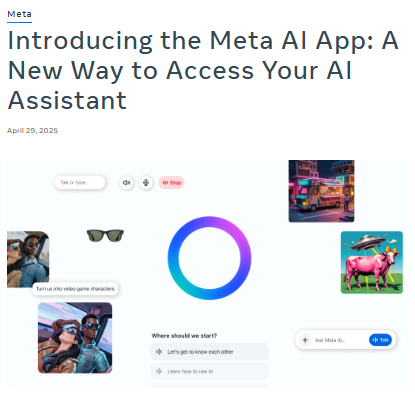
Upon doing reverse image search from the keyframe of the viral video, we found a WhatsApp blog post from April 2025 that explains new privacy features to help users control their chats and data. It states that Meta AI can only see messages directly sent to it or tagged with @Meta AI. All personal and group chats are secured with end-to-end encryption, so only the sender and receiver can read them. The "Advanced Chat Privacy" setting helps stop chats from being shared outside WhatsApp, like blocking exports or auto-downloads, but it doesn’t affect Meta AI since it’s already blocked from reading chats. This shows the viral claim is false and meant to confuse people.

Conclusion:
The claim that Meta AI is reading WhatsApp Group Chats and that enabling the "Advance Chat Privacy" setting can prevent this is false and misleading. WhatsApp has officially confirmed that Meta AI only accesses messages explicitly shared with it, and all chats remain protected by end-to-end encryption, ensuring privacy. The "Advanced Chat Privacy" setting does not relate to Meta AI access, as it is already restricted by default.
- Claim: Viral social media video claims that WhatsApp Group Chats are being read by Meta AI due to current settings, and enabling the "Advance Chat Privacy" setting can prevent this.
- Claimed On: Social Media
- Fact Check: False and Misleading
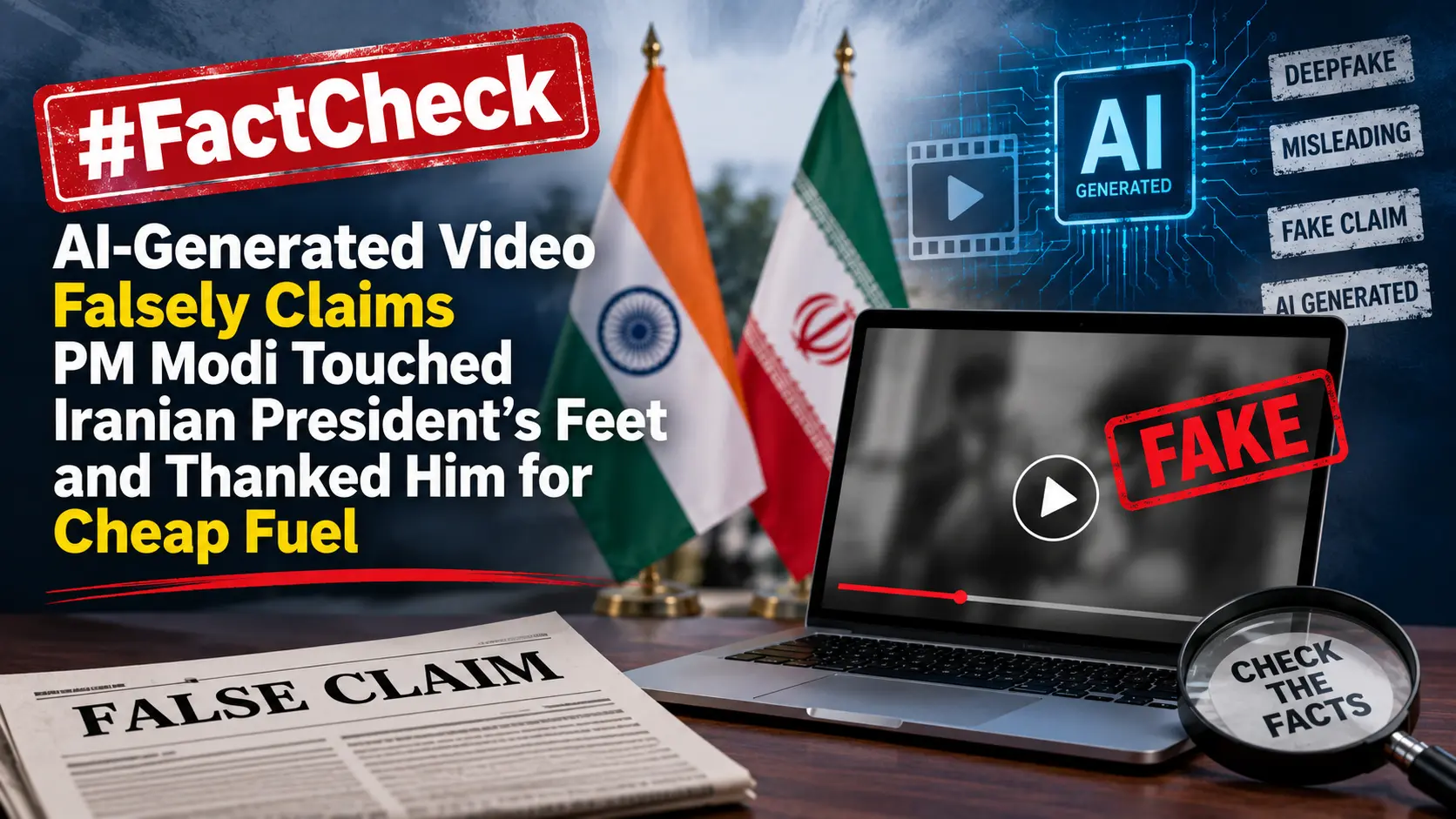
Executive Summary
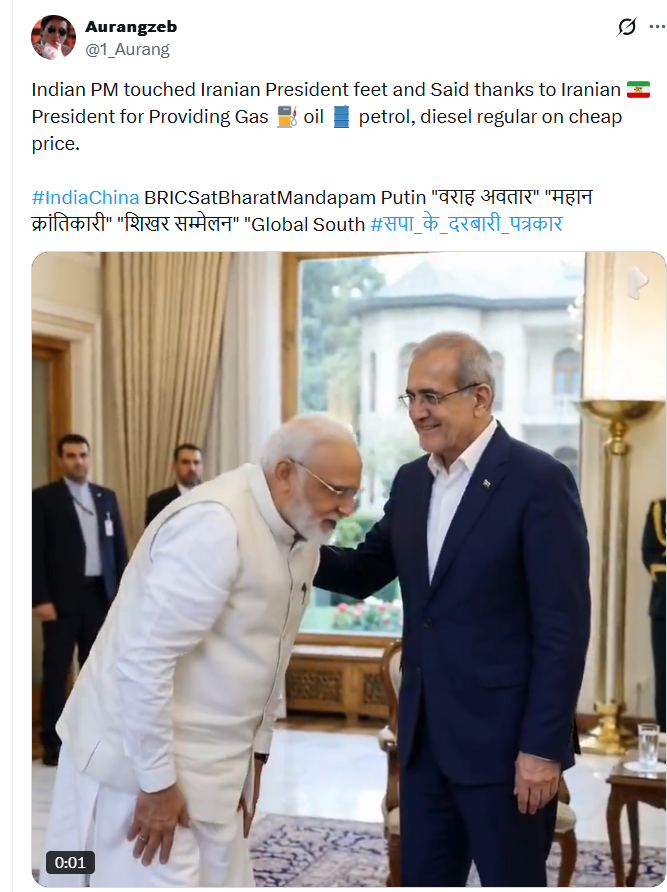
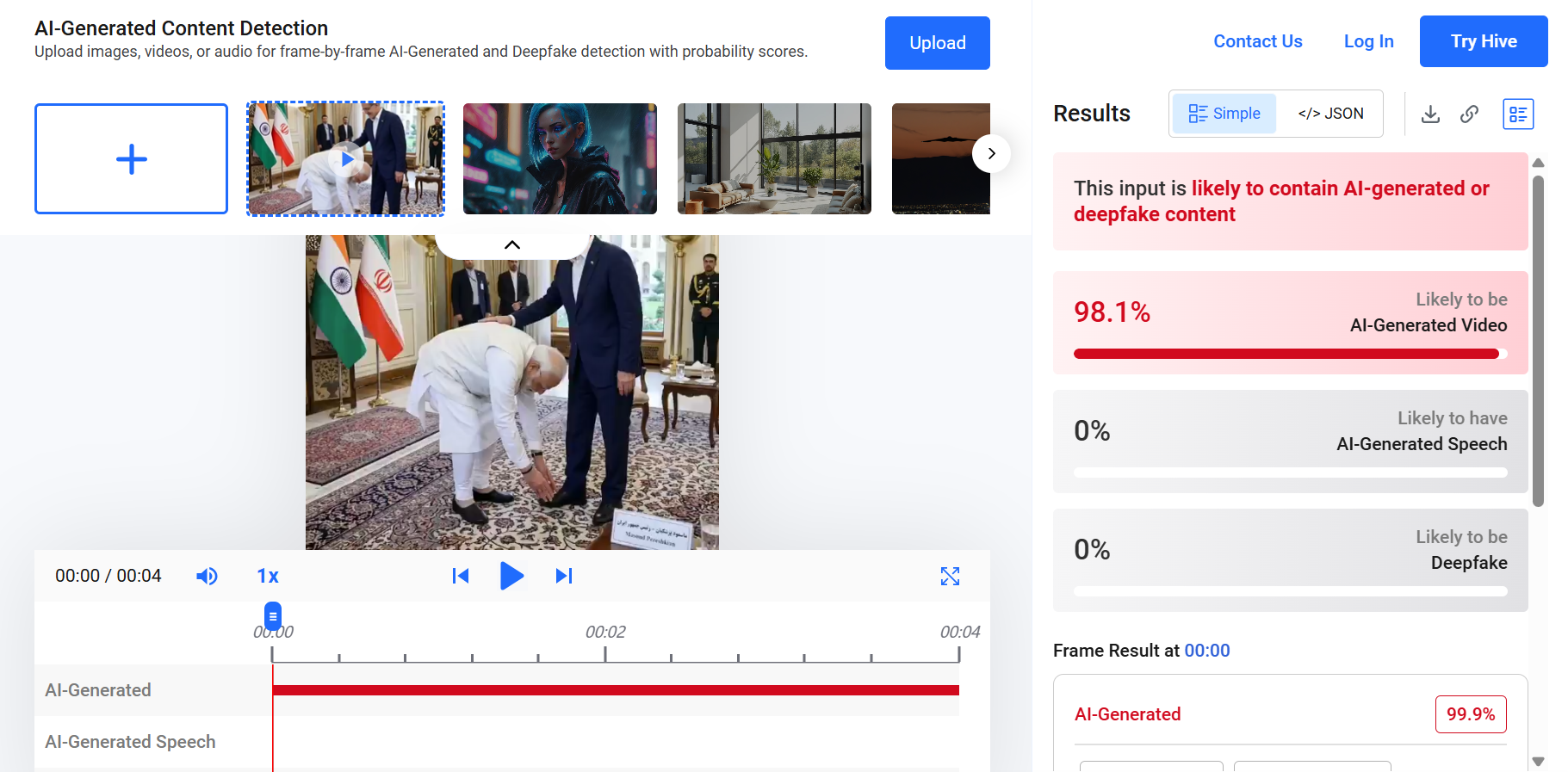
A video of Prime Minister Narendra Modi and Iranian President Masoud Pezeshkian is being shared on social media with the claim that the Prime Minister touched the Iranian President’s feet and thanked him for providing gas, petrol and diesel to India at cheap prices. The post links the video to the 2026 BRICS Summit and claims that the two leaders had this conversation during the summit. CyberPeace Research Wing’s research found that the viral video is not authentic and is AI-generated.It is worth noting that Prime Minister Narendra Modi and Iranian President Masoud Pezeshkian held a bilateral meeting on September 11, 2026, on the sidelines of the BRICS Summit in New Delhi. According to the Prime Minister’s Office, the two leaders discussed various aspects of bilateral relations, the situation in West Asia, the safety of maritime routes, and the need to ensure peace and stability in the region.
During the meeting, Prime Minister Modi thanked Iran for its regular and high-level participation in BRICS-related meetings. He also thanked President Pezeshkian for participating in the Leaders’ Session of the BRICS Business Forum. However, the official statement issued by the Prime Minister’s Office makes no mention of Modi thanking the Iranian President for providing gas, petrol, diesel or oil at cheap prices.
Claim:
Prime Minister Narendra Modi touched the feet of Iranian President Masoud Pezeshkian and thanked him for providing gas, oil, petrol and diesel to India at cheap prices.
https://x.com/1_Aurang/status/2099001779719749833
Fact Check:
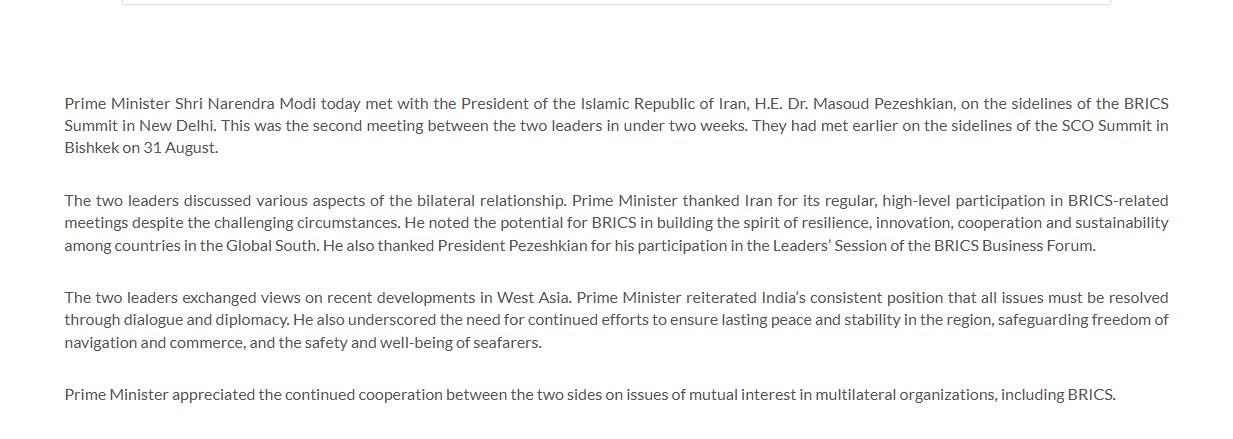
To verify the authenticity of the viral claim, we conducted a Google search using relevant keywords. However, we did not find any credible media report supporting the claim.As part of our research, we found a press release published on the Prime Minister’s Office (PMO) website on September 11, 2026. The release provides details of the meeting between Prime Minister Narendra Modi and Iranian President Masoud Pezeshkian on the sidelines of the BRICS Summit. According to the press release, Prime Minister Modi thanked President Pezeshkian for Iran’s regular and high-level participation in BRICS-related meetings. He also thanked Pezeshkian for participating in the Leaders’ Session of the BRICS Business Forum.The two leaders also discussed bilateral relations and recent developments in West Asia. Prime Minister Modi reiterated India’s position that all issues should be resolved through dialogue and diplomacy and stressed the need to ensure peace and stability in the region. However, the press release makes no mention of Prime Minister Modi thanking the Iranian President for providing gas, oil, petrol or diesel at cheap prices.
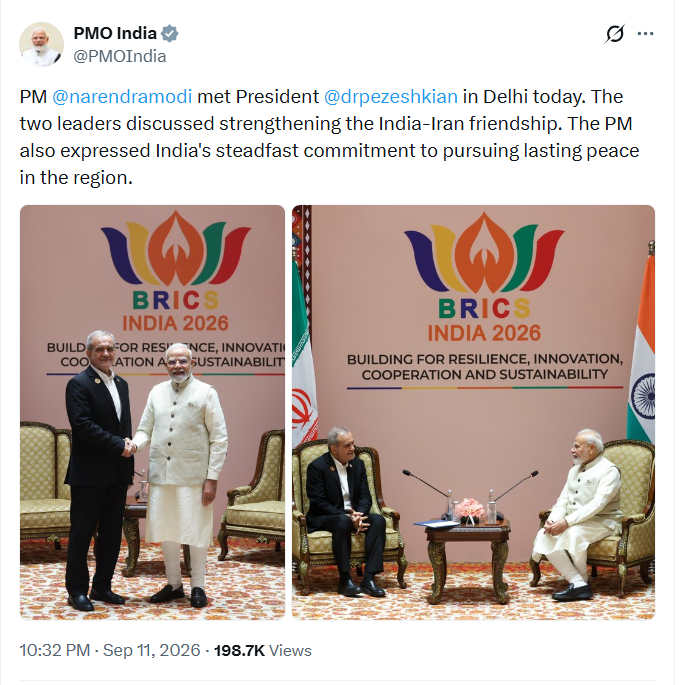
As part of our further research, we found the original photograph of the two leaders on the official X handle of the Prime Minister’s Office (PMO). The photograph shows Prime Minister Narendra Modi and Iranian President Masoud Pezeshkian shaking hands with each other.
https://x.com/PMOIndia/status/2098457126842851492?s=20
We then examined the video closely and noticed several visual inconsistencies. We subsequently scanned the video using the AI detection tool Hive Moderation. According to the results, the viral video has a 98% probability of being AI-generated.
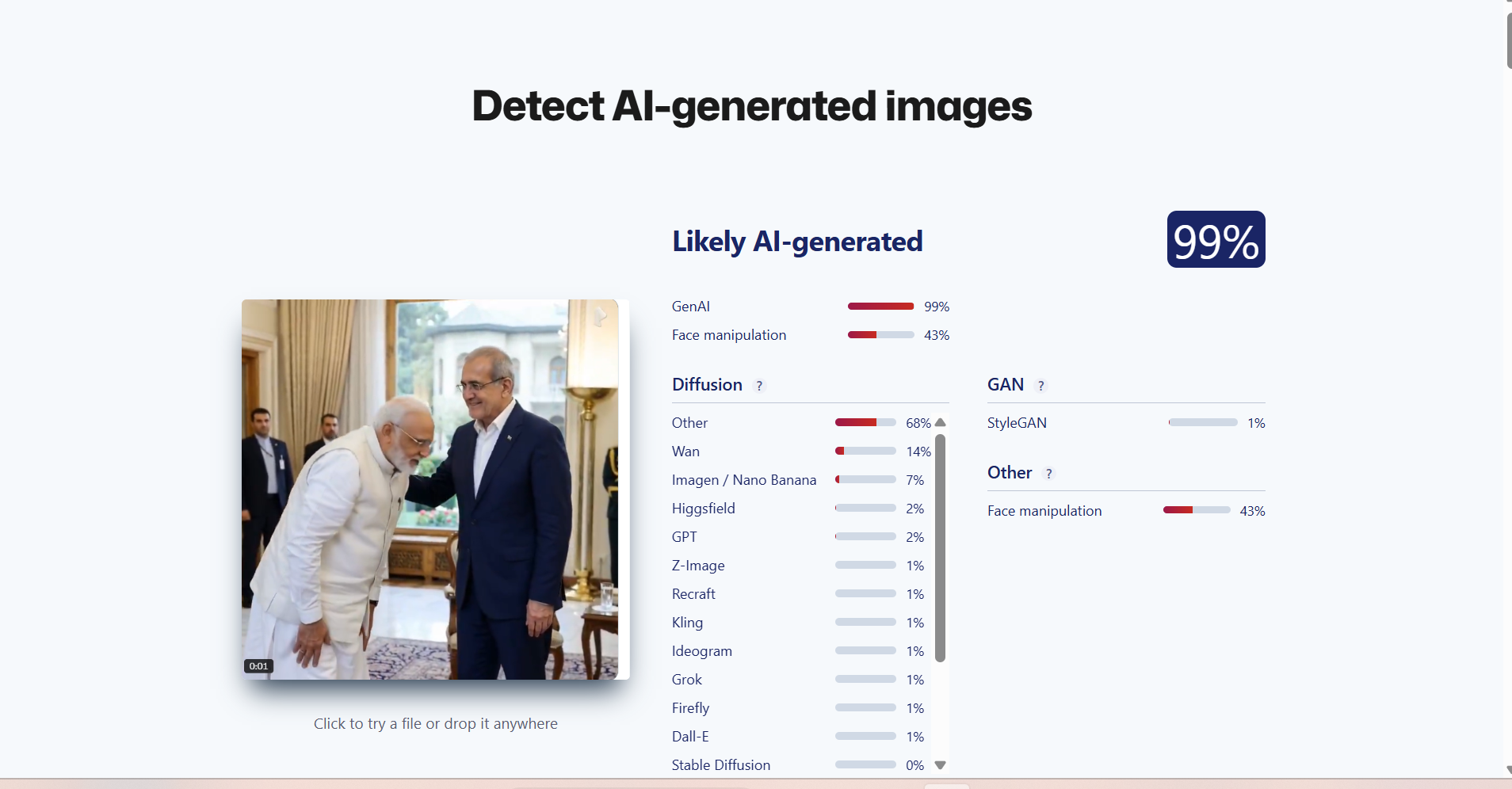
We also scanned the video using another AI detection tool, Sightengine. According to the results, the viral video has a 99% probability of being AI-generated.
Conclusion
Our research found that the viral claim is false. The video claiming that Prime Minister Narendra Modi touched Iranian President Masoud Pezeshkian’s feet and thanked him for providing cheap gas, oil, petrol and diesel to India is AI-generated and does not show a genuine interaction between the two leaders. Our research found several visual inconsistencies in the video. The findings were further supported by AI detection tools, with Hive Moderation identifying a 98% probability of AI generation, while Sightengine indicated a 99% probability. Furthermore, the official information released by the Prime Minister’s Office regarding Modi’s meeting with Pezeshkian contains no reference to the Prime Minister thanking Iran for providing fuel at cheap prices. Therefore, the video is being circulated on social media with a false and misleading claim.
