
#FactCheck- Viral Video Misleadingly Linked to Alleged Israeli Strike on Iran
Executive Summary:
A video is rapidly circulating on social media following claims that Iran’s national security chief Ali Larijani was killed in an Israeli airstrike. The viral clip is being shared with the assertion that it shows the moment Israel launched a powerful attack on Iran to eliminate Larijani, allegedly shaking the ground due to the intensity of the strike However, research by CyberPeace has found the claim to be misleading. The viral video is AI-generated and has no connection to real-world events.
Claim:
Social media users have shared the video with alarming captions. One such post by Deepak Sharma reads:
“WAR UPDATE… Iran is in its final phase… Israel is striking selectively… This attack will leave you shocked… Iran’s national security chief Ali Larijani has been killed in this attack… The intensity of the strike shook the Iranian الأرض.
Post links:
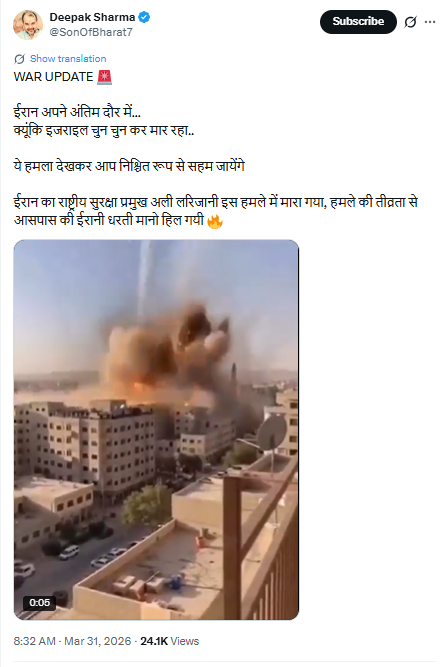
Similar videos were also shared by other users:
- urabh_raj3026/status/2038834832869032026
- https://x.com/ibmindia20/status/2038938020154597447
- https://x.com/Saurabh_raj3026/status/2038834832869032026
Fact Check
To verify the claim, we extracted keyframes from the viral video and conducted a reverse image search. During this process, we found the same video on Instagram, uploaded on March 9, 2026, by the account “_iranwar_2026” without any descriptive caption.
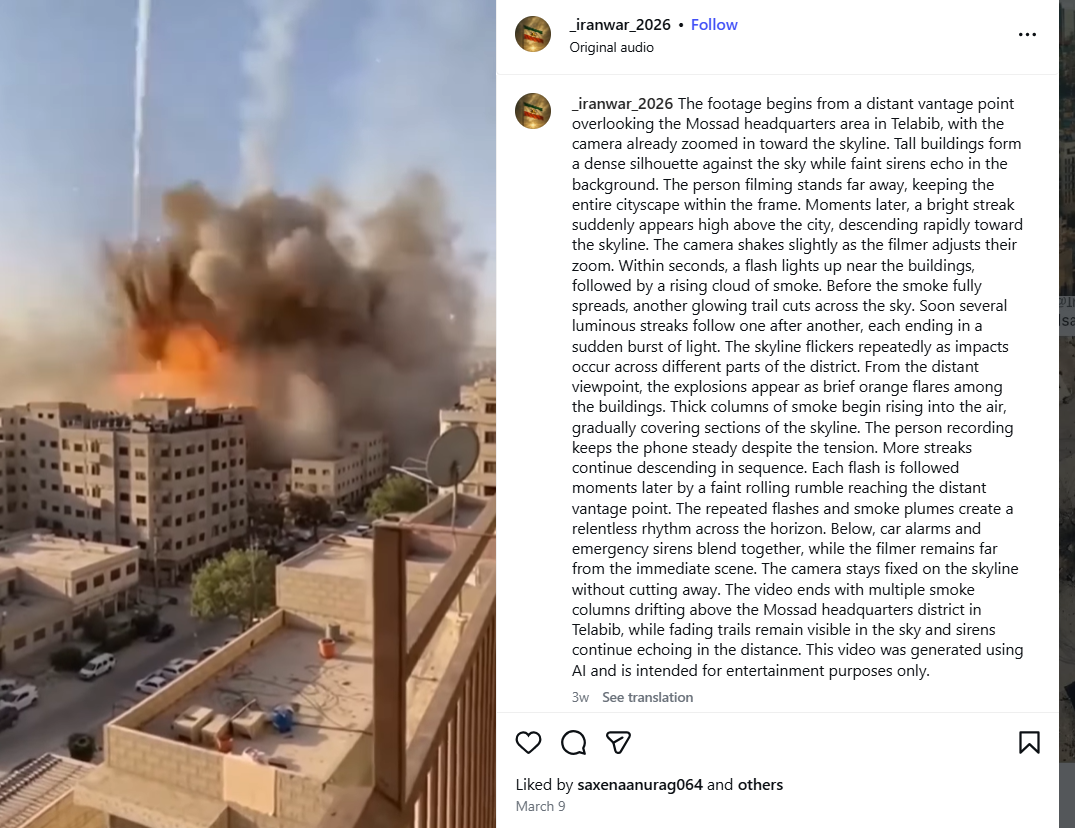
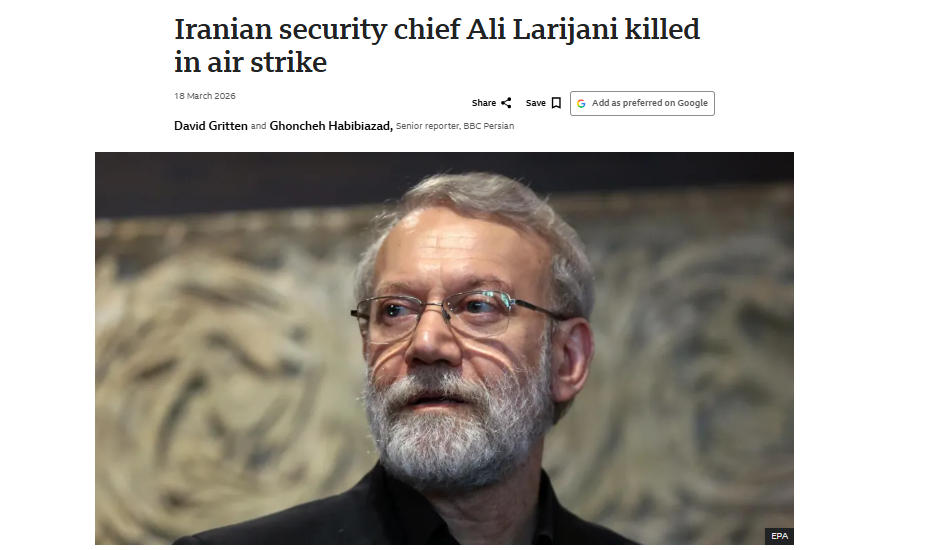
According to a BBC report, Ali Larijani died on March 17 in an Israeli strike. This establishes that the viral video predates the reported incident, making the claim factually inconsistent. Further examination of the Instagram account revealed that it frequently shares pro-Iran content, including gaming visuals and AI-generated clips, raising doubts about the authenticity of the video.
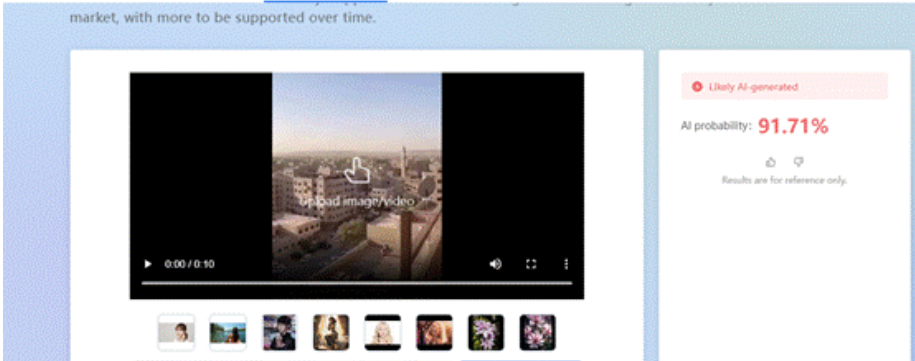
To strengthen the verification, we analyzed the viral clip using the AI detection tool “Zhuque AI Detection Assistant.” The results indicated a 91.71% probability that the video is AI-generated, confirming that it is not real footage.
Conclusion
The viral claim linking the video to an Israeli airstrike that allegedly killed Ali Larijani is misleading and factually incorrect. Multiple layers of verification show that the video existed online before the reported incident, ruling out any direct connection. Additionally, AI detection analysis strongly suggests that the video is artificially generated. The source account’s pattern of sharing AI and gaming-related content further weakens the credibility of the claim. There is no verified evidence to support that the viral clip depicts a real attack or any event related to Larijani’s death. Instead, the video appears to be a digitally created visual circulated without context to amplify misinformation.

Related Blogs
.webp)
Executive Summary
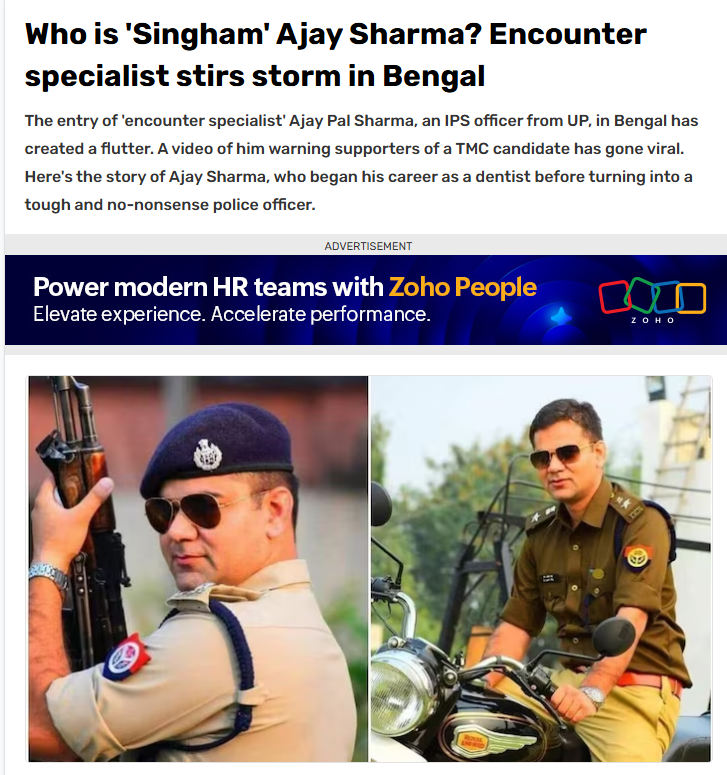
Ahead of the final phase of the West Bengal Assembly elections, a claim regarding Uttar Pradesh cadre IPS officer Ajay Pal Sharma began circulating widely on social media. Users claimed that Sharma was being sent to West Bengal on deputation for a period of five years. However, research conducted by CyberPeace Research Wing found the claim to be false. Sources close to the IPS officer confirmed that no such deputation order has been issued so far and that Ajay Pal Sharma is currently posted as Additional Commissioner in Prayagraj, Uttar Pradesh. Ajay Pal Sharma had earlier been deployed as a police observer during the West Bengal elections. During that period, a video of him warning Trinamool Congress candidate Jahangir Khan from the Falta constituency had gone viral on social media.
Claim
Several users on Facebook and X claimed that Ajay Pal Sharma had been transferred to West Bengal for five years under an administrative arrangement involving experienced officers from different states. One Facebook user wrote:“This decision has been taken under an administrative arrangement through which experienced officers are deployed in different states.”
- https://www.facebook.com/photo.php?fbid=818902764628152&set=a.296761956842238&type=3
- https://perma.cc/FD8Q-CF7L?type=standard

Fact Check
Our research found that the deputation claim is false. Ajay Pal Sharma is currently serving as Additional Commissioner in Prayagraj, a position he has held since 2025. Further scrutiny revealed that the claim appears to have originated from a parody account on X. On May 4, around 6 PM, the account @abdullah_0mar posted the claim regarding Sharma’s alleged five-year deputation to Bengal. However, in the comments section, the user later clarified that the post was intended as satire.

We also reviewed several news reports regarding Ajay Pal Sharma’s role during the West Bengal elections. Reports confirmed that the Election Commission had deployed him as a police observer in South 24 Parganas district during the polls. However, none of the reports mentioned any five-year transfer or deputation to West Bengal.
Conclusion
The viral claim is false. No official order has been issued regarding IPS officer Ajay Pal Sharma’s deputation to West Bengal for five years. Sources close to the officer confirmed that he continues to serve as Additional Commissioner in Prayagraj, Uttar Pradesh. Sharma had only been deputed as a police observer during the West Bengal Assembly elections, during which a video of him warning TMC candidate Jahangir Khan went viral online.

Introduction
Google is committed to supporting the upcoming elections in India by providing high-quality information to voters, safeguarding platforms from abuse, and helping people navigate AI-generated content. Google will connect voters to helpful information through enhanced features, collaborating with the Election Commission of India (ECI) to provide voting information in both English and Hindi. Emphasis is also placed on showcasing authoritative information on YouTube. YouTube will highlight authoritative news sources and offer context on topics prone to misinformation. YouTube also appends information panels directing viewers to the Election Commission of India's FAQs. This support will help millions of eligible voters navigate the electoral process and ensure a fair and transparent election process.
Key Highlights of Google’s Approach
The step taken by Google will support the democratic process during the upcoming General Election in India. The initiative focuses on three main pillars: disseminating information, tackling misinformation, and navigating AI-generated content. Google is enhancing its Search and YouTube features to provide essential election-related information, including voter registration, polling guidelines, and candidate profiles. Google is also addressing the challenges posed by AI-generated content by offering clarity on content origins, particularly for election-related ads and YouTube videos. Google has strict policies and restrictions regarding who can run election-related advertising on its platforms, including identity verification, pre-certificates, and in-ad disclosures. Additionally, Google is utilising tools and policies like Ads disclosures, content labels on YouTube, and digital watermarking to help users to identify AI-generated content.
Google has joined hands with ECI
The tech giant Google is partnering with the Election Commission of India (ECI) to provide voting information on Google Search in both English and Hindi. YouTube will feature election information panels, including candidate profiles and registration guidelines, ensuring users have access to authoritative sources. Google's recommendation system will display content from trusted publishers on election-related topics. Protecting the integrity of elections is a top priority, and the company is employing advanced AI models and machine learning techniques to identify and remove content that violates its policies at scale. A dedicated team of local experts across major Indian languages is assigned to provide relevant context and ensure swift action against emerging threats. Google is also tightening up who can advertise on its platforms, requiring advertisers to undergo an identity verification process and obtain a pre-certificate from the ECI or authorised entities for each election ad they wish to run.
Tackling Electoral Misinformation
Google is enhancing its platform security measures to prevent misinformation. It is using AI models and human expertise to identify and address policy violations, while stringent verification processes and disclosures are being implemented to maintain user trust.
Collaborations to promote reliable information
Google is supporting the Shakti, India Election Fact-Checking Collective, a consortium of news publishers and fact checkers to detect online misinformation, including deepfakes. The project will provide news entities and fact checkers with essential training in fact-checking methodologies, deepfake detection, and the latest Google tools to streamline verification processes, as stated in Google’s blog post.
Conclusion
Google has taken proactive steps to ensure a secure electoral process during the upcoming general elections in India. These include preventing the misuse of false information by helping voters navigate AI-generated content and safeguarding its platforms from abuse. Google India has built faster and more adaptable enforcement systems with recent advances in its Large Language Models (LLMs), enabling the company to remain nimble and take action quickly when new threats emerge. Google is dedicated to collaborating with government, industry, and civil society to provide voters with reliable and trustworthy online information. Google is implementing a comprehensive strategy to empower voters, safeguard its platforms, and combat misinformation in India's upcoming general elections. Google’s step is commendable and aims to ensure a secure electoral process, empowering millions of citizens to exercise their democratic rights.
References:
- https://blog.google/intl/en-in/company-news/outreach-initiatives/supporting-the-2024-indian-general-election/
- https://inc42.com/buzz/following-gemini-row-google-strengthens-checks-on-ai-generated-content-before-elections/#:~:text=In%20an%20effort%20to%20ensure,safeguarding%20its%20platforms%20from%20abuse
- https://www.indiatvnews.com/technology/news/google-introduces-enhanced-tools-for-supporting-elections-in-india-2024-03-12-921096
- https://economictimes.indiatimes.com/news/elections/lok-sabha/india/google-ties-up-with-eci-to-prevent-spread-of-false-information/articleshow/108431021.cms?from=mdr
- https://www.businesstoday.in/technology/news/story/google-joins-hands-with-election-commission-of-india-to-help-voters-via-search-youtube-421112-2024-03-12
- https://indianexpress.com/article/technology/tech-news-technology/google-2024-general-elections-support-9209588/

Executive Summary
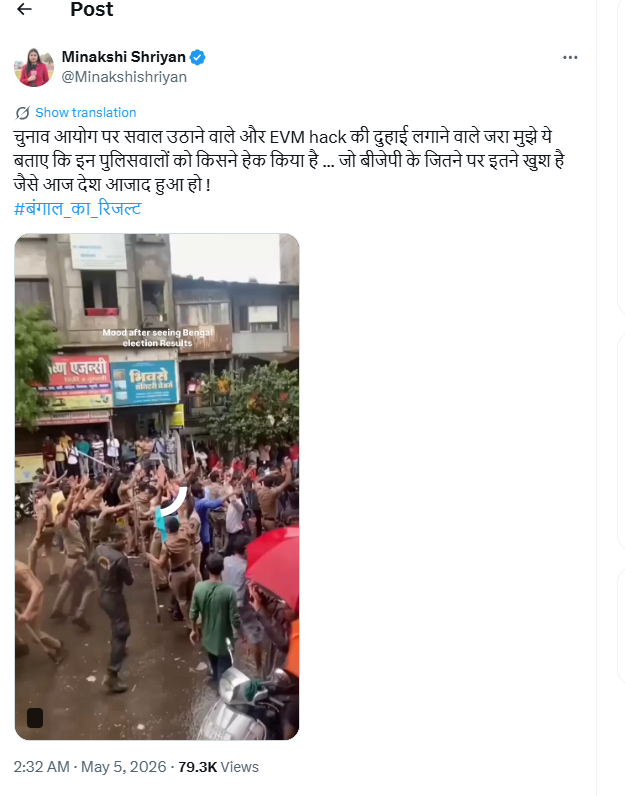
A video showing police personnel dancing on the streets along with civilians is going viral on social media. The clip is being shared with the claim that policemen in West Bengal were celebrating the defeat of Mamata Banerjee and the victory of the BJP.
Research by CyberPeace Research Wing found that the claim is misleading. The viral video is old and unrelated to the West Bengal elections.
Claim
An X user shared the video on April 26, 2026, alleging that police personnel were celebrating BJP’s victory. The post questioned those raising concerns over EVMs, suggesting that even police were openly rejoicing over the election outcome.
- https://x.com/Minakshishriyan/status/2051490074957930510
- https://archive.is/d81OT
Fact Check
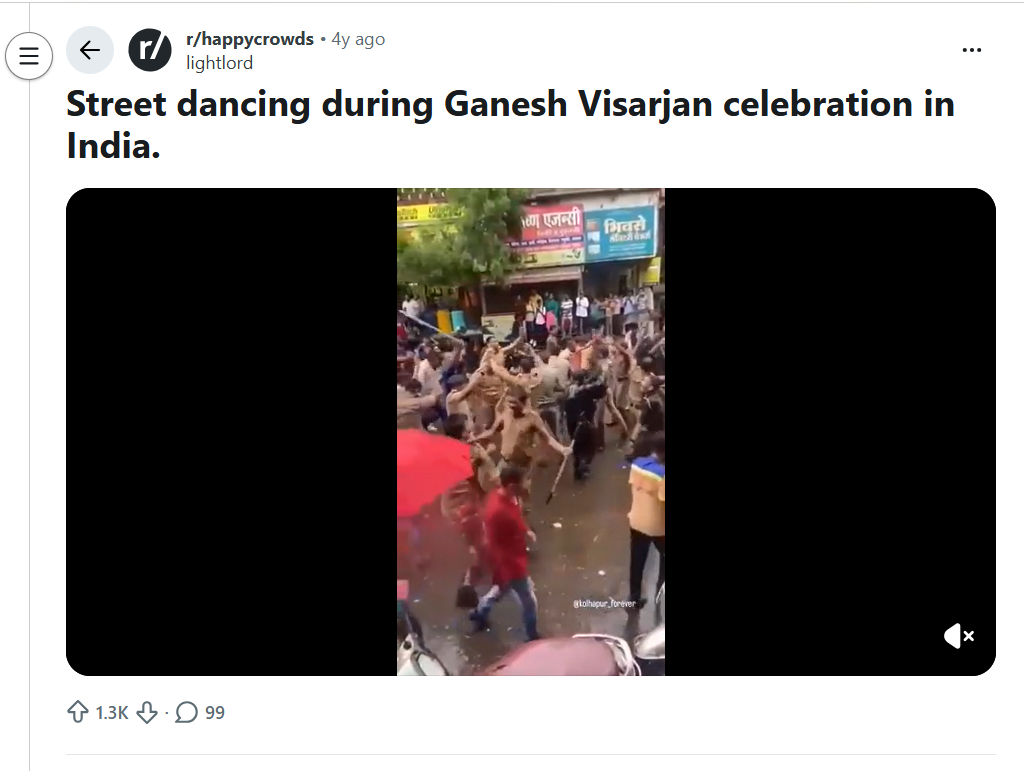
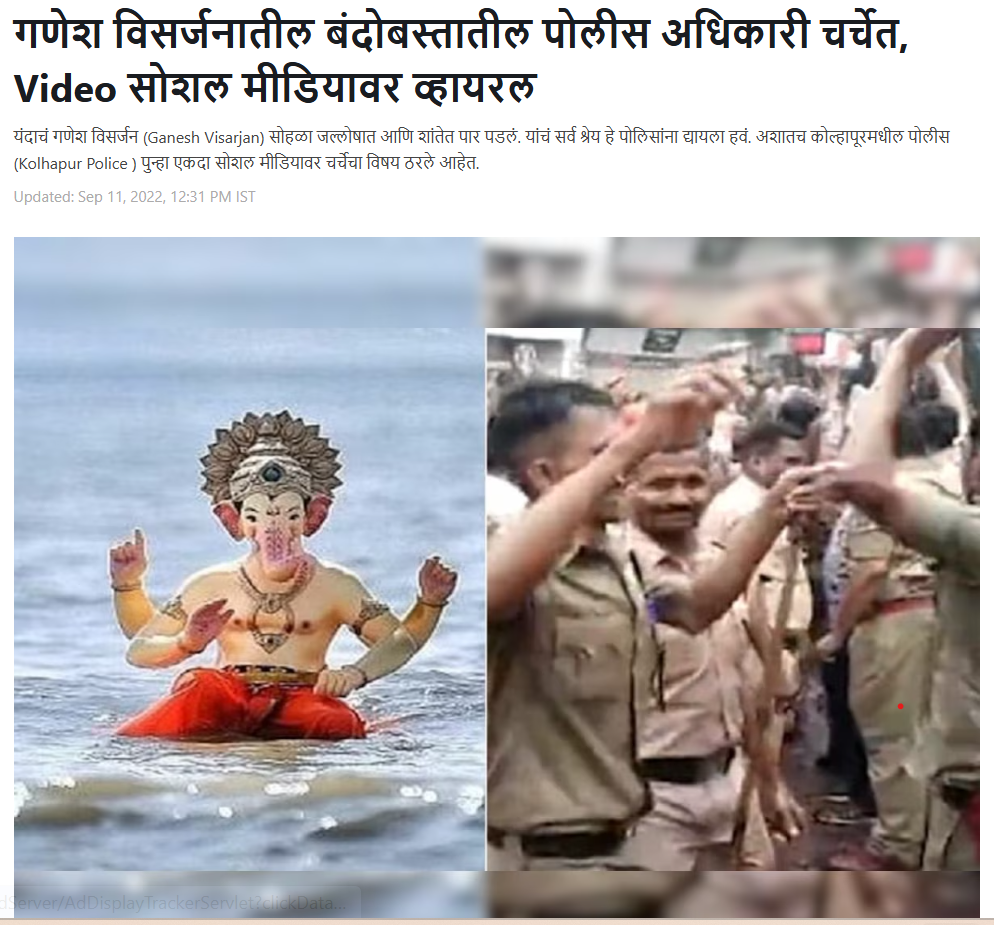
To verify the claim, we extracted keyframes from the viral video and conducted a reverse image search. This led us to a Reddit post dated September 13, 2022, where the same video was shared. The post described it as footage from Ganesh Visarjan celebrations in India, and several users in the comments identified the location as Maharashtra.
Further research led us to a YouTube channel “Yash Arate Vlogs,” which uploaded the same video on September 10, 2022. The description stated that the clip was recorded during Ganpati immersion celebrations in Kolhapur.
https://www.youtube.com/shorts/0_w5t-4rmTY
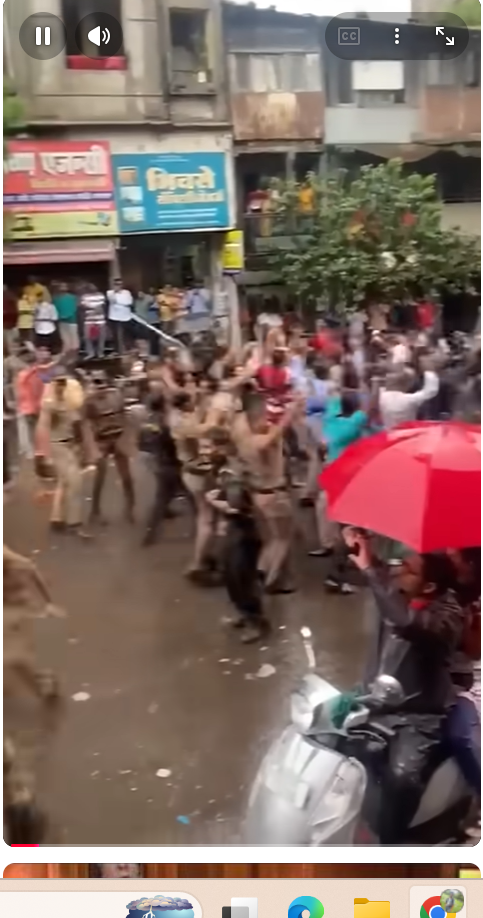
We also found media reports from September 2022 indicating that during Ganesh Visarjan in Kolhapur, loud music and festive atmosphere led even on-duty police personnel to briefly join the celebrations.
Conclusion
Our research confirms that the viral video does not show any post-election celebration in West Bengal. It is an old clip from Maharashtra, recorded during Ganesh Visarjan festivities, and is being falsely shared with a misleading political claim.
