
TRAI’s New Directions
Introduction
The Telecom Regulatory Authority of India (TRAI) has directed all telcos to set up detection systems based on Artificial Intelligence and Machine Learning (AI/ML) technologies in order to identify and control spam calls and text messages from unregistered telemarketers (UTMs).
The TRAI Directed telcos
The telecom regulator, TRAI, has directed all Access Providers to detect Unsolicited commercial communication (UCC)by systems, which is based on Artificial Intelligence and Machine Learning to detect, identify, and act against senders of Commercial Communication who are not registered in accordance with the provisions of the Telecom Commercial Communication Customer Preference Regulations, 2018 (TCCCPR-2018). Unregistered Telemarketers (UTMs) are entities that do not register with Access Providers and use 10-digit mobile numbers to send commercial communications via SMS or calls.
TRAI steps to curb Unsolicited commercial communication
TRAI has taken several initiatives to reduce Unsolicited Commercial Communication (UCC), which is a major source of annoyance for the public. It has resulted in fewer complaints filed against Registered Telemarketers (RTMs). Despite the TSPs’ efforts, UCC from Unregistered Telemarketers (UTMs) continues. Sometimes, these UTMs use messages with bogus URLs and phone numbers to trick clients into revealing crucial information, leading to financial loss.
To detect, identify, and prosecute all Unregistered Telemarketers (UTMs), the TRAI has mandated that Access Service Providers implement the UCC.
Detect the System with the necessary functionalities within the TRAI’s Telecom Commercial Communication Customer Preference Regulations, 2018 framework.
Access service providers have implemented such detection systems based on their applicability and practicality. However, because UTMs are constantly creating new strategies for sending unwanted communications, the present UCC detection systems provided by Access Service providers cannot detect such UCC.
TRAI also Directs Telecom Providers to Set Up Digital Platform for Customer Consent to Curb Promotional Calls and Messages.
Unregistered Telemarketers (UTMs) sometimes use messages with fake URLs and phone numbers to trick customers into revealing essential information, resulting in financial loss.
TRAI has urged businesses like banks, insurance companies, financial institutions, and others to re-verify their SMS content templates with telcos within two weeks. It also directed telecom companies to stop misusing commercial messaging templates within the next 45 days.
The telecom regulator has also instructed operators to limit the number of variables in a content template to three. However, if any business intends to utilise more than three variables in a content template for communicating with their users, this should be permitted only after examining the example message, as well as adequate justifications and justification.
In order to ensure consistency in UCC Detect System implementations, TRAI has directed all Access Providers to deploy UCC and detect systems based on artificial intelligence and Machine Learning that are capable of constantly evolving to deal with new signatures, patterns, and techniques used by UTMs.
Access Providers have also been directed to use the DLT platform to share intelligence with others. Access Providers have also been asked to ensure that such UCC Detect System detects senders that send unsolicited commercial communications in bulk and do not comply with the requirements. All Access Providers are directed to follow the instructions and provide an update on actions done within thirty days.
The move by TRAI is to curb the menacing calls as due to this, the number of scam cases is increasing, and now a new trend of scams started as recently, a Twitter user reported receiving an automated call from +91 96681 9555 with the message “This call is from Delhi Police.” It then asked her to stay in the queue since some of her documents needed to be picked up. Then he said he works as a sub-inspector at the Kirti Nagar police station in New Delhi. He then inquired whether she had recently misplaced her Aadhaar card, PAN card, or ATM card, to which she replied ‘no’. The scammer then poses as a cop and requests that she authenticate the last four digits of her card because they have found a card with her name on it. And a lot of other people tweeted about it.

Conclusion
TRAI directed the telcos to check the calls and messages from Unregistered numbers. This step of TRAI will curb the pesky calls and messages and catch the Frauds who are not registered with the regulation. Sometimes the unregistered sender sends fraudulent links, and through these fraudulent calls and messages, the sender tries to take the personal information of the customers, which results in financial losses.

Related Blogs
Introduction
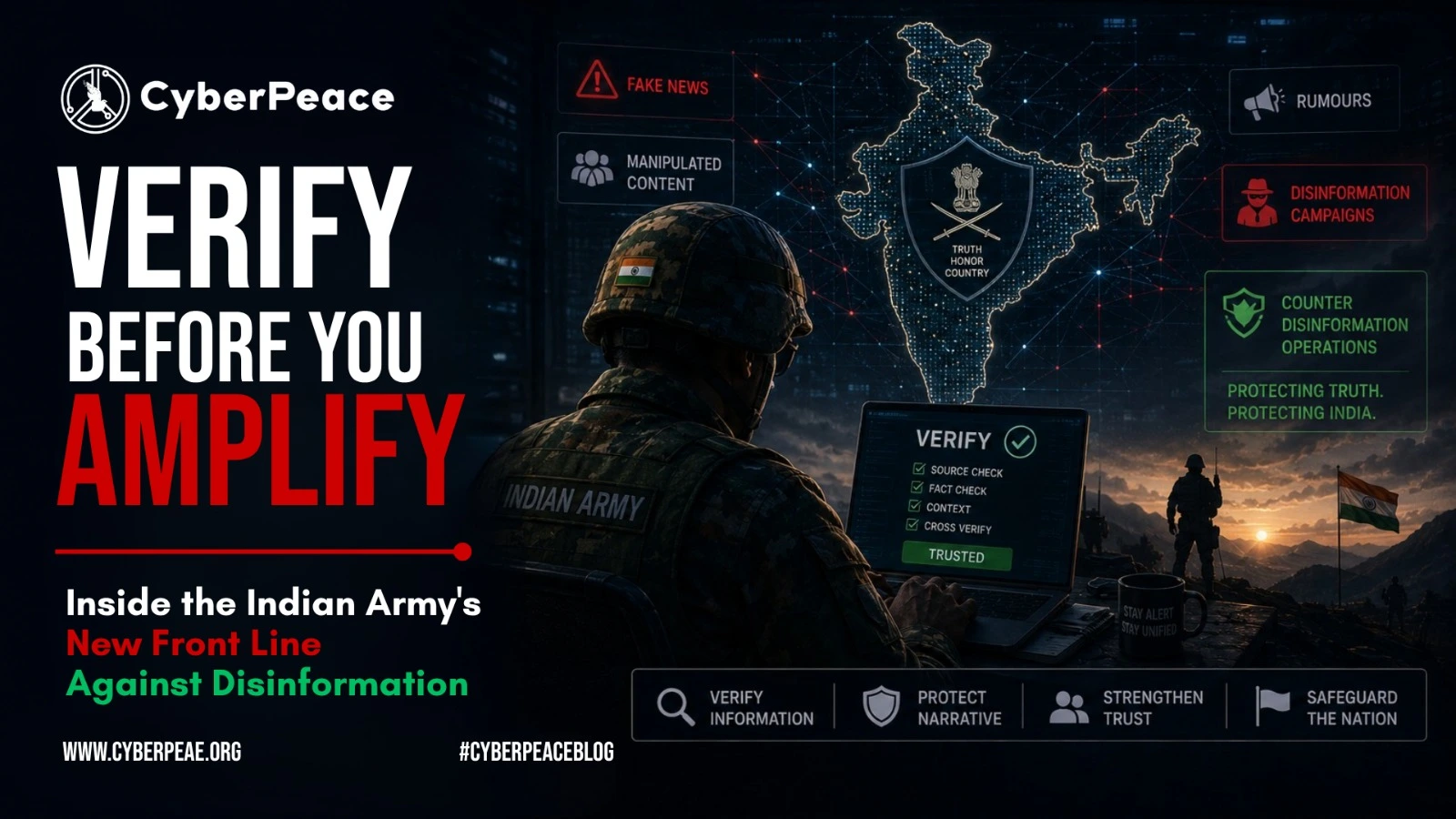
In a significant step, the Indian Army beefed up its information warfare capacity on June 25, 2026, with the operationalisation of @MythbusterXX, its dedicated fact-checking handle designed to counter any form of misinformation, disinformation, malinformation, and deepfakes on the army swiftly. Adopting the motto 'Verify Before You Amplify,' the service seeks to pivot from reactive statements to active cognitive warfare. In a milieu where manipulated narratives can be as decisive in shaping public perception as kinetic force is on the battlefield, truth itself has transformed into a critical national security objective.
This is clear proof that protecting India’s digital battleground will from now on be defined not just by troop deployments but also by its institutional verification capacities, swift attribution mechanisms, and public awareness.
When the Battlefield Went Digital
Today warfare extends to timelines, group chats, and prime-time graphics packages. The distinction between misinformation , disinformation , and malinformation is crucial to operations. After all, they necessitate different types of counters. Generative AI just exponentially increased their velocity, cost, and the creepy believability of synthesized audio, video, and images. Operation Sindoor, India's May 2025 military response to a Pahalgam terror attack, provides a blueprint for just how large it can get.
According to the fact-checking site BOOM, 68% of fact checks in May related to Operation Sindoor, describing the campaign as a misinformation superspreader, and, more directly, India's Chief of Defence Staff General Anil Chauhan lamented at last year’s Shangri-La Dialogue that roughly 15% of his military’s operational time was spent on countering false news. New Delhi matched this response level; the Ministry of Information and Broadcasting had blocked over 1,400 URLs, many bearing false information or communally inciteful narratives from accounts in Pakistan. These challenges won't be vanishing any time soon. Microsoft's July 2025 Digital Defence Report lists India among the top countries targeted for AI-powered state-backed hacking, noting the automation of attacks and generation of fake content used to influence opinion.
CyberPeace's regulatory tracking also indicates steps toward building infrastructure to mitigate this, a Rule 7 complaint system for deepfakes, and efforts to foster local detection capabilities under the IndiaAI mission signal it's now an infrastructural threat.
Why the Army Chose to Speak First
On 1 June 2026, the Indian government’s official fact-checking unit debunked a deepfake of former Army Chief General Dhiraj Seth talking about India’s engagement with the Taliban that emanated from Pakistan-affiliated propaganda sources, appearing within days of a change of military command. Barely days after General Dhiraj Seth was elevated to Chief of Army Staff, the 31st person to hold the post, another fabricated deepfake used spliced authentic footage with AI-cloned audio to falsely allege he had blamed the past army leadership for hiding the bodies of soldiers to protect their image.
Such a dual targeting of India’s army chiefs with deepfakes in such close succession is a testament as to why an authoritative, constantly running fact-check machine isn’t an optional extra but a strategic must-have.
Architecture is as important as architecture itself. India tried a statutory fact-checking model with a government-owned Fact Check Unit under the Information Technology (IT) Rules of 2023 through the Press Information Bureau (PIB). It had to retreat from the edge of the constitutional cliff. In September 2024, when the Bombay High Court struck down key provisions of these rules. It ruled it unconstitutional to empower the state to declare digital content relating to the state itself as fake, false, or misleading. A similar reading of the analysis by CyberPeace found that digital speech should be given the same protections as offline speech, and this should be the benchmark for any counter-misinformation policy.
MythbusterXX carefully avoids the constitutional controversy by acting as an institutional avenue that produces verified information and rebuttals in response to disinformation. There is a profound distinction between answering falsehoods with factual, credible speech versus shutting them down with state power, the very proportionality that civil libertarians have said must govern a democracy's approach to online misinformation.
Platforms as Accelerants, Not Just Conduits
Part of the issue lies upstream, with the algorithms and broadcasters that favor speedy falsehood over careful confirmation. A month’s supply of “false and misleading stories,” the Reuters Institute for the Study of Journalism observed, streamed online within hours of Operation Sindoor's onset: one fact-checker identified approximately seventy false claims by the close of day one. Meanwhile, on the small screen, graphics depicting escalating conflicts were being televised, with broadcasters forced to scramble under 24/7 competition.
Amplified manipulation of the crisis narrative is also a factor; studies show that thousands of accounts have been reposting exactly the same party content for three years, making crisis-induced viral narratives predictable rather than organic phenomena. For the most part, the platforms that manage these narratives and the algorithms that direct content on both sides of the divide are not just innocent delivery systems.
Digital Literacy as the First Line of Defence
Institutional rebuttals only go so far if citizens lack the reflex to pause before sharing, which is where CyberPeace's own work becomes directly relevant. Through a multi-year, Google.org-backed initiative, CyberPeace Foundation aims to reach over 40 million Indian internet users, including 9 million underserved beneficiaries, through a multilingual resource centre offering 650 hours of content, state-level helplines, and quick-response teams staffed by digital forensics and fact-checking experts. Longer-running efforts such as the Digital Shakti campaign and the annual eRaksha competition, run with NCERT, have built a culture of responsible digital citizenship among young and first-time internet users since 2019, while CyberPeace Corps, the foundation's volunteer arm, carries the same message into classrooms and campuses through cyber-awareness sessions run with universities and school networks nationwide. Notably, CyberPeace's own research on children's online safety had already flagged manipulated Army-related videos as a category of digital manipulation designed to cast doubt on official military positions, well before @MythbusterXX existed. The Army's tagline and CyberPeace's mission converge on the same insight: verification is a civic skill, not merely an institutional service.
A Season of Deepfakes
The history book of compromised defence material in the past year alone would be edifying. The International Federation of Journalists recorded one such deepfake widely circulated that relied on AI voice cloning and lip-sync tools to present the Pakistani PM conceding defeat, though the video actually contained his praise for the Pakistani air force’s performance following Operation Sindoor.
Other similar videos featured the Indian Prime Minister, External Affairs Minister, and Home Minister allegedly apologising to Pakistan and a deepfake with a foreign head of state in voice-cloned style applauding India’s armed forces. None needed a state’s resources, but just a laptop, voice cloning available readily, and a citizenry ready to spread rather than confirm the authenticity of any such sensational information before spreading it on to the masses.
Building the Verification Reflex
A resilient information ecosystem needs different actors playing complementary roles:
- Citizens: Do not equate virality with credibility. Verify all national security-related information through official sources, such as @MythbusterXX, before reposting or forwarding it.
- Journalists: Apply rigorous verification standards to live broadcasts, war-room graphics, and breaking reports, just as you would to print journalism, and avoid speculation during fast-moving military operations.
- Researchers and fact-checkers: Use open-source forensic and AI-detection technologies to authenticate questionable material. BOOM researchers, for instance, used Deepfake-o-meter to scrutinize misleading videos of political leaders before fact-checking and publishing them.
- Policymakers: Favored constitutionally proportional and carefully tailored regulations over broad-based takedown mandates. While the 2026 IT Amendment Rules require platforms to shift their obligations from compliance with takedowns towards preventive diligence on synthetic media, implementation should continue to be informed by judicial protections afforded to freedom of speech and due process.
Cyber Resilience Is National Security Now
Legal scholars examining Operation Sindoor have drawn a useful distinction between coordinated information warfare, which is strategic and intentional, and the diffuse, uncoordinated mis/disinformation that dominated timelines during the conflict, cautioning that disproportionate state responses to the latter can compromise citizens' right to know just as much as the falsehoods themselves. Getting that balance right, between speed and due process, between institutional voice and censorship, is the real test facing India's information ecosystem, in defence and far beyond it. CyberPeace has made a related argument in its own work on AI-enabled espionage: institutions such as the National Critical Information Infrastructure Protection Centre and the Defence Cyber Agency are already folding AI-based monitoring into their processes, yet no amount of institutional surveillance substitutes for a citizenry trained to spot manipulation on sight.
@MythbusterXX will not end deepfakes, and no single handle can. But it signals something CyberPeace has argued for years: resilience against synthetic and manipulated media requires authoritative institutional voices, digitally literate citizens, forensically equipped researchers, and proportionate policy, all pulling in the same direction. "Verify before you amplify" is not just an Army campaign. It is the operating discipline a democracy needs to protect its own information age.
Conclusion
@MythbusterXX can't possibly kill deepfakes and disinformation, but this marks a milestone shift towards developing an institutional resilience for India's info battlefield. For, after all, national security in the age of info warfare depends less on tech and more on robust institutions, constitutional balance in policymaking, responsible social platforms, and a citizenry that clicks "forward" only after clicking "verify."
* * * * *
This piece is part of CyberPeace's ongoing work on misinformation, disinformation, and digital citizenship in India. For more on CyberPeace's initiatives in digital literacy and cyber resilience, visit cyberpeace.org.
Key Sources
- Dynamite News, "Indian Army launches fact-check push against deepfake videos and fake military claims" (June 2026)
- ADG PI – Indian Army, official announcement on X (@adgpi)
- Press Information Bureau, Government of India, press release on countering misinformation during Operation Sindoor
- Reuters Institute for the Study of Journalism, "Truth is the casualty: How Indian fact-checkers debunked false claims during the India-Pakistan crisis"
- International Federation of Journalists, "AI, Deepfakes, and the Fog of War" and "Operation Sindoor and the Two Wars" (June 2025)
- Republic World, "Operation Sindoor Haunts Pakistan: Islamabad's Latest AI Deepfake Bid Against Indian Army Chief General Dhiraj Seth Exposed" (July 2026)
- TechPolicy Press, "Sanity Prevails as Bombay High Court Strikes Down India Government's Fact Check Unit", and LiveLaw, coverage of the tie-breaker verdict, on the IT Amendment Rules, 2023 (Fact-Check Unit)
- Dark Reading, "Indian Army Propaganda Spread by 1.4K AI-Powered Social Media Accounts"
- Inforrm, "(Dis)information warfare and the right to know: lessons from Operation Sindoor"
- CyberPeace Foundation, initiatives page and The CyberPeace Initiative (Google.org-backed digital literacy programme)
- CyberPeace Foundation, "AI-Powered Espionage: How India's Cybersecurity Strategy Must Evolve"
- CyberPeace Foundation, "From Deepfakes to Due Diligence – Decoding India's IT Amendment Rules"
- Wikipedia, CyberPeace Foundation (background on Digital Shakti and eRaksha)

Executive Summary
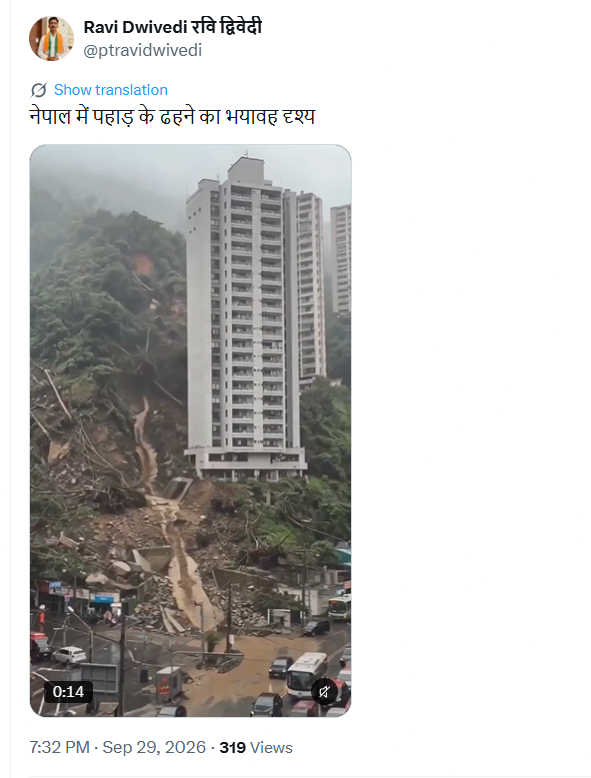
A video is being shared on social media showing a large amount of debris cascading down a mountain amid multi-storey buildings. The video is being shared with the claim that it shows a landslide incident in Nepal. CyberPeace Research found the viral claim to be false. Our research found that the viral video is AI-generated and is being shared with a misleading claim.
Claim:
A Facebook user shared the viral video on September 29, 2026, with the caption, “A horrifying scene of a mountain collapsing in Nepal.” The post link, archive link and screenshot are provided below.
https://x.com/ptravidwivedi/status/2104934750595219494
Fact Check
To verify the authenticity of the viral claim, we conducted a reverse image search using keyframes from the video. However, we did not find any credible media reports or other reliable sources related to the video during the search. Upon closely examining the viral video, we noticed several inconsistencies that raised suspicions that the video may be AI-generated.
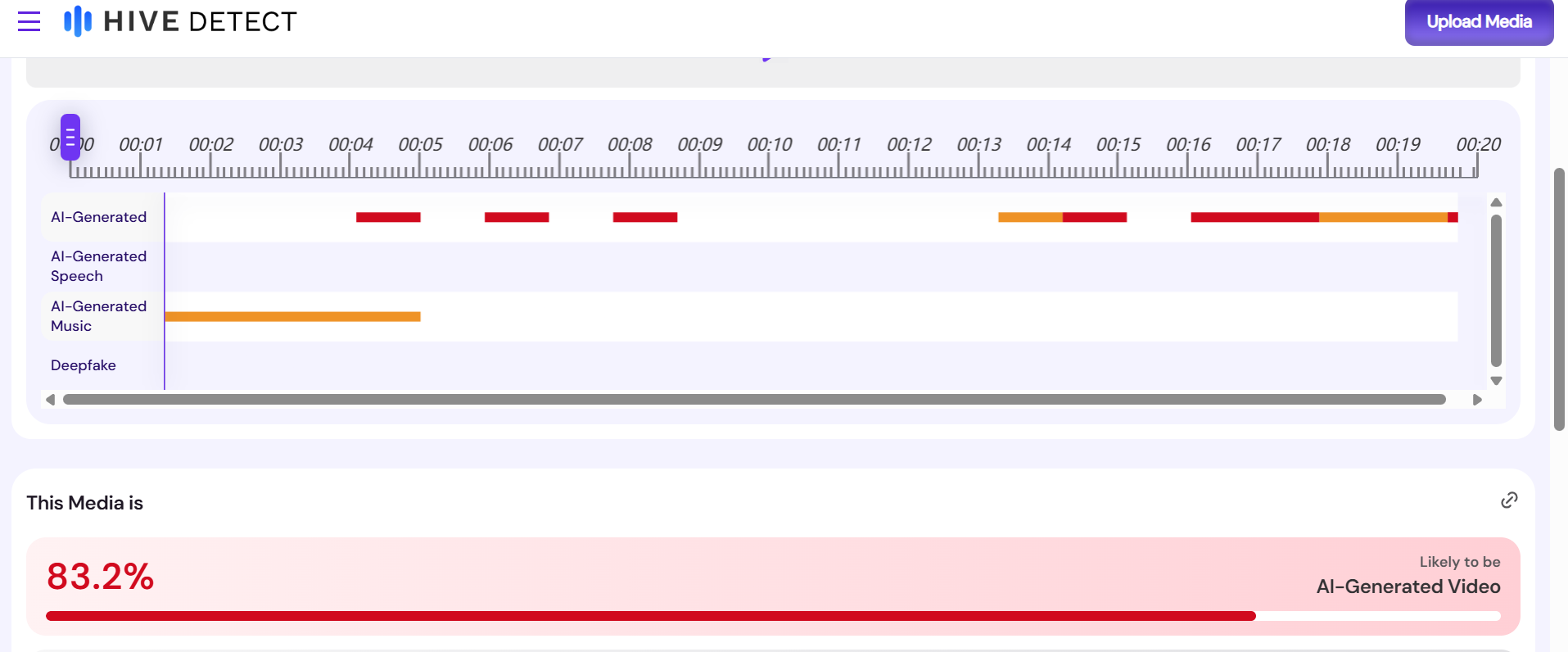
As part of the next step in our research, we scanned the video using the AI detection tool Hive Detect. According to the results, the viral video has an 83 per cent likelihood of being AI-generated.

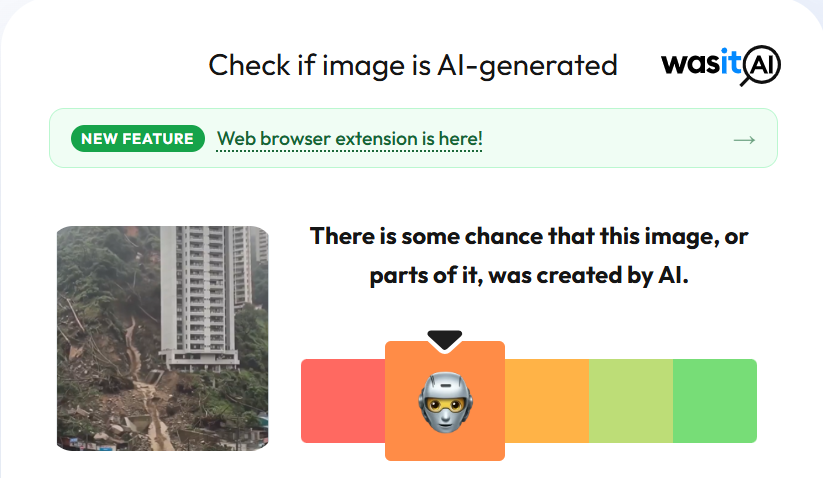
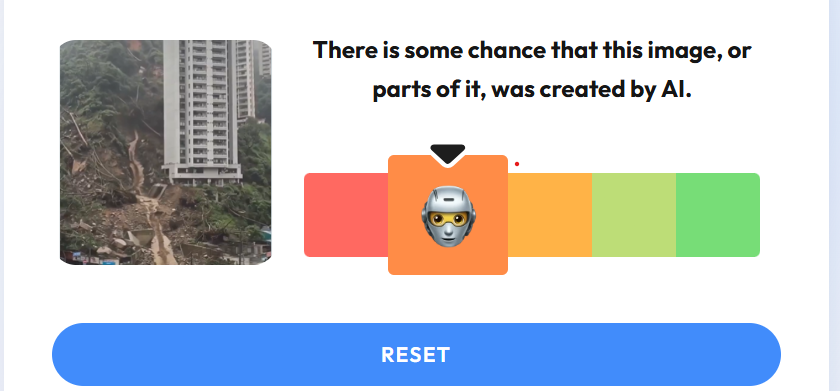
At the end of our research, we scanned the viral video using the AI detection tool WasIt AI. According to the results, the viral video was found to be AI-generated.
Conclusion
Our research found that the viral video is AI-generated and is being shared with a misleading claim.
Executive Summary
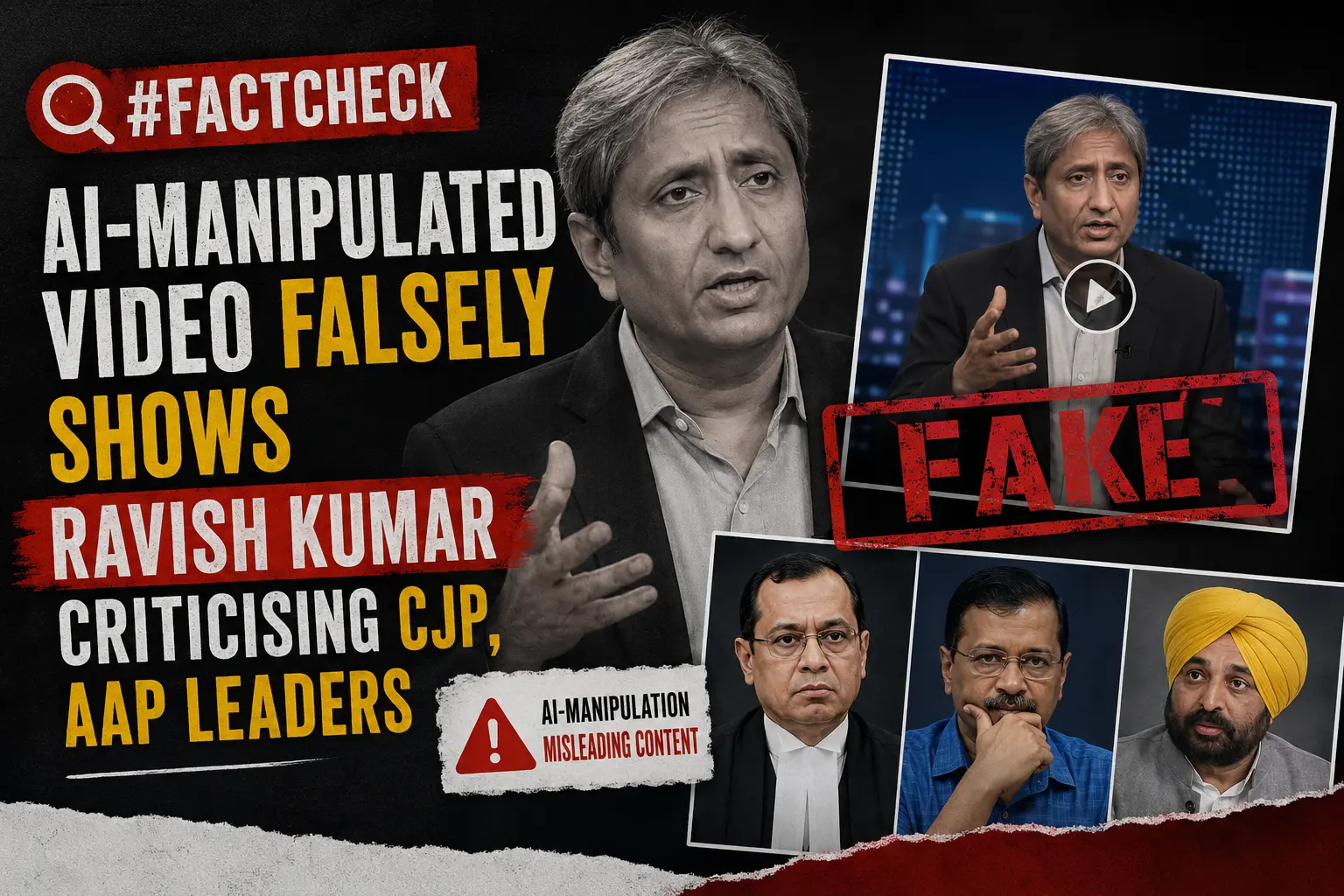
A video of journalist Ravish Kumar is being widely shared on social media. The video is being circulated with the claim that Kumar criticised Abhijeet Deepak, the CJP and Aam Aadmi Party (AAP) leaders over the CJP’s alleged absence from the ongoing student protest in Jharkhand. The CyberPeace Research Wing found the claim to be false. The research established that the original video of Ravish Kumar was digitally manipulated using artificial intelligence (AI), and altered audio was added before it was shared with a misleading claim.
Claim
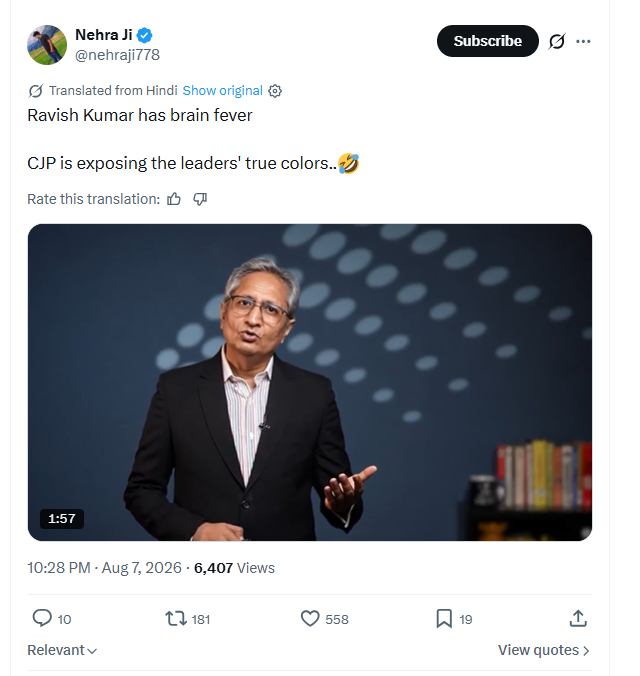
A user on X (formerly Twitter) shared the viral video on August 7, 2026, with the caption: “Ravish Kumar has brain fever. CJP is exposing the leaders’ true colors.”
https://x.com/nehraji778/status/2085772474915164506
Factcheck
To verify the claim, we extracted several keyframes from the viral video and conducted a reverse image search using Google Lens. During the search, we found a video uploaded on Ravish Kumar’s official YouTube channel on July 29, 2026.
The visuals in the original video match those seen in the viral clip. Ravish Kumar can be seen wearing the same clothes and appearing in almost the same frame as in the viral video.
https://www.youtube.com/watch?v=Rdn_hfyZVRM
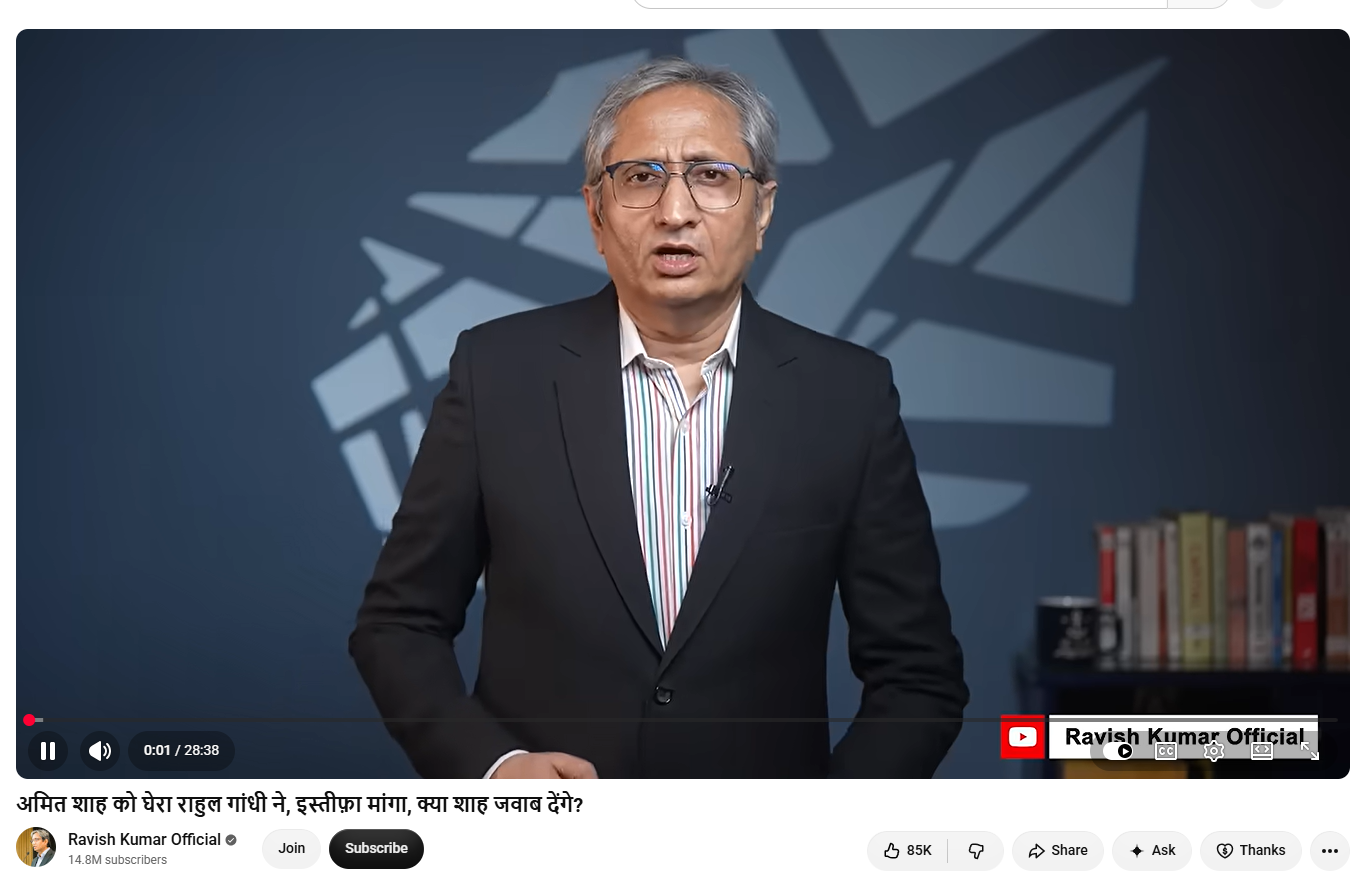
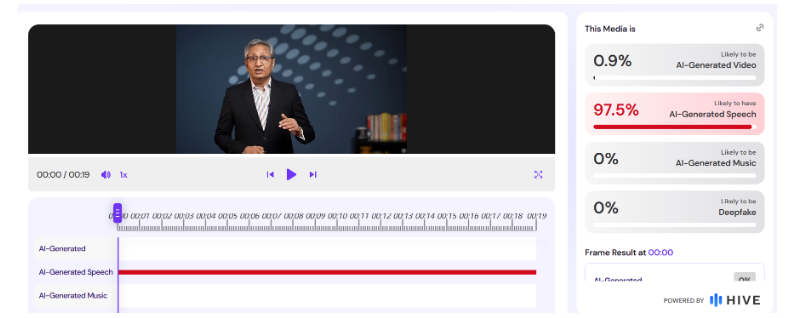
In the next step, we analysed the viral video using Hive Moderation. The tool indicated a 97 per cent probability that the video was AI-generated.
Conclusion
The research found that the viral claim is false. The visuals are taken from a genuine video of Ravish Kumar, but the original footage has been digitally manipulated and altered audio has been added using AI. The modified video is being circulated with a misleading claim that Kumar criticised Abhijeet Deepak, CJP and AAP leaders over the Jharkhand student protest.
