
#FactCheck: Old Odesa Footage Falsely Linked to Recent Iran-US Military Conflict
Executive Summary
A video has recently gone viral on social media, with claims that it shows Iranian air defence systems intercepting attacks by US fighter jets. The video is being widely shared across various social media platforms, linking it to the ongoing military tensions between Iran and the United States. CyberPeace’s research found the viral claim to be misleading. The research revealed that the video is old and has no connection with the ongoing war between Iran and the US or any recent military action.
Claim:
A video shared on the social media platform X claims that Iranian air defence systems are responding to an attack by US aircraft.
https://x.com/tvir_X/status/2095185048567968013?s=20

Factcheck
As part of our research, we conducted a reverse image search of the keyframes from the viral video. During the search, we found the same video on The Sun’s YouTube channel, where it was published on November 16, 2024. According to the video’s description, the incident took place in Odesa, Ukraine, where Ukrainian air defence systems engaged in a heavy confrontation with Russian drones. The descr
https://www.youtube.com/watch?v=TxECQr27wng

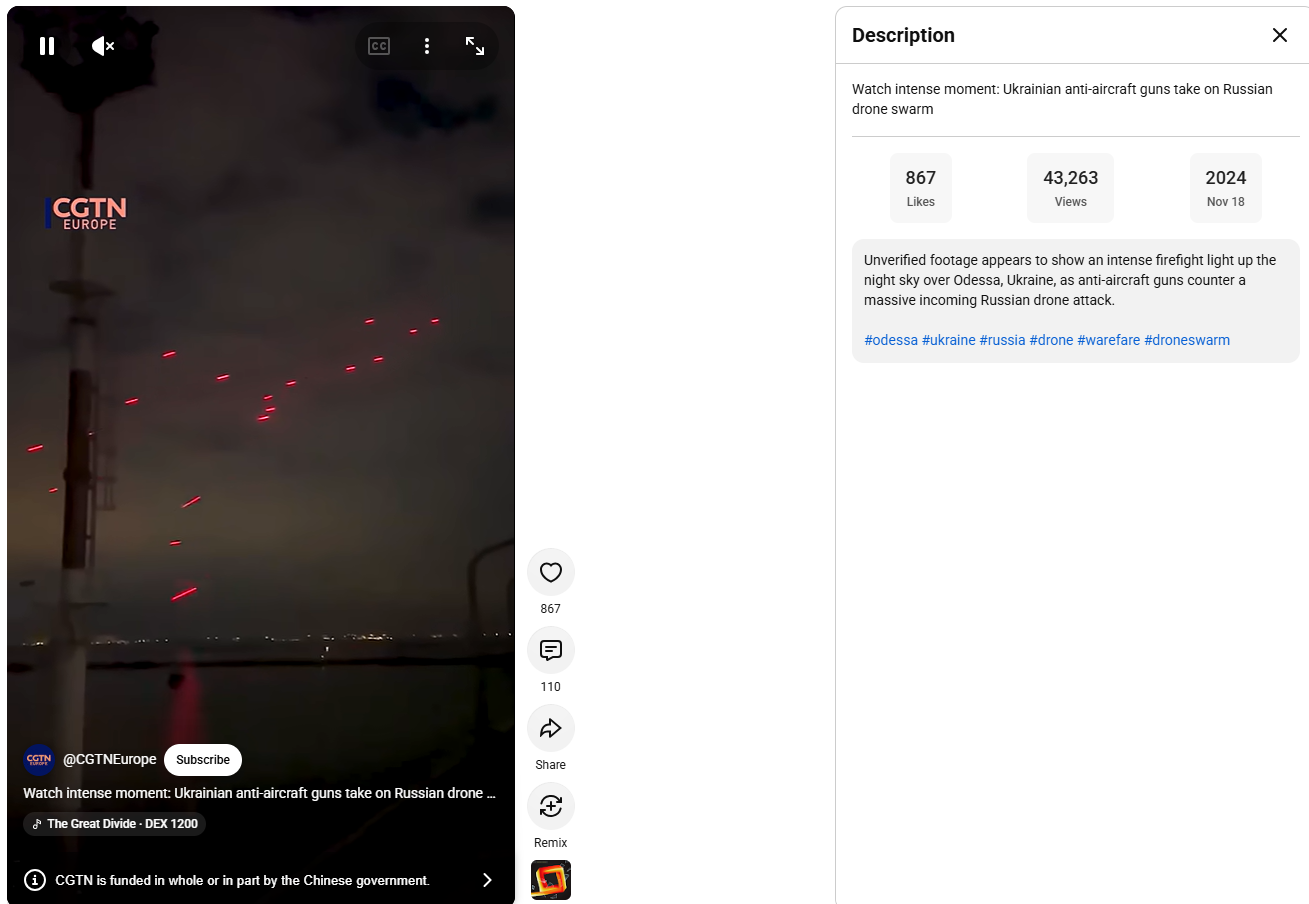
As part of our research, we found the video on the CGTN Europe YouTube channel, where it was published on November 18, 2024.The unverified footage appears to show heavy gunfire lighting up the night sky over Odesa, Ukraine. It is claimed that anti-aircraft guns were fired in response to a Russian drone attack.
https://www.youtube.com/shorts/Hq5P-UoPNHc
Conclusion:
The evidence gathered during our research makes it clear that the video circulating on social media is not related to the ongoing military tensions or any recent military action between Iran and the United States. A reverse image search revealed that the same video was published in November 2024. According to the video’s description, it shows Ukrainian air defence systems responding to a Russian drone attack in Odesa, Ukraine. Therefore, the claim that the viral video shows Iranian air defence systems intercepting attacks by US fighter jets is misleading.

Related Blogs

Introduction
Significantly, in March 2023, the Prevention of Money Laundering Act, 2002's regulations placed Virtual Digital Asset Service Providers functioning located under the purview of the Anti Money Laundering/Counter Financing of Terrorism (AML-CFT) scheme. An important step toward controlling VDA SP operations and guaranteeing adherence to Anti-Money Laundering and Combating the Financing of Terrorism (AML-CFT) regulations.
The significance of AML-CFT procedures
The AML-CFT framework's incorporation of Virtual Digital Asset Service Providers (VDA SPs) is essential for protecting the banking industry from illegal activities including the laundering of funds and counter-financing of terrorist attacks. These regulations become more crucial as the market for digital assets develops and becomes more well-known.
The practice of money laundering is hiding the source of the sum received illegally, thus it's critical to have strict policies in place to track down and stop these kinds of operations. Furthermore, funding for terrorism is a serious danger to international safety, hence stopping the flow of money to terrorist companies is a top concern for global officials.
The goal of policymakers' move to include VDA SPs in the AML-CFT architecture is to set up control and surveillance procedures that will guarantee these organisations' open and honest operations. This involves tracking transactions, flagging questionable activity, and conducting extensive customer investigations. Incorporating such procedures not only reduces the potential for financial crimes but also builds confidence and trust in the electronic asset market.
It is important to see the significance of AML-CFT procedures and the changes in the legal framework to reflect the evolving characteristics of digital currencies. These procedures are essential to preserving the reliability and safety of the wider banking system.
Notifications of Compliance Show Cause
Under Section 13 of the PMLA Act 2002, FIU IND sent adherence Show Cause Notices to nine offshore Virtual Digital Asset Service Providers (VDA SPs) as part of its dedication to upholding compliance with regulations. This affirmative step requires organisations to be scrutinised and attempted to bring them under inspection.
Governmental Response
The Director of FIU IND has addressed the Secretary of the Ministry of Electronics and Information Technology to take further measures due to the disregard of offshore firms. According to the notification, URLs connected to these organisations that operate in India in violation of the PML Act's requirements must be blocked.
Mandatory Registration for VDA SPs
Virtual Digital Asset Service Providers (both onshore and offshore) who perform a range of operations, including the trading of digital goods for monetary currencies, the distribution of digital currency, and the management or preservation of electronic assets, are now obliged to register with FIU.
Range of Statutory Responsibilities
In accordance with the PML Act, VDA SPs are subject to several requirements, including documentation, disclosure, and other duties. One of their responsibilities is to register with the FIU IND. The primary focus is on guaranteeing that VDA SPs comply with AML-CFT protocols, hence enhancing the general reliability of the banking industry.
Difficulties with Offshore Compliance
There are many obstacles in guaranteeing that offshore organisations comply with Anti Money Laundering/Counter Financing of Terrorism (AML-CFT), chief amongst them being their unwillingness to undergo registration. Some overseas Virtual Digital Asset Service Providers (VDA SPs) have been reluctant to comply with the existing rules and regulations, even though they cater to a significant number of Indian users. There are several reasons for this hesitation, such as worries about heightened monitoring, the expense of compliance, and the apparent complexity of governmental processes. Regulatory organisations have taken steps to close the discrepancy between offshore businesses' real activities and the regulations they must follow. In addition to maintaining the trustworthiness of the economic system, resolving the issues with offshore adherence is essential for promoting confidence and openness in the market for electronic assets.
Conclusion
FIU IND has demonstrated its dedication to creating an effective regulatory framework for Virtual Digital Asset Service Providers through its recent measures. India hopes to fortify its countermeasures against money laundering and safeguard the financial well-being of its users by expanding the AML-CFT legislation to offshore firms. The continuous efforts to restrict the URLs of non-compliant companies show a proactive approach to stopping illicit activity and fostering a safe and law-abiding virtual asset ecosystem. The safety and soundness of the banking sector will be crucially maintained by laws and regulations as the digital world develops.
References
- https://pib.gov.in/PressReleasePage.aspx?PRID=1991372
- https://www.thehindubusinessline.com/books/reviews/business-economy/fiu-ind-issues-compliance-showcause-notices-to-nine-offshore-vda-sps/article67684613.ece
- https://business.outlookindia.com/news/fiu-issues-notice-to-9-offshore-crypto-platforms-writes-to-meity-for-blocking-of-urls

Executive Summary
A video featuring former Indian cricketer Sachin Tendulkar is being widely circulated on social media with the date “12-5-2026” displayed on the screen. In the viral clip, Tendulkar appears to promote an investment scheme, allegedly saying that people investing in the scheme today could earn Rs 80 lakh by the end of the day. Throughout the video, he is seen speaking about investment opportunities and financial returns. However, research conducted by CyberPeace Research Wing found that the video is AI-generated and misleading. The original footage was actually from an event marking the centenary celebrations of Sri Sathya Sai Baba.
Claim
A Facebook user shared the viral video on May 12, 2026, claiming that Sachin Tendulkar was endorsing a high-return investment scheme. The post quickly gained traction on social media platforms.

Fact Check
To verify the claim, we searched the internet using relevant keywords but found no credible media reports suggesting that Tendulkar had endorsed any such investment scheme. As part of our research, we extracted key frames from the viral clip and conducted a reverse image search. During the search, we found the original video uploaded on November 19, 2025, on the YouTube channel of IANS. According to the video description, Tendulkar was attending an event organized to mark the centenary year celebrations of Sri Sathya Sai Baba.

We further found a similar version of the same video uploaded on November 19, 2025, on the official Facebook page of Times Now, confirming that the footage was unrelated to any investment or financial scheme.

Conclusion
Our research found that the viral video has been manipulated using AI-generated audio or editing techniques to falsely portray Sachin Tendulkar promoting an investment scheme. The original video was from a public event related to Sri Sathya Sai Baba’s centenary celebrations and had no connection to any financial investment platform.
.webp)
Introduction
Autonomous transportation, smart cities, remote medical care, and immersive augmented reality are just a few of the revolutionary applications made possible by the global rollout of 5G technology. However, along with this revolution in connectivity, a record-breaking rise in vulnerabilities and threats has emerged, driven by software-defined networks, growing attack surfaces, and increasingly complex networks. As work on next-generation 6G networks accelerates, with commercialisation starting in 2030, security issues are piling up, including those related to AI-driven networks, terahertz communications, and quantum computing attacks. For a nation like India, poised to become a global technological leader, next-generation network procurement is not merely a technical necessity but a strategic imperative. Initiatives such as India-UK collaboration on telecom security in recent years say a lot about how international alliances are the order of the day to address these challenges.
Why Cybersecurity in 5G and 6G Networks is Crucial
With the launch of global 5G services and the rapid introduction of 6G technologies, the telecom sector is seeing a fundamental transformation. Besides expanding connectivity, future networks are also creating the building blocks for networked and highly intelligent environments. With its ultra-high speed of 10 Gbps, network slicing, and ultra-low latency, 5G provides new capabilities that are perfectly suited for mission-critical applications such as telemedicine, autonomous vehicles, and industrial IoT. Sixth-generation wireless technology is still in development, and it will be approximately one hundred times faster than fifth-generation. Here are a few drawbacks and challenges:
- Decentralised Infrastructure (edge computing nodes): Increased number of entry points for attack.
- Virtual Network Functions (VNFs): Greater vulnerability to configuration issues and software exploitation.
- Billions of IoT devices with different security states, thus forming networks that are more difficult to secure.
Although these challenges are unparalleled, the advancement in technology also creates new opportunities.
Understanding the Cyber Threat Landscape for 5G and 6G
The move to 5G and the upgrade to 6G open great opportunities, but also open doors for new cybersecurity risks. Open RAN usage offers flexibility and vendor selection but exposes the supply chain to untested third-party components and attacks. SBA security vulnerabilities can be exploited to disrupt vital network services, resulting in outages or data breaches. Similarly, widespread adoption of edge computing to reduce latency creates multiple entry points for an attacker to target. Compounding the problem is the explosion of IoT device connections through 5G, which, if breached, can fuel massive botnets capable of conducting massive distributed denial-of-service (DDoS) attacks.
Challenges in 6G
- AI-Powered Cyberattacks: AI-native 6G networks are susceptible to adversarial machine learning attacks, data model poisoning, both for security and for traffic optimisation.
- Quantum Threats: Post-quantum cryptography may be required if quantum computing renders current encryption algorithms outdated.
- Privacy Concerns with Digital Twins: 6G may result in creating enormous privacy and data protection issues in addition to offering real-time virtual replicas of the physical world.
- Cross-Border Data Flow Risks: Secure interoperability frameworks and standardised data sovereignty are essential for the worldwide rollout of 6G.
A Critical Step Toward Secure Telecom: The India-UK Partnership
India's recent foray with the UK reflects its active role in shaping the future of telecom security. Major points of the UK-India Telecom Roundtable are:
- MoU between SONIC Labs and C-DOT: Dedicated to Open RAN and AI integration security in 4G/5G deployments. This will offer supply chain diversity without sacrificing resilience.
- Research Partnerships for 6G: Partnerships with UK institutions like CHEDDAR (Cloud & Distributed Computing Hub) and the University of Glasgow 6G Research Centre are focused on developing AI-driven network security solutions, green 6G, and quantum-resistant design.
- Telecom Cybersecurity Centres of Excellence: Constructing two-way CoEs for telecom cybersecurity, ethical AI, and digital twin security models.
- Standardisation Efforts: Joint contribution to ITU for the creation of IMT-2030 standards, in a way that cybersecurity-by-design principles are integrated into worldwide 6G specifications.
- Future Initiatives:
- Application of privacy-enhancing technologies (PETs) for cross-sectoral data usage.
- Secure quantum communications to be used for satellite and submarine cable connections.
- Encouragement of native telecommunication stacks for strategic independence.
Global Policy and Regulatory Aspects
- India's Bharat 6G Vision: India will lead the global standardisation process in the Bharat 6G Alliance with a vision of inclusive, secure, and sustainable connectivity.
- International Harmonisation:
- 3GPP and ITU's joint effort towards standardisation of 6G security.
- Cross-border privacy and cybersecurity compliance system designs to enable secure flows of data.
- Cyber Diplomacy for Telecom Security: Cross-border sharing of information architectures, threat intelligence sharing, and coordinated incident response schemes are essential to 6G security resilience globally.
Building a Secure and Resilient Future for 5G and 6G
Establishing a safe and future-proof 5G and 6G environment should be an end-to-end effort involving governments, industry, and technology vendors. Security should be integrated into the underlying architecture of the networks and not an afterthought feature to be optionally provided. Active engagement in international bodies to establish homogeneous security and privacy standards across geographies is also required. Public-private partnerships, including academia partnerships, will be the driver for innovation and the creation of advanced protection mechanisms. Simultaneously, creating a competent talent pool to manage AI-based threat analysis, quantum-resistant cryptography, and next-generation cryptographic methods will be required to combat the advanced menace of new telecom technologies.
Conclusion
Given 6G on the way and 5G technologies already changing global connections, cybersecurity needs to continue to be a key focus. The partnership between India and the UK serves as an example of why the safe rise of tomorrow's networks depends on global collaboration, AI-driven security measures, plus quantum preparedness. The world can unleash the potential for transformation of 5G and 6G through combining security by design, supporting international standards, and encouraging innovation via cooperation. This will result in an online future that is not only quick and egalitarian but also solid and trustworthy.
References:
- https://www.pib.gov.in/PressReleasePage.aspx?PRID=2105225
- https://www.itu.int/en/ITU-R/study-groups/rsg5/rwp5d/imt-2030/pages/default.aspx
- https://dot.gov.in/sites/default/files/Bharat%206G%20Vision%20Statement%20-%20full.pdf
- https://www.gsma.com/solutions-and-impact/technologies/security/wp-content/uploads/2024/07/FS.40-v3.0-002-19-July.pdf
