
#FactCheck- Viral Video of ₹500 Notes Found in Floodwater Is Not From Nepal
Executive Summary
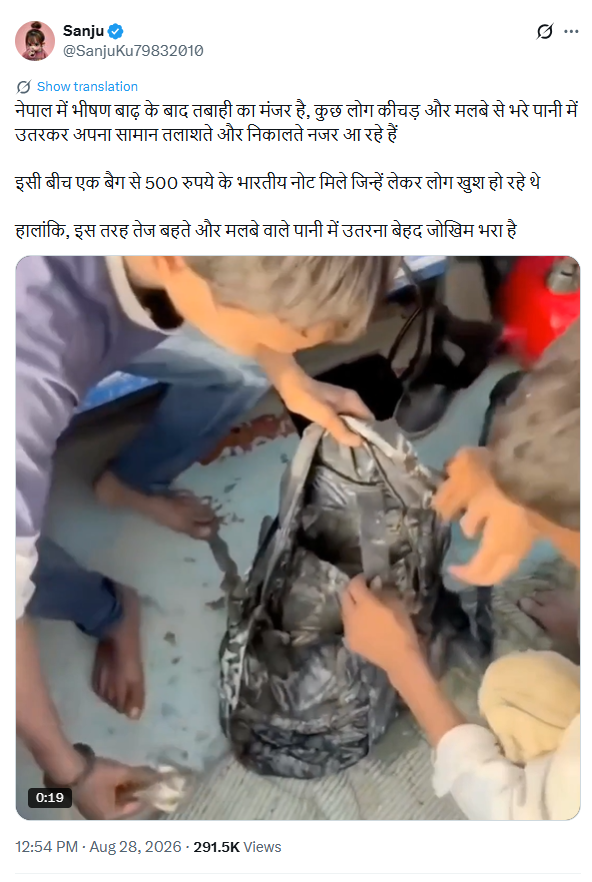
A video is going viral on social media with the claim that ₹500 Indian currency notes were found inside a bag during the floods in Nepal. A research by CyberPeace’s research wing found that the video is not from the recent floods in Nepal, but from Vrindavan in Uttar Pradesh. The video was uploaded on July 14 by an Instagram creator on their account. The 30-second video shows people travelling in a boat finding a bag floating in the water, from which several ₹500 currency notes are pulled out.
Claim:
The video has been shared on X with a caption claiming that Nepal is witnessing widespread destruction following severe floods, with people seen wading through muddy, debris-filled water to search for and recover their belongings. The caption further claims that people found a bag containing ₹500 Indian currency notes and were seen rejoicing over the discovery. It also cautions that entering fast-flowing, debris-filled floodwater is extremely dangerous.
https://x.com/SanjuKu79832010/status/2093238274206887946
Fact Check:
To verify the viral video claiming that a bag containing ₹500 Indian currency notes was found during the floods in Nepal, we conducted a reverse image search using keyframes from the footage. The search led us to a video uploaded on the Instagram account ‘parshuram_676’ on July 14, 2024.
https://www.instagram.com/p/Daw7aYJAjoc/

Additionally, we found the same boat seen in the viral video in several other videos uploaded on the same Instagram account.
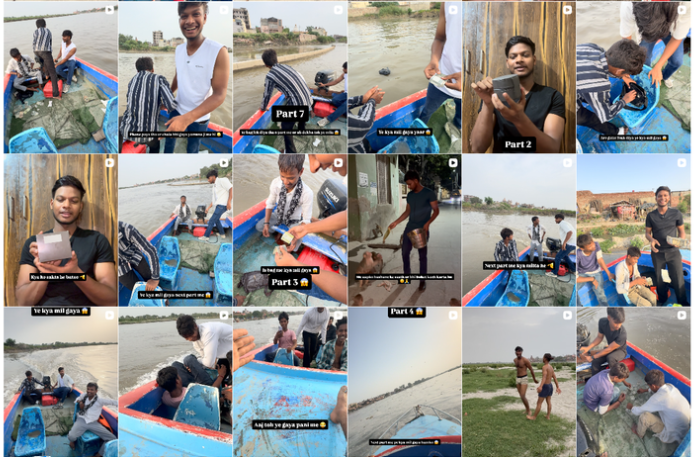
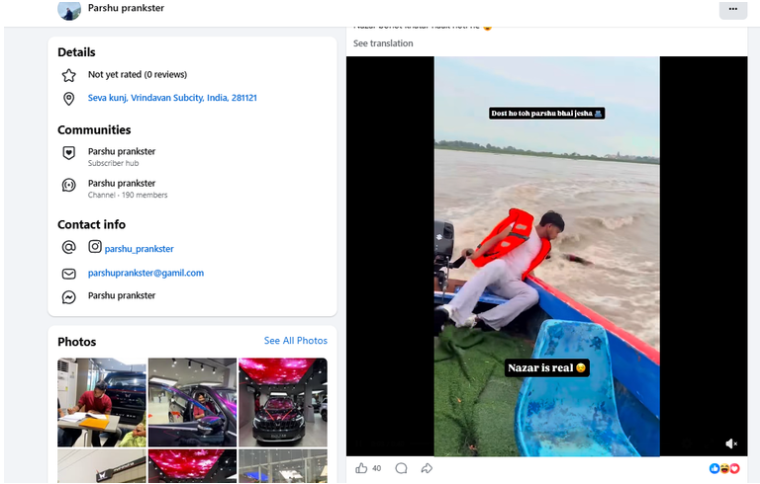
Not only that, we also found several videos with visuals similar to those in the viral video uploaded on the same video creator’s Facebook account. The information provided on the Facebook account also lists Vrindavan, Uttar Pradesh, as the location.
https://www.facebook.com/profile.php?id=61567184794045
Conclusion:
The evidence gathered during our research clearly establishes that the video being circulated with the claim that ₹500 Indian currency notes were found inside a bag during the floods in Nepal was actually filmed by a video creator in Vrindavan, Uttar Pradesh.

Related Blogs

The Illusion of Digital Serenity
In the age of technology, our email accounts have turned into overcrowded spaces, full of newsletters, special offers, and unwanted updates. To most, the presence of an "unsubscribe" link brings a minor feeling of empowerment, a chance to declutter and restore digital serenity. Yet behind this harmless-seeming tool lurks a developing cybersecurity threat. Recent research and expert discussions indicate that the "unsubscribe" button is being used by cybercriminals to carry out phishing campaigns, confirm active email accounts, and distribute malware. This new threat not only undermines individual users but also has wider implications for trust, behaviour, and governance in cyberspace.
Exploiting User Behaviour
The main challenge is the manipulation of user behaviour. Cyber thieves have learned to analyse typical user habits, most notably the instinctive process of unsubscribing from spam mail. Taking advantage of this, they now place criminal codes in emails that pose as real subscription programs. These codes may redirect traffic to fake websites that attempt to steal credentials, force the installation of malicious code, or merely count the click as verification that the recipient's email address is valid. Once confirmed, these addresses tend to be resold on the dark web or included in additional spam lists, further elevating the threat of subsequent attacks.
A Social Engineering Trap
This type of cyber deception is a prime example of social engineering, where the weakest link in the security chain ends up being the human factor. In the same way, misinformation campaigns take advantage of cognitive biases such as confirmation or familiarity, and these unsubscribe traps exploit user convenience and habits. The bait is so simple, and that is exactly what makes it work. Someone attempting to combat spam may unknowingly walk into a sophisticated cyber threat. Unlike phishing messages impersonating banks or government agencies, which tend to elicit suspicion, spoofed unsubscribe links are integrated into regular digital habits, making them more difficult to recognise and resist.
Professional Disguise, Malicious Intent
Technical analysis determines that most of these messages come from suspicious domains or spoofed versions of valid ones, like "@offers-zomato.ru" in place of the authentic "@zomato.com." The appearance of the email looks professional, complete with logos and styling copied from reputable businesses. But behind the HTML styling lies redirection code and obfuscated scripts with a very different agenda. At times, users are redirected to sites that mimic login pages or questionnaire forms, capturing sensitive information under the guise of email preference management.
Beyond the Inbox: Broader Consequences
The consequences of this attack go beyond the individual user. The compromise of a personal email account can be used to carry out more extensive spamming campaigns, engage in botnets, or even execute identity theft. Furthermore, the compromised devices may become entry points for ransomware attacks or espionage campaigns, particularly if the individual works within sensitive sectors such as finance, defence, or healthcare. In this context, what appears to be a personal lapse becomes a national security risk. This is why the issue posed by the weaponised unsubscribe button must be considered not just as a cybersecurity risk but also as a policy and public awareness issue.
Platform Responsibility
Platform responsibility is yet another important aspect. Email service providers such as Gmail, Outlook, and ProtonMail do have native unsubscribe capabilities, under the List-Unsubscribe header mechanism. These tools enable users to remove themselves from valid mailing lists safely without engaging with the original email content. Yet many users do not know about these safer options and instead resort to in-body unsubscribe links that are easier to find but risky. To that extent, email platforms need to do more not only to enhance backend security but also to steer user actions through simple interfaces, safety messages, and digital hygiene alerts.
Education as a Defence
Education plays a central role in mitigation. Just as cyber hygiene campaigns have been launched to teach users not to click on suspicious links or download unknown attachments, similar efforts are needed to highlight the risks associated with casual unsubscribing. Cybersecurity literacy must evolve to match changing threat patterns. Rather than only targeting clearly malicious activity, awareness campaigns should start tackling deceptive tactics that disguise themselves as beneficial, including unsubscribe traps or simulated customer support conversations. Partnerships between public and private institutions might be vital in helping with this by leveraging their resources for mass digital education.
Practical Safeguards for Users
Users are advised to always check the sender's domain before clicking any link, avoid unknown promotional emails, and hover over any link to preview its true destination. Rather than clicking "unsubscribe," users can simply mark such emails as spam or junk so that their email providers can automatically filter similar messages in the future. For enhanced security, embracing mechanisms such as mail client sandboxing, two-factor authentication (2FA) support, and alias email addresses for sign-ups can also help create layered defences.
Policy and Regulatory Implications
Policy implications are also significant. Governments and data protection regulators must study the increasing misuse of misleading unsubscribe hyperlinks under electronic communication and consent laws. In India, the new Digital Personal Data Protection Act, 2023 (DPDPA), provides a legislative framework to counter such deceptive practices, especially under the principles of legitimate processing and purpose limitation. The law requires that the processing of data should be transparent and fair, a requirement that malicious emails obviously breach. Regulatory agencies like CERT-In can also release periodic notifications warning users against such trends as part of their charter to encourage secure digital practices.
The Trust Deficit
The vulnerability also relates to broader issues of trust in digital infrastructure. When widely used tools such as an unsubscribe feature become points of exploitation, user trust in digital platforms erodes. Such a trust deficit can lead to generalised distrust of email systems, digital communication, and even legitimate marketing. Restoring and maintaining such trust demands a unified response that includes technical measures, user education, and regulatory action.
Conclusion: Inbox Hygiene with Caution
The "unsubscribe button trap" is a parable of the modern age. It illustrates how mundane digital interactions, when manipulated, can do great damage not only to individual users but also to the larger ecosystem of online security and trust. As cyber-attacks grow increasingly psychologically advanced and behaviorally focused, our response must similarly become more sophisticated, interdisciplinary, and user-driven. Getting your inbox in order should never involve putting yourself in cyber danger. But as things stand, even that basic task requires caution, context, and clear thinking.

Executive Summary
Following the tragic cruise accident at Bargi Dam in Jabalpur, a heartbreaking image of a woman lying unconscious in a river with a child resting on top of her has gone viral on social media. Users are claiming that the picture shows victims of the recent Bargi Dam accident. Research by CyberPeace Research Wing found that the viral claim is false. The circulating image was created using AI (Artificial Intelligence) and is now being misleadingly linked to the real tragedy. However, reports indicate that a similar real-life image of a mother and child did emerge after the accident.
Claim
An X user shared the viral image on May 1, 2026, claiming that despite wearing a life jacket, the mother lost her life while trying to save her child. The emotional post praised mothers’ sacrifice and linked the image directly to the Bargi Dam cruise mishap An X user shared the viral image on May 1, 2026, claiming that despite wearing a life jacket, the mother lost her life while trying to save her child. The emotional post praised mothers’ sacrifice and linked the image directly to the Bargi Dam cruise mishap
Fact Check
To verify the claim, we searched relevant keywords on Google but found no credible news reports connecting the viral image to the Bargi Dam accident. A closer examination of the image revealed multiple visual inconsistencies. The hands of the woman and child appear unnaturally merged at one point, while the woman’s eyebrows seem split into two sections. Such distortions are common indicators of AI-generated imagery.
We then analyzed the picture using AI detection tool Hive Moderation, which estimated nearly a 90% probability that the image was AI-generated.

During the research , we also found a clarification post from the official Facebook account of the Jabalpur District Collector, who stated that the viral image was AI-generated or sourced elsewhere and had no connection with the Bargi cruise accident.

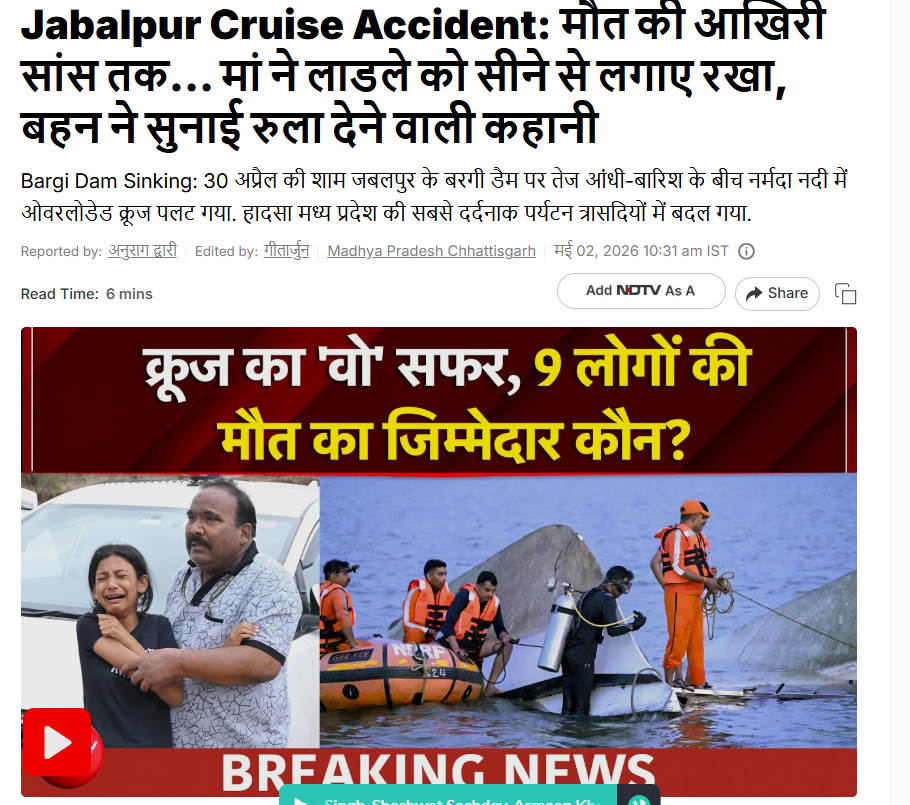
According to a report published by NDTV on May 2, 2026, the accident occurred on April 30 near Khamaria Island when an overloaded tourist cruise capsized amid strong winds, heavy rain, and rising waves. At least nine people died, while 28 others were rescued.
Conclusion
Our research confirms that the viral mother-child image being linked to the Bargi Dam tragedy is fake. The picture was created using AI and falsely circulated in connection with the real cruise accident.
Introduction
The Digital Personal Data Protection (DPDP) Act 2023 of India is a significant transition for privacy legislation in this age of digital data. A key element of this new law is a requirement for organisations to have appropriate, user-friendly consent mechanisms in place for their customers so that collection, use or removal of an individual's personal data occurs in a clear and compliant manner. As a means of putting this requirement into practice, the Ministry of Electronics and Information Technology (MeitY) issued a comprehensive Business Requirements Document (BRD) in June 2025 to guide organizations, as well as Consent Managers, on how to create a Consent Management System (CMS). This document establishes the technical and functional framework by which organizations and individuals (Data Principals) will exercise control over the way their data is gathered, used and removed.
Understanding the BRD and Its Purpose
BRD represents an optional guide created as part of the "Code for Consent" programme run by MeitY in India. The purpose of the BRD is to provide guidance to startups, digital platforms and other enterprises on how to create a technology system that supports management of user consent per the requirements of the DPDP Act. Although the contents of the BRD do not carry any legal weight, it lays out a clear path for organisations to create their own consent mechanisms using best practices that align with the principles of transparency, accountability and purpose limitation in the DPDP Act.
The goal is threefold:
- Enable complete consent lifecycle management from collection to withdrawal.
- Empower individuals to manage their consents actively and transparently.
- Support data fiduciaries and processors with an interoperable system that ensures compliance.
Key Components of the Consent Management System
The BRD proposes the development of a modular Consent Management System (CMS) that provides users with secure APIs and user-friendly interfaces. This system will allow for a variety of features and modules, including:
- Consent Lifecycle Management – consent should be specific, informed and tied to an explicit purpose. The CMS will manage the collection, validation, renewal, updates and withdrawal of consent. Each transaction of consent will create a tamper-proof “consent artifact,” which will include the timestamp of creation as well as an ID identifying the purpose for which it was given.
- User Dashboard – A user will be able to view and modify the status of their active, expired or withdrawn consent and revoke access at any time via the multilingual user-friendly interface. This would make the system accessible to people from different regions and cultures.
- Notification Engine – The CMS will automatically notify users, fiduciaries and processors of any action taken with respect to consent, in order to ensure real-time updates and accountability.
- Grievance Redress Mechanism – The CMS will include a complaints mechanism that allows users to submit complaints related to the misuse of consent or the denial of their rights. This will enable tracking of the complaint resolution status, and will allow for escalation if necessary.
- Audit and Logging – As part of the CMS's internal controls for compliance and regulatory purposes, the CMS must maintain an immutable record of every instance of consent for auditing and regulatory review. The records must be encrypted, time-stamped, and linked permanently to a user and purpose ID.
- Cookie Consent Management – A separate module will enable users to manage cookie consent for websites separately from any other consents.
Roles and Responsibilities
The BRD identifies the various stakeholders involved and their associated responsibilities.
- Data Principals (Users): The user has full authority to give, withhold, amend, or revoke their consent for the use of their personal data, at any time.
- Data Fiduciaries (Companies): Companies (the fiduciaries) must collect the data principals' consents for each particular reason and must only begin processing a data subject's personal data after validating that consent through the CMS. Companies must also provide the data principals with any information or notifications needed, as well as how to resolve their complaints.
- Data Processors: Data Processors must strictly adhere to the consent stated in the CMS, and Data Processors may only process personal data on behalf of the Data Fiduciary.
- Consent Managers: The Consent Managers are independent entities that are registered with the Data Protection Board. They are responsible for administering the CMS, allowing users to manage their consent across different platforms.
This layered structure ensures transparency and shared responsibility for the consent ecosystem.
Technical Specifications and Security
The following principles of the DPDP Act must be followed to remain compliant with the DPDP Act.
- End-to-End Encryption: All exchanges of data with users must be encrypted using a minimum of TSL 1.3 and also encrypting within that standard.
- API-First Approach: API’s will be utilized to validate, withdraw and update consent in a secured manner using external sources.
- Interoperability/Accessibility: The CMS needs to allow for users to utilize several different languages (e.g. Hindi, Tamil, etc.) and be appropriate for use with various types of mobile devices and different abilities.
- Data Retention Policy: The CMS should also include automatic deletion of consent data (when the consent has expired or has been withdrawn) in order to maintain compliance with data retention limits.
Legal Relevance and Timelines
While the BRD itself is not enforceable, it is directly aligned with the upcoming enforcement of the DPDP Act, 2023. The Act was passed in August 2023 but is expected to come into effect in stages, once officially notified by the central government. Draft implementation rules, including those defining the role of Consent Managers, were released for public consultation in early 2025.
For businesses, the BRD serves as an early compliance tool—offering both a conceptual roadmap and technical framework to prepare before the law is enforced. Legal experts have described it as a critical resource for aligning data governance systems with emerging regulatory expectations.
Implications for Businesses
Organizations that collect and process user data will be required to overhaul their consent workflows:
- No blanket consents: Every data processing activity must have explicit, separate consent.
- Granular audit logs: Companies must maintain tamper-proof logs for every consent action.
- Integration readiness: Enterprises need to integrate their platforms with third-party or in-house CMS platforms via the specified APIs.
- Grievance redress and user support: Systems must be in place to handle complaints and withdrawal requests in a timely, verifiable manner.
Failing to comply once the DPDP Act is in force may expose companies to penalties, reputational damage, and potential regulatory action.
Conclusion
The BRD on Consent Management of India is a forward-looking initiative laying a technological framework that is an essential component of the DPDP Act concerning user consent; Although not yet a legal document, it provides an extent of going into all the necessary discipline for companies to prepare. As data protection grows in importance, developing consent mechanisms based on security, transparency, and the needs of the user is no longer just a regulatory requirement, but rather a requirement for the development of trust. This is the time for businesses to establish or implement CMS solutions that support this objective to be better equipped for the future of data governance in India.
References
- https://d38ibwa0xdgwxx.cloudfront.net/whatsnew-docs/8d5409f5-d26c-4697-b10e-5f6fb2d583ef.pdf
- https://ssrana.in/articles/ministry-releases-business-requirement-document-for-consent-management-under-the-dpdp-act-2023/
- https://dpo-india.com/Blogs/consent-dpdpa/
- https://corporate.cyrilamarchandblogs.com/2025/06/the-ghost-in-the-machine-the-recent-business-requirement-document-on-consent/
- https://www.mondaq.com/india/privacy-protection/1660964/analysis-of-the-business-requirement-document-for-consent-management-system
