
#FactCheck-AI-generated image falsely shared as an old photograph of PM Modi and Amit Shah
Executive Summary
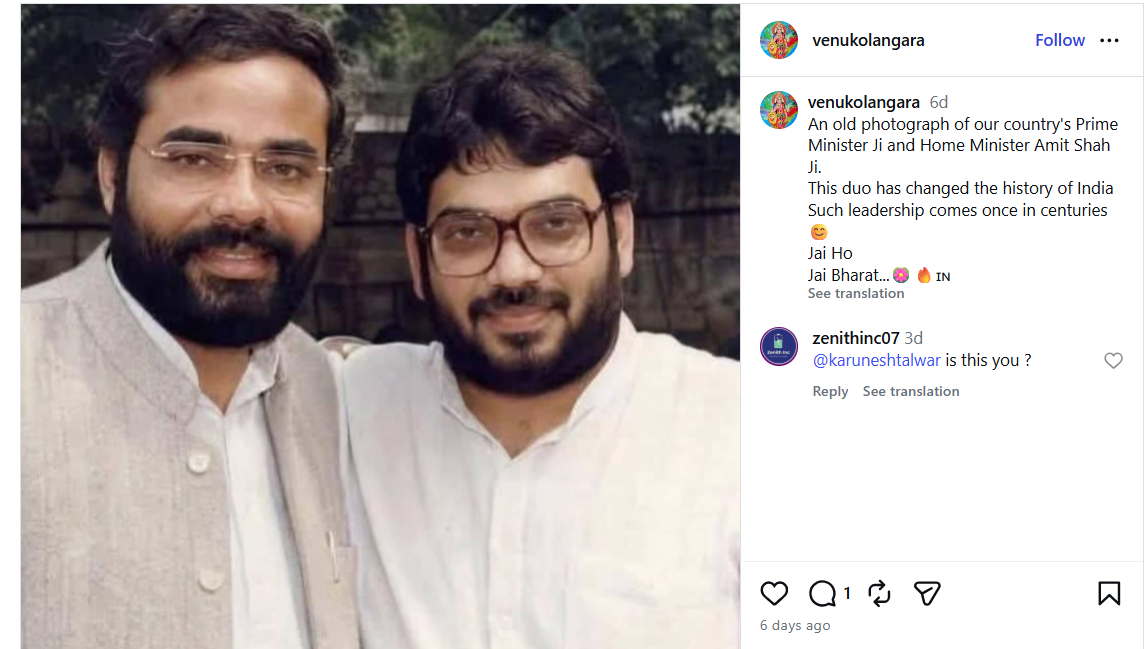
An image featuring Prime Minister Narendra Modi and Union Home Minister Amit Shah is being widely shared on social media. The image is being circulated with the claim that it is a decades-old photograph of the two leaders. A research by the Research Wing of CyberPeace found that the viral image is not authentic and was generated using artificial intelligence (AI).
Claim
On August 14, 2026, a user shared the viral image on Instagram with the caption: “An old photograph of our country's Prime Minister Ji and Home Minister Amit Shah Ji. This duo has changed the history of India. Such leadership comes once in centuries.”
https://www.instagram.com/p/DcAsngdyjQ0/
Fact Check:
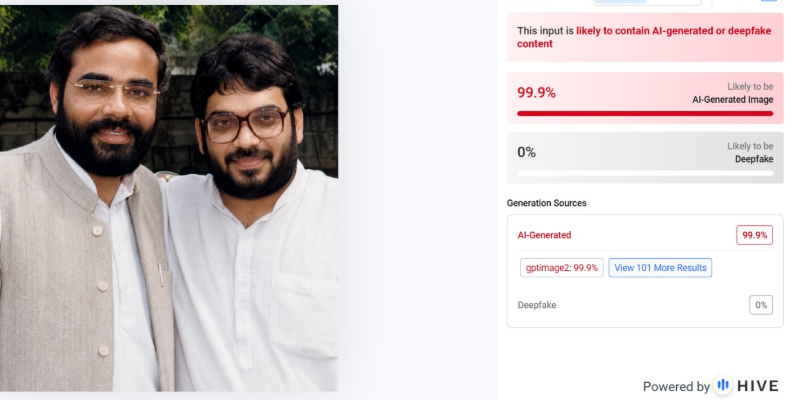
On closely examining the viral image, we noticed several visual inconsistencies that raised suspicion that it may have been AI-generated. We subsequently analysed the image using Hive Moderation, an AI-detection tool. The tool indicated a 99 per cent probability that the image was AI-generated.
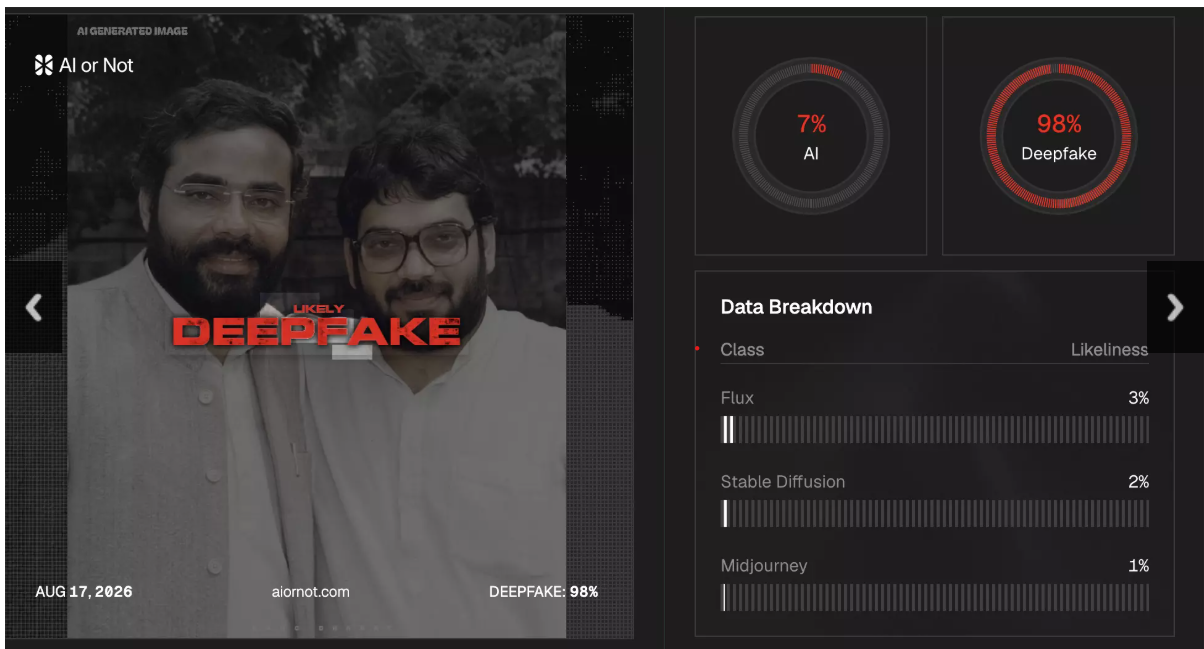
As part of the next stage of our research, we analysed the viral image using another AI-detection tool, AI or Not. The tool's results indicated a 98 per cent probability that the image was AI-generated.
Conclusion:
The viral image being circulated as a decades-old photograph of Prime Minister Narendra Modi and Union Home Minister Amit Shah is fake. Our research found that the image was generated using AI and is being falsely presented as a genuine old photograph.

Related Blogs
Introduction
A policy, no matter how artfully conceived, is like a timeless idiom, its truth self-evident, its purpose undeniable, standing in silent witness before those it vows to protect, yet trapped in the stillness of inaction, where every moment of delay erodes the very justice it was meant to serve. This is the case of the Digital Personal Data Protection Act, 2023, which holds in its promise a resolution to all the issues related to data protection and a protection framework at par with GDPR and Global Best Practices. While debates on its substantive efficacy are inevitable, its execution has emerged as a site of acute contention. The roll-out and the decision-making have been making headlines since late July on various fronts. The government is being questioned by industry stakeholders, media and independent analysts on certain grounds, be it “slow policy execution”, “centralisation of power” or “arbitrary amendments”. The act is now entrenched in a never-ending dilemma of competing interests under the DPDP Act.
The change to the Right to Information Act (RTI), 2005, made possible by Section 44(3) of the DPDP Act, has become a focal point of debate. This amendment is viewed by some as an attack on weakening the hard-won transparency architecture of Indian democracy by substituting an absolute exemption for personal information for the “public interest override” in Section 8(1)(j) of the RTI Act.
The Lag Ledger: Tracking the Delays in DPDP Enforcement
As per a news report of July 28, 2025, the Parliamentary Standing Committee on Information and Communications Technology has expressed its concern over the delayed implementation and has urged the Ministry of Electronics and Information Technology (MeitY) to ensure that data privacy is adequately ensured in the nation. In the report submitted to the Lok Sabha on July 24, the committee reviewed the government’s reaction to the previous recommendations and concluded that MeitY had only been able to hold nine consultations and twenty awareness workshops about the Draft DPDP Rules, 2025. In addition, four brainstorming sessions with academic specialists were conducted to examine the needs for research and development. The ministry acknowledges that this is a specialised field that urgently needs industrial involvement. Another news report dated 30th July, 2025, of a day-long consultation held where representatives from civil society groups, campaigns, social movements, senior lawyers, retired judges, journalists, and lawmakers participated on the contentious and chilling effects of the Draft Rules that were notified in January this year. The organisers said in a press statement the DPDP Act may have a negative impact on the freedom of the press and people’s right to information and the activists, journalists, attorneys, political parties, groups and organisations “who collect, analyse, and disseminate critical information as they become ‘data fiduciaries’ under the law.”
The DPDP Act has thus been caught up in an uncomfortable paradox: praised as a significant legislative achievement for India’s digital future, but caught in a transitional phase between enactment and enforcement, where every day not only postpones protection but also feeds worries about the dwindling amount of room for accountability and transparency.
The Muzzling Effect: Diluting Whistleblower Protections
The DPDP framework raises a number of subtle but significant issues, one of which is the possibility that it would weaken safeguards for whistleblowers. Critics argue that the Act runs the risk of trapping journalists, activists, and public interest actors who handle sensitive material while exposing wrongdoing because it expands the definition of “personal data” and places strict compliance requirements on “data fiduciaries.”One of the most important checks on state overreach may be silenced if those who speak truth to power are subject to legal retaliation in the absence of clear exclusions of robust public-interest protections.
Noted lawyer Prashant Bhushan has criticised the law for failing to protect whistleblowers, warning that “If someone exposes corruption and names officials, they could now be prosecuted for violating the DPDP Act.”
Consent Management under the DPDP Act
In June 2025, the National e-Governance Division (NeGD) under MeitY released a Business Requirement Document (BRD) for developing consent management systems under the DPDP Act, 2023. The document supports the idea of “Consent Manager”, which acts as a single point of contact between Data Principals and Data Fiduciaries. This idea is fundamental to the Act, which is now being operationalised with the help of MeitY’s “Code for Consent: The DPDP Innovation Challenge.” The government has established a collaborative ecosystem to construct consent management systems (CMS) that can serve as a single, standardised interface between Data Principals and Data Fiduciaries by choosing six distinct entities, such as Jio Platforms, IDfy, and Zoop. Such a framework could enable people to have meaningful control over their personal data, lessen consent fatigue, and move India’s consent architecture closer to international standards if it is implemented precisely and transparently.
There is no debate to the importance of this development however, there are various concerns associated with this advancement that must be considered. Although effective, a centralised consent management system may end up being a single point of failure in terms of political overreach and technical cybersecurity flaws. Concerns are raised over the concentration of power over the framing, seeking, and recording of consent when big corporate entities like Jio are chosen as key innovators. Critics contend that the organisations responsible for generating revenue from user data should not be given the responsibility for designing the gatekeeping systems. Furthermore, the CMS can create opaque channels for data access, compromising user autonomy and whistleblower protections, in the absence of strong safeguards, transparency mechanisms and independent oversight.
Conclusion
Despite being hailed as a turning point in India’s digital governance, the DPDP Act is still stuck in a delayed and unequal transition from promise to reality. Its goals are indisputable, but so are the conundrum it poses to accountability, openness, and civil liberties. Every delay increases public mistrust, and every safeguard that remains unsolved. The true test of a policy intended to safeguard the digital rights of millions lies not in how it was drafted, but in the integrity, pace, and transparency with which it is to be implemented. In the digital age, the true cost of delay is measured not in time, but in trust. CyberPeace calls for transparent, inclusive, and timely execution that balances innovation with the protection of digital rights.
References
- https://www.storyboard18.com/how-it-works/parliamentary-committee-raises-concern-with-meity-over-dpdp-act-implementation-lag-77105.htm
- https://thewire.in/law/excessive-centralisation-of-power-lawyers-activists-journalists-mps-express-fear-on-dpdp-act
- https://www.medianama.com/2025/08/223-jio-idfy-meity-consent-management-systems-dpdpa/
- https://www.downtoearth.org.in/governance/centre-refuses-to-amend-dpdp-act-to-protect-journalists-whistleblowers-and-rti-activists

Introduction
Have you ever wondered how the internet works? Yes, there are screens and wires, but what’s going on beneath the surface? Every time you open a website, send an email, chat on messaging apps, or stream movies, you’re relying on something you probably don’t think about: the TCP/IP protocol suite. Without it, the internet as we know it wouldn’t exist. Let’s take a look at why this unassuming set of rules allows us to connect to anyone anywhere in the world.
The Problem: Networks That Couldn't Talk to Each Other
The internet is widely called a network of networks. A network is a group of devices that are connected and can share data with each other.
Researchers and governments began building early computer networks in the 1960s and 70s. But as the Cold War intensified, the U.S. military felt the need to establish a robust data-sharing infrastructure through interconnected networks that could withstand attacks. At the time, each network had different standards and protocols, which meant getting networks to communicate wasn’t easy or efficient. One network would have to be subsumed into another. This would lead to major problems in the reliability of data relay, flexibility of including more nodes, scalability of the interconnected network, and innovation.
The Breakthrough: Open Architecture Networking
This changed in the 1970s, when Bob Kahn proposed the concept of open architecture networking. It was a simple but revolutionary idea. He envisioned a system where all networks could talk to each other as equals. In this conceptualisation, all networks, even though unique in design and interface, could connect as peers to facilitate end-to-end communication. End-to-end communication helps deliver data between the source and destination without relying on intermediate nodes to control or modify it. This helps to make data relay more reliable and less prone to errors.
Along with Vint Cerf, he developed a network protocol, the TCP/IP suite, that would go on to enable different networks across satellite, wired, and non-wired domains to communicate with one another.
What Is TCP/IP?
TCP/IP stands for Transmission Control Protocol / Internet Protocol. It’s a set of communication rules that allow computers and devices to exchange information across different networks.
It’s powerful because:
- Layered and open architecture: Each function (like data delivery or routing) is handled by a specific layer. This modular design makes it easy to build new technologies like the World Wide Web or streaming services on top of it.
- Decentralisation: There's no single point of control. Any device can connect to another across the internet, making it scalable and resilient.
- Standardisation: TCP/IP works across all kinds of hardware and operating systems, making it truly universal.
The Core Components
- TCP (Transmission Control Protocol): Ensures that data is delivered accurately and in order. If any piece is lost or duplicated, TCP handles it.
- IP (Internet Protocol): Handles addressing and routing. It decides where each packet of data should go and how it gets there.
- UDP (User Datagram Protocol): A lightweight version of TCP, used when speed is more important than accuracy, such as for video calls or online gaming.
Why It Matters
The TCP/IP protocol suite introduced a set of standardised guidelines that enable networks to communicate, thereby laying the foundation of the Internet. It has made the Internet global, open, reliable, interoperable, scalable, and resilient, — features because of which the Internet has come to become the backbone of modern communication systems. So the next time you open a browser or send a message, remember: it’s TCP/IP quietly making it all possible.
References
- https://www.techtarget.com/searchnetworking/definition/ARPANET
- https://www.internetsociety.org/internet/history-internet/brief-history-internet/
- https://www.geeksforgeeks.org/tcp-ip-model/
- https://www.oreilly.com/library/view/tcpip-network-administration/0596002971/ch01.html

Executive Summary
A video is being widely circulated on social media by Pakistani users as propaganda against the Indian Army. In the video, a man can be seen being beaten by a group of women in the middle of a road. Based on the viral video, it is being claimed that in Phuket, Thailand, Lieutenant General Rajiv Kiran Sahni, DG EME of the Indian Army, was thrashed by "ladyboys" after he allegedly harassed them and refused to pay the full amount.
Research by the CyberPeace Research Wing found the viral claim to be misleading and baseless. The viral video has no connection with Lieutenant General Rajiv Kiran Sahni (DG EME) of the Indian Army. According to credible media reports obtained during the research, this incident took place in Pattaya, Thailand, in December 2025, where a dispute over payment allegedly broke out between an Indian tourist named Raj Jasuja and some transgender women (ladyboys). Subsequently, the tourist was assaulted.
Claim:
A Pakistani website shared the viral video claiming that Indian Army Lieutenant General Rajiv Kiran Sahni (DG EME) was publicly thrashed in Phuket, Thailand, by ladyboys after he harassed them and refused to pay the full amount.
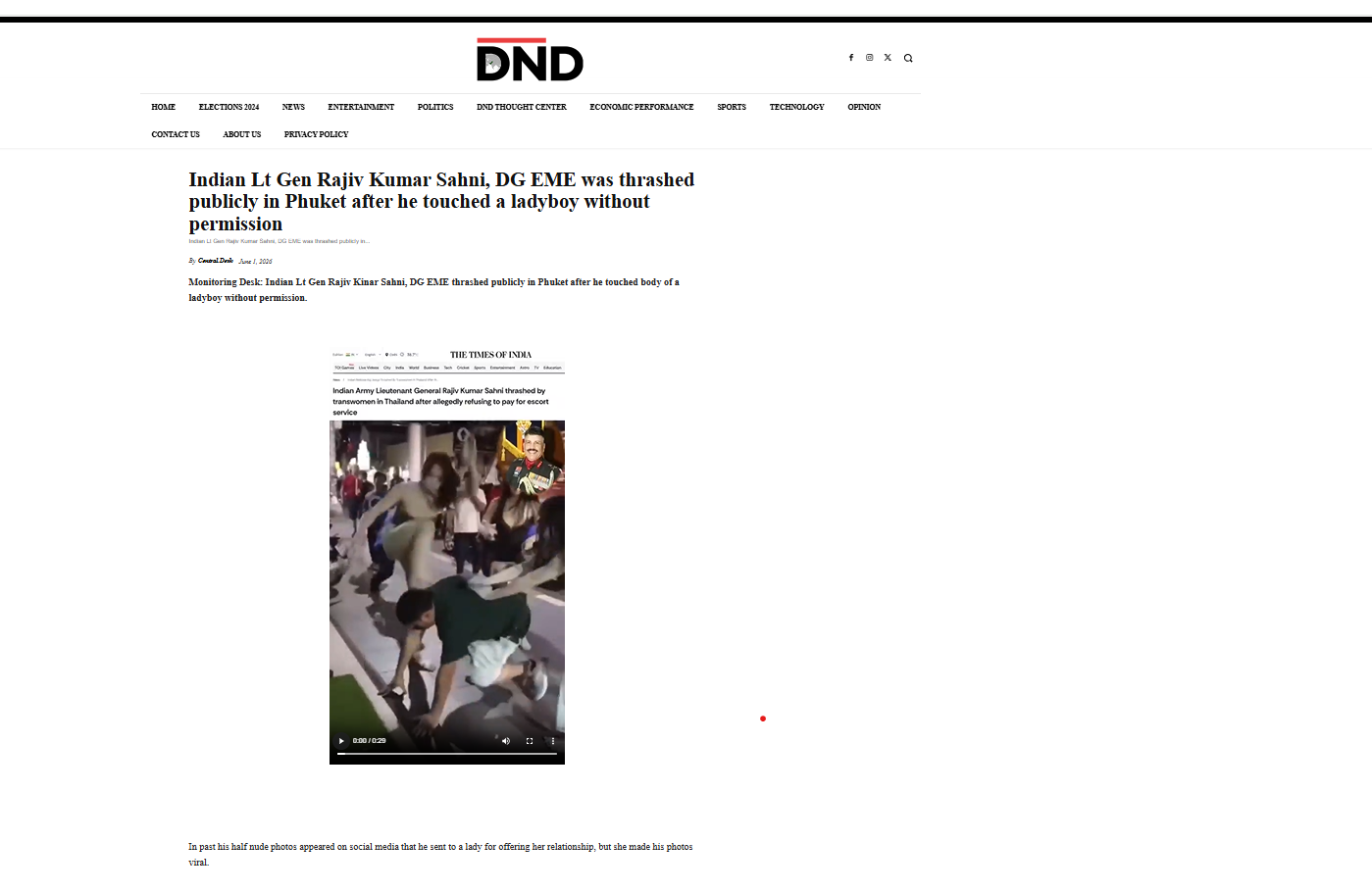
Meanwhile, on the social site X (formerly Twitter), a user shared the viral video and wrote, “Indian Army Lt Gen Rajiv Kiran Sahni, DG EME, thrashed by Thai ladyboys in Phuket after harassing them and refusing to pay full amount. They think they can bully and oppress people everywhere like Christians in Manipur, but Thailand showed them the reality.”
https://x.com/uthmanrumi2025/status/2061554209036898369

Fact Check:
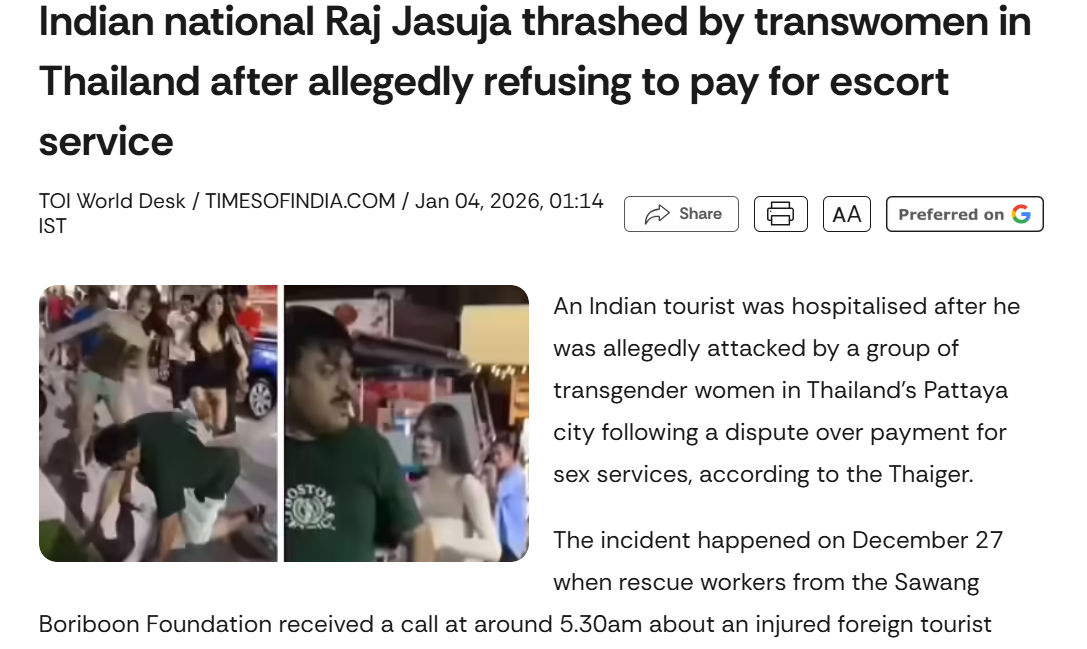
To investigate the claim made with the viral video, we conducted a reverse search of the video's keyframes. During this process, we found a report by The Times of India. The report, published on January 4, 2026, stated that “According to 'The Thaiger', an Indian tourist was hospitalized in Pattaya, Thailand. It is alleged that a group of transgender women attacked him following a dispute over payment for escort services. The incident occurred on December 27, when rescue workers from the Sawang Boriboon Foundation received a call around 5:30 AM regarding an injured foreign tourist near the beachside entrance of Walking Street. According to the rescue workers who found the victim, he was identified as 52-year-old Indian national Raj Jasuja. Injury marks were clearly visible on his face and the back of his head. He was given first aid before being taken to the hospital for further treatment. A 19-year-old Thai witness, Pongpol Boonchid, told police and rescue workers that the fight began when Raj was seen arguing with a transgender sex worker near the entry gate of Walking Street. The row escalated as both began chasing and hitting each other. According to the witness, the transgender woman then called several of her friends, who arrived and collectively attacked the Indian tourist. It is believed the fight started over money, as the tourist reportedly did not pay the full amount agreed upon for the services. Raj has not made any public statement regarding the incident.”
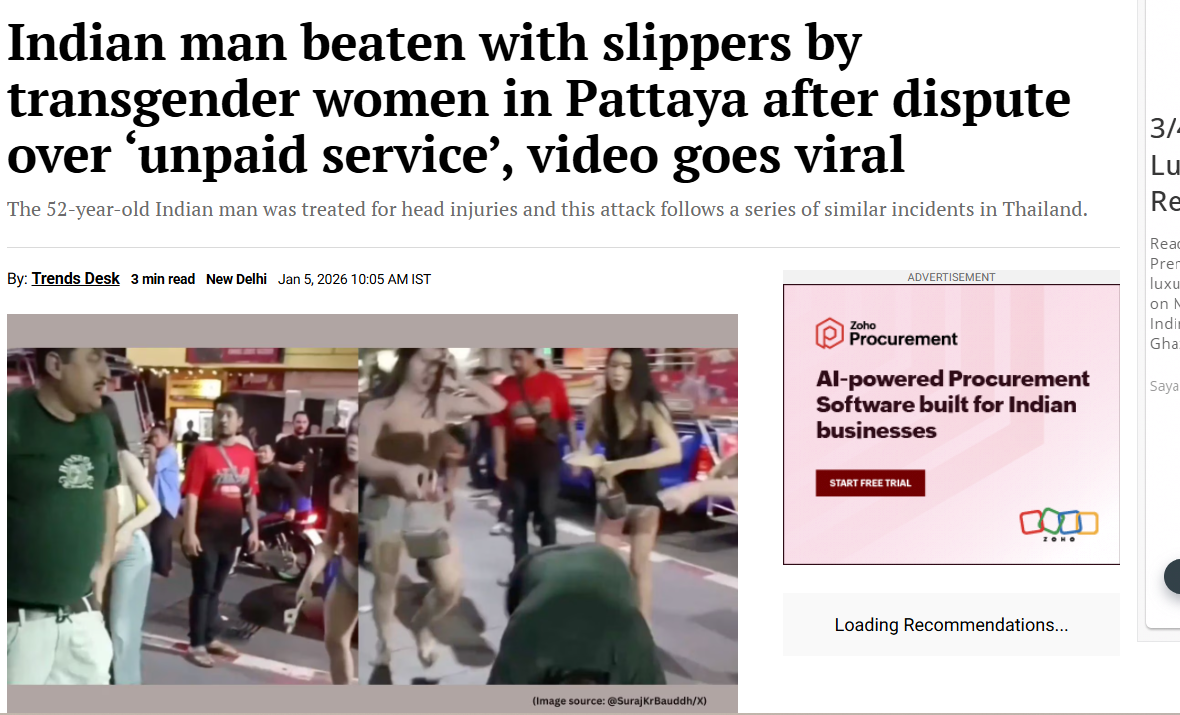
Furthermore, another report by The Indian Express, published on January 5, 2026, stated regarding the incident: “A group of transgender women allegedly beat up an Indian tourist in Pattaya, Thailand, according to a local media report. The dispute reportedly arose over non-payment of fees for sex services. In a viral video from December 27, three transgender women are seen hitting the 52-year-old man with slippers. The situation worsened when the man refused to pay the requested amount and tried to leave the spot in a car. The transgender women accused the man of not paying. Subsequently, he was allegedly kicked and punched, after which emergency responders intervened. According to a report by 'The Thaiger', the man suffered injuries to his face and the back of his head. He was given first aid on the spot and later taken to Pattamaku Hospital for further treatment. A Thai eyewitness told rescue workers that he saw the man arguing with a transgender sex worker near the entrance of the famous 'Walking Street' area. The witness stated that the argument turned into a physical altercation, with both parties reportedly chasing and hitting each other, after which others joined in, turning it into a group attack. According to the report, the witness further claimed the dispute occurred because the Indian tourist allegedly did not pay the full amount fixed for sexual services. Thai police said they would ask the man to file a formal complaint once he fully recovers.”
Conclusion:
Our research found the viral claim to be misleading and baseless. The viral video has no connection with Lieutenant General Rajiv Kiran Sahni (DG EME) of the Indian Army. According to credible media reports, the incident occurred in Pattaya, Thailand, where in December 2025, an Indian tourist named Raj Jasuja had a dispute over payment with some transgender women (ladyboys), leading to the assault.
