
#FactCheck -Fake Viral Poster Falsely Attributes Political Endorsement of Rahul Gandhi to Sachin Tendulkar
Executive Summary
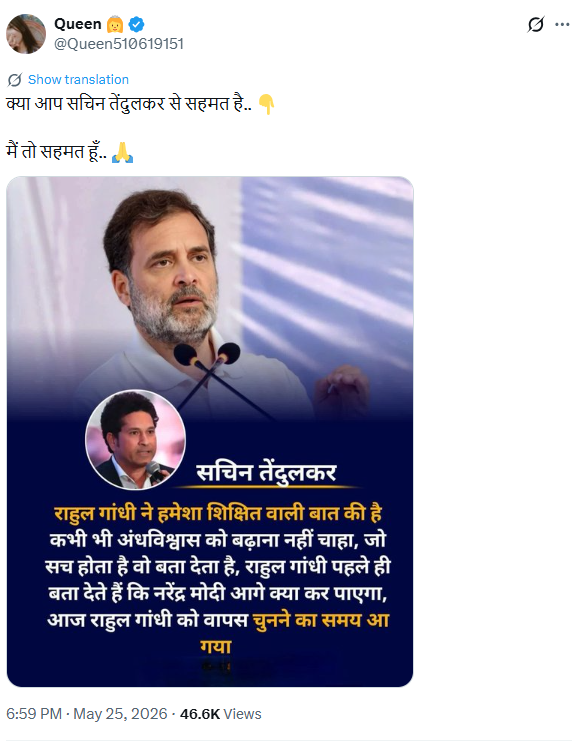
A post claiming that former Indian cricketer Sachin Tendulkar praised Congress leader Rahul Gandhi and urged people to elect him as Prime Minister is being widely circulated on social media.The viral poster falsely attributes a political statement to Sachin Tendulkar, suggesting that he has endorsed Rahul Gandhi for the post of Prime Minister. However, CyberPeace Research Wing research found the claim to be fake. Sachin Tendulkar has not made any such appeal or statement supporting Rahul Gandhi for Prime Minister.
Claim
On X (formerly Twitter), a verified user “Queen” shared a viral poster claiming:“Sachin Tendulkar has always supported education and never promoted superstition. Rahul Gandhi always predicts what Narendra Modi will do next. It is time to choose Rahul Gandhi again.”
Fact Check
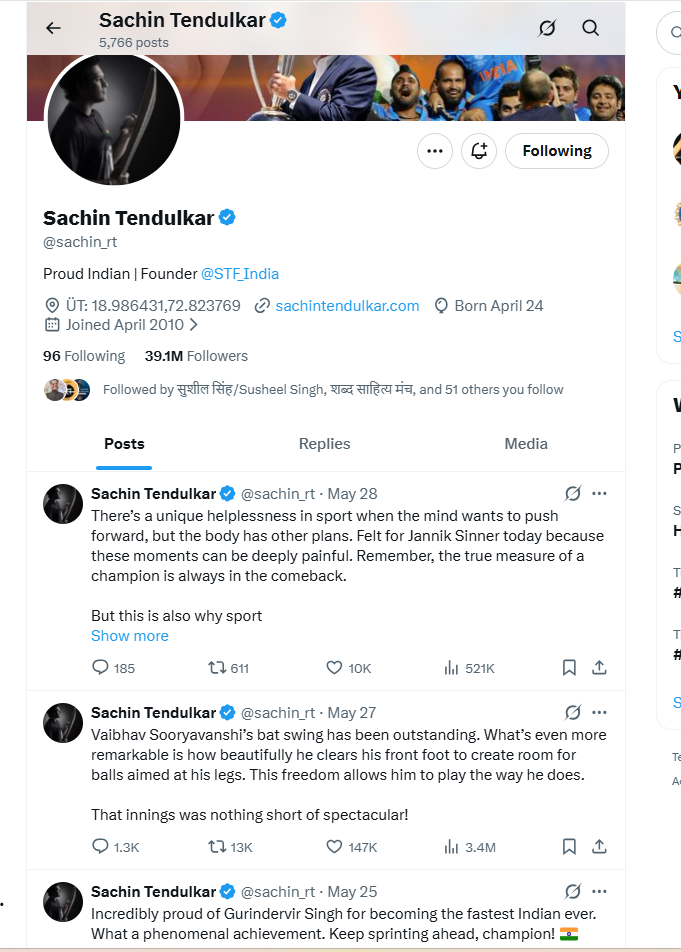
To verify the claim, we first searched for any news reports, interviews, or credible references linking Sachin Tendulkar to such a political statement. However, we found no evidence in any reliable media source or public record suggesting that he made any such remark about Rahul Gandhi or the Prime Ministership. We also reviewed Sachin Tendulkar’s official social media accounts, but found no post, video, or statement endorsing any political leader in this manner.
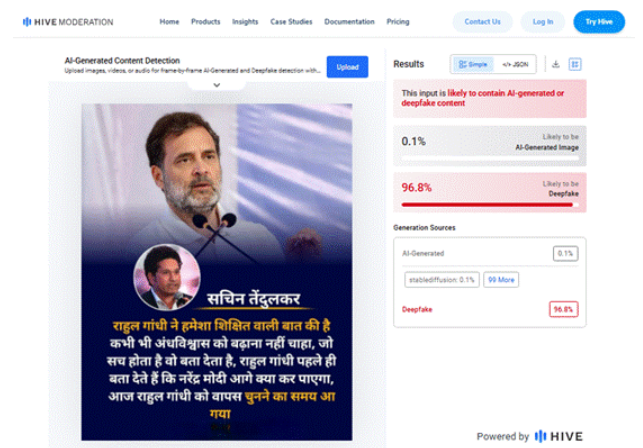
Finally, the viral poster was analysed using the AI detection tool Hive Moderation. The analysis indicated a 96.8% probability that the poster was digitally created or manipulated, suggesting possible AI-generated or edited content.
Conclusion
CyberPeace Research Wing research found the claim to be fake. Sachin Tendulkar has not made any appeal to elect Rahul Gandhi as Prime Minister. The viral poster appears to be digitally fabricated and is being shared to spread misinformation.

Related Blogs

Executive Summary
Following recent escalations between Iran and Israel, where both countries reportedly exchanged missile strikes over the weekend, a video is now circulating on social media claiming to show the latest attacks between the two nations. However, CyberPeace Research Wing research found that the viral video is not related to the recent developments. The footage is actually from a March incident involving reported US-Israeli strikes in Tehran’s Jannat Abad area.
Claim
An X (formerly Twitter) user shared the viral video with the caption:“Israel, ignoring Trump’s advice, has carried out a major retaliatory strike on Tehran, Karaj, Tabriz, and Kermanshah.”
https://x.com/ocjain4/status/2063844698138239357?s=20
The video is being widely shared with claims that it shows recent Iran–Israel missile exchanges following Sunday’s reported attacks.

Fact Check
To verify the claim, we extracted keyframes from the viral video and conducted a reverse image search. The research led us to a post from BBC Persian journalist Ghoncheh Habibiazad’s X account dated 3 March. The video was shared with a caption describing it as showing a strike in Tehran attributed to US-Israeli action.
https://x.com/GhonchehAzad/status/2028632595156598874?s=20

Further verification found the same footage published by Sky News and uploaded on Al Arabiya’s YouTube channel on 3 March 2026. The accompanying descriptions referred to smoke rising from Tehran’s District 5 and near the Hemmat Expressway following the strike.
https://news.sky.com/video/smoke-seen-rising-after-strike-in-tehran-13514731
https://www.youtube.com/shorts/AceFmYiBkuA


Additionally, a comparison using Google Satellite View confirmed that the location seen in the viral video matches the same area shown in the earlier March footage shared by BBC-affiliated reporting.

Conclusion
Our research confirms that the viral video has no connection to the recent Iran–Israel missile exchanges. The footage is from a March incident showing reported strikes in Tehran’s Jannat Abad area, and is being misleadingly shared as a recent escalation between the two countries.

Introduction
February marks the beginning of Valentine’s Week, the time when we transcend from the season of smog to the season of love. This is a time when young people are more active on social media and dating apps with the hope of finding a partner to celebrate the occasion. Dating Apps, in order to capitalise on this occasion, launch special offers and campaigns to attract new users and string on the current users with the aspiration of finding their ideal partner. However, with the growing popularity of online dating, the tactics of cybercriminals have also penetrated this sphere. Scammers are now becoming increasingly sophisticated in manipulating individuals on digital platforms, often engaging in scams, identity theft, and financial fraud under the guise of romance. As love fills the air, netizens must stay vigilant and cautious while searching for a connection online and not fall into a scammer’s trap.
Here Are Some CyberPeace Tips To Avoid Romance Scams
- Recognize Red Flags of Romance Scams:- Online dating has made it easier to connect with people, but it has also become a tool for scammers to exploit the emotions of netizens for financial gain. They create fake profiles, build trust quickly, and then manipulate victims into sending money. Understanding their tactics can help you stay safe.
- Warning Signs of a Romance Scam:- If someone expresses strong feelings too soon, it’s a red flag. Scammers often claim to have fallen in love within days or weeks, despite never meeting in person. They use emotional pressure to create a false sense of connection. Their messages might seem off. Scammers often copy-paste scripted responses, making conversations feel unnatural. Poor grammar, inconsistencies in their stories, or vague answers are warning signs. Asking for money is the biggest red flag. They might have an emergency, a visa issue, or an investment opportunity they want you to help with. No legitimate relationship starts with financial requests.
- Manipulative Tactics Used by Scammers:- Scammers use love bombing to gain trust. They flood you with compliments, calling you their soulmate or destiny. This is meant to make you emotionally attached. They often share fake sob stories. It could be anything ranging from losing a loved one, facing a medical emergency, or even being stuck in a foreign country. These are designed to make you feel sorry for them and more willing to help. Some of these scammers might even pretend to be wealthy, being investors or successful business owners, showing off their fabricated luxury lifestyle in order to appear credible. Eventually, they’ll try to lure you into a fake investment. They create a sense of urgency. Whether it’s sending money, investing, or sharing personal details, scammers will push you to act fast. This prevents you from thinking critically or verifying your claims.
- Financial Frauds Linked to Romance Scams:- Romance scams have often led to financial fraud. Victims may be tricked into sending money directly or get roped into elaborate schemes. One common scam is the disappearing date, where someone insists on dining at an expensive restaurant, only to vanish before the bill arrives. Crypto scams are another major concern. Scammers convince victims to invest in fake cryptocurrency platforms, promising huge returns. Once the money is sent, the scammer disappears, leaving the victim with nothing.
- AI & Deepfake Risks in Online Dating:- Advancements in AI have made scams even more convincing. Scammers use AI-generated photos to create flawless, yet fake, profile pictures. These images often lack natural imperfections, making them hard to spot. Deepfake technology is also being used for video calls. Some scammers use pre-recorded AI-generated videos to fake live interactions. If a person’s expressions don’t match their words or their screen glitches oddly, it could be a deepfake.
- How to Stay Safe:-
- Always verify the identities of those who contact you on these sites. A simple reverse image search can reveal if someone’s profile picture is stolen.
- Avoid clicking suspicious links or downloading unknown apps sent by strangers. These can be used to steal your personal information.
- Trust your instincts. If something feels off, it probably is. Stay alert and protect yourself from online romance scams.
Best Online Safety Practices
- Prioritize Social Media Privacy:- Review and update your privacy settings regularly. Think before you share and be mindful of who can see your posts/stories. Avoid oversharing personal details.
- Report Suspicious Activities:- Even if a scam attempt doesn’t succeed, report it. Indian Cyber Crime Coordination Centre (I4C) 'Report Suspect' feature allow users to flag potential threats, helping prevent cybercrimes.
- Think Before You Click or Download:- Avoid clicking on unknown links or downloading attachments from unverified sources. These can be traps leading to phishing scams or malware attacks.
- Protect Your Personal Information:- Be cautious with whom and how you share your sensitive details online. Cybercriminals exploit even the smallest data points to orchestrate fraud.

On March 02, 2023, the Biden-Harris Administration unveiled the National Cybersecurity Plan to ensure that all Americans can enjoy the advantages of a secure digital environment. In this pivotal decade, the United States will reimagine cyberspace as a tool to achieve our goals in a way that is consistent with our values. These values include a commitment to economic security and prosperity, respect for human rights and fundamental freedoms, faith in our democracy and its institutions, and a commitment to creating a fair and diverse society. This goal cannot be achieved without a dramatic reorganisation of the United States’ cyberspace responsibilities, roles, and resources.
VISION- AIM
A more planned, organised, and well-resourced strategy to cyber protection is necessary for today’s rapidly developing world. State and non-state actors alike are launching creative new initiatives to challenge the United States. New avenues for innovation are opening up as next-generation technologies attain maturity and digital interdependencies are expanding. Thus, this Plan lays forth a plan to counter these dangers and protect the digital future. Putting it into effect can safeguard spending on things like infrastructure, clean energy, and the re-shoring of American industry.
The USA will create its digital environment by:
- Defensible if the cyber defence is comparatively easier, more effective, cheaper
- Resilient, where the impacts of cyberattacks and operator mistakes are lasting and little widespread.
- Values-aligned, where our most cherished values shape—and are in turn reinforced by— our digital world.
Already, the National Security Strategy, Executive Order 14028 (Improving the Nation’s Cybersecurity), National Security Memorandum 5 (Improving Cybersecurity for Critical Infrastructure Control Systems), M-22-09 (Moving the U.S. Government Toward Zero-Trust Cybersecurity Principles), and National Security Memorandum 10 (Improving Cybersecurity for Federal Information Systems) have all been issued to help secure cyberspace and our digital ecosystem (Promoting United States Leadership in Quantum Computing While Mitigating Risks to Vulnerable Cryptographic Systems). The Strategy builds upon previous efforts by acknowledging that the Internet serves not as an end in itself but as a means to a goal—the achievement of our highest ideals.
There are five key points that constitute the National Cybersecurity Strategy:
1. Defend Critical Infrastructure –
Defend critical infrastructure by, among other things: i) enacting cybersecurity regulations to secure essential infrastructure; (ii) boosting public-private sector collaboration; (iii) integrating federal cybersecurity centres; (iv) updating federal incident response plans and processes; and (v) modernising federal systems in accordance with zero trust principles.
2. Disrupt and Dismantle Threat Actors
Disrupt and dismantle threat actors, including by i) integrating military, diplomatic, information, financial, intelligence, and law enforcement competence, (ii) strengthening public-private sector collaborations, (iii) increasing the speed and scale of intelligence sharing and victim information, (iv) preventing the abuse of U.S.-based infrastructure, and (v) increasing disruption campaigns and other endeavours against ransomware operators;
3. Shape Market Forces to Drive Security and Resilience
The federal government can help shape market forces that drive security and resilience by doing the following: i) supporting legislative efforts to limit organisations’ ability to collect, use, transfer, and maintain personal information and providing strong protections for sensitive data (such as geolocation and health data), (ii) boosting IoT device security via federal research, development, sourcing, risk management efforts, and IoT security labelling programs, and (iii) instituting legislation establishing standards for the security of IoT devices. (iv) strengthening cybersecurity contract standards with government suppliers, (v) studying a federal cyber insurance framework, and (vi) using federal grants and other incentives to invest in efforts to secure critical infrastructure.
4. Invest in a Resilient Future
Invest in a resilient future by doing things like i) securing the Internet’s underlying infrastructure, (ii) funding federal cybersecurity R&D in areas like artificial intelligence, cloud computing, telecommunications, and data analytics used in critical infrastructure, (iii) migrating vulnerable public networks and systems to quantum-resistant cryptography-based environments, and (iv) investing hardware and software systems that strengthen the resiliency, safety, and security of these areas, (v) enhancing and expanding the nation’s cyber workforce; and (vi) investing in verifiable, strong digital identity solutions that promote security, interoperability, and accessibility.
5. Forge International Partnerships to Pursue Shared Goals
The United States should work with other countries to advance common interests, such as i) forming international coalitions to counter threats to the digital ecosystem; (ii) increasing the scope of U.S. assistance to allies and partners in strengthening cybersecurity; (iii) forming international coalitions to reinforce global norms of responsible state behaviour; and (v) securing global supply chains for information, communications, and operational technologies.
Conclusion:
The Strategy results from months of work by the Office of the National Cyber Director (“ONCD”), the primary cybersecurity policy and strategy advisor to President Biden and coordinates cybersecurity engagement with business and international partners. The National Security Council will oversee the Strategy’s implementation through ONCD and the Office of Management and Budget.
In conclusion, we can say that the National Cybersecurity Plan of the Biden administration lays out an ambitious goal for American cybersecurity that is to be accomplished by the end of the decade. The administration aims to shift tasks and responsibilities to those organisations in the best position to safeguard systems and software and to encourage incentives for long-term investment in cybersecurity to build a more cyber-secure future.
It is impossible to assess the cyber strategy in a vacuum. It’s critical to consider the previous efforts and acknowledge the ones that still need to be made. The implementation specifics for several aspects of the approach are left up to a yet-to-be-written plan.
Given these difficulties, it would be simple to voice some pessimism at this stage regarding the next effort that will be required. Yet, the Biden administration has established a vision for cybersecurity oriented towards the future, with novel projects that could fundamentally alter how the United States handles and maintains cybersecurity. The Biden administration raised the bar for cybersecurity by outlining this robust plan, which will be challenging for succeeding administrations to let go. Also, it has alerted Congress to areas where it will need to act.
References:
- https://www.whitehouse.gov/briefing-room/statements-releases/2023/03/02/fact-sheet-biden-harris-administration-announces-national-cybersecurity-strategy/
- https://www.huntonprivacyblog.com/2023/03/02/white-house-releases-national-cybersecurity-strategy/
- https://www.lawfareblog.com/biden-harris-administration-releases-new-national-cybersecurity-strategy
