
#FactCheck-Old Cargo Ship Fire Video Misrepresented as Drone Strike on Indian Vessel Near Oman
Executive Summary
A video is being widely shared on social media showing an Indian cargo vessel engulfed in flames. It is being claimed that the ship was carrying chemical weapons to Israel and was hit by a drone near the Strait of Hormuz off the coast of Oman, after which it caught fire. CyberPeace Research Wing research found the claim to be misleading. The viral video does not show any such incident. Instead, it shows an Indian cargo vessel on fire, but in a completely different context unrelated to any drone strike or weapons shipment allegation.
Claim
The video circulating online is being shared with the claim that it shows an Indian cargo ship carrying chemical weapons to Israel, which was struck by a drone near the Strait of Hormuz off the coast of Oman and subsequently caught fire. https://x.com/ThokaReturns/status/2070224570792251728 , https://x.com/ThokaReturns/status/2070224570792251728

FactCheck
A reverse image search of keyframes from the viral video led us to a Times of India post dated July 19, 2024, on X (formerly Twitter), which contained the same visuals. The report stated that a major fire broke out on a container cargo vessel approximately 102 nautical miles southwest of Goa, following which the Indian Coast Guard launched firefighting operations. A comparison between the news footage and the viral video confirmed that both refer to the same incident. https://x.com/timesofindia/status/1814352708473856175
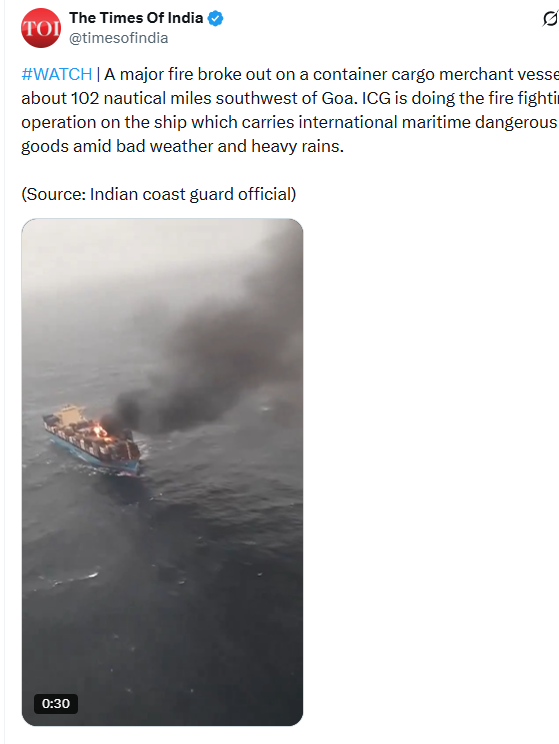
We also found an India Today report on the incident, which stated that the vessel was travelling from Mundra to Colombo, Sri Lanka, when the fire broke out. The Indian Coast Guard immediately diverted one of its ships to respond to the distress call. https://www.indiatoday.in/india/story/fire-breaks-out-container-cargo-merchant-vessel-off-goa-coast-rescue-ops-2569320-2024-07-19

Conclusion
Our research confirms that an old and unrelated video has been shared on social media as visuals of an Indian cargo vessel allegedly hit by a drone off the coast of Oman

Related Blogs
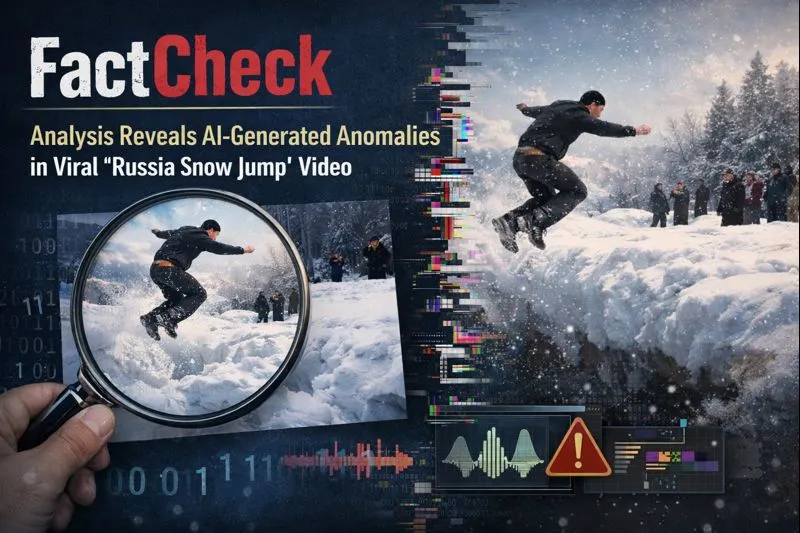
Executive Summary
A dramatic video showing several people jumping from the upper floors of a building into what appears to be thick snow has been circulating on social media, with users claiming that it captures a real incident in Russia during heavy snowfall. In the footage, individuals can be seen leaping one after another from a multi-storey structure onto a snow-covered surface below, eliciting reactions ranging from amusement to concern. The claim accompanying the video suggests that it depicts a reckless real-life episode in a snow-hit region of Russia.
A thorough analysis by CyberPeace confirmed that the video is not a real-world recording but an AI-generated creation. The footage exhibits multiple signs of synthetic media, including unnatural human movements, inconsistent physics, blurred or distorted edges, and a glossy, computer-rendered appearance. In some frames, a partial watermark from an AI video generation tool is visible. Further verification using the Hive Moderation AI-detection platform indicated that 98.7% of the video is AI-generated, confirming that the clip is entirely digitally created and does not depict any actual incident in Russia.
Claim:
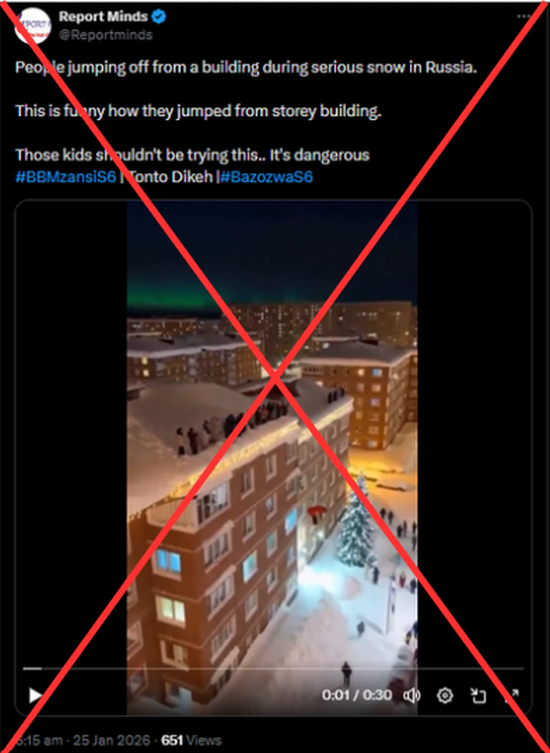
The video was shared on social media by an X (formerly Twitter) user ‘Report Minds’ on January 25, claiming it showed a real-life event in Russia. The post caption read: "People jumping off from a building during serious snow in Russia. This is funny, how they jumped from a storey building. Those kids shouldn't be trying this. It's dangerous." Here is the link to the post, and below is a screenshot.
Fact Check:
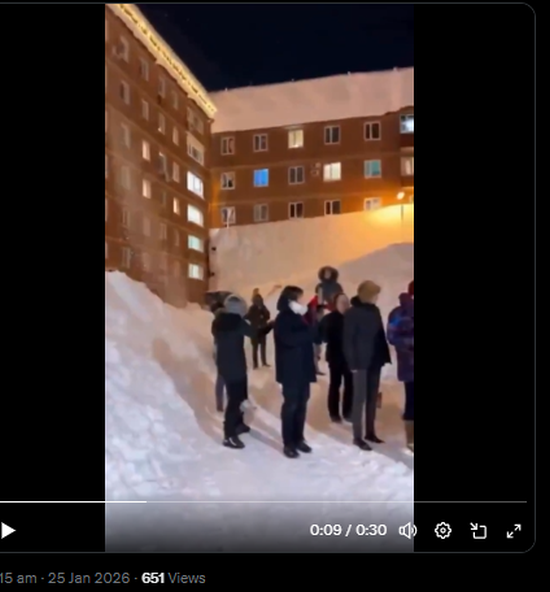
The Desk used the InVid tool to extract keyframes from the viral video and conducted a reverse image search, which revealed multiple instances of the same video shared by other users with similar claims. Upon close visual examination, several anomalies were observed, including unnatural human movements, blurred and distorted sections, a glossy, digitally-rendered appearance, and a partially concealed logo of the AI video generation tool ‘Sora AI’ visible in certain frames. Screenshots highlighting these inconsistencies were captured during the research .
- https://x.com/DailyLoud/status/2015107152772297086?s=20
- https://x.com/75secondes/status/2015134928745164848?s=20
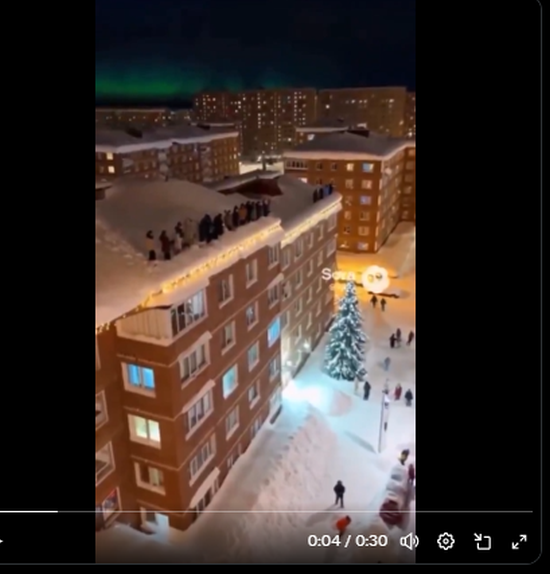
The video was analyzed on Hive Moderation, an AI-detection platform, which confirmed that 98.7% of the content is AI-generated.

The viral video showing people jumping off a building into snow, claimed to depict a real incident in Russia, is entirely AI-generated. Social media users who shared it presented the digitally created footage as if it were real, making the claim false and misleading.

Executive Summary
Prime Minister Narendra Modi recently appealed to citizens to reduce the consumption of gold and edible oil for a year. He also urged people to conserve petrol, diesel, and cooking gas amid the crisis arising from the ongoing tensions in West Asia involving the United States, Israel, and Iran. Amid this backdrop, a purported image of Union Home Minister Amit Shah and his son Jay Shah, who currently serves as Chairman of the International Cricket Council, has gone viral on social media. The image shows them seated inside a chartered aircraft along with two other individuals. Several social media users shared the picture as genuine while targeting the central government and Amit Shah.
However, CyberPeace Research Wing reseach found that the viral image is fake and was generated using Artificial Intelligence (AI).
Claim
An Instagram user named “Om Prakash Shukla” shared the viral image on May 24, 2026, with the caption:“People are sacrificing their desires for the nation, while they are enjoying luxury.”
https://www.instagram.com/p/DYuFqnmCh7T

Fact Check
To verify the authenticity of the viral image, we conducted a Google Lens search. However, the image was not found on any credible news platform, which raised suspicion about its authenticity. We also performed keyword-based searches related to the image using Google Search, but found no authentic reports or media coverage associated with the picture.
Further reseach involved analysing the image using AI detection tools. We first examined the picture using the “Sight Engine” AI detection tool, which indicated a 99 percent probability that the image was AI-generated.
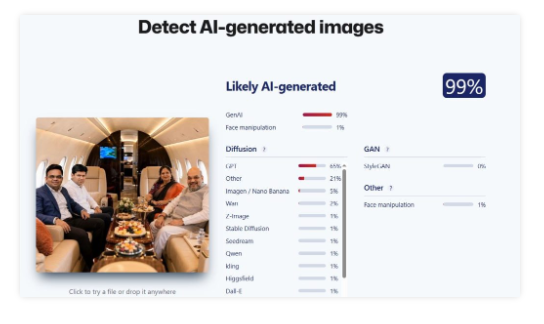
We also tested the image using another AI detection platform called “TruthScan.” This tool likewise suggested, with around 97 percent probability, that the image had been created using artificial intelligence

Conclusion
The reseach found that the viral image featuring Union Home Minister Amit Shah and ICC Chairman Jay Shah inside a chartered aircraft is AI-generated. The image was digitally created using AI tools, and the viral claim associated with it is false.
Introduction
The use of AI in content production, especially images and videos, is changing the foundations of evidence. AI-generated videos and images can mirror a person’s facial features, voice, or actions with a level of fidelity to which the average individual may not be able to distinguish real from fake. The ability to provide creative solutions is indeed a beneficial aspect of this technology. However, its misuse has been rapidly escalating over recent years. This creates threats to privacy and dignity, and facilitates the creation of dis/misinformation. Its real-world consequences are the manipulation of elections, national security threats, and the erosion of trust in society.
Why India Needs Deepfake Regulation
Deepfake regulation is urgently needed in India, evidenced by the recent Rashmika Mandanna incident, where a hoax deepfake of an actress created a scandal throughout the country. This was the first time that an individual's image was superimposed on the body of another woman in a viral deepfake video that fooled many viewers and created outrage among those who were deceived by the video. The incident even led to law enforcement agencies issuing warnings to the public about the dangers of manipulated media.
This was not an isolated incident; many influencers, actors, leaders and common people have fallen victim to deepfake pornography, deepfake speech scams, defraudations, and other malicious uses of deepfake technology. The rapid proliferation of deepfake technology is outpacing any efforts by lawmakers to regulate its widespread use. In this regard, a Private Member’s Bill was introduced in the Lok Sabha in its Winter Session. This proposal was presented to the Lok Sabha as an individual MP's Private Member's Bill. Even though these have had a low rate of success in being passed into law historically, they do provide an opportunity for the government to take notice of and respond to emerging issues. In fact, Private Member's Bills have been the catalyst for government action on many important matters and have also provided an avenue for parliamentary discussion and future policy creation. The introduction of this Bill demonstrates the importance of addressing the public concern surrounding digital impersonation and demonstrates that the Parliament acknowledges digital deepfakes to be a significant concern and, therefore, in need of a legislative framework to combat them.
Key Features Proposed by the New Deepfake Regulation Bill
The proposed legislation aims to create a strong legal structure around the creation, distribution and use of deepfake content in India. Its five core proposals are:
1. Prior Consent Requirement: individuals must give their written approval before producing or distributing deepfake media, including digital representations of themselves, as well as their faces, images, likenesses and voices. This aims to protect women, celebrities, minors, and everyday citizens against the use of their identities with the intent to harm them or their reputations or to harass them through the production of deepfakes.
2. Penalties for Malicious Deepfakes: Serious criminal consequences should be placed for creating or sharing deepfake media, particularly when it is intended to cause harm (defame, harass, impersonate, deceive or manipulate another person). The Bill also addresses financially fraudulent use of deepfakes, political misinformation, interfering with elections and other types of explicit AI-generated media.
3. Establishment of a Deepfake Task Force: To look at the potential impact of deepfakes on national security, elections and public order, as well as on public safety and privacy. This group will work with academic institutions, AI research labs and technology companies to create advanced tools for the detection of deepfakes and establish best practices for the safe and responsible use of generative AI.
4. Creation of a Deepfake Detection and Awareness Fund: To assist with the development of tools for detecting deepfakes, increasing the capacity of law enforcement agencies to investigate cybercrime, promoting public awareness of deepfakes through national campaigns, and funding research on artificial intelligence safety and misinformation.
How Other Countries Are Handling Deepfakes
1. United States
Many States in the United States, including California and Texas, have enacted laws to prohibit the use of politically deceptive deepfakes during elections. Additionally, the Federal Government is currently developing regulations requiring that AI-generated content be clearly labelled. Social Media Platforms are also being encouraged to implement a requirement for users to disclose deepfakes.
2. United Kingdom
In the United Kingdom, it is illegal to create or distribute intimate deepfake images without consent; violators face jail time. The Online Safety Act emphasises the accountability of digital media providers by requiring them to identify, eliminate, and avert harmful synthetic content, which makes their role in curating safe environments all the more important.
3. European Union:
The EU has enacted the EU AI Act, which governs the use of deepfakes by requiring an explicit label to be affixed to any AI-generated content. The absence of a label would subject an offending party to potentially severe regulatory consequences; therefore, any platform wishing to do business in the EU should evaluate the risks associated with deepfakes and adhere strictly to the EU's guidelines for transparency regarding manipulated media.
4. China:
China has among the most rigorous regulations regarding deepfakes anywhere on the planet. All AI-manipulated media will have to be marked with a visible watermark, users will have to authenticate their identities prior to being allowed to use advanced AI tools, and online platforms have a legal requirement to take proactive measures to identify and remove synthetic materials from circulation.
Conclusion
Deepfake technology has the potential to be one of the greatest (and most dangerous) innovations of AI technology. There is much to learn from incidents such as that involving Rashmika Mandanna, as well as the proliferation of deepfake technology that abuses globally, demonstrating how easily truth can be altered in the digital realm. The new Private Member's Bill created by India seeks to provide for a comprehensive framework to address these abuses based on prior consent, penalties that actually work, technical preparedness, and public education/awareness. With other nations of the world moving towards increased regulation of AI technology, proposals such as this provide a direction for India to become a leader in the field of responsible digital governance.
References
- https://www.ndtv.com/india-news/lok-sabha-introduces-bill-to-regulate-deepfake-content-with-consent-rules-9761943
- https://m.economictimes.com/news/india/shiv-sena-mp-introduces-private-members-bill-to-regulate-deepfakes/articleshow/125802794.cms
- https://www.bbc.com/news/world-asia-india-67305557
- https://www.akingump.com/en/insights/blogs/ag-data-dive/california-deepfake-laws-first-in-country-to-take-effect
- https://codes.findlaw.com/tx/penal-code/penal-sect-21-165/
- https://www.mishcon.com/news/when-ai-impersonates-taking-action-against-deepfakes-in-the-uk#:~:text=As%20of%2031%20January%202024,of%20intimate%20deepfakes%20without%20consent.
- https://www.politico.eu/article/eu-tech-ai-deepfakes-labeling-rules-images-elections-iti-c2pa/
- https://www.reuters.com/article/technology/china-seeks-to-root-out-fake-news-and-deepfakes-with-new-online-content-rules-idUSKBN1Y30VT/
